Part 1, Chapter 6
At Full Steam
At this cry the whole ship’s crew hurried towards the harpooner,—commander, officers, masters, sailors, cabin boys; even the engineers left their engines, and the stokers their furnaces.
At the cry, the whole crew rushed toward the harpooner: the commander, officers, masters, sailors, and cabin boys. Even the engineers left their engines, and the stokers left their furnaces.
The order to stop her had been given, and the frigate now simply went on by her own momentum. The darkness was then profound, and however good the Canadian’s eyes were, I asked myself how he had managed to see, and what he had been able to see. My heart beat as if it would break. But Ned Land was not mistaken, and we all perceived the object he pointed to. At two cables’ length from the Abraham Lincoln, on the starboard quarter, the sea seemed to be illuminated all over. It was not a mere phosphoric phenomenon. The monster emerged some fathoms from the water, and then threw out that very intense but inexplicable light mentioned in the report of several captains. This magnificent irradiation must have been produced by an agent of great shining power. The luminous part traced on the sea an immense oval, much elongated, the centre of which condensed a burning heat, whose overpowering brilliancy died out by successive gradations.
The order to stop the frigate had been given, and she now moved forward on momentum alone. The darkness was deep. However good the Canadian’s eyesight was, I wondered how he had managed to see and what he had seen. My heart beat as if it would break. But Ned Land was not mistaken. We all saw the object he pointed to. Two cables’ lengths from the Abraham Lincoln, off her starboard quarter, the sea seemed lit up all over. It was not merely a glow of phosphorescence. The monster rose several fathoms out of the water. It then gave off the intense, inexplicable light mentioned in the reports of several captains. This magnificent radiance must have come from a source with great shining power. The light formed an immense, elongated oval on the sea. At its center was a concentrated, burning heat, whose overpowering brilliance gradually faded toward the edges.
“It is only an agglomeration of phosphoric particles,” cried one of the officers.
“It’s only a cluster of phosphoric particles!” cried one of the officers.
“No, sir, certainly not,” I replied. “Never did pholades or salpæ produce such a powerful light. That brightness is of an essentially electrical nature. Besides, see, see! it moves; it is moving forwards, backwards; it is darting towards us!”
“No, sir, certainly not,” I replied. “Pholades and salpæ could never produce such a powerful light. That light is definitely electrical. Besides, look, look! It’s moving forward, then backward. It’s darting toward us!”
A general cry rose from the frigate.
A cry went up from everyone on the frigate.
“Silence!” said the Captain; “up with the helm, reverse the engines.”
“Silence!” said the Captain. “Put the helm up. Reverse the engines.”
The steam was shut off, and the Abraham Lincoln, beating to port, described a semicircle.
The steam was shut off, and the Abraham Lincoln turned to port in a semicircle.
“Right the helm, go ahead,” cried the Captain.
“Straighten the helm and go ahead,” cried the Captain.
These orders were executed, and the frigate moved rapidly from the burning light.
The orders were carried out, and the frigate moved quickly away from the burning light.
I was mistaken. She tried to sheer off, but the supernatural animal approached with a velocity double her own.
I was wrong. She tried to turn away, but the supernatural animal approached at twice her speed.
We gasped for breath. Stupefaction more than fear made us dumb and motionless. The animal gained on us, sporting with the waves. It made the round of the frigate, which was then making fourteen knots, and enveloped it with its electric rings like luminous dust. Then it moved away two or three miles, leaving a phosphorescent track, like those volumes of steam that the express trains leave behind. All at once from the dark line of the horizon whither it retired to gain its momentum, the monster rushed suddenly towards the Abraham Lincoln with alarming rapidity, stopped suddenly about twenty feet from the hull, and died out,—not diving under the water, for its brilliancy did not abate,—but suddenly, and as if the source of this brilliant emanation was exhausted. Then it reappeared on the other side of the vessel, as if it had turned and slid under the hull. Any moment a collision might have occurred which would have been fatal to us. However, I was astonished at the manœuvres of the frigate. She fled and did not attack.
We gasped for breath. Amazement more than fear left us speechless and motionless. The animal gained on us, playing in the waves. It circled the frigate, which was moving at fourteen knots, and surrounded it with electric rings like luminous dust. Then it moved two or three miles away, leaving a glowing trail like the clouds of steam left by express trains. It withdrew to the dark line of the horizon to gain speed. Then, all at once, the monster rushed toward the Abraham Lincoln with alarming speed. It stopped about twenty feet from the hull, and its light suddenly went out. It had not dived underwater, since its brilliance had not faded. Instead, the light went out suddenly, as if its source had been exhausted. Then the monster reappeared on the other side of the vessel, as if it had turned and slipped beneath the hull. A collision could have occurred at any moment, and it would have been fatal to us. Yet I was astonished by the frigate's maneuvers. It fled rather than attack.
On the captain’s face, generally so impassive, was an expression of unaccountable astonishment.
The captain’s usually expressionless face showed unexplained astonishment.
“M. Aronnax,” he said, “I do not know with what formidable being I have to deal, and I will not imprudently risk my frigate in the midst of this darkness. Besides, how attack this unknown thing, how defend one’s self from it? Wait for daylight, and the scene will change.”
“M. Aronnax,” he said, “I do not know what formidable creature we are dealing with. I will not risk my frigate recklessly in this darkness. Besides, how can we attack this unknown thing or defend ourselves against it? Wait for daylight, and the scene will change.”
“You have no further doubt, captain, of the nature of the animal?”
“You no longer have any doubt about what kind of animal it is, captain?”
“No, sir; it is evidently a gigantic narwhal, and an electric one.”
“No, sir; it is clearly a gigantic electric narwhal.”
“Perhaps,” added I, “one can only approach it with a gymnotus or a torpedo.”
“Perhaps,” I added, “you can only approach it with a gymnotus or a torpedo.”
“Undoubtedly,” replied the captain, “if it possesses such dreadful power, it is the most terrible animal that ever was created. That is why, sir, I must be on my guard.”
“Certainly,” the captain replied. “If it has such terrible power, it is the most terrifying animal ever created. That is why I must be on my guard, sir.”
The crew were on their feet all night. No one thought of sleep. The Abraham Lincoln, not being able to struggle with such velocity, had moderated its pace, and sailed at half speed. For its part, the narwhal, imitating the frigate, let the waves rock it at will, and seemed decided not to leave the scene of the struggle. Towards midnight, however, it disappeared, or, to use a more appropriate term, it “died out” like a large glow-worm. Had it fled? One could only fear, not hope. But at seven minutes to one o’clock in the morning a deafening whistling was heard, like that produced by a body of water rushing with great violence.
The crew stayed on their feet all night. No one thought of sleep. The Abraham Lincoln could not match such speed, so it slowed to half speed. The narwhal followed the frigate’s example, letting the waves rock it. It seemed determined not to leave the scene of the struggle. Around midnight, however, it disappeared, or, more accurately, it “died out” like a giant glowworm. Had it fled? We could only fear that it had, not hope for it. But at 12:53 in the morning, we heard a deafening whistle. It sounded like water rushing with great force.
The captain, Ned Land, and I, were then on the poop, eagerly peering through the profound darkness.
The captain, Ned Land, and I were on the poop deck, eagerly peering into the deep darkness.
“Ned Land,” asked the commander, “you have often heard the roaring of whales?”
“Ned Land,” the commander asked, “have you often heard whales roaring?”
“Often, sir; but never such whales the sight of which brought me in two thousand dollars. If I can only approach within four harpoon lengths of it!”
“Often, sir, but I’ve never seen a whale that earned me two thousand dollars. If only I could get within four harpoon lengths of it!”
“But to approach it,” said the commander, “I ought to put a whaler at your disposal?”
“But to approach it,” said the commander, “should I provide you with a whaling boat?”
“Certainly, sir.”
“Of course, sir.”
“That will be trifling with the lives of my men.”
“That would be playing with my men’s lives.”
“And mine too,” simply said the harpooner.
“And mine too,” the harpooner said simply.
Towards two o’clock in the morning, the burning light reappeared, not less intense, about five miles to windward of the Abraham Lincoln. Notwithstanding the distance, and the noise of the wind and sea, one heard distinctly the loud strokes of the animal’s tail, and even its panting breath. It seemed that, at the moment that the enormous narwhal had come to take breath at the surface of the water, the air was engulfed in its lungs, like the steam in the vast cylinders of a machine of two thousand horse-power.
Around two in the morning, the blazing light appeared again, just as bright as before. It was about five miles upwind of the Abraham Lincoln. Despite the distance and the noise of the wind and sea, we could clearly hear the animal’s tail striking the water. We could even hear its panting breath. As the enormous narwhal surfaced to breathe, air seemed to rush into its lungs like steam into the huge cylinders of a two thousand horsepower engine.
“Hum!” thought I, “a whale with the strength of a cavalry regiment would be a pretty whale!”
“Hmm!” I thought. “A whale with the strength of a cavalry regiment would be quite a whale!”
We were on the qui vive till daylight, and prepared for the combat. The fishing implements were laid along the hammock nettings. The second lieutenant loaded the blunderbusses, which could throw harpoons to the distance of a mile, and long duck-guns, with explosive bullets, which inflicted mortal wounds even to the most terrible animals. Ned Land contented himself with sharpening his harpoon—a terrible weapon in his hands.
We stayed on alert until daylight and prepared for battle. The fishing equipment was laid along the hammock nettings. The second lieutenant loaded the blunderbusses, which could fire harpoons a mile. He also loaded the long duck guns with explosive bullets. These could kill even the most formidable animals. Ned Land simply sharpened his harpoon, a fearsome weapon in his hands.
At six o’clock day began to break; and, with the first glimmer of light, the electric light of the narwhal disappeared. At seven o’clock the day was sufficiently advanced, but a very thick sea fog obscured our view, and the best spy-glasses could not pierce it. That caused disappointment and anger.
At six o’clock, day began to break. With the first glimmer of light, the narwhal’s electric light disappeared. By seven o’clock, there was enough daylight to see. But a thick sea fog blocked our view, and even the best spyglasses could not see through it. This caused disappointment and anger.
I climbed the mizzen-mast. Some officers were already perched on the mast heads. At eight o’clock the fog lay heavily on the waves, and its thick scrolls rose little by little. The horizon grew wider and clearer at the same time. Suddenly, just as on the day before, Ned Land’s voice was heard:
I climbed the mizzen-mast. Some officers were already perched at the tops of the masts. At eight o’clock, thick fog lay over the waves, and its dense banks slowly rose. The horizon grew wider and clearer. Suddenly, just as on the day before, Ned Land’s voice rang out:
“The thing itself on the port quarter!” cried the harpooner.
“The thing itself, off the left rear of the ship!” shouted the harpooner.
Every eye was turned towards the point indicated. There, a mile and a half from the frigate, a long blackish body emerged a yard above the waves. Its tail, violently agitated, produced a considerable eddy. Never did a caudal appendage beat the sea with such violence. An immense track, of dazzling whiteness, marked the passage of the animal, and described a long curve.
Everyone looked in the direction indicated. A mile and a half from the frigate, a long, blackish body rose a yard above the waves. Its tail churned violently, creating a large whirlpool. Never had a tail beaten the sea with such violence. A vast, dazzling white wake marked the animal's passage in a long curve.
The frigate approached the cetacean. I examined it thoroughly.
The frigate approached the whale. I examined it closely.
The reports of the Shannon and of the Helvetia had rather exaggerated its size, and I estimated its length at only two hundred and fifty feet. As to its dimensions, I could only conjecture them to be admirably proportioned. While I watched this phenomenon, two jets of steam and water were ejected from its vents, and rose to the height of 120 feet; thus I ascertained its way of breathing. I concluded definitely that it belonged to the vertebrate branch, class mammalia.
The reports from the Shannon and the Helvetia had somewhat exaggerated its size. I estimated its length at only two hundred and fifty feet. I could only guess that its other dimensions were admirably proportioned. As I watched this strange creature, two jets of steam and water shot from its vents, rising 120 feet. This showed me how it breathed. I concluded with certainty that it was a vertebrate and belonged to the class of mammals.
The crew waited impatiently for their chief’s orders. The latter, after having observed the animal attentively, called the engineer. The engineer ran to him.
The crew waited impatiently for their chief’s orders. After watching the animal carefully, the chief called the engineer. The engineer ran to him.
“Sir,” said the commander, “you have steam up?”
“Sir,” said the commander, “is your steam engine ready?”
“Yes, sir,” answered the engineer.
“Yes, sir,” the engineer replied.
“Well, make up your fires and put on all steam.”
“Well, build up the fires and use full steam.”
Three hurrahs greeted this order. The time for the struggle had arrived. Some moments after, the two funnels of the frigate vomited torrents of black smoke, and the bridge quaked under the trembling of the boilers.
Three cheers greeted the order. The time for the struggle had come. Moments later, the frigate’s two funnels spewed torrents of black smoke, and the bridge shook as the boilers trembled.
The Abraham Lincoln, propelled by her wonderful screw, went straight at the animal. The latter allowed it to come within half a cable’s length; then, as if disdaining to dive, it took a little turn, and stopped a short distance off.
The Abraham Lincoln, driven by its remarkable propeller, headed straight for the animal. The animal let the ship come within half a cable’s length. Then, as if it thought diving beneath it, the animal turned slightly and stopped a short distance away.
This pursuit lasted nearly three-quarters of an hour, without the frigate gaining two yards on the cetacean. It was quite evident that at that rate we should never come up with it.
The chase lasted nearly forty-five minutes, but the frigate gained less than two yards on the cetacean. It was clear that at this rate, we would never catch up with it.
“Well, Mr. Land,” asked the captain, “do you advise me to put the boats out to sea?”
“Well, Mr. Land,” the captain asked, “do you suggest I send the boats out to sea?”
“No, sir,” replied Ned Land; “because we shall not take that beast easily.”
“No, sir,” Ned Land replied, “because we won't catch that beast easily.”
“What shall we do then?”
“What will we do then?”
“Put on more steam if you can, sir. With your leave, I mean to post myself under the bowsprit, and if we get within harpooning distance, I shall throw my harpoon.”
“Give it more steam if you can, sir. With your permission, I'll take my place under the bowsprit. If we get close enough, I'll throw my harpoon.”
“Go, Ned,” said the captain. “Engineer, put on more pressure.”
“Go, Ned,” said the captain. “Engineer, increase the pressure.”
Ned Land went to his post. The fires were increased, the screw revolved forty-three times a minute, and the steam poured out of the valves. We heaved the log, and calculated that the Abraham Lincoln was going at the rate of 18½ miles an hour.
Ned Land went to his post. The fires were stoked, the propeller turned forty-three times a minute, and steam poured from the valves. We measured the ship's speed with the log and calculated that the Abraham Lincoln was traveling at 18½ miles an hour.
But the accursed animal swam too at the rate of 18½ miles an hour.
But the cursed animal could swim at 18½ miles an hour too.
For a whole hour, the frigate kept up this pace, without gaining six feet. It was humiliating for one of the swiftest sailers in the American navy. A stubborn anger seized the crew; the sailors abused the monster, who, as before, disdained to answer them; the captain no longer contented himself with twisting his beard—he gnawed it.
For a whole hour, the frigate kept up this pace without gaining six feet. It was humiliating for one of the fastest ships in the American navy. The crew grew stubbornly angry. The sailors shouted insults at the monster, which, as before, did not bother to answer them. The captain no longer just twisted his beard. He gnawed it.
The engineer was again called.
The engineer was called again.
“You have turned full steam in?”
“Have you turned the steam on full?”
“Yes, sir,” replied the engineer.
“Yes, sir,” said the engineer.
The speed of the Abraham Lincoln increased. Its masts trembled down to their stepping holes, and the clouds of smoke could hardly find way out of the narrow funnels.
The Abraham Lincoln sped up. Its masts trembled all the way down to their bases, and smoke could hardly escape through the narrow funnels.
They heaved the log a second time.
They tossed the speed-measuring log overboard again.
“Well?” asked the captain of the man at the wheel.
“Well?” the captain asked the man at the wheel.
“Nineteen miles and three-tenths, sir.”
“Nineteen point three miles, sir.”
“Clap on more steam.”
“Give it more steam.”
The engineer obeyed. The manometer showed ten degrees. But the cetacean grew warm itself, no doubt; for without straining itself, it made 19-3/10 miles.
The engineer obeyed. The pressure gauge showed ten degrees. But the whale was warming up too, no doubt. Without straining itself, it reached 19.3 miles.
What a pursuit! No, I cannot describe the emotion that vibrated through me. Ned Land kept his post, harpoon in hand. Several times the animal let us gain upon it.—“We shall catch it! we shall catch it!” cried the Canadian. But just as he was going to strike, the cetacean stole away with a rapidity that could not be estimated at less than thirty miles an hour, and even during our maximum of speed, it bullied the frigate, going round and round it. A cry of fury broke from everyone!
What a chase! No, I cannot describe the emotion that swept through me. Ned Land stayed at his post, harpoon in hand. Several times the animal let us get closer. “We’ll catch it! We’ll catch it!” cried the Canadian. But just as he was about to strike, the creature darted away at no less than thirty miles an hour. Even when we were going at full speed, it harassed the frigate, circling it again and again. Everyone cried out in fury!
At noon we were no further advanced than at eight o’clock in the morning.
By noon, we had made no more progress than we had by eight that morning.
The captain then decided to take more direct means.
The captain then decided to take more direct action.
“Ah!” said he, “that animal goes quicker than the Abraham Lincoln. Very well! we will see whether it will escape these conical bullets. Send your men to the forecastle, sir.”
“Ah!” he said. “That animal is faster than the Abraham Lincoln. Very well! We’ll see if it can escape these conical bullets. Send your men to the forecastle, sir.”
The forecastle gun was immediately loaded and slewed round. But the shot passed some feet above the cetacean, which was half a mile off.
The gun at the front of the ship was immediately loaded and turned toward the cetacean. But the shot passed several feet above it. The cetacean was half a mile away.
“Another, more to the right,” cried the commander, “and five dollars to whoever will hit that infernal beast.”
“Another one, farther to the right!” the commander cried. “Five dollars to whoever hits that damn beast.”
An old gunner with a grey beard—that I can see now—with steady eye and grave face, went up to the gun and took a long aim. A loud report was heard, with which were mingled the cheers of the crew.
I can still see the old gunner with his gray beard, steady eye, and serious face. He went up to the gun and took careful aim. A loud blast rang out, mingled with the cheers of the crew.
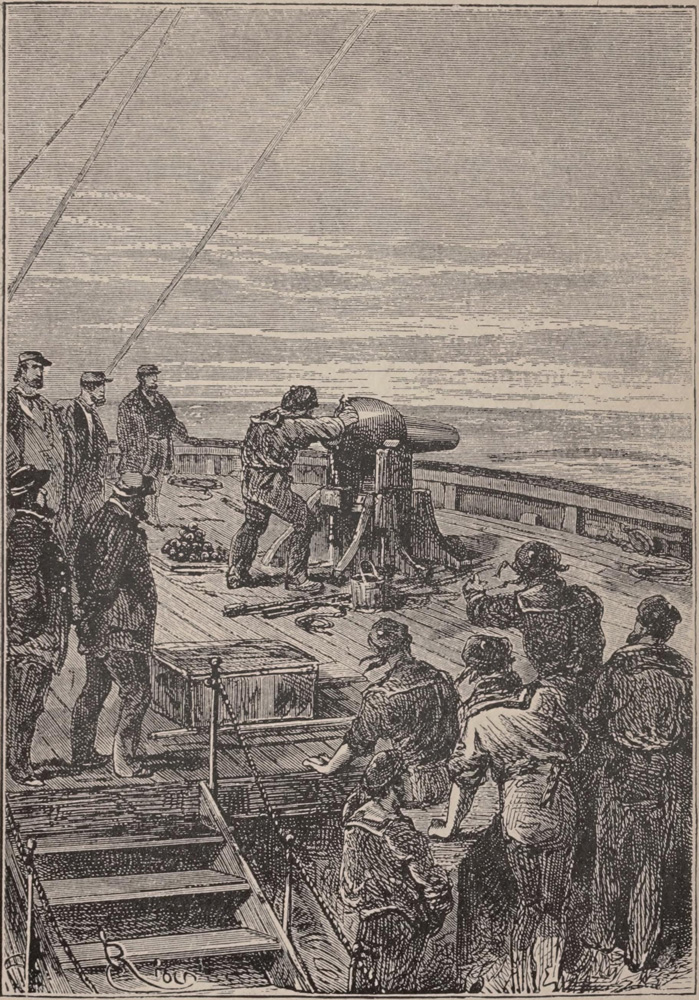
The bullet did its work; it hit the animal, but not fatally, and sliding off the rounded surface, was lost in two miles depth of sea.
The bullet did its job. It hit the animal but did not kill it. It slid off the rounded surface and disappeared into the sea, two miles deep.
The chase began again, and the captain, leaning towards me, said—
The chase began again. The captain leaned toward me and said:
“I will pursue that beast till my frigate bursts up.”
“I’ll chase that beast until my frigate bursts apart.”
“Yes,” answered I; “and you will be quite right to do it.”
“Yes,” I replied, “and you will be right to do it.”
I wished the beast would exhaust itself, and not be insensible to fatigue like a steam engine! But it was of no use. Hours passed, without its showing any signs of exhaustion.
I wished the beast would tire itself out, instead of being immune to fatigue like a steam engine! But it was no use. Hours passed without the beast showing any signs of exhaustion.
However, it must be said in praise of the Abraham Lincoln, that she struggled on indefatigably. I cannot reckon the distance she made under three hundred miles during this unlucky day, November the 6th. But night came on, and overshadowed the rough ocean.
However, the Abraham Lincoln deserves praise for pressing on tirelessly. I estimate that she covered at least three hundred miles on that unlucky day, November the 6th. But night fell over the rough ocean.
Now I thought our expedition was at an end, and that we should never again see the extraordinary animal. I was mistaken. At ten minutes to eleven in the evening, the electric light reappeared three miles to windward of the frigate, as pure, as intense as during the preceding night.
I thought our expedition was over and that we would never see the extraordinary animal again. I was wrong. At 10:50 that evening, the electric light appeared again, three miles upwind of the frigate. It was just as pure and intense as it had been the night before.
The narwhal seemed motionless; perhaps, tired with its day’s work, it slept, letting itself float with the undulation of the waves. Now was a chance of which the captain resolved to take advantage.
The narwhal seemed motionless. Perhaps, tired from its day's work, it was asleep, floating on the waves. The captain decided to take advantage of the opportunity.
He gave his orders. The Abraham Lincoln kept up half steam, and advanced cautiously so as not to awake its adversary. It is no rare thing to meet in the middle of the ocean whales so sound asleep that they can be successfully attacked, and Ned Land had harpooned more than one during its sleep. The Canadian went to take his place again under the bowsprit.
He gave his orders. The Abraham Lincoln continued at half steam and moved cautiously so as not to wake its adversary. In the middle of the ocean, it is not uncommon to find whales sleeping soundly enough to be attacked successfully. Ned Land had harpooned more than one whale in its sleep. The Canadian returned to his place beneath the bowsprit.
The frigate approached noiselessly, stopped at two cables’ lengths from the animal, and following its track. No one breathed; a deep silence reigned on the bridge. We were not a hundred feet from the burning focus, the light of which increased and dazzled our eyes.
The frigate approached silently, following the animal’s path, and stopped two cable lengths away. No one breathed. A deep silence fell over the bridge. We were less than a hundred feet from the glowing center. Its light grew brighter and dazzled our eyes.
At this moment, leaning on the forecastle bulwark, I saw below me Ned Land grappling the martingale in one hand, brandishing his terrible harpoon in the other, scarcely twenty feet from the motionless animal. Suddenly his arm straightened, and the harpoon was thrown; I heard the sonorous stroke of the weapon, which seemed to have struck a hard body. The electric light went out suddenly, and two enormous waterspouts broke over the bridge of the frigate, rushing like a torrent from stem to stern, overthrowing men, and breaking the lashings of the spars. A fearful shock followed, and, thrown over the rail without having time to stop myself, I fell into the sea.
At that moment, I was leaning against the railing at the bow. Below me, I saw Ned Land gripping the martingale with one hand and brandishing his terrible harpoon with the other. He was barely twenty feet from the motionless animal. Suddenly, he thrust out his arm and threw the harpoon. I heard the weapon ring out as it struck what seemed to be a hard surface. The electric light suddenly went out. Two enormous spouts of water broke over the frigate’s deck. They rushed like a torrent from bow to stern, knocking men down and breaking the ropes that held the spars. A terrible impact followed. I was thrown over the railing before I could stop myself and fell into the sea.