Part 2, Chapter 3
A Pearl Worth Ten Million
The next morning at four o’clock I was awakened by the steward whom Captain Nemo had placed at my service. I rose hurriedly, dressed, and went into the saloon.
The next morning at four, I was awakened by the steward Captain Nemo had assigned to help me. I got up quickly, dressed, and went into the saloon.
Captain Nemo was awaiting me.
Captain Nemo was waiting for me.
“M. Aronnax,” said he, “are you ready to start?”
“Mr. Aronnax,” he said, “are you ready to go?”
“I am ready.”
“I am ready.”
“Then please to follow me.”
“Then please follow me.”
“And my companions, Captain?”
“And what about my companions, Captain?”
“They have been told and are waiting.”
“They’ve been told and are waiting.”
“Are we not to put on our diver’s dresses?” asked I.
“Aren’t we going to put on our diving suits?” I asked.
“Not yet. I have not allowed the Nautilus to come too near this coast, and we are some distance from the Manaar Bank; but the boat is ready, and will take us to the exact point of disembarking, which will save us a long way. It carries our diving apparatus, which we will put on when we begin our submarine journey.”
“Not yet. I have kept the Nautilus from coming too close to this coast. We are still some distance from the Manaar Bank, but the boat is ready. It will take us to the exact landing point, saving us a long journey. The boat carries our diving equipment, which we will put on when we begin our underwater journey.”
Captain Nemo conducted me to the central staircase, which led on the platform. Ned and Conseil were already there, delighted at the idea of the “pleasure party” which was preparing. Five sailors from the Nautilus, with their oars, waited in the boat, which had been made fast against the side.
Captain Nemo led me to the central staircase, which led up to the platform. Ned and Conseil were already there, delighted at the “pleasure party” being planned. Five sailors from the Nautilus waited with their oars in the boat, which was tied alongside.
The night was still dark. Layers of clouds covered the sky, allowing but few stars to be seen. I looked on the side where the land lay, and saw nothing but a dark line enclosing three parts of the horizon, from south-west to north-west. The Nautilus, having returned during the night up the western coast of Ceylon, was now west of the bay, or rather gulf, formed by the mainland and the Island of Manaar. There, under the dark waters, stretched the pintadine bank, an inexhaustible field of pearls, the length of which is more than twenty miles.
The night was still dark. Layers of clouds covered the sky, leaving only a few stars visible. I looked toward the land but saw only a dark line stretching from southwest to northwest, enclosing three sides of the horizon. During the night, the Nautilus had traveled back up the western coast of Ceylon. It was now west of the bay, or rather gulf, formed by the mainland and the Island of Manaar. There, beneath the dark water, lay the pintadine bank, an inexhaustible field of pearls more than twenty miles long.
Captain Nemo, Ned Land, Conseil, and I took our places in the stern of the boat. The master went to the tiller; his four companions leaned on their oars, the painter was cast off, and we sheered off.
Captain Nemo, Ned Land, Conseil, and I took our places at the back of the boat. The master took the steering handle, and his four companions took up their oars. The boat’s rope was untied, and we pushed away.
The boat went towards the south; the oarsmen did not hurry. I noticed that their strokes, strong in the water, only followed each other every ten seconds, according to the method generally adopted in the navy. Whilst the craft was running by its own velocity, the liquid drops struck the dark depths of the waves crisply like spats of melted lead. A little billow, spreading wide, gave a slight roll to the boat, and some samphire reeds flapped before it.
The boat headed south, and the oarsmen took their time. I noticed that they pulled hard, but only once every ten seconds, as was customary in the navy. As the boat glided on, drops of water struck the dark waves sharply, like splashes of melted lead. A small swell spread out and rocked the boat gently, and some samphire reeds flapped in front of it.
We were silent. What was Captain Nemo thinking of? Perhaps of the land he was approaching, and which he found too near to him, contrary to the Canadian’s opinion, who thought it too far off. As to Conseil, he was merely there from curiosity.
We were silent. What was Captain Nemo thinking about? Perhaps he was thinking about the land he was approaching, which he found too close. The Canadian, on the other hand, thought it was too far away. As for Conseil, he was there only out of curiosity.
About half-past five the first tints on the horizon showed the upper line of coast more distinctly. Flat enough in the east, it rose a little to the south. Five miles still lay between us, and it was indistinct owing to the mist on the water. At six o’clock it became suddenly daylight, with that rapidity peculiar to tropical regions, which know neither dawn nor twilight. The solar rays pierced the curtain of clouds, piled up on the eastern horizon, and the radiant orb rose rapidly. I saw land distinctly, with a few trees scattered here and there. The boat neared Manaar Island, which was rounded to the south. Captain Nemo rose from his seat and watched the sea.
Around half past five, the first light on the horizon made the coastline clearer. It was fairly flat to the east, but rose a little to the south. We were still five miles away, and mist on the water blurred the view. At six o’clock, daylight came suddenly, as it does in the tropics, where there is neither dawn nor twilight. Sunlight pierced the clouds piled along the eastern horizon, and the radiant sun rose quickly. I could see the land clearly, with a few trees scattered here and there. The boat approached Manaar Island, which was rounded at its southern end. Captain Nemo rose from his seat and watched the sea.
At a sign from him the anchor was dropped, but the chain scarcely ran, for it was little more than a yard deep, and this spot was one of the highest points of the bank of pintadines.
At his signal, the anchor was dropped, but little chain ran out because the water was barely over a yard deep. This spot was one of the highest points of the pintadine bank.
“Here we are, M. Aronnax,” said Captain Nemo. “You see that enclosed bay? Here, in a month will be assembled the numerous fishing boats of the exporters, and these are the waters their divers will ransack so boldly. Happily, this bay is well situated for that kind of fishing. It is sheltered from the strongest winds; the sea is never very rough here, which makes it favourable for the diver’s work. We will now put on our dresses, and begin our walk.”
“Here we are, M. Aronnax,” said Captain Nemo. “Do you see that sheltered bay? In a month, many fishing boats belonging to the exporters will gather here. Their divers will boldly search these waters. Fortunately, this bay is well suited to that kind of fishing. It is sheltered from the strongest winds, and the sea is never very rough here. That makes it easier for the divers to work. We will now put on our diving suits and begin our walk.”
I did not answer, and, while watching the suspected waves, began with the help of the sailors to put on my heavy sea-dress. Captain Nemo and my companions were also dressing. None of the Nautilus men were to accompany us on this new excursion.
I did not answer. As I watched the suspicious waves, the sailors helped me put on my heavy diving suit. Captain Nemo and my companions were getting dressed too. None of the Nautilus crew would accompany us on this new excursion.
Soon we were enveloped to the throat in india-rubber clothing; the air apparatus fixed to our backs by braces. As to the Ruhmkorff apparatus, there was no necessity for it. Before putting my head into the copper cap, I had asked the question of the Captain.
Soon we were dressed up to our necks in rubber suits, with the air apparatus strapped to our backs. We did not need the Ruhmkorff apparatus. I had asked the Captain about it before putting on the copper helmet.
“They would be useless,” he replied. “We are going to no great depth, and the solar rays will be enough to light our walk. Besides, it would not be prudent to carry the electric light in these waters; its brilliancy might attract some of the dangerous inhabitants of the coast most inopportunely.”
“They would be useless,” he replied. “We will not go very deep, and sunlight will be enough to light our walk. Besides, it would not be wise to carry the electric light in these waters. Its brightness might attract some of the dangerous creatures that live along the coast at the worst possible moment.”
As Captain Nemo pronounced these words, I turned to Conseil and Ned Land. But my two friends had already encased their heads in the metal cap, and they could neither hear nor answer.
As Captain Nemo said these words, I turned to Conseil and Ned Land. But my two friends had already put on their metal helmets. They could neither hear me nor answer.
One last question remained to ask of Captain Nemo.
One last question remained to ask Captain Nemo.
“And our arms?” asked I; “our guns?”
“And our weapons?” I asked. “Our guns?”
“Guns! What for? Do not mountaineers attack the bear with a dagger in their hand, and is not steel surer than lead? Here is a strong blade; put it in your belt, and we start.”
“Guns! What for? Don’t mountaineers attack bears with a dagger in hand? And isn’t steel more reliable than lead? Here’s a strong blade. Put it in your belt, and we’ll set off.”
I looked at my companions; they were armed like us, and, more than that, Ned Land was brandishing an enormous harpoon, which he had placed in the boat before leaving the Nautilus.
I looked at my companions. They were armed like us, and Ned Land was even brandishing an enormous harpoon. He had put it in the boat before leaving the Nautilus.
Then, following the Captain’s example, I allowed myself to be dressed in the heavy copper helmet, and our reservoirs of air were at once in activity. An instant after we were landed, one after the other, in about two yards of water upon an even sand. Captain Nemo made a sign with his hand, and we followed him by a gentle declivity till we disappeared under the waves.
Then, following the Captain’s example, I let them fit me with the heavy copper helmet. Our air reservoirs began working at once. A moment later, we landed one after another on a flat sandy bottom, in about two yards of water. Captain Nemo signaled with his hand, and we followed him down a gentle slope until we disappeared beneath the waves.
Over our feet, like coveys of snipe in a bog, rose shoals of fish, of the genus monoptera, which have no other fins but their tail. I recognized the Javanese, a real serpent two and a half feet long, of a livid colour underneath, and which might easily be mistaken for a conger eel if it were not for the golden stripes on its side. In the genus stromateus, whose bodies are very flat and oval, I saw some of the most brilliant colours, carrying their dorsal fin like a scythe; an excellent eating fish, which, dried and pickled, is known by the name of Karawade; then some tranquebars, belonging to the genus apsiphoroides, whose body is covered with a shell cuirass of eight longitudinal plates.
Shoals of monoptera rose over our feet, like flocks of snipe rising from a bog. These fish have no fins except their tails. I recognized the Javanese, a true serpent two and a half feet long, with a pale, bluish underside. It could easily be mistaken for a conger eel, if not for the golden stripes on its sides. I saw some brilliantly colored fish of the genus stromateus, whose bodies are very flat and oval. They carried their dorsal fins like scythes. These fish are excellent to eat. When dried and pickled, they are known as Karawade. Then I saw some tranquebars, belonging to the genus apsiphoroides. Their bodies are covered with a shell of eight lengthwise plates, like a suit of armor.
The heightening sun lit the mass of waters more and more. The soil changed by degrees. To the fine sand succeeded a perfect causeway of boulders, covered with a carpet of molluscs and zoophytes. Amongst the specimens of these branches I noticed some placenae, with thin unequal shells, a kind of ostracion peculiar to the Red Sea and the Indian Ocean; some orange lucinae with rounded shells; rockfish three feet and a half long, which raised themselves under the waves like hands ready to seize one. There were also some panopyres, slightly luminous; and lastly, some oculines, like magnificent fans, forming one of the richest vegetations of these seas.
As the sun rose, it lit the water more and more. The seabed gradually changed. The fine sand gave way to a pavement of boulders, carpeted with mollusks and zoophytes. Among them, I noticed some placenae, with thin, uneven shells. These are a kind of ostracion found only in the Red Sea and the Indian Ocean. There were orange lucinae with rounded shells, too. Rockfish three and a half feet long rose beneath the waves like hands ready to seize someone. There were also some faintly glowing panopyres. Finally, there were oculines, like magnificent fans, forming some of the richest vegetation in these seas.
In the midst of these living plants, and under the arbours of the hydrophytes, were layers of clumsy articulates, particularly some raninae, whose carapace formed a slightly rounded triangle; and some horrible looking parthenopes.
Among these living plants, beneath the canopies of aquatic plants, lay layers of clumsy jointed creatures. These included some raninae, whose shells formed slightly rounded triangles, and some horrible-looking parthenopes.
At about seven o’clock we found ourselves at last surveying the oyster-banks on which the pearl-oysters are reproduced by millions.
At about seven o’clock, we finally looked out over the oyster beds, where pearl oysters reproduce by the millions.
Captain Nemo pointed with his hand to the enormous heap of oysters; and I could well understand that this mine was inexhaustible, for Nature’s creative power is far beyond man’s instinct of destruction. Ned Land, faithful to his instinct, hastened to fill a net which he carried by his side with some of the finest specimens. But we could not stop. We must follow the Captain, who seemed to guide himself by paths known only to himself. The ground was sensibly rising, and sometimes, on holding up my arm, it was above the surface of the sea. Then the level of the bank would sink capriciously. Often we rounded high rocks scarped into pyramids. In their dark fractures huge crustacea, perched upon their high claws like some war-machine, watched us with fixed eyes, and under our feet crawled various kinds of annelides.
Captain Nemo pointed to the enormous pile of oysters. I could see that this mine was inexhaustible, because nature’s power to create far exceeds man’s instinct to destroy. True to his instinct, Ned Land hurried to fill a net at his side with some of the finest oysters. But we could not stop. We had to follow the Captain, who seemed to navigate by paths known only to him. The ground was rising noticeably, and sometimes, when I raised my arm, it reached above the sea’s surface. Then the bank would drop away unpredictably. We often went around tall rocks shaped like pyramids. In their dark cracks, huge crustaceans watched us with fixed eyes. They stood high on their claws like war machines. Various kinds of segmented worms crawled under our feet.
At this moment there opened before us a large grotto dug in a picturesque heap of rocks and carpeted with all the thick warp of the submarine flora. At first it seemed very dark to me. The solar rays seemed to be extinguished by successive gradations, until its vague transparency became nothing more than drowned light. Captain Nemo entered; we followed. My eyes soon accustomed themselves to this relative state of darkness. I could distinguish the arches springing capriciously from natural pillars, standing broad upon their granite base, like the heavy columns of Tuscan architecture. Why had our incomprehensible guide led us to the bottom of this submarine crypt? I was soon to know. After descending a rather sharp declivity, our feet trod the bottom of a kind of circular pit. There Captain Nemo stopped, and with his hand indicated an object I had not yet perceived. It was an oyster of extraordinary dimensions, a gigantic tridacne, a goblet which could have contained a whole lake of holy-water, a basin the breadth of which was more than two yards and a half, and consequently larger than that ornamenting the saloon of the Nautilus. I approached this extraordinary mollusc. It adhered by its filaments to a table of granite, and there, isolated, it developed itself in the calm waters of the grotto. I estimated the weight of this tridacne at 600 lbs. Such an oyster would contain 30 lbs. of meat; and one must have the stomach of a Gargantua to demolish some dozens of them.
At that moment, a large grotto opened before us. It had been hollowed out of a picturesque pile of rocks and carpeted with thickly woven underwater plants. At first, it seemed very dark. The sun’s rays seemed to fade gradually, until the faint transparency was nothing more than drowned light. Captain Nemo entered, and we followed. My eyes soon grew used to the relative darkness. I could make out arches rising in irregular patterns from natural pillars. The pillars stood broad on their granite bases, like the heavy columns of Tuscan architecture. Why had our mysterious guide led us to the bottom of this underwater crypt? I was soon to find out. After descending a fairly steep slope, we reached the bottom of a kind of circular pit. There Captain Nemo stopped and pointed to an object I had not yet noticed. It was an enormous oyster, a giant tridacne, shaped like a goblet that could have held a whole lake of holy water. The shell was more than two and a half yards across. It was therefore larger than the one decorating the saloon of the Nautilus. I approached the extraordinary mollusc. It was attached by its filaments to a slab of granite. There it grew in isolation, in the calm waters of the grotto. I estimated that the tridacne weighed 600 pounds. An oyster that size would contain 30 pounds of meat. You would need a stomach like Gargantua’s to eat a few dozen of them.
Captain Nemo was evidently acquainted with the existence of this bivalve, and seemed to have a particular motive in verifying the actual state of this tridacne. The shells were a little open; the Captain came near and put his dagger between to prevent them from closing; then with his hand he raised the membrane with its fringed edges, which formed a cloak for the creature. There, between the folded plaits, I saw a loose pearl, whose size equalled that of a coco-nut. Its globular shape, perfect clearness, and admirable lustre made it altogether a jewel of inestimable value. Carried away by my curiosity, I stretched out my hand to seize it, weigh it, and touch it; but the Captain stopped me, made a sign of refusal, and quickly withdrew his dagger, and the two shells closed suddenly. I then understood Captain Nemo’s intention. In leaving this pearl hidden in the mantle of the tridacne he was allowing it to grow slowly. Each year the secretions of the mollusc would add new concentric circles. I estimated its value at £500,000 at least.
Captain Nemo clearly knew about this bivalve and seemed to have a particular reason for checking on the tridacne. Its shells were slightly open. The Captain approached and put his dagger between them to keep them from closing. Then he lifted the creature’s fringed mantle with his hand. There, between its folds, I saw a loose pearl as large as a coconut. Its round shape, perfect clarity, and wonderful luster made it a jewel of incalculable value. Overcome by curiosity, I reached out to take it, weigh it, and touch it. But the Captain stopped me with a gesture. He quickly withdrew his dagger, and the two shells snapped shut. I then understood Captain Nemo’s intention. By leaving the pearl hidden in the tridacne’s mantle, he was allowing it to grow slowly. Each year, the mollusk’s secretions would add new concentric layers. I estimated its value at £500,000 at least.
After ten minutes Captain Nemo stopped suddenly. I thought he had halted previously to returning. No; by a gesture he bade us crouch beside him in a deep fracture of the rock, his hand pointed to one part of the liquid mass, which I watched attentively.
After ten minutes, Captain Nemo suddenly stopped. I thought he had stopped before turning back. But no. He gestured for us to crouch beside him in a deep crack in the rock. He pointed to an area of the water, and I watched it closely.
About five yards from me a shadow appeared, and sank to the ground. The disquieting idea of sharks shot through my mind, but I was mistaken; and once again it was not a monster of the ocean that we had anything to do with.
About five yards away, a shadow appeared and sank to the ground. I worried that it might be a shark, but I was wrong. Once again, we were not dealing with a sea monster.
It was a man, a living man, an Indian, a fisherman, a poor devil who, I suppose, had come to glean before the harvest. I could see the bottom of his canoe anchored some feet above his head. He dived and went up successively. A stone held between his feet, cut in the shape of a sugar loaf, whilst a rope fastened him to his boat, helped him to descend more rapidly. This was all his apparatus. Reaching the bottom, about five yards deep, he went on his knees and filled his bag with oysters picked up at random. Then he went up, emptied it, pulled up his stone, and began the operation once more, which lasted thirty seconds.
It was a man, a living man, an Indian fisherman. The poor devil had, I supposed, come to gather oysters before the harvest. I could see the bottom of his canoe, anchored a few feet above his head. He dived and surfaced again and again. A stone shaped like a sugar loaf helped him descend more quickly. He held it between his feet, and a rope fastened him to his boat. That was all his equipment. When he reached the bottom, about five yards deep, he knelt and filled his bag with oysters picked at random. Then he surfaced, emptied the bag, pulled up his stone, and began again. The whole operation took thirty seconds.
The diver did not see us. The shadow of the rock hid us from sight. And how should this poor Indian ever dream that men, beings like himself, should be there under the water watching his movements and losing no detail of the fishing? Several times he went up in this way, and dived again. He did not carry away more than ten at each plunge, for he was obliged to pull them from the bank to which they adhered by means of their strong byssus. And how many of those oysters for which he risked his life had no pearl in them! I watched him closely; his manœuvres were regular; and for the space of half an hour no danger appeared to threaten him.
The diver did not see us. The shadow of the rock hid us from view. How could this poor Indian imagine that other men like himself were underwater, watching his every move and missing no detail of his fishing? Several times he surfaced and dived again. He brought up no more than ten oysters with each dive. He had to pull them from the bank, where they clung by their strong byssus threads. And how many of the oysters he risked his life for had no pearl inside! I watched him closely. His movements were steady, and for half an hour no danger seemed to threaten him.
I was beginning to accustom myself to the sight of this interesting fishing, when suddenly, as the Indian was on the ground, I saw him make a gesture of terror, rise, and make a spring to return to the surface of the sea.
I was beginning to get used to watching this fascinating fishing. Then, suddenly, while the Indian was on the bottom, I saw him gesture in terror. He rose and sprang toward the surface of the sea.
I understood his dread. A gigantic shadow appeared just above the unfortunate diver. It was a shark of enormous size advancing diagonally, his eyes on fire, and his jaws open. I was mute with horror and unable to move.
I understood why he was afraid. A gigantic shadow appeared just above the unfortunate diver. It was an enormous shark, approaching diagonally with its eyes blazing and its jaws open. Horror left me speechless and unable to move.
The voracious creature shot towards the Indian, who threw himself on one side to avoid the shark’s fins; but not its tail, for it struck his chest and stretched him on the ground.
The hungry creature lunged at the Indian. He threw himself aside to avoid the shark’s fins, but its tail struck his chest and knocked him to the ground.
This scene lasted but a few seconds: the shark returned, and, turning on his back, prepared himself for cutting the Indian in two, when I saw Captain Nemo rise suddenly, and then, dagger in hand, walk straight to the monster, ready to fight face to face with him. The very moment the shark was going to snap the unhappy fisherman in two, he perceived his new adversary, and, turning over, made straight towards him.
The scene lasted only a few seconds. The shark returned and turned on its back, ready to cut the Indian in two. Then I saw Captain Nemo suddenly rise and walk straight toward the monster, dagger in hand, ready to fight it face to face. Just as the shark was about to snap the unfortunate fisherman in two, it saw its new opponent. It turned over and headed straight for Nemo.
I can still see Captain Nemo’s position. Holding himself well together, he waited for the shark with admirable coolness; and, when it rushed at him, threw himself on one side with wonderful quickness, avoiding the shock, and burying his dagger deep into its side. But it was not all over. A terrible combat ensued.
I can still picture Captain Nemo. Keeping his composure, he waited for the shark with admirable calm. When it charged, he leaped aside with astonishing speed, avoiding the impact and plunging his dagger deep into its side. But it was not over. A terrible fight followed.
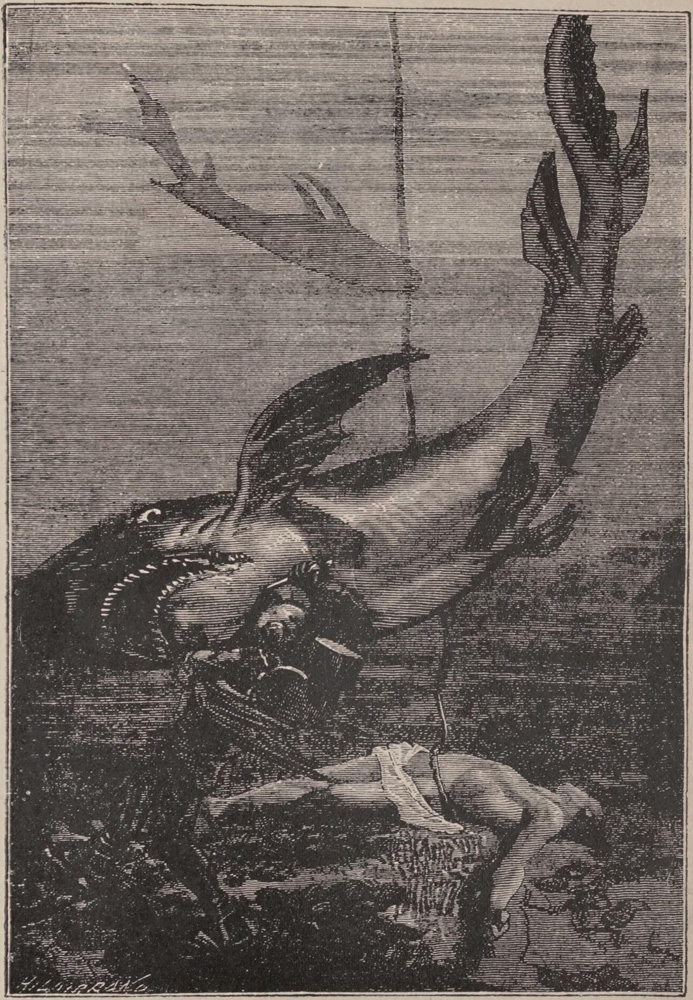
The shark had seemed to roar, if I might say so. The blood rushed in torrents from its wound. The sea was dyed red, and through the opaque liquid I could distinguish nothing more. Nothing more until the moment when, like lightning, I saw the undaunted Captain hanging on to one of the creature’s fins, struggling, as it were, hand to hand with the monster, and dealing successive blows at his enemy, yet still unable to give a decisive one.
The shark seemed to roar, if I can put it that way. Blood poured from its wound, turning the sea red. I could see nothing through the clouded water. Then, in a flash, I saw the fearless Captain hanging on to one of the creature’s fins. He was fighting the monster almost hand to hand, striking it again and again, but still unable to land a decisive blow.
The shark’s struggles agitated the water with such fury that the rocking threatened to upset me.
The shark struggled so fiercely that the water rocked me and threatened to overturn me.
I wanted to go to the Captain’s assistance, but, nailed to the spot with horror, I could not stir.
I wanted to help the Captain, but I was frozen in horror and could not move.
I saw the haggard eye; I saw the different phases of the fight. The Captain fell to the earth, upset by the enormous mass which leant upon him. The shark’s jaws opened wide, like a pair of factory shears, and it would have been all over with the Captain; but, quick as thought, harpoon in hand, Ned Land rushed towards the shark and struck it with its sharp point.
I saw the wild eye. I saw every stage of the fight. The Captain fell to the ground, knocked over by the enormous mass pressing against him. The shark’s jaws opened wide, like a pair of factory shears. It would have been all over for the Captain, but Ned Land rushed at the shark as quick as thought. Harpoon in hand, he struck the shark with its sharp point.
The waves were impregnated with a mass of blood. They rocked under the shark’s movements, which beat them with indescribable fury. Ned Land had not missed his aim. It was the monster’s death-rattle. Struck to the heart, it struggled in dreadful convulsions, the shock of which overthrew Conseil.
The waves were filled with blood. They churned as the shark thrashes with indescribable fury. Ned Land had not missed. The monster was dying. Struck in the heart, it struggled in terrible convulsions. The force of its movements knocked Conseil over.
But Ned Land had disentangled the Captain, who, getting up without any wound, went straight to the Indian, quickly cut the cord which held him to his stone, took him in his arms, and, with a sharp blow of his heel, mounted to the surface.
But Ned Land freed the Captain, who got up unhurt and went straight to the Indian. He quickly cut the cord tying the Indian to his stone and took him in his arms. Then, with a sharp kick, he rose to the surface.
We all three followed in a few seconds, saved by a miracle, and reached the fisherman’s boat.
All three of us followed a few seconds later and reached the fisherman’s boat, saved by a miracle.
Captain Nemo’s first care was to recall the unfortunate man to life again. I did not think he could succeed. I hoped so, for the poor creature’s immersion was not long; but the blow from the shark’s tail might have been his death-blow.
Captain Nemo’s first concern was to revive the unfortunate man. I did not think he could succeed. I hoped he could, since the poor man had not been underwater for long. But the shark’s tail might have struck him a fatal blow.
Happily, with the Captain’s and Conseil’s sharp friction, I saw consciousness return by degrees. He opened his eyes. What was his surprise, his terror even, at seeing four great copper heads leaning over him! And, above all, what must he have thought when Captain Nemo, drawing from the pocket of his dress a bag of pearls, placed it in his hand! This munificent charity from the man of the waters to the poor Cingalese was accepted with a trembling hand. His wondering eyes showed that he knew not to what super-human beings he owed both fortune and life.
Fortunately, the Captain and Conseil rubbed him vigorously, and I saw him slowly regain consciousness. He opened his eyes. How surprised, even terrified, he must have been to see four great copper heads leaning over him! And what must he have thought when Captain Nemo took a bag of pearls from his suit and placed it in his hand! The poor Cingalese accepted this generous gift from the man of the waters with a trembling hand. His wondering eyes showed that he did not know which superhuman beings had given him both fortune and life.
At a sign from the Captain we regained the bank, and, following the road already traversed, came in about half an hour to the anchor which held the canoe of the Nautilus to the earth.
At a signal from the Captain, we returned to the bank and followed the road we had taken before. About half an hour later, we reached the anchor that held the Nautilus’s canoe to the ground.
Once on board, we each, with the help of the sailors, got rid of the heavy copper helmet.
Once aboard, we each removed our heavy copper helmet with the sailors' help.
Captain Nemo’s first word was to the Canadian.
Captain Nemo spoke first to the Canadian.
“Thank you, Master Land,” said he.
“Thank you, Master Land,” he said.
“It was in revenge, Captain,” replied Ned Land. “I owed you that.”
“That was revenge, Captain,” Ned Land replied. “I owed you that.”
A ghastly smile passed across the Captain’s lips, and that was all.
A ghastly smile crossed the Captain’s lips, and that was all.
“To the Nautilus,” said he.
“To the Nautilus,” he said.
The boat flew over the waves. Some minutes after we met the shark’s dead body floating. By the black marking of the extremity of its fins, I recognised the terrible melanopteron of the Indian Seas, of the species of shark so properly called. It was more than twenty-five feet long; its enormous mouth occupied one-third of its body. It was an adult, as was known by its six rows of teeth placed in an isosceles triangle in the upper jaw.
The boat flew over the waves. A few minutes later, we came upon the shark’s dead body floating in the water. I recognized it by the black markings on the tips of its fins. It was the terrible melanopteron of the Indian Seas, a species rightly called a shark. It was more than twenty-five feet long. Its enormous mouth took up one-third of its body. It was an adult, as its six rows of teeth showed. The teeth formed an isosceles triangle in its upper jaw.
Whilst I was contemplating this inert mass, a dozen of these voracious beasts appeared round the boat; and, without noticing us, threw themselves upon the dead body and fought with one another for the pieces.
As I watched the motionless mass, a dozen of these ravenous beasts appeared around the boat. Ignoring us, they threw themselves at the dead body and fought each other for pieces of it.
At half-past eight we were again on board the Nautilus. There I reflected on the incidents which had taken place in our excursion to the Manaar Bank.
At 8:30, we were back on board the Nautilus. There I thought about what had happened during our trip to the Manaar Bank.
Two conclusions I must inevitably draw from it—one bearing upon the unparalleled courage of Captain Nemo, the other upon his devotion to a human being, a representative of that race from which he fled beneath the sea. Whatever he might say, this strange man had not yet succeeded in entirely crushing his heart.
I had to draw two conclusions from it. One concerned Captain Nemo’s unmatched courage. The other concerned his devotion to a fellow human being, a member of the race he had fled beneath the sea. Whatever he might say, this strange man had not yet managed to crush his heart completely.
When I made this observation to him, he answered in a slightly moved tone:
When I made this observation to him, he answered in a slightly emotional tone:
“That Indian, sir, is an inhabitant of an oppressed country; and I am still, and shall be, to my last breath, one of them!”
“That Indian, sir, comes from an oppressed country. And I am still one of its people, and will be until my last breath!”