Chapter 22
ARRIVAL IN NEW-ORLEANS—GLIMPSE OF FREEMAN—GENOIS, THE RECORDER—HIS DESCRIPTION OF SOLOMON—REACH CHARLESTON—INTERRUPTED BY CUSTOM HOUSE OFFICERS—PASS THROUGH RICHMOND—ARRIVAL IN WASHINGTON—BURCH ARRESTED—SHEKELS AND THORN—THEIR TESTIMONY—BURCH ACQUITTED—ARREST OF SOLOMON—BURCH WITHDRAWS THE COMPLAINT—THE HIGHER TRIBUNAL—DEPARTURE FROM WASHINGTON—ARRIVAL AT SANDY HILL—OLD FRIENDS AND FAMILIAR SCENES—PROCEED TO GLENS FALLS—MEETING WITH ANNE, MARGARET AND ELIZABETH—SOLOMON NORTHUP STAUNTON—INCIDENTS—CONCLUSION.
ARRIVAL IN NEW-ORLEANS. A GLIMPSE OF FREEMAN. GENOIS, THE RECORDER. HIS DESCRIPTION OF SOLOMON. REACHING CHARLESTON. STOPPED BY CUSTOMS OFFICERS. PASSING THROUGH RICHMOND. ARRIVAL IN WASHINGTON. BURCH ARRESTED. SHEKELS AND THORN. THEIR TESTIMONY. BURCH ACQUITTED. SOLOMON ARRESTED. BURCH WITHDRAWS THE COMPLAINT. THE HIGHER COURT. DEPARTURE FROM WASHINGTON. ARRIVAL AT SANDY HILL. OLD FRIENDS AND FAMILIAR PLACES. CONTINUING TO GLENS FALLS. MEETING WITH ANNE, MARGARET AND ELIZABETH. SOLOMON NORTHUP STAUNTON. INCIDENTS. CONCLUSION.
As the steamer glided on its way towards New-Orleans, perhaps I was not happy—perhaps there was no difficulty in restraining myself from dancing round the deck—perhaps I did not feel grateful to the man who had come so many hundred miles for me—perhaps I did not light his pipe, and wait and watch his word, and run at his slightest bidding. If I didn't—well, no matter.
As the steamboat made its way toward New Orleans, perhaps I wasn't happy. Perhaps I had no trouble keeping myself from dancing around the deck. Perhaps I wasn't grateful to the man who had come hundreds of miles for me. Perhaps I didn't light his pipe, hang on his every word, and run to do whatever he asked. If I didn't, well, never mind.
We tarried at New-Orleans two days. During that time I pointed out the locality of Freeman's slave pen, and the room in which Ford purchased me. We happened to meet Theophilus in the street, but I did not think it worth while to renew acquaintance with him. From respectable citizens we ascertained he had become a low, miserable rowdy—a broken-down, disreputable man.
We stayed in New-Orleans for two days. During that time, I pointed out where Freeman's slave pen was and the room where Ford purchased me. We happened to meet Theophilus in the street, but I did not think it worth renewing our acquaintance. Respectable citizens told us he had become a low, miserable rowdy, a broken-down, disreputable man.
We also visited the recorder, Mr. Genois, to whom Senator Soule's letter was directed, and found him a man well deserving the wide and honorable reputation that he bears. He very generously furnished us with a sort of legal pass, over his signature and seal of office, and as it contains the recorder's description of my personal appearance, it may not be amiss to insert it here. The following is a copy:
We also visited the recorder, Mr. Genois, to whom Senator Soule's letter was addressed. We found that he fully deserved his widespread and honorable reputation. He very generously gave us a kind of legal pass, bearing his signature and official seal. Since it includes the recorder's description of my appearance, it may be worth including here. The following is a copy:
"State of Louisiana—City of New-Orleans: Recorder's Office, Second District. "To all to whom these presents shall come:— "This is to certify that Henry B. Northup, Esquire, of the county of Washington, New-York, has produced before me due evidence of the freedom of Solomon, a mulatto man, aged about forty-two years, five feet, seven inches and six lines, woolly hair, and chestnut eyes, who is a native born of the State of New-York. That the said Northup, being about bringing the said Solomon to his native place, through the southern routes, the civil authorities are requested to let the aforesaid colored man Solomon pass unmolested, he demeaning well and properly. "Given under my hand and the seal of the city of New-Orleans this 7th January, 1853. [L. S.] "TH. GENOIS, Recorder."
State of Louisiana, City of New-Orleans: Recorder's Office, Second District. "To all who receive this document: "This certifies that Henry B. Northup, Esquire, of Washington County, New-York, has presented me with sufficient evidence that Solomon is free. Solomon is a mulatto man, about forty-two years old, five feet, seven inches and six lines tall, with woolly hair and chestnut eyes. He was born in the State of New-York. Northup is about to take Solomon back to his native place by southern routes. Civil authorities are therefore requested to let Solomon, the colored man named above, pass without interference, as long as he behaves well and properly. "Given under my hand and the seal of the city of New-Orleans on January 7, 1853. [L. S.] "TH. GENOIS, Recorder."
On the 8th we came to Lake Pontchartrain, by railroad, and, in due time, following the usual route, reached Charleston. After going on board the steamboat, and paying our passage at this city, Mr. Northup was called upon by a custom-house officer to explain why he had not registered his servant. He replied that he had no servant—that, as the agent of New-York, he was accompanying a free citizen of that State from slavery to freedom, and did not desire nor intend to make any registry whatever. I conceived from his conversation and manner, though I may perhaps be entirely mistaken, that no great pains would be taken to avoid whatever difficulty the Charleston officials might deem proper to create. At length, however, we were permitted to proceed, and, passing through Richmond, where I caught a glimpse of Goodin's pen, arrived in Washington January 17th, 1853.
On the 8th, we traveled by railroad to Lake Pontchartrain. In time, following the usual route, we reached Charleston. There, after we boarded the steamboat and paid our fare, a customs officer questioned Mr. Northup. The officer asked why he had not registered his servant. Mr. Northup replied that he had no servant. He said that, as an agent of New-York, he was accompanying a free citizen of that State from slavery to freedom. He neither wished nor intended to make any such registration. From his words and manner, I thought he would make little effort to avoid any trouble the Charleston officials might choose to create. I may, however, be entirely mistaken. At last, we were allowed to continue. We passed through Richmond, where I caught a glimpse of Goodin's pen, and arrived in Washington on January 17th, 1853.
We ascertained that both Burch and Radburn were still residing in that city. Immediately a complaint was entered with a police magistrate of Washington, against James H. Burch, for kidnapping and selling me into slavery. He was arrested upon a warrant issued by Justice Goddard, and returned before Justice Mansel, and held to bail in the sum of three thousand dollars. When first arrested, Burch was much excited, exhibiting the utmost fear and alarm, and before reaching the justice's office on Louisiana Avenue, and before knowing the precise nature of the complaint, begged the police to permit him to consult Benjamin O. Shekels, a slave trader of seventeen years' standing, and his former partner. The latter became his bail.
We learned that both Burch and Radburn were still living in that city. A complaint was immediately filed with a Washington police magistrate against James H. Burch for kidnapping and selling me into slavery. Burch was arrested on a warrant issued by Justice Goddard. He was brought before Justice Mansel, who set bail at three thousand dollars. When first arrested, Burch was very agitated and showed great fear and alarm. Before reaching the justice's office on Louisiana Avenue, he begged the police to let him consult Benjamin O. Shekels. Burch did not yet know the exact nature of the complaint against him. Shekels had been a slave trader for seventeen years and was Burch's former partner. He posted Burch's bail.
At ten o'clock, the 18th of January, both parties appeared before the magistrate. Senator Chase, of Ohio, Hon. Orville Clark, of Sandy Hill, and Mr. Northup acted as counsel for the prosecution, and Joseph H. Bradley for the defence.
At ten o'clock on January 18, both parties appeared before the magistrate. Senator Chase of Ohio, the Hon. Orville Clark of Sandy Hill, and Mr. Northup represented the prosecution. Joseph H. Bradley represented the defense.
Gen. Orville Clark was called and sworn as a witness, and testified that he had known me from childhood, and that I was a free man, as was my father before me. Mr. Northup then testified to the same, and proved the facts connected with his mission to Avoyelles.
Gen. Orville Clark was called as a witness and sworn in. He testified that he had known me since childhood and that I was a free man, as my father had been before me. Mr. Northup then testified to the same facts and proved the facts surrounding his mission to Avoyelles.
Ebenezer Radburn was then sworn for the prosecution, and testified he was forty-eight years old; that he was a resident of Washington, and had known Burch fourteen years; that in 1841 he was keeper of Williams' slave pen; that he remembered the fact of my confinement in the pen that year. At this point it was admitted by the defendant's counsel, that I had been placed in the pen by Burch in the spring of 1841, and hereupon the prosecution rested.
Ebenezer Radburn was then sworn in as a witness for the prosecution. He testified that he was forty-eight years old and lived in Washington. He had known Burch for fourteen years. In 1841, he had been the keeper of Williams' slave pen. He remembered that I had been confined in the pen that year. At this point, the defendant's lawyer admitted that Burch had placed me in the pen in the spring of 1841. The prosecution then rested its case.
Benjamin O. Shekels was then offered as a witness by the prisoner. Benjamin is a large, coarse-featured man, and the reader may perhaps get a somewhat correct conception of him by reading the exact language he used in answer to the first question of defendant's lawyer. He was asked the place of his nativity, and his reply, uttered in a sort of rowdyish way, was in these very words—
The prisoner then called Benjamin O. Shekels as a witness. Benjamin is a large man with coarse features. The reader may get a fairly accurate picture of him from his exact answer to the defense lawyer’s first question. He was asked where he was born. He answered in a somewhat rowdy manner, using these exact words:
"I was born in Ontario county, New-York, and weighed fourteen pounds!"
"I was born in Ontario County, New York, and weighed fourteen pounds!"
Benjamin was a prodigious baby! He further testified that he kept the Steamboat Hotel in Washington in 1841, and saw me there in the spring of that year. He was proceeding to state what he had heard two men say, when Senator Chase raised a legal objection, to wit, that the sayings of third persons, being hearsay, was improper evidence. The objection was overruled by the Justice, and Shekels continued, stating that two men came to his hotel and represented they had a colored man for sale; that they had an interview with Burch; that they stated they came from Georgia, but he did not remember the county; that they gave a full history of the boy, saying he was a bricklayer, and played on the violin; that Burch remarked he would purchase if they could agree; that they went out and brought the boy in, and that I was the same person. He further testified, with as much unconcern as if it was the truth, that I represented I was born and bred in Georgia; that one of the young men with me was my master; that I exhibited a great deal of regret at parting with him, and he believed "got into tears!"—nevertheless, that I insisted my master had a right to sell me; that he ought to sell me; and the remarkable reason I gave was, according to Shekels, because he, my master, "had been gambling and on a spree!"
Benjamin was an enormous baby! Shekels also testified that he ran the Steamboat Hotel in Washington in 1841. He said he had seen me there in the spring of that year. He began to tell what he had heard two men say. But Senator Chase raised a legal objection. He argued that the words of third parties were hearsay and could not be used as evidence. The Justice overruled the objection, and Shekels continued. He said two men had come to his hotel and told him they had a colored man for sale. They had met with Burch and said they came from Georgia, though Shekels did not remember the county. They gave a full history of the boy, saying he was a bricklayer and played the violin. Burch said he would buy him if they could agree on a price. The men went out and brought the boy in. Shekels said I was that same person. He went on to testify, as casually as if he were telling the truth, that I had said I was born and raised in Georgia. I had said that one of the young men with me was my master. I had shown great regret at parting with him and, Shekels believed, "got into tears!" Yet I had insisted that my master had a right to sell me and that he ought to sell me. According to Shekels, my remarkable reason was that my master "had been gambling and on a spree!"
He continued, in these words, copied from the minutes taken on the examination: "Burch interrogated the boy in the usual manner, told him if he purchased him he should send him south. The boy said he had no objection, that in fact he would like to go south. Burch paid $650 for him, to my knowledge. I don't know what name was given him, but think it was not Solomon. Did not know the name of either of the two men. They were in my tavern two or three hours, during which time the boy played on the violin. The bill of sale was signed in my bar-room. It was a printed blank, filled up by Burch. Before 1838 Burch was my partner. Our business was buying and selling slaves. After that time he was a partner of Theophilus Freeman, of New-Orleans. Burch bought here—Freeman sold there!"
He continued, in these words, copied from the notes taken during the examination: "Burch questioned the boy in the usual way. He told the boy that if he bought him, he would send him south. The boy said he had no objection. In fact, he said he would like to go south. I know that Burch paid $650 for him. I don't know what name was given to the boy, but I think it was not Solomon. I did not know the name of either of the two men. They were in my tavern for two or three hours. During that time, the boy played the violin. The bill of sale was signed in my barroom. It was a printed blank, filled out by Burch. Before 1838, Burch was my partner. Our business was buying and selling slaves. After that, he was a partner of Theophilus Freeman, of New-Orleans. Burch bought here. Freeman sold there!"
Shekels, before testifying, had heard my relation of the circumstances connected with the visit to Washington with Brown and Hamilton, and therefore, it was, undoubtedly, he spoke of "two men," and of my playing on the violin. Such was his fabrication, utterly untrue, and yet there was found in Washington a man who endeavored to corroborate him.
Before testifying, Shekels had heard my account of my visit to Washington with Brown and Hamilton. That was undoubtedly why he spoke of "two men" and of my playing the violin. His story was completely false. Yet a man in Washington tried to corroborate it.
Benjamin A. Thorn testified he was at Shekels' in 1841, and saw a colored boy playing on a fiddle. "Shekels said he was for sale. Heard his master tell him he should sell him. The boy acknowledged to me he was a slave. I was not present when the money was paid. Will not swear positively this is the boy. The master came near shedding tears: I think the boy did! I have been engaged in the business of taking slaves south, off and on, for twenty years. When I can't do that I do something else."
Benjamin A. Thorn testified that he was at Shekels' in 1841 and saw a colored boy playing a fiddle. "Shekels said the boy was for sale. I heard his master tell him he would sell him. The boy admitted to me that he was a slave. I was not there when the money was paid. I cannot swear for certain that this is the boy. The master nearly shed tears: I think the boy did! I have been taking slaves south, off and on, for twenty years. When I can't do that, I do something else."
I was then offered as a witness, but, objection being made, the court decided my evidence inadmissible. It was rejected solely on the ground that I was a colored man—the fact of my being a free citizen of New-York not being disputed.
I was then called as a witness, but someone objected, and the court ruled that my testimony could not be admitted. The court rejected it solely because I was a colored man. No one disputed that I was a free citizen of New-York.
Shekels having testified there was a bill of sale executed, Burch was called upon by the prosecution to produce it, inasmuch as such a paper would corroborate the testimony of Thorn and Shekels. The prisoner's counsel saw the necessity of exhibiting it, or giving some reasonable explanation for its non-production. To effect the latter, Burch himself was offered as a witness in his own behalf. It was contended by counsel for the people, that such testimony should not be allowed—that it was in contravention of every rule of evidence, and if permitted would defeat the ends of justice. His testimony, however, was received by the court! He made oath that such a bill of sale had been drawn up and signed, but he had lost it, and did not know what had become of it! Thereupon the magistrate was requested to dispatch a police officer to Burch's residence, with directions to bring his books, containing his bills of sales for the year 1841. The request was granted, and before any measure could be taken to prevent it, the officer had obtained possession of the books, and brought them into court. The sales for the year 1841 were found, and carefully examined, but no sale of myself, by any name, was discovered!
Shekels testified that a bill of sale had been signed. The prosecution then called on Burch to produce it, since it would support the testimony of Thorn and Shekels. The prisoner's lawyer saw that he needed to produce the bill of sale or reasonably explain its absence. To explain its absence, Burch himself was offered as a witness on his own behalf. The prosecutor argued that his testimony should not be allowed. It violated every rule of evidence, and allowing it would defeat the ends of justice. The court, however, accepted his testimony! He swore that a bill of sale had been drawn up and signed, but he had lost it and did not know what had happened to it! The magistrate was then asked to send a police officer to Burch's home. The officer was to bring back his books containing his bills of sale for 1841. The magistrate granted the request. Before anyone could take steps to prevent it, the officer had obtained the books and brought them into court. The bills of sale for 1841 were found and carefully examined, but no sale of me under any name was found!
Upon this testimony the court held the fact to be established, that Burch came innocently and honestly by me, and accordingly he was discharged.
Based on this testimony, the court found that Burch had acquired me innocently and honestly. He was therefore released.
An attempt was then made by Burch and his satellites, to fasten upon me the charge that I had conspired with the two white men to defraud him—with what success, appears in an extract taken from an article in the New-York Times, published a day or two subsequent to the trial: "The counsel for the defendant had drawn up, before the defendant was discharged, an affidavit, signed by Burch, and had a warrant out against the colored man for a conspiracy with the two white men before referred to, to defraud Burch out of six hundred and twenty-five dollars. The warrant was served, and the colored man arrested and brought before officer Goddard. Burch and his witnesses appeared in court, and H. B. Northup appeared as counsel for the colored man, stating he was ready to proceed as counsel on the part of the defendant, and asking no delay whatever. Burch, after consulting privately a short time with Shekels, stated to the magistrate that he wished him to dismiss the complaint, as he would not proceed farther with it. Defendant's counsel stated to the magistrate that if the complaint was withdrawn, it must be without the request or consent of the defendant. Burch then asked the magistrate to let him have the complaint and the warrant, and he took them. The counsel for the defendant objected to his receiving them, and insisted they should remain as part of the records of the court, and that the court should endorse the proceedings which had been had under the process. Burch delivered them up, and the court rendered a judgment of discontinuance by the request of the prosecutor, and filed it in his office."
Burch and his associates then tried to accuse me of conspiring with the two white men to defraud him. An excerpt from the New-York Times shows how their attempt succeeded. It appeared a day or two after the trial: "Before the defendant was discharged, his lawyer had prepared an affidavit, which Burch signed. The lawyer had also obtained a warrant against the colored man. It charged him with conspiring with the two white men mentioned earlier to defraud Burch of six hundred and twenty-five dollars. The warrant was served, and the colored man was arrested and brought before officer Goddard. Burch and his witnesses appeared in court. H. B. Northup appeared as the colored man's lawyer. He said he was ready to proceed on the defendant's behalf and asked for no delay. After a short private consultation with Shekels, Burch told the magistrate he wanted the complaint dismissed. He said he would pursue it no further. The defendant's lawyer told the magistrate that any withdrawal of the complaint must be without the defendant's request or consent. Burch then asked the magistrate for the complaint and the warrant, and he took them. The defendant's lawyer objected to Burch receiving them. He insisted that they remain part of the court records and that the court record what had happened under the warrant. Burch returned the documents. At the prosecutor's request, the court then entered a judgment discontinuing the case and filed it in the court office."
There may be those who will affect to believe the statement of the slave-trader—those, in whose minds his allegations will weigh heavier than mine. I am a poor colored man—one of a down-trodden and degraded race, whose humble voice may not be heeded by the oppressor—but knowing the truth, and with a full sense of my accountability, I do solemnly declare before men, and before God, that any charge or assertion, that I conspired directly or indirectly with any person or persons to sell myself; that any other account of my visit to Washington, my capture and imprisonment in Williams' slave pen, than is contained in these pages, is utterly and absolutely false. I never played on the violin in Washington. I never was in the Steamboat Hotel, and never saw Thorn or Shekels, to my knowledge, in my life, until last January. The story of the trio of slave-traders is a fabrication as absurd as it is base and unfounded. Were it true, I should not have turned aside on my way back to liberty for the purpose of prosecuting Burch. I should have avoided rather than sought him. I should have known that such a step would have resulted in rendering me infamous. Under the circumstances—longing as I did to behold my family, and elated with the prospect of returning home—it is an outrage upon probability to suppose I would have run the hazard, not only of exposure, but of a criminal prosecution and conviction, by voluntarily placing myself in the position I did, if the statements of Burch and his confederates contain a particle of truth. I took pains to seek him out, to confront him in a court of law, charging him with the crime of kidnapping; and the only motive that impelled me to this step, was a burning sense of the wrong he had inflicted upon me, and a desire to bring him to justice. He was acquitted, in the manner, and by such means as have been described. A human tribunal has permitted him to escape; but there is another and a higher tribunal, where false testimony will not prevail, and where I am willing, so far at least as these statements are concerned, to be judged at last.
Some people may pretend to believe the slave-trader’s statement. In their minds, his claims may carry more weight than mine. I am a poor colored man, a member of a downtrodden and degraded race. The oppressor may not listen to my humble voice. But I know the truth, and I am fully aware that I must answer for my words. I solemnly declare before men and before God that I never conspired, directly or indirectly, with anyone to sell myself. Any claim that I did so is utterly and absolutely false. Any account of my visit to Washington, my capture, and my imprisonment in Williams’ slave pen that differs from the one in these pages is also utterly and absolutely false. I never played the violin in Washington. I was never in the Steamboat Hotel. To my knowledge, I never saw Thorn or Shekels in my life until last January. The story told by the three slave-traders is a fabrication, as absurd as it is base and groundless. If it were true, I would not have interrupted my journey back to liberty to prosecute Burch. I would have avoided him rather than sought him out. I would have known that such a step would have made me infamous. I longed to see my family and was overjoyed at the prospect of returning home. Under those circumstances, it defies all probability to suppose that I would have voluntarily placed myself as I did. If the statements of Burch and his associates contained a particle of truth, I would have risked exposure, criminal prosecution, and conviction. I took pains to seek Burch out and confront him in a court of law, charging him with kidnapping. My only motive was a burning sense of the wrong he had done me and a desire to bring him to justice. He was acquitted, in the manner and by the means already described. A human court has allowed him to escape. But there is another, higher court where false testimony will not prevail. There, at least as far as these statements are concerned, I am willing to be judged in the end.
We left Washington on the 20th of January, and proceeding by the way of Philadelphia, New-York, and Albany, reached Sandy Hill in the night of the 21st. My heart overflowed with happiness as I looked around upon old familiar scenes, and found myself in the midst of friends of other days. The following morning I started, in company with several acquaintances, for Glens Falls, the residence of Anne and our children.
We left Washington on January 20 and traveled through Philadelphia, New-York, and Albany. We reached Sandy Hill on the night of the 21st. My heart overflowed with happiness as I looked around at familiar places and found myself among old friends. The next morning, several acquaintances and I set out for Glens Falls, where Anne and our children lived.
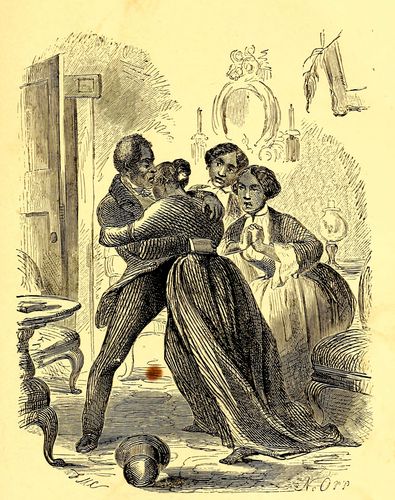
As I entered their comfortable cottage, Margaret was the first that met me. She did not recognize me. When I left her, she was but seven years old, a little prattling girl, playing with her toys. Now she was grown to womanhood—was married, with a bright-eyed boy standing by her side. Not forgetful of his enslaved, unfortunate grand-father, she had named the child Solomon Northup Staunton. When told who I was, she was overcome with emotion, and unable to speak. Presently Elizabeth entered the room, and Anne came running from the hotel, having been informed of my arrival. They embraced me, and with tears flowing down their cheeks, hung upon my neck. But I draw a veil over a scene which can better be imagined than described.
As I entered their comfortable cottage, Margaret was the first to greet me. She did not recognize me. When I left her, she was only seven, a little girl chattering and playing with her toys. Now she was a grown woman, married, with a bright-eyed boy standing beside her. She had not forgotten her unfortunate grandfather, who was enslaved. She had named the child Solomon Northup Staunton. When she was told who I was, she was overcome with emotion and could not speak. Soon Elizabeth entered the room. Anne, who had been told of my arrival, came running from the hotel. They embraced me and held me around the neck, tears flowing down their cheeks. But I will draw a veil over a scene that can be better imagined than described.
When the violence of our emotions had subsided to a sacred joy—when the household gathered round the fire, that sent out its warm and crackling comfort through the room, we conversed of the thousand events that had occurred—the hopes and fears, the joys and sorrows, the trials and troubles we had each experienced during the long separation. Alonzo was absent in the western part of the State. The boy had written to his mother a short time previous, of the prospect of his obtaining sufficient money to purchase my freedom. From his earliest years, that had been the chief object of his thoughts and his ambition. They knew I was in bondage. The letter written on board the brig, and Clem Ray himself, had given them that information. But where I was, until the arrival of Bass' letter, was a matter of conjecture. Elizabeth and Margaret once returned from school—so Anne informed me—weeping bitterly. On inquiring the cause of the children's sorrow, it was found that, while studying geography, their attention had been attracted to the picture of slaves working in the cotton-field, and an overseer following them with his whip. It reminded them of the sufferings their father might be, and, as it happened, actually was, enduring in the South. Numerous incidents, such as these, were related—incidents showing they still held me in constant remembrance, but not, perhaps, of sufficient interest to the reader, to be recounted.
When our overwhelming emotions had settled into a sacred joy, the family gathered around the fire. It filled the room with warmth and the comforting sound of crackling. We talked about the thousand events that had occurred during our long separation. We shared the hopes and fears, joys and sorrows, trials and troubles we had each experienced. Alonzo was away in the western part of the State. Shortly before, the boy had written to his mother about his chances of earning enough money to buy my freedom. From his earliest years, that had been his chief thought and ambition. My family knew I was in bondage. They had learned that from the letter written on board the brig and from Clem Ray himself. But until Bass' letter arrived, they could only guess where I was. Anne told me that Elizabeth and Margaret had once returned from school weeping bitterly. When she asked why they were so upset, she learned what had happened. While studying geography, they had noticed a picture of slaves working in a cotton-field, followed by an overseer with his whip. It reminded them of the suffering their father might be enduring in the South. As it happened, I actually was enduring it. My family told me of many such incidents, showing that they still remembered me constantly. But perhaps those incidents are not interesting enough to recount to the reader.
My narrative is at an end. I have no comments to make upon the subject of Slavery. Those who read this book may form their own opinions of the "peculiar institution." What it may be in other States, I do not profess to know; what it is in the region of Red River, is truly and faithfully delineated in these pages. This is no fiction, no exaggeration. If I have failed in anything, it has been in presenting to the reader too prominently the bright side of the picture. I doubt not hundreds have been as unfortunate as myself; that hundreds of free citizens have been kidnapped and sold into slavery, and are at this moment wearing out their lives on plantations in Texas and Louisiana. But I forbear. Chastened and subdued in spirit by the sufferings I have borne, and thankful to that good Being through whose mercy I have been restored to happiness and liberty, I hope henceforward to lead an upright though lowly life, and rest at last in the church yard where my father sleeps.
My story is at an end. I have no comments to make about slavery. Those who read this book may form their own opinions of the "peculiar institution." I do not claim to know what slavery is like in other States. What it is like in the Red River region is portrayed truly and faithfully in these pages. This is no fiction or exaggeration. If I have failed in anything, I have given too much attention to the bright side of the picture. I have no doubt that hundreds have been as unfortunate as I have. Hundreds of free citizens have been kidnapped and sold into slavery. They are spending their lives on plantations in Texas and Louisiana at this very moment. But I will say no more. The suffering I have endured has humbled and subdued my spirit. I am thankful to that good Being whose mercy has restored me to happiness and liberty. From now on, I hope to lead an upright though humble life. I hope to rest at last in the churchyard where my father sleeps.