Chapter 18
O'NIEL, THE TANNER—CONVERSATION WITH AUNT PHEBE OVERHEARD—EPPS IN THE TANNING BUSINESS—STABBING OF UNCLE ABRAM—THE UGLY WOUND—EPPS IS JEALOUS—PATSEY IS MISSING—HER RETURN FROM SHAW'S—HARRIET, SHAW'S BLACK WIFE—EPPS ENRAGED—PATSEY DENIES HIS CHARGES—SHE IS TIED DOWN NAKED TO FOUR STAKES—THE INHUMAN FLOGGING—FLAYING OF PATSEY—THE BEAUTY OF THE DAY—THE BUCKET OF SALT WATER—THE DRESS STIFF WITH BLOOD—PATSEY GROWS MELANCHOLY—HER IDEA OF GOD AND ETERNITY—OF HEAVEN AND FREEDOM—THE EFFECT OF SLAVE-WHIPPING—EPPS' OLDEST SON—"THE CHILD IS FATHER TO THE MAN."
O'NIEL, THE TANNER. A CONVERSATION WITH AUNT PHEBE IS OVERHEARD. EPPS GOES INTO THE TANNING BUSINESS. UNCLE ABRAM IS STABBED. THE UGLY WOUND. EPPS IS JEALOUS. PATSEY IS MISSING. SHE RETURNS FROM SHAW'S. HARRIET, SHAW'S BLACK WIFE. EPPS IS ENRAGED. PATSEY DENIES HIS CHARGES. SHE IS TIED DOWN NAKED TO FOUR STAKES. THE INHUMAN WHIPPING. PATSEY'S SKIN IS STRIPPED AWAY. THE BEAUTY OF THE DAY. THE BUCKET OF SALT WATER. THE DRESS STIFF WITH BLOOD. PATSEY GROWS MELANCHOLY. HER IDEA OF GOD AND ETERNITY. OF HEAVEN AND FREEDOM. THE EFFECT OF WHIPPING SLAVES. EPPS' OLDEST SON. "THE CHILD IS FATHER TO THE MAN."
Wiley suffered severely at the hands of Master Epps, as has been related in the preceding chapter, but in this respect he fared no worse than his unfortunate companions. "Spare the rod," was an idea scouted by our master. He was constitutionally subject to periods of ill-humor, and at such times, however little provocation there might be, a certain amount of punishment was inflicted. The circumstances attending the last flogging but one that I received, will show how trivial a cause was sufficient with him for resorting to the whip.
Wiley suffered severely at the hands of Master Epps, as I described in the preceding chapter. But in this respect, he fared no worse than his unfortunate companions. Our master scoffed at the idea of "spare the rod." He was naturally prone to periods of bad temper. At such times, he would inflict a certain amount of punishment, however little provocation there was. The circumstances of my second-to-last flogging show how little cause he needed to use the whip.
A Mr. O'Niel, residing in the vicinity of the Big Pine Woods, called upon Epps for the purpose of purchasing me. He was a tanner and currier by occupation, transacting an extensive business, and intended to place me at service in some department of his establishment, provided he bought me. Aunt Phebe, while preparing the dinner-table in the great house, overheard their conversation. On returning to the yard at night, the old woman ran to meet me, designing, of course, to overwhelm me with the news. She entered into a minute repetition of all she had heard, and Aunt Phebe was one whose ears never failed to drink in every word of conversation uttered in her hearing. She enlarged upon the fact that "Massa Epps was g'wine to sell me to a tanner ober in de Pine Woods," so long and loudly as to attract the attention of the mistress, who, standing unobserved on the piazza at the time, was listening to our conversation.
A Mr. O'Niel, who lived near the Big Pine Woods, came to Epps to buy me. He was a tanner and currier with an extensive business. If he bought me, he intended to put me to work in some part of his establishment. Aunt Phebe overheard their conversation while setting the dinner table in the great house. When I returned to the yard that night, the old woman ran to meet me. She meant, of course, to overwhelm me with the news. She repeated everything she had heard in detail. Aunt Phebe never failed to take in every word spoken within her hearing. She went on about how "Massa Epps was going to sell me to a tanner over in the Pine Woods." She spoke so long and loudly that she attracted the mistress's attention. The mistress was standing unnoticed on the piazza, listening to our conversation.
"Well, Aunt Phebe," said I, "I'm glad of it. I'm tired of scraping cotton, and would rather be a tanner. I hope he'll buy me."
"Well, Aunt Phebe," I said, "I'm glad of it. I'm tired of scraping cotton, and I'd rather be a tanner. I hope he'll buy me."
O'Niel did not effect a purchase, however, the parties differing as to price, and the morning following his arrival, departed homewards. He had been gone but a short time, when Epps made his appearance in the field. Now nothing will more violently enrage a master, especially Epps, than the intimation of one of his servants that he would like to leave him. Mistress Epps had repeated to him my expressions to Aunt Phebe the evening previous, as I learned from the latter afterwards, the mistress having mentioned to her that she had overheard us. On entering the field, Epps walked directly to me.
O'Niel did not make the purchase, however, because the parties could not agree on a price. He left for home the morning after his arrival. He had been gone only a short time when Epps appeared in the field. Nothing enrages a master more violently than a servant suggesting that he would like to leave him. This was especially true of Epps. Mistress Epps had told him what I had said to Aunt Phebe the evening before. I learned this later from Aunt Phebe, whom the mistress had told she had overheard us. When Epps entered the field, he walked straight to me.
"So, Platt, you're tired of scraping cotton, are you? You would like to change your master, eh? You're fond of moving round—traveler—ain't ye? Ah, yes—like to travel for your health, may be? Feel above cotton-scraping, I 'spose. So you're going into the tanning business? Good business—devilish fine business. Enterprising nigger! B'lieve I'll go into that business myself. Down on your knees, and strip that rag off your back! I'll try my hand at tanning."
“So, Platt, you're tired of scraping cotton, are you? You'd like to change your master, eh? You're fond of moving around, traveler, ain't you? Ah, yes. You like to travel for your health, maybe? You feel above scraping cotton, I suppose. So you're going into the tanning business? Good business. Devilishly fine business. Enterprising nigger! I believe I'll go into that business myself. Get down on your knees and strip that rag off your back! I'll try my hand at tanning.”
I begged earnestly, and endeavored to soften him with excuses, but in vain. There was no other alternative; so kneeling down, I presented my bare back for the application of the lash.
I begged him and tried to soften him with excuses, but nothing worked. I had no other choice. So I knelt down and bared my back for the lash.
"How do you like tanning?" he exclaimed, as the rawhide descended upon my flesh. "How do you like tanning?" he repeated at every blow. In this manner he gave me twenty or thirty lashes, incessantly giving utterance to the word "tanning," in one form of expression or another. When sufficiently "tanned," he allowed me to arise, and with a half-malicious laugh assured me, if I still fancied the business, he would give me further instruction in it whenever I desired. This time, he remarked, he had only given me a short lesson in "tanning"—the next time he would "curry me down."
"How do you like tanning?" he shouted as the rawhide whip struck my flesh. "How do you like tanning?" he repeated with every blow. He gave me twenty or thirty lashes, constantly using the word "tanning" in one way or another. When I was sufficiently "tanned," he let me get up. With a slightly malicious laugh, he assured me that if I still liked the business, he would teach me more whenever I wanted. He said he had only given me a short lesson in "tanning" this time. Next time, he would "curry me down."
Uncle Abram, also, was frequently treated with great brutality, although he was one of the kindest and most faithful creatures in the world. He was my cabin-mate for years. There was a benevolent expression in the old man's face, pleasant to behold. He regarded us with a kind of parental feeling, always counseling us with remarkable gravity and deliberation.
Uncle Abram was also often treated with great brutality, although he was one of the kindest and most faithful people in the world. He was my cabin-mate for years. The old man's face had a kind expression that was pleasant to see. He felt a kind of parental affection for us and always gave us advice with remarkable seriousness and care.
Returning from Marshall's plantation one afternoon, whither I had been sent on some errand of the mistress, I found him lying on the cabin floor, his clothes saturated with blood. He informed me that he had been stabbed! While spreading cotton on the scaffold, Epps came home intoxicated from Holmesville. He found fault with every thing, giving many orders so directly contrary that it was impossible to execute any of them. Uncle Abram, whose faculties were growing dull, became confused, and committed some blunder of no particular consequence. Epps was so enraged thereat, that, with drunken recklessness, he flew upon the old man, and stabbed him in the back. It was a long, ugly wound, but did not happen to penetrate far enough to result fatally. It was sewed up by the mistress, who censured her husband with extreme severity, not only denouncing his inhumanity, but declaring that she expected nothing else than that he would bring the family to poverty—that he would kill all the slaves on the plantation in some of his drunken fits.
One afternoon, I returned from Marshall's plantation, where the mistress had sent me on an errand. I found him lying on the cabin floor, his clothes soaked with blood. He told me he had been stabbed! While he was spreading cotton on the scaffold, Epps came home drunk from Holmesville. Epps found fault with everything and gave many orders that directly contradicted one another. It was impossible to carry out any of them. Uncle Abram's faculties were growing dull, and he became confused and made a minor mistake. Epps was so enraged that he attacked the old man in a drunken rage and stabbed him in the back. The wound was long and ugly, but it had not penetrated deeply enough to kill him. The mistress sewed it up and severely scolded her husband. She condemned his cruelty and said she expected him to bring the family to poverty. She also expected him to kill all the slaves on the plantation in one of his drunken fits.
It was no uncommon thing with him to prostrate Aunt Phebe with a chair or stick of wood; but the most cruel whipping that ever I was doomed to witness—one I can never recall with any other emotion than that of horror—was inflicted on the unfortunate Patsey.
He often knocked Aunt Phebe to the ground with a chair or a stick of wood. But the most cruel whipping I was ever forced to witness was inflicted on the unfortunate Patsey. I can never remember it without feeling horror.
It has been seen that the jealousy and hatred of Mistress Epps made the daily life of her young and agile slave completely miserable. I am happy in the belief that on numerous occasions I was the means of averting punishment from the inoffensive girl. In Epps' absence the mistress often ordered me to whip her without the remotest provocation. I would refuse, saying that I feared my master's displeasure, and several times ventured to remonstrate with her against the treatment Patsey received. I endeavored to impress her with the truth that the latter was not responsible for the acts of which she complained, but that she being a slave, and subject entirely to her master's will, he alone was answerable.
As we have seen, Mistress Epps’ jealousy and hatred made the daily life of her young, agile slave completely miserable. I am glad to believe that I saved the innocent girl from punishment on many occasions. When Epps was away, the mistress often ordered me to whip Patsey without the slightest provocation. I refused, saying I feared my master’s displeasure. Several times, I dared to protest against her treatment of Patsey. I tried to make her understand that Patsey was not responsible for the acts she complained of. Patsey was a slave, entirely subject to her master’s will. He alone was responsible.
At length "the green-eyed monster" crept into the soul of Epps also, and then it was that he joined with his wrathful wife in an infernal jubilee over the girl's miseries.
Eventually, "the green-eyed monster" crept into Epps’s soul too. Then he joined his angry wife in a hellish celebration of the girl’s misery.
On a Sabbath day in hoeing time, not long ago, we were on the bayou bank, washing our clothes, as was our usual custom. Presently Patsey was missing. Epps called aloud, but there was no answer. No one had observed her leaving the yard, and it was a wonder with us whither she had gone. In the course of a couple of hours she was seen approaching from the direction of Shaw's. This man, as has been intimated, was a notorious profligate, and withal not on the most friendly terms with Epps. Harriet, his black wife, knowing Patsey's troubles, was kind to her, in consequence of which the latter was in the habit of going over to see her every opportunity. Her visits were prompted by friendship merely, but the suspicion gradually entered the brain of Epps, that another and a baser passion led her thither—that it was not Harriet she desired to meet, but rather the unblushing libertine, his neighbor. Patsey found her master in a fearful rage on her return. His violence so alarmed her that at first she attempted to evade direct answers to his questions, which only served to increase his suspicions. She finally, however, drew herself up proudly, and in a spirit of indignation boldly denied his charges.
On a Sunday during hoeing season, not long ago, we were washing our clothes on the bayou bank, as usual. Soon we noticed that Patsey was missing. Epps called out, but there was no answer. No one had seen her leave the yard, and we wondered where she had gone. A couple of hours later, we saw her coming from the direction of Shaw's. As mentioned before, Shaw was a notorious scoundrel and was not on the friendliest terms with Epps. Harriet, his black wife, knew about Patsey's troubles and was kind to her. So Patsey made a habit of visiting Harriet whenever she had the chance. Patsey visited Harriet only out of friendship. But Epps gradually began to suspect that a baser desire led her there. He thought she wanted to see his neighbor, the shameless womanizer, rather than Harriet. When Patsey returned, she found her master in a terrible rage. His violence frightened her so much that she at first tried to avoid answering his questions directly. This only increased his suspicions. Finally, though, she drew herself up proudly and, indignant, boldly denied his accusations.
"Missus don't give me soap to wash with, as she does the rest," said Patsey, "and you know why. I went over to Harriet's to get a piece," and saying this, she drew it forth from a pocket in her dress and exhibited it to him. "That's what I went to Shaw's for, Massa Epps," continued she; "the Lord knows that was all."
"Missus don't give me soap to wash with, like she does the rest," said Patsey, "and you know why. I went over to Harriet's to get a piece." She pulled the soap from a pocket in her dress and showed it to him. "That's what I went to Shaw's for, Massa Epps," she continued. "The Lord knows that was all."
"You lie, you black wench!" shouted Epps.
"You're lying, you black woman!" shouted Epps.
"I don't lie, massa. If you kill me, I'll stick to that."
"I don't lie, master. If you kill me, I'll stick to that."
"Oh! I'll fetch you down. I'll learn you to go to Shaw's. I'll take the starch out of ye," he muttered fiercely through his shut teeth.
"Oh! I'll fetch you down. I'll learn you to go to Shaw's. I'll take the starch out of you," he muttered fiercely through clenched teeth.
Then turning to me, he ordered four stakes to be driven into the ground, pointing with the toe of his boot to the places where he wanted them. When the stakes were driven down, he ordered her to be stripped of every article of dress. Ropes were then brought, and the naked girl was laid upon her face, her wrists and feet each tied firmly to a stake. Stepping to the piazza, he took down a heavy whip, and placing it in my hands, commanded me to lash her. Unpleasant as it was, I was compelled to obey him. Nowhere that day, on the face of the whole earth, I venture to say, was there such a demoniac exhibition witnessed as then ensued.
Then he turned to me and ordered four stakes driven into the ground. He pointed with the toe of his boot to the places where he wanted them. Once the stakes were in the ground, he ordered her stripped of all her clothes. Ropes were brought, and the naked girl was laid face down. Her wrists and feet were each tied firmly to a stake. He went to the porch, took down a heavy whip, and placed it in my hands. Then he ordered me to whip her. Unpleasant as it was, I was forced to obey him. I dare say that nowhere on the whole earth that day was there such a demonic spectacle as what followed.
Mistress Epps stood on the piazza among her children, gazing on the scene with an air of heartless satisfaction. The slaves were huddled together at a little distance, their countenances indicating the sorrow of their hearts. Poor Patsey prayed piteously for mercy, but her prayers were vain. Epps ground his teeth, and stamped upon the ground, screaming at me, like a mad fiend, to strike harder.
Mistress Epps stood on the porch among her children, watching the scene with heartless satisfaction. The slaves huddled together a short distance away, their faces showing the sorrow in their hearts. Poor Patsey begged pitifully for mercy, but her pleas were in vain. Epps ground his teeth and stamped on the ground. Like a mad fiend, he screamed at me to strike harder.
"Strike harder, or your turn will come next, you scoundrel," he yelled.
"Hit harder, or your turn will come next, you scoundrel," he yelled.
"Oh, mercy, massa!—oh! have mercy, do. Oh, God! pity me," Patsey exclaimed continually, struggling fruitlessly, and the flesh quivering at every stroke.
"Oh, mercy, master! Oh, have mercy, do. Oh, God! pity me," Patsey cried out again and again. She struggled in vain, and her flesh trembled with every blow.
When I had struck her as many as thirty times, I stopped, and turned round toward Epps, hoping he was satisfied; but with bitter oaths and threats, he ordered me to continue. I inflicted ten or fifteen blows more. By this time her back was covered with long welts, intersecting each other like net work. Epps was yet furious and savage as ever, demanding if she would like to go to Shaw's again, and swearing he would flog her until she wished she was in h—l. Throwing down the whip, I declared I could punish her no more. He ordered me to go on, threatening me with a severer flogging than she had received, in case of refusal. My heart revolted at the inhuman scene, and risking the consequences, I absolutely refused to raise the whip. He then seized it himself, and applied it with ten-fold greater force than I had. The painful cries and shrieks of the tortured Patsey, mingling with the loud and angry curses of Epps, loaded the air. She was terribly lacerated—I may say, without exaggeration, literally flayed. The lash was wet with blood, which flowed down her sides and dropped upon the ground. At length she ceased struggling. Her head sank listlessly on the ground. Her screams and supplications gradually decreased and died away into a low moan. She no longer writhed and shrank beneath the lash when it bit out small pieces of her flesh. I thought that she was dying!
After I had struck her thirty times, I stopped and turned toward Epps, hoping he was satisfied. But he cursed and threatened me bitterly, ordering me to continue. I struck her ten or fifteen more times. By then, her back was covered with long welts, crossing each other like a net. Epps was still as furious and savage as ever. He demanded to know if she would like to go to Shaw's again. He swore he would flog her until she wished she was in h—l. I threw down the whip and declared that I could punish her no more. He ordered me to go on. If I refused, he threatened to flog me more severely than he had flogged her. My heart revolted at the inhuman scene. Risking the consequences, I flatly refused to raise the whip. He then seized it himself and used it with ten times the force I had. The air was filled with the tortured Patsey's cries and shrieks, mixed with Epps's loud, angry curses. She was terribly torn. I can say, without exaggeration, that she was literally skinned. The whip was wet with blood, which flowed down her sides and dripped onto the ground. At last she stopped struggling. Her head sank limply to the ground. Her screams and pleas gradually faded into a low moan. She no longer twisted or flinched as the whip tore small pieces of flesh from her body. I thought she was dying!
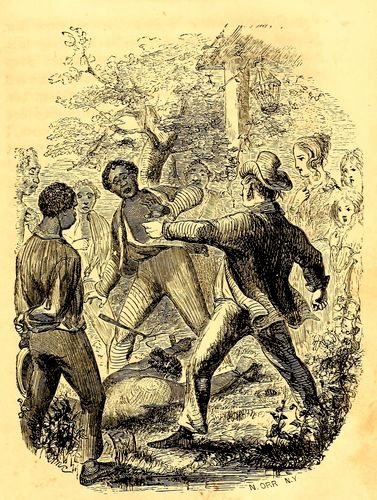
It was the Sabbath of the Lord. The fields smiled in the warm sunlight—the birds chirped merrily amidst the foliage of the trees—peace and happiness seemed to reign everywhere, save in the bosoms of Epps and his panting victim and the silent witnesses around him. The tempestuous emotions that were raging there were little in harmony with the calm and quiet beauty of the day. I could look on Epps only with unutterable loathing and abhorrence, and thought within myself—"Thou devil, sooner or later, somewhere in the course of eternal justice, thou shalt answer for this sin!"
It was the Lord’s Sabbath. The fields smiled in the warm sunlight, and birds chirped merrily among the leaves. Peace and happiness seemed to reign everywhere except in the hearts of Epps, his panting victim, and the silent witnesses around him. The turbulent emotions raging in their hearts were at odds with the calm, quiet beauty of the day. I could look at Epps only with unspeakable loathing and disgust. I thought to myself, “You devil, sooner or later, somewhere in the course of eternal justice, you will answer for this sin!”
Finally, he ceased whipping from mere exhaustion, and ordered Phebe to bring a bucket of salt and water. After washing her thoroughly with this, I was told to take her to her cabin. Untying the ropes, I raised her in my arms. She was unable to stand, and as her head rested on my shoulder, she repeated many times, in a faint voice scarcely perceptible, "Oh, Platt—oh, Platt!" but nothing further. Her dress was replaced, but it clung to her back, and was soon stiff with blood. We laid her on some boards in the hut, where she remained a long time, with eyes closed and groaning in agony. At night Phebe applied melted tallow to her wounds, and so far as we were able, all endeavored to assist and console her. Day after day she lay in her cabin upon her face, the sores preventing her resting in any other position.
Finally, he stopped whipping her because he was exhausted. He ordered Phebe to bring a bucket of salt and water. After she was thoroughly washed with it, I was told to take her to her cabin. I untied the ropes and lifted her in my arms. She could not stand. As her head rested on my shoulder, she repeated many times, in a voice barely audible, "Oh, Platt, oh, Platt!" She said nothing else. Her dress was put back on, but it clung to her back and soon became stiff with blood. We laid her on some boards in the hut. She remained there for a long time, her eyes closed, groaning in agony. That night, Phebe put melted tallow on her wounds. All of us did what we could to help and comfort her. Day after day, she lay face down in her cabin. The sores kept her from resting in any other position.
A blessed thing it would have been for her—days and weeks and months of misery it would have saved her—had she never lifted up her head in life again. Indeed, from that time forward she was not what she had been. The burden of a deep melancholy weighed heavily on her spirits. She no longer moved with that buoyant and elastic step—there was not that mirthful sparkle in her eyes that formerly distinguished her. The bounding vigor—the sprightly, laughter-loving spirit of her youth, were gone. She fell into a mournful and desponding mood, and oftentimes would start up in her sleep, and with raised hands, plead for mercy. She became more silent than she was, toiling all day in our midst, not uttering a word. A care-worn, pitiful expression settled on her face, and it was her humor now to weep, rather than rejoice. If ever there was a broken heart—one crushed and blighted by the rude grasp of suffering and misfortune—it was Patsey's.
It would have been a blessing for her never to lift her head again. It would have saved her days, weeks, and months of misery. From that time on, she was no longer the person she had been. A deep sadness weighed heavily on her. She no longer walked with the same spring in her step. The joyful sparkle that once distinguished her was gone from her eyes. The lively energy and laughter-loving spirit of her youth were gone. She grew sad and hopeless. Often, she would wake suddenly in her sleep, raise her hands, and beg for mercy. She grew quieter, working among us all day without saying a word. A weary, pitiful expression settled on her face. Now she was more inclined to weep than rejoice. If ever a heart was broken, crushed and blighted by the cruel grip of suffering and misfortune, it was Patsey's.
She had been reared no better than her master's beast—looked upon merely as a valuable and handsome animal—and consequently possessed but a limited amount of knowledge. And yet a faint light cast its rays over her intellect, so that it was not wholly dark. She had a dim perception of God and of eternity, and a still more dim perception of a Saviour who had died even for such as her. She entertained but confused notions of a future life—not comprehending the distinction between the corporeal and spiritual existence. Happiness, in her mind, was exemption from stripes—from labor—from the cruelty of masters and overseers. Her idea of the joy of heaven was simply rest, and is fully expressed in these lines of a melancholy bard:
She had been raised no better than her master's animal. She was viewed merely as a valuable and beautiful animal, and consequently knew very little. Yet a faint light shone over her mind, so that it was not completely dark. She had a dim understanding of God and eternity, and an even dimmer understanding of a Savior who had died even for someone like her. Her ideas about a future life were confused. She did not understand the difference between physical and spiritual existence. To her, happiness meant freedom from whipping, labor, and the cruelty of masters and overseers. Her idea of the joy of heaven was simply rest, and is fully expressed in these lines by a melancholy poet:
"I ask no paradise on high, With cares on earth oppressed, The only heaven for which I sigh, Is rest, eternal rest."
"I ask for no paradise above. Burdened by cares on earth, The only heaven I long for Is rest, eternal rest."
It is a mistaken opinion that prevails in some quarters, that the slave does not understand the term—does not comprehend the idea of freedom. Even on Bayou Bœuf, where I conceive slavery exists in its most abject and cruel form—where it exhibits features altogether unknown in more northern States—the most ignorant of them generally know full well its meaning. They understand the privileges and exemptions that belong to it—that it would bestow upon them the fruits of their own labors, and that it would secure to them the enjoyment of domestic happiness. They do not fail to observe the difference between their own condition and the meanest white man's, and to realize the injustice of the laws which place it in his power not only to appropriate the profits of their industry, but to subject them to unmerited and unprovoked punishment, without remedy, or the right to resist, or to remonstrate.
Some people mistakenly believe that a slave does not understand the word or the idea of freedom. Even on Bayou Bœuf, most slaves, however ignorant, know full well what freedom means. I believe slavery exists there in its most degraded and cruel form, with features unknown in more northern States. Slaves understand the rights and protections that come with freedom. They know it would give them the fruits of their own labor and secure their enjoyment of family happiness. They see the difference between their own condition and that of the lowest white man. They also recognize the injustice of the laws that give him power over them. Those laws allow him to take the profits of their labor and punish them without cause or provocation. Slaves have no remedy and no right to resist or protest.
Patsey's life, especially after her whipping, was one long dream of liberty. Far away, to her fancy an immeasurable distance, she knew there was a land of freedom. A thousand times she had heard that somewhere in the distant North there were no slaves—no masters. In her imagination it was an enchanted region, the Paradise of the earth. To dwell where the black man may work for himself—live in his own cabin—till his own soil, was a blissful dream of Patsey's—a dream, alas! the fulfillment of which she can never realize.
Patsey's life, especially after her whipping, was one long dream of liberty. She knew there was a land of freedom far away. To her, the distance seemed immeasurable. A thousand times she had heard that somewhere in the distant North there were no slaves and no masters. In her imagination, it was an enchanted region, a Paradise on earth. Patsey dreamed of living where a black man could work for himself, live in his own cabin, and farm his own land. It was a blissful dream, but alas, one she can never see come true.
The effect of these exhibitions of brutality on the household of the slave-holder, is apparent. Epps' oldest son is an intelligent lad of ten or twelve years of age. It is pitiable, sometimes, to see him chastising, for instance, the venerable Uncle Abram. He will call the old man to account, and if in his childish judgment it is necessary, sentence him to a certain number of lashes, which he proceeds to inflict with much gravity and deliberation. Mounted on his pony, he often rides into the field with his whip, playing the overseer, greatly to his father's delight. Without discrimination, at such times, he applies the rawhide, urging the slaves forward with shouts, and occasional expressions of profanity, while the old man laughs, and commends him as a thorough-going boy.
The effect of these displays of brutality on the slave-holder’s household is clear. Epps’ oldest son is an intelligent boy of ten or twelve. It is sometimes pitiful to see him punish the venerable Uncle Abram, for example. He calls the old man to account. If the boy judges that punishment is necessary, he sentences him to a certain number of lashes. He then delivers them with great seriousness and care. He often rides his pony into the field with his whip, playing the overseer, much to his father’s delight. At such times, he lashes the slaves indiscriminately with the rawhide whip. He urges them on with shouts and occasional curses, while the old man laughs and praises him as a thoroughgoing boy.
"The child is father to the man," and with such training, whatever may be his natural disposition, it cannot well be otherwise than that, on arriving at maturity, the sufferings and miseries of the slave will be looked upon with entire indifference. The influence of the iniquitous system necessarily fosters an unfeeling and cruel spirit, even in the bosoms of those who, among their equals, are regarded as humane and generous.
"The child is father to the man." With such training, whatever a child’s natural disposition, he will almost inevitably grow up entirely indifferent to the slave’s suffering and misery. The influence of this unjust system necessarily fosters a cruel and unfeeling spirit. It does so even in those regarded as humane and generous among their equals.
Young Master Epps possessed some noble qualities, yet no process of reasoning could lead him to comprehend, that in the eye of the Almighty there is no distinction of color. He looked upon the black man simply as an animal, differing in no respect from any other animal, save in the gift of speech and the possession of somewhat higher instincts, and, therefore, the more valuable. To work like his father's mules—to be whipped and kicked and scourged through life—to address the white man with hat in hand, and eyes bent servilely on the earth, in his mind, was the natural and proper destiny of the slave. Brought up with such ideas—in the notion that we stand without the pale of humanity—no wonder the oppressors of my people are a pitiless and unrelenting race.
Young Master Epps had some noble qualities, yet no reasoning could make him understand that, before the Almighty, color makes no difference. He saw the black man simply as an animal, no different from any other animal except for speech and somewhat higher instincts. Those gifts made him more valuable. In his mind, the slave’s natural and proper destiny was to work like his father’s mules and be whipped, kicked, and beaten throughout life. The slave was to address the white man with hat in hand and eyes lowered submissively to the ground. Having been raised with such ideas, with the belief that we stand outside humanity, it is no wonder the oppressors of my people are pitiless and unrelenting.