Chapter 8
FORD'S EMBARRASSMENTS—THE SALE TO TIBEATS—THE CHATTEL MORTGAGE—MISTRESS FORD'S PLANTATION ON BAYOU BŒUF—DESCRIPTION OF THE LATTER—FORD'S BROTHER-IN-LAW, PETER TANNER—MEETING WITH ELIZA—SHE STILL MOURNS FOR HER CHILDREN—FORD'S OVERSEER, CHAPIN—TIBEAT'S ABUSE—THE KEG OF NAILS—THE FIRST FIGHT WITH TIBEATS—HIS DISCOMFITURE AND CASTIGATION—THE ATTEMPT TO HANG ME—CHAPIN'S INTERFERENCE AND SPEECH—UNHAPPY REFLECTIONS—ABRUPT DEPARTURE OF TIBEATS, COOK AND RAMSAY—LAWSON AND THE BROWN MULE—MESSAGE TO THE PINE WOODS.
FORD'S FINANCIAL TROUBLES. THE SALE TO TIBEATS. THE CHATTEL MORTGAGE. MISTRESS FORD'S PLANTATION ON BAYOU BŒUF. A DESCRIPTION OF THE PLANTATION. FORD'S BROTHER-IN-LAW, PETER TANNER. MEETING WITH ELIZA. SHE STILL MOURNS FOR HER CHILDREN. FORD'S OVERSEER, CHAPIN. TIBEATS'S ABUSE. THE KEG OF NAILS. THE FIRST FIGHT WITH TIBEATS. HIS DEFEAT AND PUNISHMENT. THE ATTEMPT TO HANG ME. CHAPIN'S INTERVENTION AND SPEECH. UNHAPPY THOUGHTS. THE ABRUPT DEPARTURE OF TIBEATS, COOK AND RAMSAY. LAWSON AND THE BROWN MULE. A MESSAGE TO THE PINE WOODS.
William Ford unfortunately became embarrassed in his pecuniary affairs. A heavy judgment was rendered against him in consequence of his having become security for his brother, Franklin Ford, residing on Red River, above Alexandria, and who had failed to meet his liabilities. He was also indebted to John M. Tibeats to a considerable amount in consideration of his services in building the mills on Indian Creek, and also a weaving-house, corn-mill and other erections on the plantation at Bayou Bœuf, not yet completed. It was therefore necessary, in order to meet these demands, to dispose of eighteen slaves, myself among the number. Seventeen of them, including Sam and Harry, were purchased by Peter Compton, a planter also residing on Red River.
William Ford unfortunately ran into financial trouble. A large judgment was entered against him because he had guaranteed his brother Franklin Ford’s debts. Franklin lived on Red River, above Alexandria, and had failed to pay what he owed. William also owed John M. Tibeats a considerable amount for building the mills on Indian Creek. Tibeats had also built a weaving-house, a corn-mill, and other structures on the plantation at Bayou Bœuf. Those structures were not yet complete. To pay these debts, Ford had to sell eighteen slaves, including me. Peter Compton, a planter who also lived on Red River, bought seventeen of them, including Sam and Harry.
I was sold to Tibeats, in consequence, undoubtedly, of my slight skill as a carpenter. This was in the winter of 1842. The deed of myself from Freeman to Ford, as I ascertained from the public records in New-Orleans on my return, was dated June 23d, 1841. At the time of my sale to Tibeats, the price agreed to be given for me being more than the debt, Ford took a chattel mortgage of four hundred dollars. I am indebted for my life, as will hereafter be seen, to that mortgage.
I was sold to Tibeats, undoubtedly because of my limited skill as a carpenter. This was in the winter of 1842. On my return, I checked the public records in New-Orleans. I learned that the deed transferring me from Freeman to Ford was dated June 23, 1841. The price Tibeats agreed to pay for me was more than the debt. So Ford took a chattel mortgage for four hundred dollars at the time of the sale. As will be seen later, I owe my life to that mortgage.
I bade farewell to my good friends at the opening, and departed with my new master Tibeats. We went down to the plantation on Bayou Bœuf, distant twenty-seven miles from the Pine Woods, to complete the unfinished contract. Bayou Bœuf is a sluggish, winding stream—one of those stagnant bodies of water common in that region, setting back from Red River. It stretches from a point not far from Alexandria, in a south-easterly direction, and following its tortuous course, is more than fifty miles in length. Large cotton and sugar plantations line each shore, extending back to the borders of interminable swamps. It is alive with alligators, rendering it unsafe for swine, or unthinking slave children to stroll along its banks. Upon a bend in this bayou, a short distance from Cheneyville, was situated the plantation of Madam Ford—her brother, Peter Tanner, a great landholder, living on the opposite side.
I said goodbye to my good friends at the opening and left with my new master, Tibeats. We went to the plantation on Bayou Bœuf to complete the unfinished contract. It was twenty-seven miles from the Pine Woods. Bayou Bœuf is a slow, winding stream, one of the stagnant waterways common in that region that branch off from Red River. It begins not far from Alexandria and runs southeast. Following its winding course, it is more than fifty miles long. Large cotton and sugar plantations line both banks, stretching back to the edges of endless swamps. The bayou is full of alligators, making it unsafe for swine or unwary slave children to wander along its banks. Madam Ford’s plantation stood on a bend in the bayou, a short distance from Cheneyville. Her brother, Peter Tanner, a major landowner, lived on the opposite bank.
On my arrival at Bayou Bœuf, I had the pleasure of meeting Eliza, whom I had not seen for several months. She had not pleased Mrs. Ford, being more occupied in brooding over her sorrows than in attending to her business, and had, in consequence, been sent down to work in the field on the plantation. She had grown feeble and emaciated, and was still mourning for her children. She asked me if I had forgotten them, and a great many times inquired if I still remembered how handsome little Emily was—how much Randall loved her—and wondered if they were living still, and where the darlings could then be. She had sunk beneath the weight of an excessive grief. Her drooping form and hollow cheeks too plainly indicated that she had well nigh reached the end of her weary road.
When I arrived at Bayou Bœuf, I was glad to see Eliza, whom I had not seen for several months. She had not pleased Mrs. Ford because she spent more time dwelling on her sorrows than attending to her work. As a result, she had been sent to work in the plantation fields. She had grown weak and thin, and she was still mourning her children. She asked if I had forgotten them. Many times, she asked if I still remembered how beautiful little Emily was and how much Randall loved her. She wondered if they were still alive and where the darlings could be. She had been overwhelmed by grief. Her slumped figure and hollow cheeks showed all too clearly that she had nearly reached the end of her weary road.
Ford's overseer on this plantation, and who had the exclusive charge of it, was a Mr. Chapin, a kindly-disposed man, and a native of Pennsylvania. In common with others, he held Tibeats in light estimation, which fact, in connection with the four hundred dollar mortgage, was fortunate for me.
Ford's overseer on this plantation was a Mr. Chapin, who had complete charge of it. He was a kind man from Pennsylvania. Like others, he had a low opinion of Tibeats. This, together with the four hundred dollar mortgage, was fortunate for me.
I was now compelled to labor very hard. From earliest dawn until late at night, I was not allowed to be a moment idle. Notwithstanding which, Tibeats was never satisfied. He was continually cursing and complaining. He never spoke to me a kind word. I was his faithful slave, and earned him large wages every day, and yet I went to my cabin nightly, loaded with abuse and stinging epithets.
I was now forced to work very hard. From early dawn until late at night, I was not allowed a moment of rest. Even so, Tibeats was never satisfied. He was always cursing and complaining. He never said a kind word to me. I was his faithful slave and earned him large wages every day. Yet every night, I went back to my cabin burdened by his abuse and cruel insults.
We had completed the corn mill, the kitchen, and so forth, and were at work upon the weaving-house, when I was guilty of an act, in that State punishable with death. It was my first fight with Tibeats. The weaving-house we were erecting stood in the orchard a few rods from the residence of Chapin, or the "great house," as it was called. One night, having worked until it was too dark to see, I was ordered by Tibeats to rise very early in the morning, procure a keg of nails from Chapin, and commence putting on the clapboards. I retired to the cabin extremely tired, and having cooked a supper of bacon and corn cake, and conversed a while with Eliza, who occupied the same cabin, as also did Lawson and his wife Mary, and a slave named Bristol, laid down upon the ground floor, little dreaming of the sufferings that awaited me on the morrow. Before daylight I was on the piazza of the "great house," awaiting the appearance of overseer Chapin. To have aroused him from his slumbers and stated my errand, would have been an unpardonable boldness. At length he came out. Taking off my hat, I informed him Master Tibeats had directed me to call upon him for a keg of nails. Going into the store-room, he rolled it out, at the same time saying, if Tibeats preferred a different size, he would endeavor to furnish them, but that I might use those until further directed. Then mounting his horse, which stood saddled and bridled at the door, he rode away into the field, whither the slaves had preceded him, while I took the keg on my shoulder, and proceeding to the weaving-house, broke in the head, and commenced nailing on the clapboards.
We had completed the corn mill, the kitchen, and other buildings and were working on the weaving-house. There I committed an act punishable by death in that State. It was my first fight with Tibeats. The weaving-house stood in the orchard, a few rods from Chapin’s residence, or the "great house," as it was called. One night, we worked until it was too dark to see. Tibeats ordered me to rise very early the next morning, get a keg of nails from Chapin, and start putting up the clapboards. I returned to the cabin extremely tired. I cooked a supper of bacon and corn cake and talked for a while with Eliza. She shared the cabin with me, as did Lawson and his wife Mary, and a slave named Bristol. Then I lay down on the dirt floor, little dreaming of the suffering that awaited me the next day. Before daylight, I was on the porch of the "great house," waiting for overseer Chapin to appear. Waking him to tell him why I had come would have been an unforgivable act of boldness. At last he came out. I took off my hat and told him that Master Tibeats had sent me for a keg of nails. Chapin went into the storeroom and rolled one out. He said that if Tibeats preferred a different size, he would try to provide it. But I could use those nails until I was told otherwise. Then Chapin mounted his horse, which stood saddled and bridled at the door. He rode into the field, where the slaves had gone ahead of him. I put the keg on my shoulder and carried it to the weaving-house. There I broke open the top and began nailing on the clapboards.
As the day began to open, Tibeats came out of the house to where I was, hard at work. He seemed to be that morning even more morose and disagreeable than usual. He was my master, entitled by law to my flesh and blood, and to exercise over me such tyrannical control as his mean nature prompted; but there was no law that could prevent my looking upon him with intense contempt. I despised both his disposition and his intellect. I had just come round to the keg for a further supply of nails, as he reached the weaving-house.
At daybreak, Tibeats came out of the house to where I was working hard. He seemed even more gloomy and unpleasant than usual that morning. He was my master, legally entitled to my flesh and blood. The law allowed him to exercise whatever tyrannical control his mean nature prompted. But no law could stop me from looking on him with intense contempt. I despised both his character and his intellect. I had just returned to the keg for more nails when he reached the weaving-house.
"I thought I told you to commence putting on weather-boards this morning," he remarked.
"I thought I told you to start putting up siding this morning," he said.
"Yes, master, and I am about it," I replied.
"Yes, master, and I'm working on it," I replied.
"Where?" he demanded.
"Where?" he demanded.
"On the other side," was my answer.
"On the other side," I answered.
He walked round to the other side, examined my work for a while, muttering to himself in a fault-finding tone.
He walked around to the other side and examined my work for a while, muttering complaints to himself.
"Didn't I tell you last night to get a keg of nails of Chapin?" he broke forth again.
"Didn't I tell you last night to get a keg of nails from Chapin?" he burst out again.
"Yes, master, and so I did; and overseer said he would get another size for you, if you wanted them, when he came back from the field."
"Yes, master, I did. The overseer said he would get another size for you if you wanted them, when he came back from the field."
Tibeats walked to the keg, looked a moment at the contents, then kicked it violently. Coming towards me in a great passion, he exclaimed,
Tibeats walked to the keg, looked at its contents for a moment, then kicked it violently. He came toward me in a rage and exclaimed,
"G—d d—n you! I thought you knowed something."
"G-d d-n you! I thought you knowed something."
I made answer: "I tried to do as you told me, master. I didn't mean anything wrong. Overseer said—" But he interrupted me with such a flood of curses that I was unable to finish the sentence. At length he ran towards the house, and going to the piazza, took down one of the overseer's whips. The whip had a short wooden stock, braided over with leather, and was loaded at the butt. The lash was three feet long, or thereabouts, and made of raw-hide strands.
I answered: "I tried to do as you told me, master. I didn't mean anything wrong. Overseer said..." But he interrupted me with so many curses that I couldn't finish my sentence. Finally, he ran to the house and went onto the porch. There he took down one of the overseer's whips. The whip had a short wooden handle covered in braided leather, with a weight in the end. The lash was about three feet long and made of rawhide strands.
At first I was somewhat frightened, and my impulse was to run. There was no one about except Rachel, the cook, and Chapin's wife, and neither of them were to be seen. The rest were in the field. I knew he intended to whip me, and it was the first time any one had attempted it since my arrival at Avoyelles. I felt, moreover, that I had been faithful—that I was guilty of no wrong whatever, and deserved commendation rather than punishment. My fear changed to anger, and before he reached me I had made up my mind fully not to be whipped, let the result be life or death.
At first I was somewhat frightened, and my instinct was to run. No one else was around except Rachel, the cook, and Chapin's wife, and neither of them was in sight. The rest were in the field. I knew he intended to whip me. No one had tried to whip me before since I arrived at Avoyelles. I also felt that I had been faithful. I had done nothing wrong and deserved praise rather than punishment. My fear turned to anger. Before he reached me, I had made up my mind not to be whipped, whether I lived or died.
Winding the lash around his hand, and taking hold of the small end of the stock, he walked up to me, and with a malignant look, ordered me to strip.
He wrapped the lash around his hand and grabbed the narrow end of the handle. Then he walked up to me and, with a malicious look, ordered me to strip.
"Master Tibeats" said I, looking him boldly in the face, "I will not." I was about to say something further in justification, but with concentrated vengeance, he sprang upon me, seizing me by the throat with one hand, raising the whip with the other, in the act of striking. Before the blow descended, however, I had caught him by the collar of the coat, and drawn him closely to me. Reaching down, I seized him by the ankle, and pushing him back with the other hand, he fell over on the ground. Putting one arm around his leg, and holding it to my breast, so that his head and shoulders only touched the ground, I placed my foot upon his neck. He was completely in my power. My blood was up. It seemed to course through my veins like fire. In the frenzy of my madness I snatched the whip from his hand. He struggled with all his power; swore that I should not live to see another day; and that he would tear out my heart. But his struggles and his threats were alike in vain. I cannot tell how many times I struck him. Blow after blow fell fast and heavy upon his wriggling form. At length he screamed—cried murder—and at last the blasphemous tyrant called on God for mercy. But he who had never shown mercy did not receive it. The stiff stock of the whip warped round his cringing body until my right arm ached.
"Master Tibeats," I said, looking him boldly in the face, "I will not." I was about to explain myself further, but he sprang at me with focused rage. He grabbed me by the throat with one hand and raised the whip to strike with the other. Before the blow fell, I caught him by the coat collar and pulled him close. I reached down and grabbed his ankle, then pushed him back with my other hand. He fell to the ground. I wrapped one arm around his leg and held it against my chest. Only his head and shoulders touched the ground. I placed my foot on his neck. He was completely in my power. My blood was up. It seemed to race through my veins like fire. In my frenzy, I snatched the whip from his hand. He struggled with all his strength. He swore that I would not live to see another day and that he would tear out my heart. But his struggles and threats were equally useless. I cannot say how many times I struck him. Blow after blow fell quickly and heavily on his writhing body. Finally he screamed and cried murder. At last, the blasphemous tyrant called on God for mercy. But he who had never shown mercy received none. The stiff stock of the whip bent around his cowering body until my right arm ached.
Until this time I had been too busy to look about me. Desisting for a moment, I saw Mrs. Chapin looking from the window, and Rachel standing in the kitchen door. Their attitudes expressed the utmost excitement and alarm. His screams had been heard in the field. Chapin was coming as fast as he could ride. I struck him a blow or two more, then pushed him from me with such a well-directed kick that he went rolling over on the ground.
Until then, I had been too busy to look around. I stopped for a moment and saw Mrs. Chapin looking out the window and Rachel standing in the kitchen doorway. Both looked extremely excited and alarmed. His screams had been heard in the field. Chapin was riding toward us as fast as he could. I struck him once or twice more, then kicked him so squarely that he rolled over on the ground.
Rising to his feet, and brushing the dirt from his hair, he stood looking at me, pale with rage. We gazed at each other in silence. Not a word was uttered until Chapin galloped up to us.
He got to his feet and brushed the dirt from his hair. He stood looking at me, pale with rage. We stared at each other in silence. Neither of us spoke until Chapin galloped up to us.
"What is the matter?" he cried out.
"What's wrong?" he cried out.
"Master Tibeats wants to whip me for using the nails you gave me," I replied.
"Master Tibeats wants to whip me for using the nails you gave me," I replied.
"What is the matter with the nails?" he inquired, turning to Tibeats.
"What is wrong with the nails?" he asked, turning to Tibeats.
Tibeats answered to the effect that they were too large, paying little heed, however, to Chapin's question, but still keeping his snakish eyes fastened maliciously on me.
Tibeats answered that they were too large, but he paid little attention to Chapin's question. He kept his snakelike eyes fixed maliciously on me.
"I am overseer here," Chapin began. "I told Platt to take them and use them, and if they were not of the proper size I would get others on returning from the field. It is not his fault. Besides, I shall furnish such nails as I please. I hope you will understand that, Mr. Tibeats."
"I am the overseer here," Chapin began. "I told Platt to take the nails and use them. If they were not the right size, I would get others when I returned from the field. It is not his fault. Besides, I will provide whatever nails I please. I hope you understand that, Mr. Tibeats."
Tibeats made no reply, but, grinding his teeth and shaking his fist, swore he would have satisfaction, and that it was not half over yet. Thereupon he walked away, followed by the overseer, and entered the house, the latter talking to him all the while in a suppressed tone, and with earnest gestures.
Tibeats said nothing, but ground his teeth and shook his fist. He swore he would get satisfaction and that it was not half over yet. Then he walked away and entered the house, followed by the overseer. All the while, the overseer spoke to him in a low voice and gestured earnestly.
I remained where I was, doubting whether it was better to fly or abide the result, whatever it might be. Presently Tibeats came out of the house, and, saddling his horse, the only property he possessed besides myself, departed on the road to Cheneyville.
I stayed where I was, unsure whether to run away or stay and face whatever happened. Soon Tibeats came out of the house and saddled his horse. The horse was the only property he owned besides me. He rode off on the road to Cheneyville.
When he was gone, Chapin came out, visibly excited, telling me not to stir, not to attempt to leave the plantation on any account whatever. He then went to the kitchen, and calling Rachel out, conversed with her some time. Coming back, he again charged me with great earnestness not to run, saying my master was a rascal; that he had left on no good errand, and that there might be trouble before night. But at all events, he insisted upon it, I must not stir.
When he was gone, Chapin came out, visibly upset. He told me not to move or try to leave the plantation under any circumstances. He then went to the kitchen, called Rachel out, and talked with her for some time. When he came back, he again urged me, very earnestly, not to run. He said my master was a rascal and had left on no good errand. There might be trouble before night. But whatever happened, he insisted that I must not move.
As I stood there, feelings of unutterable agony overwhelmed me. I was conscious that I had subjected myself to unimaginable punishment. The reaction that followed my extreme ebullition of anger produced the most painful sensations of regret. An unfriended, helpless slave—what could I do, what could I say, to justify, in the remotest manner, the heinous act I had committed, of resenting a white man's contumely and abuse. I tried to pray—I tried to beseech my Heavenly Father to sustain me in my sore extremity, but emotion choked my utterance, and I could only bow my head upon my hands and weep. For at least an hour I remained in this situation, finding relief only in tears, when, looking up, I beheld Tibeats, accompanied by two horsemen, coming down the bayou. They rode into the yard, jumped from their horses, and approached me with large whips, one of them also carrying a coil of rope.
As I stood there, I was overwhelmed by unspeakable agony. I knew I had exposed myself to unimaginable punishment. After my violent outburst of anger, I felt a painful sense of regret. I was a helpless slave without a friend. What could I do, what could I say, to justify even in the slightest the terrible act I had committed? I had resented a white man’s insults and abuse. I tried to pray. I tried to beg my Heavenly Father to sustain me in my desperate situation. But emotion choked my words, and I could only bow my head on my hands and weep. I remained like this for at least an hour, finding relief only in tears. Then I looked up and saw Tibeats coming down the bayou with two horsemen. They rode into the yard, jumped from their horses, and approached me with large whips. One of them also carried a coil of rope.
"Cross your hands," commanded Tibeats, with the addition of such a shuddering expression of blasphemy as is not decorous to repeat.
"Cross your hands," Tibeats ordered, adding a curse so shocking that it would be improper to repeat it.
"You need not bind me, Master Tibeats, I am ready to go with you anywhere," said I.
"You don't need to tie me up, Master Tibeats. I'm ready to go anywhere with you," I said.
One of his companions then stepped forward, swearing if I made the least resistance he would break my head—he would tear me limb from limb—he would cut my black throat—and giving wide scope to other similar expressions. Perceiving any importunity altogether vain, I crossed my hands, submitting humbly to whatever disposition they might please to make of me. Thereupon Tibeats tied my wrists, drawing the rope around them with his utmost strength. Then he bound my ankles in the same manner. In the meantime the other two had slipped a cord within my elbows, running it across my back, and tying it firmly. It was utterly impossible to move hand or foot. With a remaining piece of rope Tibeats made an awkward noose, and placed it about my neck.
One of his companions then stepped forward. He swore that if I offered the slightest resistance, he would break my head. He would tear me limb from limb and cut my black throat. He went on with many other threats like these. Seeing that any plea would be useless, I crossed my hands and humbly submitted to whatever they chose to do with me. Tibeats then tied my wrists, pulling the rope around them as tightly as he could. He tied my ankles the same way. Meanwhile, the other two had slipped a cord inside my elbows, drawn it across my back, and tied it tightly. I could not move a hand or foot. With the rope that remained, Tibeats made a clumsy noose and put it around my neck.
"Now, then," inquired one of Tibeats' companions, "where shall we hang the nigger?"
"Now then," asked one of Tibeats' companions, "where should we hang the nigger?"
One proposed such a limb, extending from the body of a peach tree, near the spot where we were standing. His comrade objected to it, alleging it would break, and proposed another. Finally they fixed upon the latter.
One suggested a branch of a peach tree near where we were standing. His companion objected, saying it would break, and suggested another branch. Finally, they chose the second one.
During this conversation, and all the time they were binding me, I uttered not a word. Overseer Chapin, during the progress of the scene, was walking hastily back and forth on the piazza. Rachel was crying by the kitchen door, and Mrs. Chapin was still looking from the window. Hope died within my heart. Surely my time had come. I should never behold the light of another day—never behold the faces of my children—the sweet anticipation I had cherished with such fondness. I should that hour struggle through the fearful agonies of death! None would mourn for me—none revenge me. Soon my form would be mouldering in that distant soil, or, perhaps, be cast to the slimy reptiles that filled the stagnant waters of the bayou! Tears flowed down my cheeks, but they only afforded a subject of insulting comment for my executioners.
During this conversation, and the whole time they were tying me up, I said nothing. As the scene unfolded, Overseer Chapin walked quickly back and forth on the porch. Rachel was crying by the kitchen door, and Mrs. Chapin was still looking out the window. Hope died in my heart. Surely my time had come. I would never see the light of another day. I would never see my children’s faces again, as I had so fondly hoped. Within the hour, I would struggle through the terrible agony of death! No one would mourn me. No one would avenge me. Soon my body would be rotting in that distant soil. Or perhaps it would be thrown to the slimy reptiles that filled the stagnant waters of the bayou! Tears ran down my cheeks, but they only gave my executioners something to insult me about.
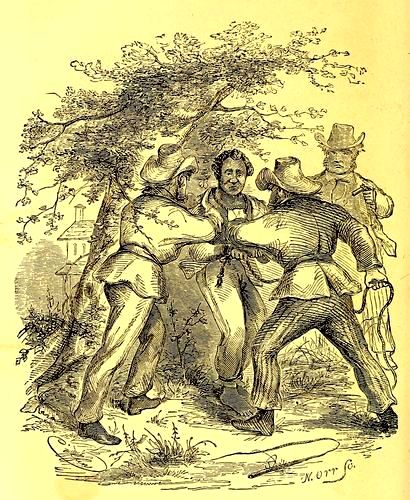
At length, as they were dragging me towards the tree, Chapin, who had momentarily disappeared from the piazza, came out of the house and walked towards us. He had a pistol in each hand, and as near as I can now recall to mind, spoke in a firm, determined manner, as follows:
At last, as they were dragging me toward the tree, Chapin came out of the house and walked toward us. He had briefly disappeared from the porch. He held a pistol in each hand and, as best I can recall, spoke firmly and with determination:
"Gentlemen, I have a few words to say. You had better listen to them. Whoever moves that slave another foot from where he stands is a dead man. In the first place, he does not deserve this treatment. It is a shame to murder him in this manner. I never knew a more faithful boy than Platt. You, Tibeats, are in the fault yourself. You are pretty much of a scoundrel, and I know it, and you richly deserve the flogging you have received. In the next place, I have been overseer on this plantation seven years, and, in the absence of William Ford, am master here. My duty is to protect his interests, and that duty I shall perform. You are not responsible—you are a worthless fellow. Ford holds a mortgage on Platt of four hundred dollars. If you hang him he loses his debt. Until that is canceled you have no right to take his life. You have no right to take it any way. There is a law for the slave as well as for the white man. You are no better than a murderer.
“Gentlemen, I have a few words to say, and you had better listen. Whoever moves that slave another foot from where he stands is a dead man. First, he does not deserve this treatment. It is shameful to murder him this way. I have never known a more faithful boy than Platt. You, Tibeats, are at fault yourself. You are quite a scoundrel, and I know it. You fully deserve the flogging you received. Second, I have been overseer on this plantation for seven years. In William Ford’s absence, I am the master here. My duty is to protect his interests, and I will do it. You cannot be trusted to pay your debts, Tibeats. You are a worthless fellow. Ford holds a four-hundred-dollar mortgage on Platt. If you hang him, Ford loses the money you owe him. Until that debt is paid, you have no right to take his life. You have no right to take it anyway. There is a law for the slave as well as for the white man. You are no better than a murderer.
"As for you," addressing Cook and Ramsay, a couple of overseers from neighboring plantations, "as for you—begone! If you have any regard for your own safety, I say, begone."
"As for you," he said to Cook and Ramsay, two overseers from neighboring plantations, "as for you, get out! If you care about your own safety, I say, get out."
Cook and Ramsay, without a further word, mounted their horses and rode away. Tibeats, in a few minutes, evidently in fear, and overawed by the decided tone of Chapin, sneaked off like a coward, as he was, and mounting his horse, followed his companions.
Cook and Ramsay mounted their horses and rode away without another word. A few minutes later, Tibeats sneaked off like the coward he was. He was clearly afraid and intimidated by Chapin's firm tone. He mounted his horse and followed his companions.
I remained standing where I was, still bound, with the rope around my neck. As soon as they were gone, Chapin called Rachel, ordering her to run to the field, and tell Lawson to hurry to the house without delay, and bring the brown mule with him, an animal much prized for its unusual fleetness. Presently the boy appeared.
I stayed where I was, still tied up, with the rope around my neck. As soon as they left, Chapin called Rachel. He told her to run to the field and tell Lawson to hurry to the house and bring the brown mule. The mule was prized for its unusual speed. Soon the boy appeared.
"Lawson," said Chapin, "you must go to the Pine Woods. Tell your master Ford to come here at once—that he must not delay a single moment. Tell him they are trying to murder Platt. Now hurry, boy. Be at the Pine Woods by noon if you kill the mule."
"Lawson," said Chapin, "you must go to the Pine Woods. Tell your master Ford to come here right away. He must not waste a moment. Tell him they are trying to murder Platt. Now hurry, boy. Get to the Pine Woods by noon, even if you kill the mule."
Chapin stepped into the house and wrote a pass. When he returned, Lawson was at the door, mounted on his mule. Receiving the pass, he plied the whip right smartly to the beast, dashed out of the yard, and turning up the bayou on a hard gallop, in less time than it has taken me to describe the scene, was out of sight.
Chapin went into the house and wrote a pass. When he returned, Lawson was at the door, sitting on his mule. Lawson took the pass, whipped the mule hard, and raced out of the yard. He turned up the bayou at a hard gallop. He was out of sight in less time than it has taken me to describe the scene.