Chapter 6
FREEMAN'S INDUSTRY—CLEANLINESS AND CLOTHES—EXERCISING IN THE SHOW ROOM—THE DANCE—BOB, THE FIDDLER—ARRIVAL OF CUSTOMERS—SLAVES EXAMINED—THE OLD GENTLEMAN OF NEW-ORLEANS—SALE OF DAVID, CAROLINE AND LETHE—PARTING OF RANDALL AND ELIZA—SMALL POX—THE HOSPITAL—RECOVERY AND RETURN TO FREEMAN'S SLAVE PEN—THE PURCHASER OF ELIZA, HARRY AND PLATT—ELIZA'S AGONY ON PARTING FROM LITTLE EMILY.
FREEMAN'S HARD WORK. CLEANLINESS AND CLOTHES. EXERCISE IN THE SHOWROOM. THE DANCE. BOB, THE FIDDLER. CUSTOMERS ARRIVE. SLAVES ARE EXAMINED. THE OLD GENTLEMAN FROM NEW-ORLEANS. DAVID, CAROLINE AND LETHE ARE SOLD. RANDALL AND ELIZA ARE SEPARATED. SMALLPOX. THE HOSPITAL. RECOVERY AND RETURN TO FREEMAN'S SLAVE PEN. THE BUYER OF ELIZA, HARRY AND PLATT. ELIZA'S AGONY AT PARTING FROM LITTLE EMILY.
The very amiable, pious-hearted Mr. Theophilus Freeman, partner or consignee of James H. Burch, and keeper of the slave pen in New-Orleans, was out among his animals early in the morning. With an occasional kick of the older men and women, and many a sharp crack of the whip about the ears of the younger slaves, it was not long before they were all astir, and wide awake. Mr. Theophilus Freeman bustled about in a very industrious manner, getting his property ready for the sales-room, intending, no doubt, to do that day a rousing business.
The very kind, pious Mr. Theophilus Freeman was out among his animals early in the morning. He was James H. Burch’s partner or consignee and kept the slave pen in New Orleans. He occasionally kicked the older men and women and often cracked his whip sharply near the younger slaves’ ears. Before long, they were all up and wide awake. Mr. Theophilus Freeman bustled about, working hard to get his property ready for the salesroom. No doubt he intended to do a booming business that day.
In the first place we were required to wash thoroughly, and those with beards, to shave. We were then furnished with a new suit each, cheap, but clean. The men had hat, coat, shirt, pants and shoes; the women frocks of calico, and handkerchiefs to bind about their heads. We were now conducted into a large room in the front part of the building to which the yard was attached, in order to be properly trained, before the admission of customers. The men were arranged on one side of the room, the women on the other. The tallest was placed at the head of the row, then the next tallest, and so on in the order of their respective heights. Emily was at the foot of the line of women. Freeman charged us to remember our places; exhorted us to appear smart and lively,—sometimes threatening, and again, holding out various inducements. During the day he exercised us in the art of "looking smart," and of moving to our places with exact precision.
First, we were required to wash thoroughly, and those with beards had to shave. We were then each given a new outfit, cheap but clean. The men received hats, coats, shirts, pants, and shoes. The women received calico dresses and handkerchiefs to tie around their heads. We were then led into a large room at the front of the building attached to the yard. There we were to be trained before the customers were admitted. The men were lined up on one side of the room and the women on the other. The tallest stood at the head of each line, followed by the next tallest, and so on. Emily was at the end of the women's line. Freeman told us to remember our places and urged us to appear smart and lively. Sometimes he threatened us, and at other times he offered us various incentives. During the day, he drilled us in the art of "looking smart" and moving precisely into our places.
After being fed, in the afternoon, we were again paraded and made to dance. Bob, a colored boy, who had some time belonged to Freeman, played on the violin. Standing near him, I made bold to inquire if he could play the "Virginia Reel." He answered he could not, and asked me if I could play. Replying in the affirmative, he handed me the violin. I struck up a tune, and finished it. Freeman ordered me to continue playing, and seemed well pleased, telling Bob that I far excelled him—a remark that seemed to grieve my musical companion very much.
After we were fed that afternoon, we were once again put on display and made to dance. Bob, a colored boy who had belonged to Freeman for some time, played the violin. Standing near him, I dared to ask if he could play the "Virginia Reel." He said he could not and asked if I could play. When I said yes, he handed me the violin. I played a tune all the way through. Freeman ordered me to keep playing and seemed very pleased. He told Bob that I played much better than he did. This remark seemed to upset my fellow musician very much.
Next day many customers called to examine Freeman's "new lot." The latter gentleman was very loquacious, dwelling at much length upon our several good points and qualities. He would make us hold up our heads, walk briskly back and forth, while customers would feel of our hands and arms and bodies, turn us about, ask us what we could do, make us open our mouths and show our teeth, precisely as a jockey examines a horse which he is about to barter for or purchase. Sometimes a man or woman was taken back to the small house in the yard, stripped, and inspected more minutely. Scars upon a slave's back were considered evidence of a rebellious or unruly spirit, and hurt his sale.
The next day, many customers came to examine Freeman's "new lot." Freeman was very talkative and spoke at length about each of our good points and qualities. He made us hold up our heads and walk briskly back and forth. Customers felt our hands, arms, and bodies, turned us around, and asked what we could do. They made us open our mouths and show our teeth, just as a jockey examines a horse before trading for or buying it. Sometimes a man or woman was taken to the small house in the yard, stripped, and examined more closely. Scars on a slave's back were considered evidence of a rebellious or unruly spirit and made the slave harder to sell.
One old gentleman, who said he wanted a coachman, appeared to take a fancy to me. From his conversation with Burch, I learned he was a resident in the city. I very much desired that he would buy me, because I conceived it would not be difficult to make my escape from New-Orleans on some northern vessel. Freeman asked him fifteen hundred dollars for me. The old gentleman insisted it was too much, as times were very hard. Freeman, however, declared that I was sound and healthy, of a good constitution, and intelligent. He made it a point to enlarge upon my musical attainments. The old gentleman argued quite adroitly that there was nothing extraordinary about the nigger, and finally, to my regret, went out, saying he would call again. During the day, however, a number of sales were made. David and Caroline were purchased together by a Natchez planter. They left us, grinning broadly, and in the most happy state of mind, caused by the fact of their not being separated. Lethe was sold to a planter of Baton Rouge, her eyes flashing with anger as she was led away.
One old gentleman said he wanted a coachman and seemed to take a liking to me. From his conversation with Burch, I learned that he lived in the city. I very much wanted him to buy me. I thought it would not be difficult to escape from New-Orleans on a northern vessel. Freeman asked him fifteen hundred dollars for me. The old gentleman insisted that was too much, since times were very hard. But Freeman declared that I was sound and healthy, strong, and intelligent. He made a point of praising my musical skills at length. The old gentleman argued quite cleverly that there was nothing extraordinary about the nigger. Finally, to my regret, he left, saying he would come back. During the day, however, a number of sales were made. A Natchez planter bought David and Caroline together. They left us grinning broadly, overjoyed that they were not being separated. Lethe was sold to a planter from Baton Rouge. Her eyes flashed with anger as she was led away.
The same man also purchased Randall. The little fellow was made to jump, and run across the floor, and perform many other feats, exhibiting his activity and condition. All the time the trade was going on, Eliza was crying aloud, and wringing her hands. She besought the man not to buy him, unless he also bought herself and Emily. She promised, in that case, to be the most faithful slave that ever lived. The man answered that he could not afford it, and then Eliza burst into a paroxysm of grief, weeping plaintively. Freeman turned round to her, savagely, with his whip in his uplifted hand, ordering her to stop her noise, or he would flog her. He would not have such work—such snivelling; and unless she ceased that minute, he would take her to the yard and give her a hundred lashes. Yes, he would take the nonsense out of her pretty quick—if he didn't, might he be d—d. Eliza shrunk before him, and tried to wipe away her tears, but it was all in vain. She wanted to be with her children, she said, the little time she had to live. All the frowns and threats of Freeman, could not wholly silence the afflicted mother. She kept on begging and beseeching them, most piteously, not to separate the three. Over and over again she told them how she loved her boy. A great many times she repeated her former promises—how very faithful and obedient she would be; how hard she would labor day and night, to the last moment of her life, if he would only buy them all together. But it was of no avail; the man could not afford it. The bargain was agreed upon, and Randall must go alone. Then Eliza ran to him; embraced him passionately; kissed him again and again; told him to remember her—all the while her tears falling in the boy's face like rain.
The same man also bought Randall. The little boy was made to jump, run across the floor, and perform many other feats. These showed how active and healthy he was. Throughout the sale, Eliza cried aloud and wrung her hands. She begged the man not to buy Randall unless he bought her and Emily too. She promised that, if he did, she would be the most faithful slave who ever lived. The man answered that he could not afford to buy them all. Eliza then burst into a fit of grief, weeping pitifully. Freeman turned on her savagely, his whip raised in his hand. He ordered her to stop making noise or he would whip her. He would not tolerate such behavior, such sniveling. Unless she stopped that minute, he would take her to the yard and give her a hundred lashes. Yes, he would put a stop to her nonsense pretty quickly. If he did not, he could be d—d. Eliza shrank before him and tried to wipe away her tears, but she could not. She said she wanted to be with her children for the little time she had left to live. All of Freeman's frowns and threats could not completely silence the grieving mother. She kept begging and pleading with them, most pitifully, not to separate the three of them. Again and again, she told them how much she loved her boy. She repeated her promises many times. She would be very faithful and obedient. She would work hard day and night, until the last moment of her life, if he would buy them all together. But it was no use. The man could not afford to buy them all. The deal was made, and Randall had to go alone. Then Eliza ran to him and held him close. She kissed him again and again and told him to remember her. All the while, her tears fell on the boy's face like rain.
Freeman damned her, calling her a blubbering, bawling wench, and ordered her to go to her place, and behave herself, and be somebody. He swore he wouldn't stand such stuff but a little longer. He would soon give her something to cry about, if she was not mighty careful, and that she might depend upon.
Freeman cursed her, calling her a sobbing, bawling woman. He ordered her to go to her place, behave herself, and make something of herself. He swore he would not put up with such behavior much longer. If she was not very careful, he would soon give her something to cry about. She could depend on that.
The planter from Baton Rouge, with his new purchases, was ready to depart.
The planter from Baton Rouge was ready to leave with his new purchases.
"Don't cry, mama. I will be a good boy. Don't cry," said Randall, looking back, as they passed out of the door.
"Don't cry, mama. I will be a good boy. Don't cry," Randall said, looking back as they went out the door.
What has become of the lad, God knows. It was a mournful scene indeed. I would have cried myself if I had dared.
God knows what became of the boy. It was a truly sad scene. I would have cried myself if I had dared.
That night, nearly all who came in on the brig Orleans, were taken ill. They complained of violent pain in the head and back. Little Emily—a thing unusual with her—cried constantly. In the morning a physician was called in, but was unable to determine the nature of our complaint. While examining me, and asking questions touching my symptoms, I gave it as my opinion that it was an attack of small-pox—mentioning the fact of Robert's death as the reason of my belief. It might be so indeed, he thought, and he would send for the head physician of the hospital. Shortly, the head physician came—a small, light-haired man, whom they called Dr. Carr. He pronounced it small-pox, whereupon there was much alarm throughout the yard. Soon after Dr. Carr left, Eliza, Emmy, Harry and myself were put into a hack and driven to the hospital—a large white marble building, standing on the outskirts of the city. Harry and I were placed in a room in one of the upper stories. I became very sick. For three days I was entirely blind. While lying in this state one day, Bob came in, saying to Dr. Carr that Freeman had sent him over to inquire how we were getting on. Tell him, said the doctor, that Platt is very bad, but that if he survives until nine o'clock, he may recover.
That night, nearly everyone who had come on the brig Orleans fell ill. They complained of severe pain in their heads and backs. Little Emily cried constantly, which was unusual for her. In the morning, a physician was called, but he could not determine what was wrong with us. As he examined me and asked about my symptoms, I told him I thought it was smallpox. I explained that I believed this because Robert had died. He thought it might be smallpox and said he would send for the hospital's head physician. Soon the head physician arrived. He was a small, light-haired man whom they called Dr. Carr. He said it was smallpox, and there was great alarm throughout the yard. Soon after Dr. Carr left, Eliza, Emmy, Harry, and I were put into a carriage and driven to the hospital. It was a large white marble building on the outskirts of the city. Harry and I were placed in a room on one of the upper floors. I became very sick. For three days I was completely blind. One day, while I lay there blind, Bob came in. He told Dr. Carr that Freeman had sent him to ask how we were getting on. The doctor told him to say that Platt was very ill, but that if he survived until nine o'clock, he might recover.
I expected to die. Though there was little in the prospect before me worth living for, the near approach of death appalled me. I thought I could have been resigned to yield up my life in the bosom of my family, but to expire in the midst of strangers, under such circumstances, was a bitter reflection.
I expected to die. Though I had little to live for, the nearness of death terrified me. I thought I could have accepted dying surrounded by my family. But the thought of dying among strangers, under such circumstances, was bitter.
There were a great number in the hospital, of both sexes, and of all ages. In the rear of the building coffins were manufactured. When one died, the bell tolled—a signal to the undertaker to come and bear away the body to the potter's field. Many times, each day and night, the tolling bell sent forth its melancholy voice, announcing another death. But my time had not yet come. The crisis having passed, I began to revive, and at the end of two weeks and two days, returned with Harry to the pen, bearing upon my face the effects of the malady, which to this day continues to disfigure it. Eliza and Emily were also brought back next day in a hack, and again were we paraded in the sales-room, for the inspection and examination of purchasers. I still indulged the hope that the old gentleman in search of a coachman would call again, as he had promised, and purchase me. In that event I felt an abiding confidence that I would soon regain my liberty. Customer after customer entered, but the old gentleman never made his appearance.
There were many people in the hospital, of both sexes and all ages. Coffins were made at the back of the building. When someone died, the bell tolled, signaling the undertaker to come and carry the body to the potter's field. Many times each day and night, the bell's mournful toll announced another death. But my time had not yet come. After the crisis passed, I began to recover. After two weeks and two days, I returned with Harry to the pen. The illness had left marks on my face that disfigure it to this day. Eliza and Emily were also brought back the next day in a hired carriage. Once again, we were paraded in the salesroom for buyers to inspect and examine. I still hoped that the old gentleman looking for a coachman would return, as he had promised, and buy me. If he did, I felt sure I would soon regain my liberty. Customer after customer came in, but the old gentleman never appeared.
At length, one day, while we were in the yard, Freeman came out and ordered us to our places, in the great room. A gentleman was waiting for us as we entered, and inasmuch as he will be often mentioned in the progress of this narrative, a description of his personal appearance, and my estimation of his character, at first sight, may not be out of place.
Finally, one day, while we were in the yard, Freeman came out and ordered us to our places in the large room. A gentleman was waiting for us when we entered. He will be mentioned often in this narrative, so it may be worth describing his appearance and my first impression of his character.
He was a man above the ordinary height, somewhat bent and stooping forward. He was a good-looking man, and appeared to have reached about the middle age of life. There was nothing repulsive in his presence; but on the other hand, there was something cheerful and attractive in his face, and in his tone of voice. The finer elements were all kindly mingled in his breast, as any one could see. He moved about among us, asking many questions, as to what we could do, and what labor we had been accustomed to; if we thought we would like to live with him, and would be good boys if he would buy us, and other interrogatories of like character.
He was taller than average, slightly bent, and stooped forward. He was good-looking and appeared to be about middle-aged. There was nothing unpleasant about his presence. On the contrary, his face and voice were cheerful and attractive. Anyone could see that all the finer qualities were kindly blended in his heart. He moved among us, asking many questions about what we could do and what work we were used to. He asked whether we thought we would like living with him. He also asked whether we would be good boys if he bought us, and other questions of that kind.
After some further inspection, and conversation touching prices, he finally offered Freeman one thousand dollars for me, nine hundred for Harry, and seven hundred for Eliza. Whether the small-pox had depreciated our value, or from what cause Freeman had concluded to fall five hundred dollars from the price I was before held at, I cannot say. At any rate, after a little shrewd reflection, he announced his acceptance of the offer.
After inspecting us further and discussing prices, he finally offered Freeman $1,000 for me, $900 for Harry, and $700 for Eliza. I cannot say whether smallpox had lowered our value. Nor can I say why else Freeman had decided to lower my previous price by $500. In any case, after some shrewd thought, he announced that he accepted the offer.
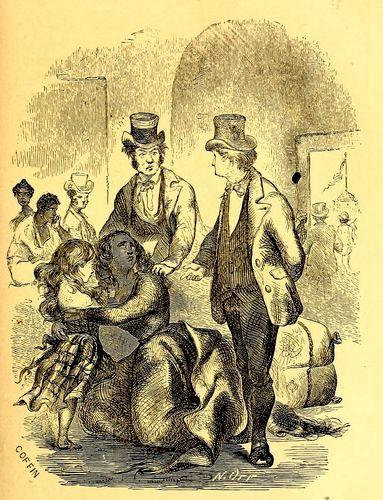
As soon as Eliza heard it, she was in an agony again. By this time she had become haggard and hollow-eyed with sickness and with sorrow. It would be a relief if I could consistently pass over in silence the scene that now ensued. It recalls memories more mournful and affecting than any language can portray. I have seen mothers kissing for the last time the faces of their dead offspring; I have seen them looking down into the grave, as the earth fell with a dull sound upon their coffins, hiding them from their eyes forever; but never have I seen such an exhibition of intense, unmeasured, and unbounded grief, as when Eliza was parted from her child. She broke from her place in the line of women, and rushing down where Emily was standing, caught her in her arms. The child, sensible of some impending danger, instinctively fastened her hands around her mother's neck, and nestled her little head upon her bosom. Freeman sternly ordered her to be quiet, but she did not heed him. He caught her by the arm and pulled her rudely, but she only clung the closer to the child. Then, with a volley of great oaths, he struck her such a heartless blow, that she staggered backward, and was like to fall. Oh! how piteously then did she beseech and beg and pray that they might not be separated. Why could they not be purchased together? Why not let her have one of her dear children? "Mercy, mercy, master!" she cried, falling on her knees. "Please, master, buy Emily. I can never work any if she is taken from me: I will die."
As soon as Eliza heard it, she was overcome with anguish again. By then, sickness and sorrow had left her gaunt and hollow-eyed. It would be a relief if I could pass over the scene that followed without saying anything. It brings back memories more sorrowful and moving than words can describe. I have seen mothers kiss their dead children’s faces for the last time. I have seen them look into the grave as earth fell with a dull sound on their children’s coffins. The earth hid the coffins from their eyes forever. But I have never seen such intense, limitless grief as when Eliza was separated from her child. She broke away from the line of women and rushed to where Emily stood. She caught the child in her arms. Emily sensed some approaching danger and instinctively wrapped her hands around her mother’s neck. She nestled her little head against her mother’s chest. Freeman sternly ordered Eliza to be quiet, but she paid no attention. He grabbed her arm and pulled her roughly, but she only held the child closer. Then he let loose a string of curses and struck her with a heartless blow. She staggered backward and nearly fell. Oh, how pitifully she begged and pleaded that they not be separated. Why could they not be bought together? Why not let her keep one of her dear children? "Mercy, mercy, master!" she cried, falling on her knees. "Please, master, buy Emily. I can never work any if she is taken from me: I will die."
Freeman interfered again, but, disregarding him, she still plead most earnestly, telling how Randall had been taken from her—how she never would see him again, and now it was too bad—oh, God! it was too bad, too cruel, to take her away from Emily—her pride—her only darling, that could not live, it was so young, without its mother!
Freeman intervened again, but she ignored him and kept pleading desperately. She told how Randall had been taken from her and how she would never see him again. And now it was too much. Oh, God! It was too much, too cruel, to take her away from Emily, her pride, her only darling. Emily was so young that she could not live without her mother!
Finally, after much more of supplication, the purchaser of Eliza stepped forward, evidently affected, and said to Freeman he would buy Emily, and asked him what her price was.
Finally, after much more pleading, the man who had bought Eliza stepped forward, clearly moved. He told Freeman he would buy Emily and asked her price.
"What is her price? Buy her?" was the responsive interrogatory of Theophilus Freeman. And instantly answering his own inquiry, he added, "I won't sell her. She's not for sale."
"What is her price? Buy her?" Theophilus Freeman asked in reply. He immediately answered his own question: "I won't sell her. She's not for sale."
The man remarked he was not in need of one so young—that it would be of no profit to him, but since the mother was so fond of her, rather than see them separated, he would pay a reasonable price. But to this humane proposal Freeman was entirely deaf. He would not sell her then on any account whatever. There were heaps and piles of money to be made of her, he said, when she was a few years older. There were men enough in New-Orleans who would give five thousand dollars for such an extra, handsome, fancy piece as Emily would be, rather than not get her. No, no, he would not sell her then. She was a beauty—a picture—a doll—one of the regular bloods—none of your thick-lipped, bullet-headed, cotton-picking niggers—if she was might he be d—d.
The man said he did not need a child so young. She would bring him no profit. But her mother was so fond of her that he would pay a reasonable price rather than see them separated. Freeman, however, would not listen to this humane proposal. He would not sell her then under any circumstances. He said there were heaps and piles of money to be made from her when she was a few years older. There were plenty of men in New-Orleans who would pay five thousand dollars rather than miss out on such an exceptionally handsome fancy piece as Emily would be. No, no, he would not sell her then. She was a beauty, a picture, a doll, one of the regular bloods. She was none of your thick-lipped, bullet-headed, cotton-picking niggers. If she was, he might be damned.
When Eliza heard Freeman's determination not to part with Emily, she became absolutely frantic.
When Eliza heard that Freeman had decided not to part with Emily, she became absolutely frantic.
"I will not go without her. They shall not take her from me," she fairly shrieked, her shrieks commingling with the loud and angry voice of Freeman, commanding her to be silent.
"I will not go without her. They shall not take her from me," she practically shrieked. Her shrieks mixed with Freeman's loud, angry voice as he ordered her to be quiet.
Meantime Harry and myself had been to the yard and returned with our blankets, and were at the front door ready to leave. Our purchaser stood near us, gazing at Eliza with an expression indicative of regret at having bought her at the expense of so much sorrow. We waited some time, when, finally, Freeman, out of patience, tore Emily from her mother by main force, the two clinging to each other with all their might.
Meanwhile, Harry and I had gone to the yard and returned with our blankets. We stood at the front door, ready to leave. Our purchaser stood near us, looking at Eliza. He seemed to regret having bought her at the cost of so much sorrow. We waited for some time. Finally, Freeman lost patience and forcibly tore Emily from her mother, though they clung to each other with all their strength.
"Don't leave me, mama—don't leave me," screamed the child, as its mother was pushed harshly forward; "Don't leave me—come back, mama," she still cried, stretching forth her little arms imploringly. But she cried in vain. Out of the door and into the street we were quickly hurried. Still we could hear her calling to her mother, "Come back—don't leave me—come back, mama," until her infant voice grew faint and still more faint, and gradually died away, as distance intervened, and finally was wholly lost.
"Don't leave me, mama, don't leave me," screamed the child as her mother was pushed roughly forward. "Don't leave me, come back, mama," she continued to cry, reaching out her little arms in a plea. But her cries were in vain. We were quickly hurried out the door and into the street. We could still hear her calling to her mother, "Come back, don't leave me, come back, mama." As we moved farther away, her young voice grew fainter and fainter, until we could no longer hear it.
Eliza never after saw or heard of Emily or Randall. Day nor night, however, were they ever absent from her memory. In the cotton field, in the cabin, always and everywhere, she was talking of them—often to them, as if they were actually present. Only when absorbed in that illusion, or asleep, did she ever have a moment's comfort afterwards.
Eliza never saw or heard of Emily or Randall again. But she never forgot them, day or night. In the cotton field and in the cabin, she talked about them always and everywhere. She often talked to them, as if they were really there. After that, she found comfort only when she was lost in that illusion or asleep.
She was no common slave, as has been said. To a large share of natural intelligence which she possessed, was added a general knowledge and information on most subjects. She had enjoyed opportunities such as are afforded to very few of her oppressed class. She had been lifted up into the regions of a higher life. Freedom—freedom for herself and for her offspring, for many years had been her cloud by day, her pillar of fire by night. In her pilgrimage through the wilderness of bondage, with eyes fixed upon that hope-inspiring beacon, she had at length ascended to "the top of Pisgah," and beheld "the land of promise." In an unexpected moment she was utterly overwhelmed with disappointment and despair. The glorious vision of liberty faded from her sight as they led her away into captivity. Now "she weepeth sore in the night, and tears are on her cheeks: all her friends have dealt treacherously with her: they have become her enemies."
As I have said, she was no ordinary slave. She was naturally very intelligent and well informed on most subjects. She had enjoyed opportunities available to very few in her oppressed class. She had been raised into a higher life. For many years, freedom for herself and her children had been her cloud by day, her pillar of fire by night. As she journeyed through the wilderness of bondage, she kept her eyes fixed on that beacon of hope. At last, she had climbed to "the top of Pisgah" and seen "the land of promise." Then, without warning, she was overwhelmed by disappointment and despair. The glorious vision of liberty faded from her sight as they led her away into captivity. Now "she weeps bitterly at night, with tears on her cheeks: all her friends have betrayed her: they have become her enemies."