A long speech within a dialogue describes how the universe and human beings came into existence. Its account pictures a divine craftsman shaping the world from disorder.
255 pages 4h 57m reading time
One of the most influential works of ancient Greek thought about nature and the cosmos.
Argues that the world is orderly and beautiful because it was made on the pattern of a perfect, unchanging model, so that the visible world is a copy of something higher.
Imagines that everything is built from four elements (earth, water, air, and fire), each made of tiny geometric shapes, an early attempt to explain nature through mathematics.
For about a thousand years it was the only work of Plato widely read in Latin in Western Europe, and it shaped how medieval thinkers and Christian writers pictured the creation of the world.
It is the source of the story of Atlantis, the lost island that has inspired countless later books, legends, and films.
Part of an unfinished trilogy
It was meant to open three linked dialogues, but the second stops mid-sentence and the third was never written.
Opens with a missing guest
The talk begins with Socrates counting his friends and asking about a fourth guest, who is said to be ill.
A tale passed down
The Atlantis story is presented as told by Egyptian priests to the Athenian lawmaker Solon, then handed down in one family.
Only half reached medieval readers
The Latin version most people read for centuries covered only the first part of the dialogue.


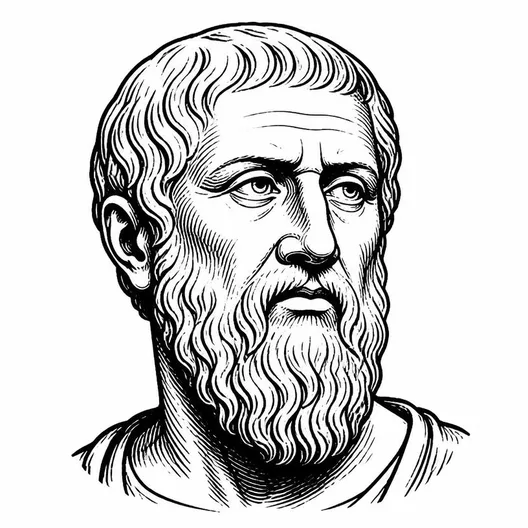 Plato c. 360 BCE