Excerpt From Kepler’s Dioptrics Preface. Augsburg, 1611
“The Sidereal Messenger” of Galileo has been for a long time in everybody’s hands, also my “Discussion, such as it is, with this Messenger,” and my Brief Narrative in confirmation of Galileo’s Sidereal Messenger, so any reader may briefly weigh the chief points of that Messenger and see the nature and the value of the discoveries made by the aid of the telescope, the theory of which I am intending to demonstrate in this treatise. Actual sight testified that there is a certain bright heavenly body which we call the Moon. It was demonstrated from the laws of optics that this body is round; also Astronomy, by some arguments founded upon optics, had built up the conclusion that its distance from the earth is about sixty semi-diameters of the earth. Various spots showed themselves in that body; and the result was a dubious opinion among a few philosophers, derived from Hecatæus’ account of the stories about the island of the Hyperboreans, that the reflected images of mountains and valleys, sea and land, were seen there; but now the telescope places all these matters before our eyes in such a way that he must be an intellectual coward who, while enjoying such a view, still thinks that the matter is open to doubt. Nothing is more certain than that the southern parts of the moon teem with mountains, very many in number, and vast in size; and that the northern parts, inasmuch as they are lower, receive in most extensive lakes the water flowing down from the south. The conclusions which previously Pena published as disclosed by the aid of optics, started indeed from certain slight supports, rather than foundations, afforded by actual sight, but were proved by long arguments depending one upon another, so that they might be assigned to human reason rather than to sight; but now our very eyes, as if a new door of heaven had been opened, are led to the view of matters once hidden from them. But if it should please any one to exhaust the force of reasoning upon these new observations, who does not see how far the contemplation of nature will extend her boundaries, when we ask, “What is the use of the tracts of mountains and valleys, and the very wide expanse of seas in the moon?” and “May not some creature less noble than man be imagined such as might inhabit those tracts?”
“The Sidereal Messenger” by Galileo has long been widely available. So have my “Discussion, such as it is, with this Messenger,” and my Brief Narrative confirming Galileo’s Sidereal Messenger. Thus any reader can briefly assess the main points of that Messenger. Readers can also judge the nature and value of the discoveries made with the telescope. I intend to explain the telescope’s theory in this treatise. Direct observation showed that there is a certain bright heavenly body we call the Moon. The laws of optics demonstrated that the Moon is round. Astronomy also used arguments based on optics to establish its distance from the earth: about sixty times the earth’s radius. Various spots appeared on the Moon. These spots led a few philosophers to a doubtful opinion drawn from Hecatæus’ account of stories about the Hyperboreans’ island,. They thought reflected images of mountains and valleys, sea and land, could be seen there. But now the telescope brings all these things before our eyes. Anyone who enjoys such a view yet still doubts the matter must be an intellectual coward. Nothing is more certain than that the Moon’s southern regions teem with mountains, very numerous and vast. Its northern regions, being lower, collect water flowing down from the south in enormous lakes. Pena previously published conclusions revealed through optics. Those conclusions began with only slight support from direct observation, rather than firm foundations. But they were proved through long chains of reasoning, each argument depending on the last. Thus the conclusions could be credited to human reason rather than sight. But now our own eyes see things once hidden from them, as if a new door to heaven had opened. Yet suppose someone wished to apply the full power of reasoning to these new observations. Who cannot see how far the study of nature will expand when we ask these questions? “What purpose do the stretches of mountains and valleys, and the vast expanses of seas on the Moon, serve?” And “Might we not imagine some creature less noble than man that could inhabit those regions?”
Diodorus Siculus, ii. 47.
With no less certainty also do we decide by the use of this instrument even that famous question, which, coeval with philosophy itself, is disputed to this day by the noblest intellects—I mean, whether the earth can move (as the theory of the Planets greatly requires) without the overthrow of all bodies that have weight, or the confusion of the motion of the elements? For if the earth were banished from the centre of the universe, some fear lest the water should leave the orb of the earth and flow to the centre of the universe; and yet we see that in the moon, as well as in the earth, there is a quantity of moisture occupying the sunken hollows of that globe; and although this orb revolves actually in the ether, and outside the centres not merely of the universe, but even of our earth, yet the mass of water in the moon is not at all hindered from cleaving invariably to the orb of the moon, and tending to the centre of the body to which it belongs. So, by this instance of the phenomena of the moon, the science of optics amends the received theory of mechanics, and confirms on this point my introduction to my Commentaries upon the Motions of the Planet Mars.
With equal certainty, this instrument also settles a famous question as old as philosophy itself. The finest minds still debate the question today. Can the earth move without overturning all bodies that have weight or disrupting the motion of the elements? The theory of the Planets strongly requires such movement. For if the earth were removed from the universe’s centre, some fear that water would leave the earth’s surface. The water would then flow to the centre of the universe. Yet we see moisture filling hollows in the moon’s surface, just as on earth. Although the moon revolves in the ether, away from the centres of both the universe and our earth, its water remains attached. Nothing prevents the moon’s water from constantly clinging to the moon and tending toward the centre of that body. So these observations of the moon allow the science of optics to correct the accepted theory of mechanics. They also confirm, on this point, my introduction to my Commentaries upon the Motions of the Planet Mars.
In his introduction to Commentaries upon the Motions of the Planet Mars, Kepler says gravitation theory depends on certain axioms. One is that “heavy bodies do not tend to the centre of the universe, supposing the earth to be placed there, because that point is the centre of the universe, but because it is the centre of the earth. So, wherever the earth be set, or whithersoever it be transported, heavy bodies have a continual tendency to it.” Kepler’s aim in this work was to correct methods for calculating the planets’ apparent positions under three competing theories. These were the Ptolemaic theory, the Copernican theory, and that of Tycho Brahe.
The followers of the Samian philosophy (for I may use this epithet to designate the philosophy originated by the Samians, Pythagoras and Aristarchus) have a strong argument against the apparent immobility of the earth provided in the phenomena of the moon. For we are taught by optics that if any one of us was in the moon, to him the moon, his abode, would seem quite immovable, but our earth and sun and all the rest of the heavenly bodies movable; for the conclusions of sight are thus related.
Followers of the Samian philosophy find a strong argument in the moon’s phenomena against the earth’s apparent stillness. (I may use this name for the philosophy founded by the Samians, Pythagoras and Aristarchus.) For optics teaches us that if any of us were on the moon, our view would be different. The moon, our home, would seem completely motionless. But our earth, the sun, and all the other heavenly bodies would seem to move. This is how what we see depends on our viewpoint.
Pena has noticed how astronomers, using the principles of optics, have by most laborious reasoning removed the Milky Way from the elementary universe, where Aristotle had placed it, into the highest region of the ether; but now, by the aid of the telescope lately invented, the very eyes of astronomers are conducted straight to a thorough survey of the substance of the Milky Way; and whoever enjoys this sight is compelled to confess that the Milky Way is nothing else but a mass of extremely small stars.
Pena has noted how astronomers used the principles of optics and painstaking reasoning to determine the Milky Way’s location. They moved it from the realm of the elements, where Aristotle had placed it, to the highest region of the ether. But now the newly invented telescope lets astronomers see for themselves exactly what the Milky Way is made of. Anyone who sees this sight must admit that the Milky Way is nothing but a mass of extremely small stars.
Again, up to this time the nature of nebulous stars had been entirely unknown; but if the telescope be directed to one of such nebulous balls, as Ptolemy calls them, it again shows, as in the case of the Milky Way, three or four very bright stars clustered very close together.
Again, until now, the nature of nebulous stars had been entirely unknown. Ptolemy calls them nebulous balls. But if a telescope is pointed at one of these balls, the telescope reveals three or four very bright stars clustered closely together, as with the Milky Way.
Again, who without this instrument would have believed that the number of the fixed stars was ten times, or perhaps twenty times, more than that which is given in Ptolemy’s description of the fixed stars? And whence, pray, should we seek for conclusive evidence about the end or boundary of this visible universe, proving that it is actually the sphere of the fixed stars, and that there is nothing beyond, except from this very discovery by the telescope of this multitude of fixed stars, which is, as it were, the vaulting of the mobile universe? Again, how greatly an astronomer would go wrong in determining the magnitude of the fixed stars, except he should survey the stars all over again with a telescope, also may be seen in Galileo’s treatise, and we will also hereafter produce in proof a letter from a German astronomer.
Again, without the telescope, who would have believed there were ten or perhaps twenty times as many fixed stars? Yet that is how their number compares with the stars listed in Ptolemy’s description. And where, I ask, should we look for conclusive evidence of the visible universe’s limit? What could prove that the sphere of fixed stars is that boundary, with nothing beyond? Where else but in the telescope’s discovery of this multitude of fixed stars? These stars form, as it were, the vaulted ceiling of the moving universe. Again, Galileo’s treatise shows how badly an astronomer could misjudge the size of the fixed stars without reexamining them all through a telescope. We will also provide a letter from a German astronomer later as evidence.
But no words can express my admiration of that chapter of the Sidereal Messenger where the story is told of the discovery, by the aid of a very highly finished telescope, of another world, as it were, in the planet Jupiter. The mind of the philosopher almost reels as he considers that there is a vast orb, which is equal in mass to fourteen orbs like the earth (unless on this point the telescope of Galileo shall shortly reveal something more exact than the measurements of Tycho Brahe) round which circle four moons, not unlike this moon of ours; the slowest revolving in the space of fourteen of our days, as Galileo has published; the next to this, by far the brightest of the four, in the space of eight days, as I detected in last April and May; the other two in still shorter periods. And here the reasoning of my Commentaries about the Planet Mars, applied to a similar case, induces me to conclude also that the actual orb of Jupiter rotates with very great rapidity, most certainly faster than once in the space of one of our days; so that this rotation of the mighty orb upon its own axis is accompanied wherever it goes by the perpetual circuits of those four moons. Moreover, this sun of ours, the common source of heat and light for this terrestrial world as well as for that world of Jupiter, which we consider to be of the angular magnitude of 30´ at most, there scarcely subtends more than 6´ or 7´, and is found again in the same position among the fixed stars, having completed the zodiac in the interval, after a period of twelve of our years. Accordingly, the creatures which live on that orb of Jupiter, while they contemplate the very swift courses of those four moons among the fixed stars, while they behold them and the sun rising and setting day by day, would swear by Jupiter-in-stone, like the Romans (for I have lately returned from those parts), that their orb of Jupiter remains immovable in one spot, and that the fixed stars and the sun, which are the bodies really at rest, no less than those four moons of theirs, revolve round that abode of theirs with manifold variety of motions. And from this instance now, much more than before from the instance of the moon, any follower of the Samian philosophy will learn what reply may be made to any one objecting to the theory of the motion of the earth as absurd, and alleging the evidence of our sight. O telescope, instrument of much knowledge, more precious than any sceptre! Is not he who holds thee in his hand made king and lord of the works of God? Truly
But no words can express my admiration for that chapter of the Sidereal Messenger. It tells how a finely crafted telescope revealed what seems like another world in the planet Jupiter. The philosopher’s mind almost reels at the thought of this vast globe, equal in mass to fourteen Earths. On this point, however, Galileo’s telescope may soon reveal something more accurate than Tycho Brahe’s measurements. Four moons circle Jupiter, not unlike our own moon. The slowest completes its orbit in fourteen of our days, as Galileo has reported. The next, by far the brightest of the four, takes eight days, as I discovered last April and May. The other two complete their orbits in still shorter periods. Here, the reasoning in my Commentaries about the Planet Mars, applied to a similar case, leads me to another conclusion. Jupiter itself rotates very rapidly, certainly more than once in one of our days. So, wherever this mighty globe travels, its rotation on its axis is accompanied by the four moons’ endless orbits. Moreover, our sun is the common source of heat and light for both our earthly world and Jupiter’s world. From Earth, we consider the sun’s apparent width to be no more than 30´. From Jupiter, the sun’s apparent width is scarcely more than 6´ or 7´. After twelve of our years, the sun returns to the same position among the fixed stars, having completed the zodiac. Accordingly, the creatures living on Jupiter watch the very swift movements of those four moons among the fixed stars. They also see the moons and the sun rise and set each day. They would swear by Jupiter-in-stone, like the Romans, that their globe of Jupiter stays motionless in one place. I have lately returned from those parts. These creatures would swear that the fixed stars and sun, though really at rest, revolve around their home. They would believe the same of their four moons, seeing all these bodies move in many different ways. This example now teaches any follower of the Samian philosophy far more than the example of our moon did before. Such a follower can answer anyone who calls the theory of Earth’s motion absurd and appeals to what we see. O telescope, instrument of great knowledge, more precious than any sceptre! Does holding you not make a person king and lord of the works of God? Truly
Comparing these statements with later astronomers’ measurements shows how accurate Kepler and Galileo were, despite their imperfect instruments. Jupiter is about 1300 times the size of the Earth. Its diameter is about 87,000 miles. Its rotation takes 9 h. 55 m. 21 sec., and its orbit takes nearly 4333 days. Seen from Jupiter, the sun’s angular diameter is between 6´ and 7´. As already stated, the four satellites’ orbital periods are: (i.) 1 d. 18 h. 28 m., (ii.) 3 d. 13 h. 15 m., (iii.) 7 d. 3 h. 43 m., (iv.) 16 d. 16 h. 32 m.
“All that is overhead, the mighty orbs With all their motions, thou dost subjugate To man’s intelligence.”
“All above us, the mighty spheres And all their movements, you bring Within the reach of human understanding.”
If there is any one in some degree friendly to Copernicus and the lights of the Samian philosophy, who finds this difficulty only, that he doubts how it can happen, supposing the earth to perform again and again her course among the planets through the ethereal plains, that the moon should keep so constantly by her side, like an inseparable companion, and at the same time fly round and round the actual orb of the earth, just like a faithful dog which goes round and round his master on some journey, now running in front, now deviating to this side or that, in ever-varying mazes, let him look at the planet Jupiter, which, as this telescope shows, certainly carries in its train not one such companion only, like the earth, as Copernicus showed, but actually four, that never leave it, though all the time hastening each in its own orbit.
If anyone is somewhat sympathetic to Copernicus and the insights of the Samian philosophy, but has just one difficulty, consider this. Suppose the earth repeatedly travels among the planets through the heavens. How can the moon stay so constantly beside the earth, like an inseparable companion, while also circling the earth itself? The moon would be like a faithful dog circling its master on a journey. The dog runs ahead, then darts to one side or the other, following ever-changing, winding paths. Let anyone with this doubt look at Jupiter. As this telescope shows, Jupiter certainly carries companions along with it. Jupiter has not just one companion, as Copernicus showed the earth has, but actually four. These companions never leave Jupiter, though each is constantly speeding along its own orbit.
But enough has been said about these matters in my Discussion with the Sidereal Messenger. It is time that I should turn to those discoveries which have been made since the publication of Galileo’s Sidereal Messenger, and since my Discussion with it, by means of this telescope.
But I have said enough about these matters in my Discussion with the Sidereal Messenger. It is time to turn to the discoveries made with this telescope since Galileo’s Sidereal Messenger and my Discussion were published.
It is now just a year since Galileo wrote to Prague, and gave full notice that he had detected something new in the heavens beyond his former discoveries; and that there might not be any one who, with the intention of detracting from his credit, should try to pass himself off as an earlier observer of the phenomenon, Galileo gave a certain space of time for the publication of the new phenomena which any one had seen; he himself meanwhile described his discovery in letters transposed in this manner: s m a i s m r m i l m e p o e t a l e u m i b u n n u g t t a u i r a s. Out of these letters I made an uncouth verse which I inserted in my Short Account in the month of September of last year:—
It has now been just a year since Galileo wrote to Prague. He gave full notice that he had discovered something new in the heavens beyond his earlier discoveries. Galileo wanted to prevent anyone from undermining his reputation by claiming to have observed the phenomenon before him. So he allowed a set time for others to publish any new phenomena they had seen. Meanwhile, he described his own discovery with its letters rearranged as follows: s m a i s m r m i l m e p o e t a l e u m i b u n n u g t t a u i r a s. From these letters I made an awkward verse, which I included in my Short Account last September:
Salve umbistineum geminatum Martia proles. Hail, twin companionship, children of Mars.
Salve umbistineum geminatum Martia proles. Greetings, twin companions, children of Mars.
Umbistineum. Apparently, this is a German word with a Latin ending, such as um-bei-stehn. Kepler thought Galileo had discovered two satellites of Mars.
But I was a very long way from the meaning of the letters; it contained nothing to do with Mars; and, not to detain you, reader, here is the solution of the riddle in the words of Galileo himself, the author of it:—
But I was far from understanding what the letters meant. They had nothing to do with Mars. And, reader, to avoid keeping you waiting, here is the riddle’s solution in Galileo’s own words. Galileo himself created the riddle:
The four letters by Galileo reproduced here follow the text in the edition of Galileo’s works published at Florence, 1842-56. The text in the edition of Kepler’s Dioptrics, published at Augsburg, 1611, is very inaccurate. Galileo wrote these letters to Giuliano de’ Medici, the Grand-Duke of Tuscany’s ambassador to Emperor Rudolf II. at Prague.
“Di Firenze li 13 di Novembre 1610.—Ma passando ad altro, giacchè il Sig. Keplero ha in questa sua ultima narrazione stampate le lettere che io mandai trasposte a Vostra Signoria Illustrissima e Reverendissima venendomi anco significato come Sua Maestà ne desidera il senso, ecco che io lo mando a Vostra Signoria Illustrissima per participarlo con Sua Maestà col Sig. Keplero e con chi piacerà a Vostra Signoria Illustrissima bramando io che lo sappia ognuno. Le lettere dunque combinate nel lor vero senso dicono così, Altissimum planetam tergeminum observavi. Questo è, che Saturno con mia grandissima ammirazione ho osservato essere non una stella sola, ma tre insieme, le quali quasi si toccano; e sono trà di loro totalmente immobili, e constituite in questa guisa Quella di mezzo è assai più grande delle laterali; sono situate una da oriente, l’altra da occidente, nella medesima linea retta a capello; non sono giustamente secondo la dirittura del Zodiaco, ma l’occidentale si eleva alquanto verso Borea; forse sono parallele all’ Equinoziale?]. Se si guarderanno con un occhiale che non sia di grandissima moltiplicazione, non appariranno tre stelle ben distinte, ma parrà, che Saturno sia una stella lunghetta in forma di un’ oliva, così, Ma servendosi di un occhiale che moltiplichi più di mille volte in superficie, si vedranno tre globi distintissimi, che quasi si toccano, non apparendo trà essi maggior divisione di un sottil filo oscuro. Or ecco trovata la corte a Giove, e due Servi a questo Vecchio che l’aiutano a camminare nè mai se gli staccano dal fianco. Intorno agli altri Pianeti non ci è novità alcuna, ec.”
“Florence, November 13, 1610. But turning to another subject, Signor Keplero has printed my scrambled letters in his latest account. These are the letters I sent to Your Most Illustrious and Reverend Lordship. I have also been told that His Majesty wishes to know their meaning. So I now send Your Lordship the meaning to share with His Majesty, Signor Keplero, and anyone else you choose. I want everyone to know. Arranged in their proper order, the letters read: Altissimum planetam tergeminum observavi. This means, ‘I have observed the most distant planet to be triple.’ To my great amazement, I have observed that Saturno is not one star, but three together, almost touching. The three remain completely motionless relative to one another and are arranged like this. The middle star is much larger than the stars on either side. One lies to the east and the other to the west, all in a perfectly straight line. Their alignment does not quite follow the Zodiac, since the western star lies somewhat farther north. Perhaps they are parallel to the celestial equator? Through a telescope without very high magnification, the three will not appear as clearly distinct stars. Instead, Saturno will look like a slightly elongated star, shaped like an olive, like this. But a telescope that magnifies area more than a thousand times will show three very distinct globes, almost touching. The gap between the globes appears no wider than a thin, dark thread. So now Giove has his court, and this Old Man has two servants to help him walk. The servants never leave his side. There is nothing new concerning the other planets, etc.”
Although these words differ little from Latin, yet I will translate them that no difficulty may hinder my reader from following me. Thus then Galileo writes:—“But to come now to my second topic. Since Kepler has published in that recent ‘Narrative’ of his the letters which I sent as an anagram to your illustrious Lordship, and since an intimation has been given me that his Majesty desires to be taught the meaning of those letters, I send it to your illustrious Lordship, that your Lordship may communicate it to his Majesty, to Kepler, and to any one your Lordship may wish.
Although these words differ little from Latin, I will translate them so my reader can follow me without difficulty. Galileo writes: “But now to my second topic. In his recent ‘Narrative’, Kepler published the letters I sent to your illustrious Lordship as an anagram. I have also been told that his Majesty wishes to know the meaning of those letters. For these reasons, I am sending the meaning to your illustrious Lordship. Your Lordship may then share the meaning with his Majesty, Kepler, and anyone else your Lordship wishes.
“The letters when joined together as they ought to be, say this,
“When put together correctly, the letters say this,
’Altissimum planetam tergeminum observavi,’ ’I have observed the most distant of the planets to have a triple form.’
’Altissimum planetam tergeminum observavi,’ ’I have observed that the most distant planet has a triple form.’
“For in truth I have found out with the most intense surprise that the planet Saturn is not merely one single star, but three stars very close together, so much so that they are all but in contact one with another. They are quite immovable with regard to each other, and are arranged in this manner, The middle star of the three is by far greater than the two on either side. They are situated one towards the east, the other towards the west, in one straight line to a hair’s-breadth; not, however, exactly in the direction of the Zodiac, for the star furthest to the west rises somewhat towards the north; perhaps they are parallel to the equator. If you look at them through a glass that does not multiply much, the stars will not appear clearly separate from one another, but Saturn’s orb will appear somewhat elongated, of the shape of an olive, thus, But if you should use a glass which multiplies a surface more than a thousand times, there will appear very distinctly three orbs, almost touching one another; and they will be thought to be not farther apart than the breadth of a very fine and scarcely visible thread. So you see a guard of satellites has been found for Jupiter, and for the decrepit little old man two servants to help his steps and never leave his side. Concerning the rest of the planets I have found nothing new.”
“In fact, to my immense surprise, I have discovered that the planet Saturn is not just one star, but three. These stars are so close together that they almost touch. They do not move at all relative to one another and are arranged as follows. The middle star is far larger than the stars on either side. One outer star lies to the east, the other to the west, in a perfectly straight line. However, this line does not follow the Zodiac exactly, since the westernmost star lies slightly farther north. Perhaps the stars lie parallel to the equator. If you look through a telescope with little magnifying power, the stars will not appear clearly separate. Instead, Saturn’s disk will look somewhat elongated, like an olive. But if you use a telescope that magnifies surface area more than a thousand times, three disks will appear distinctly. The disks will almost touch. The gaps between them will seem no wider than a very fine, barely visible thread. So, as you see, Jupiter has been found to have a guard of satellites. And the decrepit little old man has two servants to support his steps and never leave his side. I have found nothing new about the other planets.”
So says Galileo; but if I may do so, I will not make an old dotard out of Saturn, and two servants for him out of his companion orbs, but rather out of those three united bodies I will make a triple Geryon, out of Galileo Hercules, and out of the telescope his club, armed with which, Galileo has conquered that most distant of the planets, drawn it out of the furthest recesses of nature, dragged it down to earth, and exposed it to the gaze of us all. It pleases me too, now that the nest has been found, to consider with curiosity what kind of brood must be in it, what kind of life, if there be any life there, between orbs which all but touch each other two and two, where not even
So Galileo says. But if I may, I will not turn Saturn into a senile old man with two companion orbs as servants. Instead, I will turn those three joined bodies into a triple Geryon, Galileo into Hercules, and the telescope into his club. Armed with that club, Galileo has conquered the most distant planet. He has pulled Saturn from nature’s farthest depths, dragged it down to earth, and shown it to us all. Now that the nest has been found, I also enjoy wondering what kind of brood must be inside. I wonder what kind of life exists there, if there is any life there at all. What life could exist between orbs that almost touch each other in pairs, where not even
“a space Of sky extends not more than three ells wide,”
“a patch Of sky is no more than three ells wide,”
Virgil, Eclog. iii. 105.
but where there is scarcely a chink of a nail’s-breadth all round.
but where there is barely a gap the width of a fingernail all around.
Do indeed the astrologers rightly ascribe to Saturn the guardianship of miners, who, accustomed to spend their lives, like moles, underground, seldom breathe the free air under the open sky? Although the darkness here is rather more supportable than in Saturn, because the sun, which appears there only as large as Venus appears to us on the earth, continually casts its rays through the spaces between the different orbs in such a way that those inhabitants who are situated on one orb are covered by the other as by a ceiling; while those on the latter orb, on the top of this roof of theirs, exposed as it is to the full light of the sun, receive a glare as if from very firebrands. But I must draw in the reins and check my mind in its enjoyment of the free fields of ether; for fear, perchance, later observations should report something different from the first account, something changed in course of time.
Are the astrologers indeed right to make Saturn the guardian of miners? Miners are used to spending their lives underground like moles and seldom breathe fresh air under the open sky. Yet the darkness here is more bearable than on Saturn. Seen from Saturn, the sun looks only as large as Venus looks to us on earth. The sun continually sends its rays through the spaces between the different orbs. As a result, inhabitants on one orb have another orb above them like a ceiling. Meanwhile, inhabitants on the upper orb stand on top of that roof, fully exposed to the sun. They receive a glare as if from burning torches. But I must rein in my mind as it delights in roaming the open fields of ether. Otherwise, later observations may perhaps reveal something different from this first account, something that has changed over time.
Completing Galileo’s observations of Saturn depended on improvements in astronomical instruments, as the following account shows. Galileo first detected signs of Saturn’s ring in 1610, using a magnifying power of thirty, as his letter describes. But in December 1612, he wrote to his friend Marco Velseri that he could no longer see these signs. He began to think his telescope had deceived him and apparently gave up further research. Hevelius saw the ring more clearly in 1642, but depicted it as two crescents attached to Saturn at their tips. Finally, in 1653, Huyghens equipped himself with a magnifying power of one hundred, using lenses he had made himself. He immediately found the explanation for the phenomena that had baffled earlier observers. He published his explanation of Saturn’s ring and his discovery of the first satellite in his Systema Saturnium, 1659. Using still more powerful instruments, Cassini discovered four more satellites in 1671, 1672, 1684. Sir William Herschel detected two more in 1789, “which can only be seen with telescopes of extraordinary power and perfection, and under the most favourable atmospheric circumstances.” (Herschel, Outlines of Astronomy, § 548.) The last of the eight satellites was discovered in 1848, simultaneously by Lassell of Liverpool and Bond of Cambridge, U.S.
At the end of his letter Galileo seemed to think that he had come to the end of his reports about the planets, and observations of new phenomena respecting them, but ever on the watch, that eye of his, that one not of Nature’s making—I mean his telescope—in a short time made more discoveries, concerning which read the following letter of Galileo:—
At the end of his letter, Galileo seemed to think he had finished reporting on the planets and their newly observed phenomena. But his ever-watchful eye soon made more discoveries. I mean his telescope, the eye not made by Nature. Read about these discoveries in the following letter from Galileo:
“Di Firenze li 11 di Decembre 1610.—Sto con desiderio, attendendo la risposta a due mie scritte ultimamente per sentire quello, che averà detto il Sig. Keplero della stravaganza di Saturno. Intanto mando [a Vostra Signoria Illustrissima e Reverendissima] la cifra di un altro particolare osservato da me nuovamente, il quale si tira dietro la decisione di grandissime controversie in Astronomia, ed in particolare contiene in se un gagliardo argomento per la constitutione [Pitagorica e Copernicana] dell’Universo; e a suo tempo pubblicherò la deciferazione ed altri particolari. Spero che averò trovato il metodo per definire i periodi dei quattro Pianeti Medicei, stimati con gran ragione quasi inesplicabili dal Sig. Keplero, al quale piacerà, ec. “Le lettere trasposte sono queste: “Haec immatura a me jam frustra leguntur, o.y.”
“Firenze, December 11, 1610. I eagerly await replies to my two recent letters. I want to hear what Mr. Keplero has said about Saturno’s strange appearance. Meanwhile, I am sending [Your Most Illustrious and Reverend Lordship] a coded message about another detail I recently observed. This observation brings with it the resolution of major disputes in astronomy. In particular, it provides a powerful argument for the [Pythagorean and Copernican] arrangement of the universe. In due course, I will publish the decoded message and further details. I hope I have found a method for determining the orbital periods of the four Medicean planets. Mr. Keplero has, with good reason, considered these periods almost impossible to work out. He will be pleased by this method, etc. “The rearranged letters are as follows: “Haec immatura a me jam frustra leguntur, o.y.”
Which may be translated thus:—
This may be translated as follows:
“I am anxiously looking for an answer to my last two letters, that I may learn what Kepler says about the marvels of Saturn’s orb. In the meantime I send him a riddle concerning a certain new and splendid observation which tends to decide great controversies in astronomy; and especially contains a fine argument in favour of the Pythagorean and Copernican system of the universe. At the proper time I will publish the solution of the riddle, and some other particulars. I hope that I have found a method of determining the periodic times of the four Medicean planets, which Kepler, not without very good reason, thought inexplicable, etc. “The letters turned into an anagram, are these: “Haec immatura a me jam frustra leguntur, o.y.”
“I am anxiously awaiting a reply to my last two letters to learn what Kepler says about Saturn’s marvelous orb. Meanwhile, I am sending him a riddle about a new and splendid observation. The observation helps settle major controversies in astronomy. In particular, it offers a strong argument for the Pythagorean and Copernican system of the universe. At the right time, I will publish the answer to the riddle and some other details. I hope I have found a way to determine the orbital periods of the four Medicean planets. Kepler thought these periods could not be worked out, and he had very good reason to think so, etc. “The letters, rearranged into an anagram, are these: “Haec immatura a me jam frustra leguntur, o.y.”
So far Galileo. But if, reader, this letter has filled you with a desire to know the meaning contained in those letters, then you must read another letter of Galileo which follows.
That is all from Galileo. But, reader, if this letter has made you want to understand those letters, you must read Galileo’s next letter.
Fig. 1.
Figure 1.
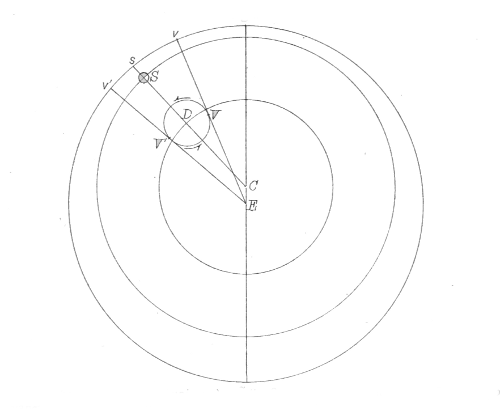
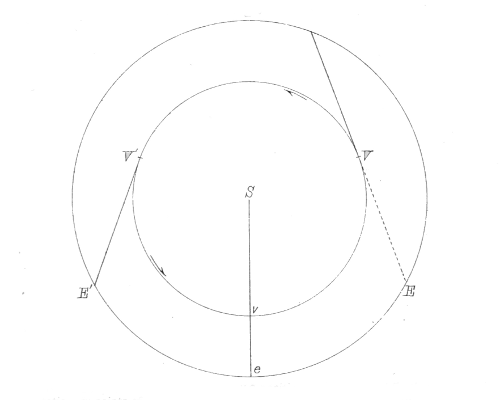
Fig. 2
Figure 2
But before you do so, I should like you to notice, by the way, what Galileo says about the Pythagorean and Copernican system of the universe. For he points to my Mystery of the Universe, published fourteen years ago, in which I took the dimensions of the Planetary orbits according to the astronomy of Copernicus, who makes the sun immovable in the centre, and the earth movable both round the sun and upon its own axis; and I showed that the differences of their orbits corresponded to the five regular Pythagorean figures, which had been already distributed by their author among the elements of the world, though the attempt was admirable rather than happy or legitimate, and for which figures’ sake Euclid wrote the whole of his Geometry. Now, in that Mystery you may find a sort of combination of Astronomy and Euclid’s Geometry, and through this combination a most thorough completion and finishing of them both; and this was the reason why I waited with intense longing to see what sort of an argument Galileo would produce in favour of the Pythagorean system of the universe. After this explanation, Galileo’s letter about this argument was as follows:—
But before you do so, I would like you to notice Galileo’s comments on the Pythagorean and Copernican system of the universe. He refers to my Mystery of the Universe, published fourteen years ago. In that work, I used the dimensions of the planetary orbits given by Copernicus’s astronomy. Copernicus places the sun motionless at the centre, with the earth moving around the sun and rotating on its axis. I showed that the differences between the orbits corresponded to the five regular Pythagorean figures. Their originator had already assigned these figures to the elements of the world. Though admirable, that attempt was neither successful nor well-founded. It was for the sake of these figures that Euclid wrote the whole of his Geometry. Now, in that Mystery you may find a kind of combination of Astronomy and Euclid’s Geometry. Through this combination, both subjects are brought to the fullest completion. For this reason, I eagerly awaited Galileo’s argument in favour of the Pythagorean system of the universe. After this explanation, Galileo’s letter about the argument read as follows:
Kepler, in his Mystery of the Universe, tried to connect the planets’ orbits with the five regular solids as follows. Suppose a cube is inscribed in a sphere (i.), and a sphere (ii.) is inscribed in the cube. Inside sphere (ii.), inscribe a tetrahedron, then a sphere (iii.) inside the tetrahedron. Inside sphere (iii.), inscribe a dodecahedron, then a sphere (iv.) inside the dodecahedron. Inside sphere (iv.), inscribe an icosahedron, then a sphere (v.) inside the icosahedron. Inside sphere (v.), inscribe an octahedron, then a sphere (vi.) inside the octahedron. Then the six spheres’ diameters will be proportional to the orbital diameters of Saturn, Jupiter, Mars, the Earth, Venus, and Mercury, respectively. Or, as Kepler puts it, the spheres’ common centre represents the Sun’s position. The six spheres represent the spheres of the planets.
“Illustrissimo e Reverendissimo Signore mio colendissimo. “È tempo che io deciferi a Vostra Signoria Illustrissima e Reverendissima e per lei al Sig. Keplero le lettere trasposte le quali alcune settimane sono le inviai; è tempo dico, giacchè sono interamente chiaro della verità del fatto, sicchè non ci resta un minimo scrupolo, o dubbio. Sapranno dunque come circa a tre mesi fa vedendosi Venere vespertina la cominciai ad osservar diligentemente coll’occhiale, per veder col senso stesso quello di che non dubitava punto l’intelletto. La vidi dunque sul principio di figura rotonda, pulita e terminata, ma molto picciola; di tal figura si mantenne sino che cominciò ad avvicinarsi alla sua massima digressione, ma tra tanto andò crescendo in mole. Cominciò poi a mancare dalla rotondità nella sua parte orientale ed avversa al Sole, e in pochi giorni si ridusse ad esser un mezzo cerchio perfettissimo, e tale si mantenne, senza punto alterarsi, finchè incominciò à ritirarsi verso il Sole, allontanandosi dalla tangente. Ora va calando dal mezzo cerchio, e si mostra cornicolata, e anderà assottigliandosi sino all’occultazione, riducendosi allora con corna sottilissime. Quindi passando all’apparizione mattutina, la vedremo pur falcata, e sottilissima e colle corna avverse al Sole; anderà poi crescendo fino alla massima digressione, dove apparirà semicircolare, e tale senza alterarsi si manterrà molti giorni, e poi dal mezzo cerchio passerà presto al tutto tondo, e così rotonda si conserverà poi per molti mesi. Il suo diametro adesso è circa cinque volte maggiore di quello, che si mostrava nella sua prima apparizione vespertina; dalla quale mirabile esperienza abbiamo sensata, e certa dimostrazione di due gran questioni state fin qui dubbie trà i maggiori ingegni del Mondo. L’una è, che i Pianeti tutti son di lor natura tenebrosi (accadendo anco a Mercurio l’istesso, che a Venere). L’altra, che Venere necessarissimamente si volge intorno al Sole, come anco Mercurio, cosa, che degli altri Pianeti, fu creduta da’ Pitagorici, dal Copernico, dal Keplero e da’ loro seguaci, ma non sensatamente provata, come ora in Venere, ed in Mercurio. “Averanno dunque il Sig. Keplero, e gli altri Copernicani da gloriarsi di aver creduto e filosofato bene, sebbene ci è toccato, e ci è per toccare ancora ad esser reputati dall’ università dei Filosofi in libris, per poco intendenti, e poco meno che stolti. “Le parole dunque, che mandai trasposte, e che dicevano, Haec immatura a me jam frustra leguntur, o.y. dicono ordinate Cynthiae figuras aemulatur mater amorum. “Cioè, che Venere imita le figure della Luna. Osservai tre notti sono l’ecclisse, nella quale non vi è cosa notabile, solo si vede il taglio dell’ombra indistinto, confuso e come annebbiato, e questo per derivare essa ombra dalla Terra lontanissima da essa Luna. Voleva scrivere altri particolari, ma essendo stato trattenuto molto da alcuni gentiluomini, ed essendo l’ora tardissima, son forzato a finire. Favoriscami salutare in mio nome i SS. Keplero, Asdale e Segheti, ed a Vostra Signoria Illustrissima con ogni reverenza bacio le mani, e dal Signore Dio gli prego felicità. Di Firenze il primo di Gennaio 1610. Ab Incarnatione. “Di Vostra Signoria Illustrissima e Reverendissima Servidore obbligatissimo. Galileo Galilei.”
“My most honored and reverend lord. “The time has come to explain the scrambled letters I sent you several weeks ago, and through you, to Sig. Keplero. I say the time has come because I am now entirely certain of the facts. Not the slightest doubt or concern remains. “About three months ago, when Venere appeared as an evening star, I began observing the planet carefully through the telescope. I wanted to see with my own eyes what my reason did not doubt at all. At first, Venere appeared round, clear, and sharply defined, but very small. The planet kept this shape until it began approaching its greatest angular distance from the Sun. Meanwhile, its apparent size increased. “Then Venere began losing its roundness on its eastern side, facing away from the Sun. Within a few days, the planet became a perfect semicircle. It remained exactly that shape until it began moving back toward the Sun, away from the tangent. Now Venere is shrinking beyond the semicircle and appears crescent-shaped. The crescent will grow thinner until the planet disappears from view, when its horns will be extremely slender. “Then, when Venere appears in the morning, we will again see a very thin crescent, with its horns pointing away from the Sun. The illuminated portion will then grow until the planet reaches its greatest angular distance from the Sun. There, Venere will appear semicircular and remain unchanged for many days. Then the planet will quickly change from a semicircle to a full circle, remaining round for many months. “The planet’s diameter is now about five times greater than when it first appeared in the evening. These remarkable observations give us direct and certain proof concerning two great questions. Until now, even the world’s greatest minds have been uncertain about them. The first is that all planets are naturally dark bodies (Mercurio undergoes the same changes as Venere). The second is that Venere must orbit the Sun, as must Mercurio. The Pythagoreans, Copernico, Keplero, and their followers believed the same of the other planets. But direct observation had not proved this, as it now has for Venere and Mercurio. “Sig. Keplero and the other Copernicans can therefore take pride in having believed and reasoned correctly. Yet the whole community of bookish philosophers has regarded us as ignorant and little better than fools. We must still expect more of the same. “The scrambled words I sent were Haec immatura a me jam frustra leguntur, o.y. Rearranged, they read Cynthiae figuras aemulatur mater amorum. “This means that Venere imitates the phases of the Moon. Three nights ago, I observed the eclipse. There was nothing noteworthy, except that the shadow’s edge looked indistinct, blurred, and almost misty. This is because the shadow comes from the Earth, which is very far from the Moon. “I wanted to write about other details, but several gentlemen kept me occupied for a long time. Since it is now extremely late, I must finish. Please give my greetings to Keplero, Asdale, and Segheti. With every respect, I kiss your hands and pray that the Lord God grants you happiness. “Florence, January 1, 1610. Reckoned from the Incarnation. “Your most devoted servant, Galileo Galilei.”
Such is Galileo’s letter; but let me give you the substance of it:—
That is Galileo’s letter, but let me summarize it for you:
“It is time for me to disclose the method of reading the letters which some weeks since I sent you as an anagram. It is time now, I mean, after I have become quite certain about the matter, so much so that I have no longer even a shadow of doubt. You must know then that about three months ago, when the star of Venus could be seen, I began to look at it through a telescope with great attention, so that I might grasp with my physical senses an idea which I was entertaining as certain. At first then you must know the planet Venus appeared of a perfectly circular form, accurately so, and bounded by a distinct edge, but very small; this figure Venus kept until it began to approach its greatest distance from the sun, and meanwhile the apparent size of its orb kept on increasing. From that time it began to lose its roundness on the eastern side, which was turned away from the sun, and in a few days it contracted its visible portion into an exact semicircle; that figure lasted without the smallest alteration until it began to return towards the sun where it leaves the tangent drawn to its epicycle. At this time it loses the semicircular form more and more, and keeps on diminishing that figure until its conjunction, when it will wane to a very thin crescent. After completing its passage past the sun, it will appear to us, at its appearance as a morning star, as only sickle-shaped, turning a very thin crescent away from the sun; afterwards the crescent will fill up more and more until the planet reaches its greatest distance from the sun, in which position it will appear semicircular, and that figure will last for many days without appreciable variation. Then by degrees, from being semicircular it will change to a full orb, and will keep that perfectly circular figure for several months; but at this instant the diameter of the orb of Venus is about five times as large as that which it showed at its first appearance as an evening star. “From the observation of these wonderful phenomena we are supplied with a determination most conclusive, and appealing to the evidence of our senses, of two very important problems, which up to this day were discussed by the greatest intellects with different conclusions. One is that the planets are bodies not self-luminous (if we may entertain the same views about Mercury as we do about Venus). The second is that we are absolutely compelled to say that Venus (and Mercury also) revolves round the sun, as do also all the rest of the planets. A truth believed indeed by the Pythagorean school, by Copernicus, and by Kepler, but never proved by the evidence of our senses, as it is now proved in the case of Venus and Mercury. Kepler therefore and the rest of the school of Copernicus have good reason for boasting that they have shown themselves good philosophers, and that their belief was not devoid of foundation; however much it has been their lot, and may even hereafter be their lot, to be regarded by the philosophers of our times, who philosophise on paper, with an universal agreement, as men of no intellect, and little better than absolute fools. “The words which I sent with their letters transposed, and which said, Haec immatura a me jam frustra leguntur, o.y. when reduced to their proper order, read thus, Cynthiae figuras aemulatur mater amorum: The mother of the Loves rivals the phases of Cynthia: that is, Venus imitates the phases of the Moon. “Three days ago I observed an eclipse of the moon, but not anything worthy of special notice occurred in it. Only the edge of the shadow appeared indistinct, blurred, and hazy; the cause of the phenomenon no doubt is that the shadow has its origin at the earth, at a great distance from the body of the moon. “I have some other particulars, but I am prevented by time from writing about them, etc.”
“It is time to explain how to read the letters I sent you as an anagram some weeks ago. I mean that the time has come now that I am completely certain about the matter. I no longer have even a shadow of doubt. About three months ago, when Venus was visible, I began observing the planet very carefully through a telescope. I wanted to confirm with my own senses an idea I already believed to be certain. At first, Venus appeared perfectly circular, with a sharply defined edge, but very small. Venus kept this shape until the planet began approaching its greatest apparent distance from the sun. Meanwhile, its apparent size continued to increase. From then on, Venus began losing its roundness on the eastern side, which faced away from the sun. Within a few days, the visible portion had shrunk to an exact semicircle. This shape remained completely unchanged until Venus began returning toward the sun, leaving the tangent drawn to its epicycle. Now Venus is losing its semicircular shape more and more. Its illuminated portion will continue shrinking until conjunction with the sun, when Venus will become a very thin crescent. After passing the sun, Venus will appear as a morning star, showing only a sickle shape. This very thin crescent will face away from the sun. Afterward, the crescent will gradually fill out until Venus reaches its greatest apparent distance from the sun. At that point, Venus will appear semicircular, and this shape will remain for many days without any noticeable change. Then Venus will gradually change from a semicircle to a full disk. The planet will keep that perfectly circular shape for several months. But right now, Venus’s apparent diameter is about five times what it was when Venus first appeared as an evening star. “Observing these wonderful phenomena gives us decisive answers, supported by our senses, to two very important questions. Until now, the greatest minds have debated these questions and reached different conclusions. The first answer is that the planets do not produce their own light. This assumes that we may draw the same conclusions about Mercury as about Venus. The second is that we are absolutely compelled to say that Venus revolves around the sun. Mercury does too, as do all the other planets. The Pythagorean school, Copernicus, and Kepler believed this truth. But our senses had never proved it, as they now have in the case of Venus and Mercury. Kepler and the other followers of Copernicus therefore have good reason to boast that they have proved themselves good philosophers. Their belief was not without foundation. Yet the philosophers of our time, who do their philosophizing on paper, have unanimously treated these thinkers as unintelligent. They have regarded them as little better than complete fools, and may continue to do so. “The words I sent with their letters rearranged were Haec immatura a me jam frustra leguntur, o.y. Restored to their proper order, the letters read: Cynthiae figuras aemulatur mater amorum. This means: The mother of the Loves rivals the phases of Cynthia. In other words, Venus imitates the phases of the Moon. “Three days ago I observed an eclipse of the moon, but nothing especially noteworthy occurred. Only the edge of the shadow appeared indistinct, blurred, and hazy. The cause is undoubtedly that the shadow originates at the earth, a great distance from the moon itself. “I have some other details to share, but time prevents me from writing about them, etc.”
In the Ptolemaic system, the earth’s centre was considered the centre of the universe. The movements of heavenly bodies were explained using eccentrics and epicycles. The sun was thought to move in a circle around a point slightly different from the earth’s centre. This circle was called the sun’s eccentric. The planets moved in epicycles (circles), whose centres moved along eccentrics (circles). The centres of these eccentrics coincided with the centre of the sun’s eccentric. For Mercury and Venus, the epicycle’s centre always lay on the line connecting the eccentric’s centre to the sun’s centre. For the other planets, the construction was more complicated. Stationary points were found by drawing tangents from the earth’s centre (or the observer) to the epicycle, as in figure (1). (Gassendi, Institutio Astronomica, 1647.) This construction explains Kepler’s description of stationary points as points where a planet leaves the tangent to its epicycle. That explanation assumes he uses the terms of the astronomy then current (i.e. Ptolemaic astronomy).
Copernicus placed the sun, rather than the earth, at the centre of the universe. But to calculate planetary positions at any given time as accurately as the Ptolemaic system allowed, he also needed eccentrics and epicycles. So Kepler’s wording may describe stationary points according to the Copernican theory. Still, it is strange that he should not recognise the elliptical shape of planetary orbits. He had recently demonstrated that shape through painstaking reasoning in his Commentaries on the Motion of the Planet Mars, 1609. Galileo’s own wording seems, as expected, to describe stationary points according to the Copernican system. He describes them as points where a planet leaves the tangent drawn from the earth to its orbit (Fig. 2).
So writes Galileo.
That is what Galileo writes.
What now, dear reader, shall we make out of our telescope? Shall we make a Mercury’s magic-wand to cross the liquid ether with, and, like Lucian, lead a colony to the uninhabited evening star, allured by the sweetness of the place? or shall we make it a Cupid’s arrow, which, entering by our eyes, has pierced our inmost mind, and fired us with a love of Venus? For what language is too strong for the marvellous beauty of this orb, if, having no light of its own, it can attain simply by the borrowed light of the sun to such splendour, as Jupiter has not, nor the moon, though enjoying a proximity to the sun as close as Venus; for if the moon’s light be compared with the light of Venus, it will be seen to be certainly greater on account of the apparent magnitude of the moon, but, in comparison with the light of Venus, dull, dead, and leaden. O truly golden Venus! Will any one doubt any more that the whole orb of Venus is wrought most smoothly out of pure unalloyed gold, since its surface, when only placed in the sunlight, reflects a splendour so intense! And here let me add my experiments about the alteration of the light of Venus on blinking the eye, which I have examined in the part of my Astronomy which treats of Optics. Reasoning will be able to conclude nothing else but this, that the orb of Venus turns on its own axis with an exceedingly swift rotation, displaying one after another different parts of its surface which are more or less capable of retaining the sun’s light.
What shall we turn our telescope into now, dear reader? Shall we make it Mercury’s magic wand, to cross the liquid ether? Shall we, like Lucian, lead a colony to the uninhabited evening star, drawn by the charms of the place? Or shall we make it Cupid’s arrow, entering through our eyes and piercing our deepest thoughts? Has it set us on fire with love for Venus? For what words could be too strong to describe this orb’s marvelous beauty? Venus has no light of its own. Yet, with only borrowed sunlight, it can shine with a splendor neither Jupiter nor the moon possesses. This is so even though the moon is as close to the sun as Venus. If we compare the moon’s light with Venus’s, the moon’s is certainly greater because the moon appears larger. But beside Venus’s light, the moon’s looks dull, lifeless, and leaden. O truly golden Venus! Will anyone still doubt that the entire orb of Venus is made of pure, unmixed gold, polished perfectly smooth? For its surface reflects such intense splendor simply by being placed in sunlight! Let me also add my experiments on how Venus’s light changes when the eye blinks. I have examined these experiments in the section of my Astronomy dealing with Optics. Reasoning can lead to only one conclusion: Venus spins on its own axis extremely quickly. As Venus spins, different parts of its surface appear in turn, each more or less able to retain sunlight.
Lucian, Ver. Hist. i. 12.
Dominique Cassini made the first scientific measurement of Venus’s rotation period in 1666 by observing spots on the planet. He concluded that the period was about 24 hours. But in 1726 Bianchini used similar observations to calculate a period of 24 d. 8 h. The true period is considered to be 23 h. 21 m., as determined by Schroeter. His observations, from 1788 to 1793, tracked recurring changes in the shape of the horns of Venus. (Arago, Astronomie Populaire, 1854.)
But enough of my own conclusions. Let us now hear as an epilogue Galileo’s conclusions built up out of all the observations which he has made with his telescope, and announced from time to time. Thus he writes once more:—
But enough of my own conclusions. To close, let us hear Galileo’s conclusions, drawn from all his telescope observations and announced from time to time. He writes once again:
“Illustrissimo e Reverendissimo Signore mio colendissimo. “Ho ricevuto gusto, e contento particolarissimo nella lettura dell’ ultima di Vostra Signoria Illustrissima e Reverendissima delli 7 stante, ed in particolare in quella parte dove ella m’accenna la favorevole inclinazione dell’ Illustriss. Sig. Cons. Wackher, verso di me, la quale io infinitamente stimo, ed apprezzo; e poichè quella ha principalmente origine dall’ aver io incontrate osservazioni necessariamente dimostranti conclusioni per avanti tenute vere da sua Signoria Illustrissima per confermarmi maggiormente il possesso di grazia tanto pregiata da me, prego Vostra Signoria Illustrissima e Reverendissima a fargli intendere per mia parte come conforme alla credenza di Sua Signoria Illustrissima ho dimostrazione certa, che siccome tutti i Pianeti ricevono il lume dal Sole, essendo per se stessi tenebrosi, e opachi; così le Stelle fisse risplendono per lor natura, non bisognose dell’ illustrazione de’ raggi solari, li quali, Dio sa, se arrivino a tanta altezza, più di quello, che arrivi a noi il lume di una di esse fisse. Il principal fondamento del mio discorso è nell’ osservare io molto evidentemente con gli occhiali che quei Pianeti di mano in mano, che si trovano più vicini a noi, o al Sole, ricevono maggiore splendore, e più illustremente ce lo riverberano; e perciò Marte perigeo, e a noi vicinissimo si vede assai più splendido, che Giove; benchè a quello di mole assai inferiore; e difficilmente se gli può coll’ occhiale levare quella irradiazione, che impedisce il vedere il suo disco terminato, e rotondo; il che in Giove non accade, vedendosi esquisitamente circolare. Saturno poi per la sua gran lontananza si vede esattamente terminato, sì la Stella maggiore di mezzo, come le due piccole laterali; ed appare il suo lume languido, ed abbacinato e senza niuna irradiazione, che impedisca il distinguere i suoi tre piccoli globi terminatissimi. Ora poichè apertamente veggiamo, che il Sole molto splendidamente illustra Marte vicino, e che molto più languido è il lume di Giove (sebbene senza lo strumento appare assai chiaro, il che accade per la grandezza, e candore della Stella) languidissimo, e fosco quello di Saturno, come molto più lontano, quali doveriano apparirci le Stelle fisse lontane indicibilmente più di Saturno, quando il lume loro derivasse dal Sole? Certamente debolissime, torbide e smorte. Ma tutto l’opposito si vede, perocchè se rimireremo per esempio il Cane, incontreremo un fulgore vivissimo, che quasi ci toglie la vista, con una vibrazione di raggi tanto fiera, e possente, che in comparazione di quello rimangono i Pianeti, e dico Giove e Venere stessa, come un impurissimo vetro appresso un limpidissimo e finissimo diamante. E benchè il disco di esso Cane apparisca non maggiore della cinquantesima parte di quello di Giove, tuttavia la sua irradiazione è grande, e fiera in modo, che l’istesso globo tra i proprii crini s’implica, e quasi si perde, e con qualche difficoltà si distingue; dove che Giove (e molto più Saturno) si vedono e terminati, e di una luce languida, e per così dire quieta. E per tanto io stimo, che bene filosoferemo, referendo la causa della scintillazione delle Stelle fisse, al vibrare, che elle fanno dello splendore proprio e nativo dall’intima loro sustanza; dove che nella superficie de’ Pianeti termina più presto, e si finisce l’illuminazione, che dal Sole deriva, e si parte. Se io sentirò qualche particolare questione ricevuta dal medesimo Sig. Wackher, non resterò d’affaticarmivi intorno, per dimostrarmi, quale io sono desiderosissimo di servire un tanto Signore, e non già con isperanza di aggiungere al termine conseguito dal suo discorso, perchè benissimo comprendo, che a quanto sia passato per lo finissimo cribro del giudizio di esso, e del Sig. Keplero, non si può aggiungere di squisitezza; nè io pretenderei altro, che col dubitare, e mal filosofare, eccitar loro al ritrovamento di nuove sottigliezze. Gl’ingegni singolari, che in gran numero fioriscono nell’Alemagna, mi hanno lungo tempo tenuto in desiderio di vederla, il qual desiderio ora si raddoppia per la nuova grazia dell’Illustrissimo Sig. Wackher, la quale mi farebbe divenir grande ogni picciola occasione, che mi si presentasse. Ma ho di soverchio occupata Vostra Signoria Illustrissima e Reverendissima. Degnisi per fine di offerirmi e dedicarmi devotissimo servidore all’Illustrissimo Sig. Wackher, salutando anco caramente il Sig. Keplero, ed a lei con ogni riverenza bacio le mani, e dal Signore Dio le prego somma felicità. “[Di Firenze li 26] di Marzo 1611. Di Vostra Signoria Illustrissima e Reverendissima obbligatissimo Servidore, Galileo Galilei.”
“Most distinguished and reverend Sir, my deeply respected patron. “I read your latest letter, dated the 7th of this month, with particular pleasure and satisfaction. I especially welcomed the news of the distinguished Councillor Wackher’s favorable opinion of me. I value and appreciate his goodwill beyond measure. His goodwill chiefly arises because my observations conclusively demonstrate ideas he already held to be true. To strengthen my claim to such highly valued favor, please convey the following to him on my behalf. In agreement with his belief, I have certain proof that all the planets receive their light from the Sun. In themselves, the planets are dark and opaque. The fixed stars, however, shine by their own nature and do not need light from the Sun’s rays. God knows whether those rays reach such heights any more powerfully than a fixed star’s light reaches us. My argument rests chiefly on what I see very clearly through telescopes. The nearer planets are to us or to the Sun, the more brightly they shine and reflect light toward us. Thus, Mars at perigee, when closest to us, appears much brighter than Jupiter, although Mars is much smaller. Even with a telescope, it is difficult to remove the glare that prevents us from seeing Mars’s clear, round outline. This does not happen with Jupiter, whose circular outline is perfectly clear. Saturn, being so distant, has a sharply defined outline. This applies both to the larger central star and to the two smaller stars on either side. Saturn’s light appears faint and dim. No glare prevents us from distinguishing its three small, sharply defined globes. Now, we plainly see that the Sun lights nearby Mars very brightly, while Jupiter’s light is much fainter. Jupiter does look quite bright without the telescope, but that is because of the planet’s size and whiteness. Saturn’s light is extremely faint and dull because Saturn is much farther away. How, then, should the fixed stars appear if their light came from the Sun? Their distance is beyond expression greater than Saturn’s. Surely they should appear extremely faint, cloudy, and pale. Yet we see precisely the opposite. If we look at Cane, for example, we encounter a brilliance so intense that it almost blinds us. Its rays quiver with such fierce power that even Jupiter and Venus look like very impure glass beside a flawless diamond. Although Cane’s disk appears no larger than one-fiftieth of Jupiter’s, its glare is immense and fierce. The globe becomes entangled in its own surrounding rays and almost disappears, making the globe somewhat difficult to distinguish. Jupiter, by contrast, has a clear outline and a faint, almost quiet light. This is even more true of Saturn. I therefore think we reason soundly if we attribute the fixed stars’ twinkling to their own quivering light. That light is native to the stars and comes from their innermost substance. By contrast, the illumination that comes from the Sun ends and stops at the planets’ surfaces. If I hear of any particular question from Signor Wackher, I will spare no effort in examining it. I wish to show how deeply I desire to serve so distinguished a gentleman. I would not do so hoping to advance beyond the conclusions he has reached. I understand perfectly that nothing can refine whatever has passed through the exceptionally fine judgment of him and Signor Keplero. My only aim would be to prompt them toward new insights through my questions and faulty reasoning. The many outstanding minds flourishing in Alemagna have long made me wish to visit that country. Signor Wackher’s newly shown favor now doubles that desire. His goodwill would make even the smallest opportunity to visit seem a great one to me. But I have taken up too much of your time. Finally, please present me to the distinguished Signor Wackher as his most devoted servant. Please also give my warm greetings to Signor Keplero. With all respect, I kiss your hands and pray that the Lord God grants you the greatest happiness. “[From Florence, the 26th] of March 1611. Your most obliged servant, Galileo Galilei.”
When translated, the meaning is as follows:—
In translation, the meaning is as follows:
“Your last letter has exceedingly pleased me, especially that part which assures me of the friendly feeling entertained towards me by the most illustrious Imperial Counsellor, Wagher, which I for my part highly appreciate. And since the cause of this friendliness is, that I have incontestably demonstrated by some observations of mine certain conclusions which he had long held as true, I wish to confirm my possession of favour, which I value so much, and accordingly I ask you to give him this piece of news from me; that I have most conclusive arguments ready, showing clearly that, just as he holds, all the planets receive their light from the sun, being by constitution bodies dark and devoid of light; but that the fixed stars shine by their own proper light, not needing to be illuminated by the sun’s rays, since God knows whether they reach the very remote region of the fixed stars with intensity even equal to the small intensity with which the rays of the fixed stars come down to us. “My demonstration depends chiefly on this fact, that with the telescope I have distinctly observed that the planets receive greater brightness, and reflect it more intensely, in proportion as each one is nearer to us and to the sun. So Mars in perigee, that is, when nearest to the earth, greatly surpasses Jupiter in brightness, although in actual size it is far inferior to Jupiter; and in consequence it is difficult to receive the effulgence of this planet in the telescope, for it is so great as to prevent the eye from being able to distinguish the circular termination of the planet’s disc. This does not happen in the case of Jupiter, for it appears quite circular. The next planet, Saturn, on account of its great distance likewise—for indeed it is the most remote of the planets,—appears bounded by a well-defined edge, both the greater orb in the middle and the two small orbs at its sides. Indeed, it appears to shine with a faint and delicate light, without any effulgence to prevent an observer recognising the well-defined termination of its three orbs. Since, then, we see that Mars, the nearest of the three, is illumined by the sun with very great splendour, and that the light of Jupiter, at a greater distance, is much more faint (although without the use of an instrument it appears tolerably bright, which is due to the size and brilliancy of its body), and that the light of Saturn, at the greatest distance, is most faint, and almost watery, of what kind, do you think, would appear the light of the fixed stars, which are at an immeasurable distance further from the sun than Saturn, if they only received light from the sun? Most certainly, extremely feeble, indistinct, and pallid. And yet we find quite the contrary; for, let us look with our eyes at the Dog-Star, for example. We shall encounter a most vivid brilliancy, which almost pricks the eye with the rapid sparkling of its rays, of such intensity that, in comparison with it, the planets, even Jupiter, and Venus too, are as thoroughly outshone as common and bad glass compared with a highly polished and most sparkling diamond. And although the orb of the Dog-Star appears no larger than the fiftieth part of Jupiter’s disc, nevertheless its brilliancy is great and very strong; so that the form of its disc, which you expect to see, hides itself among the rays of its own refulgence, envelops itself in them, and almost disappears; and it is not distinguished without some difficulty from the rays which surround it. Whereas Jupiter, and still more Saturn, are seen well defined; and their light is without intensity, and, if I may say so, quiescent. Wherefore I think that we shall rightly apply our philosophy if we refer the cause of the twinkling of the fixed stars to vibrations of a brilliancy, which is their own, belonging to their constitution, and inherent in their substance, and say, on the other hand, that the illumination of the planets, which is derived from the sun, and distributed to the world, is limited to their surface.”
“Your last letter pleased me greatly. I was especially pleased to hear of the friendship shown toward me by the most illustrious Imperial Counsellor, Wagher. For my part, I value his friendship highly. His friendship comes from my having conclusively proved, through some observations, certain conclusions he had long believed true. Since I value his favor so much, I wish to secure it further. So I ask you to give him this news from me. I have decisive arguments ready, clearly showing that, just as he believes, all the planets receive their light from the sun. By their nature, the planets are dark bodies without light of their own. But the fixed stars shine by their own light and do not need illumination from the sun’s rays. God knows whether the sun’s rays reach the distant fixed stars with even the faint intensity of starlight reaching us. “My proof rests chiefly on one fact. Through the telescope, I have clearly observed that planets receive more light and reflect it more intensely when nearer us and the sun. Thus Mars at perigee, when nearest the earth, far outshines Jupiter, although Mars is actually much smaller. Consequently, Mars’s glare is difficult to view through the telescope. The glare is so great that the eye cannot distinguish the circular edge of the planet’s disc. Jupiter does not present this problem, for its outline appears clearly circular. The next planet, Saturn, likewise has a clearly defined edge because of its great distance. Indeed, Saturn is the most distant planet. Both the larger central orb and the two small orbs beside it have clear outlines. Saturn shines with a faint, delicate light. No glare prevents the observer from recognizing the clearly defined edges of its three orbs. Thus we see that Mars, the nearest of the three, is lit by the sun with great brilliance. Jupiter’s light is much fainter at its greater distance. Yet without an instrument, Jupiter looks fairly bright because of its size and the brightness of its body. Saturn’s light, at the greatest distance, is faintest and almost watery. What, then, would the light of the fixed stars look like if they received light only from the sun? They are immeasurably farther from the sun than Saturn. Most certainly, their light would be extremely weak, indistinct, and pale. Yet we find quite the opposite. Let us look with our own eyes at the Dog-Star, for example. We encounter an intense brilliance that almost pricks the eye with the rapid sparkling of its rays. Beside that brilliance, the planets, even Jupiter and Venus, are completely outshone. They are like ordinary, poor-quality glass beside a highly polished, intensely sparkling diamond. Although the Dog-Star’s orb appears no larger than one-fiftieth of Jupiter’s disc, its brilliance is great and very strong. As a result, the disc’s outline, which you expect to see, hides among its own brilliant rays. Wrapped in those rays, the disc almost disappears. Its outline is difficult to distinguish from the surrounding rays. By contrast, Jupiter, and still more Saturn, have clearly defined outlines. Their light lacks intensity and, if I may put it this way, is calm. So I think sound reasoning leads us to explain the fixed stars’ twinkling as vibrations in their own brilliance. That brilliance belongs to their nature and is inherent in their substance. The planets’ light, on the other hand, comes from the sun and spreads out into the world. That illumination is confined to their surfaces.”
Proctor (Other Worlds than Ours, 1875) has offered some reasons to believe Jupiter and Saturn partly produce their own light because of their intense internal heat.
These are the scientific conclusions in Galileo’s letter; the rest I omit.
These are the scientific conclusions in Galileo’s letter. I leave out the rest.
You see then, studious reader, how the subtle mind of Galileo, in my opinion the first philosopher of the day, uses this telescope of ours like a sort of ladder, scales the furthest and loftiest walls of the visible world, surveys all things with his own eyes, and, from the position he has gained, darts the glances of his most acute intellect upon these petty abodes of ours—the planetary spheres I mean,—and compares with keenest reasoning the distant with the near, the lofty with the deep.
You see, then, eager reader, how Galileo’s subtle mind uses this telescope of ours like a kind of ladder. In my opinion, he is the leading philosopher of our day. He climbs the farthest and highest walls of the visible world and surveys all things with his own eyes. From that vantage point, he turns his exceptionally sharp intellect toward these tiny homes of ours. I mean the planetary spheres. With the keenest reasoning, he compares the distant with the near, the heights with the depths.
VALE ET DEUM IN OPERIBUS SUIS CELEBRARE NUNQUAM DESINE.
Farewell, and never stop praising God through his works.
Kepler, Narratio.
Kepler, Narratio.
The end