A life story told as a long prayer, as Augustine recalls his wild youth and turn to God. As a boy he stole pears he did not even want, just for the thrill of it.
397 pages 7h 42m reading time
Often called the first autobiography in Western literature, and a classic of Christian spiritual writing.
Recounts Augustine's restless youth, from stealing pears and keeping a mistress to his conversion in a Milan garden in 386.
Tells God that our hearts are restless until they rest in him, so happiness lies in God, not pleasure or success.
Turns honest self-examination, of memory, desire and even time itself, into a way to know oneself and God.
It inspired a long line of confessional writing, including Rousseau's Confessions.
Its ideas of original sin and grace shaped Western Christianity, from medieval theology to Luther and Calvin.
A new bishop's public admission
Augustine wrote it soon after becoming bishop of Hippo in North Africa, confessing his past sins to every reader.
A title with two meanings
In Augustine's Latin, "confession" meant both admitting your sins and praising God, and the book does both at once.
The story stops early
His life story ends around his mother's death, and the last three books explain the Bible's first chapter instead.
Still moved its author
Near the end of his life, Augustine wrote that rereading it still stirred his heart.


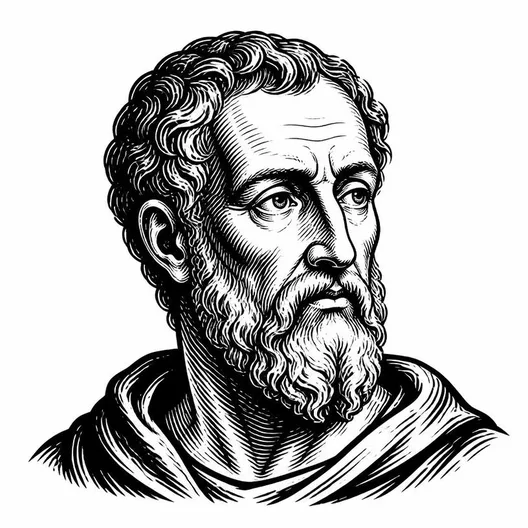 Augustine of Hippo c. 401 CE