Chapter 1
The Airlords Under Siege
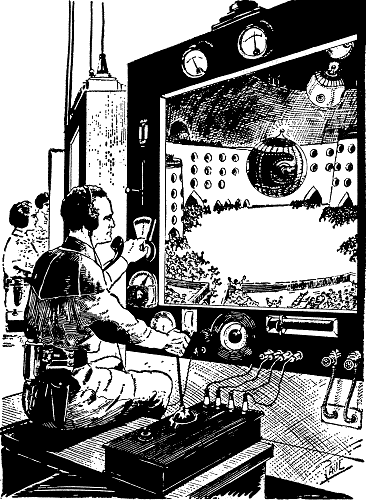
In a previous record of my adventures in the early part of the Second War of Independence I explained how I, Anthony Rogers, was overcome by radioactive gases in an abandoned mine near Scranton in the year 1927, where I existed in a state of suspended animation for nearly five hundred years; and awakened to find that the America I knew had been crushed under the cruel tyranny of the Airlords of Han, fierce Mongolians, who, as scientists now contend, had in their blood a taint not of this earth, and who with science and resources far in advance of those of a United States, economically prostrate at the end of a long series of wars with a Bolshevik Europe, in the year 2270 A.D., had swept down from the skies in their great airships that rode "repeller rays" as a ball rides the stream of a fountain, and with their terrible "disintegrator rays" had destroyed more than four-fifths of the American race, and driven the other fifth to cover in the vast forests which grew up over the remains of the once mighty civilization of the United States.
In an earlier account of my adventures during the early part of the Second War of Independence, I explained what happened to me, Anthony Rogers. In 1927, radioactive gases overcame me in an abandoned mine near Scranton. I remained there in a state of suspended animation for nearly five hundred years. When I awoke, I found that the America I knew had been crushed under the cruel tyranny of the Airlords of Han. They were fierce Mongolians who, scientists now argue, had a taint in their blood that was not of this earth. In 2270 A.D., the Airlords had swept down from the skies in great airships. Their ships rode on "repeller rays" as a ball rides the stream of a fountain. Their science and resources were far ahead of those of the United States. The country had been left economically devastated by a long series of wars with a Bolshevik Europe. With their terrible "disintegrator rays", the Airlords destroyed more than four-fifths of the American race. They drove the other fifth into hiding in the vast forests that had grown over the remains of the once mighty civilization of the United States.
I explained the part I played in the fall of the year 2419, when the rugged Americans, with science secretly developed to terrific efficiency in their forest fastness, turned fiercely and assumed the aggressive against a now effete Han population, which for generations had shut itself up in the fifteen great Mongolian cities of America, having abandoned cultivation of the soil and the operation of mines; for these Hans produced all they needed in the way of food, clothing, shelter and machinery through electrono-synthetic processes.
I explained the part I played in the fall of 2419. The rugged Americans had secretly developed highly effective science in their forest stronghold. They turned fiercely against the now weakened Han population and went on the offensive. For generations, the Hans had shut themselves up in the fifteen great Mongolian cities of America. They had abandoned farming and mining because they produced all the food, clothing, shelter, and machinery they needed through electrono-synthetic processes.
I explained how I was adopted into the Wyoming Gang, or clan, descendants of the original populations of Wilkes-Barre, Scranton and the Wyoming Valley in Pennsylvania; how quite by accident I stumbled upon a method of destroying Han aircraft by shooting explosive rockets, not directly at the heavily armored ships, but at the repeller ray columns, which automatically drew the rockets upward where they exploded in the generators of the aircraft; how the Wyomings threw the first thrill of terror into the Airlords by bringing an entire squadron crashing to earth; how a handful of us in a rocketship successfully raided the Han city of Nu-Yok; and how by the application of military principles I remembered from the First World War, I was able to lead the Wyomings to victory over the Sinsings, a Hudson River tribe which had formed a traitorous alliance with the hereditary enemies and oppressors of the White Race in America.
I explained how I was adopted into the Wyoming Gang, or clan. The Wyomings were descendants of the original populations of Wilkes-Barre, Scranton, and the Wyoming Valley in Pennsylvania. I explained how I had stumbled quite by accident upon a way to destroy Han aircraft. Instead of shooting explosive rockets directly at the heavily armored ships, I fired them at the repeller ray columns. The columns automatically drew the rockets upward, where they exploded inside the aircraft’s generators. I told how the Wyomings first terrified the Airlords by bringing an entire squadron crashing to earth. I also described how a handful of us had successfully raided the Han city of Nu-Yok in a rocketship. Finally, I explained how I had led the Wyomings to victory over the Sinsings using military principles I remembered from the First World War. The Sinsings were a Hudson River tribe that had formed a traitorous alliance with the hereditary enemies and oppressors of the White Race in America.
By the Spring of 2420 A.D., a short six months after these events, the positions of the Yellow and the White Races in America had been reversed. The hunted were now the hunters. The Hans desperately were increasing the defenses of their fifteen cities, around each of which the American Gangs had drawn a widely deployed line of long-gunners; while nervous air convoys, closely bunched behind their protective screen of disintegrator beams, kept up sporadic and costly systems of transportation between the cities.
By the spring of 2420 A.D., just six months after these events, the positions of the Yellow and White Races in America had reversed. The hunted were now the hunters. The Hans were desperately strengthening the defenses of their fifteen cities. The American Gangs had surrounded each city with a widely spread line of long-gunners. Nervous air convoys clustered closely behind protective screens of disintegrator beams. They maintained a sporadic and costly transport system between the cities.
During this period our own campaign against the Hans of Nu-Yok was fairly typical of the development of the war throughout the country. Our force was composed of contingents from most of the Gangs of Pennsylvania, Jersey and New England. We encircled the city on a wide radius, our line running roughly from Staten Island to the forested site of the ancient city of Elizabeth, to First and Second Mountains just west of the ruins of Newark, Bloomfield and Montclair, thence Northeasterly across the Hudson, and down to the Sound. On Long Island our line was pushed forward to the first slopes of the hills.
During this period, our campaign against the Hans of Nu-Yok was fairly typical of how the war developed across the country. Our force included groups from most of the Gangs of Pennsylvania, Jersey and New England. We surrounded the city at a wide distance. Our line ran roughly from Staten Island to the forested site of the ancient city of Elizabeth. From there, it ran to First and Second Mountains, just west of the ruins of Newark, Bloomfield and Montclair. It then continued northeast across the Hudson and down to the Sound. On Long Island, our line extended forward to the first slopes of the hills.
We had no more than four long-gunners to the square mile in our first line, but each of these was equal to a battery of heavy artillery such as I had known in the First World War. And when their fire was first concentrated on the Han city, they blew its outer walls and roof levels into a chaotic mass of wreckage before the nervous Yellow engineers could turn on the ring of generators which surrounded the city with a vertical film of disintegrator rays. Our explosive rockets could not penetrate this film, for it disintegrated them instantly and harmlessly, as it did all other material substance with the sole exception of "inertron," that synthetic element developed by the Americans from the sub-electronic and ultronic orders.
We had no more than four long-gunners per square mile in our first line. But each was equal to a battery of heavy artillery like those I had known in the First World War. When their fire was first concentrated on the Han city, they blasted its outer walls and roof levels into a chaotic mass of wreckage. They did this before the nervous Yellow engineers could turn on the ring of generators surrounding the city. The generators enclosed the city in a vertical film of disintegrator rays. Our explosive rockets could not penetrate this film, which instantly and harmlessly disintegrated them. The film did the same to all other material substance, with the sole exception of "inertron," a synthetic element developed by the Americans from the sub-electronic and ultronic orders.
The continuous operation of the disintegrators destroyed the air and maintained a constant vacuum wherever they played, into which the surrounding air continuously rushed, naturally creating atmospheric disturbances after a time, which resulted in a local storm. This, however, ceased after a number of hours, when the flow of air toward the city became steady.
The disintegrators ran continuously, destroying the air and maintaining a constant vacuum wherever they were aimed. The surrounding air kept rushing into the vacuum, eventually causing atmospheric disturbances that led to a local storm. After several hours, however, the storm stopped as the flow of air toward the city became steady.
The Hans suffered severely from atmospheric conditions inside their city at first, but later rearranged their disintegrator ring in a system of overlapping films that left diagonal openings, through which the air rushed to them, and through which their ships emerged to scout our positions.
At first, the Hans suffered severely from the air conditions inside their city. But later, they rearranged their disintegrator ring into overlapping films, leaving diagonal openings. Air rushed through these openings, and their ships emerged through them to scout our positions.
We shot down seven of their cruisers before they realized the folly of floating individually over our invisible line. Their beams traced paths of destruction like scars across the countryside, but caught less than half a dozen of our gunners all told, for it takes a lot of time to sweep every square foot of a square mile with a beam whose cross section is not more than twenty or twenty-five feet in diameter. Our gunners, completely concealed beneath the foliage of the forest, with weapons which did not reveal their position, as did the flashes and detonation of the Twentieth Century artillery, hit their repeller rays with comparative ease.
We shot down seven of their cruisers before they realized how foolish it was to fly individually over our invisible line. Their beams left trails of destruction like scars across the countryside, but hit fewer than six of our gunners in all. It takes a long time to sweep every square foot of a square mile with a beam only twenty or twenty-five feet wide. Our gunners were completely hidden beneath the forest foliage. Their weapons did not reveal their positions, unlike the flashes and explosions of Twentieth Century artillery. They hit the cruisers’ repeller rays with relative ease.
The "drop ships," which the Hans next sent out, were harder to handle. Rising to immense heights behind the city's disintegrator wall, these tiny, projectile-like craft slipped through the rifts in the cylinder of destruction, and then turning off their repeller rays, dropped at terrific speed until their small vanes were sufficient to support them as they volplaned in great circles, shooting back into the city defenses at a lower level.
The "drop ships" the Hans sent out next were harder to handle. These tiny, projectile-like craft rose to immense heights behind the city's disintegrator wall. They slipped through gaps in the cylinder of destruction, then turned off their repeller rays and dropped at tremendous speed. Once their small vanes could support them, they glided in great circles, shooting back at the city defenses from a lower level.
The great speed of these craft made it almost impossible to register a direct hit against them with rocket guns, and they had no repeller rays at which we might shoot while they were over our lines.
The craft were so fast that it was almost impossible to hit them directly with rocket guns. And while they were over our lines, they had no repeller rays for us to shoot at.
But by the same token they were able to do little damage to us. So great was the speed of a drop ship, that the only way in which it could use a disintegrator ray was from a fixed generator in the nose of the structure, as it dropped in a straight line toward its target. But since they could not sight the widely deployed individual gunners in our line, their scouting was just as ineffective as our attempts were to shoot them down.
But for the same reason, they could do little damage to us. A drop ship was so fast that it could only use a disintegrator ray from a fixed generator in its nose. It had to fire as it dropped in a straight line toward its target. But they could not see the individual gunners spread across our line. So their scouting was just as ineffective as our attempts to shoot them down.
For more than a month the situation remained a deadlock, with the Hans locked up in their cities, while we mobilized gunners and supplies.
For more than a month, the situation remained at a standstill. The Hans stayed locked in their cities while we gathered gunners and supplies.
Had our stock of inertron been sufficiently great at this period, we could have ended the war quickly, with aircraft impervious to the "dis" ray. But the production of inertron is a painfully slow process, involving the building up of this weightless element from ultronic vibrations through the sub-electronic, electronic and atomic states into molecular form. Our laboratories had barely begun production on a quantity basis, for we had just learned how to protect them from Han air raids, and it would be many months more before the supply they had just started to manufacture would be finished. In the meantime we had enough for a few aircraft, for jumping belts and a small amount of armor.
If we had had enough inertron at the time, we could have ended the war quickly. We could have built aircraft impervious to the "dis" ray. But producing inertron is painfully slow. The process builds this weightless element from ultronic vibrations through sub-electronic, electronic and atomic states into molecular form. Our laboratories had barely begun producing it in quantity. We had only just learned how to protect them from Han air raids. It would be many more months before the supply they had just begun to manufacture was ready. In the meantime, we had enough for a few aircraft, jumping belts and a small amount of armor.
We Wyomings possessed one swooper completely sheathed with inertron and counterweighted with ultron. The Altoonas and the Lycomings also had one apiece. But a shielded swooper, while impervious to the "dis" ray, was helpless against squadrons of Han aircraft, for the Hans developed a technique of playing their beams underneath the swooper in such fashion as to suck it down flutteringly into the vacuum so created, until they brought it finally, and more or less violently, to earth.
We Wyomings had one swooper completely covered in inertron and counterweighted with ultron. The Altoonas and the Lycomings each had one too. But although a shielded swooper was immune to the "dis" ray, it was helpless against squadrons of Han aircraft. The Hans had developed a technique for directing their beams beneath a swooper. The beams created a vacuum that sucked the swooper down, fluttering, until it finally hit the ground, more or less violently.
Ultimately the Hans broke our blockade to a certain extent, when they resumed traffic between their cities in great convoys, protected by squadrons of cruisers in vertical formation, playing a continuous cross-fire of disintegrator beams ahead of them and down on the sides in a most effective screen, so that it was very difficult for us to get a rocket through to the repeller rays.
Eventually, the Hans partly broke our blockade by resuming traffic between their cities in large convoys. Squadrons of cruisers in vertical formation protected the convoys. They fired a continuous crossfire of disintegrator beams ahead and down the sides, creating a highly effective screen. This made it very difficult for us to get a rocket through to the repeller rays.
But we lined the scar paths beneath their air routes for miles at a stretch with concealed gunners, some of whom would sooner or later register hits, and it was seldom that a convoy made the trip between Nu-Yok and Bos-Tan, Bah-Flo, Si-ka-ga or Ah-la-nah without losing several of its ships.
But we placed hidden gunners along miles of the scar paths beneath their air routes. Sooner or later, some of them would hit their targets. As a result, convoys rarely traveled between Nu-Yok and Bos-Tan, Bah-Flo, Si-ka-ga or Ah-la-nah without losing several ships.
Hans who reached the ground alive were never taken prisoner. Not even the splendid discipline of the Americans could curb the wild hate developed through centuries of dastardly oppression, and the Hans were mercilessly slaughtered, when they did not save us the trouble by committing suicide.
Hans who reached the ground alive were never taken prisoner. Even the Americans' splendid discipline could not restrain the fierce hatred born of centuries of cruel oppression. The Hans were mercilessly slaughtered, unless they saved us the trouble by killing themselves.
Several times the Hans drove "air wedges" over our lines in this vertical or "cloud bank" formation, ploughing a scar path a mile or more wide through our positions. But at worst, to us, this did not mean the loss of more than a dozen men and girls, and generally their raids cost them one or more ships. They cut paths of destruction across the map, but they could not cover the entire area, and when they had ploughed out over our lines, there was nothing left for them to do but to turn around and plough back to Nu-Yok. Our lines closed up again after each raid, and we continued to take heavy toll from convoys and raiding fleets. Finally they abandoned these tactics.
Several times, the Hans sent “air wedges” over our lines in this vertical or “cloud bank” formation. They carved a path of destruction a mile or more wide through our positions. But even at worst, we lost no more than a dozen men and girls. The raids usually cost the Hans one or more ships. They cut paths of destruction across the map, but they could not cover the entire area. Once they had plowed through our lines, they could only turn around and plow back to Nu-Yok. Our lines closed up again after each raid, and we continued to take a heavy toll on convoys and raiding fleets. Finally, the Hans abandoned these tactics.
So at the time of which I speak, the Spring of 2420 A.D., the Americans and the Hans were temporarily at pretty much of a deadlock. But the Hans were as desperate as we were sanguine, for we had time on our side.
So in the spring of 2420 A.D., the Americans and the Hans were temporarily at a near stalemate. But the Hans were desperate, while we were optimistic, because time was on our side.
It was at this period that we first learned of the Airlords' determination, a very unpopular one with their conscripted populations, to carry the fight to us on the ground. The time had passed when command of the air meant victory. We had no visible cities nor massed bodies of men for them to destroy, nothing but vast stretches of silent forests and hills, where our forces lurked, invisible from the air.
It was around this time that we first learned the Airlords were determined to fight us on the ground. Their conscripted populations strongly opposed this decision. Control of the air no longer meant victory. We had no visible cities or large groups of men for them to destroy. There were only vast stretches of silent forests and hills, where our forces hid, invisible from the air.