Chapter 31
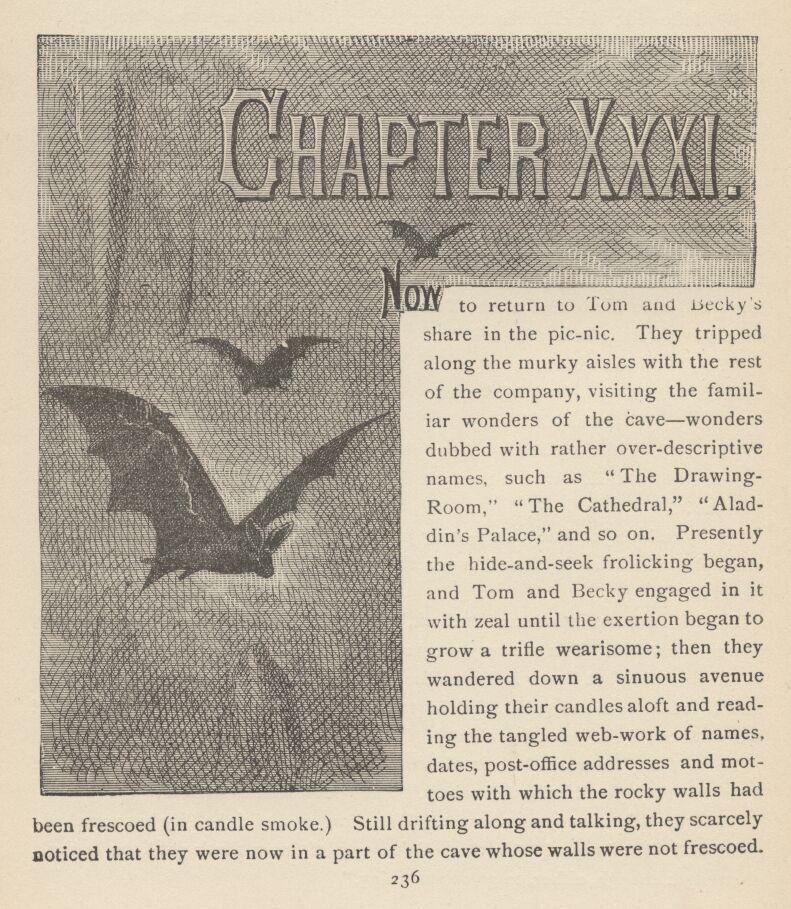
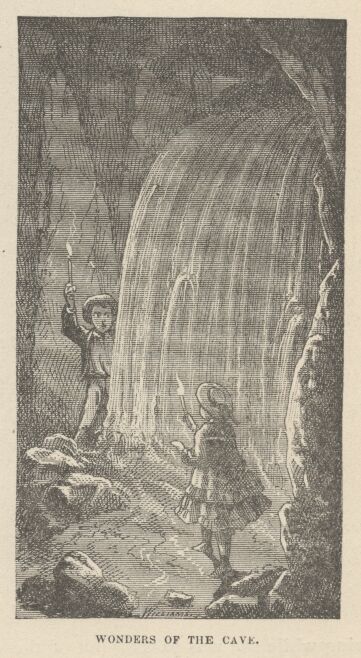
Now to return to Tom and Becky’s share in the picnic. They tripped along the murky aisles with the rest of the company, visiting the familiar wonders of the cave—wonders dubbed with rather over-descriptive names, such as “The Drawing-Room,” “The Cathedral,” “Aladdin’s Palace,” and so on. Presently the hide-and-seek frolicking began, and Tom and Becky engaged in it with zeal until the exertion began to grow a trifle wearisome; then they wandered down a sinuous avenue holding their candles aloft and reading the tangled webwork of names, dates, postoffice addresses, and mottoes with which the rocky walls had been frescoed (in candle-smoke). Still drifting along and talking, they scarcely noticed that they were now in a part of the cave whose walls were not frescoed. They smoked their own names under an overhanging shelf and moved on. Presently they came to a place where a little stream of water, trickling over a ledge and carrying a limestone sediment with it, had, in the slow-dragging ages, formed a laced and ruffled Niagara in gleaming and imperishable stone. Tom squeezed his small body behind it in order to illuminate it for Becky’s gratification. He found that it curtained a sort of steep natural stairway which was enclosed between narrow walls, and at once the ambition to be a discoverer seized him.
Now to return to Tom and Becky’s part in the picnic. They tripped along the dark passages with the rest of the party, visiting the familiar wonders of the cave. These wonders had been given rather overblown names, such as “The Drawing-Room,” “The Cathedral,” “Aladdin’s Palace,” and so on. Soon the hide-and-seek games began, and Tom and Becky joined in eagerly until the effort began to grow a little tiresome. Then they wandered down a winding passage, holding their candles high and reading the tangled web of names, dates, post-office addresses, and mottoes that the rocky walls had been frescoed with (in candle smoke). Still drifting along and talking, they hardly noticed that they were now in a part of the cave whose walls were not frescoed. They smoked their own names under an overhanging shelf and moved on. Soon they came to a place where, over the slow-dragging ages, a little stream of water trickling over a ledge and carrying limestone sediment with it had formed a laced and ruffled Niagara of gleaming, imperishable stone. Tom squeezed his small body behind it so he could light it up for Becky to enjoy. He found that it curtained a sort of steep natural stairway enclosed between narrow walls, and at once he was seized by the ambition to be a discoverer.
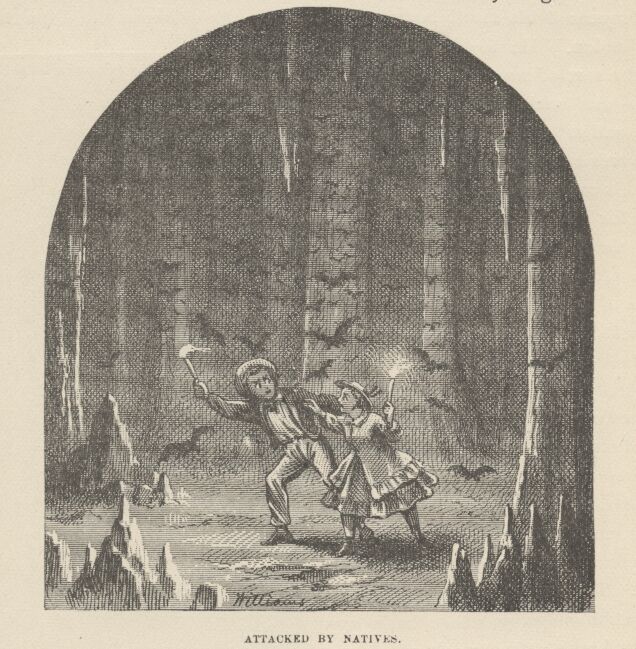
Becky responded to his call, and they made a smoke-mark for future guidance, and started upon their quest. They wound this way and that, far down into the secret depths of the cave, made another mark, and branched off in search of novelties to tell the upper world about. In one place they found a spacious cavern, from whose ceiling depended a multitude of shining stalactites of the length and circumference of a man’s leg; they walked all about it, wondering and admiring, and presently left it by one of the numerous passages that opened into it. This shortly brought them to a bewitching spring, whose basin was incrusted with a frostwork of glittering crystals; it was in the midst of a cavern whose walls were supported by many fantastic pillars which had been formed by the joining of great stalactites and stalagmites together, the result of the ceaseless water-drip of centuries. Under the roof vast knots of bats had packed themselves together, thousands in a bunch; the lights disturbed the creatures and they came flocking down by hundreds, squeaking and darting furiously at the candles. Tom knew their ways and the danger of this sort of conduct. He seized Becky’s hand and hurried her into the first corridor that offered; and none too soon, for a bat struck Becky’s light out with its wing while she was passing out of the cavern. The bats chased the children a good distance; but the fugitives plunged into every new passage that offered, and at last got rid of the perilous things. Tom found a subterranean lake, shortly, which stretched its dim length away until its shape was lost in the shadows. He wanted to explore its borders, but concluded that it would be best to sit down and rest awhile, first. Now, for the first time, the deep stillness of the place laid a clammy hand upon the spirits of the children. Becky said:
Becky answered his call, and they made a smoke mark to help them find their way back. Then they set off to explore. They wound this way and that, deep into the cave’s hidden passages, and made another mark. Then they took a new path, searching for unusual things to tell the world above about. In one place they found a spacious cavern with countless shining stalactites hanging from its ceiling. Each was as long and as thick around as a man’s leg. They walked all around the cavern, gazing in wonder and admiration. Soon they left through one of the many passages leading out of it. The passage soon brought them to an enchanting spring. Its basin was coated with glittering crystals that looked like frost. The spring lay in a cavern whose walls were supported by many strangely shaped pillars. These pillars had formed where great stalactites and stalagmites joined together, built by centuries of endlessly dripping water. Beneath the ceiling, bats were packed together in huge clusters, thousands in each. The candlelight disturbed them, and hundreds swooped down, squeaking and darting furiously at the candles. Tom knew how bats behaved and how dangerous these attacks could be. He grabbed Becky’s hand and hurried her into the first passage he saw. They escaped just in time. As Becky was leaving the cavern, a bat’s wing knocked out her candle flame. The bats chased the children for quite a distance. But the children rushed into every new passage they came to and finally escaped the dangerous creatures. Soon Tom found an underground lake. Its dim length stretched away until its outline disappeared into the shadows. He wanted to explore its shores, but decided they should sit down and rest a while first. Now, for the first time, the deep silence of the place laid a cold, damp hand on the children’s spirits. Becky said:
“Why, I didn’t notice, but it seems ever so long since I heard any of the others.”
“Well, I didn’t notice. But it feels like ages since I heard any of the others.”
“Come to think, Becky, we are away down below them—and I don’t know how far away north, or south, or east, or whichever it is. We couldn’t hear them here.”
“Now that I think about it, Becky, we’re far below them. And I don’t know how far north, south, east, or whatever direction we are from them. We couldn’t hear them here.”
Becky grew apprehensive.
Becky began to worry.
“I wonder how long we’ve been down here, Tom? We better start back.”
“I wonder how long we’ve been down here, Tom? We better head back.”
“Yes, I reckon we better. P’raps we better.”
“Yes, I reckon we better. Perhaps we better.”
“Can you find the way, Tom? It’s all a mixed-up crookedness to me.”
“Can you find the way, Tom? It all looks like a confusing tangle of twists and turns to me.”
“I reckon I could find it—but then the bats. If they put our candles out it will be an awful fix. Let’s try some other way, so as not to go through there.”
“I reckon I could find it. But then there are the bats. If they put our candles out, we’ll be in real trouble. Let’s try another way so we don’t have to go through there.”
“Well. But I hope we won’t get lost. It would be so awful!” and the girl shuddered at the thought of the dreadful possibilities.
“Well. But I hope we won’t get lost. It would be so awful!” The girl shuddered at the thought of all the terrible things that could happen.
They started through a corridor, and traversed it in silence a long way, glancing at each new opening, to see if there was anything familiar about the look of it; but they were all strange. Every time Tom made an examination, Becky would watch his face for an encouraging sign, and he would say cheerily:
They started down a corridor and walked a long way in silence. They glanced at each new opening to see if anything looked familiar, but all the openings were unfamiliar. Every time Tom checked an opening, Becky watched his face for an encouraging sign, and he would say cheerfully:
“Oh, it’s all right. This ain’t the one, but we’ll come to it right away!”
“Oh, it’s all right. This ain’t the one, but we’ll get to it right away!”
But he felt less and less hopeful with each failure, and presently began to turn off into diverging avenues at sheer random, in desperate hope of finding the one that was wanted. He still said it was “all right,” but there was such a leaden dread at his heart that the words had lost their ring and sounded just as if he had said, “All is lost!” Becky clung to his side in an anguish of fear, and tried hard to keep back the tears, but they would come. At last she said:
But he felt less and less hopeful with each failure. Soon he began turning into branching passages at random, desperately hoping to find the right one. He still said it was “all right,” but a heavy dread weighed on his heart. His words had lost their confidence and sounded just as if he had said, “All is lost!” Becky clung to his side, overwhelmed by fear. She tried hard to hold back her tears, but they kept coming. At last she said:
“Oh, Tom, never mind the bats, let’s go back that way! We seem to get worse and worse off all the time.”
“Oh, Tom, never mind the bats. Let’s go back that way! Things seem to keep getting worse and worse for us.”
“Listen!” said he.
“Listen!” he said.
Profound silence; silence so deep that even their breathings were conspicuous in the hush. Tom shouted. The call went echoing down the empty aisles and died out in the distance in a faint sound that resembled a ripple of mocking laughter.
Deep silence. It was so quiet that even their breathing stood out. Tom shouted. His call echoed down the empty aisles and faded into the distance, sounding faintly like a ripple of mocking laughter.
“Oh, don’t do it again, Tom, it is too horrid,” said Becky.
“Oh, don’t do it again, Tom. It’s too awful,” said Becky.
“It is horrid, but I better, Becky; they might hear us, you know,” and he shouted again.
“It’s awful, but I better, Becky. They might hear us, you know.” And he shouted again.
The “might” was even a chillier horror than the ghostly laughter, it so confessed a perishing hope. The children stood still and listened; but there was no result. Tom turned upon the back track at once, and hurried his steps. It was but a little while before a certain indecision in his manner revealed another fearful fact to Becky—he could not find his way back!
The word “might” was even more chilling than the ghostly laughter, because it revealed that hope was dying. The children stood still and listened, but heard nothing. Tom immediately turned back the way they had come and hurried along. Before long, his hesitation revealed another terrifying fact to Becky: he could not find his way back!
“Oh, Tom, you didn’t make any marks!”
“Oh, Tom, you didn’t make any marks!”
“Becky, I was such a fool! Such a fool! I never thought we might want to come back! No—I can’t find the way. It’s all mixed up.”
“Becky, I was such a fool! Such a fool! I never thought we might want to come back! No, I can’t find the way. It’s all mixed up.”
“Tom, Tom, we’re lost! we’re lost! We never can get out of this awful place! Oh, why did we ever leave the others!”
“Tom, Tom, we’re lost! We’re lost! We’ll never get out of this awful place! Oh, why did we ever leave the others!”
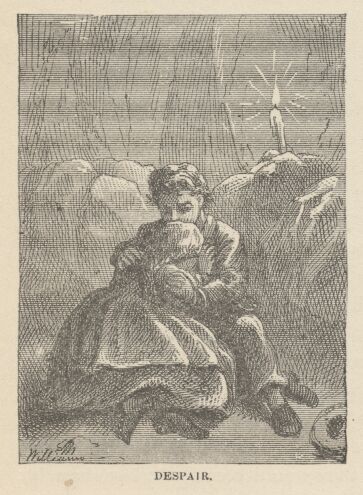
She sank to the ground and burst into such a frenzy of crying that Tom was appalled with the idea that she might die, or lose her reason. He sat down by her and put his arms around her; she buried her face in his bosom, she clung to him, she poured out her terrors, her unavailing regrets, and the far echoes turned them all to jeering laughter. Tom begged her to pluck up hope again, and she said she could not. He fell to blaming and abusing himself for getting her into this miserable situation; this had a better effect. She said she would try to hope again, she would get up and follow wherever he might lead if only he would not talk like that any more. For he was no more to blame than she, she said.
She sank to the ground and began crying so wildly that Tom feared she might die or lose her mind. He sat down beside her and put his arms around her. She buried her face in his chest and clung to him. She poured out her fears and her useless regrets, and the distant echoes turned them all into mocking laughter. Tom begged her to try to hope again, but she said she could not. He began blaming himself and calling himself names for getting her into this miserable situation. His self-blame had a better effect. She said she would try to hope again. She would get up and follow wherever he led, if only he would stop talking about himself that way. After all, she said, he was no more to blame than she was.
So they moved on again—aimlessly—simply at random—all they could do was to move, keep moving. For a little while, hope made a show of reviving—not with any reason to back it, but only because it is its nature to revive when the spring has not been taken out of it by age and familiarity with failure.
So they moved on again, aimlessly, at random. All they could do was move, keep moving. For a little while, hope seemed to return. There was no reason for it, but hope naturally revives when age and repeated failure haven't worn it down.
By-and-by Tom took Becky’s candle and blew it out. This economy meant so much! Words were not needed. Becky understood, and her hope died again. She knew that Tom had a whole candle and three or four pieces in his pockets—yet he must economize.
After a while, Tom took Becky’s candle and blew it out. Saving the candle meant so much! No words were needed. Becky understood, and her hope died again. She knew Tom had a whole candle and three or four pieces in his pockets. Yet he still had to save what they had.
By-and-by, fatigue began to assert its claims; the children tried to pay attention, for it was dreadful to think of sitting down when time was grown to be so precious, moving, in some direction, in any direction, was at least progress and might bear fruit; but to sit down was to invite death and shorten its pursuit.
Before long, the children began to feel exhausted. They tried to stay focused, because sitting down seemed dreadful now that time had become so precious. Moving in some direction, any direction, was at least progress and might lead to something. But sitting down meant inviting death and helping it catch up sooner.
At last Becky’s frail limbs refused to carry her farther. She sat down. Tom rested with her, and they talked of home, and the friends there, and the comfortable beds and, above all, the light! Becky cried, and Tom tried to think of some way of comforting her, but all his encouragements were grown thread-bare with use, and sounded like sarcasms. Fatigue bore so heavily upon Becky that she drowsed off to sleep. Tom was grateful. He sat looking into her drawn face and saw it grow smooth and natural under the influence of pleasant dreams; and by-and-by a smile dawned and rested there. The peaceful face reflected somewhat of peace and healing into his own spirit, and his thoughts wandered away to bygone times and dreamy memories. While he was deep in his musings, Becky woke up with a breezy little laugh—but it was stricken dead upon her lips, and a groan followed it.
At last, Becky’s weak legs could carry her no farther. She sat down. Tom rested with her, and they talked about home, their friends there, the comfortable beds, and above all, the light! Becky cried, and Tom tried to think of a way to comfort her. But he had repeated all his words of encouragement so often that they sounded like mockery. Becky was so exhausted that she drifted off to sleep. Tom was grateful. He sat looking at her strained face and watched it relax and look natural again as she dreamed pleasant dreams. After a while, a smile appeared and stayed on her face. Her peaceful face brought some peace and comfort to his own troubled mind. His thoughts wandered back to old times and dreamy memories. While he was lost in thought, Becky woke with a cheerful little laugh. But the laugh died on her lips, and a groan followed.
“Oh, how could I sleep! I wish I never, never had waked! No! No, I don’t, Tom! Don’t look so! I won’t say it again.”
“Oh, how could I sleep! I wish I had never, never woken up! No! No, I don’t, Tom! Don’t look like that! I won’t say it again.”
“I’m glad you’ve slept, Becky; you’ll feel rested, now, and we’ll find the way out.”
“I’m glad you got some sleep, Becky. You’ll feel rested now, and we’ll find the way out.”
“We can try, Tom; but I’ve seen such a beautiful country in my dream. I reckon we are going there.”
“We can try, Tom. But I’ve seen such a beautiful country in my dream. I reckon we’re going there.”
“Maybe not, maybe not. Cheer up, Becky, and let’s go on trying.”
“Maybe not, maybe not. Cheer up, Becky, and let’s keep trying.”
They rose up and wandered along, hand in hand and hopeless. They tried to estimate how long they had been in the cave, but all they knew was that it seemed days and weeks, and yet it was plain that this could not be, for their candles were not gone yet. A long time after this—they could not tell how long—Tom said they must go softly and listen for dripping water—they must find a spring. They found one presently, and Tom said it was time to rest again. Both were cruelly tired, yet Becky said she thought she could go a little farther. She was surprised to hear Tom dissent. She could not understand it. They sat down, and Tom fastened his candle to the wall in front of them with some clay. Thought was soon busy; nothing was said for some time. Then Becky broke the silence:
They got up and wandered on, hand in hand and without hope. They tried to work out how long they had been in the cave. All they knew was that it felt like days and weeks. Yet clearly it could not have been that long, because their candles had not burned out yet. A long time later, though they could not tell how long, Tom said they must walk quietly. They had to listen for dripping water and find a spring. Soon they found one, and Tom said it was time to rest again. Both were terribly tired, but Becky said she thought she could go a little farther. She was surprised when Tom disagreed. She could not understand why. They sat down, and Tom used some clay to attach his candle to the wall in front of them. Soon they were lost in thought, and neither spoke for a while. Then Becky broke the silence:
“Tom, I am so hungry!”
“Tom, I’m so hungry!”
Tom took something out of his pocket.
Tom took something out of his pocket.
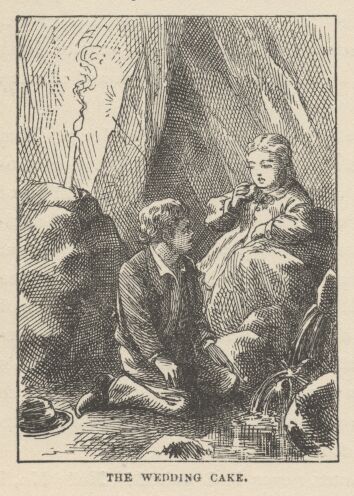
“Do you remember this?” said he.
“Do you remember this?” he asked.
Becky almost smiled.
Becky almost smiled.
“It’s our wedding-cake, Tom.”
“It’s our wedding cake, Tom.”
“Yes—I wish it was as big as a barrel, for it’s all we’ve got.”
“Yes, I wish it was as big as a barrel, because it’s all we’ve got.”
“I saved it from the picnic for us to dream on, Tom, the way grownup people do with wedding-cake—but it’ll be our—”
“I saved it from the picnic for us to dream on, Tom. Just like grownups do with wedding cake. But it’ll be our...”
She dropped the sentence where it was. Tom divided the cake and Becky ate with good appetite, while Tom nibbled at his moiety. There was abundance of cold water to finish the feast with. By-and-by Becky suggested that they move on again. Tom was silent a moment. Then he said:
She left the sentence unfinished. Tom divided the cake, and Becky ate eagerly while Tom nibbled at his half. There was plenty of cold water to finish off the feast. After a while, Becky suggested they move on again. Tom was silent for a moment. Then he said:
“Becky, can you bear it if I tell you something?”
“Becky, can you handle it if I tell you something?”
Becky’s face paled, but she thought she could.
Becky’s face turned pale, but she thought she could.
“Well, then, Becky, we must stay here, where there’s water to drink. That little piece is our last candle!”
“Well, then, Becky, we have to stay here, where there’s water to drink. That little piece of candle is our last one!”
Becky gave loose to tears and wailings. Tom did what he could to comfort her, but with little effect. At length Becky said:
Becky burst into tears and loud sobs. Tom did what he could to comfort her, but it did little good. Finally, Becky said:
“Tom!”
“Tom!”
“Well, Becky?”
“Well, Becky?”
“They’ll miss us and hunt for us!”
“They’ll miss us and look for us!”
“Yes, they will! Certainly they will!”
“Yes, they will! They definitely will!”
“Maybe they’re hunting for us now, Tom.”
“Maybe they’re looking for us now, Tom.”
“Why, I reckon maybe they are. I hope they are.”
“Why, I reckon maybe they are. I hope they are.”
“When would they miss us, Tom?”
“When would they notice we were gone, Tom?”
“When they get back to the boat, I reckon.”
“When they get back to the boat, I reckon.”
“Tom, it might be dark then—would they notice we hadn’t come?”
“Tom, it might be dark by then. Would they notice we hadn’t come?”
“I don’t know. But anyway, your mother would miss you as soon as they got home.”
“I don’t know. But anyway, your mother would notice you were missing as soon as they got home.”
A frightened look in Becky’s face brought Tom to his senses and he saw that he had made a blunder. Becky was not to have gone home that night! The children became silent and thoughtful. In a moment a new burst of grief from Becky showed Tom that the thing in his mind had struck hers also—that the Sabbath morning might be half spent before Mrs. Thatcher discovered that Becky was not at Mrs. Harper’s.
The frightened look on Becky’s face brought Tom to his senses, and he realized he had made a mistake. Becky wasn’t supposed to go home that night! The children grew quiet and thoughtful. A moment later, Becky burst into tears again, showing Tom that she had realized the same thing he had. Sunday morning might be half over before Mrs. Thatcher discovered that Becky wasn’t at Mrs. Harper’s.
The children fastened their eyes upon their bit of candle and watched it melt slowly and pitilessly away; saw the half inch of wick stand alone at last; saw the feeble flame rise and fall, climb the thin column of smoke, linger at its top a moment, and then—the horror of utter darkness reigned!
The children stared at their little piece of candle and watched it melt slowly and mercilessly away. At last, only half an inch of wick stood alone. They watched the weak flame rise and fall, climb the thin trail of smoke, and linger briefly at the top. Then the horror of complete darkness took over!
How long afterward it was that Becky came to a slow consciousness that she was crying in Tom’s arms, neither could tell. All that they knew was, that after what seemed a mighty stretch of time, both awoke out of a dead stupor of sleep and resumed their miseries once more. Tom said it might be Sunday, now—maybe Monday. He tried to get Becky to talk, but her sorrows were too oppressive, all her hopes were gone. Tom said that they must have been missed long ago, and no doubt the search was going on. He would shout and maybe some one would come. He tried it; but in the darkness the distant echoes sounded so hideously that he tried it no more.
Neither could say how much time had passed before Becky slowly realized she was crying in Tom’s arms. All they knew was that, after what seemed like an eternity, they both woke from a deep, heavy sleep. Then their misery began again. Tom said it might be Sunday now, maybe Monday. He tried to get Becky to talk, but her grief overwhelmed her. All her hopes were gone. Tom said people must have noticed they were missing long ago. No doubt a search was underway. He would shout, and maybe someone would come. He tried, but the distant echoes sounded so horrifying in the darkness that he did not shout again.
The hours wasted away, and hunger came to torment the captives again. A portion of Tom’s half of the cake was left; they divided and ate it. But they seemed hungrier than before. The poor morsel of food only whetted desire.
The hours dragged on, and hunger began to torment the captives again. Some of Tom’s half of the cake was left. They split what remained and ate it. But they seemed hungrier than before. The tiny bit of food only made them want more.
By-and-by Tom said:
After a while, Tom said:
“SH! Did you hear that?”
“SHH! Did you hear that?”
Both held their breath and listened. There was a sound like the faintest, far-off shout. Instantly Tom answered it, and leading Becky by the hand, started groping down the corridor in its direction. Presently he listened again; again the sound was heard, and apparently a little nearer.
Both held their breath and listened. They heard what sounded like a very faint shout from far away. Tom called back at once. Holding Becky’s hand, he began feeling his way down the corridor toward the sound. Soon he stopped to listen again. The sound came again and seemed a little closer.
“It’s them!” said Tom; “they’re coming! Come along, Becky—we’re all right now!”
“It’s them!” said Tom. “They’re coming! Come on, Becky. We’re all right now!”
The joy of the prisoners was almost overwhelming. Their speed was slow, however, because pitfalls were somewhat common, and had to be guarded against. They shortly came to one and had to stop. It might be three feet deep, it might be a hundred—there was no passing it at any rate. Tom got down on his breast and reached as far down as he could. No bottom. They must stay there and wait until the searchers came. They listened; evidently the distant shoutings were growing more distant! a moment or two more and they had gone altogether. The heart-sinking misery of it! Tom whooped until he was hoarse, but it was of no use. He talked hopefully to Becky; but an age of anxious waiting passed and no sounds came again.
The prisoners’ joy was almost overwhelming. But they moved slowly because pits were fairly common, and they had to watch out for them. Soon they reached one and had to stop. It might be three feet deep, or it might be a hundred. Either way, they could not get across. Tom lay on his stomach and reached down as far as he could. He could not touch the bottom. They would have to stay there and wait for the searchers. They listened. The distant shouts seemed to be growing even more distant! A moment or two later, the shouts had faded away completely. Their hearts sank in misery! Tom shouted until he was hoarse, but it was no use. He spoke hopefully to Becky. But they waited anxiously for what felt like ages, and no sounds came again.
The children groped their way back to the spring. The weary time dragged on; they slept again, and awoke famished and woe-stricken. Tom believed it must be Tuesday by this time.
The children felt their way back to the spring. The exhausting hours dragged on. They slept again and woke up starving and miserable. Tom believed it must be Tuesday by now.
Now an idea struck him. There were some side passages near at hand. It would be better to explore some of these than bear the weight of the heavy time in idleness. He took a kite-line from his pocket, tied it to a projection, and he and Becky started, Tom in the lead, unwinding the line as he groped along. At the end of twenty steps the corridor ended in a “jumping-off place.” Tom got down on his knees and felt below, and then as far around the corner as he could reach with his hands conveniently; he made an effort to stretch yet a little farther to the right, and at that moment, not twenty yards away, a human hand, holding a candle, appeared from behind a rock! Tom lifted up a glorious shout, and instantly that hand was followed by the body it belonged to—Injun Joe’s! Tom was paralyzed; he could not move. He was vastly gratified the next moment, to see the “Spaniard” take to his heels and get himself out of sight. Tom wondered that Joe had not recognized his voice and come over and killed him for testifying in court. But the echoes must have disguised the voice. Without doubt, that was it, he reasoned. Tom’s fright weakened every muscle in his body. He said to himself that if he had strength enough to get back to the spring he would stay there, and nothing should tempt him to run the risk of meeting Injun Joe again. He was careful to keep from Becky what it was he had seen. He told her he had only shouted “for luck.”
Then an idea struck him. There were some side passages nearby. Exploring some of them would be better than doing nothing while time dragged painfully on. He took a kite string from his pocket and tied it to a piece of rock sticking out. Then he and Becky set off, with Tom leading, unwinding the string as he felt his way along. After twenty steps, the passage ended at a “drop-off.” Tom got down on his knees and felt below him. Then he felt around the corner as far as his hands could easily reach. He tried to stretch a little farther to the right. At that moment, less than twenty yards away, a human hand holding a candle appeared from behind a rock! Tom let out a joyful shout. Instantly, the person holding the candle stepped into view. It was Injun Joe! Tom froze. He could not move. A moment later, he was enormously relieved to see the “Spaniard” turn and run out of sight. Tom wondered why Joe had not recognized his voice and come over to kill him for testifying in court. But the echoes must have disguised his voice. That had to be the explanation, he reasoned. Fear left every muscle in Tom’s body weak. He told himself that if he had enough strength to get back to the spring, he would stay there. Nothing would tempt him to risk meeting Injun Joe again. He was careful not to tell Becky what he had seen. He told her he had only shouted “for luck.”
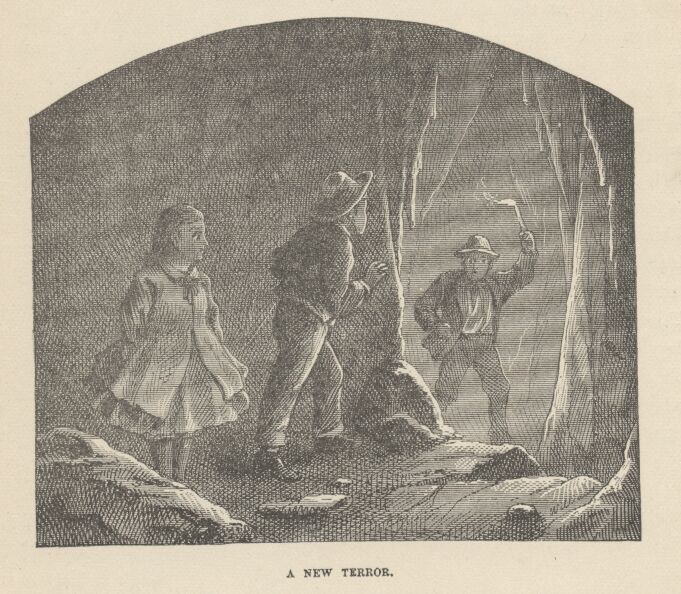
But hunger and wretchedness rise superior to fears in the long run. Another tedious wait at the spring and another long sleep brought changes. The children awoke tortured with a raging hunger. Tom believed that it must be Wednesday or Thursday or even Friday or Saturday, now, and that the search had been given over. He proposed to explore another passage. He felt willing to risk Injun Joe and all other terrors. But Becky was very weak. She had sunk into a dreary apathy and would not be roused. She said she would wait, now, where she was, and die—it would not be long. She told Tom to go with the kite-line and explore if he chose; but she implored him to come back every little while and speak to her; and she made him promise that when the awful time came, he would stay by her and hold her hand until all was over.
But in the long run, hunger and misery overcome fear. Another dull wait at the spring and another long sleep brought changes. The children woke up tormented by intense hunger. Tom thought it must be Wednesday or Thursday by now, or even Friday or Saturday. He believed the search had been abandoned. He suggested exploring another passage. He was willing to risk facing Injun Joe and all the other terrors. But Becky was very weak. She had sunk into hopeless indifference, and nothing could rouse her. She said she would stay where she was now and die. It would not take long. She told Tom to take the kite-line and explore if he wanted. But she begged him to come back every little while and talk to her. And she made him promise to stay beside her when the awful time came. He was to hold her hand until it was all over.
Tom kissed her, with a choking sensation in his throat, and made a show of being confident of finding the searchers or an escape from the cave; then he took the kite-line in his hand and went groping down one of the passages on his hands and knees, distressed with hunger and sick with bodings of coming doom.
Tom kissed her, his throat tight with emotion. He acted confident that he could find the searchers or a way out of the cave. Then he took the kite string in his hand and crawled down one of the passages, feeling his way. He was painfully hungry and sick with dread of the doom he felt approaching.