Chapter 27
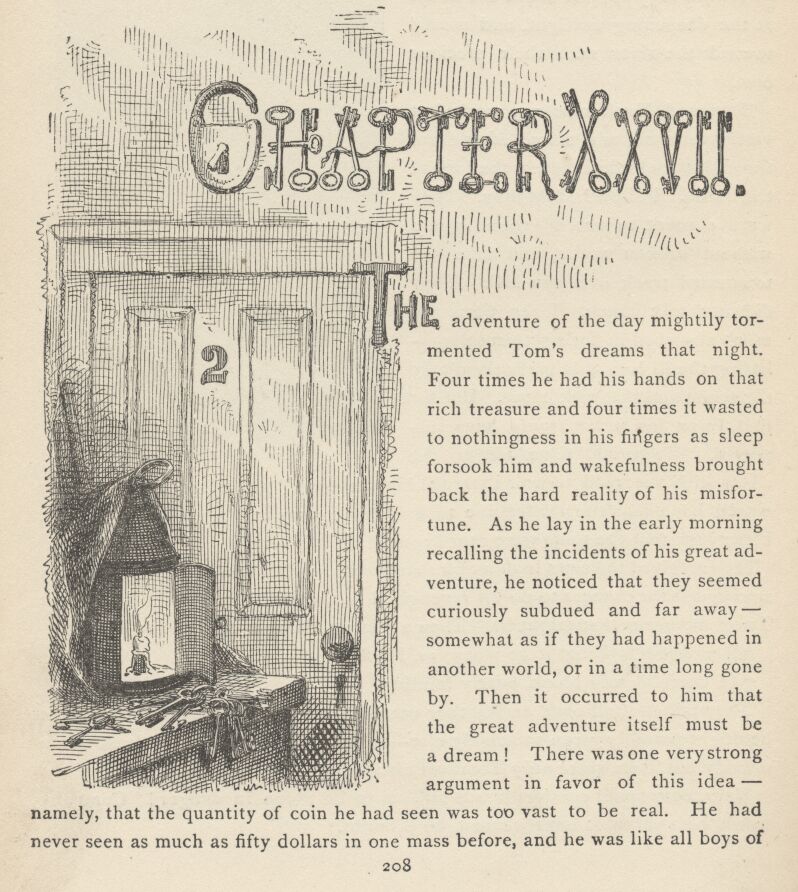
The adventure of the day mightily tormented Tom’s dreams that night. Four times he had his hands on that rich treasure and four times it wasted to nothingness in his fingers as sleep forsook him and wakefulness brought back the hard reality of his misfortune. As he lay in the early morning recalling the incidents of his great adventure, he noticed that they seemed curiously subdued and far away—somewhat as if they had happened in another world, or in a time long gone by. Then it occurred to him that the great adventure itself must be a dream! There was one very strong argument in favor of this idea—namely, that the quantity of coin he had seen was too vast to be real. He had never seen as much as fifty dollars in one mass before, and he was like all boys of his age and station in life, in that he imagined that all references to “hundreds” and “thousands” were mere fanciful forms of speech, and that no such sums really existed in the world. He never had supposed for a moment that so large a sum as a hundred dollars was to be found in actual money in any one’s possession. If his notions of hidden treasure had been analyzed, they would have been found to consist of a handful of real dimes and a bushel of vague, splendid, ungraspable dollars.
The day’s adventure badly troubled Tom’s dreams that night. Four times he held that rich treasure in his hands. Four times it vanished between his fingers as he woke and faced the hard reality of his bad luck. As he lay in bed early that morning, remembering his great adventure, the events seemed strangely faded and far away. It was almost as if they had happened in another world or long ago. Then he thought the great adventure itself must have been a dream! One very strong reason supported this idea: he had seen far too many coins for them to be real. He had never seen even fifty dollars all together before. Like all boys of his age and position in life, he thought talk of “hundreds” and “thousands” was just fanciful language. He believed no such amounts really existed in the world. He had never imagined for a moment that anyone actually possessed as much as a hundred dollars in real money. If anyone had examined his ideas about hidden treasure, they would have found a handful of real dimes. The rest was a bushel of vague, glorious dollars he could never quite picture or grasp.
But the incidents of his adventure grew sensibly sharper and clearer under the attrition of thinking them over, and so he presently found himself leaning to the impression that the thing might not have been a dream, after all. This uncertainty must be swept away. He would snatch a hurried breakfast and go and find Huck.
But the details of his adventure grew noticeably sharper and clearer as he thought them over. So he soon began to think the adventure might not have been a dream after all. He had to clear up this uncertainty. He would grab a quick breakfast and go find Huck.
Huck was sitting on the gunwale of a flatboat, listlessly dangling his feet in the water and looking very melancholy. Tom concluded to let Huck lead up to the subject. If he did not do it, then the adventure would be proved to have been only a dream.
Huck was sitting on the edge of a flatboat, dangling his feet listlessly in the water and looking very sad. Tom decided to let Huck bring up the subject. If Huck didn't bring it up, that would prove the adventure had only been a dream.
“Hello, Huck!”
“Hello, Huck!”
“Hello, yourself.”
“Hello to you, too.”
Silence, for a minute.
There was silence for a minute.
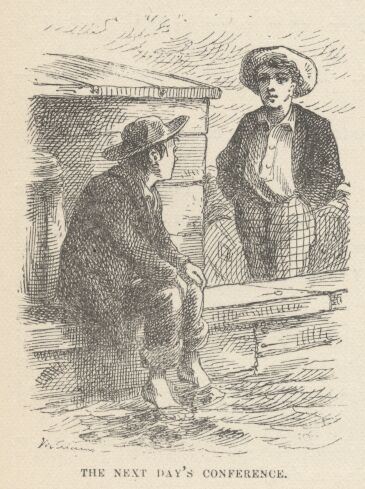
“Tom, if we’d ’a’ left the blame tools at the dead tree, we’d ’a’ got the money. Oh, ain’t it awful!”
“Tom, if we’d have left the blame tools at the dead tree, we’d have got the money. Oh, ain’t it awful!”
“’Tain’t a dream, then, ’tain’t a dream! Somehow I most wish it was. Dog’d if I don’t, Huck.”
“It ain't a dream, then, it ain't a dream! Somehow I almost wish it was. Dogged if I don't, Huck.”
“What ain’t a dream?”
“What ain’t a dream?”
“Oh, that thing yesterday. I been half thinking it was.”
“Oh, that thing yesterday. I been half thinking it was.”
“Dream! If them stairs hadn’t broke down you’d ’a’ seen how much dream it was! I’ve had dreams enough all night—with that patch-eyed Spanish devil going for me all through ’em—rot him!”
“Dream! If them stairs hadn’t broke down, you’d have seen how much dream it was! I’ve had dreams enough all night, with that Spanish devil with the eye patch coming after me through all of them. Rot him!”
“No, not rot him. Find him! Track the money!”
“No, not rot him. Find him! Track the money!”
“Tom, we’ll never find him. A feller don’t have only one chance for such a pile—and that one’s lost. I’d feel mighty shaky if I was to see him, anyway.”
“Tom, we’ll never find him. A fellow don’t have only one chance at that much money, and that chance is lost. I’d feel mighty shaky if I was to see him, anyway.”
“Well, so’d I; but I’d like to see him, anyway—and track him out—to his Number Two.”
“Well, so would I. But I’d like to see him, anyway, and track him out to his Number Two.”
“Number Two—yes, that’s it. I been thinking ’bout that. But I can’t make nothing out of it. What do you reckon it is?”
“Number Two, yes, that’s it. I been thinking about that. But I can’t make nothing out of it. What do you reckon it is?”
“I dono. It’s too deep. Say, Huck—maybe it’s the number of a house!”
“I don't know. It's too hard to figure out. Say, Huck, maybe it's a house number!”
“Goody!... No, Tom, that ain’t it. If it is, it ain’t in this one-horse town. They ain’t no numbers here.”
“Great!... No, Tom, that ain’t it. If it is, it ain’t in this little backwater town. They ain’t no numbers here.”
“Well, that’s so. Lemme think a minute. Here—it’s the number of a room—in a tavern, you know!”
“Well, that’s true. Let me think a minute. Here, it’s a room number. In an inn, you know!”
“Oh, that’s the trick! They ain’t only two taverns. We can find out quick.”
“Oh, that’s the trick! They ain’t only two inns. We can find out quick.”
“You stay here, Huck, till I come.”
“You stay here, Huck, until I come back.”
Tom was off at once. He did not care to have Huck’s company in public places. He was gone half an hour. He found that in the best tavern, No. 2 had long been occupied by a young lawyer, and was still so occupied. In the less ostentatious house, No. 2 was a mystery. The tavern-keeper’s young son said it was kept locked all the time, and he never saw anybody go into it or come out of it except at night; he did not know any particular reason for this state of things; had had some little curiosity, but it was rather feeble; had made the most of the mystery by entertaining himself with the idea that that room was “ha’nted”; had noticed that there was a light in there the night before.
Tom left at once. He did not want to be seen with Huck in public places. He was gone half an hour. He learned that room No. 2 in the best tavern had long been occupied by a young lawyer. The lawyer was still staying there. At the less fancy tavern, room No. 2 was a mystery. The tavern keeper’s young son said the room was kept locked all the time. He never saw anyone go in or come out except at night. He knew no particular reason why the room was kept that way. He had been a little curious, but not very. He had made the most of the mystery by amusing himself with the idea that the room was “haunted”. He had noticed a light in the room the night before.
“That’s what I’ve found out, Huck. I reckon that’s the very No. 2 we’re after.”
“That’s what I’ve found out, Huck. I reckon that’s the exact No. 2 we’re looking for.”
“I reckon it is, Tom. Now what you going to do?”
“I reckon it is, Tom. Now what you going to do?”
“Lemme think.”
“Let me think.”
Tom thought a long time. Then he said:
Tom thought for a long time. Then he said:
“I’ll tell you. The back door of that No. 2 is the door that comes out into that little close alley between the tavern and the old rattle trap of a brick store. Now you get hold of all the doorkeys you can find, and I’ll nip all of auntie’s, and the first dark night we’ll go there and try ’em. And mind you, keep a lookout for Injun Joe, because he said he was going to drop into town and spy around once more for a chance to get his revenge. If you see him, you just follow him; and if he don’t go to that No. 2, that ain’t the place.”
“I’ll tell you. The back door of that No. 2 opens into that narrow little alley. It’s between the tavern and the old, run-down brick store. Now you get hold of all the door keys you can find, and I’ll sneak off with all of auntie’s. The first dark night, we’ll go there and try them. And mind you, keep a lookout for Injun Joe. He said he was going to drop into town and look around once more for a chance to get his revenge. If you see him, you just follow him. And if he don’t go to that No. 2, that ain’t the place.”
“Lordy, I don’t want to foller him by myself!”
“Lordy, I don’t want to follow him by myself!”
“Why, it’ll be night, sure. He mightn’t ever see you—and if he did, maybe he’d never think anything.”
“Why, it’ll be nighttime for sure. He might never see you. And if he did, maybe he wouldn’t think anything of it.”
“Well, if it’s pretty dark I reckon I’ll track him. I dono—I dono. I’ll try.”
“Well, if it’s pretty dark I reckon I’ll track him. I don’t know. I don’t know. I’ll try.”
“You bet I’ll follow him, if it’s dark, Huck. Why, he might ’a’ found out he couldn’t get his revenge, and be going right after that money.”
“You bet I’ll follow him if it’s dark, Huck. Why, he might have found out he couldn’t get his revenge. And he might be going straight after that money.”
“It’s so, Tom, it’s so. I’ll foller him; I will, by jingoes!”
“It’s so, Tom, it’s so. I’ll follow him. I will, by jingoes!”
“Now you’re talking! Don’t you ever weaken, Huck, and I won’t.”
“Now you’re talking! Don’t you ever give up, Huck, and I won’t either.”