Chapter 19
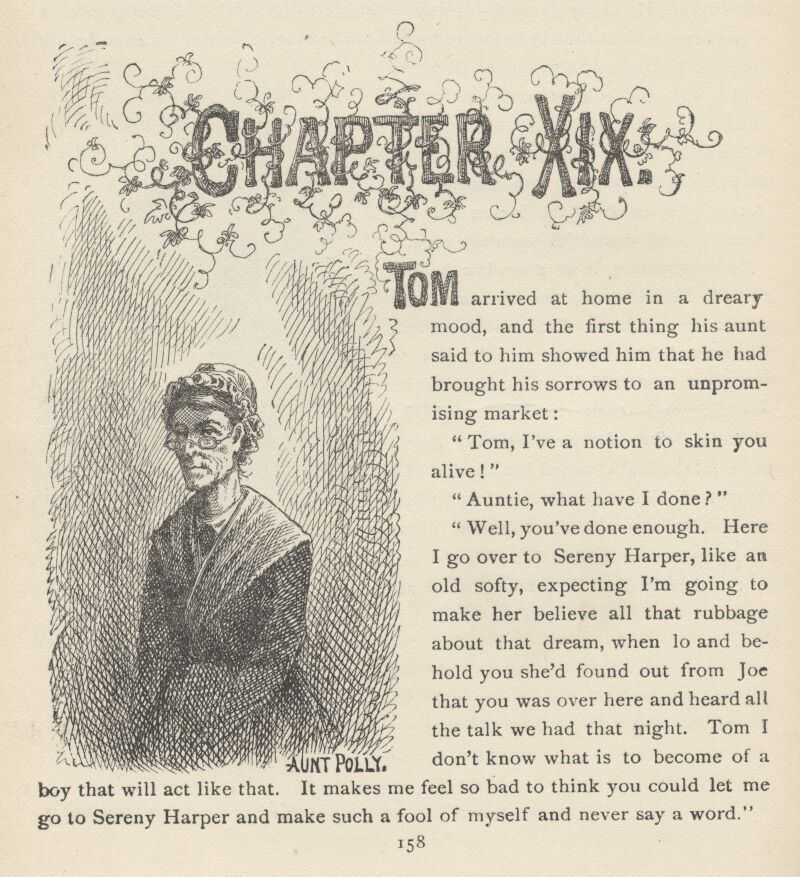
Tom arrived at home in a dreary mood, and the first thing his aunt said to him showed him that he had brought his sorrows to an unpromising market:
Tom came home feeling miserable. And the first thing his aunt said showed him he had come to the wrong place for sympathy:
“Tom, I’ve a notion to skin you alive!”
“Tom, I feel like skinning you alive!”
“Auntie, what have I done?”
“Auntie, what have I done?”
“Well, you’ve done enough. Here I go over to Sereny Harper, like an old softy, expecting I’m going to make her believe all that rubbage about that dream, when lo and behold you she’d found out from Joe that you was over here and heard all the talk we had that night. Tom, I don’t know what is to become of a boy that will act like that. It makes me feel so bad to think you could let me go to Sereny Harper and make such a fool of myself and never say a word.”
“Well, you’ve done enough. Here I go over to Sereny Harper, like an old softy. I’m expecting to make her believe all that rubbish about that dream. But wouldn’t you know, she’d found out from Joe that you was over here. She knew you’d heard all the talk we had that night. Tom, I don’t know what will become of a boy that will act like that. It makes me feel so bad to think you could let me go to Sereny Harper. You let me make such a fool of myself and never said a word.”
This was a new aspect of the thing. His smartness of the morning had seemed to Tom a good joke before, and very ingenious. It merely looked mean and shabby now. He hung his head and could not think of anything to say for a moment. Then he said:
This was a new way of looking at things. Tom had thought his clever trick that morning was a good joke, and very clever. Now it just seemed mean and shameful. He hung his head and, for a moment, could not think of anything to say. Then he said:
“Auntie, I wish I hadn’t done it—but I didn’t think.”
“Auntie, I wish I hadn’t done it, but I wasn’t thinking.”
“Oh, child, you never think. You never think of anything but your own selfishness. You could think to come all the way over here from Jackson’s Island in the night to laugh at our troubles, and you could think to fool me with a lie about a dream; but you couldn’t ever think to pity us and save us from sorrow.”
“Oh, child, you never think. You never think about anything but yourself. You could think to come all the way here from Jackson’s Island at night to laugh at our troubles. And you could think to fool me with a lie about a dream. But you couldn’t ever think to feel sorry for us and spare us this sadness.”
“Auntie, I know now it was mean, but I didn’t mean to be mean. I didn’t, honest. And besides, I didn’t come over here to laugh at you that night.”
“Auntie, I know now it was mean, but I didn’t mean to be mean. I didn’t, honest. And besides, I didn’t come over here to laugh at you that night.”
“What did you come for, then?”
“Why did you come, then?”
“It was to tell you not to be uneasy about us, because we hadn’t got drownded.”
“It was to tell you not to worry about us, because we hadn’t drowned.”
“Tom, Tom, I would be the thankfullest soul in this world if I could believe you ever had as good a thought as that, but you know you never did—and I know it, Tom.”
“Tom, Tom, I would be the thankfullest soul in this world if I could believe you ever had as good a thought as that. But you know you never did, and I know it, Tom.”
“Indeed and ’deed I did, auntie—I wish I may never stir if I didn’t.”
“I really, truly did, auntie. May I never move again if I didn’t.”
“Oh, Tom, don’t lie—don’t do it. It only makes things a hundred times worse.”
“Oh, Tom, don’t lie. Don’t do it. Lying only makes things a hundred times worse.”
“It ain’t a lie, auntie; it’s the truth. I wanted to keep you from grieving—that was all that made me come.”
“It ain’t a lie, auntie. It’s the truth. I wanted to keep you from feeling sad. That was the only reason I came.”
“I’d give the whole world to believe that—it would cover up a power of sins, Tom. I’d ’most be glad you’d run off and acted so bad. But it ain’t reasonable; because, why didn’t you tell me, child?”
“I’d give the whole world to believe that. It would cover up a whole lot of sins, Tom. I’d almost be glad you’d run off and acted so bad. But it ain’t reasonable, because why didn’t you tell me, child?”
“Why, you see, when you got to talking about the funeral, I just got all full of the idea of our coming and hiding in the church, and I couldn’t somehow bear to spoil it. So I just put the bark back in my pocket and kept mum.”
“Well, you see, when you started talking about the funeral, I got caught up in the idea. We could come and hide in the church, and I somehow couldn’t bear to spoil the plan. So I just put the bark back in my pocket and kept quiet.”
“What bark?”
“What bark?”
“The bark I had wrote on to tell you we’d gone pirating. I wish, now, you’d waked up when I kissed you—I do, honest.”
“The tree bark I had wrote on to tell you we’d gone pirating. I wish now you’d waked up when I kissed you. I do, honest.”
The hard lines in his aunt’s face relaxed and a sudden tenderness dawned in her eyes.
The stern lines in his aunt’s face softened. And a sudden tenderness appeared in her eyes.
“Did you kiss me, Tom?”
“Did you kiss me, Tom?”
“Why, yes, I did.”
“Why, yes, I did.”
“Are you sure you did, Tom?”
“Are you sure you did, Tom?”
“Why, yes, I did, auntie—certain sure.”
“Why, yes, I did, auntie. I sure did.”
“What did you kiss me for, Tom?”
“Why did you kiss me, Tom?”
“Because I loved you so, and you laid there moaning and I was so sorry.”
“Because I loved you so much, and you laid there moaning, and I felt so sorry.”
The words sounded like truth. The old lady could not hide a tremor in her voice when she said:
The words sounded true. The old woman could not hide the shake in her voice when she said:
“Kiss me again, Tom!—and be off with you to school, now, and don’t bother me any more.”
“Kiss me again, Tom! Now go off to school, and don’t bother me anymore.”
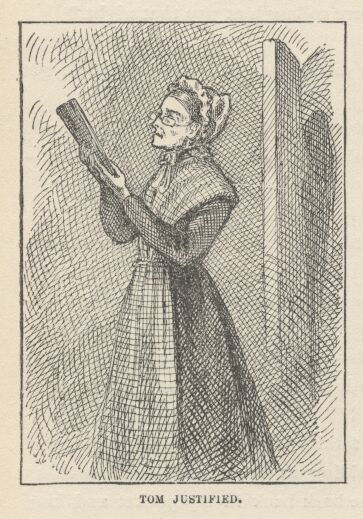
The moment he was gone, she ran to a closet and got out the ruin of a jacket which Tom had gone pirating in. Then she stopped, with it in her hand, and said to herself:
As soon as he left, she ran to a closet and pulled out the ruined jacket Tom had worn while playing pirate. Then she stopped, holding the jacket in her hand, and said to herself:
“No, I don’t dare. Poor boy, I reckon he’s lied about it—but it’s a blessed, blessed lie, there’s such a comfort come from it. I hope the Lord—I know the Lord will forgive him, because it was such good-heartedness in him to tell it. But I don’t want to find out it’s a lie. I won’t look.”
“No, I don’t dare. Poor boy, I reckon he’s lied about it. But it’s a blessed, blessed lie. It’s brought such comfort. I hope the Lord will forgive him. I know the Lord will, because he was so kindhearted to tell that lie. But I don’t want to find out it’s a lie. I won’t look.”
She put the jacket away, and stood by musing a minute. Twice she put out her hand to take the garment again, and twice she refrained. Once more she ventured, and this time she fortified herself with the thought: “It’s a good lie—it’s a good lie—I won’t let it grieve me.” So she sought the jacket pocket. A moment later she was reading Tom’s piece of bark through flowing tears and saying: “I could forgive the boy, now, if he’d committed a million sins!”
She put the jacket away and stood thinking for a minute. Twice she reached out to take the jacket again, and twice she stopped herself. Once more she tried, this time giving herself courage with the thought: “It’s a good lie. It’s a good lie. I won’t let it upset me.” So she reached into the jacket pocket. A moment later, she was reading Tom’s piece of bark with tears streaming down her face. She said: “I could forgive the boy now, even if he’d committed a million sins!”