Weather
By L. D. A. HUSSEY, B.Sc., (Lond.), Capt. R.G.A.
By L. D. A. Hussey, B.Sc. (London), Captain, Royal Garrison Artillery.
The meteorological results of the Expedition, when properly worked out and correlated with those from other stations in the southern hemisphere, will be extremely valuable, both for their bearing on the science of meteorology in general, and for their practical and economic applications.
Once the expedition’s weather data has been properly analyzed and compared with data from other stations in the southern hemisphere, it will be extremely valuable. It will advance meteorology in general and have practical and economic uses.
South America is, perhaps, more intimately concerned than any other country, but Australia, New Zealand, and South Africa are all affected by the weather conditions of the Antarctic. Researches are now being carried on which tend to show that the meteorology of the two hemispheres is more interdependent than was hitherto believed, so that a meteorological disturbance in one part of the world makes its presence felt, more or less remotely perhaps, all over the world.
South America is perhaps more directly affected than any other country. But Australia, New Zealand, and South Africa are all affected by Antarctic weather conditions. Research now underway suggests that weather in the two hemispheres is more interconnected than previously believed. A weather disturbance in one part of the world may therefore be felt everywhere, perhaps only indirectly.
It is evident, therefore, that a complete knowledge of the weather conditions in any part of the world, which it is understood carries with it the ability to make correct forecasts, can never be obtained unless the weather conditions in every other part are known. This makes the need for purely scientific Polar Expeditions so imperative, since our present knowledge of Arctic and Antarctic meteorology is very meagre, and to a certain extent unsystematic. What is wanted is a chain of observing stations well equipped with instruments and trained observers stretching across the Antarctic Continent. A series of exploring ships could supplement these observations with others made by them while cruising in the Antarctic Seas. It would pay to do this, even for the benefit accruing to farmers, sailors, and others who are so dependent on the weather.
Clearly, we can never fully understand the weather in any part of the world unless we know the weather conditions everywhere else. Complete knowledge is understood to include the ability to make accurate forecasts. This makes purely scientific Polar Expeditions essential. Our present knowledge of Arctic and Antarctic meteorology is very limited and, to some extent, unsystematic. We need a chain of observing stations stretching across the Antarctic Continent. They should be well equipped with instruments and staffed by trained observers. A series of exploring ships could add to these observations while cruising in the Antarctic Seas. The effort would be worthwhile, even for the benefit it would bring to farmers, sailors, and others who depend so heavily on the weather.
As an instance of the value of a knowledge of Antarctic weather conditions, it may be mentioned that, as the result of observations and researches carried out at the South Orkneys—a group of sub-Antarctic islands at the entrance to the Weddell Sea—it has been found that a cold winter in that sea is a sure precursor of a drought over the maize and cereal bearing area of Argentina three and a half years later. To the farmers, the value of this knowledge so far in advance is enormous, and since England has some three hundred million pounds sterling invested in Argentine interests, Antarctic Expeditions have proved, and will prove, their worth even from a purely commercial point of view.
One example shows the value of understanding Antarctic weather conditions. Observations and research were carried out in the South Orkneys, a group of sub-Antarctic islands at the entrance to the Weddell Sea. Researchers found that a cold winter in the Weddell Sea is a sure sign of a drought in Argentina’s maize and cereal growing region three and a half years later. Knowing this so far in advance is enormously valuable to farmers. England has some three hundred million pounds sterling invested in Argentine interests. Antarctic expeditions have therefore proved their worth, and will continue to do so, even from a purely commercial point of view.
I have given just this one instance to satisfy those who question the utility of Polar Expeditions, but many more could be cited.
I have given just this one example for those who question the value of polar expeditions, but many more could be given.
As soon as it was apparent that no landing could be made, and that we should have to spend a winter in the ship drifting round with the pack, instruments were set up and observations taken just as if we had been ashore.
As soon as it became clear that we could not land, we knew we would spend the winter aboard. The ship would drift with the pack ice. So we set up instruments and took observations just as if we had been ashore.
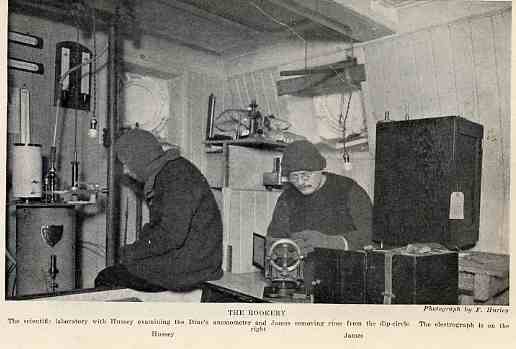
A meteorological screen or box was erected on a platform over the stern, right away from the living quarters, and in it were placed the maximum and minimum thermometers, the recording barograph, and thermograph—an instrument which writes every variation of the temperature and pressure on a sheet of paper on a revolving drum—and the standard thermometer, a very carefully manufactured thermometer, with all its errors determined and tabulated. The other thermometers were all checked from this one. On top of the screen a Robinson’s anemometer was screwed. This consisted of an upright rod, to the top of which were pivoted four arms free to revolve in a plane at right angles to it. At the end of these arms hemispherical cups were screwed. These were caught by the wind and the arms revolved at a speed varying with the force of the wind. The speed of the wind could be read off on a dial below the arms.
A weather screen, or box, was set up on a platform over the stern, well away from the living quarters. It held the maximum and minimum thermometers, the recording barograph and thermograph, and the standard thermometer. The recording instrument traced every change in temperature and pressure on paper wrapped around a revolving drum. The standard thermometer was very carefully made, and all its errors had been measured and listed. All the other thermometers were checked against it. A Robinson’s anemometer was screwed to the top of the screen. It consisted of an upright rod with four arms attached to the top. The arms could rotate freely in a plane at right angles to the rod. A hemispherical cup was screwed to the end of each arm. The cups caught the wind, and the arms rotated at a speed that varied with the wind’s force. The wind speed could be read on a dial below the arms.
In addition there was an instrument called a Dines anemometer which supplied interesting tracings of the force, duration, and direction of the wind. There was an added advantage in the fact that the drum on which these results were recorded was comfortably housed down below, so that one could sit in a comparatively warm room and follow all the varying phases of the blizzard which was raging without. The barometer used was of the Kew Standard pattern. When the ship was crushed, all the monthly records were saved, but the detailed tracings, which had been packed up in the hold, were lost. Though interesting they were not really essential. Continuous observations were made during the long drift on the floe and while on Elephant Island the temperature was taken at midday each day as long as the thermometers lasted. The mortality amongst these instruments, especially those which were tied to string and swung round, was very high.
There was also an instrument called a Dines anemometer. It produced interesting charts showing the wind’s force, duration, and direction. The recording drum had the added advantage of being safely housed below deck. This meant one could sit in a relatively warm room and follow every change in the blizzard raging outside. The barometer was a Kew Standard model. When the ship was crushed, all the monthly records were saved. But the detailed charts, which had been packed away in the hold, were lost. Though interesting, the charts were not really essential. Observations continued throughout the long drift on the ice floe. On Elephant Island, the temperature was taken at midday each day for as long as the thermometers lasted. These instruments had a very high mortality rate, especially those tied to string and swung around.
A few extracts from the observations taken during 1915—the series for that year being practically complete—may be of interest. January was dull and overcast, only 7 per cent. of the observations recording a clear blue sky, 71 per cent. being completely overcast.
A few extracts from the observations taken in 1915 may be of interest. The records for that year are nearly complete. January was dull and overcast. Only 7 percent of the observations recorded a clear blue sky, while 71 percent recorded completely overcast skies.
The percentage of clear sky increased steadily up till June and July, these months showing respectively 42 per cent. and 45.7 per cent. In August 40 per cent. of the observations were clear sky, while September showed a sudden drop to 27 per cent. October weather was much the same, and November was practically overcast the whole time, clear sky showing at only 8 per cent. of the observations. In December the sky was completely overcast for nearly 90 per cent. of the time.
The percentage of clear sky rose steadily until June and July. The figures for those months were 42 percent and 45.7 percent, respectively. In August, 40 percent of the observations recorded clear skies, but the figure dropped sharply to 27 percent in September. October’s weather was much the same. November was overcast almost all the time, with clear skies in only 8 percent of the observations. In December, the sky was completely overcast for nearly 90 percent of the time.
Temperatures on the whole were fairly high, though a sudden unexpected drop in February, after a series of heavy north-easterly gales, caused the ship to be frozen in, and effectually put an end to any hopes of landing that year. The lowest temperature experienced was in July, when –35° Fahr., i.e. 67° below freezing, was reached. Fortunately, as the sea was one mass of consolidated pack, the air was dry, and many days of fine bright sunshine occurred. Later on, as the pack drifted northwards and broke up, wide lanes of water were formed, causing fogs and mist and dull overcast weather generally. In short, it may be said that in the Weddell Sea the best weather comes in winter. Unfortunately during that season the sun also disappears, so that one cannot enjoy it as much as one would like.
Temperatures were generally fairly high. But in February, after a series of heavy northeasterly gales, the temperature suddenly dropped. The ship froze in, putting an end to any hope of landing that year. The lowest temperature came in July, when it reached −35° Fahrenheit, i.e. 67° below freezing. Fortunately, because the sea was covered by a solid mass of pack ice, the air was dry. There were also many days of clear, bright sunshine. Later, as the pack ice drifted north and broke up, wide lanes of open water formed. These brought fog, mist, and generally dull, overcast weather. In short, the best weather in the Weddell Sea comes in winter. Unfortunately, the sun also disappears during winter, so one cannot enjoy the good weather as much as one would like.
As a rule, too, southerly winds brought fine clear weather, with marked fall in the temperature, and those from the north were accompanied by mist, fog, and overcast skies, with comparatively high temperatures. In the Antarctic a temperature of 30°, i.e. 2° below freezing, is considered unbearably hot.
Usually, southerly winds also brought fine, clear weather and a sharp drop in temperature. Northerly winds brought mist, fog, and overcast skies, with comparatively high temperatures. In the Antarctic, a temperature of 30°, i.e. 2° below freezing, is considered unbearably hot.
The greatest difficulty that was experienced was due to the accumulation of rime on the instruments. In low temperatures everything became covered with ice-crystals, deposited from the air, which eventually grew into huge blocks. Sometimes these blocks became dislodged and fell, making it dangerous to walk along the decks. The rime collected on the thermometers, the glass bowl of the sunshine recorder, and the bearings of the anemometer, necessitating the frequent use of a brush to remove it, and sometimes effectively preventing the instruments from recording at all.
The greatest difficulty was the buildup of rime on the instruments. In low temperatures, ice crystals from the air covered everything and eventually grew into huge blocks. Sometimes these blocks came loose and fell, making it dangerous to walk along the decks. Rime collected on the thermometers, the glass bowl of the sunshine recorder, and the bearings of the anemometer. It had to be brushed off frequently, and sometimes it prevented the instruments from recording at all.
One of our worst blizzards occurred on August 1, 1915, which was, for the ship, the beginning of the end. It lasted for four days, with cloudy and overcast weather for the three following days, and from that time onwards we enjoyed very little sun.
One of our worst blizzards began on August 1, 1915. For the ship, it was the beginning of the end. The blizzard lasted four days, and the next three days were cloudy and overcast. From then on, we saw very little sun.
The weather that we experienced on Elephant Island can only be described as appalling. Situated as we were at the mouth of a gully, down which a huge glacier was slowly moving, with the open sea in front and to the left, and towering, snow-covered mountains on our right, the air was hardly ever free from snowdrift, and the winds increased to terrific violence through being forced over the glacier and through the narrow gully. Huge blocks of ice were hurled about like pebbles, and cases of clothing and cooking utensils were whisked out of our hands and carried away to sea. For the first fortnight after our landing there, the gale blew, at times, at over one hundred miles an hour. Fortunately it never again quite reached that intensity, but on several occasions violent squalls made us very fearful for the safety of our hut. The island was almost continuously covered with a pall of fog and snow, clear weather obtaining occasionally when pack-ice surrounded us. Fortunately a series of south-westerly gales had blown all the ice away to the north-east two days before the rescue ship arrived, leaving a comparatively clear sea for her to approach the island.
The weather we experienced on Elephant Island can only be described as appalling. We were at the mouth of a gully, down which a huge glacier was slowly moving. The open sea lay in front of us and to our left, and towering, snow-covered mountains rose on our right. The air was hardly ever free of blowing snow. The winds became terribly violent as they were forced over the glacier and through the narrow gully. Huge blocks of ice were tossed about like pebbles. Cases of clothing and cooking utensils were snatched from our hands and carried out to sea. For the first two weeks after we landed, the gale sometimes blew at over one hundred miles an hour. Fortunately, it never quite reached that strength again. But on several occasions, violent squalls made us fear greatly for the safety of our hut. The island was almost constantly shrouded in fog and snow. Occasionally, the weather cleared when pack ice surrounded us. Fortunately, a series of southwesterly gales had blown all the ice away to the northeast two days before the rescue ship arrived. This left a comparatively clear sea for the ship to approach the island.
Being one solitary moving station in the vast expanse of the Weddell Sea, with no knowledge of what was happening anywhere around us, forecasting was very difficult and at times impossible.
We were a single moving station in the vast Weddell Sea, with no knowledge of what was happening around us. This made forecasting very difficult and at times impossible.
Great assistance in this direction was afforded by copies of Mr. R. C. Mossmann’s researches and papers on Antarctic meteorology, which he kindly supplied to us.
Copies of Mr. R. C. Mossmann’s research and papers on Antarctic meteorology were a great help in this work. He kindly supplied them to us.

I have tried to make this very brief account of the meteorological side of the Expedition rather more “popular” than scientific, since the publication and scientific discussion of the observations will be carried out elsewhere; but if, while showing the difficulties under which we had to work, it emphasizes the value of Antarctic Expeditions from a purely utilitarian point of view, and the need for further continuous research into the conditions obtaining in the immediate neighbourhood of the Pole, it will have achieved its object.
I have tried to make this brief account of the Expedition’s weather observations more “popular” than scientific. The observations will be published and discussed scientifically elsewhere. But I hope this account shows the difficulties we faced in our work. If it also highlights the practical value of Antarctic Expeditions and the need for further continuous research into conditions near the Pole, it will have achieved its purpose.