Chapter 4
Loss of the Endurance
The ice did not trouble us again seriously until the end of September, though during the whole month the floes were seldom entirely without movement. The roar of pressure would come to us across the otherwise silent ice-fields, and bring with it a threat and a warning. Watching from the crow’s-nest, we could see sometimes the formation of pressure-ridges. The sunshine glittered on newly riven ice-surfaces as the masses of shattered floe rose and fell away from the line of pressure. The area of disturbance would advance towards us, recede, and advance again. The routine of work and play on the Endurance proceeded steadily. Our plans and preparations for any contingency that might arise during the approaching summer had been made, but there seemed always plenty to do in and about our prisoned ship. Runs with the dogs and vigorous games of hockey and football on the rough snow-covered floe kept all hands in good fettle. The record of one or two of these September days will indicate the nature of our life and our surroundings:
The ice did not seriously trouble us again until the end of September. Even so, the floes were moving almost constantly throughout the month. Across the otherwise silent ice fields, we could hear the roar of pressure, a threat and a warning. From the crow’s-nest, we could sometimes see pressure ridges forming. Sunshine glittered on freshly split surfaces as masses of shattered ice rose and fell away from the line of pressure. The disturbed area would move toward us, retreat, and then move forward again. Work and play aboard the Endurance continued as usual. We had planned and prepared for anything that might happen during the approaching summer. But there always seemed to be plenty to do in and around our trapped ship. Runs with the dogs and vigorous games of hockey and football on the rough, snow-covered floe kept everyone in good shape. The record of one or two days in September will give an idea of our life and surroundings:
“September 4.—Temperature, –14.1° Fahr. Light easterly breeze, blue sky, and stratus clouds. During forenoon notice a distinct terra-cotta or biscuit colour in the stratus clouds to the north. This travelled from east to west and could conceivably have come from some of the Graham Land volcanoes, now about 300 miles distant to the north-west. The upper current of air probably would come from that direction. Heavy rime. Pack unbroken and unchanged as far as visible. No land for 22 miles. No animal life observed.”
“September 4. Temperature, –14.1° Fahrenheit. Light breeze from the east, blue sky, and stratus clouds. During the morning, I noticed a distinct terracotta or biscuit color in the stratus clouds to the north. The color moved from east to west. It could conceivably have come from some of the Graham Land volcanoes, now about 300 miles to the northwest. The upper air current would probably come from that direction. Heavy frost. The pack ice remained unbroken and unchanged as far as I could see. No land within 22 miles. No animal life observed.”
“September 7.—Temperature, –10.8° Fahr. Moderate easterly to southerly winds, overcast and misty, with light snow till midnight, when weather cleared. Blue sky and fine clear weather to noon. Much rime aloft. Thick fresh snow on ship and floe that glistens brilliantly in the morning sunlight. Little clouds of faint violet-coloured mist rise from the lower and brinier portions of the pack, which stretches unbroken to the horizon. Very great refraction all round. A tabular berg about fifty feet high ten miles west is a good index of the amount of refraction. On ordinary days it shows from the mast-head, clear-cut against the sky; with much refraction, the pack beyond at the back of it lifts up into view; to-day a broad expanse of miles of pack is seen above it. Numerous other bergs generally seen in silhouette are, at first sight, lost, but after a closer scrutiny they appear as large lumps or dark masses well below the horizon. Refraction generally results in too big an altitude when observing the sun for position, but to-day, the horizon is thrown up so much that the altitude is about 12´ too small. No land visible for twenty miles. No animal life observed. Lower Clark’s tow-net with 566 fathoms of wire, and hoist it up at two and a half miles an hour by walking across the floe with the wire. Result rather meagre—jelly-fish and some fish larvæ. Exercise dogs in sledge teams. The young dogs, under Crean’s care, pull as well, though not so strongly, as the best team in the pack. Hercules for the last fortnight or more has constituted himself leader of the orchestra. Two or three times in the twenty-four hours he starts a howl—a deep, melodious howl—and in about thirty seconds he has the whole pack in full song, the great deep, booming, harmonious song of the half-wolf pack.”
“September 7. Temperature, –10.8° Fahrenheit. Moderate winds from the east to south. Overcast and misty, with light snow until midnight, when the weather cleared. Blue sky and fine, clear weather until noon. Much frost high on the ship. Thick, fresh snow on the ship and the ice floe glistens brilliantly in the morning sunlight. Small clouds of pale violet mist rise from the lower, saltier parts of the pack ice. The ice stretches unbroken to the horizon. Refraction is very strong in every direction. A flat-topped iceberg about fifty feet high and ten miles to the west is a good measure of the refraction. On ordinary days, it can be seen from the masthead, sharply outlined against the sky. With strong refraction, the pack ice behind it rises into view. Today, a broad expanse of pack ice, miles across, can be seen above the iceberg. Many other icebergs usually seen in silhouette seem at first to have disappeared. On closer inspection, they appear as large lumps or dark masses well below the horizon. Refraction generally makes the sun’s altitude reading too high when we use it to determine our position. But today, the horizon is raised so much that the altitude reading is about 12 minutes too low. No land is visible within twenty miles. No animal life observed. We lower Clark’s tow-net on 566 fathoms of wire. We haul it up at two and a half miles an hour by walking across the floe with the wire. The catch is rather meagre: jellyfish and some fish larvae. We exercise the dogs in sledge teams. The young dogs, under Crean’s care, pull as well as the best team in the pack, though not as strongly. For the past two weeks or more, Hercules has appointed himself leader of the orchestra. Two or three times a day, he starts a deep, melodious howl. In about thirty seconds, he has the whole pack singing: the great, deep, booming, harmonious song of the half-wolf pack.”
By the middle of September we were running short of fresh meat for the dogs. The seals and penguins seemed to have abandoned our neighbourhood altogether. Nearly five months had passed since we killed a seal, and penguins had been seen seldom. Clark, who was using his trawl as often as possible, reported that there was a marked absence of plankton in the sea, and we assumed that the seals and the penguins had gone in search of their accustomed food. The men got an emperor on the 23rd. The dogs, which were having their sledging exercise, became wildly excited when the penguin, which had risen in a crack, was driven ashore, and the best efforts of the drivers failed to save it alive. On the following day Wild, Hurley, Macklin, and McIlroy took their teams to the Stained Berg, about seven miles west of the ship, and on their way back got a female crab-eater, which they killed, skinned, and left to be picked up later. They ascended to the top of the berg, which lay in about lat. 69° 30´ S., long. 51° W., and from an elevation of 110 ft. could see no land. Samples of the discoloured ice from the berg proved to contain dust with black gritty particles or sand-grains. Another seal, a bull Weddell, was secured on the 26th. The return of seal-life was opportune, since we had nearly finished the winter supply of dog-biscuit and wished to be able to feed the dogs on meat. The seals meant a supply of blubber, moreover, to supplement our small remaining stock of coal when the time came to get up steam again. We initiated a daylight-saving system on this day by putting forward the clock one hour. “This is really pandering to the base but universal passion that men, and especially seafarers, have for getting up late, otherwise we would be honest and make our routine earlier instead of flogging the clock.”
By the middle of September, we were running short of fresh meat for the dogs. The seals and penguins seemed to have abandoned our area altogether. Nearly five months had passed since we killed a seal, and penguins had rarely been seen. Clark, who used his trawl as often as possible, reported a marked absence of plankton in the sea. We assumed that the seals and penguins had gone in search of their usual food. On the 23rd, the men caught an emperor penguin. It had emerged from a crack in the ice and was driven ashore. The dogs were out for their sledging exercise, and they became wildly excited. The drivers did their best, but they could not save the penguin alive. The next day, Wild, Hurley, Macklin, and McIlroy took their teams to the Stained Berg, about seven miles west of the ship. They climbed to the top of the berg, which lay at about lat. 69° 30´ S., long. 51° W. From a height of 110 feet, they could see no land. On their way back, they caught a female crab-eater seal. They killed and skinned her, then left her to be picked up later. Samples of the berg’s discoloured ice proved to contain dust with black gritty particles or grains of sand. On the 26th, we caught another seal, a male Weddell. The return of the seals was timely. We had nearly finished the winter supply of dog biscuits and wanted to feed the dogs meat. The seals also supplied blubber to supplement our small remaining stock of coal when it was time to raise steam again. That day, we introduced daylight saving by putting the clock forward one hour. “This really caters to the base but universal desire among men, especially seafarers, to get up late. Otherwise, we would be honest and start our routine earlier instead of tampering with the clock.”
During the concluding days of September the roar of the pressure grew louder, and I could see that the area of disturbance was rapidly approaching the ship. Stupendous forces were at work and the fields of firm ice around the Endurance were being diminished steadily. September 30 was a bad day. It began well, for we got two penguins and five seals during the morning. Three other seals were seen. But at 3 p.m. cracks that had opened during the night alongside the ship commenced to work in a lateral direction. The ship sustained terrific pressure on the port side forward, the heaviest shocks being under the forerigging. It was the worst squeeze we had experienced. The decks shuddered and jumped, beams arched, and stanchions buckled and shook. I ordered all hands to stand by in readiness for whatever emergency might arise. Even the dogs seemed to feel the tense anxiety of the moment. But the ship resisted valiantly, and just when it appeared that the limit of her strength was being reached the huge floe that was pressing down upon us cracked across and so gave relief.
In the final days of September, the roar of the pressure grew louder. I could see that the disturbed ice was rapidly approaching the ship. Enormous forces were at work, steadily reducing the fields of solid ice around the Endurance. September 30 was a bad day. It began well, as we got two penguins and five seals that morning. We saw three other seals. But at 3 p.m., cracks that had opened beside the ship during the night began to shift sideways. The ship came under tremendous pressure on her forward port side, with the heaviest shocks beneath the forward rigging. It was the worst squeeze we had experienced. The decks shuddered and jumped, beams bent, and supports buckled and shook. I ordered all hands to stand ready for any emergency. Even the dogs seemed to feel the tense anxiety of the moment. But the ship resisted bravely. Just when her strength seemed to be reaching its limit, the huge ice floe pressing against us cracked across, relieving the pressure.
“The behaviour of our ship in the ice has been magnificent,” wrote Worsley. “Since we have been beset her staunchness and endurance have been almost past belief again and again. She has been nipped with a million-ton pressure and risen nobly, falling clear of the water out on the ice. She has been thrown to and fro like a shuttlecock a dozen times. She has been strained, her beams arched upwards, by the fearful pressure; her very sides opened and closed again as she was actually bent and curved along her length, groaning like a living thing. It will be sad if such a brave little craft should be finally crushed in the remorseless, slowly strangling grip of the Weddell pack after ten months of the bravest and most gallant fight ever put up by a ship.”
“Our ship has behaved magnificently in the ice,” wrote Worsley. “Since the ice trapped her, her strength and endurance have been almost unbelievable, time and again. She has been squeezed by a million tons of pressure and risen nobly, lifting clear of the water onto the ice. She has been tossed back and forth like a shuttlecock a dozen times. The terrible pressure has strained her and bent her beams upward. Her very sides opened and closed again as her whole length bent and curved. She groaned like a living thing. It will be sad if such a brave little ship is finally crushed in the relentless, slowly strangling grip of the Weddell pack ice. She has spent ten months putting up the bravest and most gallant fight ever fought by a ship.”
The Endurance deserved all that could be said in praise of her. Shipwrights had never done sounder or better work; but how long could she continue the fight under such conditions? We were drifting into the congested area of the western Weddell Sea, the worst portion of the worst sea in the world, where the pack, forced on irresistibly by wind and current, impinges on the western shore and is driven up in huge corrugated ridges and chaotic fields of pressure. The vital question for us was whether or not the ice would open sufficiently to release us, or at least give us a chance of release, before the drift carried us into the most dangerous area. There was no answer to be got from the silent bergs and the grinding floes, and we faced the month of October with anxious hearts.
The Endurance deserved all the praise she could get. Shipwrights had never built a stronger or better ship. But how long could she keep fighting under such conditions? We were drifting into the ice-choked western Weddell Sea, the worst part of the worst sea in the world. There, wind and currents drive the pack ice relentlessly against the western shore. The ice is forced up into huge ridges and chaotic fields of crushed ice. The vital question was whether the ice would open enough to release us, or at least give us a chance to escape, before the drift carried us into the most dangerous area. The silent icebergs and grinding floes offered no answer, and we faced October with anxious hearts.
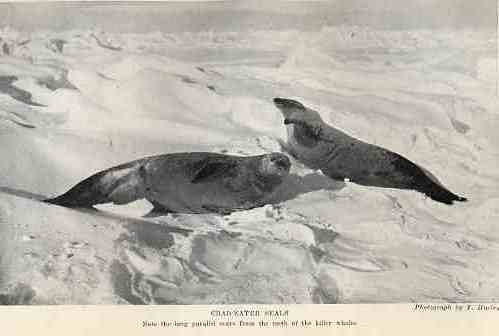
The leads in the pack appeared to have opened out a little on October 1, but not sufficiently to be workable even if we had been able to release the Endurance from the floe. The day was calm, cloudy and misty in the forenoon and clearer in the afternoon, when we observed well-defined parhelia. The ship was subjected to slight pressure at intervals. Two bull crab-eaters climbed on to the floe close to the ship and were shot by Wild. They were both big animals in prime condition, and I felt that there was no more need for anxiety as to the supply of fresh meat for the dogs. Seal-liver made a welcome change in our own menu. The two bulls were marked, like many of their kind, with long parallel scars about three inches apart, evidently the work of the killers. A bull we killed on the following day had four parallel scars, sixteen inches long, on each side of its body; they were fairly deep and one flipper had been nearly torn away. The creature must have escaped from the jaws of a killer by a very small margin. Evidently life beneath the pack is not always monotonous. We noticed that several of the bergs in the neighbourhood of the ship were changing their relative positions more than they had done for months past. The floes were moving.
The openings in the pack ice seemed to have widened a little on October 1. But they were still too narrow to navigate, even if we had been able to free the Endurance from the floe. The morning was calm, cloudy, and misty. The afternoon was clearer, and we saw clearly defined parhelia, or bright spots beside the sun. The ship came under slight pressure from time to time. Two bull crabeater seals climbed onto the floe close to the ship, and Wild shot them. Both were large animals in prime condition. I felt there was no longer any need to worry about a supply of fresh meat for the dogs. Seal liver was a welcome change to our own menu. Like many of their kind, the two bulls had long parallel scars about three inches apart. These were evidently the work of killer whales. A bull we killed the following day had four parallel scars on each side of its body. The scars were sixteen inches long and fairly deep, and one flipper had been nearly torn away. The creature must have escaped from a killer whale’s jaws by a very small margin. Evidently life beneath the pack ice is not always monotonous. We noticed that several icebergs near the ship were changing position relative to one another more than they had for months. The floes were moving.
Our position on Sunday, October 3, was lat. 69° 14´ S., long. 51° 8´ W. During the night the floe holding the ship aft cracked in several places, and this appeared to have eased the strain on the rudder. The forenoon was misty, with falls of snow, but the weather cleared later in the day and we could see that the pack was breaking. New leads had appeared, while several old leads had closed. Pressure-ridges had risen along some of the cracks. The thickness of the season’s ice, now about 230 days old, was 4 ft. 5 in. under 7 or 8 in. of snow. This ice had been slightly thicker in the early part of September, and I assumed that some melting had begun below. Clark had recorded plus temperatures at depths of 150 and 200 fathoms in the concluding days of September. The ice obviously had attained its maximum thickness by direct freezing, and the heavier older floes had been created by the consolidation of pressure-ice and the overlapping of floes under strain. The air temperatures were still low, –24.5° Fahr. being recorded on October 4.
Our position on Sunday, October 3, was latitude 69° 14´ S., longitude 51° 8´ W. During the night, the floe gripping the ship at the stern cracked in several places. This seemed to ease the strain on the rudder. The morning was misty, with snow falling, but the weather cleared later in the day. We could then see that the pack ice was breaking up. New leads had appeared, while several old leads had closed. Ridges of ice pushed up by pressure had risen along some of the cracks. The season’s ice was now about 230 days old. It was 4 ft. 5 in. thick, with 7 or 8 in. of snow on top. The ice had been slightly thicker in early September, and I assumed that some melting had begun underneath. Clark had recorded temperatures above freezing at depths of 150 and 200 fathoms in the last days of September. The ice had obviously reached its maximum thickness through direct freezing. The heavier old floes had formed as pressure-ice consolidated and floes overlapped under strain. Air temperatures were still low, with –24.5° Fahr. recorded on October 4.
The movement of the ice was increasing. Frost-smoke from opening cracks was showing in all directions during October 6. It had the appearance in one place of a great prairie fire, rising from the surface and getting higher as it drifted off before the wind in heavy, dark, rolling masses. At another point there was the appearance of a train running before the wind, the smoke rising from the locomotive straight upwards; and the smoke columns elsewhere gave the effect of warships steaming in line ahead. During the following day the leads and cracks opened to such an extent that if the Endurance could have been forced forward for thirty yards we could have proceeded for two or three miles; but the effort did not promise any really useful result. The conditions did not change materially during the rest of that week. The position on Sunday, October 10, was lat. 69° 21´ S., long. 50° 34´ W. A thaw made things uncomfortable for us that day. The temperature had risen from –10° Fahr. to +29.8° Fahr., the highest we had experienced since January, and the ship got dripping wet between decks. The upper deck was clear of ice and snow and the cabins became unpleasantly messy. The dogs, who hated wet, had a most unhappy air. Undoubtedly one grows to like familiar conditions. We had lived long in temperatures that would have seemed distressingly low in civilized life, and now we were made uncomfortable by a degree of warmth that would have left the unaccustomed human being still shivering. The thaw was an indication that winter was over, and we began preparations for reoccupying the cabins on the main deck. I had the shelter-house round the stern pulled down on the 11th and made other preparations for working the ship as soon as she got clear. The carpenter had built a wheel-house over the wheel aft as shelter in cold and heavy weather. The ice was still loosening and no land was visible for twenty miles.
The ice was moving more and more. On October 6, frost-smoke rose from opening cracks in every direction. In one place, it looked like a great prairie fire. It rose from the surface and drifted higher before the wind in heavy, dark, rolling masses. Elsewhere, it looked like a train moving before the wind, with smoke rising straight up from the locomotive. Other columns of smoke made it look as if warships were steaming in a line. The next day, the leads and cracks opened much wider. If we could have forced the Endurance forward thirty yards, we could have traveled two or three miles. But the effort promised no really useful result. Conditions did not change much during the rest of the week. On Sunday, October 10, our position was lat. 69° 21´ S., long. 50° 34´ W. A thaw made us uncomfortable that day. The temperature had risen from −10° Fahrenheit to +29.8° Fahrenheit, the highest we had experienced since January. The space between decks became dripping wet. The upper deck was clear of ice and snow, and the cabins became unpleasantly messy. The dogs, who hated being wet, looked most unhappy. There is no doubt that one grows to like familiar conditions. We had lived for a long time in temperatures that would have seemed distressingly low in civilized life. Now we were uncomfortable in a warmth that would still have left an unaccustomed person shivering. The thaw showed that winter was over, and we began preparing to move back into the main deck cabins. On the 11th, I had the shelter-house around the stern pulled down. I also made other preparations to work the ship as soon as she got clear. The carpenter had built a wheel-house over the wheel aft to provide shelter in cold and heavy weather. The ice was still loosening, and no land was visible within twenty miles.
The temperature remained relatively high for several days. All hands moved to their summer quarters in the upper cabins on the 12th, to the accompaniment of much noise and laughter. Spring was in the air, and if there were no green growing things to gladden our eyes, there were at least many seals, penguins, and even whales disporting themselves in the leads. The time for renewed action was coming, and though our situation was grave enough, we were facing the future hopefully. The dogs were kept in a state of uproar by the sight of so much game. They became almost frenzied when a solemn-looking emperor penguin inspected them gravely from some point of vantage on the floe and gave utterance to an apparently derisive “Knark!” At 7 p.m. on the 13th the ship broke free of the floe on which she had rested to starboard sufficiently to come upright. The rudder freed itself, but the propeller was found to be athwartship, having been forced into that position by the floe some time after August 1. The water was very clear and we could see the rudder, which appeared to have suffered only a slight twist to port at the water-line. It moved quite freely. The propeller, as far as we could see, was intact, but it could not be moved by the hand-gear, probably owing to a film of ice in the stern gland and sleeve. I did not think it advisable to attempt to deal with it at that stage. The ship had not been pumped for eight months, but there was no water and not much ice in the bilges. Meals were served again in the wardroom that day.
The temperature stayed relatively high for several days. On the 12th, everyone moved to their summer quarters in the upper cabins, with much noise and laughter. Spring was in the air. Though there were no green plants to delight our eyes, many seals, penguins, and even whales were playing in the open channels in the ice. The time for renewed action was coming. Though our situation was serious enough, we faced the future with hope. The sight of so much game kept the dogs in an uproar. They became almost frantic when a solemn-looking emperor penguin studied them gravely from a high point on the ice floe. The penguin then gave an apparently mocking “Knark!” At 7 p.m. on the 13th, the ship broke free enough from the floe supporting her starboard side to come upright. The rudder freed itself, but the propeller was found to be lying across the ship. The floe had forced it into that position sometime after August 1. The water was very clear, and we could see the rudder. It seemed to have suffered only a slight twist to port at the waterline and moved quite freely. As far as we could see, the propeller was intact. But it could not be moved by the hand-gear, probably because of a thin layer of ice in the stern gland and sleeve. I did not think it wise to try to deal with the propeller at that stage. The ship had not been pumped for eight months, but there was no water and not much ice in the bilges. Meals were served again in the wardroom that day.
The south-westerly breeze freshened to a gale on the 14th, and the temperature fell from +31° Fahr. to –1° Fahr. At midnight the ship came free from the floe and drifted rapidly astern. Her head fell off before the wind until she lay nearly at right-angles across the narrow lead. This was a dangerous position for rudder and propeller. The spanker was set, but the weight of the wind on the ship gradually forced the floes open until the Endurance swung right round and drove 100 yds. along the lead. Then the ice closed and at 3 a.m. we were fast again. The wind died down during the day and the pack opened for five or six miles to the north. It was still loose on the following morning, and I had the boiler pumped up with the intention of attempting to clear the propeller; but one of the manholes developed a leak, the packing being perished by cold or loosened by contraction, and the boiler had to be emptied out again.
The southwesterly breeze strengthened into a gale on the 14th, and the temperature fell from 31°F to minus 1°F. At midnight the ship broke free from the floe and drifted rapidly backward. Her bow turned away from the wind until she lay almost crosswise in the narrow channel. This put the rudder and propeller in danger. We set the spanker, but the force of the wind on the ship gradually pushed the floes apart. The Endurance swung all the way around and was driven 100 yards along the channel. Then the ice closed in, and at 3 a.m. we were trapped again. The wind died down during the day, and the pack ice opened up for five or six miles to the north. The ice was still loose the next morning, so I had the boiler filled, intending to try to clear the propeller. But one of the manholes began to leak. The packing had either been damaged by the cold or loosened by contraction, and we had to empty the boiler again.
The pack was rather closer on Sunday the 17th. Top-sails and head-sails were set in the afternoon, and with a moderate north-easterly breeze we tried to force the ship ahead out of the lead; but she was held fast. Later that day heavy pressure developed. The two floes between which the Endurance was lying began to close and the ship was subjected to a series of tremendously heavy strains. In the engine-room, the weakest point, loud groans, crashes, and hammering sounds were heard. The iron plates on the floor buckled up and overrode with loud clangs. Meanwhile the floes were grinding off each other’s projecting points and throwing up pressure-ridges. The ship stood the strain well for nearly an hour and then, to my great relief, began to rise with heavy jerks and jars. She lifted ten inches forward and three feet four inches aft, at the same time heeling six degrees to port. The ice was getting below us and the immediate danger had passed. The position was lat. 69° 19´ S., long. 50° 40´ W.
The pack ice was somewhat closer on Sunday the 17th. In the afternoon, we set the topsails and headsails. With a moderate northeasterly breeze, we tried to force the ship forward out of the lead, but she was held fast. Later that day, heavy pressure developed. The two floes on either side of the Endurance began to close in, putting the ship under tremendous strain. In the engine room, the ship’s weakest point, we heard loud groans, crashes, and hammering sounds. The iron floor plates buckled and slid over one another with loud clangs. Meanwhile, the floes ground off each other’s projecting points and pushed up pressure ridges. The ship stood up to the strain for nearly an hour. Then, to my great relief, she began to rise with heavy jerks and jolts. She rose ten inches at the bow and three feet four inches at the stern. At the same time, she tilted six degrees to port. The ice was getting underneath us, and the immediate danger had passed. Our position was lat. 69° 19´ S., long. 50° 40´ W.
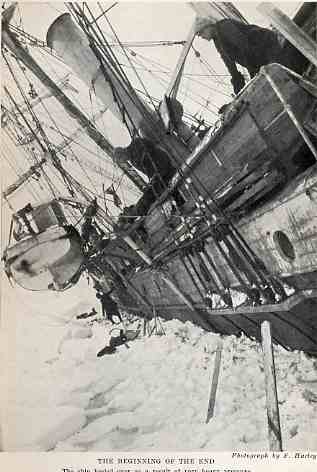
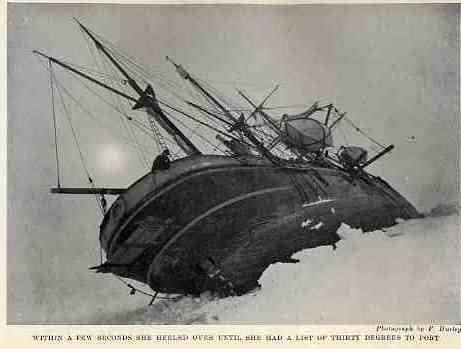
The next attack of the ice came on the afternoon of October 18th. The two floes began to move laterally, exerting great pressure on the ship. Suddenly the floe on the port side cracked and huge pieces of ice shot up from under the port bilge. Within a few seconds the ship heeled over until she had a list of thirty degrees to port, being held under the starboard bilge by the opposing floe. The lee boats were now almost resting on the floe. The midship dog-kennels broke away and crashed down on to the lee kennels, and the howls and barks of the frightened dogs assisted to create a perfect pandemonium. Everything movable on deck and below fell to the lee side, and for a few minutes it looked as if the Endurance would be thrown upon her beam ends. Order was soon restored. I had all fires put out and battens nailed on the deck to give the dogs a foothold and enable people to get about. Then the crew lashed all the movable gear. If the ship had heeled any farther it would have been necessary to release the lee boats and pull them clear, and Worsley was watching to give the alarm. Hurley meanwhile descended to the floe and took some photographs of the ship in her unusual position. Dinner in the wardroom that evening was a curious affair. Most of the diners had to sit on the deck, their feet against battens and their plates on their knees. At 8 p.m. the floes opened, and within a few minutes the Endurance was nearly upright again. Orders were given for the ice to be chipped clear of the rudder. The men poled the blocks out of the way when they had been detached from the floe with the long ice-chisels, and we were able to haul the ship’s stern into a clear berth. Then the boiler was pumped up. This work was completed early in the morning of October 19, and during that day the engineer lit fires and got up steam very slowly, in order to economize fuel and avoid any strain on the chilled boilers by unequal heating. The crew cut up all loose lumber, boxes, etc., and put them in the bunkers for fuel. The day was overcast, with occasional snowfalls, the temperature +12° Fahr. The ice in our neighbourhood was quiet, but in the distance pressure was at work. The wind freshened in the evening, and we ran a wire-mooring astern. The barometer at 11 p.m. stood at 28.96, the lowest since the gales of July. An uproar among the dogs attracted attention late in the afternoon, and we found a 25-ft. whale cruising up and down in our pool. It pushed its head up once in characteristic killer fashion, but we judged from its small curved dorsal fin that it was a specimen of Balænoptera acutorostrata, not Orca gladiator.
The ice attacked again on the afternoon of October 18th. The two floes began to move sideways, putting great pressure on the ship. Suddenly, the floe on the port side cracked, and huge pieces of ice shot up from beneath the port bilge. Within seconds, the ship had tilted thirty degrees to port. The opposing floe held her under the starboard bilge. The boats on the low side were now almost resting on the floe. The dog kennels amidships broke away and crashed onto the kennels on the low side. The frightened dogs howled and barked, adding to the chaos. Everything movable on deck and below fell to the low side. For a few minutes, it looked as if the Endurance would be thrown onto her side. Order was soon restored. I had all fires put out and wooden strips nailed to the deck. These gave the dogs a foothold and allowed people to move about. The crew then tied down all the movable gear. If the ship had tilted any farther, we would have had to release the boats on the low side and pull them clear. Worsley was watching, ready to raise the alarm. Meanwhile, Hurley went down onto the floe and took photographs of the ship in her unusual position. Dinner in the wardroom that evening was a strange affair. Most of the diners had to sit on the deck, with their feet against the wooden strips and their plates on their knees. At 8 p.m. the floes opened, and within a few minutes the Endurance was nearly upright again. Orders were given to chip the ice away from the rudder. The men used long ice chisels to detach the blocks from the floe, then pushed them out of the way with poles. We were able to pull the ship’s stern into a clear space. Then the boiler was filled by pump. This work was completed early on October 19. During the day, the engineer lit fires and raised steam very slowly. This saved fuel and prevented uneven heating from straining the chilled boilers. The crew cut up all the loose lumber, boxes, and other such material and put them in the fuel bunkers. The day was overcast, with occasional snowfalls and a temperature of +12° Fahr. The ice around us was quiet, but pressure was at work in the distance. The wind grew stronger in the evening, and we ran a wire mooring from the stern. At 11 p.m. the barometer stood at 28.96, its lowest reading since the gales of July. Late in the afternoon, an uproar among the dogs attracted our attention. We found a 25-foot whale swimming up and down in our pool. It pushed its head up once, in the characteristic manner of a killer whale. But its small, curved dorsal fin led us to judge it a specimen of Balænoptera acutorostrata, not Orca gladiator.
A strong south-westerly wind was blowing on October 20 and the pack was working. The Endurance was imprisoned securely in the pool, but our chance might come at any time. Watches were set so as to be ready for working ship. Wild and Hudson, Greenstreet and Cheetham, Worsley and Crean, took the deck watches, and the Chief Engineer and Second Engineer kept watch and watch with three of the A.B.’s for stokers. The staff and the forward hands, with the exception of the cook, the carpenter and his mate, were on “watch and watch”—that is, four hours on deck and four hours below, or off duty. The carpenter was busy making a light punt, which might prove useful in the navigation of lanes and channels. At 11 a.m. we gave the engines a gentle trial turn astern. Everything worked well after eight months of frozen inactivity, except that the bilge-pump and the discharge proved to be frozen up; they were cleared with some little difficulty. The engineer reported that to get steam he had used one ton of coal, with wood-ashes and blubber. The fires required to keep the boiler warm consumed one and a quarter to one and a half hundred-weight of coal per day. We had about fifty tons of coal remaining in the bunkers.
On October 20, a strong southwesterly wind was blowing, and the pack ice was moving. The Endurance was held fast in the pool, but our chance might come at any time. Watches were set so that we would be ready to work the ship. Wild and Hudson, Greenstreet and Cheetham, and Worsley and Crean took the deck watches. The Chief Engineer and Second Engineer stood alternate watches, with three of the able-bodied seamen serving as stokers. The staff and the crew forward were also on “watch and watch”, except for the cook, the carpenter and his mate. This meant four hours on deck and four hours below, or off duty. The carpenter was busy making a light punt, which might prove useful for navigating lanes and channels. At 11 a.m. we gave the engines a gentle trial run in reverse. Everything worked well after eight months of frozen inactivity, except that the bilge pump and its discharge were frozen. We cleared them with some difficulty. The engineer reported that he had used one ton of coal, along with wood ashes and blubber, to raise steam. The fires needed to keep the boiler warm used between one and a quarter and one and a half hundredweight of coal a day. We had about fifty tons of coal left in the bunkers.
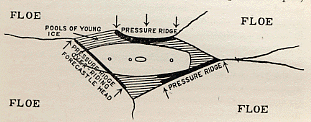
October 21 and 22 were days of low temperature, which caused the open leads to freeze over. The pack was working, and ever and anon the roar of pressure came to our ears. We waited for the next move of the gigantic forces arrayed against us. The 23rd brought a strong north-westerly wind, and the movement of the floes and pressure-ridges became more formidable. Then on Sunday, October 24, there came what for the Endurance was the beginning of the end. The position was lat. 69° 11´ S., long. 51° 5´ W. We had now twenty-two and a half hours of daylight, and throughout the day we watched the threatening advance of the floes. At 6.45 p.m. the ship sustained heavy pressure in a dangerous position. The attack of the ice is illustrated roughly in the appended diagram. The shaded portions represent the pool, covered with new ice that afforded no support to the ship, and the arrows indicate the direction of the pressure exercised by the thick floes and pressure-ridges. The onslaught was all but irresistible. The Endurance groaned and quivered as her starboard quarter was forced against the floe, twisting the sternpost and starting the heads and ends of planking. The ice had lateral as well as forward movement, and the ship was twisted and actually bent by the stresses. She began to leak dangerously at once.
October 21 and 22 were cold days, and the open channels in the ice froze over. The pack ice was shifting, and now and then we heard the roar of ice under pressure. We waited for the next move of the gigantic forces against us. On October 23, a strong northwesterly wind arose, and the movement of the floes and pressure ridges became more threatening. Then, on Sunday, October 24, came the beginning of the end for the Endurance. Our position was lat. 69° 11´ S., long. 51° 5´ W. We now had twenty-two and a half hours of daylight. Throughout the day, we watched the threatening advance of the floes. At 6.45 p.m., the ship was in a dangerous position and came under heavy pressure. The appended diagram gives a rough illustration of the ice's attack. The shaded areas represent the pool, which was covered with new ice that gave the ship no support. The arrows show the direction of the pressure from the thick floes and pressure ridges. The onslaught was almost impossible to resist. The Endurance groaned and shuddered as her starboard quarter was forced against the floe. The pressure twisted the sternpost and forced the heads and ends of the planks out of place. The ice was moving sideways as well as forward, and the forces twisted and actually bent the ship. She immediately began to leak dangerously.
I had the pumps rigged, got up steam, and started the bilge-pumps at 8 p.m. The pressure by that time had relaxed. The ship was making water rapidly aft, and the carpenter set to work to make a coffer-dam astern of the engines. All hands worked, watch and watch, throughout the night, pumping ship and helping the carpenter. By morning the leak was being kept in check. The carpenter and his assistants caulked the coffer-dam with strips of blankets and nailed strips over the seams wherever possible. The main or hand pump was frozen up and could not be used at once. After it had been knocked out Worsley, Greenstreet, and Hudson went down in the bunkers and cleared the ice from the bilges. “This is not a pleasant job,” wrote Worsley. “We have to dig a hole down through the coal while the beams and timbers groan and crack all around us like pistol-shots. The darkness is almost complete, and we mess about in the wet with half-frozen hands and try to keep the coal from slipping back into the bilges. The men on deck pour buckets of boiling water from the galley down the pipe as we prod and hammer from below, and at last we get the pump clear, cover up the bilges to keep the coal out, and rush on deck, very thankful to find ourselves safe again in the open air.”
I had the pumps set up and steam raised, and started the bilge pumps at 8 p.m. By then, the pressure had eased. Water was entering the ship rapidly at the stern. The carpenter began building a coffer-dam behind the engines. All hands worked in alternating watches throughout the night, pumping water out of the ship and helping the carpenter. By morning, the leak was under control. The carpenter and his assistants caulked the coffer-dam with strips of blankets. They also nailed strips over the seams wherever possible. The main, or hand, pump was frozen and could not be used at once. After the pump had been knocked free, Worsley, Greenstreet, and Hudson went down into the coal bunkers and cleared ice from the bilges. “This is not a pleasant job,” wrote Worsley. “We have to dig a hole down through the coal. All around us, the beams and timbers groan and crack like pistol shots. It is almost completely dark. We work in the wet with half-frozen hands and try to keep the coal from slipping back into the bilges. The men on deck pour buckets of boiling water from the galley down the pipe while we prod and hammer from below. At last we clear the pump and cover the bilges to keep the coal out. Then we rush on deck, very thankful to be safe again in the open air.”
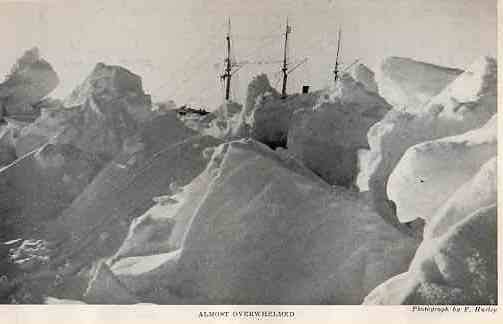
Monday, October 25, dawned cloudy and misty, with a minus temperature and a strong south-easterly breeze. All hands were pumping at intervals and assisting the carpenter with the coffer-dam. The leak was being kept under fairly easily, but the outlook was bad. Heavy pressure-ridges were forming in all directions, and though the immediate pressure upon the ship was not severe, I realized that the respite would not be prolonged. The pack within our range of vision was being subjected to enormous compression, such as might be caused by cyclonic winds, opposing ocean currents, or constriction in a channel of some description. The pressure-ridges, massive and threatening, testified to the overwhelming nature of the forces that were at work. Huge blocks of ice, weighing many tons, were lifted into the air and tossed aside as other masses rose beneath them. We were helpless intruders in a strange world, our lives dependent upon the play of grim elementary forces that made a mock of our puny efforts. I scarcely dared hope now that the Endurance would live, and throughout that anxious day I reviewed again the plans made long before for the sledging journey that we must make in the event of our having to take to the ice. We were ready, as far as forethought could make us, for every contingency. Stores, dogs, sledges, and equipment were ready to be moved from the ship at a moment’s notice.
Monday, October 25, dawned cloudy and misty, with temperatures below zero and a strong southeasterly wind. Everyone took turns pumping and helping the carpenter with the coffer-dam. We were keeping the leak under control fairly easily, but the outlook was bad. Heavy pressure ridges were forming in every direction. Although the immediate pressure on the ship was not severe, I knew the relief would not last. The pack ice as far as we could see was under enormous pressure. Cyclonic winds, opposing ocean currents, or a narrowing channel of some kind might have caused such pressure. The massive, threatening pressure ridges showed the overwhelming force at work. Huge blocks of ice, weighing many tons, were lifted into the air and tossed aside as other masses rose beneath them. We were helpless intruders in a strange world. Our lives depended on the play of grim natural forces that made a mockery of our puny efforts. I hardly dared hope now that the Endurance would survive. Throughout that anxious day, I reviewed the plans we had made long before for a sledging journey. We would have to make that journey if we had to take to the ice. We were ready for every possibility, as far as planning could make us ready. Stores, dogs, sledges, and equipment were ready to be moved from the ship at a moment’s notice.
The following day brought bright clear weather, with a blue sky. The sunshine was inspiriting. The roar of pressure could be heard all around us. New ridges were rising, and I could see as the day wore on that the lines of major disturbance were drawing nearer to the ship. The Endurance suffered some strains at intervals. Listening below, I could hear the creaking and groaning of her timbers, the pistol-like cracks that told of the starting of a trenail or plank, and the faint, indefinable whispers of our ship’s distress. Overhead the sun shone serenely; occasional fleecy clouds drifted before the southerly breeze, and the light glinted and sparkled on the million facets of the new pressure-ridges. The day passed slowly. At 7 p.m. very heavy pressure developed, with twisting strains that racked the ship fore and aft. The butts of planking were opened four and five inches on the starboard side, and at the same time we could see from the bridge that the ship was bending like a bow under titanic pressure. Almost like a living creature, she resisted the forces that would crush her; but it was a one-sided battle. Millions of tons of ice pressed inexorably upon the little ship that had dared the challenge of the Antarctic. The Endurance was now leaking badly, and at 9 p.m. I gave the order to lower boats, gear, provisions, and sledges to the floe, and move them to the flat ice a little way from the ship. The working of the ice closed the leaks slightly at midnight, but all hands were pumping all night. A strange occurrence was the sudden appearance of eight emperor penguins from a crack 100 yds. away at the moment when the pressure upon the ship was at its climax. They walked a little way towards us, halted, and after a few ordinary calls proceeded to utter weird cries that sounded like a dirge for the ship. None of us had ever before heard the emperors utter any other than the most simple calls or cries, and the effect of this concerted effort was almost startling.
The next day brought bright, clear weather and a blue sky. The sunshine lifted our spirits. We could hear the roar of the ice under pressure all around us. New ridges were rising, and as the day went on, I could see the main areas of disturbance moving closer to the ship. The Endurance came under strain from time to time. Below deck, I could hear her timbers creaking and groaning. I heard cracks like pistol shots as wooden pegs or planks came loose. I also heard the faint, indefinable whispers of our ship’s distress. Above us, the sun shone peacefully. Now and then, soft, white clouds drifted on the southerly breeze. Light glinted and sparkled on the countless facets of the new pressure ridges. The day passed slowly. At 7 p.m., the pressure became very intense. Twisting forces strained the ship from bow to stern. On the starboard side, the ends of the planks were forced four and five inches apart. At the same time, we could see from the bridge that the ship was bending like a bow under the immense pressure. She resisted the forces trying to crush her, almost like a living creature. But it was a one-sided battle. Millions of tons of ice pressed relentlessly against the little ship that had dared to challenge the Antarctic. The Endurance was now leaking badly. At 9 p.m., I ordered the boats, gear, provisions, and sledges lowered onto the ice floe. I also ordered them moved onto the flat ice a little way from the ship. As the ice shifted at midnight, the leaks closed slightly, but all hands pumped all night. A strange thing happened when the pressure on the ship was at its worst. Eight emperor penguins suddenly appeared from a crack 100 yards away. They walked a little way towards us and stopped. After a few ordinary calls, they began to make strange cries that sounded like a funeral song for the ship. None of us had ever heard emperor penguins make anything but the simplest calls or cries before. The effect of their cries together was almost startling.
Then came a fateful day—Wednesday, October 27. The position was lat. 69° 5´ S., long. 51° 30´ W. The temperature was –8.5° Fahr., a gentle southerly breeze was blowing and the sun shone in a clear sky.
Then came a fateful day, Wednesday, October 27. Our position was 69° 5´ south latitude, 51° 30´ west longitude. The temperature was −8.5°F. A gentle southerly breeze was blowing, and the sun shone in a clear sky.
“After long months of ceaseless anxiety and strain, after times when hope beat high and times when the outlook was black indeed, the end of the Endurance has come. But though we have been compelled to abandon the ship, which is crushed beyond all hope of ever being righted, we are alive and well, and we have stores and equipment for the task that lies before us. The task is to reach land with all the members of the Expedition. It is hard to write what I feel. To a sailor his ship is more than a floating home, and in the Endurance I had centred ambitions, hopes, and desires. Now, straining and groaning, her timbers cracking and her wounds gaping, she is slowly giving up her sentient life at the very outset of her career. She is crushed and abandoned after drifting more than 570 miles in a north-westerly direction during the 281 days since she became locked in the ice. The distance from the point where she became beset to the place where she now rests mortally hurt in the grip of the floes is 573 miles, but the total drift through all observed positions has been 1186 miles, and probably we actually covered more than 1500 miles. We are now 346 miles from Paulet Island, the nearest point where there is any possibility of finding food and shelter. A small hut built there by the Swedish expedition in 1902 is filled with stores left by the Argentine relief ship. I know all about those stores, for I purchased them in London on behalf of the Argentine Government when they asked me to equip the relief expedition. The distance to the nearest barrier west of us is about 180 miles, but a party going there would still be about 360 miles from Paulet Island and there would be no means of sustaining life on the barrier. We could not take from here food enough for the whole journey; the weight would be too great.
“After long months of constant anxiety and strain, the end of the Endurance has come. There were times when hope ran high, and times when the outlook was truly bleak. But though we have had to abandon the ship, we are alive and well. She is crushed beyond any hope of being put right, but we have supplies and equipment for the task ahead. Our task is to bring every member of the Expedition to land. It is hard to express what I feel. To a sailor, his ship is more than a floating home. I had invested my ambitions, hopes, and desires in the Endurance. Now she is slowly giving up her living spirit, just at the beginning of her career. She strains and groans, her timbers crack, and her wounds gape. She was crushed and abandoned after drifting more than 570 miles northwest. She had been locked in the ice for 281 days. The distance from where she first became trapped to where she now lies, mortally wounded among the ice floes, is 573 miles. But her total drift through all the positions we recorded was 1186 miles. We probably actually covered more than 1500 miles. We are now 346 miles from Paulet Island, the nearest place where there is any possibility of finding food and shelter. A small hut built there by the Swedish expedition in 1902 is filled with supplies left by the Argentine relief ship. I know all about those supplies. I bought them in London on behalf of the Argentine Government when they asked me to equip the relief expedition. The nearest ice barrier west of us is about 180 miles away. But a party going there would still be about 360 miles from Paulet Island. There would also be no way to stay alive on the barrier. We could not take enough food from here for the whole journey. The weight would be too great.
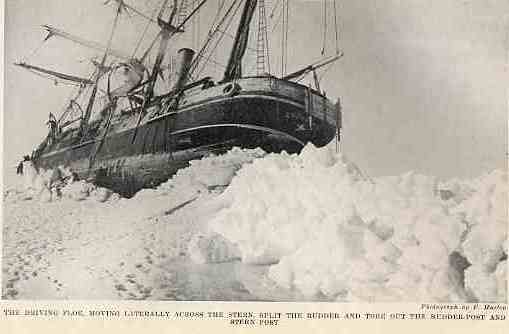
“This morning, our last on the ship, the weather was clear, with a gentle south-south-easterly to south-south-westerly breeze. From the crow’s-nest there was no sign of land of any sort. The pressure was increasing steadily, and the passing hours brought no relief or respite for the ship. The attack of the ice reached its climax at 4 p.m. The ship was hove stern up by the pressure, and the driving floe, moving laterally across the stern, split the rudder and tore out the rudder-post and stern-post. Then, while we watched, the ice loosened and the Endurance sank a little. The decks were breaking upwards and the water was pouring in below. Again the pressure began, and at 5 p.m. I ordered all hands on to the ice. The twisting, grinding floes were working their will at last on the ship. It was a sickening sensation to feel the decks breaking up under one’s feet, the great beams bending and then snapping with a noise like heavy gunfire. The water was overmastering the pumps, and to avoid an explosion when it reached the boilers I had to give orders for the fires to be drawn and the steam let down. The plans for abandoning the ship in case of emergency had been made well in advance, and men and dogs descended to the floe and made their way to the comparative safety of an unbroken portion of the floe without a hitch. Just before leaving, I looked down the engine-room skylight as I stood on the quivering deck, and saw the engines dropping sideways as the stays and bed-plates gave way. I cannot describe the impression of relentless destruction that was forced upon me as I looked down and around. The floes, with the force of millions of tons of moving ice behind them, were simply annihilating the ship.”
“This morning was our last on the ship. The weather was clear, with a gentle breeze shifting from south-south-east to south-south-west. From the crow’s-nest, there was no sign of land of any kind. The pressure was steadily increasing. As the hours passed, the ship had no relief or respite. The ice’s attack reached its peak at 4 p.m. The pressure lifted the ship’s stern. A moving floe pushed across the stern, splitting the rudder and tearing out the rudder-post and stern-post. Then, as we watched, the ice loosened and the Endurance sank a little. The decks were breaking upwards, and water was pouring in below. The pressure began again, and at 5 p.m. I ordered all hands onto the ice. The twisting, grinding floes were finally having their way with the ship. It was a sickening feeling to have the decks breaking up under our feet. The great beams bent and then snapped with a noise like heavy gunfire. Water was coming in faster than the pumps could remove it. To prevent an explosion when it reached the boilers, I had to order the fires put out and the steam released. We had made plans well in advance to abandon the ship in an emergency. The men and dogs descended onto the floe without a hitch. They made their way to the comparative safety of an unbroken part of the floe. Just before leaving, I stood on the shaking deck and looked down through the engine-room skylight. I saw the engines dropping sideways as the supports and bed-plates gave way. I cannot describe the impression of relentless destruction that came over me as I looked down and around. With the force of millions of tons of moving ice behind them, the floes were simply annihilating the ship.”
Essential supplies had been placed on the floe about 100 yds. from the ship, and there we set about making a camp for the night. But about 7 p.m., after the tents were up, the ice we were occupying became involved in the pressure and started to split and smash beneath our feet. I had the camp moved to a bigger floe about 200 yds. away, just beyond the bow of the ship. Boats, stores, and camp equipment had to be conveyed across a working pressure-ridge. The movement of the ice was so slow that it did not interfere much with our short trek, but the weight of the ridge had caused the floes to sink on either side and there were pools of water there. A pioneer party with picks and shovels had to build a snow-causeway before we could get all our possessions across. By 8 p.m. the camp had been pitched again. We had two pole-tents and three hoop-tents. I took charge of the small pole-tent, No. 1, with Hudson, Hurley, and James as companions; Wild had the small hoop-tent, No. 2, with Wordie, McNeish, and McIlroy. These hoop-tents are very easily shifted and set up. The eight forward hands had the large hoop-tent, No. 3; Crean had charge of No. 4 hoop-tent with Hussey, Marston, and Cheetham; and Worsley had the other pole-tent, No. 5, with Greenstreet, Lees, Clark, Kerr, Rickenson, Macklin, and Blackborrow, the last named being the youngest of the forward hands.
Essential supplies had been placed on the floe about 100 yards from the ship. There we began making camp for the night. But around 7 p.m., after the tents were up, the ice beneath us came under pressure. It began to split and break beneath our feet. I had the camp moved to a bigger floe about 200 yards away, just beyond the ship’s bow. We had to carry the boats, supplies, and camp equipment across a pressure ridge that was still moving. The ice moved so slowly that it did not interfere much with our short journey. But the weight of the ridge had pushed the floes down on either side, leaving pools of water. An advance party with picks and shovels had to build a snow causeway before we could get all our possessions across. By 8 p.m. the camp had been set up again. We had two pole tents and three hoop tents. I took charge of the small pole tent, No. 1, with Hudson, Hurley, and James as my companions. Wild took the small hoop tent, No. 2, with Wordie, McNeish, and McIlroy. These hoop tents are very easy to move and set up. The eight forward hands had the large hoop tent, No. 3. Crean took charge of hoop tent No. 4, with Hussey, Marston, and Cheetham. Worsley had the other pole tent, No. 5, with Greenstreet, Lees, Clark, Kerr, Rickenson, Macklin, and Blackborrow. Blackborrow was the youngest of the forward hands.
“To-night the temperature has dropped to –16° Fahr., and most of the men are cold and uncomfortable. After the tents had been pitched I mustered all hands and explained the position to them briefly and, I hope, clearly. I have told them the distance to the Barrier and the distance to Paulet Island, and have stated that I propose to try to march with equipment across the ice in the direction of Paulet Island. I thanked the men for the steadiness and good morale they have shown in these trying circumstances, and told them I had no doubt that, provided they continued to work their utmost and to trust me, we will all reach safety in the end. Then we had supper, which the cook had prepared at the big blubber-stove, and after a watch had been set all hands except the watch turned in.” For myself, I could not sleep. The destruction and abandonment of the ship was no sudden shock. The disaster had been looming ahead for many months, and I had studied my plans for all contingencies a hundred times. But the thoughts that came to me as I walked up and down in the darkness were not particularly cheerful. The task now was to secure the safety of the party, and to that I must bend my energies and mental power and apply every bit of knowledge that experience of the Antarctic had given me. The task was likely to be long and strenuous, and an ordered mind and a clear programme were essential if we were to come through without loss of life. A man must shape himself to a new mark directly the old one goes to ground.
“Tonight the temperature has dropped to 16 degrees below zero Fahrenheit, and most of the men are cold and uncomfortable. After the tents were pitched, I gathered everyone and briefly explained our position. I hope I made it clear. I told them how far we were from the Barrier and from Paulet Island. I said I planned to try to march across the ice toward Paulet Island with our equipment. I thanked the men for their steadiness and good morale in these difficult circumstances. I told them I had no doubt we would all reach safety in the end, provided they kept working their hardest and trusting me. Then we had supper, which the cook had prepared on the big blubber stove. After a watch was set, everyone except the watch went to bed.” I could not sleep. The destruction and abandonment of the ship had not come as a sudden shock. The disaster had threatened us for many months, and I had studied my plans for every possibility a hundred times. But my thoughts were not particularly cheerful as I walked up and down in the darkness. My task now was to get the party to safety. I had to devote all my energy and mental strength to it. I also had to use every bit of knowledge I had gained from experience in the Antarctic. The task was likely to be long and demanding. If we were to get through it without loss of life, I needed a well-ordered mind and a clear plan. When an old goal is lost, a man must immediately set himself a new one.
At midnight I was pacing the ice, listening to the grinding floe and to the groans and crashes that told of the death-agony of the Endurance, when I noticed suddenly a crack running across our floe right through the camp. The alarm-whistle brought all hands tumbling out, and we moved the tents and stores lying on what was now the smaller portion of the floe to the larger portion. Nothing more could be done at that moment, and the men turned in again; but there was little sleep. Each time I came to the end of my beat on the floe I could just see in the darkness the uprearing piles of pressure-ice, which toppled over and narrowed still further the little floating island we occupied. I did not notice at the time that my tent, which had been on the wrong side of the crack, had not been erected again. Hudson and James had managed to squeeze themselves into other tents, and Hurley had wrapped himself in the canvas of No. 1 tent. I discovered this about 5 a.m. All night long the electric light gleamed from the stern of the dying Endurance. Hussey had left this light switched on when he took a last observation, and, like a lamp in a cottage window, it braved the night until in the early morning the Endurance received a particularly violent squeeze. There was a sound of rending beams and the light disappeared. The connexion had been cut.
At midnight, I was pacing the ice, listening to the floe grind and to the groans and crashes of the dying Endurance. Suddenly, I noticed a crack running across our floe, right through the camp. The alarm whistle brought everyone tumbling out. We moved the tents and stores from the smaller part of the floe to the larger part. Nothing more could be done then, so the men went back to bed. But there was little sleep. Each time I reached the end of my patrol, I could just make out towering piles of pressure ice in the darkness. They toppled over, narrowing the little floating island we occupied still further. I did not notice then that my tent had not been put up again after being moved from the wrong side of the crack. Hudson and James had managed to squeeze into other tents, and Hurley had wrapped himself in the canvas of No. 1 tent. I discovered this at about 5 a.m. All night, an electric light shone from the stern of the dying Endurance. Hussey had left the light switched on after taking a final observation. Like a lamp in a cottage window, it braved the night. But early in the morning, the Endurance was squeezed particularly hard. There was a sound of beams tearing apart, and the light disappeared. The connection had been cut.
Morning came in chill and cheerless. All hands were stiff and weary after their first disturbed night on the floe. Just at daybreak I went over to the Endurance with Wild and Hurley, in order to retrieve some tins of petrol that could be used to boil up milk for the rest of the men. The ship presented a painful spectacle of chaos and wreck. The jib-boom and bowsprit had snapped off during the night and now lay at right angles to the ship, with the chains, martingale, and bob-stay dragging them as the vessel quivered and moved in the grinding pack. The ice had driven over the forecastle and she was well down by the head. We secured two tins of petrol with some difficulty, and postponed the further examination of the ship until after breakfast. Jumping across cracks with the tins, we soon reached camp, and built a fireplace out of the triangular water-tight tanks we had ripped from the lifeboat. This we had done in order to make more room. Then we pierced a petrol-tin in half a dozen places with an ice-axe and set fire to it. The petrol blazed fiercely under the five-gallon drum we used as a cooker, and the hot milk was ready in quick time. Then we three ministering angels went round the tents with the life-giving drink, and were surprised and a trifle chagrined at the matter-of-fact manner in which some of the men accepted this contribution to their comfort. They did not quite understand what work we had done for them in the early dawn, and I heard Wild say, “If any of you gentlemen would like your boots cleaned just put them outside.” This was his gentle way of reminding them that a little thanks will go a long way on such occasions.
Morning came, cold and cheerless. All hands were stiff and tired after their first restless night on the ice floe. At daybreak, Wild, Hurley, and I went over to the Endurance. We wanted to retrieve some tins of petrol to heat milk for the rest of the men. The ship was a painful sight, a scene of chaos and wreckage. The jib-boom and bowsprit had snapped off during the night. They now lay at right angles to the ship. The chains, martingale, and bob-stay dragged them as the ship shook and moved in the grinding pack ice. The ice had pushed over the forecastle, and the ship was sitting low at the bow. With some difficulty, we secured two tins of petrol. We put off examining the rest of the ship until after breakfast. We jumped across cracks in the ice with the tins and soon reached camp. There we built a fireplace out of the triangular watertight tanks we had torn from the lifeboat to make more room. Then we punched half a dozen holes in a petrol tin with an ice axe and set the petrol alight. It blazed fiercely beneath the five-gallon drum we used as a cooker, and the hot milk was ready quickly. Then we three ministering angels went around the tents with the life-giving drink. We were surprised and a little annoyed at how matter-of-factly some of the men accepted this addition to their comfort. They did not quite understand how much work we had done for them at dawn. I heard Wild say, “If any of you gentlemen would like your boots cleaned just put them outside.” That was his gentle way of reminding them that a little thanks goes a long way on such occasions.
The cook prepared breakfast, which consisted of biscuit and hoosh, at 8 a.m., and I then went over to the Endurance again and made a fuller examination of the wreck. Only six of the cabins had not been pierced by floes and blocks of ice. Every one of the starboard cabins had been crushed. The whole of the after part of the ship had been crushed concertina fashion. The forecastle and the Ritz were submerged, and the wardroom was three-quarters full of ice. The starboard side of the wardroom had come away. The motor-engine forward had been driven through the galley. Petrol-cases that had been stacked on the fore-deck had been driven by the floe through the wall into the wardroom and had carried before them a large picture. Curiously enough, the glass of this picture had not been cracked, whereas in the immediate neighbourhood I saw heavy iron davits that had been twisted and bent like the ironwork of a wrecked train. The ship was being crushed remorselessly.
The cook prepared breakfast at 8 a.m. It consisted of biscuit and hoosh. I then went back to the Endurance and examined the wreck more closely. Only six cabins had not been pierced by ice floes and blocks. Every cabin on the starboard side had been crushed. The entire rear part of the ship had been crushed like a concertina. The forecastle and the Ritz were underwater, and the wardroom was three-quarters full of ice. The starboard side of the wardroom had come away. The motor engine at the front of the ship had been driven through the galley. Cases of petrol had been stacked on the foredeck. The floe had driven them through the wall into the wardroom, pushing a large picture ahead of them. Curiously, the glass in the picture had not cracked. Yet nearby I saw heavy iron davits twisted and bent like the ironwork of a wrecked train. The ship was being crushed without mercy.
Under a dull, overcast sky I returned to camp and examined our situation. The floe occupied by the camp was still subject to pressure, and I thought it wise to move to a larger and apparently stronger floe about 200 yds. away, off the starboard bow of the ship. This camp was to become known as Dump Camp, owing to the amount of stuff that was thrown away there. We could not afford to carry unnecessary gear, and a drastic sorting of equipment took place. I decided to issue a complete new set of Burberrys and underclothing to each man, and also a supply of new socks. The camp was transferred to the larger floe quickly, and I began there to direct the preparations for the long journey across the floes to Paulet Island or Snow Hill.
Under a dull, overcast sky, I returned to camp and assessed our situation. The ice floe beneath the camp was still under pressure. I thought it wise to move to a larger, apparently stronger floe about 200 yards away, off the ship’s starboard bow. The new camp became known as Dump Camp because of the amount of stuff we threw away there. We could not afford to carry unnecessary gear, so we sorted our equipment ruthlessly. I decided to issue each man a complete new set of Burberrys and underwear, as well as new socks. We quickly moved the camp to the larger floe. There, I began directing preparations for the long journey across the floes to Paulet Island or Snow Hill.
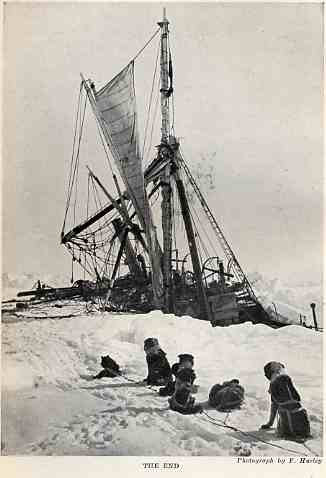
Hurley meanwhile had rigged his kinematograph-camera and was getting pictures of the Endurance in her death-throes. While he was engaged thus, the ice, driving against the standing rigging and the fore-, main- and mizzen-masts, snapped the shrouds. The foretop and topgallant-mast came down with a run and hung in wreckage on the fore-mast, with the fore-yard vertical. The main-mast followed immediately, snapping off about 10 ft. above the main deck. The crow’s-nest fell within 10 ft. of where Hurley stood turning the handle of his camera, but he did not stop the machine, and so secured a unique, though sad, picture.
Meanwhile, Hurley had set up his movie camera and was filming the Endurance in her death throes. As he filmed, the ice pressed against the standing rigging and the foremast, mainmast, and mizzenmast, snapping the shrouds. The foretop and topgallant mast came crashing down and hung in a tangled wreck on the foremast. The foreyard hung vertically. The mainmast fell immediately afterward, snapping off about 10 feet above the main deck. The crow’s-nest fell within 10 feet of Hurley as he turned the camera handle. But he kept the camera running, capturing a unique, though sad, picture.
The issue of clothing was quickly accomplished. Sleeping-bags were required also. We had eighteen fur bags, and it was necessary, therefore, to issue ten of the Jaeger woollen bags in order to provide for the twenty-eight men of the party. The woollen bags were lighter and less warm than the reindeer bags, and so each man who received one of them was allowed also a reindeer-skin to lie upon. It seemed fair to distribute the fur bags by lot, but some of us older hands did not join in the lottery. We thought we could do quite as well with the Jaegers as with the furs. With quick dispatch the clothing was apportioned, and then we turned one of the boats on its side and supported it with two broken oars to make a lee for the galley. The cook got the blubber-stove going, and a little later, when I was sitting round the corner of the stove, I heard one man say, “Cook, I like my tea strong.” Another joined in, “Cook, I like mine weak.” It was pleasant to know that their minds were untroubled, but I thought the time opportune to mention that the tea would be the same for all hands and that we would be fortunate if two months later we had any tea at all. It occurred to me at the time that the incident had psychological interest. Here were men, their home crushed, the camp pitched on the unstable floes, and their chance of reaching safety apparently remote, calmly attending to the details of existence and giving their attention to such trifles as the strength of a brew of tea.
We quickly handed out the clothing. We also needed sleeping bags. We had eighteen fur bags, so we had to issue ten Jaeger wool bags to provide for all twenty-eight men. The wool bags were lighter and less warm than the reindeer-skin bags. So each man who received a wool bag was also given a reindeer-skin to lie on. It seemed fair to distribute the fur bags by drawing lots, but some of us more experienced men did not take part. We thought we could do just as well with the Jaeger bags as with the fur ones. Once the clothing had been handed out, we turned one of the boats on its side. We propped it up with two broken oars to shelter the galley from the wind. The cook got the blubber-stove going. A little later, as I sat around the corner from the stove, I heard one man say, “Cook, I like my tea strong.” Another added, “Cook, I like mine weak.” It was pleasant to know that their minds were untroubled. But I thought it a good time to mention that everyone would get the same tea. We would be fortunate, I said, if we had any tea at all two months later. It occurred to me that the incident was psychologically interesting. These men had seen their home crushed. Their camp stood on unstable ice floes, and their chance of reaching safety seemed remote. Yet they calmly attended to the details of life, giving their attention to such trifles as the strength of their tea.
During the afternoon the work continued. Every now and then we heard a noise like heavy guns or distant thunder, caused by the floes grinding together.
Work continued through the afternoon. Every now and then, we heard a noise like heavy guns or distant thunder. It came from the ice floes grinding together.
“The pressure caused by the congestion in this area of the pack is producing a scene of absolute chaos. The floes grind stupendously, throw up great ridges, and shatter one another mercilessly. The ridges, or hedgerows, marking the pressure-lines that border the fast-diminishing pieces of smooth floe-ice, are enormous. The ice moves majestically, irresistibly. Human effort is not futile, but man fights against the giant forces of Nature in a spirit of humility. One has a sense of dependence on the higher Power. To-day two seals, a Weddell and a crabeater, came close to the camp and were shot. Four others were chased back into the water, for their presence disturbed the dog teams, and this meant floggings and trouble with the harness. The arrangement of the tents has been completed and their internal management settled. Each tent has a mess orderly, the duty being taken in turn on an alphabetical rota. The orderly takes the hoosh-pots of his tent to the galley, gets all the hoosh he is allowed, and, after the meal, cleans the vessels with snow and stores them in sledge or boat ready for a possible move.”
“The pressure from the crowded ice in this part of the pack is creating a scene of complete chaos. The floes grind against each other with tremendous force, throwing up huge ridges and shattering one another mercilessly. The ridges, or hedgerows, mark the pressure lines bordering the rapidly shrinking patches of smooth floe ice. They are enormous. The ice moves majestically and irresistibly. Human effort is not useless, but we fight the giant forces of Nature with humility. One feels dependent on a higher Power. Today two seals, a Weddell and a crabeater, came close to the camp and were shot. Four others were chased back into the water because they disturbed the dog teams. This led to floggings and trouble with the harnesses. The tents are now arranged, and the way they will be run has been settled. Each tent has a mess orderly, and everyone takes the duty in alphabetical order. The orderly takes the tent’s hoosh pots to the galley and collects all the hoosh allowed. After the meal, the orderly cleans the pots with snow and stores them in a sledge or boat. They are then ready in case we have to move.”
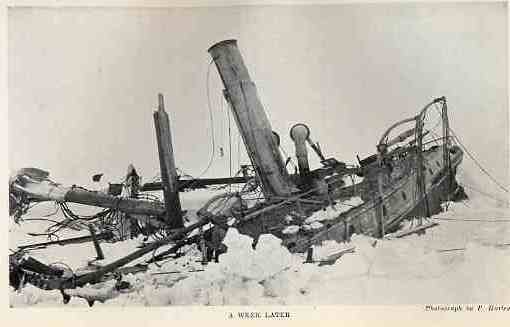
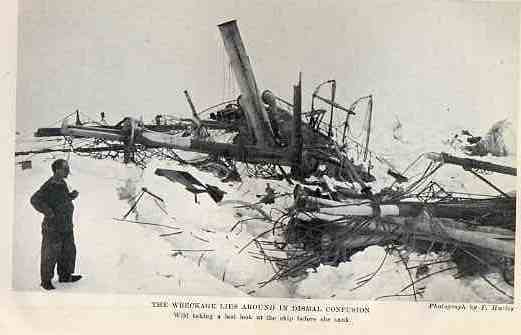
“October 29.—We passed a quiet night, although the pressure was grinding around us. Our floe is a heavy one and it withstood the blows it received. There is a light wind from the north-west to north-north-west, and the weather is fine. We are twenty-eight men with forty-nine dogs, including Sue’s and Sallie’s five grown-up pups. All hands this morning were busy preparing gear, fitting boats on sledges, and building up and strengthening the sledges to carry the boats.... The main motor-sledge, with a little fitting from the carpenter, carried our largest boat admirably. For the next boat four ordinary sledges were lashed together, but we were dubious as to the strength of this contrivance, and as a matter of fact it broke down quickly under strain.... The ship is still afloat, with the spurs of the pack driven through her and holding her up. The forecastle-head is under water, the decks are burst up by the pressure, the wreckage lies around in dismal confusion, but over all the blue ensign flies still.
“October 29. We had a quiet night, although the ice was grinding under pressure around us. Our floe is heavy, and it withstood the blows. A light wind is blowing from the northwest to north-northwest, and the weather is fine. There are twenty-eight of us and forty-nine dogs, including Sue’s and Sallie’s five grown-up pups. Everyone was busy this morning preparing gear and fitting boats onto sledges. They also built up and strengthened the sledges to carry the boats.... With a little work by the carpenter, the main motor-sledge carried our largest boat admirably. For the next boat, four ordinary sledges were lashed together. But we doubted this arrangement was strong enough, and it did, in fact, quickly break down under strain.... The ship is still afloat, with projections of pack ice driven through her and holding her up. The forecastle head is under water, and the pressure has burst the decks upward. Wreckage lies around in dismal confusion, but the blue ensign still flies over it all.
“This afternoon Sallie’s three youngest pups, Sue’s Sirius, and Mrs. Chippy, the carpenter’s cat, have to be shot. We could not undertake the maintenance of weaklings under the new conditions. Macklin, Crean, and the carpenter seemed to feel the loss of their friends rather badly. We propose making a short trial journey to-morrow, starting with two of the boats and the ten sledges. The number of dog teams has been increased to seven, Greenstreet taking charge of the new additional team, consisting of Snapper and Sallie’s four oldest pups. We have ten working sledges to relay with five teams. Wild’s and Hurley’s teams will haul the cutter with the assistance of four men. The whaler and the other boats will follow, and the men who are hauling them will be able to help with the cutter at the rough places. We cannot hope to make rapid progress, but each mile counts. Crean this afternoon has a bad attack of snow-blindness.”
“This afternoon, Sallie’s three youngest pups, Sue’s Sirius, and Mrs. Chippy, the carpenter’s cat, have to be shot. Under the new conditions, we could not take care of animals too weak to work. Macklin, Crean, and the carpenter seemed to feel the loss of their friends deeply. We plan to make a short trial journey tomorrow, starting with two boats and the ten sledges. We have increased the number of dog teams to seven. Greenstreet is taking charge of the new team, made up of Snapper and Sallie’s four oldest pups. We have ten working sledges to move in relays with five teams. Wild’s and Hurley’s teams will pull the cutter with help from four men. The whaler and the other boats will follow. The men pulling them will be able to help with the cutter over rough ground. We cannot hope to make rapid progress, but each mile counts. Crean has a bad attack of snow blindness this afternoon.”
The weather on the morning of October 30 was overcast and misty, with occasional falls of snow. A moderate north-easterly breeze was blowing. We were still living on extra food, brought from the ship when we abandoned her, and the sledging and boating rations were intact. These rations would provide for twenty-eight men for fifty-six days on full rations, but we could count on getting enough seal and penguin meat to at least double this time. We could even, if progress proved too difficult and too injurious to the boats, which we must guard as our ultimate means of salvation, camp on the nearest heavy floe, scour the neighbouring pack for penguins and seals, and await the outward rift of the pack, to open and navigable water.
On the morning of October 30, the weather was cloudy and misty, with occasional snow. A moderate breeze was blowing from the northeast. We were still living on extra food brought from the ship when we abandoned her. Our sledging and boating rations remained untouched. At full rations, these supplies would feed twenty-eight men for fifty-six days. But we could count on getting enough seal and penguin meat to make them last at least twice as long. If progress proved too difficult and too damaging to the boats, we had another option. We had to protect the boats as our last means of survival. We could camp on the nearest large, thick ice floe, search the surrounding pack ice for penguins and seals, and wait for the pack to break apart toward open, navigable water.
“This plan would avoid the grave dangers we are now incurring of getting entangled in impassable pressure-ridges and possibly irretrievably damaging the boats, which are bound to suffer in rough ice; it would also minimize the peril of the ice splitting under us, as it did twice during the night at our first camp. Yet I feel sure that it is the right thing to attempt a march, since if we can make five or seven miles a day to the north-west our chance of reaching safety in the months to come will be increased greatly. There is a psychological aspect to the question also. It will be much better for the men in general to feel that, even though progress is slow, they are on their way to land than it will be simply to sit down and wait for the tardy north-westerly drift to take us out of this cruel waste of ice. We will make an attempt to move. The issue is beyond my power either to predict or to control.”
“This plan would avoid the serious dangers we now face from becoming trapped among impassable ridges of ice. It would also prevent us from possibly damaging the boats beyond repair. The boats are bound to suffer in rough ice. The plan would reduce the risk of the ice splitting beneath us, as it did twice that night at our first camp. Yet I am sure we should try to march. If we can travel five or seven miles a day to the northwest, our chances of reaching safety in the coming months will greatly improve. There is also a psychological side to the question. For the men in general, it will be much better to feel that they are on their way to land, even if progress is slow. That is better than simply sitting and waiting for the slow northwestward drift to carry us out of this cruel waste of ice. We will try to move. I can neither predict nor control the outcome.”
That afternoon Wild and I went out in the mist and snow to find a road to the north-east. After many devious turnings to avoid the heavier pressure-ridges, we pioneered a way for at least a mile and a half. and then returned by a rather better route to the camp. The pressure now was rapid in movement and our floe was suffering from the shakes and jerks of the ice. At 3 p.m., after lunch, we got under way, leaving Dump Camp a mass of debris. The order was that personal gear must not exceed two pounds per man, and this meant that nothing but bare necessaries was to be taken on the march. We could not afford to cumber ourselves with unnecessary weight. Holes had been dug in the snow for the reception of private letters and little personal trifles, the Lares and Penates of the members of the Expedition, and into the privacy of these white graves were consigned much of sentimental value and not a little of intrinsic worth. I rather grudged the two pounds allowance per man, owing to my keen anxiety to keep weights at a minimum, but some personal belongings could fairly be regarded as indispensable. The journey might be a long one, and there was a possibility of a winter in improvised quarters on an inhospitable coast at the other end. A man under such conditions needs something to occupy his thoughts, some tangible memento of his home and people beyond the seas. So sovereigns were thrown away and photographs were kept. I tore the fly-leaf out of the Bible that Queen Alexandra had given to the ship, with her own writing in it, and also the wonderful page of Job containing the verse:
That afternoon, Wild and I went out into the mist and snow to find a route to the north-east. We made many detours to avoid the larger pressure ridges and found a way through for at least a mile and a half. Then we returned to camp by a somewhat better route. The ice was now moving rapidly under pressure, and our floe shook and jerked with it. At 3 p.m., after lunch, we set off, leaving Dump Camp a mass of debris. The order was that each man’s personal gear must weigh no more than two pounds. This meant taking only the bare necessities on the march. We could not afford to burden ourselves with unnecessary weight. We dug holes in the snow for private letters and small personal treasures, the Lares and Penates of the members of the Expedition. Into these private white graves went many things of sentimental value and quite a few of considerable material worth. I was reluctant to allow each man even two pounds, because I was so anxious to keep the weight to a minimum. But some personal belongings could fairly be considered indispensable. The journey might be long, and we might have to spend a winter in makeshift quarters on an inhospitable coast at the other end. Under such conditions, a man needs something to occupy his thoughts, some tangible reminder of his home and people across the seas. So gold sovereigns were thrown away and photographs were kept. I tore out the flyleaf of the Bible that Queen Alexandra had given to the ship, with her own writing on it. I also tore out the wonderful page of Job containing the verse:
Out of whose womb came the ice? And the hoary frost of Heaven, who hath gendered it? The waters are hid as with a stone, And the face of the deep is frozen. —[Job 38:29–30]
From whose womb did the ice come? And who gave birth to the white frost of Heaven? The waters are covered as if by stone, And the surface of the deep is frozen. [Job 38:29–30]
The other Bible, which Queen Alexandra had given for the use of the shore party, was down below in the lower hold in one of the cases when the ship received her death-blow. Suitcases were thrown away; these were retrieved later as material for making boots, and some of them, marked “solid leather,” proved, to our disappointment, to contain a large percentage of cardboard. The manufacturer would have had difficulty in convincing us at the time that the deception was anything short of criminal.
The other Bible had been given by Queen Alexandra for the shore party to use. It was in a case in the lower hold when the ship suffered its fatal blow. Suitcases were thrown away, but were later retrieved for use in making boots. Some were marked “solid leather,” but to our disappointment, they contained a large percentage of cardboard. At the time, the manufacturer would have had difficulty convincing us that the deception was anything less than criminal.
The pioneer sledge party, consisting of Wordie, Hussey, Hudson, and myself, carrying picks and shovels, started to break a road through the pressure-ridges for the sledges carrying the boats. The boats, with their gear and the sledges beneath them, weighed each more than a ton. The cutter was smaller than the whaler, but weighed more and was a much more strongly built boat. The whaler was mounted on the sledge part of the Girling tractor forward and two sledges amidships and aft. These sledges were strengthened with cross-timbers and shortened oars fore and aft. The cutter was mounted on the aero-sledge. The sledges were the point of weakness. It appeared almost hopeless to prevent them smashing under their heavy loads when travelling over rough pressure-ice which stretched ahead of us for probably 300 miles. After the pioneer sledge had started the seven dog teams got off. They took their sledges forward for half a mile, then went back for the other sledges. Worsley took charge of the two boats, with fifteen men hauling, and these also had to be relayed. It was heavy work for dogs and men, but there were intervals of comparative rest on the backward journey, after the first portion of the load had been taken forward. We passed over two opening cracks, through which killers were pushing their ugly snouts, and by 5 p.m. had covered a mile in a north-north-westerly direction. The condition of the ice ahead was chaotic, for since the morning increased pressure had developed and the pack was moving and crushing in all directions. So I gave the order to pitch camp for the night on flat ice, which, unfortunately, proved to be young and salty. The older pack was too rough and too deeply laden with snow to offer a suitable camping-ground. Although we had gained only one mile in a direct line, the necessary deviations made the distance travelled at least two miles, and the relays brought the distance marched up to six miles. Some of the dog teams had covered at least ten miles. I set the watch from 6 p.m. to 7 a.m., one hour for each man in each tent in rotation.
The advance sledge party consisted of Wordie, Hussey, Hudson, and me. We took picks and shovels and started to clear a path through the pressure ridges for the sledges carrying the boats. Each boat, with its gear and the sledges beneath it, weighed more than a ton. The cutter was smaller than the whaler, but it weighed more and was much more strongly built. The whaler was mounted on the sledge section of the Girling tractor at the front, with two sledges supporting its middle and rear. These sledges were reinforced with cross-timbers and shortened oars laid lengthwise. The cutter was mounted on the aero-sledge. The sledges were the weak point. It seemed almost hopeless to keep them from breaking under their heavy loads on the rough pressure-ice. The ice probably stretched for 300 miles ahead of us. After the advance sledge set off, the seven dog teams followed. They pulled their sledges forward half a mile, then went back for the other sledges. Worsley took charge of the two boats, with fifteen men hauling them. These also had to be moved forward in stages. It was heavy work for dogs and men, but they could rest somewhat on the return journeys, after taking the first part of the load forward. We passed over two cracks that were opening in the ice, with killer whales pushing their ugly snouts through them. By 5 p.m. we had covered a mile in a north-northwesterly direction. The ice ahead was in chaos. Pressure had increased since morning, and the pack ice was moving and crushing in all directions. So I ordered the men to pitch camp for the night on flat ice. Unfortunately, the ice proved to be young and salty. The older pack ice was too rough and too deeply covered in snow to provide a suitable campsite. Although we had gained only one mile in a straight line, the detours meant we had traveled at least two miles. Moving the loads in stages brought the total distance marched to six miles. Some of the dog teams had covered at least ten miles. I set a watch from 6 p.m. to 7 a.m., with each man in each tent taking a one-hour turn.
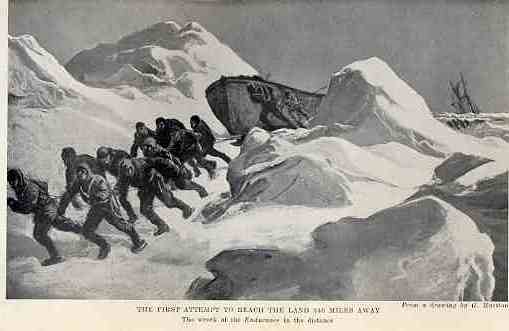
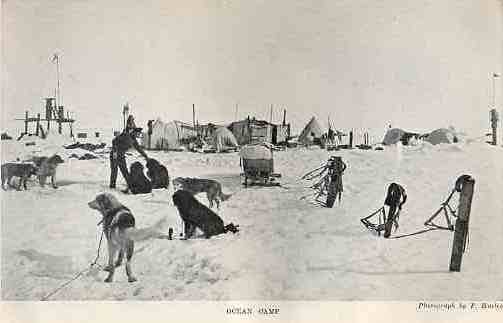
During the night snow fell heavily, and the floor-cloths of the tents got wet through, as the temperature had risen to +25° Fahr. One of the things we hoped for in those days was a temperature in the neighbourhood of zero, for then the snow surface would be hard, we would not be troubled by damp, and our gear would not become covered in soft snow. The killers were blowing all night, and a crack appeared about 20 ft. from the camp at 2 a.m. The ice below us was quite thin enough for the killers to break through if they took a fancy to do so, but there was no other camping-ground within our reach and we had to take the risk. When morning came the snow was falling so heavily that we could not see more than a few score yards ahead, and I decided not to strike camp. A path over the shattered floes would be hard to find, and to get the boats into a position of peril might be disastrous. Rickenson and Worsley started back for Dump Camp at 7 a.m. to get some wood and blubber for the fire, and an hour later we had hoosh, with one biscuit each. At 10 a.m. Hurley and Hudson left for the old camp in order to bring some additional dog-pemmican, since there were no seals to be found near us. Then, as the weather cleared, Worsley and I made a prospect to the west and tried to find a practicable road. A large floe offered a fairly good road for at least another mile to the north-west, and we went back prepared for another move. The weather cleared a little, and after lunch we struck camp. I took Rickenson, Kerr, Wordie, and Hudson as a breakdown gang to pioneer a path among the pressure-ridges. Five dog teams followed. Wild’s and Hurley’s teams were hitched on to the cutter and they started off in splendid style. They needed to be helped only once; indeed fourteen dogs did as well or even better than eighteen men. The ice was moving beneath and around us as we worked towards the big floe, and where this floe met the smaller ones there was a mass of pressed-up ice, still in motion, with water between the ridges. But it is wonderful what a dozen men can do with picks and shovels. We could cut a road through a pressure-ridge about 14 ft. high in ten minutes and leave a smooth, or comparatively smooth, path for the sledges and teams.
During the night, heavy snow fell and the tent floorcloths became soaked as the temperature rose to 25°F. In those days, we hoped for a temperature around zero. Then the snow would be hard, we would not be troubled by damp, and soft snow would not cover our gear. The killer whales were blowing all night, and at 2 a.m. a crack appeared about 20 feet from camp. The ice beneath us was thin enough for the whales to break through if they chose. But there was no other campsite within reach, so we had to take the risk. By morning, snow was falling so heavily that we could see only a few dozen yards ahead. I decided not to pack up camp. A path over the broken floes would be hard to find, and putting the boats in danger could be disastrous. At 7 a.m., Rickenson and Worsley set out for Dump Camp to fetch wood and blubber for the fire. An hour later, we had hoosh, with one biscuit each. At 10 a.m., Hurley and Hudson left for the old camp to bring back more dog-pemmican. There were no seals to be found near us. Then the weather cleared, and Worsley and I explored to the west, looking for a workable route. A large floe offered a fairly good route for at least another mile to the northwest. We returned ready to move again. The weather cleared a little, and after lunch we packed up camp. I took Rickenson, Kerr, Wordie, and Hudson as a clearing party to make a path among the pressure ridges. Five dog teams followed. Wild’s and Hurley’s teams were hitched to the cutter, and they set off splendidly. They needed help only once. Indeed, fourteen dogs did as well as or even better than eighteen men. The ice was moving beneath and around us as we worked toward the big floe. Where it met the smaller floes, there was a mass of piled-up ice, still moving, with water between the ridges. But it is wonderful what a dozen men can do with picks and shovels. In ten minutes, we could cut a road through a pressure ridge about 14 feet high. We could leave a smooth, or comparatively smooth, path for the sledges and teams.