Appendix
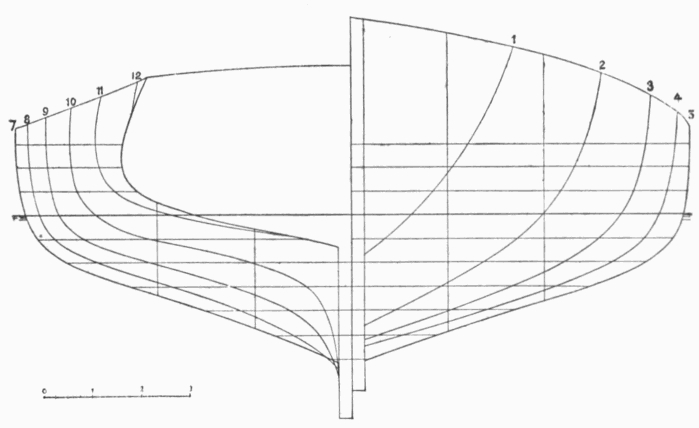
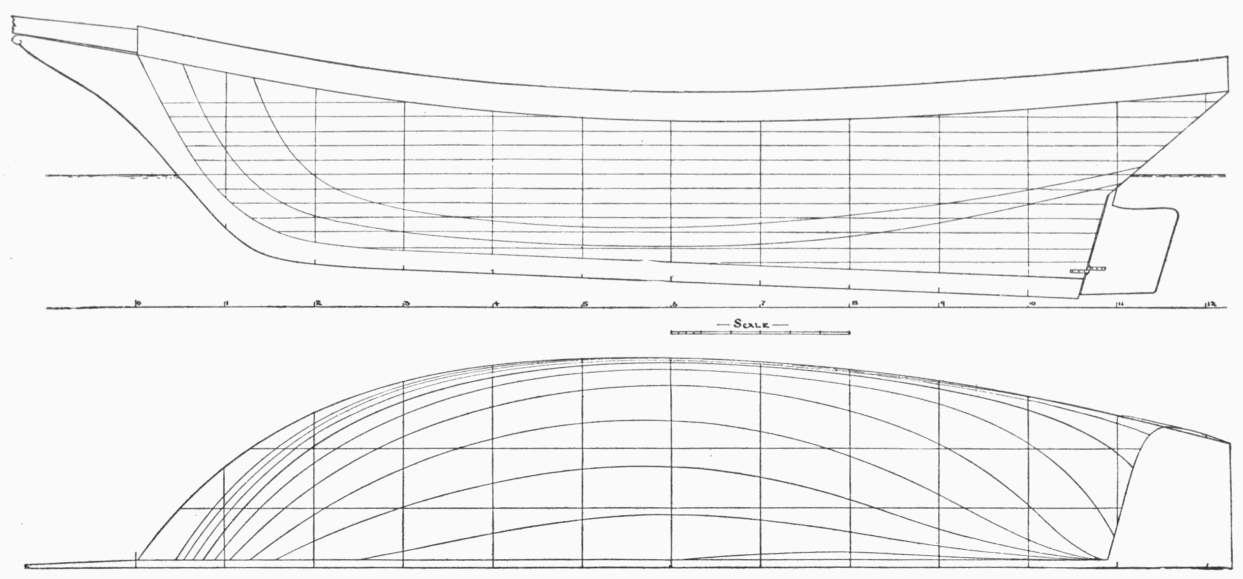
LINES AND SAIL-PLAN OF THE "SPRAY"
HULL LINES AND SAIL PLAN OF THE "SPRAY"
Her pedigree so far as known—The Lines of the Spray—Her self-steering qualities—Sail-plan and steering-gear—An unprecedented feat—A final word of cheer to would-be navigators.
Her history, as far as it is known. The shape of the Spray’s hull. Her ability to steer herself. Her sail plan and steering gear. An unprecedented feat. A final word of encouragement to aspiring sailors.
From a feeling of diffidence toward sailors of great experience, I refrained, in the preceding chapters as prepared for serial publication in the "Century Magazine," from entering fully into the details of the Spray's build, and of the primitive methods employed to sail her. Having had no yachting experience at all, I had no means of knowing that the trim vessels seen in our harbors and near the land could not all do as much, or even more, than the Spray, sailing, for example, on a course with the helm lashed.
I felt hesitant to speak before highly experienced sailors. So, in the preceding chapters prepared for serial publication in the "Century Magazine," I did not fully describe the Spray's construction or the primitive methods used to sail her. I had no yachting experience at all. So I had no way of knowing that not all the trim vessels seen in our harbors and near shore could do as much as the Spray, or even more. For example, they could not all sail on course with the helm lashed.
I was aware that no other vessel had sailed in this manner around the globe, but would have been loath to say that another could not do it, or that many men had not sailed vessels of a certain rig in that manner as far as they wished to go. I was greatly amused, therefore, by the flat assertions of an expert that it could not be done.
I knew that no other vessel had sailed around the world in this manner. But I would not have liked to say that another could not do so. Nor would I have liked to say that many men had not sailed vessels with a certain rig in this manner as far as they wished to go. I was therefore greatly amused by an expert’s flat assertions that such a voyage could not be done.
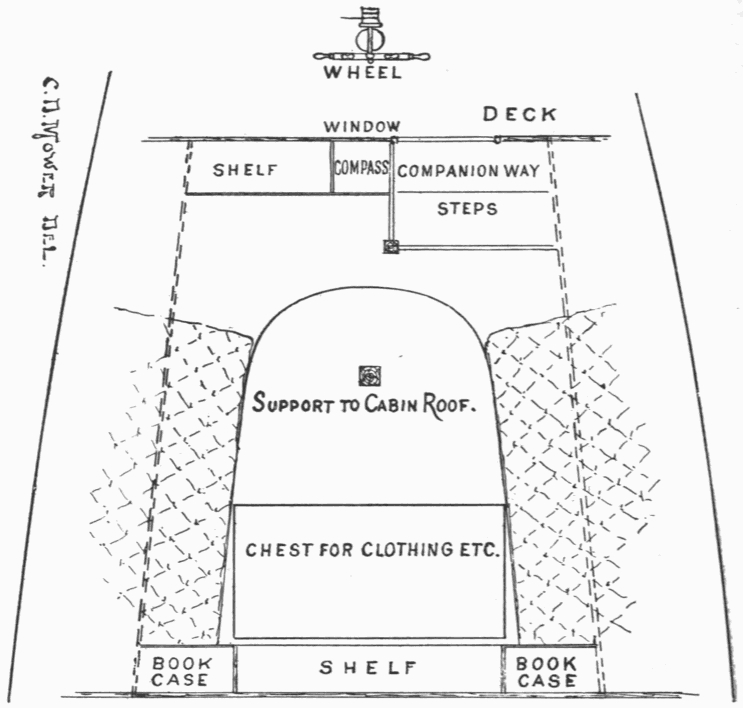
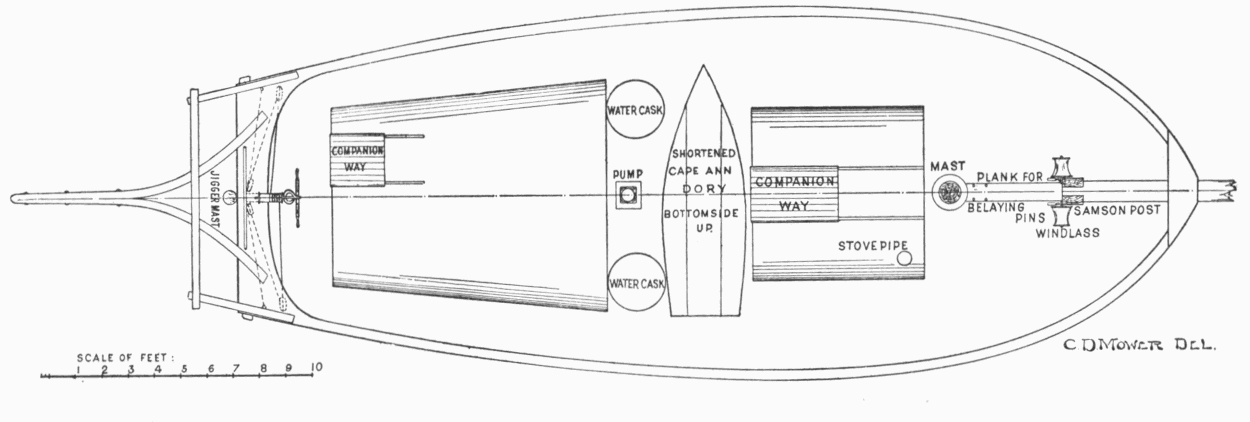
The Spray, as I sailed her, was entirely a new boat, built over from a sloop which bore the same name, and which, tradition said, had first served as an oysterman, about a hundred years ago, on the coast of Delaware. There was no record in the custom-house of where she was built. She was once owned at Noank, Connecticut, afterward in New Bedford and when Captain Eben Pierce presented her to me, at the end of her natural life, she stood, as I have already described, propped up in a field at Fairhaven. Her lines were supposed to be those of a North Sea fisherman. In rebuilding timber by timber and plank by plank, I added to her free-board twelve inches amidships, eighteen inches forward, and fourteen inches aft, thereby increasing her sheer, and making her, as I thought, a better deep-water ship. I will not repeat the history of the rebuilding of the Spray, which I have detailed in my first chapter, except to say that, when finished, her dimensions were thirty-six feet nine inches over all, fourteen feet two inches wide, and four feet two inches deep in the hold, her tonnage being nine tons net, and twelve and seventy one-hundredths tons gross.
The Spray I sailed was entirely a new boat, rebuilt from a sloop of the same name. According to tradition, the old sloop had first served as an oyster boat on the coast of Delaware, about a hundred years ago. The custom-house had no record of where she was built. She had once belonged to an owner in Noank, Connecticut, and later to one in New Bedford. When Captain Eben Pierce gave her to me, she had reached the end of her natural life. As I have already described, she stood propped up in a field at Fairhaven. Her hull was thought to have the lines of a North Sea fishing boat. I rebuilt her timber by timber and plank by plank. I raised her freeboard twelve inches amidships, eighteen inches forward, and fourteen inches aft. This increased her sheer, and I thought it made her a better deep-water ship. I will not repeat the history of the Spray's rebuilding, which I described in my first chapter. When finished, she was thirty-six feet nine inches long overall, fourteen feet two inches wide, and four feet two inches deep in the hold. Her tonnage was nine tons net and twelve and seventy one-hundredths tons gross.
I gladly produce the lines of the Spray, with such hints as my really limited fore-and-aft sailing will allow, my seafaring life having been spent mostly in barks and ships. No pains have been spared to give them accurately. The Spray was taken from New York to Bridgeport, Connecticut, and, under the supervision of the Park City Yacht Club, was hauled out of water and very carefully measured in every way to secure a satisfactory result. Captain Robins produced the model. Our young yachtsmen, pleasuring in the "lilies of the sea," very naturally will not think favorably of my craft. They have a right to their opinion, while I stick to mine. They will take exceptions to her short ends, the advantage of these being most apparent in a heavy sea.
I gladly share the plans of the Spray, along with what advice my limited experience sailing fore-and-aft rigged vessels allows. I spent most of my seafaring life aboard barks and ships. No effort was spared to make the plans accurate. The Spray was taken from New York to Bridgeport, Connecticut. There, under the supervision of the Park City Yacht Club, she was hauled out of the water and carefully measured in every way to ensure a satisfactory result. Captain Robins made the model. Our young yachtsmen, who take pleasure in the "lilies of the sea," will naturally not think much of my craft. They have a right to their opinion, while I stick to mine. They will object to her short ends, whose advantage is most apparent in a heavy sea.
Some things about the Spray's deck might be fashioned differently without materially affecting the vessel. I know of no good reason why for a party-boat a cabin trunk might not be built amidships instead of far aft, like the one on her, which leaves a very narrow space between the wheel and the line of the companionway. Some even say that I might have improved the shape of her stern. I do not know about that. The water leaves her run sharp after bearing her to the last inch, and no suction is formed by undue cutaway.
Some parts of the Spray's deck could be built differently without significantly affecting the vessel. For a party boat, I see no good reason not to build the raised cabin in the middle of the vessel instead of far aft, as on the Spray. Her cabin leaves very little room between the wheel and the companionway. Some even say I could have improved the shape of her stern. I don't know about that. The water supports her to the very end, then flows cleanly away from her sharply tapered stern. No suction is formed by cutting away too much of the hull.
Smooth-water sailors say, "Where is her overhang?" They never crossed the Gulf Stream in a nor'easter, and they do not know what is best in all weathers. For your life, build no fantail overhang on a craft going offshore. As a sailor judges his prospective ship by a "blow of the eye" when he takes interest enough to look her over at all, so I judged the Spray, and I was not deceived.
Sailors used to calm waters ask, "Where is her overhang?" They have never crossed the Gulf Stream in a nor'easter. They do not know what works best in all weather. For your own safety, never build a fantail overhang on a boat going offshore. When a sailor takes enough interest to look over a ship he might sail, he judges her with "a glance." I judged the Spray the same way, and I was not mistaken.
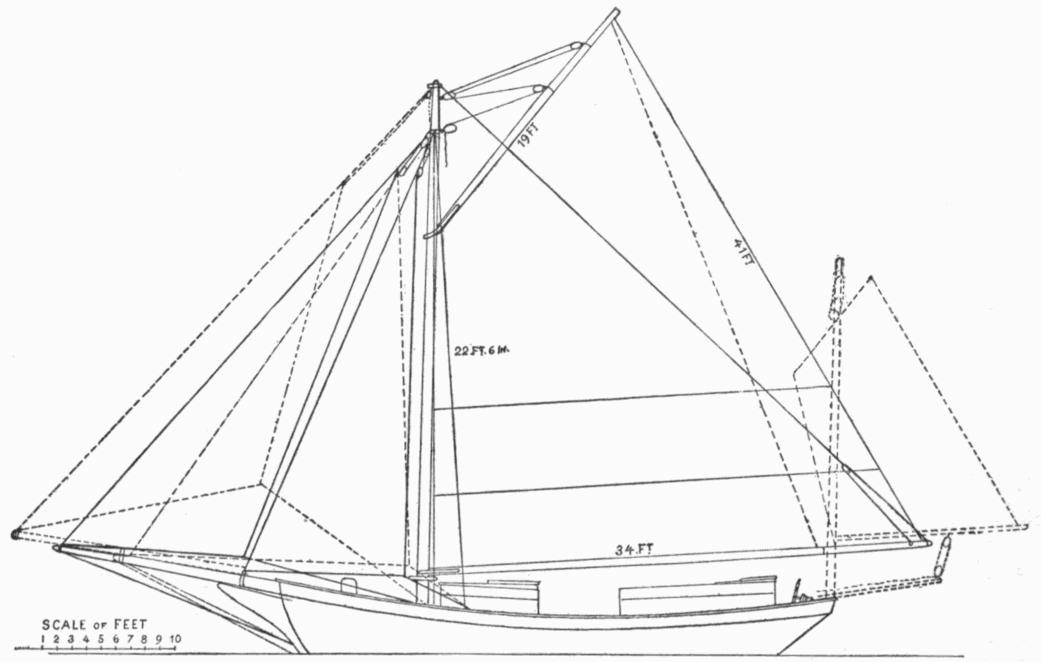
In a sloop-rig the Spray made that part of her voyage reaching from Boston through the Strait of Magellan, during which she experienced the greatest variety of weather conditions. The yawl-rig then adopted was an improvement only in that it reduced the size of a rather heavy mainsail and slightly improved her steering qualities on the wind. When the wind was aft the jigger was not in use; invariably it was then furled. With her boom broad off and with the wind two points on the quarter the Spray sailed her truest course. It never took long to find the amount of helm, or angle of rudder, required to hold her on her course, and when that was found I lashed the wheel with it at that angle. The mainsail then drove her, and the main-jib, with its sheet boused flat amidships or a little to one side or the other, added greatly to the steadying power. Then if the wind was even strong or squally I would sometimes set a flying-jib also, on a pole rigged out on the bowsprit, with, the sheets hauled flat amidships, which was a safe thing to do, even in a gale of wind. A stout downhaul on the gaff was a necessity, because without it the mainsail might not have come down when I wished to lower it in a breeze. The amount of helm required varied according to the amount of wind and its direction. These points are quickly gathered from practice.
The Spray was rigged as a sloop on her voyage from Boston through the Strait of Magellan. During that part of the voyage, she experienced the greatest variety of weather. I then changed her to a yawl rig. This was an improvement only because it reduced the size of her rather heavy mainsail and slightly improved her steering when sailing into the wind. When the wind was behind her, the jigger was never used. It was always furled. The Spray held her truest course with her boom swung well out and the wind two points off her stern. It never took long to find the angle of the rudder needed to hold her on course. Once I found it, I lashed the wheel in place. The mainsail then drove her forward. The main-jib also helped greatly to keep her steady, with its sheet pulled tight at the center or slightly to either side. Even if the wind was strong or squally, I would sometimes set a flying-jib as well. I set it on a pole extending from the bowsprit, with its sheets pulled tight at the center. This was safe to do even in a gale. A strong downhaul on the gaff was necessary. Without it, the mainsail might not have come down when I wanted to lower it in a breeze. The rudder angle needed depended on the wind's strength and direction. These things are quickly learned through practice.
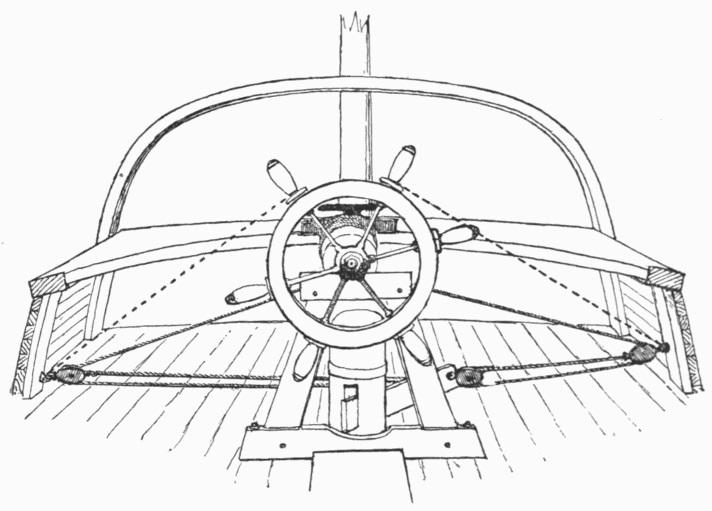
Briefly I have to say that when close-hauled in a light wind under all sail she required little or no weather helm. As the wind increased I would go on deck, if below, and turn the wheel up a spoke more or less, relash it, or, as sailors say, put it in a becket, and then leave it as before.
In short, when sailing close to the wind in a light breeze with all sails up, the boat needed little or no weather helm. As the wind increased, I would go on deck if I was below. I would turn the wheel about one spoke farther and tie it down again, or, as sailors say, put it in a becket. Then I would leave the wheel as before.
To answer the questions that might be asked to meet every contingency would be a pleasure, but it would overburden my book. I can only say here that much comes to one in practice, and that, with such as love sailing, mother-wit is the best teacher, after experience. Labor-saving appliances? There were none. The sails were hoisted by hand; the halyards were rove through ordinary ships' blocks with common patent rollers. Of course the sheets were all belayed aft.
I would be glad to answer every question that might arise in any situation, but that would overload my book. I can only say here that you learn much through practice. For those who love sailing, common sense is the best teacher after experience. Labor-saving devices? There were none. The sails were raised by hand. The halyards ran through ordinary ship’s blocks fitted with standard patent rollers. Of course, the sheets were all secured aft.
The windlass used was in the shape of a winch, or crab, I think it is called. I had three anchors, weighing forty pounds, one hundred pounds, and one hundred and eighty pounds respectively. The windlass and the forty-pound anchor, and the "fiddle-head," or carving, on the end of the cutwater, belonged to the original Spray. The ballast, concrete cement, was stanchioned down securely. There was no iron or lead or other weight on the keel.
The windlass was shaped like a winch, or a "crab," I think it is called. I had three anchors, weighing forty pounds, one hundred pounds, and one hundred and eighty pounds, respectively. The windlass, the forty-pound anchor, and the "fiddle-head," or carving, on the end of the cutwater belonged to the original Spray. The concrete cement ballast was securely held down with stanchions. There was no iron, lead, or other weight on the keel.
If I took measurements by rule I did not set them down, and after sailing even the longest voyage in her I could not tell offhand the length of her mast, boom, or gaff. I did not know the center of effort in her sails, except as it hit me in practice at sea, nor did I care a rope yarn about it. Mathematical calculations, however, are all right in a good boat, and the Spray could have stood them. She was easily balanced and easily kept in trim.
If I measured anything with a ruler, I did not write it down. Even after my longest voyage in her, I could not say offhand how long her mast, boom, or gaff was. I knew the center of effort in her sails only from how it felt in practice at sea, and I did not care a bit about it. Mathematical calculations are all right in a good boat, though, and the Spray could have stood up to them. She was easy to balance and keep in trim.
Some of the oldest and ablest shipmasters have asked how it was possible for her to hold a true course before the wind, which was just what the Spray did for weeks together. One of these gentlemen, a highly esteemed shipmaster and friend, testified as government expert in a famous murder trial in Boston, not long since, that a ship would not hold her course long enough for the steersman to leave the helm to cut the captain's throat. Ordinarily it would be so. One might say that with a square-rigged ship it would always be so. But the Spray, at the moment of the tragedy in question, was sailing around the globe with no one at the helm, except at intervals more or less rare. However, I may say here that this would have had no bearing on the murder case in Boston. In all probability Justice laid her hand on the true rogue. In other words, in the case of a model and rig similar to that of the tragedy ship, I should myself testify as did the nautical experts at the trial.
Some of the oldest and most capable shipmasters have asked how the Spray could hold a true course before the wind. Yet that is just what she did for weeks at a time. One of these men was a highly respected shipmaster and a friend of mine. Not long ago, he testified as a government expert in a famous murder trial in Boston. He said that a ship would not hold her course long enough for the steersman to leave the helm and cut the captain's throat. Ordinarily, that would be true. One might say that it would always be true of a square-rigged ship. But at the time of the murder in question, the Spray was sailing around the globe with no one at the helm, except at intervals that were more or less rare. However, I should say that this would have had no bearing on the murder case in Boston. In all probability, Justice laid her hand on the true culprit. In other words, if the ship's design and rig were similar to those of the ship in the murder case, I would testify just as the nautical experts did at the trial.
But see the run the Spray made from Thursday Island to the Keeling Cocos Islands, twenty-seven hundred miles distant, in twenty-three days, with no one at the helm in that time, save for about one hour, from land to land. No other ship in the history of the world ever performed, under similar circumstances, the feat on so long and continuous a voyage. It was, however, a delightful midsummer sail. No one can know the pleasure of sailing free over the great oceans save those who have had the experience. It is not necessary, in order to realize the utmost enjoyment of going around the globe, to sail alone, yet for once and the first time there was a great deal of fun in it. My friend the government expert, and saltest of salt sea-captains, standing only yesterday on the deck of the Spray, was convinced of her famous qualities, and he spoke enthusiastically of selling his farm on Cape Cod and putting to sea again.
But consider the voyage the Spray made from Thursday Island to the Keeling Cocos Islands, 2,700 miles away. She covered the distance in twenty-three days, with no one at the helm except for about one hour. No other ship in history had ever made such a long, continuous voyage under similar circumstances. It was, however, a delightful midsummer sail. Only those who have experienced sailing freely over the great oceans can know its pleasure. You do not need to sail alone to enjoy a voyage around the world to the fullest. Yet, for once and for the first time, sailing alone was great fun. Only yesterday, my friend the government expert stood on the deck of the Spray. He was the saltiest of sea captains, and he was convinced of her famous qualities. He spoke enthusiastically of selling his farm on Cape Cod and going to sea again.
To young men contemplating a voyage I would say go. The tales of rough usage are for the most part exaggerations, as also are the stories of sea danger. I had a fair schooling in the so-called "hard ships" on the hard Western Ocean, and in the years there I do not remember having once been "called out of my name." Such recollections have endeared the sea to me. I owe it further to the officers of all the ships I ever sailed in as boy and man to say that not one ever lifted so much as a finger to me. I did not live among angels, but among men who could be roused. My wish was, though, to please the officers of my ship wherever I was, and so I got on. Dangers there are, to be sure, on the sea as well as on the land, but the intelligence and skill God gives to man reduce these to a minimum. And here comes in again the skilfully modeled ship worthy to sail the seas.
To young men thinking of going to sea, I would say: go. Stories of harsh treatment are mostly exaggerated, as are stories of danger at sea. I learned plenty aboard so-called "hard ships" on the harsh Western Ocean. In all my years there, I do not remember once being "called out of my name." Memories like these have made the sea dear to me. I also owe it to the officers of every ship I sailed on, as a boy and as a man, to say that not one ever so much as lifted a finger against me. I did not live among angels, but among men who could be provoked. Still, wherever I sailed, I wanted to please my officers, and so I got along. There are dangers at sea, of course, just as there are on land. But the intelligence and skill God gives people reduce these dangers to a minimum. And here again, a skillfully designed ship worthy of sailing the seas has its part to play.
To face the elements is, to be sure, no light matter when the sea is in its grandest mood. You must then know the sea, and know that you know it, and not forget that it was made to be sailed over.
Facing the elements is certainly no small matter when the sea is at its fiercest. You must know the sea and be sure of your knowledge. And you must not forget that the sea was made to be sailed over.
I have given in the plans of the Spray the dimensions of such a ship as I should call seaworthy in all conditions of weather and on all seas. It is only right to say, though, that to insure a reasonable measure of success, experience should sail with the ship. But in order to be a successful navigator or sailor it is not necessary to hang a tar-bucket about one's neck. On the other hand, much thought concerning the brass buttons one should wear adds nothing to the safety of the ship.
In the plans for the Spray, I have given the dimensions of a ship I would consider seaworthy in all weather and on all seas. But to have a reasonable chance of success, the ship must also have an experienced sailor aboard. Still, you do not need to hang a tar bucket around your neck to be a successful navigator or sailor. On the other hand, worrying about the brass buttons you should wear does nothing to make the ship safer.
I may some day see reason to modify the model of the dear old Spray, but out of my limited experience I strongly recommend her wholesome lines over those of pleasure-fliers for safety. Practice in a craft such as the Spray will teach young sailors and fit them for the more important vessels. I myself learned more seamanship, I think, on the Spray than on any other ship I ever sailed, and as for patience, the greatest of all the virtues, even while sailing through the reaches of the Strait of Magellan, between the bluff mainland and dismal Fuego, where through intricate sailing I was obliged to steer, I learned to sit by the wheel, content to make ten miles a day beating against the tide, and when a month at that was all lost, I could find some old tune to hum while I worked the route all over again, beating as before. Nor did thirty hours at the wheel, in storm, overtax my human endurance, and to clap a hand to an oar and pull into or out of port in a calm was no strange experience for the crew of the Spray. The days passed happily with me wherever my ship sailed.
I may someday find a reason to change the design of the dear old Spray. But from my limited experience, I strongly recommend her sound hull design over those of fast pleasure boats for safety. Practice on a craft like the Spray will teach young sailors and prepare them for more important vessels. I think I learned more seamanship on the Spray than on any other ship I ever sailed. I also learned patience, the greatest of all virtues. In the Strait of Magellan, between the steep mainland and the bleak shores of Fuego, I had to steer through complicated passages. Even there, I learned to sit at the wheel, content to make ten miles a day tacking against the tide. When a month of that progress was lost, I could find an old tune to hum. Then I would work my way along the route all over again, tacking as before. Thirty hours at the wheel in a storm did not exhaust my endurance. And in a calm, taking up an oar to row into or out of port was nothing new for the crew of the Spray. Wherever my ship sailed, my days passed happily.
The end