Three men sealed inside a giant cannon shell travel around the moon in this adventure novel. When their dog Satellite dies, they push its body outside, and it keeps floating alongside them in space.
177 pages 3h 26m reading time
One of the earliest and best-known novels about space travel, and a founding work of science fiction.
Imagines a Moon voyage worked out with real numbers for speed, distance, and the pull of gravity, so space travel feels like a problem for engineers to solve rather than a fairy tale.
Ends with a splashdown in the Pacific Ocean, one of several details the real Apollo missions echoed a century later.
Inspired the pioneers of real rocket science, including Konstantin Tsiolkovsky in Russia and Hermann Oberth in Germany, who both said reading Verne first turned them toward space flight.
Helped inspire Georges Méliès's 1902 film "A Trip to the Moon," one of the most famous early movies and an early landmark of science fiction on screen.
Hero based on a friend
The daring Frenchman Michel Ardan is modeled on Verne's friend Nadar, a famous photographer and balloon flyer.
A cousin checked the math
Verne's cousin Henri Garcet, a math teacher, helped him work out the speeds and paths of the flight.
Readers left hanging
From the Earth to the Moon ended with the travelers' fate unknown, and readers waited four years for this sequel.
First printed in a newspaper
It first came out in parts in the Paris newspaper Journal des débats before appearing as a book.


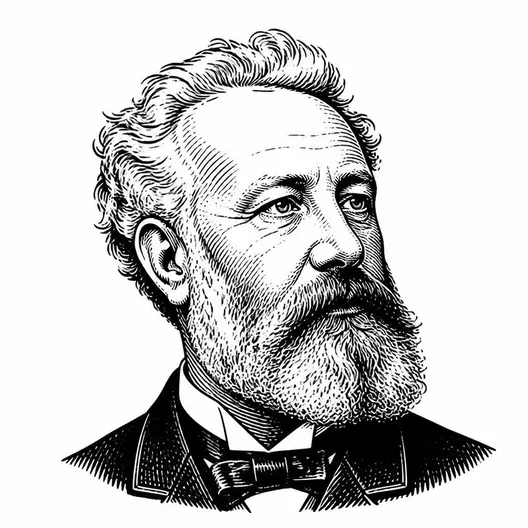 Jules Verne 1869