Postscript
The following are travelling notes from a memorandum-book of Mr. Knickerbocker.
The following are travel notes from Mr. Knickerbocker’s notebook.
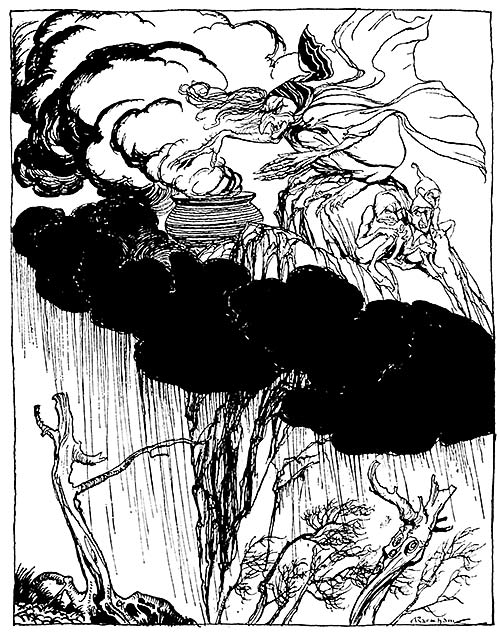
The Kaatsberg or Catskill mountains have always been a region full of fable. The Indians considered them the abode of spirits, who influenced the weather, spreading sunshine or clouds over the landscape, and sending good or bad hunting seasons. They were ruled by an old squaw spirit, said to be their mother. She dwelt on the highest peak of the Catskills, and had charge of the doors of day and night to open and shut them at the proper hour. She hung up the new moons in the skies, and cut up the old ones into stars. In times of drought, if properly propitiated, she would spin light summer clouds out of cobwebs and morning dew, and send them off from the crest of the mountain, flake after flake, like flakes of carded cotton, to float in the air, until, dissolved by the heat of the sun, they would fall in gentle showers, causing the grass to spring, the fruits to ripen, and the corn to grow an inch an hour. If displeased, however, she would brew up clouds black as ink, sitting in the midst of them like a bottle-bellied spider in the midst of its web; and when these clouds broke, woe betide the valleys!
The Kaatsberg or Catskill mountains have always been a region full of legends. Native Americans believed the mountains were home to spirits who controlled the weather. These spirits spread sunshine or clouds over the landscape and brought good or bad hunting seasons. An old woman spirit, said to be their mother, ruled over them. She lived on the highest peak of the Catskills. She controlled the doors of day and night, opening and closing them at the proper hour. She hung new moons in the sky and cut the old ones into stars. In times of drought, if properly pleased, she would spin thin summer clouds from cobwebs and morning dew. She would send the clouds from the mountaintop, flake after flake, like tufts of combed cotton floating in the air. The sun’s heat would dissolve the clouds, and they would fall as gentle showers. These showers made the grass sprout, the fruit ripen, and the corn grow an inch an hour. But if displeased, she would brew clouds as black as ink. She would sit among them like a round-bellied spider in the middle of its web. And when those clouds burst, woe to the valleys!
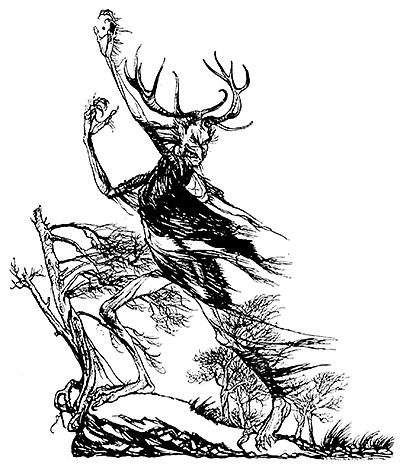
In old times, say the Indian traditions, there was a kind of Manitou or Spirit, who kept about the wildest recesses of the Catskill mountains, and took a mischievous pleasure in wreaking all kinds of evils and vexations upon the red men. Sometimes he would assume the form of a bear, a panther, or a deer, lead the bewildered hunter a weary chase through tangled forests and among ragged rocks, and then spring off with a loud ho! ho! leaving him aghast on the brink of a beetling precipice or raging torrent.
Long ago, according to Indigenous traditions, a kind of Manitou or Spirit haunted the wildest parts of the Catskill mountains. He took mischievous pleasure in bringing all kinds of harm and trouble upon the Indigenous people. Sometimes he would take the form of a bear, a panther, or a deer. He would lead a confused hunter on an exhausting chase through tangled forests and among jagged rocks. Then he would leap away with a loud ho! ho! The hunter would be left horrified at the edge of an overhanging cliff or a raging torrent.
The favourite abode of this Manitou is still shown. It is a great rock or cliff on the loneliest part of the mountains, and, from the flowering vines which clamber about it, and the wild flowers which abound in its neighbourhood, is known by the name of the Garden Rock. Near the foot of it is a small lake, the haunt of the solitary bittern, with water-snakes basking in the sun on the leaves of the pond-lilies which lie on the surface. This place was held in great awe by the Indians, insomuch that the boldest hunter would not pursue his game within its precincts. Once upon a time, however, a hunter who had lost his way penetrated to the Garden Rock, where he beheld a number of gourds placed in the crotches of trees. One of these he seized and made off with it, but in the hurry of his retreat he let it fall among the rocks, when a great stream gushed forth, which washed him away and swept him down precipices, where he was dashed to pieces, and the stream made its way to the Hudson, and continues to flow to the present day, being the identical stream known by the name of the Kaaters-kill.
The favorite home of this Manitou is still pointed out. It is a great rock or cliff in the loneliest part of the mountains. Flowering vines climb around it, and wildflowers grow nearby in abundance, giving it the name Garden Rock. Near its foot is a small lake, home to the solitary bittern. Water snakes bask in the sun on the leaves of pond lilies floating on the surface. The Native Americans regarded this place with such awe that even the boldest hunter would not follow game there. Once upon a time, however, a hunter lost his way and reached the Garden Rock. There he saw several gourds placed in the forks of trees. He grabbed one and hurried away, but in his haste he dropped the gourd among the rocks. A great stream burst out, washing him away and sweeping him down cliffs, where he was dashed to pieces. The stream flowed into the Hudson and continues to flow to this day. It is the very stream known as the Kaaters-kill.
The end