Chapter 3
Dead or Alive?
An apologetic cough came through the entrance to the laboratory. It was nearing one o'clock of the following day.
An apologetic cough came from the laboratory entrance. It was nearly one o'clock the next day.
Several minutes later it was repeated, to the intense annoyance of the scientist, who had left orders that he was not to be interrupted in his work under any circumstances.
Several minutes later, it was repeated, much to the scientist's annoyance. He had ordered that he not be interrupted in his work under any circumstances.
At the third "ahem!" he raised his head and stared fixedly at the empty space between the doorjambs. The most determined optimist could not have spelled welcome in that look.
At the third "ahem!" he raised his head and stared at the empty doorway. Even the most determined optimist could not have seen a welcome in that look.
Peter, advancing his neck around the corner until one eye met that of his master, withdrew it hastily.
Peter peeked around the corner until one eye met his master's. He quickly pulled his head back.
"Well, what is it?" came from the laboratory, in an irritated harsh voice.
"Well, what is it?" a harsh, irritated voice called from the laboratory.
Peter, in the act of retreating on tiptoe, turned, and once more cocked a solitary eye around the door-jamb. This one feature had the beseeching look of a dog trying to convey by his expression that not for worlds would he have got in the way of your boot.
Peter was tiptoeing away when he turned and peered around the doorframe with one eye. That eye had the pleading look of a dog trying to show he would never have gotten in the way of your boot for anything in the world.
"Beg pardon, sir, but there's a young—"
"Excuse me, sir, but there's a young..."
"Won't see him!"
"Won't see him!"
"But, sir, it's a young lady—"
"But, sir, it's a young woman..."
"I'm busy, get out!"
"I'm busy, get out!"
Peter gulped desperately. "The young lady from—"
Peter gulped desperately. "The young lady from..."
At this moment Ralph pressed a button nearby, an electromagnet acted, and a heavy plate glass door slid down from above, almost brushing Peter's melancholy countenance, terminating the conversation summarily.
At that moment, Ralph pressed a nearby button, activating an electromagnet. A heavy plate glass door slid down from above, almost brushing Peter's sad face and abruptly ending the conversation.
Having secured himself against further interruption Ralph returned to the large glass box over which he had been working, and in which one could see, through greenish vapors, a dog, across whose heart was strapped a flat glass box filled with a metal-like substance.
After making sure he would not be interrupted again, Ralph returned to the large glass box he had been working on. Through greenish vapors inside the box, he could see a dog. A flat glass box filled with a metal-like substance was strapped across the dog’s heart.
The substance in the box was Radium-K. Radium, which had been known for centuries, had the curious property of giving out heat for thousands of years without disintegrating and without apparently obtaining energy from any outside source.
The substance in the box was Radium-K. Radium had been known for centuries. It had a curious property: it gave off heat for thousands of years without breaking down or apparently drawing energy from any outside source.
In 2009, Anatole M610 B9, the great French physicist, found that Radium obtained all its energy from the ether of space and proved that Radium was one of the few substances having a very strong affinity for the ether. Radium, he found, attracted the ether violently and the latter surging back and forward through the Radium became charged electrically, presenting all the other well known phenomena.
In 2009, Anatole M610 B9, the great French physicist, discovered that Radium got all its energy from the ether of space. He proved that Radium was one of the few substances with a very strong affinity for the ether. He found that Radium attracted the ether violently. As the ether surged back and forth through the Radium, it became electrically charged and produced all the other well-known phenomena.
Anatole M610 B9 compared the action of Radium on the ether with that of a magnet acting upon a piece of iron. He proved this theory by examining a piece of pure metallic Radium in an etherless space, whereupon it lost all its characteristics and acted like a piece of ordinary metal.
Anatole M610 B9 compared radium’s effect on the ether to a magnet’s effect on a piece of iron. He proved this theory by examining a piece of pure metallic radium in a space without ether. There, the radium lost all its characteristics and acted like an ordinary metal.
Radium-K, as used by Ralph, was not pure Radium, but an alloy composed of Radium and Argonium. This alloy exhibited all the usual phenomena of pure Radium and produced great heat, but did not create burns on animal tissue. It could be handled freely and without danger.
The Radium-K Ralph used was not pure Radium, but an alloy of Radium and Argonium. The alloy showed all the usual properties of pure Radium and produced great heat. But it did not burn animal tissue. It could be handled freely and safely.
The dog lying in the glass box had been "dead" for three years. Just three years previous, in the presence of twenty noted scientists Ralph 124C 41+ had exhibited a live dog and had proceeded to drain off all its blood till the dog was pronounced quite dead and its heart had stopped beating. Thereupon he had refilled the empty blood vessels of the animal with a weak solution of Radium-K bromide, and the large artery through which the solution was pumped into the body had been closed.
The dog lying in the glass box had been "dead" for three years. Exactly three years earlier, Ralph 124C 41+ had shown a live dog to twenty noted scientists. He then drained all its blood until the dog was pronounced dead and its heart had stopped beating. He refilled the dog's empty blood vessels with a weak solution of Radium-K bromide. Then he closed the large artery through which the solution had been pumped into the body.
The flat box containing Radium-K was then strapped over the dog's heart and it was placed in the large glass case. The latter was filled with Permagatol, a green gas having the property of preserving animal tissue permanently and indefinitely. The purpose of the box containing Radium-K was to keep the temperature of the dog's body at a fixed point.
The flat box containing Radium-K was then strapped over the dog's heart, and the dog was placed in the large glass case. The case was filled with Permagatol, a green gas that preserves animal tissue permanently and indefinitely. The Radium-K in the box kept the dog's body temperature at a fixed point.
After the case was completely filled with gas, the glass cover was sealed in such a manner that it was impossible to open the case without breaking the seals. The scientists had agreed to return after a lapse of three years to witness the opening of the box.
After the case was completely filled with gas, the glass cover was sealed. The case could not be opened without breaking the seals. The scientists agreed to return three years later to watch the box being opened.
There were several delicate instruments inside the box and these were connected by means of wires to recording instruments on the side, and these Ralph inspected twice each day. Throughout the three years the "dead" dog had never stirred a muscle. His temperature had not varied 1/100 of a degree and his respiratory functions had shown no signs of life. To all intents and purposes the dog was "dead."
Several delicate instruments inside the box were connected by wires to recording instruments on the side. Ralph inspected the instruments twice a day. Throughout the three years, the "dead" dog had never moved a muscle. His temperature had not varied by 1/100 of a degree, and his breathing had shown no signs of life. For all practical purposes, the dog was "dead."
The time was close at hand for the final stages of what Ralph considered to be his greatest experiment. Three years ago when he faced his fellow scientists at the end of the first stage of this work, he electrified them by announcing that he expected to prove that this dog, which they had all pronounced "dead," could be restored to life, unharmed, unchanged, with no more effects upon the dog's spirits, habits, and nature, than had the animal taken but a short nap.
The final stages of what Ralph considered his greatest experiment were close at hand. Three years earlier, he had faced his fellow scientists at the end of the first stage. He electrified them by announcing that he expected to prove he could bring the dog back to life. They had all pronounced the dog "dead." Ralph expected to restore it unharmed and unchanged. He believed the dog's spirits, habits, and nature would be no more affected than if it had taken a short nap.
For three years this experiment of Ralph 124C 41+ had been the subject of innumerable scientific papers, had been discussed intermittently in the newspapers and the date of the final phase of the great experiment was fixed in the mind of every human being on the planet.
For three years, Ralph 124C 41+’s experiment had been the subject of countless scientific papers. Newspapers had discussed it from time to time. Everyone on the planet knew the date of the great experiment’s final phase.
If the experiment succeeded it meant the prolongation of human life over greater periods of the earth's history than had ever been possible. It meant that premature death except through accident would be ended.
If the experiment succeeded, human life could be extended over longer periods of the earth's history than ever before. It would mean an end to premature death, except through accidents.
Would he succeed? Had he attempted the impossible? Was he challenging Nature to a combat only to be worsted?
Would he succeed? Had he tried to do the impossible? Was he challenging Nature to a fight only to be defeated?
These thoughts obtruded themselves into his consciousness as he began the preparations for the great test of the afternoon. He pumped out the Permagatol from the box until the green vapor had completely disappeared. With infinite care he then forced a small quantity of oxygen into the box. The instruments recording the action of the respiratory organs indicated that the oxygen reaching the dog's lungs had stimulated respiration.
These thoughts came to him as he began preparing for the afternoon's great test. He pumped the Permagatol out of the box until the green vapor had completely disappeared. Then, with great care, he forced a small amount of oxygen into the box. Instruments monitoring the dog's respiratory organs showed that the oxygen reaching its lungs had stimulated breathing.
This being all he could do for the present, he pressed the button that raised the glass barrier, and summoned Peter by means of another button.
That was all he could do for now, so he pressed the button that raised the glass barrier. Then he pressed another button to call Peter.
That individual, looking a trifle more melancholy than usual, responded at once.
The person, looking a little sadder than usual, responded immediately.
"Well my boy," said Ralph good-humoredly, "the stage is all set for the experiment that will set the whole world by the ears.—But you don't look happy, Peter. What's troubling your dear old soul?"
"Well, my boy," Ralph said cheerfully, "everything is ready for the experiment that will stir up the whole world. But you don't look happy, Peter. What's troubling your dear old soul?"
Peter, whose feelings had evidently been lacerated when the door had been lowered in his face, replied with heavy dignity.
Peter's feelings had clearly been hurt when the door was lowered in his face. He replied with solemn dignity.
"Beg pardon, sir, but the young lady is still waiting."
"Excuse me, sir, but the young woman is still waiting."
"What young lady?" asked Ralph.
"What young lady?" asked Ralph.
"The young lady from Switzerland, sir."
"The young woman from Switzerland, sir."
"The—which?"
"The, which?"
"The young lady from Switzerland, sir, and her father, sir. They've been waiting half an hour."
"The young woman from Switzerland and her father are here, sir. They've been waiting for half an hour."
If a bomb had exploded that instant Ralph could not have been more astounded.
Ralph could not have been more surprised if a bomb had exploded at that moment.
"She's here—and you didn't call me? Peter, there are times when I am tempted to throw you out—"
"She's here, and you didn't call me? Peter, sometimes I'm tempted to throw you out..."
"Pardon sir," replied Peter firmly, "I made bold to assume that you might be interested in the young lady's arrival, and presumed to step into the laboratory to so inform—"
"Excuse me, sir," Peter replied firmly. "I thought you might be interested in the young lady's arrival, so I took the liberty of entering the laboratory to tell you..."
But his master had gone, shedding his laboratory smock as he went. Peter, gathering his dignity about him as a garment, reached the doorway in time to see the elevator slide downwards out of sight.
But his master had gone, taking off his lab coat as he went. Peter gathered his dignity around him like a garment. He reached the doorway just in time to see the elevator slide down out of sight.
And in it, Ralph, his heart thumping in a most undignified way, was acting more like a schoolboy than a master of science. He twitched at his tie with one hand and smoothed his hair with the other, peering into the elevator's little mirror anxiously. Discovering a smudge on his cheek he checked the car between floors while he wiped away the spot with his handkerchief.
And inside it, Ralph’s heart was pounding in a most undignified way. He was acting more like a schoolboy than a master of science. He tugged at his tie with one hand and smoothed his hair with the other. He peered anxiously into the elevator’s little mirror. When he spotted a smudge on his cheek, he stopped the elevator between floors and wiped it away with his handkerchief.
When he reached the reception room he sprang from the elevator eagerly and hurried in. Seated by one of the windows were Alice 212B 423 and her father. Both turned as he entered, and the girl rose to her feet and with a charming gesture held out both hands.
When he reached the reception room, he eagerly jumped out of the elevator and hurried inside. Alice 212B 423 and her father were sitting by one of the windows. Both turned as he entered. The girl stood up and held out both hands with a charming gesture.
"We just had to come," she said prettily, and in perfect English. "You didn't give us an opportunity to thank you yesterday, and anyhow, we felt that telephot thanks were not nearly so nice. That is, father thought we really ought to come in person—of course, I did, too. I wanted to see you ever so much"—she broke off, and then, realizing the implication of her words, went on hastily with reddened cheeks and downcast eyes, "I mean, to—to thank you, you know."
"We just had to come," she said sweetly, in perfect English. "You didn't give us a chance to thank you yesterday. Besides, we felt that thanking you by telephot wasn't nearly as nice. I mean, father thought we really should come in person. Of course, I did, too. I wanted to see you so much." She broke off, then realized what her words implied. Her cheeks turned red, and she lowered her eyes. "I mean, to, to thank you, you know," she added hastily.
"It was wonderful of you," he declared still holding her two hands, and utterly unmindful of the fact that she was gently trying to disengage them. Indeed, he was not conscious of anyone or anything but her, until the voice of her father brought him to the realization that there was someone else in the room.
"It was wonderful of you," he said, still holding both her hands. He did not notice that she was gently trying to pull them away. In fact, he was aware of nothing and no one but her until he heard her father's voice. Then he realized someone else was in the room.
"We need no introduction I think," said the gentleman, "but I am James 212B 422 and I must ask you to pardon our intrusion upon a busy scientist's time, but I felt that we should come personally to thank you for the great service you have done us both. She is my one daughter, sir, and I love her dearly—dearly—"
"I don't think we need an introduction," the gentleman said. "But I am James 212B 422. Please forgive us for taking up a busy scientist's time. But I felt we should come in person to thank you for the great service you have done us both. She is my only daughter, sir, and I love her dearly, dearly."
"I can quite understand that," said Ralph with an unconscious ardor that caused Alice, who had completely recovered from her momentary confusion, to dimple and blush delightfully.
"I can understand that," Ralph said with an enthusiasm he didn't realize he was showing. Alice had completely recovered from her brief confusion. His enthusiasm made her smile with dimples and blush delightfully.
"I'm afraid, father dear," she said, "that we are keeping a busy man too long. Your man," she added, turning to Ralph, "said you were engaged in a wonderful experiment, and could not be disturbed."
"I'm afraid, dear father," she said, "that we are keeping a busy man too long." She turned to Ralph. "Your man said you were working on a wonderful experiment and couldn't be disturbed."
"Busy? Not at all," said Ralph gracelessly. "You should not have been kept waiting one moment, and I am very indignant with Peter for not breaking down the door. He should have known, when he saw you, that you were not to wait."
"Busy? Not at all," Ralph said awkwardly. "You shouldn't have been kept waiting for a moment. I'm very angry with Peter for not breaking down the door. When he saw you, he should have known not to keep you waiting."
"Oh, please, don't scold him because of me," said Alice, not, however, at all displeased with the implied compliment.
"Oh, please, don't scold him because of me," said Alice. But she was not at all displeased by the implied compliment.
"I didn't know yesterday that you spoke English," he said, "so I used the language-rectifier, but I see that you speak it perfectly. That is a great relief to me, I assure you, for I speak French very indifferently. But tell me," he continued, "how did you get here so soon? The afternoon transatlantic aeroliner is not due yet, and it can hardly be twenty-four hours since you left Switzerland."
"I didn't know yesterday that you spoke English," he said, "so I used the language-rectifier. But I see you speak English perfectly. That's a great relief to me, I assure you, because my French isn't very good. But tell me," he continued, "how did you get here so soon? The afternoon transatlantic aeroliner isn't due yet, and it can hardly be twenty-four hours since you left Switzerland."
"We had the honor of being the first passengers to arrive by means of the new Subatlantic Tube," said James 212B 422. "As you are doubtless aware, the regular passenger service opens next week, but being one of the consulting engineers of the new electromagnetic tube, my daughter and I were permitted to make the first trip westward. We made it in perfect safety, although it was a little risky, as some small portions of the tube are not entirely completed."
"We had the honor of being the first passengers to arrive by the new Subatlantic Tube," said James 212B 422. "As you probably know, regular passenger service starts next week. But I am one of the consulting engineers for the new electromagnetic tube. So my daughter and I were allowed to make the first trip westward. We made the trip safely, although it was a little risky because some small sections of the tube aren't completely finished."
"And we were so anxious to get here as quickly as possible," broke in Alice with a glance at Ralph.
"And we were so eager to get here as quickly as possible," Alice interrupted, glancing at Ralph.
"But you shouldn't have risked your lives, in an untested tube," he exclaimed. And then, the scientist in him to the front: "Tell me all about this new tube. Busy with my own work I have not followed its progress closely enough to know all its details."
"But you shouldn't have risked your lives in an untested tube," he exclaimed. Then his scientific curiosity came to the fore: "Tell me all about this new tube. I've been busy with my own work and haven't followed its progress closely enough to know all the details."
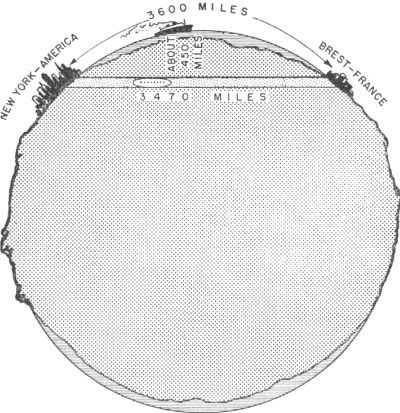
"It has been most interesting work," said James 212B 422, "and we regard it as quite an achievement in electrical engineering. The new tube runs in a straight line between New York and Brest, France. If the tube were to run straight along the bottom of the ocean the distance between the two points would be from 3600 to 3700 miles due to the curvature of the earth. For this reason the tube was pushed straight through the earth, thereby making the distance only 3470 miles.
"It has been very interesting work," said James 212B 422, "and we consider it quite an achievement in electrical engineering. The new tube runs in a straight line between New York and Brest, France. If the tube ran straight along the ocean floor, the distance between the two points would be 3,600 to 3,700 miles. That is because of the earth's curvature. For this reason, the tube was pushed straight through the earth, making the distance only 3,470 miles.
"You will understand it better by examining this chart," and unfolding a plan, he proceeded to elaborate on the finer points of the tube construction. "The greatest trouble," he went on, "our engineers experienced near the middle of the tube; this point is 450 miles nearer the center of the earth and the heat became very marked. It was necessary to install large liquid-air plants at several points in the tube to reduce the heat, and now as you ride through no heat is noticed.
"You will understand it better by examining this chart." He unfolded a plan and explained the finer details of the tube's construction. "Our engineers had the most trouble near the middle of the tube," he went on. "This point is 450 miles closer to the center of the earth, and the heat became intense. We had to install large liquid-air plants at several points in the tube to reduce the heat. Now, as you ride through, you don't notice any heat.
"We boarded the spacious steel car, which resembles a thick cigar, at Brest last night at midnight, and arrived at the New York terminal at noon today. There was only one stop, a few hundred miles out from Brest, because of several short-circuited electromagnets.
"We boarded the spacious steel car in Brest at midnight last night. The car resembles a thick cigar. We arrived at the New York terminal at noon today. We stopped only once, a few hundred miles from Brest, because several electromagnets had short-circuited.
"There are no wheels to the tube car and it is propelled by magnetism only. At each three hundred feet is stationed a powerful tubular electromagnet, about thirty feet long, through which the tube car passes. Each electromagnet exerts a tremendous pull upon the car three hundred feet away, this being the only steel object, and the car rushes toward the electromagnet with a tremendous speed. When the car is only two feet away from this electromagnet, the current is cut off automatically by the car itself, the latter plunging through the open space of the magnet coil, only to be influenced now by the next electromagnet, three hundred feet distant.
"The tube car has no wheels and is propelled entirely by magnetism. Every three hundred feet stands a powerful tubular electromagnet, about thirty feet long. The tube car passes through each one. Each electromagnet exerts a tremendous pull on the car three hundred feet away. The car is the only steel object, and it rushes toward the electromagnet at tremendous speed. When the car is only two feet from the electromagnet, it automatically cuts off the current. The car plunges through the open space in the magnet coil. It is then pulled by the next electromagnet, three hundred feet away.
"The momentum acquired by the pull of the former electromagnet propels the car with ever-increasing speed, and by the time it has passed through twenty-five electromagnets it has reached the speed of three hundred miles an hour. It then continues at a steady pace till the end of the journey.
"The pull of the previous electromagnet gives the car momentum, making it go faster and faster. After passing through twenty-five electromagnets, the car reaches three hundred miles an hour. It then travels at a steady speed for the rest of the journey.
"As the car is held suspended entirely by magnetism, there is practically no friction whatever, as there are no wheels or rails. The only friction is from the air, and in order that this may not heat the car it is equipped with a double wall, the space between the inner and outer walls being a vacuum. Consequently the temperature inside is comfortable at all times. Once inside the car, we retired and slept as soundly as in our swinging beds at home. There were no shocks, no noise, no rocking—all in all the trip was so delightful, that I must say the new tube is a decided success!"
“The car is held in suspension entirely by magnetism, so there are no wheels or rails to cause friction. The only friction comes from the air. To keep it from heating the car, the car has double walls with a vacuum between them. As a result, the temperature inside is always comfortable. Once inside the car, we went to bed and slept as soundly as in our swinging beds at home. There were no jolts, no noise, and no rocking. The trip was so delightful that I must say the new tube is a definite success!”
"Fine, fine," said Ralph enthusiastically. "This new tube is going to revolutionize intercontinental travel. I suppose it won't be long now before we will regard our tedious twenty-four hour journeys as things of the past. Tell me," turning to Alice who had been an interested listener, "how did the trip impress you?"
"Great, great," Ralph said enthusiastically. "This new tube is going to revolutionize intercontinental travel. I suppose it won't be long before our tedious twenty-four-hour journeys are a thing of the past." He turned to Alice, who had been listening with interest. "Tell me, what did you think of the trip?"
"Oh," she exclaimed eagerly, "it was delightful! So smooth and fast! I was so excited. Really, it was over too soon."
"Oh," she exclaimed eagerly, "it was wonderful! So smooth and fast! I was so excited. It really was over too soon."
As she spoke Ralph watched her with keen interest. Here was a girl who attracted him. Beneath the vivacity that so fascinated him he sensed the strength of her character, and the depth of her mind.
As she spoke, Ralph watched her with keen interest. He was attracted to her. Beneath the lively spirit that fascinated him, he sensed her strength of character and depth of mind.
"I am so glad to be in New York," she was saying. "Do you know, this is my first visit here for ages. Why, the last time I can just barely remember, I was such a little girl. Father has been promising me a trip for years," with a laughingly reproachful glance at him, "but it took an avalanche to get us started."
"I'm so glad to be in New York," she said. "You know, this is my first visit in ages. I can barely remember the last time. I was such a little girl. Father has been promising me a trip for years." She gave him a laughing, reproachful glance. "But it took an avalanche to get us started."
"I'm afraid I've been a neglectful father of late years," said her father, "but my work has kept me tied pretty close to home. I, too, am pleased to be here once more, and my visit promises to be doubly interesting, for I understand that your great dog experiment will be completed today. I am looking forward to receiving the earliest reports of it at the hotel."
"I'm afraid I've been a neglectful father in recent years," said her father, "but my work has kept me close to home. I'm glad to be here again, too. My visit promises to be doubly interesting. I understand your great dog experiment will be completed today. I look forward to receiving the first reports at the hotel."
"But I can't permit you to spend your days here in a hotel," protested Ralph. "Of course you must both be my guests. Yes, yes," as they seemed about to demur, "I won't take no for an answer. I am counting on showing you New York, and, as for my experiment, it will give me great pleasure to have you both present in my laboratory this afternoon at four."
"But I can't let you spend your days here in a hotel," Ralph protested. "Of course, you must both be my guests. Yes, yes," he said as they seemed about to object. "I won't take no for an answer. I'm counting on showing you New York. And as for my experiment, I'd be delighted to have you both in my laboratory this afternoon at four."
He pressed a button. "Peter will show you to your rooms, and I will send some one for your luggage."
He pressed a button. "Peter will show you to your rooms. I'll send someone for your luggage."
"You are more than kind," said James. "This is quite unexpected, but none the less delightful. As to attending the meeting in your laboratory this afternoon, it is an honor, sir, that I appreciate deeply."
"You are very kind," said James. "I didn't expect this, but I'm delighted. It's an honor to attend the meeting in your laboratory this afternoon, sir, and I deeply appreciate it."
At this moment Peter stepped from the elevator and Ralph, after giving him instructions to show his guests to their apartment, and directions as to their bags, escorted them to the car and returned to the laboratory.
Just then, Peter stepped out of the elevator. Ralph told him to show the guests to their apartment and gave him instructions about their bags. Then Ralph escorted the guests to the car and returned to the laboratory.
Promptly at four, Ralph greeted a notable group of fellow scientists, who had come from all corners of the planet to witness the completion of the famous "Dead-Alive Dog" experiment. A host of reporters lined the walls. Alice and her father were seated near Ralph.
At exactly four, Ralph greeted a distinguished group of fellow scientists. They had come from all over the planet to witness the completion of the famous "Dead-Alive Dog" experiment. Reporters lined the walls. Alice and her father sat near Ralph.
A number of the twenty scientists who had witnessed the beginning of the experiment three years before were dubiously contemplating the glass box, and one or two of the reporters, unawed by the personages in the laboratory, seven of whom were "Plus" men, seemed to find much covert amusement in the whole affair.
Some of the twenty scientists who had witnessed the start of the experiment three years earlier eyed the glass box doubtfully. Seven of the people in the laboratory were "Plus" men. But one or two reporters were unimpressed by the distinguished people there and seemed secretly amused by the whole affair.
Finally, when all of the preparations were completed, and Ralph's two assistants had stationed themselves beside the glass box containing the body, the young scientist addressed the gathering.
Finally, all the preparations were complete. Ralph's two assistants stood beside the glass box containing the body. Then the young scientist addressed the gathering.
"Ladies and gentlemen," he said, "you have come here to witness the final phase of my dog experiment. The preliminary phases you observed three years ago this day in this room. The seals you put in place are intact, and you may see them for yourselves, untouched as you left them.
"Ladies and gentlemen," he said, "you have come to see the final phase of my dog experiment. You saw the preliminary phases in this room three years ago today. The seals you put in place are intact. You can see for yourselves that they are untouched, just as you left them.
"As I explained three years ago I formulated the theory that a well preserved animal, though dead to all intents and purposes, could be revived, or new life given to it, provided the body had not undergone decomposition; and also provided that none of the organs had suffered in the least.
"As I explained three years ago, I developed a theory about well-preserved animals. I believed that such an animal could be revived, or given new life, even if it was dead for all practical purposes. This was possible only if the body had not decomposed and none of its organs had suffered any damage.
"I found that the rare gas Permagatol would conserve animal tissue and animal organs indefinitely; when it is used in conjunction with a weak solution of Radium-K bromide, mixed with antiseptic salts, no part of an animal body would undergo any change for many years.
"I found that the rare gas Permagatol could preserve animal tissue and organs indefinitely. When combined with a weak solution of Radium-K bromide mixed with antiseptic salts, it kept every part of an animal’s body unchanged for many years.
"I also found that the body would have to be kept at a fixed temperature and this was possible by the use of Radium-K alloy. I am now ready to prove my theory."
"I also found that the body had to be kept at a constant temperature. This was possible using Radium-K alloy. I am now ready to prove my theory."
He signaled to his assistants, and with their aid, the seals were broken and the glass cover of the case removed.
He signaled to his assistants. With their help, he broke the seals and removed the case's glass cover.
A profound silence prevailed. Every eye was focussed on the dog and many of those present found it difficult to remain seated.
A deep silence fell. Everyone was watching the dog, and many of those present found it hard to stay seated.
Ralph coolly and deliberately freed the dog of his bandages and attachments and placed him on an operating table in plain view of everyone.
Ralph calmly and carefully removed the dog’s bandages and attachments. Then he placed him on an operating table where everyone could see him.
From then on he and his aides moved rapidly. First the dead dog's artery was opened and the Radium-K bromide solution drained off. A young goat was brought in and strapped on the table, and in a very few seconds one of its arteries had been opened and connected to the dead dog's main artery. In less than a minute the dog's body was full of fresh warm blood and immediately efforts were made to bring the dog back to life.
From then on, he and his assistants worked quickly. First, they opened the dead dog's artery and drained out the Radium-K bromide solution. They brought in a young goat and strapped it to the table. Within seconds, they opened one of the goat's arteries and connected it to the dead dog's main artery. In less than a minute, the dog's body was full of fresh, warm blood. They immediately tried to bring the dog back to life.
Oxygen was freely administered and the heart was artificially pulsated by means of an electrical vibratory apparatus.
Oxygen was given freely, and an electric vibrating device kept the heart beating.
At the same time one of the assistants had trained a vacuum tube on the dog's head and its cathode shot the powerful F-9-Rays into the animal's brain. No sooner had these rays, which are among the most powerful brain stimulants, been trained on the dog than he began to show weak signs of life. One of the hind legs was drawn up with a jerk as if in a fit. Then came a faint heave of the chest, followed by a weak attempt to breathe.
At the same time, one of the assistants aimed a vacuum tube at the dog's head. Its cathode shot powerful F-9-Rays into the animal's brain. These rays are among the most powerful brain stimulants. As soon as they were aimed at the dog, he began to show faint signs of life. One of his hind legs jerked upward as if in a fit. Then his chest rose faintly, followed by a weak attempt to breathe.
A few minutes later the body seemed to contract and a shiver ran through it from head to tail. A deep respiration followed, and the animal opened its eyes as if awakening from a long sleep.
A few minutes later, the body seemed to contract, and a shiver ran through it from head to tail. The animal took a deep breath and opened its eyes, as if waking from a long sleep.
In a few minutes more the dog was lying on its paws and licking up milk when Ralph turned to the group and said:
A few minutes later, the dog was lying on its paws and lapping up milk. Ralph turned to the group and said:
"Gentlemen, the experiment is concluded and I believe the condition of the animal at this moment establishes sufficient proof of my theory."
"Gentlemen, the experiment is over. I believe the animal's current condition provides sufficient proof of my theory."
As the reporters eagerly dashed from the laboratory to get to the nearest Telephot in order to communicate the news to the waiting world the scientists gathered around Ralph and one of them, a white haired old man considered to be the dean of the "Plus" men, voiced the sentiment of the entire group.
The reporters eagerly rushed from the laboratory to the nearest Telephot to share the news with the waiting world. As they left, the scientists gathered around Ralph. One of them expressed what the whole group felt. He was a white-haired old man regarded as the dean of the "Plus" men.
"Ralph, this is one of the greatest gifts that science has brought to humanity. For what you have done with a dog, you can do with a human being. I only regret for myself that you had not lived and conducted this experiment when I was a young man, that I might have, from time to time, lived in suspended animation from century to century, and from generation to generation as it will now be possible for human beings to do."
"Ralph, this is one of the greatest gifts science has given humanity. What you have done with a dog, you can do with a human being. I only regret that you weren't alive to conduct this experiment when I was young. Then I might have spent time in suspended animation, living from century to century and generation to generation. Human beings will now be able to do that."
The vista opened up by the results of this experiment in the minds of the other scientists had dazed them and it was with the most perfunctory good-byes that they left the scene of the experiment, enveloped with their thoughts of the future.
The experiment’s results dazed the other scientists with visions of what the future might hold. They left the scene with barely a word of goodbye, absorbed in their thoughts of the future.
Tired and exhausted by the nervous strain of the afternoon Ralph, a few minutes later, lay down on his bed for a few hours' rest. But as he closed his eyes there came to him a vivid picture of a pair of warm dark eyes, radiating admiration, trust and something more that aroused an emotion he had never before experienced.
A few minutes later, Ralph lay down on his bed to rest for a few hours. He was exhausted by the nervous strain of the afternoon. But as he closed his eyes, he saw a vivid picture of a pair of warm, dark eyes. They shone with admiration, trust, and something more. That something stirred an emotion he had never felt before.