Chapter 11
The Flight Into Space
How long he was unconscious Ralph did not know, but when he came to his senses the moon had sunk low on the horizon. He felt unbearably weary and his limbs seemed too heavy to move. For a time he half lay in his seat looking stupidly down at the ocean, his mind a blank.
Ralph did not know how long he had been unconscious. But when he woke, the moon was low on the horizon. He felt unbearably tired, and his limbs seemed too heavy to move. For a while, he half lay in his seat, staring blankly down at the ocean, his mind empty.
All at once it dawned upon him that the seat next to him was empty. "Alice, Alice," he muttered, trying to shake off his stupor, "Alice, where are you?"
Suddenly, he realized that the seat next to him was empty. "Alice, Alice," he muttered, trying to shake off his daze, "Alice, where are you?"
There was no reply. The driver, his hands on the steering disc, was slumped forward in his seat, his head sunk on his breast.
There was no reply. The driver was slumped forward in his seat, his hands on the steering disc and his head bowed against his chest.
With a stupendous effort Ralph managed to open the glass window in front of him. Instantly the strong odor of chloroformal almost overpowered him, and a terrible sensation of nausea forced him to cling blindly to his seat. In a moment it passed and he was able to collect his senses somewhat. His first thought was for Alice. His dimmed sight had cleared sufficiently for him to see that she was not in the cab. He thought she must have fallen into the sea, and in his agony he cried aloud her name again and again.
With a tremendous effort, Ralph managed to open the glass window in front of him. The strong smell of chloroformal almost overwhelmed him at once. A terrible wave of nausea forced him to cling blindly to his seat. A moment later, the nausea passed, and he was able to gather his senses somewhat. His first thought was for Alice. His blurred vision had cleared enough for him to see that she was not in the cab. He thought she must have fallen into the sea. In agony, he cried out her name again and again.
And then a recollection came to him, of her father's words on the first morning of their visit. He had feared for Alice. Someone had threatened her. Ralph forced his still wandering mind to concentrate. Some one had threatened to kidnap her, and that someone was Fernand 60O 10.
Then he remembered what her father had said on the first morning of their visit. He had feared for Alice. Someone had threatened her. Ralph forced his still wandering mind to focus. Someone had threatened to kidnap her, and that someone was Fernand 60O 10.
He recalled the stranded aerocab. Its helplessness had been a trick to deceive him, and to get near enough to drug him and his driver while they took Alice away.
He remembered the stranded aerocab. Its apparent helplessness had been a trick to deceive him. It let them get close enough to drug him and his driver while they took Alice away.
The thought aroused him from his dreadful lethargy. With a rush his vitality came back. He flung himself upon the stupefied driver and shook him violently.
The thought jolted him out of his terrible stupor. His energy rushed back. He threw himself at the stunned driver and shook him violently.
The cab was still flying at an even speed in a great circle and Ralph saw that it was imperative that he get control of it at once, for another machine, bound evidently for New York, was bearing down upon the helpless men.
The cab was still flying at a steady speed in a wide circle. Ralph saw that he had to take control of it at once. Another machine, apparently bound for New York, was heading straight for the helpless men.
With a powerful shove he got the driver into the auxiliary seat and climbed over, seizing, as he did so, the steering disc. He flung it over, just in time to escape the onrushing cab, whose occupants, as it passed, leaned out, and in fluent profanity inquired if he wanted the whole airway.
With a powerful shove, he pushed the driver into the auxiliary seat and climbed over, grabbing the steering disc as he did. He turned it sharply, just in time to avoid the oncoming cab. As it passed, its occupants leaned out and swore fluently, asking if he wanted the whole airway.
Unheeding, Ralph set the steering disc toward New York, and proceeded to lighten the cab. Overboard went the glass doors, cushions, matting, even the hood of the machine. Everything that he could wrench off he tossed to the dark waters beneath him.
Ignoring this, Ralph pointed the steering disc toward New York and began to lighten the cab. He threw the glass doors, cushions, matting, and even the machine’s hood overboard. He tossed everything he could tear off into the dark water below.
The cab, relieved of the weight of its equipment shot ahead at tremendous speed, and in less than ten minutes dropped onto the landing place on top of the scientist's laboratory. Leaving the driver where he was Ralph dashed into the building. Meeting Peter he did not stop, only motioned him to the cab while he himself sprang to the nearest Telephot. And within fifteen minutes every detective and special agent had been notified of the disappearance of Alice. Ralph had immediately transmitted the lost girl's photograph to the Central Office where it was placed before a Telephot connecting with every member of the entire police force, and the picture was reproduced for them in their portable radio instruments for ten seconds, enabling them to get her features firmly impressed on their minds.
Freed of the weight of its equipment, the cab shot ahead at tremendous speed. In less than ten minutes, it landed on top of the scientist's laboratory. Ralph left the driver in the cab and dashed into the building. When he met Peter, he did not stop. He motioned Peter toward the cab and sprang to the nearest Telephot. Within fifteen minutes, every detective and special agent had been notified of Alice's disappearance. Ralph had immediately sent the missing girl's photograph to the Central Office. There, it was placed before a Telephot connected to every member of the police force. The picture appeared on their portable radio instruments for ten seconds, giving them time to fix her features firmly in their minds.
His next act was to call the Intercontinental Hotel where Fernand had been stopping.
Next, he called the Intercontinental Hotel, where Fernand had been staying.
Upon inquiry he was informed that Fernand had left three hours ago with his baggage. His destination was unknown.
When he asked, he was told that Fernand had left three hours earlier with his luggage. No one knew where he had gone.
"I knew it!" Ralph muttered to himself.
"I knew it!" Ralph muttered to himself.
On second thought it occurred to him that it might be of advantage to visit the hotel, and as it was only a few blocks away he flew over to it, leaving his assistants in charge of his radio stations, with strict orders to record every message, to tune into everything, and to take the messages down on the recorder discs.
On second thought, he realized that visiting the hotel might be useful. Since it was only a few blocks away, he flew there. He left his assistants in charge of his radio stations. He gave them strict orders to tune in to everything and record every message on the recorder discs.
At the hotel he was recognized at once, and as the news had spread over the city like wild-fire, he was treated with every consideration.
At the hotel, he was recognized at once. The news had spread across the city like wildfire, so he was treated with every courtesy.
He closely questioned everyone and then asked to see the rooms which Fernand 60O 10 had occupied.
He questioned everyone carefully. Then he asked to see the rooms Fernand 60O 10 had stayed in.
The rooms were just as their occupant had left them and Ralph requested that he be undisturbed there for a short time.
The rooms were just as their occupant had left them. Ralph asked not to be disturbed there for a short time.
He examined every nook and corner without finding anything to give him a clue to Fernand's whereabouts, and he was about to leave when his eye caught the reflection of a light-ray falling on a bright object under the dresser.
He searched every corner but found no clue to Fernand's whereabouts. He was about to leave when he noticed light reflecting off a bright object under the dresser.
Insignificant as the little metal object was, it was enough to convey a fearful picture to his mind. He recognized it at once as a metal turning belonging to the balancer of the Gyro-Gyrotor of a Space Flyer. Evidently the metal part had been dropped and Fernand had not had the time to look for it. Ralph decided that Fernand had obtained a supply of the parts which are only required on a prolonged flight into space.
Though the small metal object seemed insignificant, it brought a terrifying picture to his mind. He recognized it at once as a metal turning from the balancer of a Space Flyer’s Gyro-Gyrotor. Apparently, Fernand had dropped the metal part and had not had time to look for it. Ralph concluded that Fernand had obtained a supply of parts needed only for a long flight into space.
He was now positive that Fernand 60O 10 had carried off his sweetheart in a space flyer and that the machine by this time was probably far away from the earth, headed for unknown regions. It would also be practically impossible to follow without knowing the direction of the space-defying machine.
He was now sure that Fernand 60O 10 had carried off his sweetheart in a space flyer. By now, the machine was probably far from Earth, headed for unknown regions. It would also be practically impossible to follow the space flyer without knowing which direction it had taken.
In a daze Ralph returned to his laboratory, where he again called the Central Office. As all space flyers must be licensed by law, he had no trouble in getting the information he desired. A new machine of a well-known Detroit firm had been registered four days ago, and the description of the owner answered to that of Fernand 60O 10.
In a daze, Ralph returned to his laboratory and called the Central Office again. All space flyers had to be licensed by law, so he had no trouble getting the information he wanted. A new machine from a well-known Detroit company had been registered four days earlier. The description of its owner matched Fernand 60O 10.
Late as it was, Ralph immediately communicated with the Detroit manufacturer, who, upon hearing his reasons for the request, supplied him with all the necessary details.
Though it was late, Ralph immediately contacted the Detroit manufacturer. When the manufacturer heard his reasons for the request, he gave Ralph all the necessary details.
Ralph learned from him that the purchaser of the new machine, one of the very latest models, was Fernand, beyond any doubt, and when he was informed that the latter had plentifully supplied himself with spare parts as if for a long journey, and moreover, the most significant fact that the cabin had been fitted out as a lady's boudoir, then indeed were his worst suspicions confirmed.
Ralph learned from him that Fernand had undoubtedly bought the new machine, one of the latest models. He also learned that Fernand had stocked up on spare parts, as if preparing for a long journey. Most telling of all, the cabin had been furnished as a lady's boudoir. Ralph's worst suspicions were confirmed.
The manufacturer also told him that the entire outside shell was of Magnelium—an invention of Ralph's—and that this flyer was the first to be equipped with the new metal.
The manufacturer also told him that the entire outer shell was made of Magnelium, a metal Ralph invented. This flyer was the first to be equipped with the new metal.
As he concluded his conversation and disconnected, Ralph brought his clenched fist down upon the desk. "Magnelium," he muttered between set teeth, "the only machine out in the universe made with Magnelium. Magnelium, my own Magnelium, about which no one in the world knows more than I do. Perhaps the odds are not all with you, Fernand, damn you!"
When Ralph finished his conversation and disconnected, he slammed his fist on the desk. "Magnelium," he muttered through clenched teeth. "The only machine in the universe made with Magnelium. Magnelium, my own Magnelium, which I know more about than anyone else in the world. Perhaps the odds aren't all in your favor, Fernand, damn you!"
At first thought it might be considered a difficult feat accurately to locate a machine thousands of miles from the earth, speeding in an unknown direction somewhere in the boundless universe. The feat was easy to the scientist. As far back as the year 1800 astronomers accurately measured the distance between the earth and small celestial bodies, but it was not until the year 2659 that Ralph 124C 41+ succeeded in accurately determining the exact location of flyers, in space, beyond the reach of the most powerful telescope.
At first, it might seem difficult to locate a machine thousands of miles from Earth. The machine could be speeding in an unknown direction somewhere in the boundless universe. But the task was easy for the scientist. As early as 1800, astronomers accurately measured the distance between Earth and small celestial bodies. But not until 2659 did Ralph 124C 41+ succeed in pinpointing flyers in space beyond the reach of the most powerful telescope.
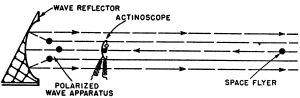
A pulsating polarized ether wave, if directed on a metal object can be reflected in the same manner as a light-ray is reflected from a bright surface or from a mirror. The reflection factor, however, varies with different metals. Thus the reflection factor from silver is 1,000 units, the reflection from iron 645, alomagnesium 460, etc. If, therefore, a polarized wave generator were directed toward space, the waves would take a direction as shown in the diagram, provided the parabolic wave reflector was used as shown. By manipulating the entire apparatus like a searchlight, waves would be sent over a large area. Sooner or later these waves would strike a space flyer. A small part of the waves would strike the metal body of the flyer, and these waves would be reflected back to the sending apparatus. Here they would fall on the Actinoscope (see diagram), which records only reflected waves, not direct ones.
A pulsating polarized ether wave directed at a metal object can be reflected like a light ray from a bright surface or a mirror. However, the reflection factor varies with the metal. For example, silver has a reflection factor of 1,000 units, iron 645, alomagnesium 460, and so on. If a polarized wave generator were directed toward space, its waves would travel as shown in the diagram, provided the parabolic wave reflector was used as shown. By moving the whole apparatus like a searchlight, one could send waves over a large area. Sooner or later, these waves would strike a space flyer. A small part of the waves would strike the flyer's metal body and be reflected back to the sending apparatus. There, they would fall on the Actinoscope (see diagram), which records only reflected waves, not direct ones.
From the actinoscope the reflection factor is then determined, which shows the kind of metal from which the reflection comes. From the intensity and the elapsed time of the reflected impulses, the distance between the earth and the flyer can then be accurately and quickly calculated.
The reflection factor is determined from the actinoscope. It shows what kind of metal the reflection comes from. The intensity and elapsed time of the reflected impulses can then be used to calculate the distance between the earth and the flyer quickly and accurately.
The reflection factor of Magnelium being 1060, Ralph succeeded in locating Fernand's space flyer in less than five hours' search. He found that Fernand's machine at that time was about 400,000 miles distant from the earth and apparently headed in the direction of the planet Venus. A few seconds' calculation showed that he was flying at the rate of about 45,000 miles an hour. This was a great surprise to Ralph and it puzzled him somewhat. He knew that Fernand's machine was capable of making at least 75,000 miles an hour. Ralph reasoned that if he were in Fernand's place, he would speed up the flyer to the utmost.
Because Magnelium had a reflection factor of 1060, Ralph located Fernand's space flyer in less than five hours. He found that Fernand's machine was about 400,000 miles from Earth and apparently headed toward Venus. A few seconds of calculation showed that Fernand was flying at about 45,000 miles an hour. This surprised and puzzled Ralph. He knew that Fernand's machine could travel at least 75,000 miles an hour. Ralph thought that if he were in Fernand's place, he would fly at full speed.
Why was Fernand flying so leisurely? Did he think himself secure? Did he think that nobody could or would follow? Or was he having trouble with the Anti-Gravitator?
Why was Fernand flying so slowly? Did he think he was safe? Did he think no one could or would follow him? Or was he having trouble with the Anti-Gravitator?
Ralph could not understand it. However, his mind had already been made up. He would pursue Fernand even though it took him into those parts of the solar system yet uncharted, and, if necessary—kill him!
Ralph could not understand it. But he had already made up his mind. He would pursue Fernand, even into the uncharted parts of the solar system. And if necessary, he would kill him!
It was now noon, and he gave sharp, quick instructions to his assistants, ordering his space flyer, the "Cassiopeia," to be made ready at once. Provisions sufficient to last for six months were put on board and Ralph himself installed a great number of scientific instruments, many of which he considered he might find useful. He also ordered a large number of duplicate parts of the flyer's machinery to be stowed on board in case of emergency.
It was noon, and he gave his assistants brisk, precise instructions. He ordered them to prepare his space flyer, the "Cassiopeia," at once. They loaded enough provisions for six months, and Ralph himself installed many scientific instruments he thought might be useful. He also ordered many spare parts for the flyer's machinery to be stored on board in case of an emergency.
To the astonishment and dismay of Peter and the others, the scientist announced his intention of making the journey alone.
To the surprise and dismay of Peter and the others, the scientist announced that he intended to make the journey alone.
"The fight is to be man against man, brain against brain," he said as he stood by his space flyer which was in readiness upon the tower-platform. "Today it is not brute force that counts, but scientific knowledge. I will demonstrate to the world that crimes of this kind need not be tolerated."
"The fight will be man against man, brain against brain," he said. He stood beside his space flyer, ready on the tower platform. "Today, brute force doesn't count. Scientific knowledge does. I will show the world that crimes like this don't have to be tolerated."
He stepped onto the running board as he spoke and was about to step into the flyer when the sound of an aeroflyer descending close by made him hesitate. It was a government flyer, and even as Ralph paused, it landed on the platform beside his own machine, and a smartly uniformed young official sprang from the seat beside the driver. Saluting Ralph he handed him a transcribed telegram with the words:
As he spoke, he stepped onto the running board and was about to enter the flyer. Then he heard an aeroflyer descending nearby and hesitated. It was a government flyer. As Ralph paused, it landed on the platform beside his own machine. A young official in a smart uniform sprang from the seat beside the driver. He saluted Ralph and handed him a transcribed telegram, saying:
"Message from the Planet Governor, sir."
"A message from the Planet Governor, sir."
Dismay seized the scientist, as, breaking the seal of the wrapper, he read the printed words:
The scientist broke the seal on the wrapper. Dismay seized him as he read the printed words:
Unipopulis, Sept. 34, 2660, Planet Governor's Capitol. I have just received news of the calamity that has befallen you. I extend to you my sincere sympathy. I will this afternoon place at your disposal six Government space flyers, the crews of which are absolutely under your instructions. I must, however, caution you not to enter into any pursuit in person. As Planet Governor it is my duty to advise you that you have not the right to place your person in unnecessary danger. Allow me furthermore to point out to you that under the law "+" scientists are not allowed to endanger their lives under any circumstances. I therefore command you not to leave the earth without my permission. I have ordered your space flyer to be guarded. In high esteem, William Kendrick 21K 4, The 18th Planet Governor. To Ralph 124C 41+, New York.
Unipopulis, Sept. 34, 2660, Planet Governor's Capitol. I have just heard of the calamity that has befallen you. You have my sincere sympathy. This afternoon, I will place six Government space flyers at your disposal. Their crews will be entirely under your command. However, I must warn you not to take part in any pursuit yourself. As Planet Governor, I must advise you that you have no right to put yourself in unnecessary danger. I must also point out that the law forbids "+" scientists to endanger their lives under any circumstances. I therefore order you not to leave the earth without my permission. I have ordered a guard for your space flyer. With high esteem, William Kendrick 21K 4, The 18th Planet Governor. To Ralph 124C 41+, New York.
Ralph read the radiogram twice before he folded it slowly and deliberately thrust it into his pocket.
Ralph read the radiogram twice. Then he slowly folded it and deliberately put it in his pocket.
Then slowly withdrawing his hand and extending it to the government official, he said:
Then he slowly pulled back his hand and held it out to the government official. He said:
"Well, I must obey orders."
"Well, I have to follow orders."
The official took the proffered hand, and no sooner had he grasped it than he stiffened and became as rigid as stone.
The official took the offered hand. As soon as he grasped it, he stiffened and became as rigid as stone.
With one bound Ralph was in his machine crying to the stupefied audience:
With one leap, Ralph was in his machine, shouting to the stunned audience:
"Don't worry about him. I pricked his hand with a little Catalepsol. In fifteen minutes he will be all right again."
"Don't worry about him. I pricked his hand with a little Catalepsol. He'll be all right again in fifteen minutes."
He slammed the door of his space flyer and simultaneously the machine rose as if shot from a cannon, and in ten seconds was lost to sight.
He slammed the door of his space flyer. At the same instant, the machine shot upward as if fired from a cannon. Within ten seconds, it was out of sight.
Since the Dark Ages, men have had a powerful longing to leave Earth and visit other planets. Towards the end of the twenty-first century, when atmospheric flying had become common, scientists began seriously to think of constructing machinery to enable man to leave the confines of the planet to which humanity had been chained for ages.
Since the Dark Ages, people have longed to leave Earth and visit other planets. By the end of the twenty-first century, flying through the atmosphere had become common. Scientists then began seriously considering machines that would let people leave Earth, the planet that had held humanity captive for ages.
Towards the beginning of the twenty-second century economic conditions had become acute and the enormous population of Earth, which had passed the twelve billion mark, clamored for an adequate outlet which the planet itself could no longer furnish.
Near the beginning of the twenty-second century, economic conditions had become severe. Earth’s population had passed twelve billion, and people demanded an adequate outlet that the planet could no longer provide.
The moon was regarded with longing eyes, and although that body was known to have no atmosphere and was known to be sterile, it was equally well known that Earth's scientists and engineers felt that they could, in a few years' time, make it habitable.
People looked at the moon with longing. Although it was known to have no atmosphere and to be sterile, something else was equally well known. Earth's scientists and engineers believed they could make the moon habitable within a few years.
Atmospheric flying machines were, of course, totally unsuited, as they could not even reach the limits of the Earth's atmosphere, only forty miles away.
Of course, atmospheric flying machines were completely unsuitable. They could not even reach the edge of Earth's atmosphere, only forty miles away.
Obviously to reach the moon or any other celestial body, it was necessary to devise a method of overcoming the enigmatical force known as the Earth's gravity, which chains all bodies to the planet.
Obviously, reaching the moon or any other celestial body required a way to overcome Earth's mysterious gravity. Gravity holds all bodies to the planet.
A multitude of inventions and suggestions were made, but none proved to be of any value until the Anti-Gravitator was invented by the American 969L 9 in the year 2210.
Many inventions and suggestions were made, but none proved useful. That changed in 2210, when the American 969L 9 invented the Anti-Gravitator.
This scientist had made extensive studies of the gyroscope and had finally evolved a machine which when set in motion would rise freely and continue to rise as long as power was supplied.
This scientist had studied the gyroscope extensively. He finally developed a machine that would rise freely when started. It would keep rising as long as power was supplied.
The action, moreover, was purely gyroscopic.
Also, the action was entirely gyroscopic.
969L 9 took a large hollow sphere (the rotor) inside of which he built a number of independent gyroscopes, all of which traveled in fixed orbits. The large sphere which hung in a gyroscopic frame was made to spin around on its axis at great speed. This sphere thus acted as the fly-wheel of a gyroscope and as such was not influenced by the so-called horizontal gravity. As in the case of simple gyroscopes, its axis would always be in a vertical line as long as the spheric rotor was in motion.
969L 9 took a large hollow sphere (the rotor) and built several independent gyroscopes inside it. All the gyroscopes traveled in fixed orbits. The large sphere hung in a gyroscopic frame and was made to spin rapidly on its axis. The sphere thus acted as a gyroscope's flywheel and was not affected by so-called horizontal gravity. As with simple gyroscopes, the sphere's axis would always remain vertical as long as the spherical rotor was spinning.
If, however, the independent gyroscopes inside of the sphere were set in motion by means of electrical current, the Vertical Gravity (weight) was overcome, the entire contrivance rising into the air, its rising (lifting) speed being directly proportional to the speed of the enclosed gyroscope rotors.
However, if an electric current set the independent gyroscopes inside the sphere in motion, Vertical Gravity (weight) was overcome. The whole device then rose into the air. Its lifting speed was directly proportional to the speed of the gyroscope rotors inside.
From 969L 9's experimental work the anti-gravitators were perfected, and it became possible to lift a weight of 1,000 kilograms with an anti-gravitator weighing but 12 kilograms.
969L 9's experimental work led to the perfection of anti-gravitators. An anti-gravitator weighing just 12 kilograms could lift 1,000 kilograms.
Space flyers were equipped with from six to twelve large anti-gravitators attached to various points of their shells, all of which could be worked in unison, or operated independently in order to control the direction of the flyer.
Space flyers had six to twelve large anti-gravitators attached at various points on their shells. These could all work together or operate independently to control the flyer's direction.
As Ralph's space flyer rushed through the atmosphere, the friction of the machine against the air made the interior uncomfortably hot in spite of the fact that the machine had triple walls, the spaces between being filled with poor heat conducting materials.
As Ralph's space flyer rushed through the atmosphere, friction against the air made the interior uncomfortably hot. This happened despite the flyer's triple walls, with insulating materials filling the spaces between them.
After the flyer, however, had left the atmosphere, the stellar cold rapidly made itself felt.
After the flyer left the atmosphere, however, the cold of space quickly made itself felt.
Ralph then took his bearings, after he had verified, by means of the polarized wave transmitter that Fernand's flyer was still headed towards Venus. He then locked the steering disc and the space flyer continued its journey in a straight line of pursuit toward the machine of Fernand.
Ralph used the polarized wave transmitter to confirm that Fernand's flyer was still headed toward Venus. Then he checked his bearings and locked the steering disc. The space flyer continued in a straight line, pursuing Fernand's machine.
This done, Ralph flashed a radiogram asking the Planet Governor's indulgence for disobeying the law. Then he took his first look at the earth, which, since he was traveling at the rate of 80,000 miles an hour, had shrunk to the dimensions of a medium-sized orange. As he was flying toward the sun, Earth, being directly behind him was fully illuminated and appeared like a full moon. The continents and oceans were visible except where temporarily obscured by mist or clouds.
After doing this, Ralph sent a radiogram asking the Planet Governor to forgive him for breaking the law. Then he took his first look at Earth. Since he was traveling at 80,000 miles an hour, it had shrunk to the size of a medium orange. He was flying toward the sun, so Earth was directly behind him. It was fully lit and looked like a full moon. The continents and oceans were visible, except where mist or clouds temporarily obscured them.
The general aspect of the Earth as seen from Ralph's flyer was that of a delicate faint blue green ball with white caps at each of the poles. The ball was surrounded by a pinkish ring near the circumference. This was the earth's atmosphere, the white caps being snow and ice around the north and south poles.
From Ralph's flyer, Earth looked like a delicate, pale blue-green ball with white caps at both poles. A pinkish ring surrounded the ball near its edge. This was Earth's atmosphere. The white caps were snow and ice around the north and south poles.
The brilliantly lighted earth was silhouetted against the inky black sky in sharp contrast. The moon, hidden behind the earth, was not in evidence, when Ralph first looked earthward.
The brightly lit earth stood out sharply against the pitch-black sky. When Ralph first looked toward earth, the moon was hidden behind it.
In outer space, the "sky" is completely black. The sky looks blue from Earth because of the atmosphere. The real sky is colorless.
The stars shone with a brilliancy never seen from Earth; distant constellations which ordinarily cannot be seen, except, with a telescope, were plainly visible to him, in outer space.
The stars shone more brilliantly than they ever did from Earth. In outer space, he could clearly see distant constellations normally visible only through a telescope.
The sun shone with a dazzling brilliancy in a pitch-black sky, and had he looked directly into its rays he would have been stricken blind.
The sun shone dazzlingly bright in a pitch-black sky. If he had looked directly at it, he would have been blinded.
The heat of the sun in the outside space when striking objects was tremendous. Had he held his hand against the glass window of the space flyer where the sun could strike it full, his hand would have been burned in a few seconds.
In space, the sun’s heat was tremendous when it struck objects. If he had held his hand against the space flyer’s glass window in direct sunlight, it would have burned within seconds.
There was of course no night in the outer space (within the bounds of the planetary system). The sun shone uninterruptedly.
Of course, there was no night in outer space within the planetary system. The sun shone without interruption.
Time was an unknown quantity. Had it not been for the chronometer, reeling off seconds and minutes according to man's standard, time would cease to exist in a space flyer.
Time was an unknown quantity. Without the chronometer ticking off seconds and minutes by human standards, time would cease to exist in a space flyer.
To a man who had never left the Earth, the phenomena encountered inside of a space flyer in the outer space was still more amazing.
For a man who had never left Earth, the phenomena inside a space flyer in outer space were even more amazing.
"Weight" is synonymous with the gravity of the Earth. The denser a celestial body, the greater its gravity. The larger such a body is, the more strongly it will attract its objects. The smaller the body (if it has the same density), the smaller its force of attraction.
"Weight" means the same thing as Earth’s gravity. The denser a celestial body is, the greater its gravity. The larger the body, the more strongly it attracts objects. A smaller body has less attractive force, if it has the same density.
Thus a man weighing eighty kilograms on a spring scale on the earth, would weigh but thirty kilograms on the planet Mars. On the sun, however, he would weigh 2232 kilograms.
So a man who weighs eighty kilograms on a spring scale on Earth would weigh only thirty kilograms on Mars. On the sun, however, he would weigh 2232 kilograms.
Inside of a space flyer, which had an infinitely small gravity, objects weighed practically nothing. They were heaviest near the walls of the machine, but in the exact center of the flyer, all objects lost their weight entirely. Thus any object, regardless of its earthly weight, hung freely suspended in the center of the space flyer. It could not move up or down, of its own accord, but hung stationary, motionless, like a balloon in the air.
Inside a space flyer, gravity was infinitesimally weak, so objects weighed almost nothing. They were heaviest near the walls of the machine, but at the exact center, all objects lost their weight entirely. Thus any object, no matter how much it weighed on Earth, hung freely suspended in the center of the space flyer. It could not move up or down on its own, but hung still and motionless, like a balloon in the air.
If a shaft were dug to the center of the earth, an object placed there would remain suspended in space.
The occupant of a space flyer, having no weight, moved around with astonishing ease. He almost floated around in the machine. There was no physical labor. The biggest table was no heavier than a match. The passenger in a flyer could perform an incredible amount of work without tiring and without effort.
A person in a space flyer had no weight and could move around with astonishing ease. He almost floated around inside the machine. There was no physical labor. The biggest table was no heavier than a match. A passenger could do an incredible amount of work without effort or getting tired.
He could walk up the walls or walk "upside down" on the ceiling without danger of falling, as there is no "up" or "down" in outer space.
He could walk up the walls or "upside down" on the ceiling without falling. That was because there is no "up" or "down" in outer space.
Sleep was practically impossible. There being nothing to tire the occupant, sleep is unnecessary. Dozing off is all he can do, and that could never last long, except after strenuous mental work.
Sleep was practically impossible. Because nothing tired the occupant, sleep is unnecessary. All he can do is doze, and that never lasts long, except after strenuous mental work.
As long as a space flyer was not too far distant from the sun (within the orbit of Mars, at least), little artificial heat was needed. The sun heated one-half of the flyer's shell to a fierce heat, but the side turned away from the sun was exposed to the terrible stellar cold (absolute zero) and a fairly comfortable temperature was the result.
As long as a space flyer was not too far from the sun (at least within Mars’s orbit), it needed little artificial heat. The sun heated one half of the flyer’s shell intensely. But the side facing away from the sun was exposed to the terrible cold of space (absolute zero). The result was a fairly comfortable temperature.
The air supply was manufactured by chemical means on board, but very little was needed, as the original supply taken from the earth is used over and over by altering the carbonic acid gas by means of automatic generators.
Air was produced on board by chemical means, but very little was needed. The original supply brought from Earth was reused repeatedly because automatic generators altered the carbon dioxide.
It was of course of the utmost importance that no port-hole or doors leading to the outside be opened. The air would have rushed from the flyer instantly, resulting in a perfect vacuum inside of the flyer, and instant death to all living organisms.
Of course, it was extremely important not to open any portholes or doors leading outside. The air would have rushed out of the flyer instantly, leaving a perfect vacuum inside. All living organisms aboard would have died instantly.
As the flyer moved away from a celestial body, the less the mechanical energy needed to propel it. There were of course exceptions. Thus between every two celestial bodies a point will be found where the attraction that one body exerts on the other is zero. If the flyer were brought to this point its gyroscopes could be at rest, as the machine would not be attracted by either body. It would "hang" between the two just as an iron ball hangs between two powerful magnets if carefully balanced. Give it the slightest push, however, and the ball will fly to either of the magnets.
The farther the flyer moved from a celestial body, the less mechanical energy it needed for propulsion. There were, of course, exceptions. Between any two celestial bodies, there is a point where the attraction one body exerts on the other is zero. If the flyer reached this point, its gyroscopes could rest because neither body would attract it. It would "hang" between the two bodies, just as an iron ball hangs between two powerful magnets if carefully balanced. Give the ball the slightest push, however, and it will fly toward one of the magnets.
The same was true of a space flyer, between two bodies at the "zero point." If it moved over that point it was immediately attracted by one of the bodies, and if its gyroscopes refused to work, the flyer would have been dashed to pieces against the attracting body.
The same was true of a space flyer at the "zero point" between two bodies. If it moved past that point, one of the bodies would immediately attract it. If the flyer's gyroscopes failed, it would be smashed to pieces against that body.
If, however, the machine came to rest at the "zero point" it would begin to turn around on its own axis, while at the same time moving in an elliptical orbit around the sun—the space flyer would become a tiny planet, and as such was subject to the universal laws of the planetary system.
However, if the machine came to rest at the "zero point," it would begin to spin on its axis. At the same time, it would move in an elliptical orbit around the sun. The space flyer would become a tiny planet, subject to the universal laws of the planetary system.
It was not hard to steer the space flyer; the nearer it came to a celestial body, the faster the gyroscopes worked; the further it drew away, the slower their movement.
The space flyer was easy to steer. The closer it came to a celestial body, the faster the gyroscopes worked. The farther away it moved, the slower they worked.
After Ralph had thoroughly inspected the entire flyer he devoted his full attention to the course of Fernand's machine. At the rate at which he was flying he computed that he would overtake Fernand in ten hours, provided the latter did not increase his speed meanwhile.
After Ralph had thoroughly inspected the entire flyer, he turned his full attention to the course of Fernand's machine. He calculated that at his current speed, he would overtake Fernand in ten hours, provided Fernand did not speed up in the meantime.
Fernand, when Ralph left Earth, had a handicap of 400,000 miles. He was moving at the rate of 45,000 miles an hour. Ralph's machine had made 80,000 miles an hour since its start. If everything went well he would overtake the other in ten or eleven hours.
When Ralph left Earth, Fernand had a 400,000-mile head start. He was traveling at 45,000 miles an hour. Ralph's machine had traveled at 80,000 miles an hour since its start. If everything went well, Ralph would catch Fernand in ten or eleven hours.
As there was nothing else to do, he busied himself in the laboratory near the conning tower at the top of the flyer in an attempt to make the hours pass more rapidly. With all its speed his machine seemed to crawl. He was in an agony of impatience.
With nothing else to do, he worked in the laboratory near the conning tower at the top of the flyer. He hoped to make the hours pass faster. Despite its speed, his machine seemed to crawl. He was in agony from impatience.
At the end of the ninth hour he finally sighted Fernand's machine through his telescope. He then tried to signal Fernand by radio, but the other either did not hear or else did not want to answer.
At the end of the ninth hour, he finally spotted Fernand's machine through his telescope. He tried to signal Fernand by radio, but Fernand either didn't hear him or didn't want to answer.
Eleven hours after his departure from Earth, his machine drew to within a few hundred meters of Fernand's. After careful maneuvering he brought the machine parallel to the other, and looking through one of the heavy plate windows saw the strained, drawn and ghastly white face of Fernand staring at him.
Eleven hours after leaving Earth, his machine came within a few hundred meters of Fernand's. He maneuvered carefully until his machine was parallel to Fernand's. Through one of the thick glass windows, he saw Fernand staring at him. Fernand's face was strained, drawn, and ghastly white.
Ralph moved a few levers and then closed a switch. A hissing sound was heard, and Fernand was seen to fall backwards, the window turning green at the same moment.
Ralph moved a few levers and then flipped a switch. A hissing sound was heard. Fernand fell backward, and the window turned green at the same moment.
Ralph had struck him senseless with his Radioperforer.
Ralph had knocked him unconscious with his Radioperforer.
In a few minutes he anchored his flyer to the other by means of a powerful electromagnet. He then pushed the connecting tube of his flyer into the tube-joint of Fernand's machine. With great care he made the joint air-tight. Taking a coil of rope he opened the port-hole and crawled through the tube leading into the other flyer.
Within a few minutes, he attached his flyer to the other one using a powerful electromagnet. He pushed his flyer's connecting tube into the tube joint on Fernand's machine. He carefully sealed the joint so no air could escape. He took a coil of rope, opened the port, and crawled through the tube into the other flyer.
Arrived at the other end he made sure that the joint at Fernand's machine was tight before he moved on.
When he reached the other end, he made sure the joint at Fernand's machine was tight before moving on.
Fernand lay unconscious on the floor and in a twinkling Ralph had bound him with the rope.
Fernand lay unconscious on the floor, and Ralph quickly tied him up with the rope.
In high excitement he bounded upstairs to gain the room Alice should be occupying. His heart throbbed tempestuously. In another moment he would hold his sweetheart in his arms.
Excited, he bounded upstairs to the room Alice was supposed to be in. His heart pounded wildly. In another moment, he would hold his sweetheart in his arms.
Arriving on the next floor he stood still for a moment and listened. There was no sound except for the gentle purring of the gyroscopic machinery.
When he reached the next floor, he stood still for a moment and listened. The only sound was the gentle purring of the gyroscopic machinery.
He went from one room to another, then to the last one. The door was open. He entered with a strange feeling of dread. The room was empty. Apparently it had never been used.
He went from room to room until he reached the last one. The door was open. He entered, feeling a strange sense of dread. The room was empty. It seemed it had never been used.
In terror Ralph ran from one end of the flyer to the other. He looked in every corner, in every closet. He could find neither Alice nor her maid. Where were they hidden? To make sure he went all over the ground again more thoroughly.
Terrified, Ralph ran from one end of the flyer to the other. He looked in every corner and every closet. He could find neither Alice nor her maid. Where were they hidden? To make sure, he searched everywhere again, more thoroughly.
After the most careful scrutiny of every inch of the machine he fell limply into a chair, and buried his face in his hands.
After examining every inch of the machine as carefully as he could, he sank limply into a chair. He buried his face in his hands.
Alice was not on board the flyer!!
Alice was not on board the flyer!!