Chapter 35
Getting Motivated
"How's the boy gittin' on, Davis?" asked Farmer John Field, as he watched his son, Marshall, waiting upon a customer. "Well, John, you and I are old friends," replied Deacon Davis, as he took an apple from a barrel and handed it to Marshall's father as a peace offering; "we are old friends, and I don't want to hurt your feelin's; but I'm a blunt man, and air goin' to tell you the truth. Marshall is a good, steady boy, all right, but he wouldn't make a merchant if he stayed in my store a thousand years. He weren't cut out for a merchant. Take him back to the farm, John, and teach him how to milk cows!"
"How's the boy getting on, Davis?" asked Farmer John Field. He watched his son, Marshall, serving a customer. "Well, John, you and I are old friends," replied Deacon Davis. He took an apple from a barrel and handed it to Marshall's father as a peace offering. "We are old friends, and I don't want to hurt your feelings. But I'm a blunt man, and am going to tell you the truth. Marshall is a good, steady boy, all right. But he wouldn't make a merchant if he stayed in my store a thousand years. He weren't cut out for a merchant. Take him back to the farm, John, and teach him how to milk cows!"
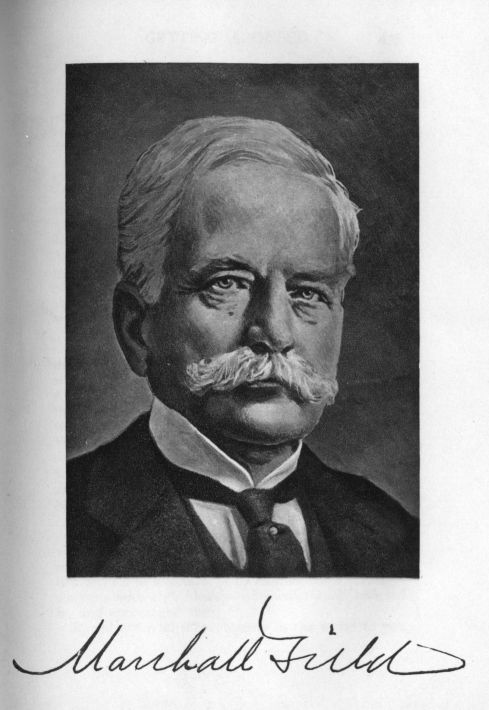
If Marshall Field had remained as clerk in Deacon Davis's store in Pittsfield, Massachusetts, where he got his first position, he could never have become one of the world's merchant princes. But when he went to Chicago and saw the marvelous examples around him of poor boys who had won success, it aroused his ambition and fired him with the determination to be a great merchant himself. "If others can do such wonderful things," he asked himself, "why cannot I?"
Marshall Field got his first job as a clerk in Deacon Davis's store in Pittsfield, Massachusetts. If he had stayed there, he could never have become one of the world's greatest merchants. But when he went to Chicago, he saw inspiring examples of poor boys who had succeeded. Their success stirred his ambition and made him determined to become a great merchant himself. "If others can do such wonderful things," he asked himself, "why can't I?"
Of course, there was the making of a great merchant in Mr. Field from the start; but circumstances, an ambition-arousing environment, had a great deal to do with stimulating his latent energy and bringing out his reserve force. It is doubtful if he would have climbed so rapidly in any other place than Chicago. In 1856, when young Field went there, this marvelous city was just starting on its unparalleled career. It had then only about eighty-five thousand inhabitants. A few years before it had been a mere Indian trading village. But the city grew by leaps and bounds, and always beat the predictions of its most sanguine inhabitants. Success was in the air. Everybody felt that there were great possibilities there.
Of course, Mr. Field had the makings of a great merchant from the start. But his circumstances and ambition-inspiring environment did much to awaken his hidden energy and draw out his reserves of strength. He probably would not have risen so quickly anywhere but Chicago. When young Field went there in 1856, this marvelous city was just beginning its unmatched rise. It then had only about eighty-five thousand inhabitants. A few years earlier, it had been just an Indian trading village. But the city grew by leaps and bounds, always surpassing the predictions of even its most optimistic inhabitants. Success was in the air. Everyone felt that Chicago held great possibilities.
Many people seem to think that ambition is a quality born within us; that it is not susceptible to improvement; that it is something thrust upon us which will take care of itself. But it is a passion that responds very quickly to cultivation, and it requires constant care and education, just as the faculty for music or art does, or it will atrophy.
Many people seem to think that ambition is something we are born with and cannot improve. They believe it is given to us and will take care of itself. But ambition is a passion that responds quickly when we cultivate it. Like a talent for music or art, it needs constant care and training, or it will fade.
If we do not try to realize our ambition, it will not keep sharp and defined. Our faculties become dull and soon lose their power if they are not exercised. How can we expect our ambition to remain fresh and vigorous through years of inactivity, indolence, or indifference? If we constantly allow opportunities to slip by us without making any attempt to grasp them, our inclination will grow duller and weaker.
If we do not try to achieve our ambition, it will lose its sharpness and clarity. Our abilities grow dull and soon lose their power if we do not use them. How can we expect our ambition to stay fresh and strong through years of inactivity, laziness, or indifference? If we keep letting opportunities pass without trying to seize them, our desire to act will grow duller and weaker.
"What I most need," as Emerson says, "is somebody to make me do what I can." To do what I can, that is my problem; not what a Napoleon or a Lincoln could do, but what I can do. It makes all the difference in the world to me whether I bring out the best thing in me or the worst,—whether I utilize ten, fifteen, twenty-five, or ninety per cent of my ability.
"What I need most," as Emerson says, "is someone to make me do what I can." My challenge is to do what I can. It is not about what a Napoleon or a Lincoln could do, but what I can do. It makes all the difference in the world to me whether I bring out the best or the worst in myself. It matters whether I use ten, fifteen, twenty-five, or ninety percent of my ability.
Everywhere we see people who have reached middle life or later without being aroused. They have developed only a small percentage of their success possibilities. They are still in a dormant state. The best thing in them lies so deep that it has never been awakened. When we meet these people we feel conscious that they have a great deal of latent power that has never been exercised. Great possibilities of usefulness and of achievement are, all unconsciously, going to waste within them.
Everywhere we see people who have reached middle age or beyond without being awakened to their potential. They have developed only a small part of their potential for success. They are still dormant. The best in them lies so deep that it has never been awakened. When we meet them, we sense that they have great powers they have never used. Without their realizing it, their great potential for usefulness and achievement is going to waste.
Some time ago there appeared in the newspapers an account of a girl who had reached the age of fifteen years, and yet had only attained the mental development of a small child. Only a few things interested her. She was dreamy, inactive, and indifferent to everything around her most of the time until, one day, while listening to a hand organ on the street, she suddenly awakened to full consciousness. She came to herself; her faculties were aroused, and in a few days she leaped forward years in her development. Almost in a day she passed from childhood to budding womanhood. Most of us have an enormous amount of power, of latent force, slumbering within us, as it slumbered in this girl, which could do marvels if we would only awaken it.
Some time ago, newspapers reported the story of a fifteen-year-old girl who had only reached the mental development of a small child. Only a few things interested her. Most of the time, she was dreamy, inactive, and indifferent to everything around her. Then one day, while listening to a street organ, she suddenly awakened to full consciousness. She came to herself, and her abilities stirred. In a few days, she advanced years in her development. Almost overnight, she passed from childhood into the beginnings of womanhood. Most of us have an enormous amount of power lying dormant within us, just as it did in this girl. It could do wonders if we would only awaken it.
The judge of the municipal court in a flourishing western city, one of the most highly esteemed jurists in his state, was in middle life, before his latent power was aroused, an illiterate blacksmith. He is now sixty, the owner of the finest library in his city, with the reputation of being its best-read man, and one whose highest endeavor is to help his fellow man. What caused the revolution in his life? The hearing of a single lecture on the value of education. This was what stirred the slumbering power within him, awakened his ambition, and set his feet in the path of self-development.
The municipal court judge in a thriving western city is one of the most respected jurists in his state. Until middle age, he was an illiterate blacksmith whose hidden abilities had not yet been awakened. Now sixty, he owns the finest library in his city and is known as its most well-read man. His greatest aim is to help his fellow human beings. What brought about this transformation in his life? He heard a single lecture on the value of education. The lecture stirred his sleeping potential, awakened his ambition, and set him on the path of self-development.
I have known several men who never realized their possibilities until they reached middle life. Then they were suddenly aroused, as if from a long sleep, by reading some inspiring, stimulating book, by listening to a sermon or a lecture, or by meeting some friend,—someone with high ideals,—who understood, believed in, and encouraged them.
I have known several men who did not realize their potential until middle age. Then they suddenly woke up, as if from a long sleep. Some were inspired by a stimulating book, a sermon, or a lecture. Others met a friend with high ideals who understood them, believed in them, and encouraged them.
It will make all the difference in the world to you whether you are with people who are watching for ability in you, people who believe in, encourage, and praise you, or whether you are with those who are forever breaking your idols, blasting your hopes, and throwing cold water on your aspirations.
The people around you can make all the difference in the world. Some look for your abilities, believe in you, encourage you, and praise you. Others are always tearing down your idols, destroying your hopes, and discouraging your ambitions.
The chief probation officer of the children's court in New York, in his report for 1905, says: "Removing a boy or girl from improper environment is the first step in his or her reclamation." The New York Society for the Prevention of Cruelty to Children, after thirty years of investigation of cases involving the social and moral welfare of over half a million of children, has also come to the conclusion that environment is stronger than heredity.
In his 1905 report, the chief probation officer of New York's children's court wrote: "The first step in helping a boy or girl reform is to remove them from an unhealthy environment." The New York Society for the Prevention of Cruelty to Children reached a similar conclusion. After thirty years of investigating cases involving the social and moral welfare of over half a million children, the society concluded that environment is stronger than heredity.
Even the strongest of us are not beyond the reach of our environment. No matter how independent, strong-willed, and determined our nature, we are constantly being modified by our surroundings. Take the best-born child, with the greatest inherited advantages, and let it be reared by savages, and how many of its inherited tendencies will remain? If brought up from infancy in a barbarous, brutal atmosphere, it will, of course, become brutal. The story is told of a well-born child who, being lost or abandoned as an infant, was suckled by a wolf with her own young ones, and who actually took on all the characteristics of the wolf,—walked on all fours, howled like a wolf, and ate like one.
Even the strongest among us are influenced by our environment. No matter how independent, strong-willed, and determined we are, our surroundings are constantly changing us. Take a child of the best birth, with the greatest inherited advantages, and let savages raise the child. How many of those inherited tendencies will remain? If the child grows up from infancy in a barbaric, brutal atmosphere, the child will, of course, become brutal. There is a story of a well-born child who was lost or abandoned as an infant. A wolf nursed the child alongside her own young. The child actually took on all the characteristics of a wolf, walking on all fours, howling like a wolf, and eating like one.
It does not take much to determine the lives of most of us. We naturally follow the examples about us, and, as a rule, we rise or fall according to the strongest current in which we live. The poet's "I am a part of all that I have met" is not a mere poetic flight of fancy; it is an absolute truth. Everything—every sermon or lecture or conversation you have heard, every person who has touched your life—has left an impress upon your character, and you are never quite the same person after the association or experience. You are a little different,—modified somewhat from what you were before,—just as Beecher was never the same man after reading Ruskin.
It doesn't take much to shape most of our lives. We naturally follow the examples around us. As a rule, we rise or fall according to the strongest influence in our lives. The poet's "I am a part of all that I have met" is not just a poetic fancy. It is an absolute truth. Everything has left a mark on your character. This includes every sermon, lecture, or conversation you have heard and every person who has touched your life. You are never quite the same after such an association or experience. You are a little different, changed somewhat from the person you were before. Just so, Beecher was never the same man after reading Ruskin.
Some years ago a party of Russian workmen were sent to this country by a Russian firm of shipbuilders, in order that they might acquire American methods and catch the American spirit. Within six months the Russians had become almost the equals of the American artisans among whom they worked. They had developed ambition, individuality, personal initiative, and a marked degree of excellence in their work. A year after their return to their own country, the deadening, non-progressive atmosphere about them had done its work. The men had lost the desire to improve; they were again plodders, with no goal beyond the day's work. The ambition aroused by stimulating environment had sunk to sleep again.
Some years ago, a Russian shipbuilding firm sent a group of Russian workers to this country. The firm wanted them to learn American methods and catch the American spirit. Within six months, the Russians had become almost as skilled as the American workers alongside them. They had developed ambition, individuality, personal initiative, and a high degree of skill in their work. A year after they returned home, the stifling atmosphere around them had done its work. The men had lost their desire to improve. They were once again plodders, with no goal beyond the day's work. The ambition awakened by a stimulating environment had gone back to sleep.
Our Indian schools sometimes publish, side by side, photographs of the Indian youths as they come from the reservation and as they look when they are graduated,—well dressed, intelligent, with the fire of ambition in their eyes. We predict great things for them; but the majority of those who go back to their tribes, after struggling awhile to keep up their new standards, gradually drop back to their old manner of living. There are, of course, many notable exceptions, but these are strong characters, able to resist the downward-dragging tendencies about them.
Our Indian schools sometimes publish side-by-side photographs of Indian youths when they arrive from the reservation and when they graduate. By graduation, they are well dressed and intelligent, with the fire of ambition in their eyes. We predict great things for them. But most of those who return to their tribes struggle for a while to maintain their new standards. Then they gradually return to their old way of life. Of course, there are many notable exceptions. These are people of strong character who can resist the downward pull of their surroundings.
If you interview the great army of failures, you will find that multitudes have failed because they never got into a stimulating, encouraging environment, because their ambition was never aroused, or because they were not strong enough to rally under depressing, discouraging, or vicious surroundings. Most of the people we find in prisons and poor-houses are pitiable examples of the influence of an environment which appealed to the worst instead of to the best in them.
If you talk to the great army of people who have failed, you will find that many lacked a stimulating, encouraging environment. Their ambition was never awakened, or they were not strong enough to overcome depressing, discouraging, or harmful surroundings. Most people in prisons and poorhouses are sad examples of how an environment can bring out the worst rather than the best in them.
Whatever you do in life, make any sacrifice necessary to keep in an ambition-arousing atmosphere, an environment that will stimulate you to self-development. Keep close to people who understand you, who believe in you, who will help you to discover yourself and encourage you to make the most of yourself. This may make all the difference to you between a grand success and a mediocre existence. Stick to those who are trying to do something and to be somebody in the world,—people of high aims, lofty ambition. Keep close to those who are dead-in-earnest. Ambition is contagious. You will catch the spirit that dominates in your environment. The success of those about you who are trying to climb upward will encourage and stimulate you to struggle harder if you have not done quite so well yourself.
Whatever you do in life, make whatever sacrifices are necessary to stay in an environment that inspires ambition and personal growth. Stay close to people who understand you and believe in you. They will help you discover who you are and encourage you to make the most of yourself. This may make all the difference between great success and a mediocre life. Stay close to people who are trying to accomplish something and become somebody in the world. Choose people with high goals and great ambition, people who are completely serious about their efforts. Ambition is contagious. You will take on the spirit that dominates your environment. If you have not done quite as well as those around you, their success as they strive to rise will encourage you to try harder.
There is a great power in a battery of individuals who are struggling for the achievement of high aims, a great magnetic force which will help you to attract the object of your ambition. It is very stimulating to be with people whose aspirations run parallel with your own. If you lack energy, if you are naturally lazy, indolent, or inclined to take it easy, you will be urged forward by the constant prodding of the more ambitious.
There is great power in a group of people striving to achieve high goals. Their collective energy is a powerful magnetic force that can help you attract what you aspire to achieve. Being with people whose aspirations are like your own is very motivating. If you lack energy or are naturally lazy, idle, or inclined to take it easy, more ambitious people will constantly push you forward.