Chapter 23
Persistence Pays Off
Every noble work is at first impossible.—CARLYLE.
Every noble work seems impossible at first. Carlyle.
Victory belongs to the most persevering.—NAPOLEON.
Victory belongs to those who persevere the most. Napoleon.
Success in most things depends on knowing how long it takes to succeed.—MONTESQUIEU.
Success in most things depends on knowing how long success takes. MONTESQUIEU.
Perpetual pushing and assurance put a difficulty out of countenance, and make a seeming impossibility give way.—JEREMY COLLIER.
Persistent effort and confidence overcome difficulties and make what seems impossible give way. JEREMY COLLIER.
"Unstable as water, thou shalt not excel."
"Unstable as water, you will not excel."
The nerve that never relaxes, the eye that never blanches, the thought that never wanders,—these are the masters of victory.—BURKE.
Steady nerves, unflinching eyes, and unwavering focus are the keys to victory. BURKE.
"The pit rose at me!" exclaimed Edmund Kean in a wild tumult of emotion, as he rushed home to his trembling wife. "Mary, you shall ride in your carriage yet, and Charles shall go to Eton!" He had been so terribly in earnest with the study of his profession that he had at length made a mark on his generation. He was a little dark man with a voice naturally harsh, but he determined, when young, to play the character of Sir Giles Overreach, in Massinger's drama, as no other man had ever played it. By a persistency that nothing seemed able to daunt, he so trained himself to play the character that his success, when it did come, was overwhelming, and all London was at his feet.
"The pit rose at me!" exclaimed Edmund Kean, overwhelmed with emotion, as he rushed home to his trembling wife. "Mary, you shall ride in your carriage yet, and Charles shall go to Eton!" He had studied his profession so intensely that he had finally made his mark on his generation. He was a small, dark man with a naturally harsh voice. But when he was young, he resolved to play Sir Giles Overreach in Massinger's drama as no one ever had. With a persistence that nothing seemed able to discourage, he trained himself to play the character. When success finally came, it was overwhelming, and all London was at his feet.
"I am sorry to say that I don't think this is in your line," said Woodfall the reporter, after Sheridan had made his first speech in Parliament. "You would better have stuck to your former pursuits." With head on his hand Sheridan mused for a time, then looked up and said, "It is in me, and it shall come out of me." From the same man came that harangue against Warren Hastings which the orator Fox called the best speech ever made in the House of Commons.
“I’m sorry to say I don’t think speaking in Parliament is for you,” said Woodfall the reporter, after Sheridan’s first speech there. “You should have stuck to your earlier pursuits.” Sheridan rested his head on his hand and thought for a while. Then he looked up and said, “It is in me, and it shall come out of me.” That same man later delivered a powerful speech against Warren Hastings. The orator Fox called it the best speech ever made in the House of Commons.
"I had no other books than heaven and earth, which are open to all," said Bernard Palissy, who left his home in the south of France in 1828, at the age of eighteen. Though only a glass-painter, he had the soul of an artist. The sight of an elegant Italian cup disturbed his whole existence and from that moment the determination to discover the enamel with which it was glazed possessed him like a passion. For months and years he tried all kinds of experiments to learn the materials of which the enamel was compounded. He built a furnace, which was a failure, and then a second, burning so much wood, spoiling so many drugs and pots of common earthenware, and losing so much time, that poverty stared him in the face, and he was forced, from lack of ability to buy fuel, to try his experiments in a common furnace. Flat failure was the result, but he decided on the spot to begin all over again, and soon had three hundred pieces baking, one of which came out covered with beautiful enamel.
"I had no books other than heaven and earth, which are open to all," said Bernard Palissy. He left his home in the south of France in 1828, at the age of eighteen. Though he was only a glass painter, he had the soul of an artist. The sight of an elegant Italian cup changed his whole life. From that moment, he was driven by a passionate determination to discover the enamel used to glaze it. For months and years, he tried all kinds of experiments to learn what materials made up the enamel. He built a furnace, but it failed. Then he built a second one. He burned so much wood, ruined so many chemicals and ordinary clay pots, and lost so much time that poverty stared him in the face. Unable to buy fuel, he had to try his experiments in an ordinary furnace. The result was a complete failure, but he decided at once to start all over again. Soon he had three hundred pieces baking, and one came out covered with beautiful enamel.
To perfect his invention he next built a glass-furnace, carrying the bricks on his back. At length the time came for a trial; but, though he kept the heat up six days, his enamel would not melt. His money was all gone, but he borrowed some, and bought more pots and wood, and tried to get a better flux. When next he lighted his fire, he attained no result until his fuel was gone. Tearing off the palings of his garden fence, he fed them to the flames, but in vain. His furniture followed to no purpose. The shelves of his pantry were then broken up and thrown into the furnace; and the great burst of heat melted the enamel. The grand secret was learned. Persistence had triumphed again.
To perfect his invention, he next built a glass furnace, carrying the bricks on his back. At last, the time came to test it. But although he kept the furnace hot for six days, his enamel would not melt. His money was all gone, but he borrowed some, bought more pots and wood, and tried to find a better flux. When he lit the fire again, he got no result before his fuel ran out. He tore the boards from his garden fence and fed them to the flames, but still had no success. Next, he burned his furniture, also without success. Then he broke up the shelves in his pantry and threw them into the furnace. The great burst of heat melted the enamel. The great secret had been discovered. Persistence had triumphed again.
"If you work hard two weeks without selling a book," wrote a publisher to an agent, "you will make a success of it."
"If you work hard for two weeks without selling a book," a publisher wrote to an agent, "you will succeed."
"Know thy work and do it," said Carlyle; "and work at it like a Hercules."
"Know your work and do it," said Carlyle, "and work at it like a Hercules."
"Whoever is resolved to excel in painting, or, indeed, in any other art," said Reynolds, "must bring all his mind to bear upon that one object from the moment that he rises till he goes to bed."
"Anyone determined to excel in painting, or any other art, must focus their entire mind on that one goal from the moment they rise until they go to bed," said Reynolds.
"I have no secret but hard work," said Turner, the painter.
"I have no secret except hard work," said Turner, the painter.
"The man who is perpetually hesitating which of two things he will do first," said William Wirt, "will do neither. The man who resolves, but suffers his resolution to be changed by the first counter-suggestion of a friend—who fluctuates from opinion to opinion, from plan to plan, and veers like a weather-cock to every point of the compass, with every breath of caprice that blows,—can never accomplish anything great or useful. Instead of being progressive in anything, he will be at best stationary, and, more probably, retrograde in all."
“The man who constantly hesitates over which of two things to do first,” said William Wirt, “will do neither. A man may make a decision, only to change his mind at a friend’s first objection. He may shift from opinion to opinion and from plan to plan. Like a weather vane, he turns in every direction with each passing whim. Such a man can never accomplish anything great or useful. Instead of making progress in anything, he will at best stand still. More likely, he will go backward in everything.”
Perseverance built the pyramids on Egypt's plains, erected the gorgeous temple at Jerusalem, inclosed in adamant the Chinese Empire, scaled the stormy, cloud-capped Alps, opened a highway through the watery wilderness of the Atlantic, leveled the forests of the new world, and reared in its stead a community of states and nations. Perseverance has wrought from the marble block the exquisite creations of genius, painted on canvas the gorgeous mimicry of nature, and engraved on a metallic surface the viewless substance of the shadow. Perseverance has put in motion millions of spindles, winged as many flying shuttles, harnessed thousands of iron steeds to as many freighted cars, and set them flying from town to town and nation to nation, tunneled mountains of granite, and annihilated space with the lightning's speed. It has whitened the waters of the world with the sails of a hundred nations, navigated every sea and explored every land. It has reduced nature in her thousand forms to as many sciences, taught her laws, prophesied her future movements, measured her untrodden spaces, counted her myriad hosts of worlds, and computed their distances, dimensions, and velocities.
Perseverance built the pyramids on Egypt's plains and raised the magnificent temple at Jerusalem. It enclosed the Chinese Empire within a wall as hard as diamond and crossed the stormy, cloud-capped Alps. It opened a highway through the vast waters of the Atlantic. It cleared the forests of the new world and built a community of states and nations in their place. Perseverance has carved exquisite works of genius from blocks of marble. It has painted magnificent likenesses of nature on canvas and captured invisible shadows on metal surfaces. Perseverance has set millions of spindles and flying shuttles in motion. It has harnessed thousands of iron locomotives to freight cars and sent them speeding from town to town and nation to nation. It has tunneled through granite mountains and conquered distance at the speed of lightning. It has filled the world's waters with the white sails of a hundred nations. It has sailed every sea and explored every land. It has made each of nature's thousand forms the subject of a science. It has taught nature's laws, predicted her future movements, and measured her unexplored spaces. It has counted her countless worlds and calculated their distances, dimensions, and speeds.
The slow penny is surer than the quick dollar. The slow trotter will out-travel the fleet racer. Genius darts, flutters, and tires; but perseverance wears and wins. The all-day horse wins the race. The afternoon-man wears off the laurels. The last blow drives home the nail.
A penny earned slowly is more certain than a dollar earned quickly. A slow horse will travel farther than a fast racehorse. Genius flashes, flutters, and tires. But perseverance endures and wins. The horse that lasts all day wins the race. The person who keeps working through the afternoon wins the honors. The last blow drives the nail home.
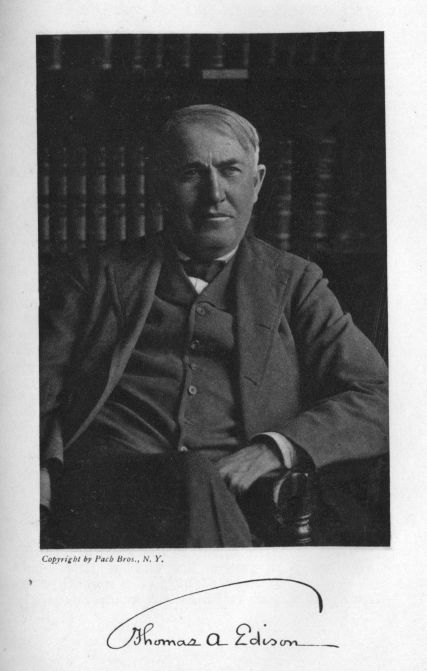
"Are your discoveries often brilliant intuitions?" asked a reporter of Thomas A. Edison. "Do they come to you while you are lying awake nights?"
"Are your discoveries often flashes of brilliant intuition?" a reporter asked Thomas A. Edison. "Do they come to you while you lie awake at night?"
"I never did anything worth doing by accident," was the reply, "nor did any of my inventions come indirectly through accident, except the phonograph. No, when I have fully decided that a result is worth getting I go ahead on it and make trial after trial until it comes. I have always kept strictly within the lines of commercially useful inventions. I have never had any time to put on electrical wonders, valuable simply as novelties to catch the popular fancy. I like it," continued the great inventor. "I don't know any other reason. Anything I have begun is always on my mind, and I am not easy while away from it until it is finished."
"I never did anything worth doing by accident," he replied. "None of my inventions came indirectly from an accident, except the phonograph. No, once I decide a result is worth achieving, I work on it. I try again and again until I get it. I have always focused strictly on inventions that are commercially useful. I have never had time for electrical wonders that are valuable only as novelties to capture the public's imagination. I like it," the great inventor continued. "I don't know any other reason. Anything I have started is always on my mind. When I am away from it, I am restless until it is finished."
A man who thus gives himself wholly to his work is certain to accomplish something; and if he have ability and common sense, his success will be great.
A man who gives himself completely to his work is sure to accomplish something. If he also has ability and common sense, his success will be great.
How Bulwer wrestled with the fates to change his apparent destiny! His first novel was a failure; his early poems were failures; and his youthful speeches provoked the ridicule of his opponents. But he fought his way to eminence through ridicule and defeat.
How hard Bulwer fought against fate to change his apparent destiny! His first novel failed, and so did his early poems. His speeches as a young man drew ridicule from his opponents. But he fought his way to prominence despite ridicule and defeat.
Gibbon worked twenty years on his "Decline and Fall of the Roman Empire." Noah Webster spent thirty-six years on his dictionary. What a sublime patience he showed in devoting a life to the collection and definition of words! George Bancroft spent twenty-six years on his "History of the United States." Newton rewrote his "Chronology of Ancient Nations" fifteen times. Titian wrote to Charles V.: "I send your majesty the Last Supper, after working on it almost daily for seven years." He worked on his Pietro Martyn eight years. George Stephenson was fifteen years perfecting his locomotive; Watt, twenty years on his condensing engine. Harvey labored eight long years before he published his discovery of the circulation of the blood. He was then called a crack-brained impostor by his fellow physicians. Amid abuse and ridicule he waited twenty-five years before his great discovery was recognized by the profession.
Gibbon spent twenty years writing "Decline and Fall of the Roman Empire." Noah Webster spent thirty-six years on his dictionary. What extraordinary patience he showed in devoting his life to collecting and defining words! George Bancroft spent twenty-six years on his "History of the United States." Newton rewrote his "Chronology of Ancient Nations" fifteen times. Titian wrote to Charles V.: "I send your majesty the Last Supper, after working on it almost daily for seven years." He spent eight years on his Pietro Martyn. George Stephenson spent fifteen years perfecting his locomotive. Watt spent twenty years on his condensing engine. Harvey worked for eight long years before publishing his discovery of blood circulation. His fellow physicians then called him a mad impostor. Despite abuse and ridicule, he waited twenty-five years for the medical profession to recognize his great discovery.
Newton discovered the law of gravitation before he was twenty-one, but one slight error in a measurement of the earth's circumference interfered with a demonstration of the correctness of his theory. Twenty years later he corrected the error, and showed that the planets roll in their orbits as a result of the same law which brings an apple to the ground.
Newton discovered the law of gravitation before he was twenty-one. But a small error in measuring the earth's circumference prevented him from proving his theory was correct. Twenty years later, he corrected the error. He showed that the same law that brings an apple to the ground also keeps the planets moving in their orbits.
Sothern, the great actor, said that the early part of his theatrical career was spent in getting dismissed for incompetency.
Sothern, the great actor, said he spent the early part of his acting career getting fired for incompetence.
"Never depend upon your genius," said John Ruskin, in the words of Joshua Reynolds; "if you have talent, industry will improve it; if you have none, industry will supply the deficiency."
"Never rely on your genius," said John Ruskin, quoting Joshua Reynolds. "If you have talent, hard work will improve it. If you have none, hard work will make up for it."
Savages believe that when they conquer an enemy, his spirit enters into them, and fights for them ever afterwards. So the spirit of our conquests enters us, and helps us to win the next victory.
Savages believe that when they defeat an enemy, his spirit enters them and fights for them ever after. In the same way, the spirit of our victories enters us and helps us win the next one.
Blücher may have been routed at Ligny yesterday, but to-day you hear the thunder of his guns at Waterloo hurling dismay and death among his former conquerors.
Blücher may have been defeated at Ligny yesterday. But today, you hear his guns thunder at Waterloo, spreading fear and death among those who defeated him.
Opposing circumstances create strength. Opposition gives us greater power of resistance. To overcome one barrier gives us greater ability to overcome the next.
Difficult circumstances build strength. Opposition makes us better able to resist. Overcoming one barrier makes us better able to overcome the next.
In February, 1492, a poor gray-haired man, his head bowed with discouragement almost to the back of his mule, rode slowly out through the beautiful gateway of the Alhambra. From boyhood he had been haunted with the idea that the earth is round. He believed that the piece of carved wood picked up four hundred miles at sea and the bodies of two men unlike any other human beings known, found on the shores of Portugal, had drifted from unknown lands in the west. But his last hope of obtaining aid for a voyage of discovery had failed. King John of Portugal, while pretending to think of helping him, had sent out secretly an expedition of his own.
In February 1492, a poor, gray-haired man rode slowly out through the beautiful gateway of the Alhambra. Discouraged, he bowed his head almost to the back of his mule. Since boyhood, he had been haunted by the idea that the earth is round. A piece of carved wood had been picked up four hundred miles at sea. The bodies of two men unlike any other known human beings had been found on the shores of Portugal. He believed the wood and the bodies had drifted from unknown lands in the west. But his last hope of getting help for a voyage of discovery had failed. King John of Portugal had pretended to consider helping him, while secretly sending out an expedition of his own.
He had begged bread, drawn maps and charts to keep from starving; he had lost his wife; his friends had called him crazy, and forsaken him. The council of wise men called by Ferdinand and Isabella ridiculed his theory of reaching the east by sailing west.
He had begged for bread and drawn maps and charts to keep from starving. He had lost his wife. His friends had called him crazy and abandoned him. Ferdinand and Isabella had called together a council of wise men. They ridiculed his theory that he could reach the east by sailing west.
"But the sun and moon are round," said Columbus, "why not the earth?"
"But the sun and moon are round," Columbus said. "Why not the earth?"
"If the earth is a ball, what holds it up?" asked the wise men.
"If the earth is a ball, what holds it up?" asked the wise men.
"What holds the sun and moon up?" inquired Columbus.
"What holds the sun and moon up?" asked Columbus.
"But how can men walk with their heads hanging down, and their feet up, like flies on a ceiling?" asked a learned doctor; "how can trees grow with their roots in the air?"
"But how can men walk with their heads hanging down and their feet up, like flies on a ceiling?" asked a learned doctor. "How can trees grow with their roots in the air?"
"The water would run out of the ponds and we should fall off," said another philosopher.
"The water would run out of the ponds, and we would fall off," said another philosopher.
"This doctrine is contrary to the Bible, which says, 'The heavens are stretched out like a tent:'—of course it is flat; it is rank heresy to say it is round," said a priest.
"This doctrine goes against the Bible, which says, 'The heavens are stretched out like a tent.' Of course it is flat. It is outright heresy to say it is round," said a priest.
Columbus left the Alhambra in despair, intending to offer his services to Charles VII., but he heard a voice calling his name. An old friend had told Isabella that it would add great renown to her reign at a trifling expense if what the sailor believed should prove true. "It shall be done," said Isabella, "I will pledge my jewels to raise the money. Call him back."
Columbus left the Alhambra in despair, intending to offer his services to Charles VII. But then he heard a voice calling his name. An old friend had spoken to Isabella about the sailor’s belief. The friend said that if Columbus was right, his discovery would bring great fame to her reign at little cost. "It shall be done," said Isabella. "I will pledge my jewels to raise the money. Call him back."
Columbus turned and with him turned the world. Not a sailor would go voluntarily; so the king and queen compelled them. Three days out, in his vessels scarcely larger than fishing-schooners, the Pinta floated a signal of distress for a broken rudder. Terror seized the sailors, but Columbus calmed their fears with pictures of gold and precious stones from India. Two hundred miles west of the Canaries, the compass ceased to point to the North Star. The sailors are ready to mutiny, but he tells them the North Star is not exactly north. Twenty-three hundred miles from home, though he tells them it is but seventeen hundred, a bush with berries floats by, land birds fly near, and they pick up a piece of wood curiously carved. On October 12, Columbus raised the banner of Castile over the western world.
Columbus changed course, and with him the world changed course. Not a single sailor would go willingly, so the king and queen forced them to go. His ships were barely larger than fishing schooners. Three days into the voyage, the Pinta signaled for help because its rudder had broken. The sailors were terrified, but Columbus calmed them with visions of gold and precious stones from India. Two hundred miles west of the Canaries, the compass stopped pointing toward the North Star. The sailors were ready to mutiny, but Columbus told them the North Star was not exactly north. They were 2,300 miles from home, though he told them it was only 1,700. A bush with berries floated past, land birds flew nearby, and they picked up a strangely carved piece of wood. On October 12, Columbus raised the banner of Castile over the western world.
"How hard I worked at that tremendous shorthand, and all improvement appertaining to it," said Dickens. "I will only add to what I have already written of my perseverance at this time of my life, and of a patient and continuous energy which then began to be matured."
"How hard I worked at that tremendous shorthand and at improving every aspect of it," said Dickens. "I will only add to what I have already written about my perseverance at this time in my life. It was also when my patient and steady energy began to mature."
Cyrus W. Field had retired from business with a large fortune when he became possessed with the idea that by means of a cable laid upon the bottom of the Atlantic Ocean, telegraphic communication could be established between Europe and America. He plunged into the undertaking with all the force of his being. The preliminary work included the construction of a telegraph line one thousand miles long, from New York to St. John's, Newfoundland. Through four hundred miles of almost unbroken forest they had to build a road as well as a telegraph line across Newfoundland. Another stretch of one hundred and forty miles across the island of Cape Breton involved a great deal of labor, as did the laying of a cable across the St. Lawrence.
Cyrus W. Field had retired from business with a large fortune when he became obsessed with an idea. He believed a cable laid on the Atlantic Ocean floor could establish telegraph communication between Europe and America. He threw himself into the project with all his energy. The preliminary work included building a telegraph line 1,000 miles long, from New York to St. John's, Newfoundland. Across 400 miles of nearly unbroken forest in Newfoundland, the workers had to build a road as well as a telegraph line. Another 140-mile stretch across the island of Cape Breton required a great deal of labor. So did laying a cable across the St. Lawrence.
By hard work he secured aid for his company from the British government, but in Congress he encountered such bitter opposition from a powerful lobby that his measure only had a majority of one in the Senate. The cable was loaded upon the Agamemnon, the flag ship of the British fleet at Sebastopol, and upon the Niagara, a magnificent new frigate of the United States Navy; but, when five miles of cable had been paid out, it caught in the machinery and parted. On the second trial, when two hundred miles at sea, the electric current was suddenly lost, and men paced the decks nervously and sadly, as if in the presence of death. Just as Mr. Field was about to give the order to cut the cable, the current returned as quickly and mysteriously as it had disappeared. The following night, when the ship was moving but four miles an hour and the cable running out at the rate of six miles, the brakes were applied too suddenly just as the steamer gave a heavy lurch, breaking the cable.
Through hard work, he secured aid for his company from the British government. But in Congress, a powerful lobby opposed him so bitterly that his measure passed the Senate by only one vote. The cable was loaded onto the Agamemnon, the flagship of the British fleet at Sebastopol, and the Niagara, a magnificent new frigate of the United States Navy. But after five miles of cable had been laid, it caught in the machinery and broke. On the second attempt, when the ship was two hundred miles out at sea, the electric current suddenly stopped. Men paced the decks, nervous and sad, as if in the presence of death. Just as Mr. Field was about to order the cable cut, the current returned as quickly and mysteriously as it had disappeared. The following night, the ship was moving at only four miles an hour, while the cable was running out at six miles an hour. The brakes were applied too suddenly, just as the steamer lurched heavily, and the cable broke.
Field was not the man to give up. Seven hundred miles more of cable were ordered, and a man of great skill was set to work to devise a better machine for paying out the long line. American and British inventors united in making a machine. At length in mid-ocean the two halves of the cable were spliced and the steamers began to separate, the one headed for Ireland, the other for Newfoundland, each running out the precious thread, which, it was hoped, would bind two continents together. Before the vessels were three miles apart, the cable parted. Again it was spliced, but when the ships were eighty miles apart, the current was lost. A third time the cable was spliced and about two hundred miles paid out, when it parted some twenty feet from the Agamemnon, and the vessels returned to the coast of Ireland.
Field was not a man to give up. He ordered seven hundred more miles of cable. A highly skilled man was put to work designing a better machine to lay the long cable. American and British inventors joined forces to build it. Finally, the two halves of the cable were joined in mid-ocean, and the steamships began to move apart. One headed for Ireland and the other for Newfoundland. Each laid out the precious thread that, it was hoped, would bind two continents together. Before the ships were three miles apart, the cable broke. It was joined again, but when the ships were eighty miles apart, the electrical current was lost. The cable was joined a third time, and about two hundred miles were laid out. Then it broke about twenty feet from the Agamemnon, and the ships returned to the coast of Ireland.
Directors were disheartened, the public skeptical, capitalists were shy, and but for the indomitable energy and persuasiveness of Mr. Field, who worked day and night almost without food or sleep, the whole project would have been abandoned. Finally a third attempt was made, with such success that the whole cable was laid without a break, and several messages were flashed through nearly seven hundred leagues of ocean, when suddenly the current ceased.
The directors were discouraged, the public was skeptical, and investors were hesitant. Without Mr. Field’s tireless energy and persuasiveness, the whole project would have been abandoned. He worked day and night, with almost no food or sleep. Finally, a third attempt succeeded in laying the entire cable without a break. Several messages were sent through nearly seven hundred leagues of ocean. Then the current suddenly stopped.
Faith now seemed dead except in the breast of Cyrus W. Field, and one or two friends, yet with such persistence did they work that they persuaded men to furnish capital for yet another trial even against what seemed their better judgment. A new and superior cable was loaded upon the Great Eastern, which steamed slowly out to sea, paying out as she advanced. Everything worked to a charm until within six hundred miles of Newfoundland, when the cable snapped and sank. After several attempts to raise it, the enterprise was abandoned for a year.
Faith now seemed dead except in Cyrus W. Field and one or two friends. Yet they worked so persistently that they persuaded men to fund another attempt, even against what seemed to be their better judgment. A new and better cable was loaded onto the Great Eastern. The ship steamed slowly out to sea, laying the cable as it went. Everything went perfectly until the ship was within six hundred miles of Newfoundland. Then the cable snapped and sank. After several attempts to raise it, the project was abandoned for a year.
Not discouraged by all these difficulties, Mr. Field went to work with a will, organized a new company, and made a new cable far superior to anything before used, and on July 13, 1866, was begun the trial which ended with the following message sent to New York:—
Undiscouraged by all these difficulties, Mr. Field set to work with determination. He organized a new company and made a cable far superior to any used before. On July 13, 1866, a trial began that ended with the following message sent to New York:
"HEART'S CONTENT, July 27.
"HEART'S CONTENT, July 27.
"We arrived here at nine o'clock this morning. All well. Thank God! the cable is laid and is in perfect working order.
"We arrived here at nine o'clock this morning. Everyone is well. Thank God! The cable is laid and working perfectly.
"CYRUS W. FIELD."
"CYRUS W. FIELD."
The old cable was picked up, spliced, and continued to Newfoundland, and the two are still working, with good prospects for usefulness for many years.
The old cable was retrieved, spliced, and extended to Newfoundland. Both cables are still working and are likely to remain useful for many years.
In Revelation we read: "He that overcometh, I will give him to sit down with me on my throne."
In Revelation we read: "To the one who overcomes, I will give a seat with me on my throne."
Successful men, it is said, owe more to their perseverance than to their natural powers, their friends, or the favorable circumstances around them. Genius will falter by the side of labor, great powers will yield to great industry. Talent is desirable, but perseverance is more so.
Successful men, it is said, owe more to perseverance than to their natural abilities, their friends, or favorable circumstances. Genius falters beside hard work, and great abilities give way to great effort. Talent is desirable, but perseverance is even more so.
"How long did it take you to learn to play?" asked a young man of Geradini. "Twelve hours a day for twenty years," replied the great violinist. Lyman Beecher when asked how long it took him to write his celebrated sermon on the "Government of God," replied, "About forty years."
"How long did it take you to learn to play?" a young man asked Geradini. "Twelve hours a day for twenty years," replied the great violinist. Lyman Beecher was asked how long it took him to write his famous sermon on the "Government of God." He replied, "About forty years."
A Chinese student, discouraged by repeated failures, had thrown away his book in despair, when he saw a poor woman rubbing an iron bar on a stone to make a needle. This example of patience sent him back to his studies with a new determination, and he became one of the three greatest scholars of China.
A Chinese student had failed many times and, in despair, threw away his book. Then he saw a poor woman rubbing an iron bar against a stone to make a needle. Her patience sent him back to his studies with new determination. He went on to become one of the three greatest scholars of China.
Malibran said: "If I neglect my practice a day, I see the difference in my execution; if for two days, my friends see it; and if for a week, all the world knows my failure." Constant, persistent struggle she found to be the price of her marvelous power.
Malibran said: "If I skip practice for a day, I notice the difference in my performance. If I skip two days, my friends notice it. If I skip a week, the whole world knows I have failed." She found that constant, persistent struggle was the price of her remarkable ability.
When an East India boy is learning archery, he is compelled to practise three months drawing the string to his ear before he is allowed to touch an arrow.
When an East India boy learns archery, he must practice drawing the bowstring to his ear for three months before he is allowed to touch an arrow.
Benjamin Franklin had this tenacity of purpose in a wonderful degree. When he started in the printing business in Philadelphia, he carried his material through the streets on a wheelbarrow. He hired one room for his office, work-room, and sleeping-room. He found a formidable rival in the city and invited him to his room. Pointing to a piece of bread from which he had just eaten his dinner, he said: "Unless you can live cheaper than I can you can not starve me out."
Benjamin Franklin had an extraordinary determination to succeed. When he started his printing business in Philadelphia, he carried his materials through the streets in a wheelbarrow. He rented one room as his office, workshop, and bedroom. He had a formidable rival in the city and invited him to his room. Pointing to a piece of bread he had just eaten for dinner, he said: "Unless you can live more cheaply than I can, you cannot starve me out."
All are familiar with the misfortune of Carlyle while writing his "History of the French Revolution." After the first volume was ready for the press, he loaned the manuscript to a neighbor who left it lying on the floor, and the servant girl took it to kindle the fire. It was a bitter disappointment, but Carlyle was not the man to give up. After many months of poring over hundreds of volumes of authorities and scores of manuscripts, he reproduced that which had burned in a few minutes.
Everyone knows about Carlyle's misfortune while writing his "History of the French Revolution." After the first volume was ready for publication, he lent the manuscript to a neighbor. The neighbor left it on the floor, and a servant girl used it to start a fire. It was a bitter disappointment, but Carlyle was not the kind of man to give up. He spent many months studying hundreds of authoritative books and dozens of manuscripts. Then he recreated what had burned in a few minutes.
Audubon, the naturalist, had spent two years with his gun and note-book in the forests of America, making drawings of birds. He nailed them all up securely in a box and went off on a vacation. When he returned he opened the box only to find a nest of Norwegian rats in his beautiful drawings. Every one was ruined. It was a terrible disappointment, but Audubon took his gun and note-book and started for the forest. He reproduced his drawings, and they were even better than the first.
Audubon, the naturalist, had spent two years in the forests of America, drawing birds with his gun and notebook beside him. He secured all his drawings in a nailed box and went on vacation. When he returned, he opened the box and found a nest of Norwegian rats among his beautiful drawings. Every drawing was ruined. It was a terrible disappointment, but Audubon took his gun and notebook and returned to the forest. He made the drawings again, and they were even better than the first ones.
When Dickens was asked to read one of his selections in public he replied that he had not time, for he was in the habit of reading the same piece every day for six months before reading it in public. "My own invention," he says, "such as it is, I assure you, would never have served me as it has but for the habit of commonplace, humble, patient, toiling attention."
When Dickens was asked to read one of his works in public, he said he did not have time. He usually practiced reading the same piece every day for six months before reading it in public. "My own creativity, such as it is, would never have served me so well without the habit of ordinary, humble, patient, hard-working attention," he said.
Addison amassed three volumes of manuscript before he began the "Spectator."
Addison had collected three volumes of manuscripts before he began the "Spectator."
Everyone admires a determined, persistent man. Marcus Morton ran sixteen times for governor of Massachusetts. At last his opponents voted for him from admiration of his pluck, and he was elected by a majority of one! Such persistence always triumphs.
Everyone admires a determined, persistent man. Marcus Morton ran for governor of Massachusetts sixteen times. At last, his opponents voted for him because they admired his courage, and he won by one vote! Such persistence always triumphs.
Webster declared that when a pupil at Phillips Exeter Academy he never could declaim before the school. He said he committed piece after piece and rehearsed them in his room, but when he heard his name called in the academy and all eyes turned towards him the room became dark and everything he ever knew fled from his brain; but he became the great orator of America. Indeed, it is doubtful whether Demosthenes himself surpassed his great reply to Hayne in the United States Senate. Webster's tenacity was illustrated by a circumstance which occurred in the academy. The principal punished him for shooting pigeons by compelling him to commit one hundred lines of Vergil. He knew the principal was to take a certain train that afternoon, so he went to his room and learned seven hundred lines. He went to recite them to the principal just before train time. After repeating the hundred lines he continued until he had recited two hundred. The principal anxiously looked at his watch and grew nervous, but Webster kept right on. The principal finally stopped him and asked him how many more he had learned. "About five hundred more," said Webster, continuing to recite.
Webster said that as a student at Phillips Exeter Academy, he could never recite before the school. He memorized one piece after another and rehearsed them in his room. But when his name was called at the academy, all eyes turned toward him. The room went dark, and everything he had ever known vanished from his mind. Yet he became America's great orator. Indeed, it is doubtful whether even Demosthenes surpassed Webster's great reply to Hayne in the United States Senate. An incident at the academy showed Webster's persistence. The principal punished him for shooting pigeons by making him memorize one hundred lines of Vergil. Webster knew the principal was taking a particular train that afternoon. So he went to his room and learned seven hundred lines. He went to recite them to the principal just before train time. After reciting the first hundred lines, he continued until he had recited two hundred. The principal anxiously looked at his watch and grew nervous, but Webster kept going. Finally, the principal stopped him and asked how many more he had learned. "About five hundred more," said Webster, and continued to recite.
"You can have the rest of the day for pigeon-shooting," said the principal.
"You can spend the rest of the day shooting pigeons," said the principal.
Great writers have ever been noted for their tenacity of purpose. Their works have not been flung off from minds aglow with genius, but have been elaborated and elaborated into grace and beauty, until every trace of their efforts has been obliterated.
Great writers have always been known for their persistence. They did not simply produce their works in a burst of genius. Instead, they refined them again and again, making them graceful and beautiful until no trace of their effort remained.
Bishop Butler worked twenty years incessantly on his "Analogy," and even then was so dissatisfied that he wanted to burn it. Rousseau says he obtained the ease and grace of his style only by ceaseless inquietude, by endless blotches and erasures. Vergil worked eleven years on the Aeneid. The note-books of great men like Hawthorne and Emerson are tell-tales of the enormous drudgery, of the years put into a book which may be read in an hour. Montesquieu was twenty-five years writing his "Esprit des Lois," yet you can read it in sixty minutes. Adam Smith spent ten years on his "Wealth of Nations." A rival playwright once laughed at Euripides for spending three days on three lines, when he had written five hundred lines. "But your five hundred lines in three days will be dead and forgotten, while my three lines will live forever," he replied.
Bishop Butler worked constantly for twenty years on his "Analogy." Even then, he was so dissatisfied with it that he wanted to burn it. Rousseau said he achieved his easy, graceful style only through constant effort, with endless blots and erasures. Vergil worked for eleven years on the Aeneid. The notebooks of great men like Hawthorne and Emerson reveal the enormous labor behind their work. They show the years spent on a book that may be read in an hour. Montesquieu spent twenty-five years writing his "Esprit des Lois," yet you can read it in sixty minutes. Adam Smith spent ten years on his "Wealth of Nations." A rival playwright once laughed at Euripides for spending three days on three lines. The rival had written five hundred lines in that time. "But your five hundred lines will be dead and forgotten in three days, while my three lines will live forever," Euripides replied.
Ariosto wrote his "Description of a Tempest" in sixteen different ways. He spent ten years on his "Orlando Furioso," and only sold one hundred copies at fifteen pence each. The proof of Burke's "Letters to a Noble Lord" (one of the sublimest things in all literature) went back to the publisher so changed and blotted with corrections that the printer absolutely refused to correct it, and it was entirely reset. Adam Tucker spent eighteen years on the "Light of Nature." Thoreau's New England pastoral, "A Week on the Concord and Merrimac Rivers," was an entire failure. Seven hundred of the one thousand copies printed were returned from the publishers. Thoreau wrote in his diary: "I have some nine hundred volumes in my library, seven hundred of which I wrote myself." Yet he took up his pen with as much determination as ever.
Ariosto wrote his "Description of a Tempest" in sixteen different ways. He spent ten years on his "Orlando Furioso" and sold only one hundred copies at fifteen pence each. Burke's "Letters to a Noble Lord" is one of the most sublime works in all literature. The proof went back to the publisher covered in changes and corrections. The printer flatly refused to correct it, so it had to be completely reset. Adam Tucker spent eighteen years on the "Light of Nature." Thoreau's New England pastoral, "A Week on the Concord and Merrimac Rivers," was a complete failure. The publishers returned seven hundred of the one thousand copies printed. Thoreau wrote in his diary: "I have some nine hundred volumes in my library, seven hundred of which I wrote myself." Yet he took up his pen with as much determination as ever.
The rolling stone gathers no moss. The persistent tortoise outruns the swift but fickle hare. An hour a day for twelve years more than equals the time given to study in a four years' course at a high school. The reading and re-reading of a single volume has been the making of many a man. "Patience," says Bulwer "is the courage of the conqueror; it is the virtue par excellence, of Man against Destiny—of the One against the World, and of the Soul against Matter. Therefore, this is the courage of the Gospel; and its importance in a social view—its importance to races and institutions—cannot be too earnestly inculcated."
A rolling stone gathers no moss. The persistent tortoise outruns the fast but fickle hare. An hour a day for twelve years adds up to more study time than four years of high school. Reading and rereading a single book has been the making of many a man. "Patience," says Bulwer, "is the courage of the conqueror. It is the virtue par excellence of Man against Destiny, of the One against the World, and of the Soul against Matter. Therefore, patience is the courage of the Gospel. We cannot stress enough its importance to society, to races, and to institutions."
Want of constancy is the cause of many a failure, making the millionaire of to-day a beggar to-morrow. Show me a really great triumph that is not the reward of persistence. One of the paintings which made Titian famous was on his easel eight years; another, seven. How came popular writers famous? By writing for years without any pay at all; by writing hundreds of pages as mere practise-work; by working like galley-slaves at literature for half a lifetime with no other compensation than—fame.
Lack of perseverance causes many failures, turning today’s millionaire into tomorrow’s beggar. Show me a truly great triumph that was not the reward of persistence. One of the paintings that made Titian famous stayed on his easel for eight years. Another stayed there for seven. How did popular writers become famous? They wrote for years without any pay. They wrote hundreds of pages just for practice. They worked like galley-slaves at literature for half a lifetime, with no reward but fame.
"Never despair," says Burke; "but if you do, work on in despair."
"Never give up hope," says Burke. "But if you do, keep working even in despair."
The head of the god Hercules is represented as covered with a lion's skin with claws joined under the chin, to show that when we have conquered our misfortunes, they become our helpers. Oh, the glory of an unconquerable will!
The god Hercules is shown with a lion's skin covering his head and its claws joined under his chin. This shows that when we conquer our misfortunes, they become our helpers. Oh, the glory of a will that cannot be conquered!