Chapter 60
ELIZABETH’S spirits soon rising to playfulness again, she wanted Mr. Darcy to account for his having ever fallen in love with her. “How could you begin?” said she. “I can comprehend your going on charmingly, when you had once made a beginning; but what could set you off in the first place?”
Elizabeth soon felt playful again. She wanted Mr. Darcy to explain how he had ever fallen in love with her. “How did you first fall in love with me?” she asked. “I can understand how you went on so happily once you had begun. But what made you start in the first place?”
“I cannot fix on the hour, or the spot, or the look, or the words, which laid the foundation. It is too long ago. I was in the middle before I knew that I had begun.”
“I can’t pinpoint the hour, the place, the look, or the words that started it all. It was too long ago. I was already in the middle before I knew I had begun.”
“My beauty you had early withstood, and as for my manners—my behaviour to you was at least always bordering on the uncivil, and I never spoke to you without rather wishing to give you pain than not. Now, be sincere; did you admire me for my impertinence?”
“You resisted my beauty from the start. As for my manners, my behaviour to you was at least always close to rude. Whenever I spoke to you, I was more inclined to hurt your feelings than not. Now, be honest. Did you admire me for my cheek?”
“For the liveliness of your mind I did.”
“I did because of your lively mind.”
“You may as well call it impertinence at once. It was very little less. The fact is, that you were sick of civility, of deference, of officious attention. You were disgusted with the women who were always speaking, and looking, and thinking for your approbation alone. I roused and interested you, because I was so unlike them. Had you not been really amiable you would have hated me for it: but in spite of the pains you took to disguise yourself, your feelings were always noble and just; and in your heart you thoroughly despised the persons who so assiduously courted you. There—I have saved you the trouble of accounting for it; and really, all things considered, I begin to think it perfectly reasonable. To be sure you know no actual good of me—but nobody thinks of that when they fall in love.”
“You might as well call it rudeness outright. It was hardly anything less. The truth is, you were tired of politeness, of being deferred to, of fussing over you. You were disgusted with women who spoke, looked, and thought only to win your approval. I stirred you up and caught your interest because I was so unlike them. If you hadn’t been truly kind, you would have hated me for it. But despite your efforts to hide your true nature, your feelings were always noble and fair. And deep down, you thoroughly despised the people who worked so hard to win your favor. There, I’ve saved you the trouble of explaining your feelings. And really, all things considered, I’m beginning to think your feelings make perfect sense. Of course, you don’t actually know anything good about me. But nobody thinks of that when they fall in love.”
“Was there no good in your affectionate behaviour to Jane, while she was ill at Netherfield?”
“Was there nothing good about how affectionately you treated Jane while she was ill at Netherfield?”
“Dearest Jane! who could have done less for her? But make a virtue of it by all means. My good qualities are under your protection, and you are to exaggerate them as much as possible; and, in return, it belongs to me to find occasions for teasing and quarrelling with you as often as may be; and I shall begin directly, by asking you what made you so unwilling to come to the point at last? What made you so shy of me, when you first called, and afterwards dined here? Why, especially, when you called, did you look as if you did not care about me?”
“Dearest Jane! Who could have done less for her? But by all means, give me credit for it. My good qualities are in your care, and you must exaggerate them as much as possible. In return, my job is to find chances to tease and quarrel with you as often as possible. And I’ll start right now by asking why you were so reluctant to say what you meant at last. Why were you so shy with me when you first visited, and later when you had dinner here? Why, especially on that first visit, did you look as if you didn’t care about me?”
“Because you were grave and silent, and gave me no encouragement.”
“Because you were serious and quiet, and gave me no encouragement.”
“But I was embarrassed.”
“But I was embarrassed.”
“And so was I.”
“And I was too.”
“You might have talked to me more when you came to dinner.”
“You could have talked to me more when you came to dinner.”
“A man who had felt less might.”
“A man with weaker feelings might.”
“How unlucky that you should have a reasonable answer to give, and that I should be so reasonable as to admit it! But I wonder how long you would have gone on, if you had been left to yourself. I wonder when you would have spoken if I had not asked you! My resolution of thanking you for your kindness to Lydia had certainly great effect. Too much, I am afraid; for what becomes of the moral, if our comfort springs from a breach of promise, for I ought not to have mentioned the subject? This will never do.”
“How unlucky that you have a reasonable answer, and that I’m reasonable enough to accept it! But I wonder how long you would have gone on if left to yourself. I wonder when you would have spoken if I hadn’t asked you! My decision to thank you for your kindness to Lydia certainly had quite an effect. Too much, I’m afraid. For what happens to the moral lesson if our happiness comes from breaking a promise? After all, I shouldn’t have mentioned the subject. This will never do.”
“You need not distress yourself. The moral will be perfectly fair. Lady Catherine’s unjustifiable endeavours to separate us were the means of removing all my doubts. I am not indebted for my present happiness to your eager desire of expressing your gratitude. I was not in a humour to wait for an opening of yours. My aunt’s intelligence had given me hope, and I was determined at once to know everything.”
“You don’t need to worry. The lesson to be drawn will be perfectly fair. Lady Catherine’s unjustifiable attempts to separate us removed all my doubts. I don’t owe my present happiness to your eagerness to express your gratitude. I wasn’t in the mood to wait for you to bring up the subject. What my aunt told me had given me hope, and I was determined to find out everything at once.”
“Lady Catherine has been of infinite use, which ought to make her happy, for she loves to be of use. But tell me, what did you come down to Netherfield for? Was it merely to ride to Longbourn and be embarrassed? or had you intended any more serious consequences?”
“Lady Catherine has been enormously helpful. That ought to make her happy, because she loves to be useful. But tell me, why did you come down to Netherfield? Was it just to ride to Longbourn and feel embarrassed? Or were you hoping for something more serious to come of your visit?”
“My real purpose was to see you, and to judge, if I could, whether I might ever hope to make you love me. My avowed one, or what I avowed to myself, was to see whether your sister was still partial to Bingley, and if she were, to make the confession to him which I have since made.”
“My real purpose was to see you. I wanted to judge, if I could, whether I might ever hope to make you love me. My stated purpose, or the one I admitted to myself, was to see whether your sister still liked Bingley. If she did, I intended to make the confession to him that I have since made.”
“Shall you ever have courage to announce to Lady Catherine what is to befall her?”
“Will you ever have the courage to tell Lady Catherine what is going to happen to her?”
“I am more likely to want time than courage, Elizabeth. But it ought to be done; and if you will give me a sheet of paper it shall be done directly.”
“I’m more likely to lack time than courage, Elizabeth. But it should be done. And if you give me a sheet of paper, I’ll do it right away.”
“And if I had not a letter to write myself, I might sit by you, and admire the evenness of your writing, as another young lady once did. But I have an aunt, too, who must not be longer neglected.”
“And if I didn’t have a letter to write myself, I might sit beside you and admire your even handwriting. Another young lady once did just that. But I have an aunt, too, and I must not neglect her any longer.”
From an unwillingness to confess how much her intimacy with Mr. Darcy had been overrated, Elizabeth had never yet answered Mrs. Gardiner’s long letter; but now, having that to communicate which she knew would be most welcome, she was almost ashamed to find that her uncle and aunt had already lost three days of happiness, and immediately wrote as follows:—
Elizabeth had not yet answered Mrs. Gardiner’s long letter. She was reluctant to admit how much her closeness with Mr. Darcy had been exaggerated. But now she had news to share that she knew would be most welcome. She was almost ashamed that her uncle and aunt had already missed three days of happiness. So she immediately wrote as follows:
“I would have thanked you before, my dear aunt, as I ought to have done, for your long, kind, satisfactory detail of particulars; but, to say the truth, I was too cross to write. You supposed more than really existed. But now suppose as much as you choose; give a loose to your fancy, indulge your imagination in every possible flight which the subject will afford, and unless you believe me actually married, you cannot greatly err. You must write again very soon, and praise him a great deal more than you did in your last. I thank you again and again, for not going to the Lakes. How could I be so silly as to wish it! Your idea of the ponies is delightful. We will go round the park every day. I am the happiest creature in the world. Perhaps other people have said so before, but no one with such justice. I am happier even than Jane; she only smiles, I laugh. Mr. Darcy sends you all the love in the world that can be spared from me. You are all to come to Pemberley at Christmas. Yours,” etc.
“I should have thanked you sooner, my dear aunt, for your long, kind letter with all its reassuring details. But, to tell the truth, I was too annoyed to write. You imagined more than was really going on. But now imagine as much as you like. Let your imagination run wild with every possibility the subject offers. Unless you believe I am already married, you cannot be far wrong. You must write again very soon and praise him much more than you did in your last letter. Thank you again and again for not going to the Lakes. How could I have been so silly as to wish you would! Your idea about the ponies is delightful. We will ride around the park every day. I am the happiest person in the world. Perhaps other people have said the same before, but no one has had such good reason. I am even happier than Jane. She only smiles, but I laugh. Mr. Darcy sends you all the love in the world he can spare from me. You must all come to Pemberley at Christmas. Yours,” etc.
Mr. Darcy’s letter to Lady Catherine was in a different style, and still different from either was what Mr. Bennet sent to Mr. Collins, in return for his last.
Mr. Darcy’s letter to Lady Catherine had a different tone. Mr. Bennet’s reply to Mr. Collins’s latest letter had a tone different from both.
“Dear Sir,
“Dear Sir,
“I must trouble you once more for congratulations. Elizabeth will soon be the wife of Mr. Darcy. Console Lady Catherine as well as you can. But, if I were you, I would stand by the nephew. He has more to give.
“I must bother you once more for congratulations. Elizabeth will soon marry Mr. Darcy. Comfort Lady Catherine as best you can. But if I were you, I would side with her nephew. He has more to give.
“Yours sincerely,” etc.
“Sincerely,” etc.
Miss Bingley’s congratulations to her brother on his approaching marriage were all that was affectionate and insincere. She wrote even to Jane on the occasion, to express her delight, and repeat all her former professions of regard. Jane was not deceived, but she was affected; and though feeling no reliance on her, could not help writing her a much kinder answer than she knew was deserved.
Miss Bingley congratulated her brother on his upcoming marriage with all the affection and insincerity imaginable. She even wrote to Jane to express her delight and repeat all her earlier claims of affection. Jane was not fooled, but she was touched. And although she did not trust Miss Bingley, she could not help writing a much kinder reply than Miss Bingley deserved.
The joy which Miss Darcy expressed on receiving similar information was as sincere as her brother’s in sending it. Four sides of paper were insufficient to contain all her delight, and all her earnest desire of being loved by her sister.
Miss Darcy’s joy at receiving similar news was as sincere as her brother’s joy in sending it. Four pages could not hold all her delight or her deep desire to be loved by her sister.
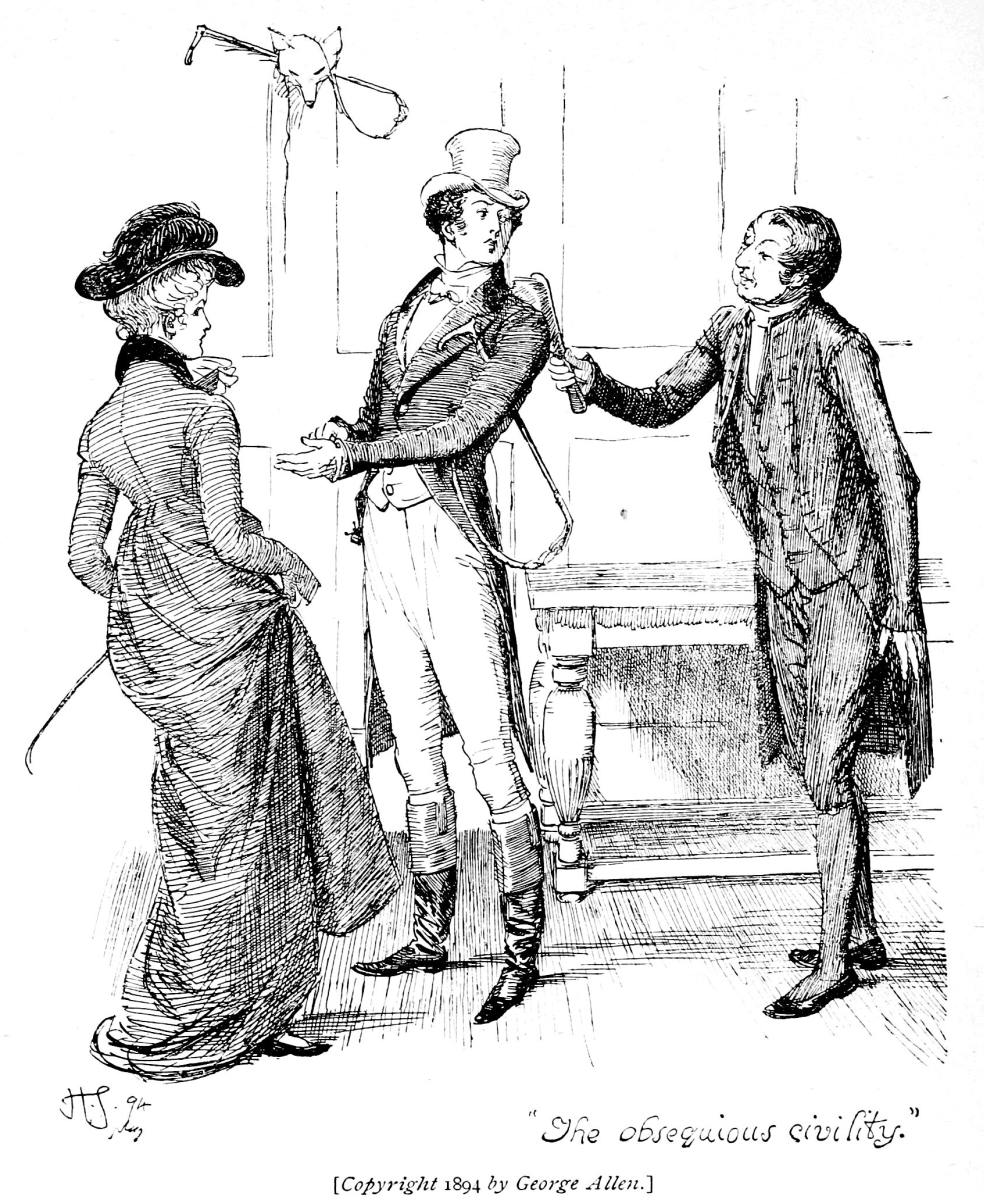
Before any answer could arrive from Mr. Collins, or any congratulations to Elizabeth from his wife, the Longbourn family heard that the Collinses were come themselves to Lucas Lodge. The reason of this sudden removal was soon evident. Lady Catherine had been rendered so exceedingly angry by the contents of her nephew’s letter, that Charlotte, really rejoicing in the match, was anxious to get away till the storm was blown over. At such a moment, the arrival of her friend was a sincere pleasure to Elizabeth, though in the course of their meetings she must sometimes think the pleasure dearly bought, when she saw Mr. Darcy exposed to all the parading and obsequious civility of her husband. He bore it, however, with admirable calmness. He could even listen to Sir William Lucas, when he complimented him on carrying away the brightest jewel of the country, and expressed his hopes of their all meeting frequently at St. James’s, with very decent composure. If he did shrug his shoulders, it was not till Sir William was out of sight.
Before any reply arrived from Mr. Collins, or any congratulations to Elizabeth from his wife, news reached the Longbourn family. The Collinses themselves had arrived at Lucas Lodge. The reason for this sudden move soon became clear. Lady Catherine had been made extremely angry by her nephew’s letter. Charlotte, who was genuinely delighted with the match, wanted to get away until the storm had passed. At such a time, her friend’s arrival was a real pleasure to Elizabeth. Yet during their visits, Elizabeth sometimes felt that pleasure came at a high price. She had to watch Mr. Darcy endure all her friend’s husband’s showy displays and fawning politeness. He bore them, however, with admirable calm. He could even listen quite calmly as Sir William Lucas congratulated him on winning the brightest jewel in the county. Sir William also expressed his hope that they would all meet often at St. James’s. If Mr. Darcy did shrug his shoulders, he waited until Sir William was out of sight.
Mrs. Philips’s vulgarity was another, and, perhaps, a greater tax on his forbearance; and though Mrs. Philips, as well as her sister, stood in too much awe of him to speak with the familiarity which Bingley’s good-humour encouraged; yet, whenever she did speak, she must be vulgar. Nor was her respect for him, though it made her more quiet, at all likely to make her more elegant. Elizabeth did all she could to shield him from the frequent notice of either, and was ever anxious to keep him to herself, and to those of her family with whom he might converse without mortification; and though the uncomfortable feelings arising from all this took from the season of courtship much of its pleasure, it added to the hope of the future; and she looked forward with delight to the time when they should be removed from society so little pleasing to either, to all the comfort and elegance of their family party at Pemberley.
Mrs. Philips’s vulgarity was another strain on his patience, and perhaps an even greater one. Like her sister, Mrs. Philips was too much in awe of him to speak as freely as Bingley’s good nature encouraged. Yet whenever she did speak, she could not help being vulgar. Although her respect for him made her quieter, it was unlikely to make her any more refined. Elizabeth did all she could to shield him from the frequent attentions of both women. She was always eager to keep him to herself and those relatives he could talk to without embarrassment. Although the discomfort of all this took away much of the pleasure of their courtship, it increased her hopes for the future. She looked forward with delight to leaving company that neither of them much enjoyed. At Pemberley, they would have all the comfort and elegance of their family circle.