Chapter 50
MR. BENNET had very often wished, before this period of his life, that, instead of spending his whole income, he had laid by an annual sum, for the better provision of his children, and of his wife, if she survived him. He now wished it more than ever. Had he done his duty in that respect, Lydia need not have been indebted to her uncle for whatever of honour or credit could now be purchased for her. The satisfaction of prevailing on one of the most worthless young men in Great Britain to be her husband might then have rested in its proper place.
Mr. Bennet had often wished he had saved some money each year instead of spending his entire income. The savings would have provided better for his children and for his wife if she outlived him. Now he wished it more than ever. If he had done his duty in saving, Lydia would not have needed to rely on her uncle. Whatever honor or respectability could now be bought for her would not have been owed to him. Mr. Bennet could then have had the satisfaction of persuading one of Great Britain’s most worthless young men to marry her. That satisfaction would have belonged where it ought to belong.
He was seriously concerned that a cause of so little advantage to anyone should be forwarded at the sole expense of his brother-in-law; and he was determined, if possible, to find out the extent of his assistance, and to discharge the obligation as soon as he could.
He was seriously concerned that something of so little benefit to anyone should come entirely at his brother-in-law’s expense. He was determined, if possible, to find out how much his brother-in-law had contributed. He would then repay him as soon as he could.
When first Mr. Bennet had married, economy was held to be perfectly useless; for, of course, they were to have a son. This son was to join in cutting off the entail, as soon as he should be of age, and the widow and younger children would by that means be provided for. Five daughters successively entered the world, but yet the son was to come; and Mrs. Bennet, for many years after Lydia’s birth, had been certain that he would. This event had at last been despaired of, but it was then too late to be saving. Mrs. Bennet had no turn for economy; and her husband’s love of independence had alone prevented their exceeding their income.
When Mr. Bennet first married, saving money was thought entirely pointless, because, of course, they would have a son. As soon as their son came of age, he would help end the entail restricting who could inherit the estate. That would allow them to provide for Mr. Bennet’s widow and younger children. Five daughters were born, one after another, but the son was still expected. For many years after Lydia’s birth, Mrs. Bennet remained certain that a son would follow. At last, they gave up hope of having a son, but by then it was too late to start saving. Mrs. Bennet had no knack for managing money. Only her husband’s desire to remain financially independent had kept them from spending more than their income.
Five thousand pounds was settled by marriage articles on Mrs. Bennet and the children. But in what proportions it should be divided amongst the latter depended on the will of the parents. This was one point, with regard to Lydia at least, which was now to be settled, and Mr. Bennet could have no hesitation in acceding to the proposal before him. In terms of grateful acknowledgment for the kindness of his brother, though expressed most concisely, he then delivered on paper his perfect approbation of all that was done, and his willingness to fulfil the engagements that had been made for him. He had never before supposed that, could Wickham be prevailed on to marry his daughter, it would be done with so little inconvenience to himself as by the present arrangement. He would scarcely be ten pounds a year the loser, by the hundred that was to be paid them; for, what with her board and pocket allowance, and the continual presents in money which passed to her through her mother’s hands, Lydia’s expenses had been very little within that sum.
The marriage agreement set aside five thousand pounds for Mrs. Bennet and the children. But the parents would decide how much of the money each child would receive. Lydia’s share, at least, now had to be settled, and Mr. Bennet could have no hesitation in accepting the proposal. He then wrote a very brief expression of gratitude for his brother’s kindness. He gave his full approval to everything that had been done and agreed to meet the commitments made for him. He had never imagined that, if Wickham could be persuaded to marry his daughter, he himself would face so little inconvenience. Paying the couple a hundred pounds a year would leave him scarcely ten pounds a year worse off. After all, Lydia’s food, lodging, and allowance, along with the constant gifts of money through her mother, had cost nearly that much.
That it would be done with such trifling exertion on his side, too, was another very welcome surprise; for his chief wish at present was to have as little trouble in the business as possible. When the first transports of rage which had produced his activity in seeking her were over, he naturally returned to all his former indolence. His letter was soon despatched; for though dilatory in undertaking business, he was quick in its execution. He begged to know further particulars of what he was indebted to his brother; but was too angry with Lydia to send any message to her.
That the matter would be settled with so little effort on his part was another very welcome surprise. His main wish now was to have as little trouble over the business as possible. His first bursts of anger had driven him to search for her. But once his anger subsided, he naturally returned to all his old laziness. His letter was soon sent, for although he was slow to begin business, he was quick to finish it. He asked for more details about what he owed his brother. But he was too angry with Lydia to send her any message.
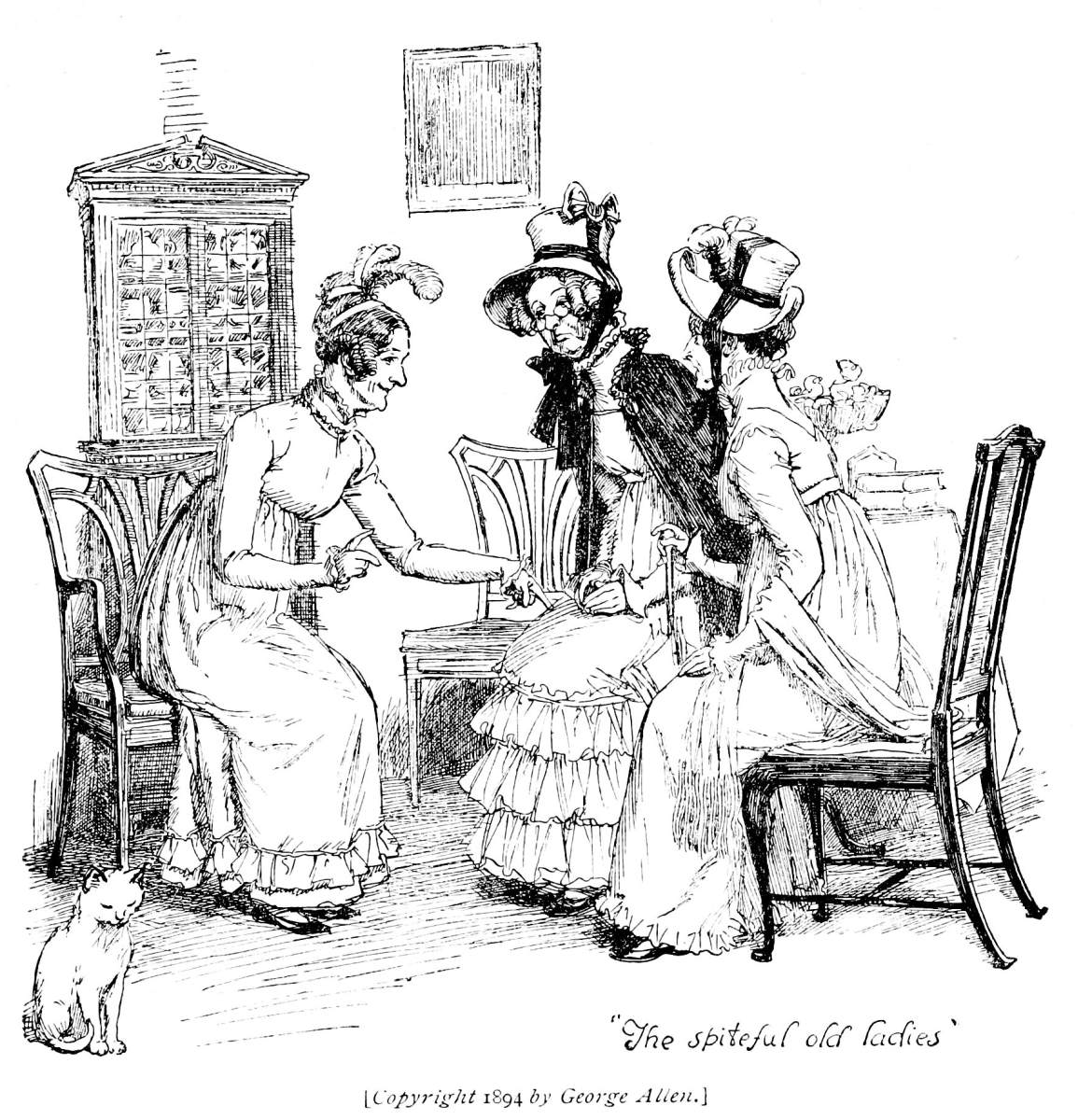
The good news quickly spread through the house; and with proportionate speed through the neighbourhood. It was borne in the latter with decent philosophy. To be sure, it would have been more for the advantage of conversation, had Miss Lydia Bennet come upon the town; or, as the happiest alternative, been secluded from the world in some distant farm-house. But there was much to be talked of, in marrying her; and the good-natured wishes for her well-doing, which had proceeded before from all the spiteful old ladies in Meryton, lost but little of their spirit in this change of circumstances, because with such a husband her misery was considered certain.
The good news spread quickly through the house, and just as quickly through the neighbourhood. The neighbours accepted it with reasonable calm. Of course, there would have been more to gossip about if Miss Lydia Bennet had become a prostitute. Or, best of all, if she had been shut away from the world in some distant farmhouse. But her marriage still gave them plenty to discuss. All the spiteful old ladies in Meryton had previously expressed kind wishes for her future happiness. Those wishes lost little of their spirit now that her circumstances had changed, because everyone thought such a husband guaranteed misery.
It was a fortnight since Mrs. Bennet had been down stairs, but on this happy day she again took her seat at the head of her table, and in spirits oppressively high. No sentiment of shame gave a damp to her triumph. The marriage of a daughter, which had been the first object of her wishes since Jane was sixteen, was now on the point of accomplishment, and her thoughts and her words ran wholly on those attendants of elegant nuptials, fine muslins, new carriages, and servants. She was busily searching through the neighbourhood for a proper situation for her daughter; and, without knowing or considering what their income might be, rejected many as deficient in size and importance.
Mrs. Bennet had not been downstairs for two weeks. But on this happy day, she again sat at the head of her table, in unbearably high spirits. No sense of shame dampened her triumph. Since Jane was sixteen, her greatest wish had been to see one of her daughters married. Now that wish was about to come true. She thought and talked only of the trappings of an elegant wedding: fine muslin dresses, new carriages, and servants. She was busily searching the neighbourhood for a suitable home for her daughter. Without knowing or considering what the couple’s income might be, she rejected many houses as too small and unimpressive.
“Haye Park might do,” said she, “if the Gouldings would quit it, or the great house at Stoke, if the drawing-room were larger; but Ashworth is too far off. I could not bear to have her ten miles from me; and as for Purvis Lodge, the attics are dreadful.”
“Haye Park might work,” she said, “if the Gouldings would move out. Or the large house at Stoke, if the living room were bigger. But Ashworth is too far away. I couldn’t bear to have her ten miles from me. And as for Purvis Lodge, the attic rooms are dreadful.”
Her husband allowed her to talk on without interruption while the servants remained. But when they had withdrawn, he said to her, “Mrs. Bennet, before you take any, or all of these houses, for your son and daughter, let us come to a right understanding. Into one house in this neighbourhood they shall never have admittance. I will not encourage the imprudence of either, by receiving them at Longbourn.”
Her husband let her talk without interruption while the servants were still there. But when the servants had left, he said to her, “Mrs. Bennet, before you rent any or all of these houses for your son and daughter, let us be clear. There is one house in this neighbourhood where they will never be welcome. I will not encourage either of them in their recklessness by welcoming them at Longbourn.”
A long dispute followed this declaration; but Mr. Bennet was firm: it soon led to another; and Mrs. Bennet found, with amazement and horror, that her husband would not advance a guinea to buy clothes for his daughter. He protested that she should receive from him no mark of affection whatever on the occasion. Mrs. Bennet could hardly comprehend it. That his anger could be carried to such a point of inconceivable resentment as to refuse his daughter a privilege, without which her marriage would scarcely seem valid, exceeded all that she could believe possible. She was more alive to the disgrace, which her want of new clothes must reflect on her daughter’s nuptials, than to any sense of shame at her eloping and living with Wickham a fortnight before they took place.
A long argument followed this declaration, but Mr. Bennet stood firm. The argument soon led to another. To Mrs. Bennet’s amazement and horror, her husband would not give a single guinea to buy clothes for his daughter. He insisted that he would give his daughter no sign of affection at all on this occasion. Mrs. Bennet could hardly understand his refusal. She could not believe his anger and resentment could go so far. He was denying his daughter new clothes, a privilege without which her marriage would hardly seem valid. Mrs. Bennet cared more about the disgrace that a lack of new clothes would bring on her daughter’s wedding. She felt less shame about her daughter running away and living with Wickham for two weeks before the wedding.
Elizabeth was now most heartily sorry that she had, from the distress of the moment, been led to make Mr. Darcy acquainted with their fears for her sister; for since her marriage would so shortly give the proper termination to the elopement, they might hope to conceal its unfavourable beginning from all those who were not immediately on the spot.
Elizabeth now deeply regretted telling Mr. Darcy about their fears for her sister in a moment of distress. Her sister’s marriage would soon bring the elopement to a proper conclusion. Because of this, they could hope to hide its disgraceful beginning from everyone who had not been there.
She had no fear of its spreading farther, through his means. There were few people on whose secrecy she would have more confidently depended; but at the same time there was no one whose knowledge of a sister’s frailty would have mortified her so much. Not, however, from any fear of disadvantage from it individually to herself; for at any rate there seemed a gulf impassable between them. Had Lydia’s marriage been concluded on the most honourable terms, it was not to be supposed that Mr. Darcy would connect himself with a family, where to every other objection would now be added an alliance and relationship of the nearest kind with the man whom he so justly scorned.
She had no fear that he would spread the news any further. There were few people she would have trusted more to keep a secret. But no one else’s knowledge of her sister’s disgrace would have embarrassed her so deeply. This was not because she feared any harm to her own prospects. In any case, the gap between them seemed impossible to cross. Even if Lydia’s marriage had been arranged on the most honorable terms, Mr. Darcy could hardly be expected to join her family. Besides all his other objections, he would now become closely related by marriage to the man he so rightly despised.
From such a connection she could not wonder that he should shrink. The wish of procuring her regard, which she had assured herself of his feeling in Derbyshire, could not in rational expectation survive such a blow as this. She was humbled, she was grieved; she repented, though she hardly knew of what. She became jealous of his esteem, when she could no longer hope to be benefited by it. She wanted to hear of him, when there seemed the least chance of gaining intelligence. She was convinced that she could have been happy with him, when it was no longer likely they should meet.
She could not be surprised that he would pull away from such a family connection. In Derbyshire, she had felt certain he wanted to win her affection. She could not reasonably expect that desire to survive such a blow. She felt humbled and sad. She regretted what she had done, though she hardly knew what she regretted. She grew anxious to keep his respect when she could no longer hope to benefit from it. She wanted news of him when there seemed the least chance of getting any. She was convinced she could have been happy with him when they were no longer likely to meet.
What a triumph for him, as she often thought, could he know that the proposals which she had proudly spurned only four months ago would now have been gladly and gratefully received! He was as generous, she doubted not, as the most generous of his sex. But while he was mortal, there must be a triumph.
What a triumph it would be for him, she often thought, if he knew! The marriage proposals she had proudly rejected only four months ago would now be gladly and gratefully accepted! She had no doubt he was as generous as any man could be. But he was only human, so he would have to feel some triumph.
She began now to comprehend that he was exactly the man who, in disposition and talents, would most suit her. His understanding and temper, though unlike her own, would have answered all her wishes. It was an union that must have been to the advantage of both: by her ease and liveliness, his mind might have been softened, his manners improved; and from his judgment, information, and knowledge of the world, she must have received benefit of greater importance.
She now began to understand that his personality and talents made him exactly the right man for her. Although his mind and temperament differed from hers, they would have met all her wishes. A marriage between them would surely have benefited them both. Her relaxed, lively nature might have softened his outlook and improved his manners. And his good judgment, knowledge, and experience of the world would have benefited her in even more important ways.
But no such happy marriage could now teach the admiring multitude what connubial felicity really was. An union of a different tendency, and precluding the possibility of the other, was soon to be formed in their family.
But no such happy marriage could now show the admiring crowds what true happiness in marriage was. A very different kind of marriage would soon take place in their family, making the happy marriage impossible.
How Wickham and Lydia were to be supported in tolerable independence she could not imagine. But how little of permanent happiness could belong to a couple who were only brought together because their passions were stronger than their virtue, she could easily conjecture.
She could not imagine how Wickham and Lydia would afford to live reasonably independently. But she could easily guess how little lasting happiness such a couple could have. They had come together only because their passions were stronger than their sense of right and wrong.
Mr. Gardiner soon wrote again to his brother. To Mr. Bennet’s acknowledgments he briefly replied, with assurances of his eagerness to promote the welfare of any of his family; and concluded with entreaties that the subject might never be mentioned to him again. The principal purport of his letter was to inform them, that Mr. Wickham had resolved on quitting the militia.
Mr. Gardiner soon wrote again to his brother. He briefly responded to Mr. Bennet’s thanks, assuring him that he was eager to help anyone in his family. He ended his reply by urging Mr. Bennet never to mention the subject to him again. The letter’s main purpose was to tell them that Mr. Wickham had decided to leave the militia.
“It was greatly my wish that he should do so,” he added, “as soon as his marriage was fixed on. And I think you will agree with me, in considering a removal from that corps as highly advisable, both on his account and my niece’s. It is Mr. Wickham’s intention to go into the Regulars; and, among his former friends, there are still some who are able and willing to assist him in the army. He has the promise of an ensigncy in General——’s regiment, now quartered in the north. It is an advantage to have it so far from this part of the kingdom. He promises fairly; and I hope among different people, where they may each have a character to preserve, they will both be more prudent. I have written to Colonel Forster, to inform him of our present arrangements, and to request that he will satisfy the various creditors of Mr. Wickham in and near Brighton with assurances of speedy payment, for which I have pledged myself. And will you give yourself the trouble of carrying similar assurances to his creditors in Meryton, of whom I shall subjoin a list, according to his information? He has given in all his debts; I hope at least he has not deceived us. Haggerston has our directions, and all will be completed in a week. They will then join his regiment, unless they are first invited to Longbourn; and I understand from Mrs. Gardiner that my niece is very desirous of seeing you all before she leaves the south. She is well, and begs to be dutifully remembered to you and her mother.—Yours, etc.
“I very much wanted him to do so,” he added, “as soon as his marriage was settled. And I think you will agree that leaving his current corps is highly advisable, both for him and my niece. Mr. Wickham intends to join the Regulars, the regular army. Some of his former friends are still able and willing to help him in his military career. He has been promised an ensign’s commission in General ——’s regiment, now stationed in the north. Being so far from this part of the country is an advantage. His promises sound good. And I hope they will both behave more sensibly among new people, where each will have a reputation to maintain. I have written to Colonel Forster to tell him about our current arrangements. I have also asked him to reassure Mr. Wickham’s various creditors in and near Brighton that they will be paid soon. I have personally guaranteed their payment. And would you take the trouble to give the same assurances to his creditors in Meryton? I will add a list of those creditors, based on the information he has provided. He has listed all his debts. At least, I hope he has not deceived us. Haggerston has our instructions, and everything will be completed within a week. The couple will then join his regiment, unless they are first invited to Longbourn. And Mrs. Gardiner tells me my niece is very eager to see you all before she leaves the south. She is well and asks you to pass on her dutiful regards to you and her mother. Yours, etc.
“E. Gardiner.”
“E. Gardiner.”
Mr. Bennet and his daughters saw all the advantages of Wickham’s removal from the ——shire, as clearly as Mr. Gardiner could do. But Mrs. Bennet was not so well pleased with it. Lydia’s being settled in the north, just when she had expected most pleasure and pride in her company, for she had by no means given up her plan of their residing in Hertfordshire, was a severe disappointment; and, besides, it was such a pity that Lydia should be taken from a regiment where she was acquainted with everybody, and had so many favourites.
Mr. Bennet and his daughters saw all the advantages of Wickham’s leaving the ___shire regiment, just as clearly as Mr. Gardiner. But Mrs. Bennet was less pleased with the move. Lydia would be settling in the north, just when her mother had expected the most pleasure and pride from her company. Mrs. Bennet had by no means abandoned her plan for the couple to live in Hertfordshire. So Lydia’s move was a bitter disappointment. Besides, it was such a pity for Lydia to leave a regiment where she knew everybody and had so many favourites.
“She is so fond of Mrs. Forster,” said she, “it will be quite shocking to send her away! And there are several of the young men, too, that she likes very much. The officers may not be so pleasant in General——’s regiment.”
“She is so fond of Mrs. Forster,” she said. “It will be quite terrible to send her away! And she likes several of the young men very much, too. The officers in General _____’s regiment may not be as pleasant.”
His daughter’s request, for such it might be considered, of being admitted into her family again, before she set off for the north, received at first an absolute negative. But Jane and Elizabeth, who agreed in wishing, for the sake of their sister’s feelings and consequence, that she should be noticed on her marriage by her parents, urged him so earnestly, yet so rationally and so mildly, to receive her and her husband at Longbourn, as soon as they were married, that he was prevailed on to think as they thought, and act as they wished. And their mother had the satisfaction of knowing, that she should be able to show her married daughter in the neighbourhood, before she was banished to the north. When Mr. Bennet wrote again to his brother, therefore, he sent his permission for them to come; and it was settled, that, as soon as the ceremony was over, they should proceed to Longbourn. Elizabeth was surprised, however, that Wickham should consent to such a scheme; and, had she consulted only her own inclination, any meeting with him would have been the last object of her wishes.
At first, Mr. Bennet flatly refused his daughter’s request to return to her family before leaving for the north. At least, her wish could be considered a request. But Jane and Elizabeth both wanted their parents to acknowledge their sister’s marriage, for her feelings and social standing. They urged him to welcome her and her husband to Longbourn as soon as they were married. Their arguments were so earnest, reasonable, and gentle that he came to agree with them and do as they wished. Their mother had the satisfaction of knowing she could show off her married daughter in the neighbourhood. She would have the chance before her daughter was banished to the north. So when Mr. Bennet next wrote to his brother, he gave the couple permission to come. It was settled that they would go to Longbourn as soon as the ceremony was over. Elizabeth was surprised, however, that Wickham would agree to such a plan. If she had followed only her own wishes, meeting him would have been the last thing she wanted.