Chapter 42
HAD Elizabeth’s opinion been all drawn from her own family, she could not have formed a very pleasing picture of conjugal felicity or domestic comfort. Her father, captivated by youth and beauty, and that appearance of good-humour which youth and beauty generally give, had married a woman whose weak understanding and illiberal mind had very early in their marriage put an end to all real affection for her. Respect, esteem, and confidence had vanished for ever; and all his views of domestic happiness were overthrown. But Mr. Bennet was not of a disposition to seek comfort for the disappointment which his own imprudence had brought on in any of those pleasures which too often console the unfortunate for their folly or their vice. He was fond of the country and of books; and from these tastes had arisen his principal enjoyments. To his wife he was very little otherwise indebted than as her ignorance and folly had contributed to his amusement. This is not the sort of happiness which a man would in general wish to owe to his wife; but where other powers of entertainment are wanting, the true philosopher will derive benefit from such as are given.
If Elizabeth had judged marriage entirely by her own family, she could not have pictured much happiness or comfort at home. Her father had been captivated by youth, beauty, and the apparent good nature that youth and beauty generally suggest. But he had married a woman whose limited intelligence and narrow mind soon ended all his real affection for her. Respect, esteem, and trust had vanished forever, and all his hopes of happiness at home had collapsed. His own poor judgment had brought him this disappointment. But Mr. Bennet was not inclined to seek comfort in pleasures that too often console people for their foolishness or wrongdoing. He loved the countryside and books, and these interests provided his main pleasures. He owed little else to his wife beyond the amusement her ignorance and foolishness gave him. This is not the kind of happiness a man would generally wish to owe to his wife. But when other sources of entertainment are lacking, a true philosopher will make the most of those he has.
Elizabeth, however, had never been blind to the impropriety of her father’s behaviour as a husband. She had always seen it with pain; but respecting his abilities, and grateful for his affectionate treatment of herself, she endeavoured to forget what she could not overlook, and to banish from her thoughts that continual breach of conjugal obligation and decorum which, in exposing his wife to the contempt of her own children, was so highly reprehensible. But she had never felt so strongly as now the disadvantages which must attend the children of so unsuitable a marriage, nor ever been so fully aware of the evils arising from so ill-judged a direction of talents—talents which, rightly used, might at least have preserved the respectability of his daughters, even if incapable of enlarging the mind of his wife.
Elizabeth, however, had never failed to see how improperly her father behaved as a husband. His behavior had always pained her. But she respected his intelligence and was grateful for his affection toward her. So she tried to forget what she could not ignore. She tried not to think about his constant failure to meet his duties as a husband and behave with decency. By making his wife an object of contempt to her own children, he behaved in a deeply blameworthy way. But never before had Elizabeth felt so strongly the disadvantages children must suffer from such an unsuitable marriage. Nor had she fully understood the harm caused by her father’s poor use of his talents. Used properly, those talents might at least have protected his daughters’ respectability, even if they could not broaden his wife’s mind.
When Elizabeth had rejoiced over Wickham’s departure, she found little other cause for satisfaction in the loss of the regiment. Their parties abroad were less varied than before; and at home she had a mother and sister, whose constant repinings at the dulness of everything around them threw a real gloom over their domestic circle; and, though Kitty might in time regain her natural degree of sense, since the disturbers of her brain were removed, her other sister, from whose disposition greater evil might be apprehended, was likely to be hardened in all her folly and assurance, by a situation of such double danger as a watering-place and a camp. Upon the whole, therefore, she found, what has been sometimes found before, that an event to which she had looked forward with impatient desire, did not, in taking place, bring all the satisfaction she had promised herself. It was consequently necessary to name some other period for the commencement of actual felicity; to have some other point on which her wishes and hopes might be fixed, and by again enjoying the pleasure of anticipation, console herself for the present, and prepare for another disappointment. Her tour to the Lakes was now the object of her happiest thoughts: it was her best consolation for all the uncomfortable hours which the discontentedness of her mother and Kitty made inevitable; and could she have included Jane in the scheme, every part of it would have been perfect.
Once Elizabeth had celebrated Wickham’s departure, she found little else to be pleased about in the regiment’s leaving. Their outings were less varied than before. At home, her mother and sister constantly complained about how dull everything was, casting a real gloom over the family. Still, Kitty might eventually recover her usual good sense, now that those who had unsettled her mind were gone. Her other sister’s character, however, gave greater cause for concern. Staying somewhere with the double dangers of a seaside resort and a military camp would probably reinforce her foolishness and overconfidence. So Elizabeth discovered, as others sometimes have, that something eagerly awaited did not bring all the happiness she had expected. She therefore had to choose another time when true happiness would begin, another goal for her hopes and wishes. Once again, the pleasure of looking forward to something would comfort her in the present and prepare her for another disappointment. Her trip to the Lakes now filled her happiest thoughts. The trip was her greatest comfort through all the unpleasant hours her mother’s and Kitty’s discontent made unavoidable. If she could have included Jane in the plans, every part of the trip would have been perfect.
“But it is fortunate,” thought she, “that I have something to wish for. Were the whole arrangement complete, my disappointment would be certain. But here, by carrying with me one ceaseless source of regret in my sister’s absence, I may reasonably hope to have all my expectations of pleasure realized. A scheme of which every part promises delight can never be successful; and general disappointment is only warded off by the defence of some little peculiar vexation.”
“But it’s lucky,” she thought, “that I still have something to wish for. If the whole plan were perfect, I would be certain to be disappointed. But as things stand, my sister’s absence will give me one constant source of regret. So I may reasonably hope to enjoy everything else as much as I expect. A plan that promises pleasure in every detail can never succeed. And only some small, particular annoyance can protect us from disappointment with the whole.”
When Lydia went away she promised to write very often and very minutely to her mother and Kitty; but her letters were always long expected, and always very short. Those to her mother contained little else than that they were just returned from the library, where such and such officers had attended them, and where she had seen such beautiful ornaments as made her quite wild; that she had a new gown, or a new parasol, which she would have described more fully, but was obliged to leave off in a violent hurry, as Mrs. Forster called her, and they were going to the camp; and from her correspondence with her sister there was still less to be learnt, for her letters to Kitty, though rather longer, were much too full of lines under the words to be made public.
When Lydia left, she promised to write to her mother and Kitty very often and in great detail. But her letters were always long awaited and always very short. Her letters to her mother contained little beyond news that they had just returned from the library. She would mention which officers had accompanied them and the beautiful accessories she had seen there, which drove her wild. She would report getting a new dress or parasol, which she would have described in more detail. But she had to stop writing in a great hurry, because Mrs. Forster was calling her to visit the camp. Even less could be learned from her letters to her sister. Although her letters to Kitty were rather longer, far too many words were underlined for the letters to be shared.
After the first fortnight or three weeks of her absence, health, good-humour, and cheerfulness began to reappear at Longbourn. Everything wore a happier aspect. The families who had been in town for the winter came back again, and summer finery and summer engagements arose. Mrs. Bennet was restored to her usual querulous serenity; and by the middle of June Kitty was so much recovered as to be able to enter Meryton without tears,—an event of such happy promise as to make Elizabeth hope, that by the following Christmas she might be so tolerably reasonable as not to mention an officer above once a day, unless, by some cruel and malicious arrangement at the War Office, another regiment should be quartered in Meryton.
After the first two or three weeks of her absence, health, good spirits, and cheerfulness began returning to Longbourn. Everything seemed happier. The families who had spent the winter in town returned, bringing summer fashions and summer social plans. Mrs. Bennet returned to her usual state of complaining contentment. By the middle of June, Kitty had recovered enough to enter Meryton without crying. This was such a promising development that Elizabeth began to hope for further improvement by the following Christmas. Perhaps Kitty might then be reasonable enough to mention an officer no more than once a day. That was unless the War Office, through some cruel and malicious arrangement, stationed another regiment in Meryton.
The time fixed for the beginning of their northern tour was now fast approaching; and a fortnight only was wanting of it, when a letter arrived from Mrs. Gardiner, which at once delayed its commencement and curtailed its extent. Mr. Gardiner would be prevented by business from setting out till a fortnight later in July, and must be in London again within a month; and as that left too short a period for them to go so far, and see so much as they had proposed, or at least to see it with the leisure and comfort they had built on, they were obliged to give up the Lakes, and substitute a more contracted tour; and, according to the present plan, were to go no farther northward than Derbyshire. In that county there was enough to be seen to occupy the chief of their three weeks; and to Mrs. Gardiner it had a peculiarly strong attraction. The town where she had formerly passed some years of her life, and where they were now to spend a few days, was probably as great an object of her curiosity as all the celebrated beauties of Matlock, Chatsworth, Dovedale, or the Peak.
The planned start of their northern tour was fast approaching. Only two weeks remained when a letter arrived from Mrs. Gardiner, delaying their departure and shortening their route. Business would prevent Mr. Gardiner from leaving until two weeks later in July. He also had to return to London within a month. This left too little time to travel so far and see as much as they had planned. At least, they could not do so with the leisure and comfort they had counted on. So they had to give up the Lakes and settle for a shorter tour. Their new plan would take them no farther north than Derbyshire. That county offered enough to see to fill most of their three weeks. For Mrs. Gardiner, it held a particularly strong attraction. She had once spent several years in a town there, where they now planned to stay for a few days. She was probably as eager to revisit that town as to see all the famous beauties of Matlock, Chatsworth, Dovedale, or the Peak.
Elizabeth was excessively disappointed: she had set her heart on seeing the Lakes; and still thought there might have been time enough. But it was her business to be satisfied—and certainly her temper to be happy; and all was soon right again.
Elizabeth was terribly disappointed. She had set her heart on seeing the Lakes and still thought there might have been enough time. But she had to make the best of things, and she was naturally cheerful. So everything was soon right again.
With the mention of Derbyshire, there were many ideas connected. It was impossible for her to see the word without thinking of Pemberley and its owner. “But surely,” said she, “I may enter his county with impunity, and rob it of a few petrified spars, without his perceiving me.”
The mention of Derbyshire brought many thoughts to mind. She could not see the word without thinking of Pemberley and its owner. “But surely,” she said, “I can safely enter his county and rob it of a few mineral crystals without him noticing me.”
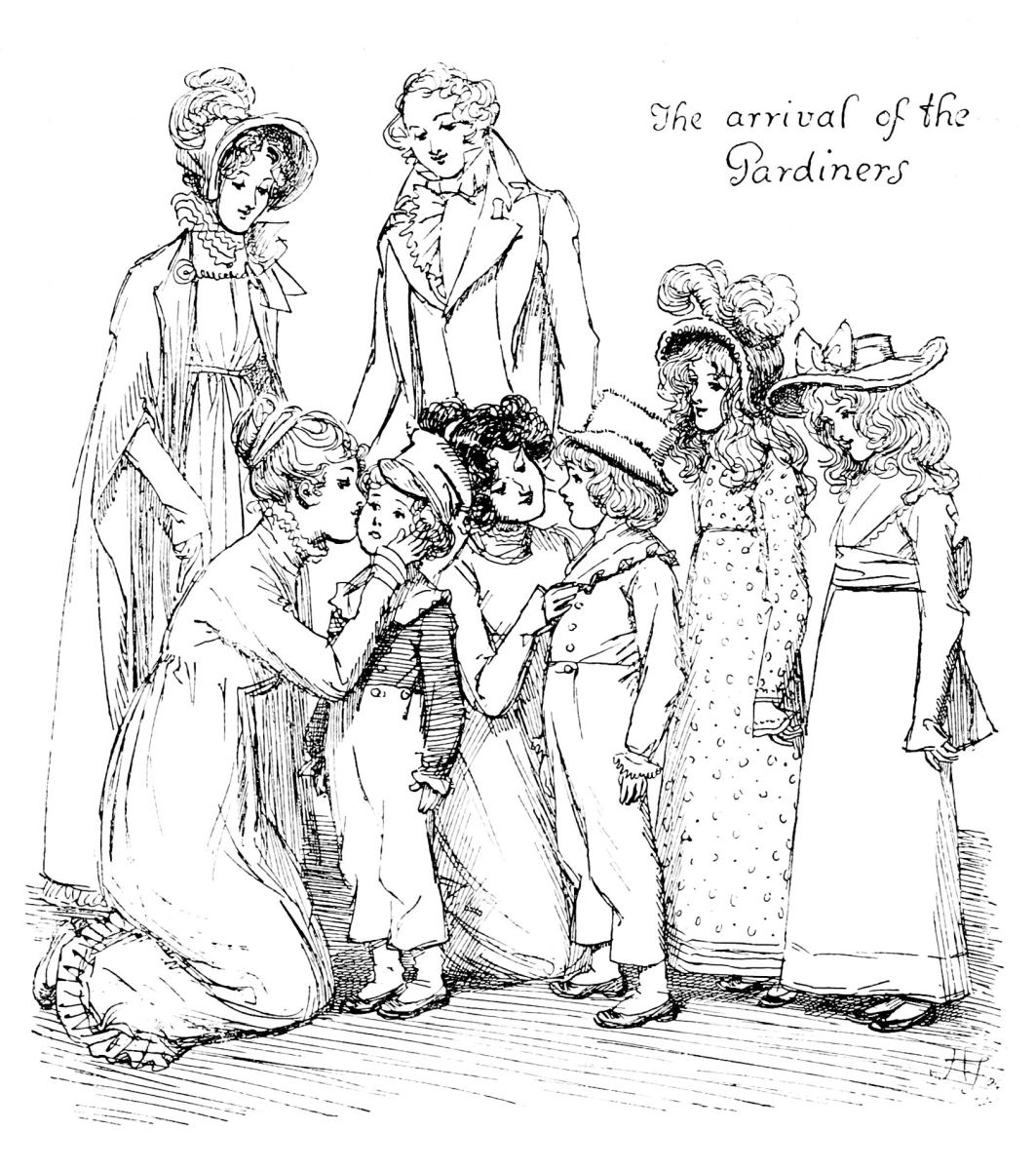
The period of expectation was now doubled. Four weeks were to pass away before her uncle and aunt’s arrival. But they did pass away, and Mr. and Mrs. Gardiner, with their four children, did at length appear at Longbourn. The children, two girls of six and eight years old, and two younger boys, were to be left under the particular care of their cousin Jane, who was the general favourite, and whose steady sense and sweetness of temper exactly adapted her for attending to them in every way—teaching them, playing with them, and loving them.
The wait was now twice as long. Four weeks had to pass before her uncle and aunt arrived. But the weeks did pass, and Mr. and Mrs. Gardiner finally arrived at Longbourn with their four children. The children were two girls, aged six and eight, and two younger boys. They were to be left in the special care of their cousin Jane, who was everyone’s favourite. Her good sense and gentle nature made her perfectly suited to caring for them in every way. She would teach them, play with them, and love them.
The Gardiners stayed only one night at Longbourn, and set off the next morning with Elizabeth in pursuit of novelty and amusement. One enjoyment was certain—that of suitableness as companions; a suitableness which comprehended health and temper to bear inconveniences—cheerfulness to enhance every pleasure—and affection and intelligence, which might supply it among themselves if there were disappointments abroad.
The Gardiners stayed only one night at Longbourn. The next morning, they set off with Elizabeth in search of new sights and amusement. One pleasure was certain: they were well suited to each other as travelling companions. They had the health and patience to cope with inconveniences, and the cheerfulness to make every pleasure greater. Their affection and intelligence might provide enjoyment among themselves if the world outside disappointed them.
It is not the object of this work to give a description of Derbyshire, nor of any of the remarkable places through which their route thither lay—Oxford, Blenheim, Warwick, Kenilworth, Birmingham, etc., are sufficiently known. A small part of Derbyshire is all the present concern. To the little town of Lambton, the scene of Mrs. Gardiner’s former residence, and where she had lately learned that some acquaintance still remained, they bent their steps, after having seen all the principal wonders of the country; and within five miles of Lambton, Elizabeth found, from her aunt, that Pemberley was situated. It was not in their direct road; nor more than a mile or two out of it. In talking over their route the evening before, Mrs. Gardiner expressed an inclination to see the place again. Mr. Gardiner declared his willingness, and Elizabeth was applied to for her approbation.
This book does not aim to describe Derbyshire or any of the remarkable places along their route there. Oxford, Blenheim, Warwick, Kenilworth, Birmingham, and the rest are well known enough. Only a small part of Derbyshire concerns us here. After seeing all the region’s main attractions, the group headed for the little town of Lambton. Mrs. Gardiner had once lived there and had recently learned that some of her acquaintances still remained. Elizabeth learned from her aunt that Pemberley was within five miles of Lambton. Pemberley was not directly on their route, but only a mile or two out of the way. While discussing their route the evening before, Mrs. Gardiner had said she would like to see the place again. Mr. Gardiner said he was willing to go, and Elizabeth was asked whether she approved.
“My love, should not you like to see a place of which you have heard so much?” said her aunt. “A place, too, with which so many of your acquaintance are connected. Wickham passed all his youth there, you know.”
“My love, wouldn’t you like to see a place you’ve heard so much about?” said her aunt. “A place connected to so many people you know, too. Wickham spent his whole youth there, you know.”
Elizabeth was distressed. She felt that she had no business at Pemberley, and was obliged to assume a disinclination for seeing it. She must own that she was tired of great houses: after going over so many, she really had no pleasure in fine carpets or satin curtains.
Elizabeth was upset. She felt she had no business at Pemberley, so she had to pretend she did not want to visit. She had to admit she was tired of grand houses. After touring so many, she really took no pleasure in fine carpets or satin curtains.
Mrs. Gardiner abused her stupidity. “If it were merely a fine house richly furnished,” said she, “I should not care about it myself; but the grounds are delightful. They have some of the finest woods in the country.”
Mrs. Gardiner scolded her for being foolish. “If it were just a grand house with expensive furnishings,” she said, “I wouldn’t care about it myself. But the grounds are beautiful. They have some of the finest woods in the country.”
Elizabeth said no more; but her mind could not acquiesce. The possibility of meeting Mr. Darcy, while viewing the place, instantly occurred. It would be dreadful! She blushed at the very idea; and thought it would be better to speak openly to her aunt, than to run such a risk. But against this there were objections; and she finally resolved that it could be the last resource, if her private inquiries as to the absence of the family were unfavourably answered.
Elizabeth said no more, but she could not accept the idea. She immediately realized she might meet Mr. Darcy while touring the place. That would be dreadful! She blushed at the very thought. She felt it would be better to speak openly to her aunt than to take such a risk. But there were reasons against speaking openly, and she finally decided to do so only as a last resort. First, she would ask privately whether the family was away. If the answer was not what she hoped, she could speak to her aunt.
Accordingly, when she retired at night, she asked the chambermaid whether Pemberley were not a very fine place, what was the name of its proprietor, and, with no little alarm, whether the family were down for the summer? A most welcome negative followed the last question; and her alarms being now removed, she was at leisure to feel a great deal of curiosity to see the house herself; and when the subject was revived the next morning, and she was again applied to, could readily answer, and with a proper air of indifference, that she had not really any dislike to the scheme.
So, when she went to bed that night, she asked the chambermaid whether Pemberley was a very fine place. She also asked who owned it and, with considerable anxiety, whether the family was staying there for the summer. To her great relief, the answer to the last question was no. With her fears gone, she was free to feel very curious about seeing the house herself. When the subject came up again the next morning, she was once more asked for her opinion. She could readily say, with a suitably indifferent air, that she had no real objection to the plan.
To Pemberley, therefore, they were to go.
So they were going to Pemberley.