Chapter 33
MORE than once did Elizabeth, in her ramble within the park, unexpectedly meet Mr. Darcy. She felt all the perverseness of the mischance that should bring him where no one else was brought; and, to prevent its ever happening again, took care to inform him, at first, that it was a favourite haunt of hers. How it could occur a second time, therefore, was very odd! Yet it did, and even the third. It seemed like wilful ill-nature, or a voluntary penance; for on these occasions it was not merely a few formal inquiries and an awkward pause and then away, but he actually thought it necessary to turn back and walk with her. He never said a great deal, nor did she give herself the trouble of talking or of listening much; but it struck her in the course of their third encounter that he was asking some odd unconnected questions—about her pleasure in being at Hunsford, her love of solitary walks, and her opinion of Mr. and Mrs. Collins’s happiness; and that in speaking of Rosings, and her not perfectly understanding the house, he seemed to expect that whenever she came into Kent again she would be staying there too. His words seemed to imply it. Could he have Colonel Fitzwilliam in his thoughts? She supposed, if he meant anything, he must mean an allusion to what might arise in that quarter. It distressed her a little, and she was quite glad to find herself at the gate in the pales opposite the Parsonage.
More than once, Elizabeth unexpectedly met Mr. Darcy while walking in the park. She felt all the frustration of such perverse luck, bringing him where she met no one else. To prevent another meeting, she made sure to tell him at once that she often walked there. How very odd, then, that they should meet a second time! Yet they did, and even a third. It seemed like deliberate unkindness, or a punishment he chose to inflict on himself. For these meetings were not simply a few polite questions, an awkward pause, and then a goodbye. He actually thought he had to turn back and walk with her. He never said very much, and she did not trouble herself to talk or listen much either. But during their third meeting, she noticed that he was asking some odd, unrelated questions. He asked how much she enjoyed Hunsford, how fond she was of solitary walks, and how happy she thought Mr. and Mrs. Collins were. He also spoke of Rosings and her not knowing the house well. He seemed to expect that whenever she returned to Kent, she would be staying there too. His words seemed to suggest as much. Could he be thinking of Colonel Fitzwilliam? She supposed that, if Darcy meant anything, he must be hinting at what might develop between her and the Colonel. The thought troubled her a little. She was quite glad to reach the gate in the fence opposite the Parsonage.
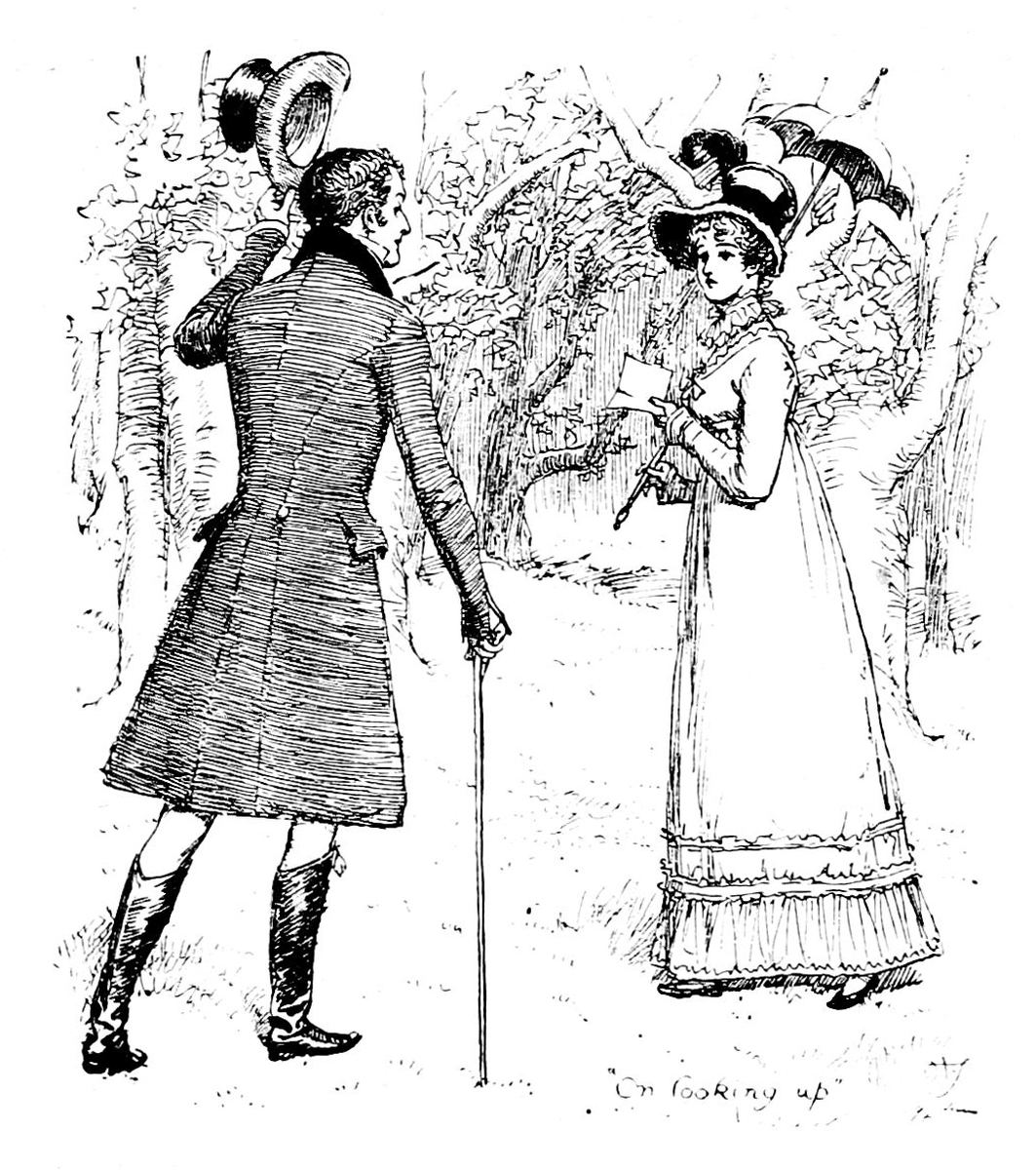
She was engaged one day, as she walked, in re-perusing Jane’s last letter, and dwelling on some passages which proved that Jane had not written in spirits, when, instead of being again surprised by Mr. Darcy, she saw, on looking up, that Colonel Fitzwilliam was meeting her. Putting away the letter immediately, and forcing a smile, she said,—
One day, as she walked, she was rereading Jane’s last letter. She lingered over some passages that showed Jane had not been in good spirits when she wrote. Then she looked up and saw Colonel Fitzwilliam approaching, instead of being surprised again by Mr. Darcy. She immediately put the letter away, forced a smile, and said:
“I did not know before that you ever walked this way.”
“I didn’t know until now that you ever walked this way.”
“I have been making the tour of the park,” he replied, “as I generally do every year, and intended to close it with a call at the Parsonage. Are you going much farther?”
“I’ve been walking around the park,” he replied, “as I usually do every year. I planned to finish my walk with a visit to the Parsonage. Are you going much farther?”
“No, I should have turned in a moment.”
“No, I would have turned right away.”
And accordingly she did turn, and they walked towards the Parsonage together.
So she turned, and they walked toward the Parsonage together.
“Do you certainly leave Kent on Saturday?” said she.
“Are you definitely leaving Kent on Saturday?” she asked.
“Yes—if Darcy does not put it off again. But I am at his disposal. He arranges the business just as he pleases.”
“Yes, if Darcy doesn't put it off again. But I'm at his disposal. He makes the arrangements just as he pleases.”
“And if not able to please himself in the arrangement, he has at least great pleasure in the power of choice. I do not know anybody who seems more to enjoy the power of doing what he likes than Mr. Darcy.”
“And if the arrangement doesn't please him, he at least takes great pleasure in having the choice. I don't know anyone who seems to enjoy doing whatever he likes more than Mr. Darcy does.”
“He likes to have his own way very well,” replied Colonel Fitzwilliam. “But so we all do. It is only that he has better means of having it than many others, because he is rich, and many others are poor. I speak feelingly. A younger son, you know, must be inured to self-denial and dependence.”
“He certainly likes to have his own way,” replied Colonel Fitzwilliam. “But so do we all. He just has more means of getting his way than many others, because he is rich and they are poor. I speak from experience. A younger son, you know, must get used to going without and depending on others.”
“In my opinion, the younger son of an earl can know very little of either. Now, seriously, what have you ever known of self-denial and dependence? When have you been prevented by want of money from going wherever you chose or procuring anything you had a fancy for?”
“In my opinion, an earl’s younger son can know very little of either. Now, seriously, what have you ever known about going without things or depending on others? When has a lack of money ever stopped you from going wherever you wanted or buying anything you fancied?”
“These are home questions—and perhaps I cannot say that I have experienced many hardships of that nature. But in matters of greater weight, I may suffer from the want of money. Younger sons cannot marry where they like.”
“These are very personal questions, and perhaps I cannot say I have faced many hardships of that kind. But in more important matters, I may suffer from a lack of money. Younger sons cannot marry whoever they like.”
“Unless where they like women of fortune, which I think they very often do.”
“Unless they like wealthy women, which I think they very often do.”
“Our habits of expense make us too dependent, and there are not many in my rank of life who can afford to marry without some attention to money.”
“Our spending habits make us too dependent. And few people of my social standing can afford to marry without giving some thought to money.”
“Is this,” thought Elizabeth, “meant for me?” and she coloured at the idea; but, recovering herself, said in a lively tone, “And pray, what is the usual price of an earl’s younger son? Unless the elder brother is very sickly, I suppose you would not ask above fifty thousand pounds.”
“Is this,” Elizabeth thought, “meant for me?” She blushed at the idea. But she composed herself and said playfully, “And tell me, what is the usual price of an earl’s younger son? Unless his older brother is very sickly, I suppose you wouldn’t ask more than fifty thousand pounds.”
He answered her in the same style, and the subject dropped. To interrupt a silence which might make him fancy her affected with what had passed, she soon afterwards said,—
He answered in the same tone, and the subject was dropped. She wanted to break the silence, which might make him think she was upset by what had happened. So, soon afterwards, she said:
“I imagine your cousin brought you down with him chiefly for the sake of having somebody at his disposal. I wonder he does not marry, to secure a lasting convenience of that kind. But, perhaps, his sister does as well for the present; and, as she is under his sole care, he may do what he likes with her.”
“I imagine your cousin brought you along mainly to have someone at his beck and call. I’m surprised he doesn’t marry to make sure he always has someone to serve him. But perhaps his sister serves just as well for now. And since she is in his care alone, he can do whatever he likes with her.”
“No,” said Colonel Fitzwilliam, “that is an advantage which he must divide with me. I am joined with him in the guardianship of Miss Darcy.”
“No,” said Colonel Fitzwilliam, “he must share that advantage with me. I am also one of Miss Darcy’s guardians.”
“Are you, indeed? And pray what sort of a guardian do you make? Does your charge give you much trouble? Young ladies of her age are sometimes a little difficult to manage; and if she has the true Darcy spirit, she may like to have her own way.”
“Are you really? And tell me, what kind of guardian are you? Does the young lady in your care give you much trouble? Young ladies her age are sometimes a little hard to manage. And if she has the true Darcy spirit, she may like to have her own way.”
As she spoke, she observed him looking at her earnestly; and the manner in which he immediately asked her why she supposed Miss Darcy likely to give them any uneasiness, convinced her that she had somehow or other got pretty near the truth. She directly replied,—
As she spoke, she noticed him looking at her intently. He immediately asked why she thought Miss Darcy was likely to cause them any worry. The way he asked convinced her that she had somehow come quite close to the truth. She replied at once:
“You need not be frightened. I never heard any harm of her; and I dare say she is one of the most tractable creatures in the world. She is a very great favourite with some ladies of my acquaintance, Mrs. Hurst and Miss Bingley. I think I have heard you say that you know them.”
“You don’t need to be frightened. I’ve never heard anything bad about her. And I dare say she is one of the most easygoing people in the world. Some ladies I know, Mrs. Hurst and Miss Bingley, are very fond of her. I think I’ve heard you say that you know them.”
“I know them a little. Their brother is a pleasant, gentlemanlike man—he is a great friend of Darcy’s.”
“I know them a little. Their brother is a pleasant, well-mannered man. He is a close friend of Darcy’s.”
“Oh yes,” said Elizabeth drily—“Mr. Darcy is uncommonly kind to Mr. Bingley, and takes a prodigious deal of care of him.”
“Oh yes,” said Elizabeth dryly. “Mr. Darcy is unusually kind to Mr. Bingley and takes an enormous amount of care of him.”
“Care of him! Yes, I really believe Darcy does take care of him in those points where he most wants care. From something that he told me in our journey hither, I have reason to think Bingley very much indebted to him. But I ought to beg his pardon, for I have no right to suppose that Bingley was the person meant. It was all conjecture.”
“Take care of him! Yes, I really believe Darcy does take care of him where he most needs help. Something Darcy told me on our journey here gives me reason to think Bingley owes him a great deal. But I should ask Darcy’s pardon. I have no right to assume he meant Bingley. It was all guesswork.”
“What is it you mean?”
“What do you mean?”
“It is a circumstance which Darcy of course could not wish to be generally known, because if it were to get round to the lady’s family it would be an unpleasant thing.”
“Of course, Darcy would not want this to become widely known, because if the lady’s family heard, things would be unpleasant.”
“You may depend upon my not mentioning it.”
“You can count on me not to mention it.”
“And remember that I have not much reason for supposing it to be Bingley. What he told me was merely this: that he congratulated himself on having lately saved a friend from the inconveniences of a most imprudent marriage, but without mentioning names or any other particulars; and I only suspected it to be Bingley from believing him the kind of young man to get into a scrape of that sort, and from knowing them to have been together the whole of last summer.”
“And remember, I have little reason to think he meant Bingley. All he told me was that he was pleased with himself for recently saving a friend from a very unwise marriage. He mentioned no names or other details. I only suspected Bingley because I thought him the kind of young man to get into that sort of trouble. And I knew the two of them had spent the whole of last summer together.”
“Did Mr. Darcy give you his reasons for this interference?”
“Did Mr. Darcy tell you why he interfered?”
“I understood that there were some very strong objections against the lady.”
“I understood there were some very strong objections to the woman.”
“And what arts did he use to separate them?”
“And what tricks did he use to separate them?”
“He did not talk to me of his own arts,” said Fitzwilliam, smiling. “He only told me what I have now told you.”
“He didn’t tell me about his own tricks,” said Fitzwilliam, smiling. “He only told me what I’ve just told you.”
Elizabeth made no answer, and walked on, her heart swelling with indignation. After watching her a little, Fitzwilliam asked her why she was so thoughtful.
Elizabeth said nothing and walked on, her heart filling with anger. After watching her for a while, Fitzwilliam asked why she was so deep in thought.
“I am thinking of what you have been telling me,” said she. “Your cousin’s conduct does not suit my feelings. Why was he to be the judge?”
“I’m thinking about what you’ve been telling me,” she said. “I don’t like the way your cousin behaved. Why was it up to him to judge?”
“You are rather disposed to call his interference officious?”
“You’re rather inclined to see his interference as meddling?”
“I do not see what right Mr. Darcy had to decide on the propriety of his friend’s inclination; or why, upon his own judgment alone, he was to determine and direct in what manner that friend was to be happy. But,” she continued, recollecting herself, “as we know none of the particulars, it is not fair to condemn him. It is not to be supposed that there was much affection in the case.”
“I don’t see what right Mr. Darcy had to decide whether his friend’s feelings were appropriate. Or why his judgment alone should determine and direct how his friend was to find happiness. But,” she continued, collecting herself, “since we don’t know any of the details, it isn’t fair to condemn him. We shouldn’t assume there was much affection involved.”
“That is not an unnatural surmise,” said Fitzwilliam; “but it is lessening the honour of my cousin’s triumph very sadly.”
“That’s not an unreasonable guess,” said Fitzwilliam. “But it takes a great deal of the glory away from my cousin’s victory.”
This was spoken jestingly, but it appeared to her so just a picture of Mr. Darcy, that she would not trust herself with an answer; and, therefore, abruptly changing the conversation, talked on indifferent matters till they reached the Parsonage. There, shut into her own room, as soon as their visitor left them, she could think without interruption of all that she had heard. It was not to be supposed that any other people could be meant than those with whom she was connected. There could not exist in the world two men over whom Mr. Darcy could have such boundless influence. That he had been concerned in the measures taken to separate Mr. Bingley and Jane, she had never doubted; but she had always attributed to Miss Bingley the principal design and arrangement of them. If his own vanity, however, did not mislead him, he was the cause—his pride and caprice were the cause—of all that Jane had suffered, and still continued to suffer. He had ruined for a while every hope of happiness for the most affectionate, generous heart in the world; and no one could say how lasting an evil he might have inflicted.
The remark was a joke, but it seemed to her such an accurate picture of Mr. Darcy that she dared not answer. So she abruptly changed the subject and talked about ordinary things until they reached the Parsonage. As soon as their visitor left, she shut herself in her room. There she could think without interruption about all she had heard. The people mentioned could only be those she was connected with. There could not be two men in the world over whom Mr. Darcy had such unlimited influence. She had never doubted his part in the efforts to separate Mr. Bingley and Jane. But she had always thought Miss Bingley was chiefly responsible for planning and arranging the separation. If his own vanity had not misled him, however, he was responsible for all Jane had suffered and still suffered. His pride and his whims were the cause. For a time, he had destroyed every hope of happiness for the most loving, generous heart in the world. And no one could say how long the harm he had done might last.
“There were some very strong objections against the lady,” were Colonel Fitzwilliam’s words; and these strong objections probably were, her having one uncle who was a country attorney, and another who was in business in London.
“There were some very strong objections to the lady,” Colonel Fitzwilliam had said. These strong objections were probably that one of her uncles was a country lawyer, and another ran a business in London.
“To Jane herself,” she exclaimed, “there could be no possibility of objection,—all loveliness and goodness as she is! Her understanding excellent, her mind improved, and her manners captivating. Neither could anything be urged against my father, who, though with some peculiarities, has abilities which Mr. Darcy himself need not disdain, and respectability which he will probably never reach.” When she thought of her mother, indeed, her confidence gave way a little; but she would not allow that any objections there had material weight with Mr. Darcy, whose pride, she was convinced, would receive a deeper wound from the want of importance in his friend’s connections than from their want of sense; and she was quite decided, at last, that he had been partly governed by this worst kind of pride, and partly by the wish of retaining Mr. Bingley for his sister.
“No one could possibly object to Jane herself,” she exclaimed, “since she is all beauty and goodness! She is intelligent, well educated, and charming. Nor could anyone object to my father, though he has some quirks. His abilities are worthy of even Mr. Darcy’s respect. And Mr. Darcy will probably never equal him in respectability.” When she thought of her mother, her confidence did weaken a little. But she refused to believe that any objections there had carried much weight with Mr. Darcy. She was convinced that his pride would be hurt more by his friend’s connections lacking social importance than good sense. In the end, she was quite certain that this worst kind of pride had partly guided him. His wish to keep Mr. Bingley available for his sister had also played a part.
The agitation and tears which the subject occasioned brought on a headache; and it grew so much worse towards the evening that, added to her unwillingness to see Mr. Darcy, it determined her not to attend her cousins to Rosings, where they were engaged to drink tea. Mrs. Collins, seeing that she was really unwell, did not press her to go, and as much as possible prevented her husband from pressing her; but Mr. Collins could not conceal his apprehension of Lady Catherine’s being rather displeased by her staying at home.
The distress and tears caused by the subject gave her a headache, which grew much worse toward evening. This, along with her reluctance to see Mr. Darcy, made her decide not to join her cousins at Rosings. They had been invited there for tea. Mrs. Collins saw that she was truly unwell and did not urge her to go. She also did as much as she could to stop her husband from urging her. But Mr. Collins could not hide his worry that Lady Catherine would be rather displeased if she stayed home.