Chapter 3
Description of Keba
During the course of my education, my landlord frequently carried me about the town, and pointed out the most remarkable things. Keba is the town next in size and importance to the capital of the kingdom of Potu. The inhabitants are distinguished for their sedateness and moderation; old age is more respected by them than by any other community. They are strangely addicted to the pitting of animals against each other; or, as they call it, "play fight." I wondered that so moral a people could enjoy these brutal sports. My landlord noticed my surprise, and said, that throughout the kingdom it was the custom to vary their lives with a due mixture of earnest duties and amusing pleasures. Theatrical plays are very much in vogue with them. I was vexed, however, to hear that disputations are reckoned suitable for the stage, while with us they are confined to the universities.
During my education, my landlord often took me around town and pointed out the most remarkable sights. Keba is second only to the capital of the kingdom of Potu in size and importance. Its people are known for their calmness and moderation. They respect old age more than any other community does. They are strangely addicted to making animals fight each other, or, as they call it, "play fight." I wondered how such moral people could enjoy these brutal sports. My landlord noticed my surprise. He explained that throughout the kingdom, people balanced serious duties with enjoyable pleasures in their daily lives. Plays are very popular among them. I was annoyed, however, to hear that formal debates are thought suitable for the stage. Among us, such debates are confined to universities.
At certain times in the year, disputants are set against each other, as we pit dogs and game cocks. High bets are made in favor of one or the other, and a premium is given to the winner.
At certain times of year, debaters are pitted against each other, just as we pit dogs and fighting cocks. People place large bets on one side or the other, and the winner receives a prize.
Beside these disputants, who are called Masbakki, or boxers, various quadrupeds, wild as well as tame, are trained to fight as on our globe.
Besides these debaters, called Masbakki, or boxers, various four-legged animals, both wild and tame, are trained to fight. The same is done on our globe.
In this town a gymnasium is established, in which the liberal arts are taught with much success.
The town has a school where the liberal arts are taught very successfully.
My landlord carried me, on a high festival day, to this academy. On this occasion a Madic, or teacher in philosophy, was elected. The candidate made a very prosy speech on some philosophical question, after which, without farther ceremony, he was entered, by the administrators, on the list of the public teachers.
My landlord took me to this academy on a major festival day. On that occasion, a Madic, or philosophy teacher, was elected. The candidate gave a very dull speech on a philosophical question. Afterward, without further ceremony, the administrators added him to the list of public teachers.
On our way home from the academy, we met a criminal, led by three watchmen. By sentence of the kaki, he had been bled, and was now on his way to the city hospital. I inquired concerning his crime, and was answered, that he had publicly lectured on the being and qualities of God—a subject entirely forbidden in this country. Disputants on these matters are regarded as insane, and are always sent to the mad-house, where they are doctored, until they recover their sound reason. I exclaimed: Heaven and Earth! how would such laws operate on our globe, where thousands of priests quarrel every day about the divine attributes, the nature of spirits, and other secrets of the same character? Truly, here they would all be sent straight-way to the mad-house. These, among many other singular customs, I observed during my college life. Finally, the time came when, furnished with appropriate testimonies from the teachers, I was ordered to court. Here is my certificate. How angry and confused, was I, when I read it:—
On our way home from the academy, we met a criminal escorted by three watchmen. On the kaki’s orders, he had had blood drawn and was now on his way to the city hospital. I asked about his crime. I was told he had publicly lectured on God’s existence and qualities, a subject entirely forbidden in this country. People who debate these matters are regarded as insane and are always sent to the madhouse. There they receive treatment until they regain their sanity. I exclaimed: Heaven and Earth! How would such laws work on our globe? Thousands of priests there quarrel every day about God’s attributes, the nature of spirits, and other mysteries of that kind. Truly, here they would all be sent straight to the madhouse. These were among the many strange customs I observed during my college days. Finally, I received the necessary references from my teachers and was ordered to court. Here is my certificate. How angry and confused I was when I read it:
"In accordance with your royal order, we hereby send the animal, which sometime since came down to us from the firmament; which animal calls itself man. We have, with sedulous care and patient industry, taught this singular creature in our school, and after a very severe examination, pronounce it to be very quick in its perceptions and very docile in its manners. Nevertheless, from its obtuse and miserable judgment—which we believe arises from its too hasty inferences—its ridiculous scepticism on unquestionable points, and its no less ridiculous credulity on doubtful ones, we may scarcely number it among sensible beings. However, as it is far quicker on its legs than any of our race, we humbly suggest, that it is very well adapted for the situation of a running-camp-footman. Written at our Seminary at Keba by your Highness' most humble servants.
"Following your royal order, we send you the animal that came down to us from the sky some time ago. This animal calls itself man. We have taught this unusual creature in our school with great care and patient effort. After a very rigorous examination, we find it very quick to understand and very willing to learn. Nevertheless, its judgment is dull and poor, which we believe results from drawing conclusions too quickly. It also shows ridiculous skepticism about unquestionable matters and equally ridiculous belief in doubtful ones. For these reasons, we can hardly count it among sensible beings. However, it is far quicker on its legs than any of our race. We therefore humbly suggest that it is very well suited to serve as a running footman in camp. Written at our Seminary at Keba by your Highness' most humble servants."
Nehek, Joktan, Rapasi, Kilak."
Nehek, Joktan, Rapasi, Kilak."
I returned sorrowfully to my landlord, and begged of him with tears in my eyes, to use his influence to alter the nature of my certificate from the Karatti, and to show them my testimony from the academy of Copenhagen, in which I was represented as a remarkable student. He replied to me, "that this diploma might be well enough in Copenhagen, where probably the shadow was regarded more than the substance: the bark more than the sap; but here, where the kernel was more important than aught else, it was of no use."
I returned sadly to my landlord and begged him, with tears in my eyes, to use his influence. I wanted him to have my certificate from the Karatti changed. I also asked him to show them my report from the academy of Copenhagen, which described me as an outstanding student. He replied, "That diploma might be good enough in Copenhagen, where appearances probably matter more than substance, bark more than sap. But here, where the kernel matters more than anything else, your diploma is no use."
He counselled me to bear my fate with patience, and assured me, in the politest manner, of his friendship. Having nothing more to say, I made ready, without delay, for the journey. There travelled in company with me several small trees, which had been educated with me in the seminary, and were now destined to the capital for preferment.
He advised me to accept my fate patiently and assured me, with the greatest courtesy, of his friendship. Having nothing more to say, I prepared for the journey without delay. Several small trees traveled with me. They had studied alongside me at the seminary and were now heading to the capital for advancement.
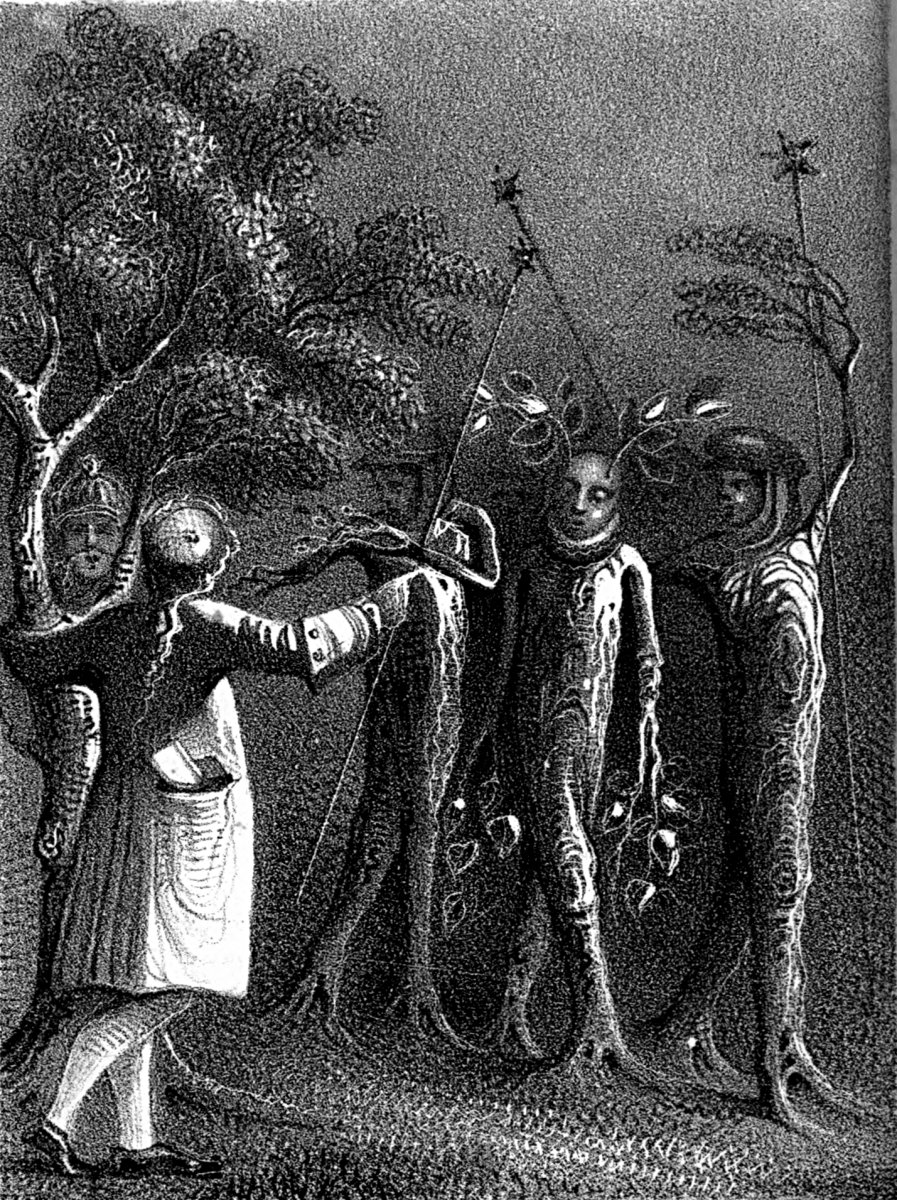
Our leader was an old Karatti, who rode on an ox, because from his age he could not walk. Our progress was very slow, so that three days were occupied in our passage. We had a quick and comfortable jaunt, if I except the meeting with some wild monkeys, that would spring towards me, and pester me now and then. They evidently supposed me to be one of their race. I could not suppress my anger, however, when I observed that the trees seemed to perceive this mistake of the monkeys, which gave the saplings food for laughter at my expense. I must remark that I was carried to court in the same dress which I wore on my descent to the planet, with the boat-hook in my hand and the rope dragging after me. This was by order of the king, who wished to see me in my own bark.
Our leader was an old Karatti who rode an ox because he was too old to walk. We moved very slowly, so the journey took three days. We had a quick and comfortable trip, except for encounters with some wild monkeys. The monkeys would leap toward me and bother me now and then. They clearly thought I was one of their own race. But I could not hold back my anger when I noticed that the trees seemed to recognize the monkeys' mistake. The mistake gave the saplings something to laugh at me about. I should mention that I was taken to court in the same clothes I wore when I descended to the planet. I still held the boat-hook in my hand, and the rope trailed behind me. The king had ordered this because he wanted to see me in my own bark.