Translator's Preface to This Edition
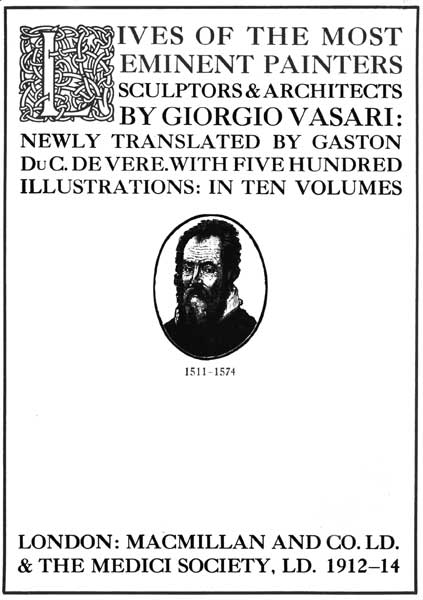
Vasari introduces himself sufficiently in his own prefaces and introduction; a translator need concern himself only with the system by which the Italian text can best be rendered in English. The style of that text is sometimes laboured and pompous; it is often ungrammatical. But the narrative is generally lively, full of neat phrases, and abounding in quaint expressions—many of them still recognizable in the modern Florentine vernacular—while, in such Lives as those of Giotto, Leonardo da Vinci, and Michelagnolo, Vasari shows how well he can rise to a fine subject. His criticism is generally sound, solid, and direct; and he employs few technical terms, except in connection with architecture, where we find passages full of technicalities, often so loosely used that it is difficult to be sure of their exact meaning. In such cases I have invariably adopted the rendering which seemed most in accordance with Vasari's actual words, so far as these could be explained by professional advice and local knowledge; and I have included brief notes where they appeared to be indispensable.
Vasari introduces himself well enough in his own prefaces and introduction. A translator needs only to consider how best to render the Italian text in English. The style is sometimes strained and pompous, and it is often ungrammatical. But the narrative is generally lively, full of neat phrases and quaint expressions. Many of these expressions are still recognizable in everyday modern Florentine speech. In Lives such as those of Giotto, Leonardo da Vinci, and Michelagnolo, Vasari shows how well he can rise to the occasion when writing about a great subject. His criticism is generally sound, solid, and direct. He uses few technical terms, except when discussing architecture. Some passages on architecture are full of technical terms, often used so loosely that their exact meaning is difficult to determine. In such cases, I have always chosen the wording that seemed closest to Vasari's actual words, as far as professional advice and local knowledge could help explain them. I have included brief notes where they seemed essential.
In Mrs. Foster's familiar English paraphrase—for a paraphrase it is rather than a translation—all Vasari's liveliness evaporates, even where his meaning is not blurred or misunderstood. Perhaps I have gone too far towards the other extreme in relying upon the Anglo-Saxon side of the English language rather than upon the Latin, and in taking no liberties whatever with the text of 1568. My intention, indeed, has been to render my original word for word, and to err, if at all, in favour of literalness. The very structure of Vasari's sentences has usually been retained, though some freedom was necessary in the matter of the punctuation, which is generally bewildering. As Mr. Horne's only too rare translation of the Life of Leonardo da Vinci has proved, it is by some such method that we can best keep Vasari's sense and Vasari's spirit—the one as important to the student of Italian art as is the other to the general reader. Such an attempt, however, places an English translator of the first volume at a conspicuous disadvantage. Throughout the earlier Lives Vasari seems to be feeling his way. He is not sure of himself, and his style is often awkward. The more faithful the attempted rendering, the more plainly must that awkwardness be reproduced.
Mrs. Foster’s familiar English version is a paraphrase rather than a translation. In it, all of Vasari’s liveliness disappears, even where his meaning is not blurred or misunderstood. Perhaps I have gone too far in the opposite direction. I have relied on the Anglo-Saxon side of English rather than the Latin, and taken no liberties with the 1568 text. Indeed, I have tried to translate the original word for word, and, if I err, to be too literal. I have usually kept the structure of Vasari’s sentences, though I had to take some freedom with his generally bewildering punctuation. Mr. Horne’s all too rare translation of the Life of Leonardo da Vinci shows why such a method works best. It preserves both Vasari’s meaning and his spirit. His meaning is as important to the student of Italian art as his spirit is to the general reader. Such an approach, however, puts an English translator of the first volume at a clear disadvantage. Throughout the earlier Lives, Vasari seems to be feeling his way. He is unsure of himself, and his style is often awkward. The more faithful the translation, the more clearly it must reproduce that awkwardness.
Vasari's Introduction on Technique has not been included, because it has no immediate connection with the Lives. In any case, there already exists an adequate translation by Miss Maclehose. All Vasari's other prefaces and introductions are given in the order in which they are found in the edition of 1568.
Vasari's Introduction on Technique has been left out because it has no direct connection to the Lives. In any case, Miss Maclehose has already published an adequate translation. All of Vasari's other prefaces and introductions appear in the order found in the 1568 edition.
With this much explanation, I may pass to personal matters, and record my thanks to many Florentine friends for help in technical and grammatical questions; to Professor Baldwin Brown for the notes on technical matters printed with Miss Maclehose's translation of "Vasari on Technique"; and to Mr. C. J. Holmes, of the National Portrait Gallery, for encouragement in a task which has proved no less pleasant than difficult.
With that explanation, I can turn to personal matters. I thank my many Florentine friends for their help with technical and grammatical questions. I also thank Professor Baldwin Brown for his technical notes published with Miss Maclehose's translation of "Vasari on Technique". Finally, I thank Mr. C. J. Holmes of the National Portrait Gallery for encouraging me in a task that has proved as pleasant as it was difficult.
G. du C. de V.
G. du C. de V.
London, March 1912.
London, March 1912.