Chapter 35
Vicksburg During the Trouble
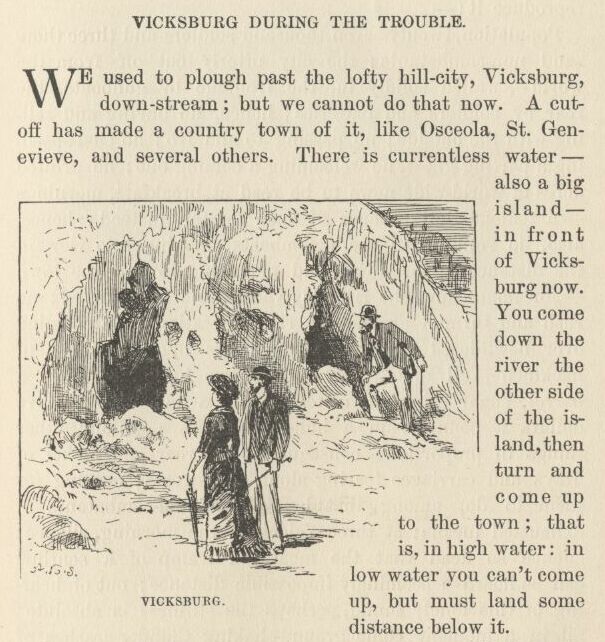
WE used to plow past the lofty hill-city, Vicksburg, down-stream; but we cannot do that now. A cut-off has made a country town of it, like Osceola, St. Genevieve, and several others. There is currentless water—also a big island—in front of Vicksburg now. You come down the river the other side of the island, then turn and come up to the town; that is, in high water: in low water you can't come up, but must land some distance below it.
We used to steam downstream past Vicksburg, the city high on the hill, but we cannot do that now. A river cutoff has made it a country town, like Osceola, St. Genevieve, and several others. Still water and a big island now lie in front of Vicksburg. You come down the river on the other side of the island, then turn and head upstream to town. That is, you can do this when the water is high. When it is low, you cannot reach the town by water and must land some distance below it.
Signs and scars still remain, as reminders of Vicksburg's tremendous war experiences; earthworks, trees crippled by the cannon balls, cave-refuges in the clay precipices, etc. The caves did good service during the six weeks' bombardment of the city—May 8 to July 4, 1863. They were used by the non-combatants—mainly by the women and children; not to live in constantly, but to fly to for safety on occasion. They were mere holes, tunnels, driven into the perpendicular clay bank, then branched Y shape, within the hill. Life in Vicksburg, during the six weeks was perhaps—but wait; here are some materials out of which to reproduce it:—
Signs and scars still remain as reminders of Vicksburg's tremendous wartime experiences. There are earthworks, trees crippled by cannonballs, cave shelters in the steep clay cliffs, and so on. The caves served people well during the city's six-week bombardment, from May 8 to July 4, 1863. Noncombatants, mainly women and children, used them. They did not live in the caves constantly, but fled there for safety when needed. The caves were simple holes, tunnels dug into the vertical clay bank, then split into a Y shape inside the hill. Life in Vicksburg during those six weeks was perhaps... But wait. Here are some materials for recreating it:
Population, twenty-seven thousand soldiers and three thousand non-combatants; the city utterly cut off from the world—walled solidly in, the frontage by gunboats, the rear by soldiers and batteries; hence, no buying and selling with the outside; no passing to and fro; no God-speeding a parting guest, no welcoming a coming one; no printed acres of world-wide news to be read at breakfast, mornings—a tedious dull absence of such matter, instead; hence, also, no running to see steamboats smoking into view in the distance up or down, and plowing toward the town—for none came, the river lay vacant and undisturbed; no rush and turmoil around the railway station, no struggling over bewildered swarms of passengers by noisy mobs of hackmen—all quiet there; flour two hundred dollars a barrel, sugar thirty, corn ten dollars a bushel, bacon five dollars a pound, rum a hundred dollars a gallon; other things in proportion: consequently, no roar and racket of drays and carriages tearing along the streets; nothing for them to do, among that handful of non-combatants of exhausted means; at three o'clock in the morning, silence; silence so dead that the measured tramp of a sentinel can be heard a seemingly impossible distance; out of hearing of this lonely sound, perhaps the stillness is absolute: all in a moment come ground-shaking thunder-crashes of artillery, the sky is cobwebbed with the crisscrossing red lines streaming from soaring bomb-shells, and a rain of iron fragments descends upon the city; descends upon the empty streets: streets which are not empty a moment later, but mottled with dim figures of frantic women and children scurrying from home and bed toward the cave dungeons—encouraged by the humorous grim soldiery, who shout 'Rats, to your holes!' and laugh.
The population was twenty-seven thousand soldiers and three thousand civilians. The city was completely cut off from the world, walled in by gunboats at the front and soldiers and artillery at the rear. So there was no buying or selling with the outside world, and no coming or going. No one wished departing guests Godspeed or welcomed arriving ones. There were no acres of printed news from around the world to read over breakfast. Instead, there was a tedious, dull absence of news. There was also no rushing to watch steamboats appear, trailing smoke in the distance upstream or downstream, and plow toward town. None came. The river lay empty and undisturbed. There was no rush and bustle around the railway station. No noisy crowds of carriage drivers fought over bewildered swarms of passengers. All was quiet there. Flour cost two hundred dollars a barrel, sugar thirty, corn ten dollars a bushel, bacon five dollars a pound, and rum a hundred dollars a gallon. Everything else cost about as much in proportion. As a result, there was no roar and racket of wagons and carriages racing through the streets. There was nothing for them to do among that handful of civilians whose money was exhausted. At three in the morning, silence. The silence was so complete that a sentry's measured footsteps could be heard at a seemingly impossible distance. Beyond the reach of that lonely sound, perhaps the stillness was absolute. Then, all at once, the artillery came crashing in ground-shaking thunder. Red trails from shells flying overhead crossed and recrossed the sky like a spiderweb. A rain of iron fragments fell on the city and its empty streets. A moment later, the streets were no longer empty. Dim figures of frantic women and children scattered across them, scrambling from their homes and beds toward the cave dungeons. The grim soldiers, amused, encouraged them by shouting 'Rats, to your holes!' and laughing.
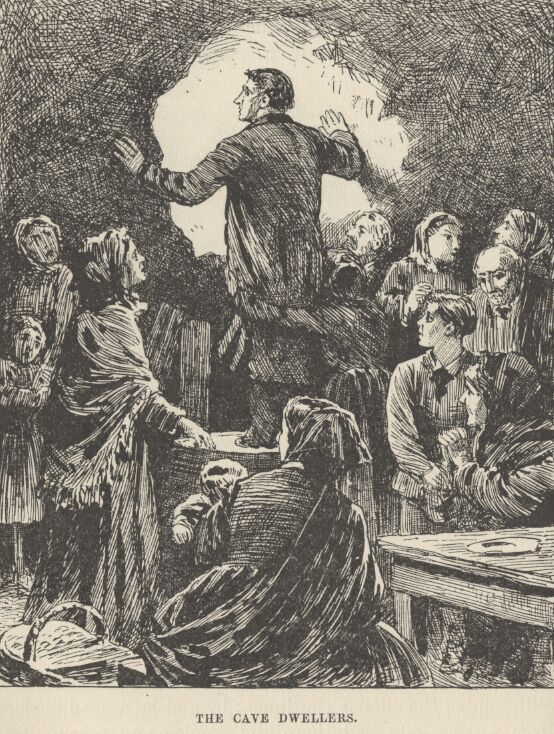
The cannon-thunder rages, shells scream and crash overhead, the iron rain pours down, one hour, two hours, three, possibly six, then stops; silence follows, but the streets are still empty; the silence continues; by-and-bye a head projects from a cave here and there and yonder, and reconnoitres, cautiously; the silence still continuing, bodies follow heads, and jaded, half smothered creatures group themselves about, stretch their cramped limbs, draw in deep draughts of the grateful fresh air, gossip with the neighbors from the next cave; maybe straggle off home presently, or take a lounge through the town, if the stillness continues; and will scurry to the holes again, by-and-bye, when the war-tempest breaks forth once more.
The cannons thunder, shells scream and crash overhead, and the iron rain pours down. It goes on for one hour, two hours, three, perhaps six, then stops. Silence follows, but the streets are still empty. The silence continues. Before long, a head pokes out of a cave here, another there, and each cautiously surveys the scene. As the silence continues, bodies follow heads. Exhausted, half-suffocated creatures gather outside, stretch their cramped limbs, and take deep breaths of the welcome fresh air. They gossip with neighbors from the next cave. If the quiet continues, they may eventually wander home or take a leisurely walk through town. And when the storm of war breaks out again, they will scurry back to their holes.
There being but three thousand of these cave-dwellers—merely the population of a village—would they not come to know each other, after a week or two, and familiarly; insomuch that the fortunate or unfortunate experiences of one would be of interest to all?
There were only three thousand of these cave-dwellers, no more than the population of a village. Wouldn’t they get to know each other well after a week or two? And wouldn’t one person’s good or bad experiences interest them all?
Those are the materials furnished by history. From them might not almost anybody reproduce for himself the life of that time in Vicksburg? Could you, who did not experience it, come nearer to reproducing it to the imagination of another non-participant than could a Vicksburger who did experience it? It seems impossible; and yet there are reasons why it might not really be. When one makes his first voyage in a ship, it is an experience which multitudinously bristles with striking novelties; novelties which are in such sharp contrast with all this person's former experiences that they take a seemingly deathless grip upon his imagination and memory. By tongue or pen he can make a landsman live that strange and stirring voyage over with him; make him see it all and feel it all. But if he wait? If he make ten voyages in succession—what then? Why, the thing has lost color, snap, surprise; and has become commonplace. The man would have nothing to tell that would quicken a landsman's pulse.
Those are the materials history gives us. Couldn’t almost anyone use them to imagine life in Vicksburg at that time? You did not experience that life. But could you bring it closer to the imagination of someone else who was not there than a Vicksburger who experienced it could? That seems impossible. And yet there are reasons why it might not be. A first voyage on a ship is full of striking new experiences. These are so different from everything the traveler has known before that they seem to grip the imagination and memory forever. In speech or writing, the traveler can make a person who has never sailed live through that strange, exciting voyage. The listener or reader can see it all and feel it all. But what if the traveler waits? What if he makes ten voyages in a row? What then? Well, the experience has lost its color, energy, and surprise. It has become ordinary. The man would have nothing to tell that would quicken the pulse of someone who had never sailed.
Years ago, I talked with a couple of the Vicksburg non-combatants—a man and his wife. Left to tell their story in their own way, those people told it without fire, almost without interest.
Years ago, I talked with two civilians from Vicksburg, a husband and wife. When left to tell their story in their own way, they told it without passion, almost without interest.
A week of their wonderful life there would have made their tongues eloquent for ever perhaps; but they had six weeks of it, and that wore the novelty all out; they got used to being bomb-shelled out of home and into the ground; the matter became commonplace. After that, the possibility of their ever being startlingly interesting in their talks about it was gone. What the man said was to this effect:—
A week of their extraordinary life there might have made them eloquent forever. But they had six weeks of it, and all the novelty wore off. They got used to being bombarded out of their homes and into the ground. It became commonplace. After that, there was no chance they would ever be startlingly interesting when they talked about it. What the man said went something like this:
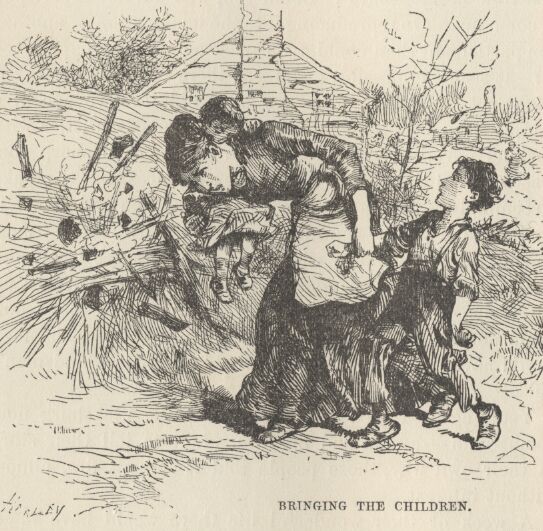
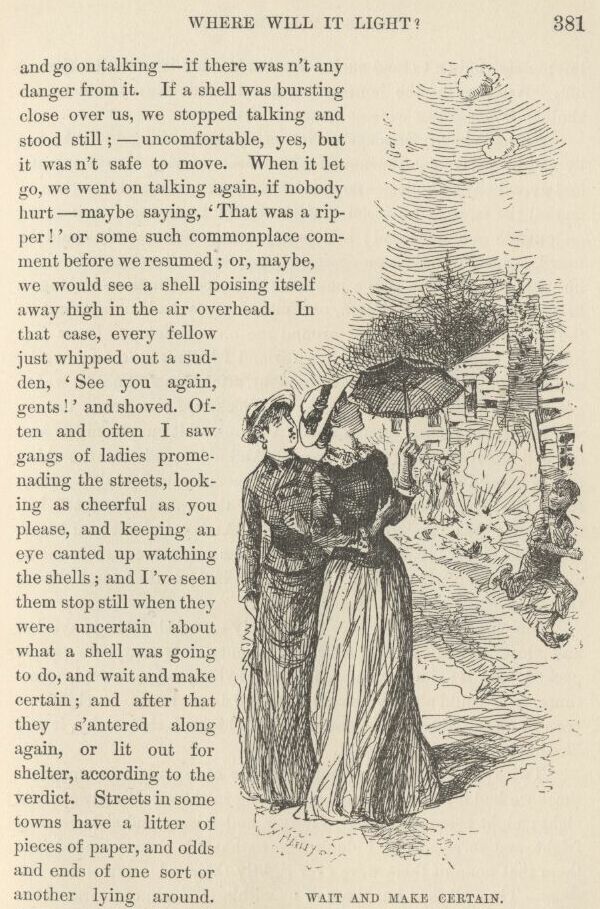
'It got to be Sunday all the time. Seven Sundays in the week—to us, anyway. We hadn't anything to do, and time hung heavy. Seven Sundays, and all of them broken up at one time or another, in the day or in the night, by a few hours of the awful storm of fire and thunder and iron. At first we used to shin for the holes a good deal faster than we did afterwards. The first time, I forgot the children, and Maria fetched them both along. When she was all safe in the cave she fainted. Two or three weeks afterwards, when she was running for the holes, one morning, through a shell-shower, a big shell burst near her, and covered her all over with dirt, and a piece of the iron carried away her game-bag of false hair from the back of her head. Well, she stopped to get that game-bag before she shoved along again! Was getting used to things already, you see. We all got so that we could tell a good deal about shells; and after that we didn't always go under shelter if it was a light shower. Us men would loaf around and talk; and a man would say, 'There she goes!' and name the kind of shell it was from the sound of it, and go on talking—if there wasn't any danger from it. If a shell was bursting close over us, we stopped talking and stood still;—uncomfortable, yes, but it wasn't safe to move. When it let go, we went on talking again, if nobody hurt—maybe saying, 'That was a ripper!' or some such commonplace comment before we resumed; or, maybe, we would see a shell poising itself away high in the air overhead. In that case, every fellow just whipped out a sudden, 'See you again, gents!' and shoved. Often and often I saw gangs of ladies promenading the streets, looking as cheerful as you please, and keeping an eye canted up watching the shells; and I've seen them stop still when they were uncertain about what a shell was going to do, and wait and make certain; and after that they sa'ntered along again, or lit out for shelter, according to the verdict. Streets in some towns have a litter of pieces of paper, and odds and ends of one sort or another lying around. Ours hadn't; they had iron litter. Sometimes a man would gather up all the iron fragments and unbursted shells in his neighborhood, and pile them into a kind of monument in his front yard—a ton of it, sometimes. No glass left; glass couldn't stand such a bombardment; it was all shivered out. Windows of the houses vacant—looked like eye-holes in a skull. Whole panes were as scarce as news.
'It became Sunday all the time. Seven Sundays a week, for us anyway. We had nothing to do, and time dragged. All seven Sundays were interrupted at some point, day or night, by hours of an awful storm of fire, thunder, and iron. At first, we used to scramble for the holes much faster than we did later. The first time, I forgot the children, and Maria brought both of them along. Once she was safe in the cave, she fainted. Two or three weeks later, she was running for the holes one morning through a shower of shells. A big shell burst near her and covered her in dirt. A piece of iron carried away her game-bag of false hair from the back of her head. Well, she stopped to pick up that game-bag before she went on! She was getting used to things already, you see. We all learned to tell a good deal about shells. After that, we didn't always take shelter if it was a light shower. We men would stand around and talk. One would say, 'There she goes!' He would name the kind of shell from its sound and go on talking if it posed no danger. If a shell was bursting close above us, we stopped talking and stood still. It was uncomfortable, yes, but it wasn't safe to move. When the shell burst, we went on talking again if nobody was hurt. Maybe we'd say, 'That was a ripper!' or make some ordinary comment like that before carrying on. Or maybe we would see a shell hovering high in the air overhead. In that case, every fellow would quickly call out, 'See you again, gents!' and take off. Many a time I saw groups of ladies strolling through the streets, looking as cheerful as you please. They kept an eye on the shells overhead. I've seen them stop still when they weren't sure what a shell would do, and wait until they knew. Then they would stroll on again or run for shelter, depending on what they decided. Some towns have streets littered with scraps of paper and odds and ends of various kinds. Ours didn't. They had iron litter. Sometimes a man would gather all the iron fragments and unexploded shells in his neighborhood. He would pile them into a kind of monument in his front yard. Sometimes there was a ton of iron. No glass was left. Glass couldn't stand such a bombardment, and it had all been shattered. The house windows were empty and looked like the eye sockets in a skull. Whole panes were as scarce as news.
'We had church Sundays. Not many there, along at first; but by-and-bye pretty good turnouts. I've seen service stop a minute, and everybody sit quiet—no voice heard, pretty funeral-like then—and all the more so on account of the awful boom and crash going on outside and overhead; and pretty soon, when a body could be heard, service would go on again. Organs and church-music mixed up with a bombardment is a powerful queer combination—along at first. Coming out of church, one morning, we had an accident—the only one that happened around me on a Sunday. I was just having a hearty handshake with a friend I hadn't seen for a while, and saying, 'Drop into our cave to-night, after bombardment; we've got hold of a pint of prime wh—.' Whiskey, I was going to say, you know, but a shell interrupted. A chunk of it cut the man's arm off, and left it dangling in my hand. And do you know the thing that is going to stick the longest in my memory, and outlast everything else, little and big, I reckon, is the mean thought I had then? It was 'the whiskey is saved.' And yet, don't you know, it was kind of excusable; because it was as scarce as diamonds, and we had only just that little; never had another taste during the siege.
'We had church on Sundays. Not many people came at first, but before long we had pretty good turnouts. I've seen the service stop for a minute while everybody sat quietly. Not a voice could be heard. It was pretty much like a funeral then, especially with the awful booming and crashing outside and overhead. Before long, when a person could be heard again, the service would go on. Organ music and church singing mixed with a bombardment make a powerful strange combination, at first. Coming out of church one morning, we had an accident. It was the only one that happened around me on a Sunday. I was shaking hands warmly with a friend I hadn't seen for a while. I was saying, 'Drop by our cave tonight, after the bombardment. We've got hold of a pint of prime wh...'. I was going to say whiskey, you know, but a shell interrupted me. A piece of it cut the man's arm off and left it dangling in my hand. And do you know what I reckon will stick in my memory longest, outlasting everything else, big and small? It's the mean thought I had then: 'the whiskey is saved.' And yet, don't you know, it was kind of excusable. Whiskey was as scarce as diamonds, and we had only that little bit. We never had another taste during the siege.
'Sometimes the caves were desperately crowded, and always hot and close. Sometimes a cave had twenty or twenty-five people packed into it; no turning-room for anybody; air so foul, sometimes, you couldn't have made a candle burn in it. A child was born in one of those caves one night, Think of that; why, it was like having it born in a trunk.
'Sometimes the caves were terribly crowded, and they were always hot and stuffy. Sometimes twenty or twenty-five people were packed into one cave. No one had room to turn around. Sometimes the air was so foul that a candle wouldn't burn. One night, a child was born in one of those caves. Think of that. Why, it was like being born in a trunk.
'Twice we had sixteen people in our cave; and a number of times we had a dozen. Pretty suffocating in there. We always had eight; eight belonged there. Hunger and misery and sickness and fright and sorrow, and I don't know what all, got so loaded into them that none of them were ever rightly their old selves after the siege. They all died but three of us within a couple of years. One night a shell burst in front of the hole and caved it in and stopped it up. It was lively times, for a while, digging out. Some of us came near smothering. After that we made two openings—ought to have thought of it at first.
'Twice we had sixteen people in our cave, and several times we had a dozen. It was pretty suffocating in there. We always had eight people. Eight belonged there. Hunger, misery, sickness, fright, sorrow, and I don't know what else weighed so heavily on them. None of them were ever quite their old selves after the siege. Within a couple of years, all but three of us had died. One night a shell burst in front of the opening, caving it in and blocking it. We had a lively time digging our way out. Some of us nearly suffocated. After that, we made two openings. We should have thought of that at first.'
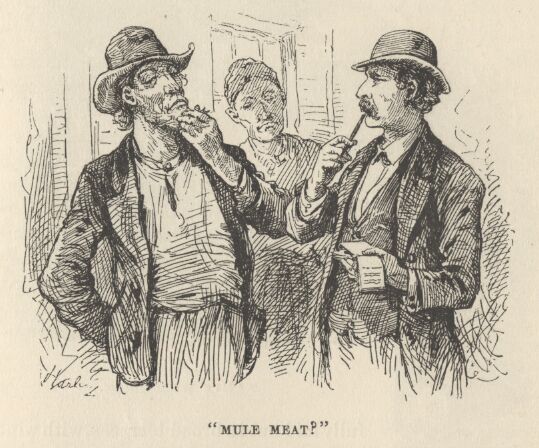
'Mule meat. No, we only got down to that the last day or two. Of course it was good; anything is good when you are starving.
'Mule meat. No, we didn't have to eat that until the last day or two. Of course it tasted good. Anything tastes good when you're starving.
This man had kept a diary during—six weeks? No, only the first six days. The first day, eight close pages; the second, five; the third, one—loosely written; the fourth, three or four lines; a line or two the fifth and sixth days; seventh day, diary abandoned; life in terrific Vicksburg having now become commonplace and matter of course.
This man had kept a diary for six weeks? No, only for the first six days. On the first day, he filled eight densely written pages. On the second, five. On the third, one, with plenty of space between the lines. On the fourth, three or four lines. On the fifth and sixth days, a line or two. On the seventh day, he abandoned the diary. Life in terrific Vicksburg had now become ordinary and routine.
The war history of Vicksburg has more about it to interest the general reader than that of any other of the river-towns. It is full of variety, full of incident, full of the picturesque. Vicksburg held out longer than any other important river-town, and saw warfare in all its phases, both land and water—the siege, the mine, the assault, the repulse, the bombardment, sickness, captivity, famine.
Vicksburg's war history has more to interest the general reader than that of any other river town. It is full of variety, incidents, and vivid scenes. Vicksburg held out longer than any other major river town. It saw every kind of warfare, on land and water: siege, mining, assault, repulse, bombardment, sickness, captivity, and famine.
The most beautiful of all the national cemeteries is here. Over the great gateway is this inscription:—
The most beautiful of all the national cemeteries is here. Above the great gateway is this inscription:
“HERE REST IN PEACE 16,600 WHO DIED FOR THEIR COUNTRY IN THE YEARS 1861 TO 1865.”
“HERE LIE 16,600 PEOPLE WHO DIED FOR THEIR COUNTRY BETWEEN 1861 AND 1865. MAY THEY REST IN PEACE.”
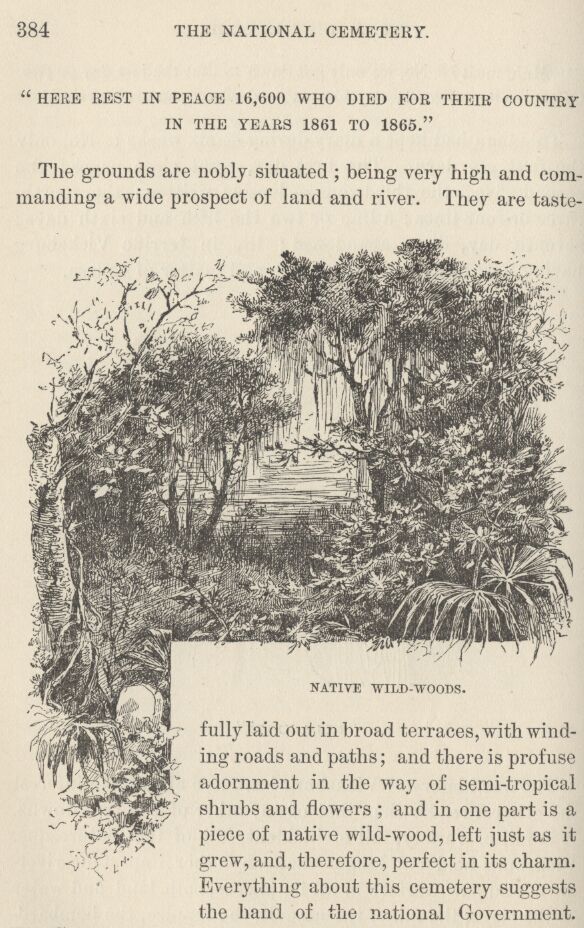
The grounds are nobly situated; being very high and commanding a wide prospect of land and river. They are tastefully laid out in broad terraces, with winding roads and paths; and there is profuse adornment in the way of semi-tropical shrubs and flowers,' and in one part is a piece of native wild-wood, left just as it grew, and, therefore, perfect in its charm. Everything about this cemetery suggests the hand of the national Government. The Government's work is always conspicuous for excellence, solidity, thoroughness, neatness. The Government does its work well in the first place, and then takes care of it.
The grounds are beautifully situated on high land, with a wide view of the land and river. They are tastefully arranged in broad terraces, with winding roads and paths. Semi-tropical shrubs and flowers grow in abundance. In one part, a patch of native woodland has been left just as it grew, preserving its perfect charm. Everything about this cemetery suggests the hand of the national Government. The Government's work always stands out for its excellence, solidity, thoroughness, and neatness. The Government does its work well in the first place and then takes care of it.
By winding-roads—which were often cut to so great a depth between perpendicular walls that they were mere roofless tunnels—we drove out a mile or two and visited the monument which stands upon the scene of the surrender of Vicksburg to General Grant by General Pemberton. Its metal will preserve it from the hackings and chippings which so defaced its predecessor, which was of marble; but the brick foundations are crumbling, and it will tumble down by-and-bye. It overlooks a picturesque region of wooded hills and ravines; and is not unpicturesque itself, being well smothered in flowering weeds. The battered remnant of the marble monument has been removed to the National Cemetery.
We drove a mile or two along winding roads to visit a monument. The roads were often cut so deeply between vertical walls that they were little more than tunnels without roofs. The monument stands on the site where General Pemberton surrendered Vicksburg to General Grant. Its metal will protect it from the hacking and chipping that badly damaged the previous monument, which was made of marble. But its brick foundations are crumbling, and it will eventually fall down. The monument overlooks a picturesque region of wooded hills and ravines. Smothered in flowering weeds, it is picturesque itself. The battered remains of the marble monument have been moved to the National Cemetery.
On the road, a quarter of a mile townward, an aged colored man showed us, with pride, an unexploded bomb-shell which has lain in his yard since the day it fell there during the siege.
A quarter mile down the road toward town, an elderly Black man proudly showed us an unexploded shell. It had been lying in his yard since it fell there during the siege.
'I was a-stannin' heah, an' de dog was a-stannin' heah; de dog he went for de shell, gwine to pick a fuss wid it; but I didn't; I says, “Jes' make you'seff at home heah; lay still whah you is, or bust up de place, jes' as you's a mind to, but I's got business out in de woods, I has!”'
'I was standing here, and the dog was standing here. The dog went after the shell, looking to pick a fight with it, but I didn't. I said, “Just make yourself at home here. Stay where you are, or blow the place apart, whichever you please, but I've got business out in the woods, I do!”'
Vicksburg is a town of substantial business streets and pleasant residences; it commands the commerce of the Yazoo and Sunflower Rivers; is pushing railways in several directions, through rich agricultural regions, and has a promising future of prosperity and importance.
Vicksburg has thriving business streets and pleasant homes. It controls commerce on the Yazoo and Sunflower Rivers. It is expanding railways in several directions through rich farming regions. Vicksburg has a promising future of prosperity and importance.
Apparently, nearly all the river towns, big and little, have made up their minds that they must look mainly to railroads for wealth and upbuilding, henceforth. They are acting upon this idea. The signs are, that the next twenty years will bring about some noteworthy changes in the Valley, in the direction of increased population and wealth, and in the intellectual advancement and the liberalizing of opinion which go naturally with these. And yet, if one may judge by the past, the river towns will manage to find and use a chance, here and there, to cripple and retard their progress. They kept themselves back in the days of steamboating supremacy, by a system of wharfage-dues so stupidly graded as to prohibit what may be called small retail traffic in freights and passengers. Boats were charged such heavy wharfage that they could not afford to land for one or two passengers or a light lot of freight. Instead of encouraging the bringing of trade to their doors, the towns diligently and effectively discouraged it. They could have had many boats and low rates; but their policy rendered few boats and high rates compulsory. It was a policy which extended—and extends—from New Orleans to St. Paul.
Apparently, nearly all the river towns, big and small, have decided to rely mainly on railroads for future wealth and growth. They are acting on that idea. The signs suggest that the next twenty years will bring some notable changes to the Valley. Its population and wealth will increase, along with the intellectual progress and more open opinions that naturally accompany them. And yet, judging by the past, the river towns will find and use chances here and there to hamper their own progress. When steamboats reigned supreme, the towns held themselves back with a system of wharfage fees. The fees were so stupidly structured that they prevented what might be called small retail traffic in freight and passengers. Boats were charged so much to use the wharves that they could not afford to stop for one or two passengers or a small load of freight. Instead of encouraging trade to come to their doors, the towns worked hard and effectively to discourage it. They could have had many boats and low rates, but their policy made few boats and high rates unavoidable. The policy extended, and still extends, from New Orleans to St. Paul.
We had a strong desire to make a trip up the Yazoo and the Sunflower—an interesting region at any time, but additionally interesting at this time, because up there the great inundation was still to be seen in force—but we were nearly sure to have to wait a day or more for a New Orleans boat on our return; so we were obliged to give up the project.
We very much wanted to take a trip up the Yazoo and the Sunflower. The region was interesting at any time. But it was especially interesting then because the great flood could still be seen there in full force. On our return, however, we would almost certainly have to wait a day or more for a New Orleans boat. So we had to give up the trip.
Here is a story which I picked up on board the boat that night. I insert it in this place merely because it is a good story, not because it belongs here—for it doesn't. It was told by a passenger—a college professor—and was called to the surface in the course of a general conversation which began with talk about horses, drifted into talk about astronomy, then into talk about the lynching of the gamblers in Vicksburg half a century ago, then into talk about dreams and superstitions; and ended, after midnight, in a dispute over free trade and protection.
Here is a story I heard on the boat that night. I include it here simply because it is a good story, not because it belongs here. It doesn't. A passenger, a college professor, told it during a wide-ranging conversation. We began by talking about horses, then drifted to astronomy. From there we moved on to the lynching of the gamblers in Vicksburg half a century ago, then to dreams and superstitions. The conversation ended after midnight with an argument over free trade and protection.