Chapter 2
The River and Its Explorers
LA SALLE himself sued for certain high privileges, and they were graciously accorded him by Louis XIV of inflated memory. Chief among them was the privilege to explore, far and wide, and build forts, and stake out continents, and hand the same over to the king, and pay the expenses himself; receiving, in return, some little advantages of one sort or another; among them the monopoly of buffalo hides. He spent several years and about all of his money, in making perilous and painful trips between Montreal and a fort which he had built on the Illinois, before he at last succeeded in getting his expedition in such a shape that he could strike for the Mississippi.
La Salle himself applied for certain high privileges, and Louis XIV, of inflated memory, graciously granted them. Chief among these was the privilege of exploring far and wide, building forts, and claiming continents for the king. La Salle would pay the expenses himself. In return, he would receive a few small advantages of one kind or another, including a monopoly on buffalo hides. He spent several years and nearly all his money making dangerous, grueling trips between Montreal and a fort he had built on the Illinois. Only then did he finally succeed in getting his expedition ready to set out for the Mississippi.
And meantime other parties had had better fortune. In 1673 Joliet the merchant, and Marquette the priest, crossed the country and reached the banks of the Mississippi. They went by way of the Great Lakes; and from Green Bay, in canoes, by way of Fox River and the Wisconsin. Marquette had solemnly contracted, on the feast of the Immaculate Conception, that if the Virgin would permit him to discover the great river, he would name it Conception, in her honor. He kept his word. In that day, all explorers traveled with an outfit of priests. De Soto had twenty-four with him. La Salle had several, also. The expeditions were often out of meat, and scant of clothes, but they always had the furniture and other requisites for the mass; they were always prepared, as one of the quaint chroniclers of the time phrased it, to 'explain hell to the savages.'
Meanwhile, other parties had better luck. In 1673, Joliet the merchant and Marquette the priest crossed the country and reached the banks of the Mississippi. They traveled by way of the Great Lakes. From Green Bay, they went by canoe along the Fox River and the Wisconsin. On the feast of the Immaculate Conception, Marquette had made a solemn promise. If the Virgin allowed him to discover the great river, he would name it Conception in her honor. He kept his word. In those days, all explorers traveled with priests in their party. De Soto had twenty-four with him. La Salle had several too. The expeditions often ran out of meat and had little clothing. But they always had the equipment and other supplies needed for mass. They were always ready, as one of the quaint chroniclers of the time put it, to 'explain hell to the savages.'
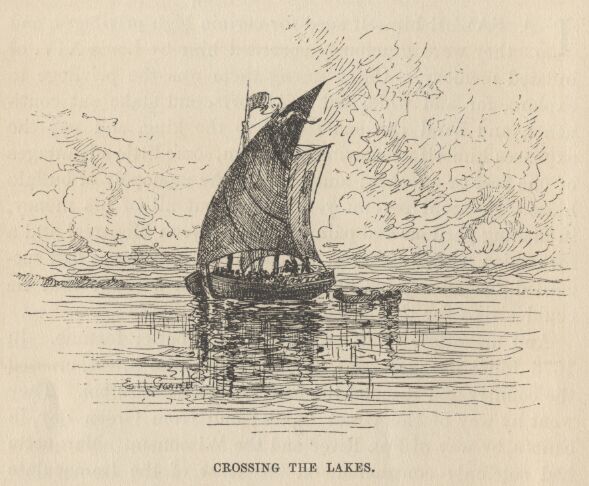
On the 17th of June, 1673, the canoes of Joliet and Marquette and their five subordinates reached the junction of the Wisconsin with the Mississippi. Mr. Parkman says: 'Before them a wide and rapid current coursed athwart their way, by the foot of lofty heights wrapped thick in forests.' He continues: 'Turning southward, they paddled down the stream, through a solitude unrelieved by the faintest trace of man.'
On June 17, 1673, the canoes of Joliet, Marquette, and their five subordinates reached the junction of the Wisconsin and the Mississippi. Mr. Parkman says: 'Before them, a wide, fast current flowed across their path, below lofty heights thickly covered in forest.' He continues: 'Turning south, they paddled downstream through a wilderness without the faintest trace of human presence.'
A big cat-fish collided with Marquette's canoe, and startled him; and reasonably enough, for he had been warned by the Indians that he was on a foolhardy journey, and even a fatal one, for the river contained a demon 'whose roar could be heard at a great distance, and who would engulf them in the abyss where he dwelt.' I have seen a Mississippi cat-fish that was more than six feet long, and weighed two hundred and fifty pounds; and if Marquette's fish was the fellow to that one, he had a fair right to think the river's roaring demon was come.
A big catfish crashed into Marquette's canoe and startled him. He had good reason to be startled. The Indians had warned him that his journey was reckless and could even be fatal. They said the river contained a demon 'whose roar could be heard from far away, and who would swallow them up in the depths where he lived.' I have seen a Mississippi catfish more than six feet long and weighing two hundred and fifty pounds. If Marquette's fish was as big as that one, he had every right to think the river's roaring demon had come.
'At length the buffalo began to appear, grazing in herds on the great prairies which then bordered the river; and Marquette describes the fierce and stupid look of the old bulls as they stared at the intruders through the tangled mane which nearly blinded them.'
'Eventually, buffalo began to appear, grazing in herds on the vast prairies that then bordered the river. Marquette describes the fierce, stupid look of the old bulls as they stared at the intruders. Their tangled manes nearly blinded them.'
The voyagers moved cautiously: 'Landed at night and made a fire to cook their evening meal; then extinguished it, embarked again, paddled some way farther, and anchored in the stream, keeping a man on the watch till morning.'
The travelers moved cautiously: 'They landed at night and made a fire to cook their evening meal. Then they put out the fire, got back in their boats, and paddled a little farther. They anchored in the stream and kept one man on watch until morning.'
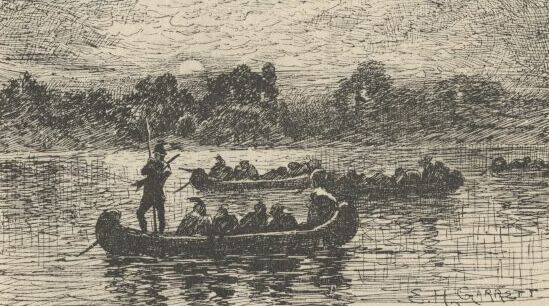
They did this day after day and night after night; and at the end of two weeks they had not seen a human being. The river was an awful solitude, then. And it is now, over most of its stretch.
They did this day after day and night after night. At the end of two weeks, they had not seen a single person. The river was terribly lonely then. It still is along most of its length.
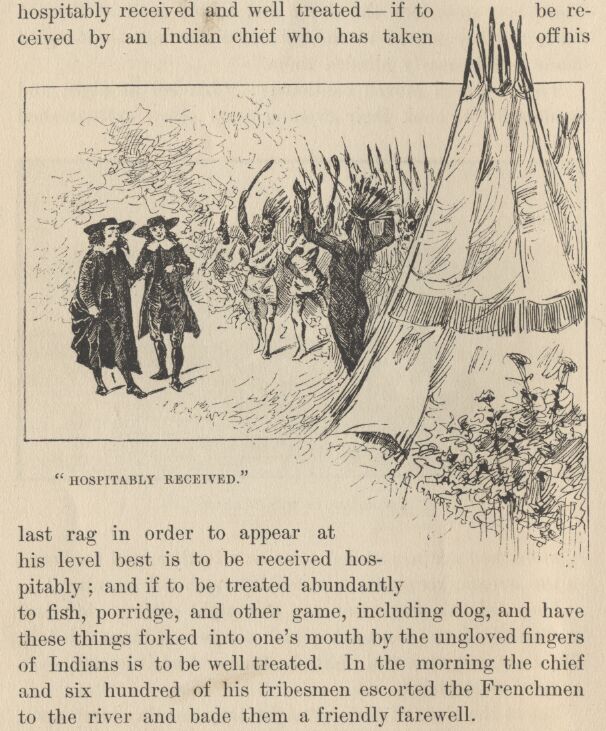
But at the close of the fortnight they one day came upon the footprints of men in the mud of the western bank—a Robinson Crusoe experience which carries an electric shiver with it yet, when one stumbles on it in print. They had been warned that the river Indians were as ferocious and pitiless as the river demon, and destroyed all comers without waiting for provocation; but no matter, Joliet and Marquette struck into the country to hunt up the proprietors of the tracks. They found them, by and by, and were hospitably received and well treated—if to be received by an Indian chief who has taken off his last rag in order to appear at his level best is to be received hospitably; and if to be treated abundantly to fish, porridge, and other game, including dog, and have these things forked into one's mouth by the ungloved fingers of Indians is to be well treated. In the morning the chief and six hundred of his tribesmen escorted the Frenchmen to the river and bade them a friendly farewell.
But at the end of two weeks, they came upon human footprints in the mud on the western bank. It was a Robinson Crusoe experience that still sends an electric shiver through a reader who comes across it in print. They had been warned that the river Indians were as fierce and merciless as the river demon. They had also been told that the Indians killed all newcomers without waiting to be provoked. But Joliet and Marquette went inland anyway to find the people who had left the tracks. Eventually they found them, and were welcomed and treated well. That is, if being greeted by an Indian chief who has taken off his last rag to look his best counts as a welcome. And if being served plenty of fish, porridge, and other game, including dog, counts as being treated well. The Indians even put the food into their mouths with bare fingers. In the morning, the chief and six hundred of his tribesmen escorted the Frenchmen to the river and gave them a friendly farewell.
On the rocks above the present city of Alton they found some rude and fantastic Indian paintings, which they describe. A short distance below 'a torrent of yellow mud rushed furiously athwart the calm blue current of the Mississippi, boiling and surging and sweeping in its course logs, branches, and uprooted trees.' This was the mouth of the Missouri, 'that savage river,' which 'descending from its mad career through a vast unknown of barbarism, poured its turbid floods into the bosom of its gentle sister.'
On the rocks above the present city of Alton, they found some crude and fantastic Native American paintings. They describe these paintings. A short distance downstream, 'a torrent of yellow mud rushed fiercely across the calm blue current of the Mississippi. It boiled and surged, sweeping along logs, branches, and uprooted trees.' This was the mouth of the Missouri, 'that savage river.' It 'descended from its wild course through a vast unknown wilderness and poured its muddy waters into the bosom of its gentle sister.'
By and by they passed the mouth of the Ohio; they passed cane-brakes; they fought mosquitoes; they floated along, day after day, through the deep silence and loneliness of the river, drowsing in the scant shade of makeshift awnings, and broiling with the heat; they encountered and exchanged civilities with another party of Indians; and at last they reached the mouth of the Arkansas (about a month out from their starting-point), where a tribe of war-whooping savages swarmed out to meet and murder them; but they appealed to the Virgin for help; so in place of a fight there was a feast, and plenty of pleasant palaver and fol-de-rol.
Eventually, they passed the mouth of the Ohio and stretches of cane thickets. They fought mosquitoes as they floated along, day after day, through the deep silence and loneliness of the river. They dozed in the little shade their makeshift awnings provided and baked in the heat. They met another group of Indians and exchanged friendly greetings. At last, about a month after setting out, they reached the mouth of the Arkansas. There, a tribe of war-whooping savages swarmed out to meet and murder them. But the travelers appealed to the Virgin for help. So instead of a fight, there was a feast, with plenty of pleasant talk and foolishness.
They had proved to their satisfaction, that the Mississippi did not empty into the Gulf of California, or into the Atlantic. They believed it emptied into the Gulf of Mexico. They turned back, now, and carried their great news to Canada.
They had convinced themselves that the Mississippi did not flow into the Gulf of California or the Atlantic. They believed it flowed into the Gulf of Mexico. They turned back and took their great news to Canada.
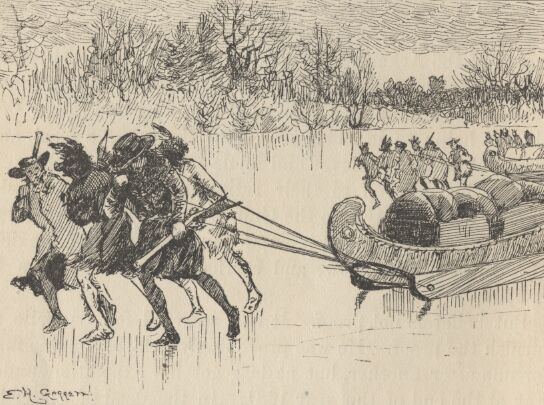
But belief is not proof. It was reserved for La Salle to furnish the proof. He was provokingly delayed, by one misfortune after another, but at last got his expedition under way at the end of the year 1681. In the dead of winter he and Henri de Tonty, son of Lorenzo Tonty, who invented the tontine, his lieutenant, started down the Illinois, with a following of eighteen Indians brought from New England, and twenty-three Frenchmen. They moved in procession down the surface of the frozen river, on foot, and dragging their canoes after them on sledges.
But belief is not proof. La Salle would provide the proof. One misfortune after another delayed him frustratingly, but he finally got his expedition under way at the end of 1681. In the middle of winter, he and his lieutenant, Henri de Tonty, set out down the Illinois. Henri was the son of Lorenzo Tonty, who invented the tontine. They were accompanied by eighteen Indians brought from New England and twenty-three Frenchmen. They traveled in a line on foot over the frozen river, dragging their canoes behind them on sleds.
At Peoria Lake they struck open water, and paddled thence to the Mississippi and turned their prows southward. They plowed through the fields of floating ice, past the mouth of the Missouri; past the mouth of the Ohio, by-and-by; 'and, gliding by the wastes of bordering swamp, landed on the 24th of February near the Third Chickasaw Bluffs,' where they halted and built Fort Prudhomme.
At Peoria Lake they reached open water and paddled on to the Mississippi, where they turned south. They pushed through fields of floating ice, passing the mouth of the Missouri and then the mouth of the Ohio. 'Gliding past the stretches of swamp along the river, they landed on February 24 near the Third Chickasaw Bluffs,' where they stopped and built Fort Prudhomme.
'Again,' says Mr. Parkman, 'they embarked; and with every stage of their adventurous progress, the mystery of this vast new world was more and more unveiled. More and more they entered the realms of spring. The hazy sunlight, the warm and drowsy air, the tender foliage, the opening flowers, betokened the reviving life of nature.'
'Again,' says Mr. Parkman, 'they set out by boat. With each stage of their adventurous journey, the mystery of this vast new world was revealed a little more. They traveled farther and farther into the world of spring. The hazy sunlight, warm, sleepy air, fresh leaves, and opening flowers showed that nature was coming back to life.'
Day by day they floated down the great bends, in the shadow of the dense forests, and in time arrived at the mouth of the Arkansas. First, they were greeted by the natives of this locality as Marquette had before been greeted by them—with the booming of the war drum and the flourish of arms. The Virgin composed the difficulty in Marquette's case; the pipe of peace did the same office for La Salle. The white man and the red man struck hands and entertained each other during three days. Then, to the admiration of the savages, La Salle set up a cross with the arms of France on it, and took possession of the whole country for the king—the cool fashion of the time—while the priest piously consecrated the robbery with a hymn. The priest explained the mysteries of the faith 'by signs,' for the saving of the savages; thus compensating them with possible possessions in Heaven for the certain ones on earth which they had just been robbed of. And also, by signs, La Salle drew from these simple children of the forest acknowledgments of fealty to Louis the Putrid, over the water. Nobody smiled at these colossal ironies.
Day after day, they floated down the great bends of the river, in the shadow of the dense forests. In time, they reached the mouth of the Arkansas. At first, the local natives greeted them as they had greeted Marquette before them, with booming war drums and a display of weapons. The Virgin had settled the trouble for Marquette. The pipe of peace did the same for La Salle. The white men and the Native Americans shook hands and entertained one another for three days. Then La Salle set up a cross bearing the arms of France, and the natives admired it. He claimed the whole country for the king, with the casual indifference fashionable at the time. Meanwhile, the priest piously blessed the robbery with a hymn. The priest explained the mysteries of the faith 'by signs' to save the natives. In this way, he offered them possible possessions in Heaven in exchange for the earthly possessions they had certainly just been robbed of. La Salle also used signs to draw pledges of loyalty from these simple children of the forest. Their pledges were to Louis the Putrid, across the water. Nobody smiled at these colossal ironies.
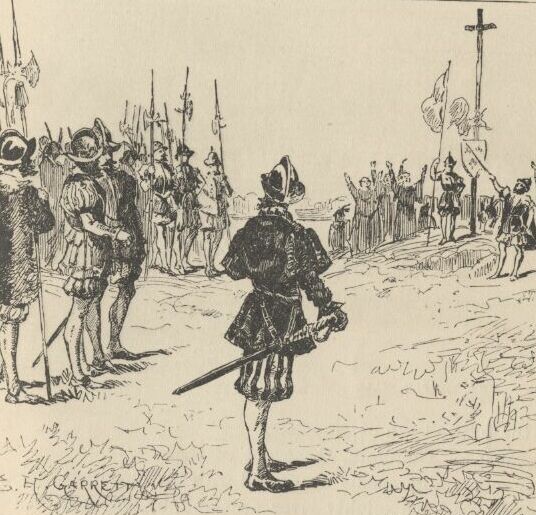
These performances took place on the site of the future town of Napoleon, Arkansas, and there the first confiscation-cross was raised on the banks of the great river. Marquette's and Joliet's voyage of discovery ended at the same spot—the site of the future town of Napoleon. When De Soto took his fleeting glimpse of the river, away back in the dim early days, he took it from that same spot—the site of the future town of Napoleon, Arkansas. Therefore, three out of the four memorable events connected with the discovery and exploration of the mighty river, occurred, by accident, in one and the same place. It is a most curious distinction, when one comes to look at it and think about it. France stole that vast country on that spot, the future Napoleon; and by and by Napoleon himself was to give the country back again!—make restitution, not to the owners, but to their white American heirs.
These events took place on the site of the future town of Napoleon, Arkansas. There, on the banks of the great river, the first confiscation-cross was raised. Marquette and Joliet’s voyage of discovery ended at the same spot, the site of the future town of Napoleon. Back in the dim early days, De Soto caught his fleeting glimpse of the river from that same spot. It was the site of the future town of Napoleon, Arkansas. So, by accident, three of the four memorable events connected with discovering and exploring the mighty river happened in one place. When you stop to think about it, that is a most curious distinction. France stole that vast country on that spot, the future Napoleon. And in time, Napoleon himself would give the country back again! He would return it not to its owners, but to their white American heirs.
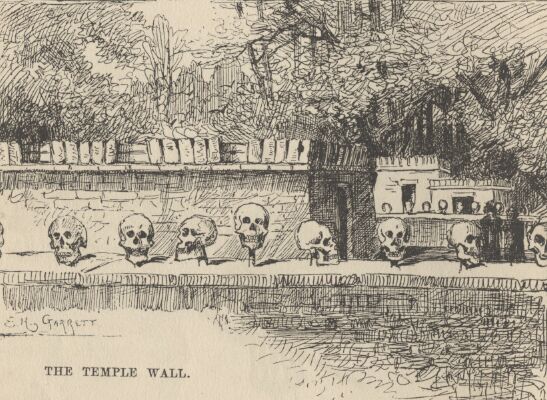
The voyagers journeyed on, touching here and there; 'passed the sites, since become historic, of Vicksburg and Grand Gulf,' and visited an imposing Indian monarch in the Teche country, whose capital city was a substantial one of sun-baked bricks mixed with straw—better houses than many that exist there now. The chiefs house contained an audience room forty feet square; and there he received Tonty in State, surrounded by sixty old men clothed in white cloaks. There was a temple in the town, with a mud wall about it ornamented with skulls of enemies sacrificed to the sun.
The travelers continued their journey, stopping here and there. They 'passed the sites, later made historic, of Vicksburg and Grand Gulf' and visited an impressive Indian monarch in the Teche country. His capital was a substantial city, built of sun-baked bricks mixed with straw. Its houses were better than many that exist there now. The chief's house had an audience room forty feet square. There he received Tonty with great ceremony, surrounded by sixty old men dressed in white cloaks. The town had a temple surrounded by a mud wall. The wall was decorated with the skulls of enemies sacrificed to the sun.
The voyagers visited the Natchez Indians, near the site of the present city of that name, where they found a 'religious and political despotism, a privileged class descended from the sun, a temple and a sacred fire.' It must have been like getting home again; it was home with an advantage, in fact, for it lacked Louis XIV.
The travelers visited the Natchez Indians, near the site of the present city of Natchez. There they found a 'religious and political dictatorship, a privileged class descended from the sun, a temple and a sacred fire.' It must have felt like coming home. In fact, it was better than home, because it had no Louis XIV.
A few more days swept swiftly by, and La Salle stood in the shadow of his confiscating cross, at the meeting of the waters from Delaware, and from Itaska, and from the mountain ranges close upon the Pacific, with the waters of the Gulf of Mexico, his task finished, his prodigy achieved. Mr. Parkman, in closing his fascinating narrative, thus sums up:
A few more days passed quickly, and La Salle stood in the shadow of his cross, raised to claim the land. He stood where the waters from Delaware, Itaska, and the mountain ranges near the Pacific met the Gulf of Mexico. His task was finished, his extraordinary feat accomplished. Mr. Parkman closes his fascinating account with this summary:
'On that day, the realm of France received on parchment a stupendous accession. The fertile plains of Texas; the vast basin of the Mississippi, from its frozen northern springs to the sultry borders of the Gulf; from the woody ridges of the Alleghanies to the bare peaks of the Rocky Mountains—a region of savannas and forests, sun-cracked deserts and grassy prairies, watered by a thousand rivers, ranged by a thousand warlike tribes, passed beneath the scepter of the Sultan of Versailles; and all by virtue of a feeble human voice, inaudible at half a mile.'
'On that day, France gained an enormous amount of territory on paper. It included the fertile plains of Texas and the vast Mississippi basin, from its frozen northern sources to the sultry shores of the Gulf. It stretched from the wooded ridges of the Alleghanies to the bare peaks of the Rocky Mountains. This region of savannas and forests, sun-cracked deserts and grassy prairies was watered by a thousand rivers and roamed by a thousand warlike tribes. All of it came under the rule of the Sultan of Versailles, thanks to a feeble human voice that could not be heard half a mile away.'