My Imprisonment in November 1660
When, by the good hand of my God, I had for five or six years together, without any interruption, freely preached the blessed gospel of our Lord Jesus Christ; and had also, through His blessed grace, some encouragement by His blessing thereupon; the devil, that old enemy of man’s salvation, took his opportunity to inflame the hearts of his vassals against me, insomuch that at the last, I was laid out for by the warrant of a justice, and was taken and committed to prison. The relation thereof is as followeth:—
By the good hand of my God, I freely preached the blessed gospel of our Lord Jesus Christ for five or six years without interruption. Through his blessed grace, I also received some encouragement from his blessing on my preaching. Then the devil, that old enemy of human salvation, took his opportunity to stir up his servants against me. At last, a justice issued a warrant for my arrest, and I was captured and sent to prison. The account follows:
Upon the 12th of this instant, November 1660, I was desired by some of the friends in the country to come to teach at Samsell, by Harlington, in Bedfordshire. To whom I made a promise, if the Lord permitted, to be with them on the time aforesaid. The justice hearing thereof (whose name is Mr Francis Wingate), forthwith issued out his warrant to take me, and bring me before him, and in the meantime to keep a very strong watch about the house where the meeting should be kept, as if we that were to meet together in that place did intend to do some fearful business, to the destruction of the country; when alas! the constable, when he came in, found us only with our Bibles in our hands, ready to speak and hear the word of God; for we were just about to begin our exercise. Nay, we had begun in prayer for the blessing of God upon our opportunity, intending to have preached the word of the Lord unto them there present: [^184] but the constable coming in prevented us. So I was taken and forced to depart the room. But had I been minded to have played the coward, I could have escaped and kept out of his hands. For when I was come to my friend’s house, there was whispering that that day I should be taken, for there was a warrant out to take me; which when my friend heard, he being somewhat timorous, questioned whether we had best have our meeting or not; and whether it might not be better for me to depart, lest they should take me and have me before the justice, and after that send me to prison (for he knew better than I what spirit they were of, living by them): to whom I said, No, by no means, I will not stir, neither will I have the meeting dismissed for this. Come, be of good cheer; let us not be daunted; our cause is good, we need not be ashamed of it; to preach God’s Word, is so good a work, that we shall be well rewarded, if we suffer for that; or to this purpose—(But as for my friend, I think he was more afraid of me, than of himself.) After this I walked into the close, where I somewhat seriously considering the matter, this came into my mind, That I had showed myself hearty and courageous in my preaching, and had, blessed be grace, made it my business to encourage others; therefore thought I, if I should now run, and make an escape, it will be of a very ill savour in the country. For what will my weak and newly-converted brethren think of it, but that I was not so strong in deed as I was in word? Also I feared that if I should run now there was a warrant out for me, I might by so doing make them afraid to stand, when great words only should be spoken to them. Besides I thought, that seeing God of His mercy should choose me to go upon the forlorn hope in this country; that is, to be the first, that should be opposed, for the gospel; if I should fly, it might be a discouragement to the whole body that might follow after. And further, I thought the world thereby would take occasion at my cowardliness, to have blasphemed the gospel, and to have had some ground to suspect worse of me and my profession, than I deserved. These things with others considered by me, I came in again to the house, with a full resolution to keep the meeting, and not to go away, though I could have been gone about an hour before the officer apprehended me; but I would not; for I was resolved to see the utmost of what they could say or do unto me. For blessed be the Lord, I knew of no evil that I had said or done. And so, as aforesaid, I begun the meeting. But being prevented by the constable’s coming in with his warrant to take me, I could not proceed. But before I went away, I spake some few words of counsel and encouragement to the people, declaring to them, that they saw we were prevented of our opportunity to speak and hear the Word of God, and were like to suffer for the same; desiring them that they would not be discouraged, for it was a mercy to suffer upon so good account. For we might have been apprehended as thieves or murderers, or for other wickedness; but blessed be God it was not so, but we suffer as Christians for well doing: and we had better be the persecuted, than the persecutors, etc. But the constable and the justice’s man waiting on us, would not be at quiet till they had me away and that we departed the house. But because the justice was not at home that day, there was a friend of mine engaged for me to bring me to the constable on the morrow morning. Otherwise the constable must have charged a watch with me, or have secured me some other way, my crime was so great. So on the next morning we went to the constable, and so to the justice. [^187] He asked the constable what we did, where we was met together, and what we had with us? I trow, he meant whether we had armour or not; but when the constable told him that there were only met a few of us together to preach and hear the Word, and no sign of anything else, he could not well tell what to say: yet because he had sent for me, he did adventure to put out a few proposals to me, which were to this effect, namely, What I did there? And why I did not content myself with following my calling? for it was against the law, that such as I should be admitted to do as I did.
On the 12th of this month, November 1660, some friends in the country asked me to come and teach at Samsell, near Harlington, in Bedfordshire. I promised to be there at the appointed time, if the Lord permitted. The justice, Mr Francis Wingate, heard about the meeting and immediately issued a warrant to arrest me and bring me before him. Meanwhile, he ordered a very strong watch around the house where the meeting was to be held. It was as if we intended to do something dreadful there, something that would destroy the country. But alas, when the constable came in, he found us only holding our Bibles, ready to speak and hear the word of God. We were just about to begin our service. Indeed, we had begun with a prayer for God’s blessing on our gathering. I had intended to preach the word of the Lord to those present, [^184] but the constable came in and prevented me. So I was arrested and forced to leave the room. But if I had been willing to play the coward, I could have escaped and kept out of his hands. When I arrived at my friend’s house, people were whispering that I would be arrested that day. A warrant had been issued for me. My friend was somewhat timid, and when he heard this, he wondered whether we should hold the meeting at all. He also wondered whether it might be better for me to leave, so they would not arrest me, take me before the justice, and then send me to prison. For he lived near these men and knew their character better than I did. I told him, “No, by no means. I will not leave, and I will not have the meeting dismissed because of this. Come, be of good cheer. Let us not be afraid. Our cause is good, and we need not be ashamed of it. Preaching God’s Word is such a good work that we shall be well rewarded if we suffer for it.” I said something to that effect. (But as for my friend, I think he was more afraid for me than for himself.) After this, I walked into the enclosed field, where I gave the matter some serious thought. It came to my mind that I had been wholehearted and courageous in my preaching. By God’s grace, I had made it my business to encourage others. So I thought that if I now ran away and escaped, it would leave a very bad impression in the country. What would my weak and newly converted brothers think, except that I was not as strong in deeds as I was in words? I also feared that if I ran now that a warrant was out for me, I might make them afraid to stand firm when they faced only harsh words. Besides, I thought that God in his mercy had chosen me to go on the forlorn hope in this country. That is, I was to be the first to face opposition for the gospel. If I fled, it might discourage the whole body of believers who might follow. I also thought that my cowardice would give the world an excuse to blaspheme the gospel. It would give people some grounds to suspect worse of me and my profession of faith than I deserved. After considering these things and others, I went back into the house, fully resolved to hold the meeting and not leave. I could have gone about an hour before the officer arrested me, but I would not. I was resolved to see the worst they could say or do to me. For, blessed be the Lord, I knew of no evil I had said or done. And so, as I have said, I began the meeting. But the constable came in with his warrant to arrest me, and I could not continue. Before I went away, I gave the people a few words of counsel and encouragement. I told them that, as they could see, we had been prevented from speaking and hearing the Word of God. We were also likely to suffer for it. I asked them not to be discouraged, for it was a mercy to suffer for such a good cause. We might have been arrested as thieves or murderers, or for some other wickedness. But blessed be God, that was not the case. We suffer as Christians for doing good, and we are better off persecuted than persecutors, and so on. But the constable and the justice’s man, who were waiting with us, would not rest until they had taken me away and we had left the house. The justice was not at home that day, so a friend of mine promised to bring me to the constable the next morning. Otherwise, the constable would have had to set a watch over me or keep me in custody some other way. My crime was so great. The next morning we went to the constable, and then to the justice. [^187] He asked the constable what we were doing, where we had met, and what we had with us. I suppose he meant whether we had weapons. But the constable told him that only a few of us had gathered to preach and hear the Word, and that there was no sign of anything else. The justice could hardly think what to say. Yet because he had sent for me, he ventured to put a few questions to me. In effect, he asked what I was doing there and why I did not simply attend to my trade. For, he said, it was against the law to allow people like me to do what I had done.
John Bunyan. To which I answered, That the intent of my coming thither, and to other places, was to instruct, and counsel people to forsake their sins, and close in with Christ, lest they did miserably perish; and that I could do both these without confusion (to wit), follow my calling, and preach the Word also.
John Bunyan. I answered that I came there and went to other places to instruct and advise people. I urged them to turn from their sins and come to Christ, so that they would not perish miserably. I also said that I could do both without conflict: I could follow my trade and preach the Word.
At which words, he [^187] was in a chafe, as it appeared; for he said that he would break the neck of our meetings.
At these words, he [^187] seemed angry, for he said he would put an end to our meetings.
Bun. I said, It may be so. Then he wished me to get sureties to be bound for me, or else he would send me to the jail.
Bun. I said, It may be so. Then he told me to find people to guarantee my appearance, or he would send me to jail.
My sureties being ready, I called them in, and when the bond for my appearance was made, he told them, that they was bound to keep me from preaching; and that if I did preach, their bonds would be forfeited. To which I answered, that then I should break them; for I should not leave speaking the Word of God: even to counsel, comfort, exhort, and teach the people among whom I came; and I thought this to be a work that had no hurt in it: but was rather worthy of commendation, than blame.
My sureties were ready, so I called them in. After the bond for my appearance was drawn up, he told them they were responsible for keeping me from preaching. If I preached, they would forfeit their bonds. I answered that I would break those bonds, because I would not stop speaking the Word of God. I would counsel, comfort, encourage, and teach the people I met. I believed there was no harm in this work. Rather, it deserved praise, not blame.
Wingate. Whereat he told me, that if they would not be so bound, my mittimus must be made, and I sent to the jail, there to lie to the quarter sessions.
Wingate. He then told me that if they would not agree to be bound, he would issue a warrant committing me to jail. I would remain there until the quarter sessions.
Now while my mittimus was making, the justice was withdrawn; and in comes an old enemy to the truth, Dr Lindale, who, when he was come in, fell to taunting at me with many reviling terms.
While my order of commitment was being prepared, the justice left. Then Dr Lindale, an old enemy of the truth, came in. He began taunting me with many insulting words.
Bun. To whom I answered, that I did not come thither to talk with him, but with the justice. Whereat he supposed that I had nothing to say for myself, and triumphed as if he had got the victory; charging and condemning me for meddling with that for which I could show no warrant; and asked me, if I had taken the oaths? and if I had not, it was pity but that I should be sent to prison, etc.
Bun. I answered that I had not come there to talk with him, but with the justice. He then supposed I had nothing to say for myself and celebrated as if he had won. He accused and condemned me for getting involved in something for which I could show no authority. He asked whether I had taken the oaths. If I had not, he said, I deserved to be sent to prison, and so on.
I told him, that if I was minded, I could answer to any sober question that he should put to me. He then urged me again, how I could prove it lawful for me to preach, with a great deal of confidence of the victory.
I told him that, if I chose, I could answer any serious question he put to me. He again pressed me to prove that I had the right to preach. He was very confident that he would win.
But at last, because he should see that I could answer him if I listed, I cited to him that verse in Peter, which saith, every man hath received the gift, even so let him minister the same, etc.
But at last, I wanted to show him that I could answer him if I chose. So I quoted a verse in Peter: as each man has received the gift, let him use it to serve others, etc.
Lind. Aye, saith he, to whom is that spoken?
Lind. Yes, he says, who is that spoken to?
Bun. To whom, said I, why to every man that hath received a gift from God. Mark, saith the apostle, As every man that hath received a gift from God, etc.; and again, You may all prophesy one by one. Whereat the man was a little stopt, and went a softlier pace: but not being willing to lose the day, he began again, and said:—
Bun. To whom? I said, Why, to everyone who has received a gift from God. Notice what the apostle says: As everyone has received a gift from God, etc. And again, You may all prophesy one by one. This stopped the man for a moment, and he slowed his pace. But he was unwilling to lose the argument, so he began again and said:
Lind. Indeed, I do remember that I have read of one Alexander a coppersmith, who did much oppose, and disturb the apostles;—(aiming it is like at me, because I was a tinker).
Lind. I do remember reading about Alexander, a coppersmith who strongly opposed and troubled the apostles. (He was probably aiming this at me because I was a tinker.)
Bun. To which I answered, that I also had read of very many priests and pharisees, that had their hands in the blood of our Lord Jesus Christ.
Bun. I answered that I had also read of many priests and Pharisees who had a hand in the death of our Lord Jesus Christ.
Lind. Aye, saith he, and you are one of those scribes and pharisees: for you, with a pretence, make long prayers to devour widows’ houses.
Lind. “Yes,” he says, “and you are one of those scribes and Pharisees. You use long prayers as a pretense to devour widows’ houses.”
Bun. I answered, that if he had got no more by preaching and praying than I had done, he would not be so rich as now he was. But that scripture coming into my mind, Answer not a fool according to his folly, I was as sparing of my speech as I could, without prejudice to truth.
Bun. I answered that if he had gained no more from preaching and praying than I had, he would not be so rich. But this scripture came to mind: Do not answer a fool according to his folly. So I spoke as little as I could without compromising the truth.
Now by this time my mittimus was made, and I committed to the constable, to be sent to the jail in Bedford, etc.
By this time, my warrant for imprisonment had been issued, and I was handed over to the constable to be sent to the jail in Bedford, etc.
But as I was going, two of my brethren met with me by the way, and desired the constable to stay, supposing that they should prevail with the justice, through the favour of a pretended friend, to let me go at liberty. So we did stay, while they went to the justice; and after much discourse with him, it came to this: that if I would come to him again, and say some certain words to him, I should be released. Which when they told me, I said if the words was such that might be said with a good conscience, I should or else I should not. So through their importunity went back again, but not believing that I should be delivered: for I feared their spirit was too full of opposition to the truth to let me go, unless I should, in something or other, dishonour my God and wound my conscience. Wherefore, as I went, I lifted up my heart to God, for light and strength to be kept, that I might not do any thing that might either dishonour Him, or wrong my own soul, or be a grief or discouragement to any that was inclining after the Lord Jesus Christ.
But as I was going, two of my fellow believers met me on the way. They asked the constable to wait. They thought a supposed friend could persuade the justice to set me free. So we waited while they went to the justice. After much discussion, the justice agreed to release me if I returned and said certain words to him. When my fellow believers told me, I said I would say the words if I could do so with a clear conscience. Otherwise, I would not. So, because they kept urging me, I went back. But I did not believe I would be released. I feared those holding me were too opposed to the truth to let me go. I thought they would release me only if I dishonored my God and wounded my conscience in some way. So, as I went, I lifted my heart to God. I asked him for light and strength to keep me from doing anything that might dishonor him or harm my own soul. I also prayed that I would do nothing to grieve or discourage anyone who was turning toward the Lord Jesus Christ.
Well, when I came to the justice again, there was Mr Foster of Bedford, who, coming out of another room, and seeing me by the light of the candle (for it was dark night when I went thither), he said unto me, Who is there? John Bunyan? with such seeming affection, as if he would have leaped on my neck and kissed [^191] me, which made me somewhat wonder, that such a man as he, with whom I had so little acquaintance, and, besides, that had ever been a close opposer of the ways of God, should carry himself so full of love to me; but, afterwards, when I saw what he did, it caused me to remember those sayings, Their tongues are smoother than oil, but their words are drawn swords. And again, Beware of men, etc. When I [^191] had answered him, that blessed be God, I was well; he said, What is the occasion of your being here? or to that purpose. To whom I answered, that I was at a meeting of people a little way off, intending to speak a word of exhortation to them; the justice hearing thereof, said I, was pleased to send his warrant to fetch me before him, etc.
Well, when I came before the justice again, Mr Foster of Bedford was there. It was dark when I arrived, and he came out of another room and saw me by candlelight. He said to me, “Who is there? John Bunyan?” He seemed so affectionate that he might have thrown his arms around my neck and kissed [^191] me. This surprised me somewhat, because I knew him so little. Besides, he had always been a determined opponent of the ways of God. Yet he acted so lovingly toward me. But afterward, when I saw what he did, I remembered these sayings: Their tongues are smoother than oil, but their words are drawn swords. And again, Beware of men, etc. When I [^191] had answered him that, blessed be God, I was well, he asked why I was there, or words to that effect. I told him that I had been at a meeting of people a little way off, intending to give them a word of encouragement. The justice had heard about it, I said, and had seen fit to send a warrant to bring me before him, etc.
Fost. So (said he), I understand: but well, if you will promise to call the people no more together, you shall have your liberty to go home; for my brother is very loath to send you to prison, if you will be but ruled.
Fost. “I understand,” he said. “But if you promise not to gather the people together anymore, you may go home. For my brother is very reluctant to send you to prison if you will obey.”
Bun. Sir (said I), pray what do you mean by calling the people together? my business is not anything among them, when they are come together, but to exhort them to look after the salvation of their souls, that they may be saved, etc.
Bun. Sir, I said, what do you mean by calling the people together? When they gather, my only purpose is to urge them to seek the salvation of their souls, so that they may be saved, etc.
Fost. Saith he, We must not enter into explication, or dispute now; but if you will say you will call the people no more together, you may have your liberty; if not, you must be sent away to prison.
Fost. He said, We must not explain or debate this now. But if you promise not to gather the people again, you may go free. If not, you must be sent to prison.
Bun. Sir, said I, I shall not force or compel any man to hear me; but yet, if I come into any place where there is a people met together, I should, according to the best of my skill and wisdom, exhort and counsel them to seek out after the Lord Jesus Christ, for the salvation of their souls.
Bun. Sir, I said, I will not force anyone to listen to me. But if I come to a place where people have gathered, I would do my best to urge and counsel them to seek the Lord Jesus Christ for the salvation of their souls.
Fost. He said, That was none of my work; I must follow my calling; and if I would but leave off preaching, and follow my calling, I should have the justice’s favour, and be acquitted presently.
Fost. He said that was not my work. I must follow my trade. If I stopped preaching and followed my trade, I would have the justice’s favor and be acquitted immediately.
Bun. To whom I said, that I could follow my calling, and that too, namely, preaching the Word: and I did look upon it as my duty to do them both, as I had an opportunity.
Bun. I told him that I could follow my trade and also preach the Word. I considered it my duty to do both whenever I had the opportunity.
Fost. He said, To have any such meetings was against the law; and, therefore, he would have me leave off, and say, I would call the people no more together.
Fost. He said that holding such meetings was against the law. So he wanted me to stop and say I would no longer gather people together.
Bun. To whom I said, that I durst not make any further promise; for my conscience would not suffer me to do it. And again, I did look upon it as my duty to do as much good as I could, not only in my trade, but also in communicating to all people wheresoever I came the best knowledge I had in the Word.
Bun. I told them I could not make any further promise, because my conscience would not allow it. I also considered it my duty to do as much good as I could. This meant not only working at my trade, but also sharing my best knowledge of the Word with all people wherever I went.
Fost. He told me that I was the nearest the Papists of any, and that he would convince me of immediately.
Fost. He told me that, of everyone, I was closest to the Papists. He said he would prove it to me immediately.
Bun. I asked him, Wherein?
Bun. I asked him, "In what way?"
Fost. He said, In that we understood the Scriptures literally.
Fost. He said it was because we understood the Scriptures literally.
Bun. I told him that those that were to be understood literally, we understood them so; but for those that was to be understood otherwise, we endeavoured so to understand them.
Bun. I told him we understood literally those things meant to be understood literally. But we tried to understand the others as they were meant to be understood.
Fost. He said, Which of the Scriptures do you understand literally?
Fost. He said, Which parts of Scripture do you understand literally?
Bun. I said this, He that believes shall be saved. This was to be understood just as it is spoken; that whosoever believeth in Christ shall, according to the plain and simple words of the text, be saved.
Bun. I said this: Whoever believes will be saved. I meant exactly what I said. According to the plain and simple words of the text, whoever believes in Christ will be saved.
Fost. He said that I was ignorant, and did not understand the Scriptures; for how, said he, can you understand them when you know not the original Greek? etc.
Fost. He said I was ignorant and did not understand the Scriptures. For how, he asked, could I understand them when I did not know the original Greek? Etc.
Bun. To whom I said, that if that was his opinion, that none could understand the Scriptures but those that had the original Greek, etc., then but a very few of the poorest sort should be saved (this is harsh); yet the Scripture saith, That God hides these things from the wise and prudent (that is, from the learned of the world), and reveals them to babes and sucklings.
Bun. I told him that his opinion had harsh consequences. If only those who knew the original Greek, etc., could understand Scripture, then very few of the poorest people would be saved. Yet Scripture says that God hides these things from the wise and prudent (the learned people of the world) and reveals them to babes and sucklings.
Fost. He said there were none that heard me but a company of foolish people.
Fost. He said that only a group of foolish people listened to me.
Bun. I told him that there was the wise as well as the foolish that do hear me; and again, those that were most commonly counted foolish by the world are the wisest before God; also, that God had rejected the wise, and mighty, and noble, and chosen the foolish, and the base.
Bun. I told him that both wise and foolish people listen to me. I also said that those the world most often considers foolish are the wisest before God. God has rejected the wise, the powerful, and the noble, and chosen the foolish and the lowly.
Fost. He told me that I made people neglect their calling; and that God had commanded people to work six days, and serve Him on the seventh.
Fost. He told me that I made people neglect their work. He said that God had commanded people to work six days and serve him on the seventh.
Bun. I told him that it was the duty of people, (both rich and poor), to look out for their souls on them days as well as for their bodies; and that God would have His people exhort one another daily, while it is called to-day.
Bun. I told him that people, both rich and poor, should care for their souls as well as their bodies on those days. And God wants his people to encourage one another daily, while it is called today.
Fost. He said again that there were none but a company of poor, simple, ignorant people that come to hear me.
Fost. He said again that only a group of poor, simple, ignorant people came to hear me.
Bun. I told him that the foolish and the ignorant had most need of teaching and information; and, therefore, it would be profitable for me to go on in that work.
Bun. I told him that foolish and ignorant people needed teaching and guidance most. So it would be worthwhile for me to continue that work.
Fost. Well, said he, to conclude, but will you promise that you will not call the people together any more? and then you may be released and go home.
Fost. Well, he said, to conclude, will you promise not to call the people together anymore? If you do, you may be released and go home.
Bun. I told him that I durst say no more than I had said; for I durst not leave off that work which God had called me to.
Bun. I told him I dared say no more than I had already said. For I dared not stop the work God had called me to do.
So he withdrew from me, and then came several of the justice’s servants to me, and told me that I stood so much upon a nicety. Their master, they said, was willing to let me go; and if I would but say I would call the people no more together, I might have my liberty, etc.
So he left me, and several of the justice’s servants came to me. They told me I was making too much of a fine point. They said their master was willing to let me go. If I would only say that I would no longer gather people together, I could go free, and so on.
Bun. I told them there were more ways than one in which a man might be said to call the people together. As for instance, if a man get upon the market-place, and there read a book, or the like, though he do not say to the people, Sirs, come hither and hear; yet if they come to him because he reads, he, by his very reading, may be said to call them together; because they would not have been there to hear if he had not been there to read. And seeing this might be termed a calling the people together; I durst not say, I would not call them together; for then, by the same argument, my preaching might be said to call them together.
Bun. I told them there was more than one way a man might be said to call people together. For example, a man might stand in the marketplace and read a book or do something similar. He might not say to the people, “Sirs, come here and listen.” Yet if they come because he is reading, he may be said to call them together simply by reading. They would not have been there to listen if he had not been there to read. Since this could be called bringing people together, I did not dare say I would not call them together. By the same reasoning, my preaching might be said to call them together.
Wing. and Fost. Then came the justice and Mr Foster to me again; (we had a little more discourse about preaching, but because the method of it is out of my mind, I pass it); and when they saw that I was at a point, and would not be moved nor persuaded, Mr Foster, the man that did at first express so much love to me, told the justice that then he must send me away to prison. And that he would do well, also, if he would present all those that were the cause of my coming among them to meetings. Thus we parted.
Wing. and Fost. Then the justice and Mr Foster came to me again. (We talked a little more about preaching, but I do not remember how the conversation went, so I will pass over it.) They saw that I had made up my mind and would not be moved or persuaded. So Mr Foster, the man who had first shown me so much love, told the justice he must send me to prison. He also said the justice would do well to report all those who had caused me to come among them to preach at meetings. And so we parted.
And, verily, as I was going forth of the doors, I had much ado to forbear saying to them that I carried the peace of God along with me; but I held my peace, and, blessed be the Lord, went away to prison, with God’s comfort in my poor soul.
Indeed, as I was leaving, I could hardly keep from telling them that I carried the peace of God with me. But I said nothing and, blessed be the Lord, went to prison with God’s comfort in my poor soul.
After I had lain in the jail five or six days, the brethren sought means, again, to get me out by bondsmen; (for so ran my mittimus, that I should lie there till I could find sureties). They went to a justice at Elstow, one Mr Crumpton, to desire him to take bond for my appearing at the quarter sessions. At the first he told them he would; but afterwards he made a demur at the business, and desired first to see my mittimus, which ran to this purpose: That I went about to several conventicles in the county, to the great disparagement of the government of the church of England, etc. When he had seen it, he said that there might be something more against me than was expressed in my mittimus; and that he was but a young man, therefore he durst not do it. This my jailor told me; and, whereat I was not at all daunted but rather glad, and saw evidently that the Lord had heard me; for before I went down to the justice, I begged of God that if I might do more good by being at liberty than in prison, that then I might be set at liberty; but if not, His will be done; for I was not altogether without hopes but that my imprisonment might be an awakening to the saints in the country, therefore I could not tell well which to choose; only I, in that manner, did commit the thing to God. And verily, at my return, I did meet my God sweetly in the prison again, comforting of me and satisfying of me that it was His will and mind that I should be there.
After I had been in jail for five or six days, the brethren again tried to secure my release through bondsmen. My commitment order said I must stay in jail until I could find people to stand surety for me. They went to a justice in Elstow, Mr Crumpton, and asked him to accept a bond for my appearance at the quarter sessions. At first he said he would. But afterward he hesitated and asked to see my commitment order first. The order said, in effect, that I went to various unauthorized religious meetings in the county, bringing great discredit on the government of the Church of England, and so on. After reading it, he said there might be more against me than the order stated. He said he was only a young man, so he did not dare accept the bond. My jailer told me this. I was not at all discouraged. Instead, I was glad and saw clearly that the Lord had heard me. Before I went down to the justice, I had prayed to God about my release. I asked to be set free if I could do more good at liberty than in prison. But if not, I prayed that his will be done. I had some hope that my imprisonment might awaken the saints in the country. So I could not tell which to choose, and I left the matter to God in that way. And indeed, when I returned to prison, I met my God there again in a sweet way. He comforted me and assured me that it was his will that I should be there.
When I came back again to prison, as I was musing at the slender answer of the justice, this word dropt in upon my heart with some life, For He knew that for envy they had delivered Him.
When I returned to prison, I reflected on the justice's brief reply. As I did, these words came to my heart with some power: For he knew they had handed him over out of envy.
Thus have I, in short, declared the manner and occasion of my being in prison; where I lie waiting the good will of God, to do with me as He pleaseth; knowing that not one hair of my head can fall to the ground without the will of my Father, which is in heaven. Let the rage and malice of men be never so great, they can do no more, nor go any further, than God permits them; but when they have done their worst, We know all things shall work together for good to them that love God.
I have briefly explained how and why I came to be in prison. Here I wait for God to do with me as he pleases. I know that not one hair of my head can fall to the ground without the will of my Father in heaven. No matter how great the rage and malice of men, they can do no more than God permits. But when they have done their worst, we know that all things will work together for good for those who love God.
Farewell.
Goodbye.
Here is the Sum of my Examination before Justice Keelin, Justice Chester, Justice Blundale, Justice Beecher, Justice Snagg, etc.
Here is a summary of my examination before Justice Keelin, Justice Chester, Justice Blundale, Justice Beecher, Justice Snagg, etc.
After I had lain in prison above seven weeks, the quarter-sessions were to be kept in Bedford, for the county thereof, unto which I was to be brought; and when my jailor had set me before those justices, there was a bill of indictment preferred against me. The extent thereof was as followeth: That John Bunyan, of the town of Bedford, labourer, being a person of such and such conditions, he hath (since such a time) devilishly and perniciously abstained from coming to church to hear Divine service, and is a common upholder of several unlawful meetings and conventicles, to the great disturbance and distraction of the good subjects of this kingdom, contrary to the laws of our sovereign lord the King, etc.
After I had been in prison for more than seven weeks, the county quarter sessions were to be held in Bedford. I was to be brought before them. My jailer brought me before the justices, and an indictment was presented against me. It stated, in substance: John Bunyan, a laborer from the town of Bedford, was a person of such and such character. Since a certain time, he had devilishly and harmfully stayed away from church and its services. He also regularly supported several unlawful meetings and religious gatherings. These greatly disturbed and distracted the good subjects of this kingdom, contrary to the laws of our sovereign lord the King, etc.
The Clerk. When this was read, the clerk of the sessions said unto me, What say you to this?
The Clerk. When this was read, the court clerk said to me, What do you say to this?
Bun. I said, that as to the first part of it, I was a common frequenter of the Church of God. And was also, by grace, a member with the people, over whom Christ is the Head.
Bun. I said that, as to the first part, I regularly attended the Church of God. By grace, I was also a member of the people over whom Christ is the head.
Keelin. But, saith Justice Keelin (who was the judge in that court), do you come to church (you know what I mean); to the parish church, to hear Divine service?
Keelin. But Justice Keelin was the judge in that court. He asked, do you go to church (you know what I mean)? Do you go to the parish church to hear the church service?
Bun. I answered, No, I did not.
Bun. I answered, No, I did not.
Keel. He asked me, Why?
Keel. He asked me why.
Bun. I said, Because I did not find it commanded in the Word of God.
Bun. I said, Because I did not find it commanded in the Word of God.
Keel. He said, We were commanded to pray.
Keel. He said that we were commanded to pray.
Bun. I said, But not by the Common Prayer-Book.
Bun. I said, But not using the Common Prayer-Book.
Keel. He said, How then?
Keel. He said, “Then how?”
Bun. I said, With the Spirit. As the apostle saith, I will pray with the Spirit, and with the understanding. 1 Cor. xiv. 15.
Bun. I said, With the Spirit. As the apostle says, I will pray with the Spirit, and with understanding. 1 Cor. 14:15.
Keel. He said, We might pray with the Spirit, and with the understanding, and with the Common Prayer-Book also.
Keel. He said we could pray with the Spirit and with understanding, and also use the Common Prayer-Book.
Bun. I said, that the prayers in the Common Prayer-Book were such as was made by other men, and not by the motions of the Holy Ghost, within our hearts; and as I said, the apostle saith, he will pray with the Spirit, and with the understanding; not with the Spirit and the Common Prayer-Book.
Bun. I said that other men had written the prayers in the Common Prayer-Book. They did not come from the Holy Ghost moving within our hearts. And as I said, the apostle says he will pray with the Spirit and with understanding, not with the Spirit and the Common Prayer-Book.
Another Justice. What do you count prayer? Do you think it is to say a few words over before or among a people?
Another Justice. What do you consider prayer? Do you think prayer is just saying a few words in front of or among people?
Bun. I said, No, not so; for men might have many elegant, or excellent words, and yet not pray at all; but when a man prayeth, he doth, through a sense of those things which he wants (which sense is begotten by the Spirit), pour out his heart before God through Christ; though his words be not so many and so excellent as others are.
Bun. I said, No, that is not so. People may use many elegant or excellent words and yet not pray at all. But when a person prays, the Spirit gives them a sense of what they need. Through that sense, they pour out their heart before God through Christ, though their words may be fewer and less excellent than those of others.
Justices. They said, That was true.
Justices. They said that was true.
Bun. I said, This might be done without the Common Prayer-Book.
Bun. I said this could be done without the Common Prayer-Book.
Another. One of them said (I think it was Justice Blundale, or Justice Snagg), How should we know that you do not write out your prayers first, and then read them afterwards to the people? This he spake in a laughing way.
Another. One of them asked how they could know I did not write out my prayers first and then read them to the people. I think it was Justice Blundale or Justice Snagg. He asked this with a laugh.
Bun. I said, it is not our use, to take a pen and paper, and write a few words thereon, and then go and read it over to a company of people.
Bun. I said, we do not usually write a few words on paper and then read them to a group of people.
But how should we know it, said he?
But how would we know it, he asked?
Bun. Sir, it is none of our custom, said I.
Bun. Sir, that is not our custom, I said.
Keel. But said Justice Keelin, It is lawful to use the Common Prayer, and such like forms: for Christ taught His disciples to pray, as John also taught his disciples. And further, said he, Cannot one man teach another to pray? Faith comes by hearing; and one man may convince another of sin, and therefore prayers made by men, and read over, are good to teach, and help men to pray.
Keel. But Justice Keelin said, It is lawful to use the Common Prayer and other forms like it. For Christ taught his disciples to pray, just as John taught his disciples. He added, Can one person not teach another to pray? Faith comes by hearing, and one person may convince another of sin. Therefore, prayers written by people and read aloud are good for teaching and helping people to pray.
While he was speaking these words, God brought that word into my mind, in the eighth of the Romans, at the 26th verse. I say, God brought it, for I thought not on it before: but as he was speaking, it came so fresh into my mind, and was set so evidently before me, as if the scripture had said, Take me, take me; so when he had done speaking,
While he was speaking these words, God brought a verse to mind: Romans 8:26. I say God brought it to mind because I had not thought of it before. But as the man was speaking, the verse came so freshly and clearly to mind. It was as if the scripture had said, Take me, take me. So when he had finished speaking,
Bun. I said, Sir, the scripture saith, that it is the spirit that helpeth our infirmities; for we know not what we should pray for as we ought: but the Spirit itself maketh intercession for us, with sighs and groanings which cannot be uttered. Mark, said I, it doth not say the Common Prayer-Book teacheth us how to pray, but the Spirit. And it is the Spirit that helpeth our infirmities, saith the apostle; he doth not say it is the Common Prayer-Book.
Bun. I said, Sir, Scripture says that the Spirit helps us in our weakness. We do not know what we should pray for as we ought. But the Spirit himself intercedes for us with sighs and groans that cannot be put into words. Notice, I said, Scripture does not say that the Common Prayer-Book teaches us how to pray. It says the Spirit does. And the apostle says that the Spirit helps us in our weakness. He does not say that the Common Prayer-Book does.
And as to the Lord’s prayer, although it be an easy thing to say, Our Father, etc., with the mouth; yet there is very few that can, in the Spirit, say the two first words in that prayer; that is, that can call God their Father, as knowing what it is to be born again, and as having experience, that they are begotten of the Spirit of God: which if they do not, all is but babbling, etc.
As for the Lord’s Prayer, it is easy to say Our Father, etc., aloud. Yet very few can say the first two words of that prayer in the Spirit. That is, very few can call God their Father while knowing what it means to be born again. Very few have experienced being born of the Spirit of God. Unless they have, all their prayer is merely babbling, etc.
Keel. Justice Keelin said that that was a truth.
Keel. Justice Keelin said that was true.
Bun. And I say further, as to your saying that one man may convince another of sin, and that faith comes by hearing, and that one man may tell another how he should pray, etc., I say men may tell each other of their sins, but it is the Spirit that must convince them.
Bun. You say that one person may convince another of sin, that faith comes by hearing, and that one person may tell another how to pray, and so on. I would add that people may tell each other about their sins, but the Spirit must convince them of those sins.
And though it be said that faith comes by hearing: yet it is the Spirit that worketh faith in the heart through hearing, or else they are not profited by hearing. Heb. iv. 12.
Although it is said that faith comes by hearing, it is the Spirit who creates faith in the heart through hearing. Otherwise, they do not benefit from hearing. Heb. iv. 12.
And that though one man may tell another how he should pray: yet, as I said before, he cannot pray, nor make his condition known to God, except the Spirit help. It is not the Common Prayer-Book that can do this. It is the Spirit that showeth us our sins, and the Spirit that showeth us a Saviour, Jn. xvi. 16, and the Spirit that stirreth up in our hearts desires to come to God, for such things as we stand in need of, Matt. xi. 27, even sighing out our souls unto Him for them with groans which cannot be uttered. With other words to the same purpose. At this they were set.
Although one person may tell another how to pray, as I said before, he cannot pray without the Spirit's help. Nor can he make his condition known to God without the Spirit's help. The Common Prayer-Book cannot do this. It is the Spirit who shows us our sins, and the Spirit who shows us a Saviour, Jn. xvi. 16. The Spirit also stirs up desires in our hearts to come to God for the things we need, Matt. xi. 27. We pour out our souls to him for those things with groans that cannot be expressed. I said other words to the same effect. At this they were set.
Keel. But says Justice Keelin, What have you against the Common Prayer-Book?
Keel. But Justice Keelin says, What do you have against the Common Prayer-Book?
Bun. I said, Sir, if you will hear me, I shall lay down my reasons against it.
Bun. I said, Sir, if you will listen, I will explain my reasons against it.
Keel. He said I should have liberty; but first, said he, let me give you one caution; take heed of speaking irreverently of the Common Prayer-Book; for if you do so, you will bring great damage upon yourself.
Keel. He said I would have liberty. But first, he said, “Let me give you a warning. Be careful not to speak irreverently of the Common Prayer-Book. If you do, you will bring great harm upon yourself.”
Bun. So I proceeded, and said, My first reason was, because it was not commanded in the Word of God, and therefore I could not use it.
Bun. So I continued, “My first reason was that it was not commanded in the Word of God. Therefore, I could not use it.”
Another. One of them said, Where do you find it commanded in the Scripture, that you should go to Elstow, or Bedford, and yet it is lawful to go to either of them, is it not?
Another. One of them said, Where does Scripture command you to go to Elstow or Bedford? Yet it is lawful to go to either place, isn’t it?
Bun. I said, To go to Elstow, or Bedford, was a civil thing, and not material, though not commanded, and yet God’s Word allowed me to go about my calling, and therefore if it lay there, then to go thither, etc. But to pray, was a great part of the Divine worship of God, and therefore it ought to be done according to the rule of God’s Word.
Bun. I said that going to Elstow or Bedford was an ordinary, unimportant matter, though not commanded. Yet God’s Word allowed me to go about my work. So if my work took me there, I could go, and so on. But prayer was a major part of the worship of God. Therefore, it should be done according to the rule of God’s Word.
Another. One of them said, He will do harm; let him speak no further.
Another. One of them said, He will do harm. Do not let him speak any further.
Keel. Justice Keelin said, No, no, never fear him, we are better established than so; he can do no harm; we know the Common Prayer-Book hath been ever since the apostles’ time, and it is lawful for it to be used in the church.
Keel. Justice Keelin said, No, no, do not fear him. We are too well established for that. He can do no harm. We know the Common Prayer-Book has existed since the apostles’ time, and it is lawful to use it in church.
Bun. I said, Show me the place in the epistles, where the Common Prayer-Book is written, or one text of Scripture, that commands me to read it, and I will use it. But yet, notwithstanding, said I, they that have a mind to use it, they have their liberty; that is, I would not keep them from it; but for our parts, we can pray to God without it. Blessed be His name!
Bun. I said, Show me where the Common Prayer-Book is written in the epistles. Or show me one passage of Scripture that commands me to read it, and I will use it. But I also said that those who want to use it are free to do so. I would not stop them. For our part, we can pray to God without it. Blessed be his name!
With that, one of them said, Who is your God? Beelzebub? Moreover, they often said, that I was possessed with the spirit of delusion, and of the devil. All which sayings I passed over; the Lord forgive them! And further, I said, Blessed be the Lord for it; we are encouraged to meet together, and to pray, and exhort one another; for, we have had the comfortable presence of God among us. For ever blessed be His holy name!
Then one of them asked, “Who is your God? Beelzebub?” They also often said that I was possessed by a spirit of delusion and by the devil. I ignored all these remarks. May the Lord forgive them! I also said, “Blessed be the Lord for it. We are encouraged to meet together, pray, and encourage one another, because we have felt God’s comforting presence among us. May his holy name be blessed forever!”
Keel. Justice Keelin called this pedler’s French, saying, that I must leave off my canting. The Lord open his eyes!
Keel. Justice Keelin called this pedler’s French, saying I must stop my canting. May the Lord open his eyes!
Bun. I said that we ought to exhort one another daily, while it is called to-day, etc.
Bun. I said that we should encourage one another every day, while it is called today, etc.
Keel. Justice Keelin said that I ought not to preach; and asked me where I had my authority? with other such like words.
Keel. Justice Keelin said that I should not preach. He asked me where I got my authority and said other similar things.
Bun. I said that I would prove that it was lawful for me, and such as I am, to preach the Word of God.
Bun. I said I would prove that I and others like me were legally allowed to preach the Word of God.
Keel. He said unto me, By what Scripture?
Keel. He asked me, By what Scripture?
Bun. I said, By that in the first epistle of Peter, chap. iv. 10, 11, and Acts xviii., with other Scriptures, which he would not suffer me to mention. But said, Hold; not so many, which is the first?
Bun. I said, By the passage in 1 Peter 4:10–11 and Acts 18, along with other Scriptures. But he would not let me mention the others. He said, Wait, not so many. Which is the first?
Bun. I said this: As every man hath received the gift, even so let him minister the same unto another, as good stewards of the manifold grace of God. If any man speak, let him speak as the oracles of God, etc.
Bun. I said this: Each person should use whatever gift they have received to serve others, as good stewards of God's many kinds of grace. If anyone speaks, they should speak as one conveying God's words, etc.
Keel. He said, Let me a little open that Scripture to you: As every man hath received the gift; that is, said he, as every one hath received a trade, so let him follow it. If any man have received a gift of tinkering, as thou hast done, let him follow his tinkering. And so other men their trades. And the divine his calling, etc.
Keel. He said, “Let me explain that Scripture to you: As every man has received the gift. This means,” he said, “that each person should follow the trade he has learned. If a man has received the gift of tinkering, as you have, let him stick to tinkering. Other men should follow their trades, and the minister his calling, and so on.”
Bun. Nay, sir, said I, but it is most clear, that the apostle speaks here of preaching the Word; if you do but compare both the verses together, the next verse explains this gift what it is, saying, if any man speak, let him speak as the oracles of God. So that it is plain, that the Holy Ghost doth not so much in this place exhort to civil callings, as to the exercising of those gifts that we have received from God. I would have gone on, but he would not give me leave.
Bun. “No, sir,” I said, “it is quite clear that the apostle is speaking here about preaching the Word. If you compare the two verses, the next verse explains what this gift is, saying, if anyone speaks, let him speak as one delivering the words of God. So it is plain that the Holy Ghost is not urging people here to pursue ordinary occupations. Rather, he is urging them to use the gifts we have received from God.” I would have continued, but he would not let me.
Keel. He said, We might do it in our families, but not otherways.
Keel. He said we could do it in our families, but not elsewhere.
Bun. I said, If it was lawful to do good to some, it was lawful to do good to more. If it was a good duty to exhort our families, it was good to exhort others; but if they held it a sin to meet together to seek the face of God, and exhort one another to follow Christ, I should sin still; for so we should do.
Bun. I said that if it was lawful to do good to some, it was lawful to do good to more. If it was a good duty to encourage our families, it was good to encourage others. But if they considered it a sin to meet together to seek God and encourage one another to follow Christ, I would continue to sin. For that is what we should do.
Keel. He said he was not so well versed in Scripture as to dispute, or words to that purpose. And said, moreover, that they could not wait upon me any longer; but said to me, Then you confess the indictment, do you not? Now, and not till now, I saw I was indicted.
Keel. He said he did not know Scripture well enough to debate, or something to that effect. He also said they could not wait for me any longer. Then he asked me, “So you admit the charge, do you not?” Only then did I realize that I had been formally charged.
Bun. I said, This I confess, we have had many meetings together, both to pray to God, and to exhort one another, and that we had the sweet comforting presence of the Lord among us for our encouragement; blessed be His name therefore. I confessed myself guilty no otherwise.
Bun. I said, I admit that we have met together many times to pray to God and encourage one another. The Lord was present among us, giving us sweet comfort and encouragement. Blessed be his name for that. I admitted to no other guilt.
Keel. Then, said he, bear your judgment. You must be had back again to prison, and there lie for three months following; and at three months’ end, if you do not submit to go to church to hear Divine service, and leave your preaching, you must be banished the realm: and if, after such a day as shall be appointed you to be gone, you shall be found in this realm, etc., or be found to come over again without special licence from the king, etc., you must stretch by the neck for it, I tell you plainly: and so he bid my jailor have me away.
Keel. Then he said, “Hear your sentence. You must be taken back to prison and held there for three months. At the end of that time, you must agree to attend church for divine service and stop preaching. If you do not, you must be banished from the kingdom. A day will be set for you to leave. If you are found in the kingdom after that day, or return without special permission from the king, you must be hanged. I tell you plainly.” Then he told my jailer to take me away.
Bun. I told him, as to this matter, I was at a point with him; for if I were out of prison to-day, I would preach the Gospel again to-morrow, by the help of God.
Bun. I told him I had made up my mind about preaching. For if I were released from prison today, I would preach the Gospel again tomorrow, with God's help.
Another. To which one made me some answer: but my jailor pulling me away to be gone, I could not tell what he said.
Another. Someone replied to this, but my jailer pulled me away, so I could not tell what he said.
Thus I departed from them; and I can truly say, I bless the Lord Jesus Christ for it, that my heart was sweetly refreshed in the time of my examination, and also afterwards, at my returning to the prison. So that I found Christ’s words more than bare trifles, where He saith, I will give you a mouth and wisdom, which all your adversaries shall not be able to gainsay, nor resist. Luke xxi. 15. And that His peace no man can take from us.
So I left them. I can truly say that I thank the Lord Jesus Christ for refreshing my heart during my examination. He also refreshed me afterward, as I returned to prison. So I found that Christ’s words were far more than empty promises. He says, I will give you words and wisdom, which none of your adversaries will be able to contradict, or resist. Luke xxi. 15. I also found that no one can take his peace from us.
Thus have I given you the substance of my examination. The Lord make this profitable to all that shall read or hear it. Farewell.
I have now given you the main points of my examination. May the Lord make this account profitable to all who read or hear it. Goodbye.
The Substance of some Discourse had between the Clerk of the Peace and myself; when he came to admonish me, according to the tenor of that Law, by which I was in prison.
The substance of a conversation between the Clerk of the Peace and me. He came to warn me in accordance with the law under which I was imprisoned.
When I had lain in prison other twelve weeks, and now not knowing what they intended to do with me, upon the third of April 1661, comes Mr Cobb unto me (as he told me), being sent by the justices to admonish me; and demand of me submittance to the church of England, etc. The extent of our discourse was as followeth.
After I had spent another twelve weeks in prison, I still did not know what they intended to do with me. On April 3, 1661, Mr Cobb came to see me. He told me the justices had sent him to admonish me and demand that I submit to the Church of England, etc. Our conversation went as follows.
Cobb. When he was come into the house he sent for me out of my chamber; who, when I was come unto him, he said, Neighbour Bunyan, how do you do?
Cobb. When he came into the house, he sent for me to come out of my room. When I came to him, he said, Neighbor Bunyan, how are you?
Bun. I thank you, Sir, said I, very well, blessed be the Lord.
Bun. I said, Thank you, sir. I am very well, blessed be the Lord.
Cobb. Saith he, I come to tell you, that it is desired you would submit yourself to the laws of the land, or else at the next sessions it will go worse with you, even to be sent away out of the nation, or else worse than that.
Cobb. He said, I have come to tell you that you are asked to submit to the laws of the land. Otherwise, at the next court session, things will go worse for you. You may be sent out of the country, or worse.
Bun. I said that I did desire to demean myself in the world, both as becometh a man and a Christian.
Bun. I said that I wanted to conduct myself in the world as a man and a Christian should.
Cobb. But, saith he, you must submit to the laws of the land, and leave off those meetings which you was wont to have; for the statute-law is directly against it; and I am sent to you by the justices to tell you that they do intend to prosecute the law against you if you submit not.
Cobb. But, he said, you must obey the laws of the land and stop holding your usual meetings. For the statute law is directly against those meetings. The justices sent me to tell you that they intend to enforce the law against you if you do not obey.
Bun. I said, Sir, I conceive that that law by which I am in prison at this time, doth not reach or condemn either me, or the meetings which I do frequent; that law was made against those, that being designed to do evil in their meetings, making the exercise of religion their pretence, to cover their wickedness. It doth not forbid the private meetings of those that plainly and simply make it their only end to worship the Lord, and to exhort one another to edification. My end in meeting with others is simply to do as much good as I can, by exhortation and counsel, according to that small measure of light which God hath given me, and not to disturb the peace of the nation.
Bun. I said, Sir, I believe the law under which I am now imprisoned does not apply to or condemn me or the meetings I attend. That law was made against people who planned to do evil at their meetings and used religion as a pretense to cover their wickedness. It does not forbid private meetings of people whose sole purpose is to worship the Lord and encourage one another to grow in faith. My only purpose in meeting with others is to do as much good as I can through encouragement and counsel, according to the small measure of understanding God has given me. It is not to disturb the peace of the nation.
Cobb. Every one will say the same, said he; you see the late insurrection [^210] at London, under what glorious pretences they went; and yet, indeed, they intended no less than the ruin of the kingdom and commonwealth.
Cobb. Everyone will say the same, he said. Consider the recent insurrection [^210] in London. Its participants claimed to have noble aims. Yet they intended nothing less than the ruin of the kingdom and commonwealth.
Bun. That practice of theirs, I abhor, said I; yet it doth not follow that, because they did so, therefore all others will do so. I look upon it as my duty to behave myself under the King’s government, both as becomes a man and a Christian, and if an occasion were offered me, I should willingly manifest my loyalty to my Prince, both by word and deed.
Bun. I hate what they did, I said. But because they did it, that does not mean everyone else will. I believe it is my duty to behave under the King’s government as a man and a Christian should. If given the opportunity, I would willingly show my loyalty to my Prince in both words and actions.
Cobb. Well, said he, I do not profess myself to be a man that can dispute; but this I say, truly, neighbour Bunyan, I would have you consider this matter seriously, and submit yourself; you may have your liberty to exhort your neighbour in private discourse, so be you do not call together an assembly of people; and, truly, you may do much good to the church of Christ, if you would go this way; and this you may do, and the law not abridge you of it. It is your private meetings that the law is against.
Cobb. Well, he said, I do not claim to be a man who can debate. But I say this, neighbour Bunyan: I truly want you to consider this matter seriously and submit. You may urge your neighbour in private conversation, as long as you do not gather a crowd. And truly, you may do much good for the church of Christ if you take this approach. You may do this without the law restricting you. It is your private meetings that the law is against.
Bun. Sir, said I, if I may do good to one by my discourse? why may I not do good to two? And if to two, why not to four, and so to eight? etc.
Bun. Sir, I said, if I can do good to one person by speaking, why not to two? And if to two, why not to four, then eight, and so on?
Cobb. Ay, saith he, and to a hundred, I warrant you.
Cobb. Yes, he says, and to a hundred, I assure you.
Bun. Yes, Sir, said I, I think I should not be forbid to do as much good as I can.
Bun. Yes, sir, I said, I think I should not be forbidden to do as much good as I can.
Cobb. But, saith he, you may but pretend to do good, and instead, notwithstanding, do harm, by seducing the people; you are, therefore, denied your meeting so many together, lest you should do harm.
Cobb. But, he says, you may only pretend to do good while actually doing harm by leading people astray. Therefore, you are not allowed to meet in such large numbers, in case you do harm.
Bun. And yet, said I, you say the law tolerates me to discourse with my neighbour; surely there is no law tolerates me seduce any one; therefore if I may by the law discourse with one, surely it is to do him good; and if I by discoursing may do good to one, surely, by the same law, I may do good to many.
Bun. And yet, I said, you say the law allows me to speak with my neighbor. Surely no law allows me to lead anyone astray. So if the law allows me to speak with one person, surely it is so I can do him good. And if I may do good to one person by speaking with him, surely the same law allows me to do good to many.
Cobb. The law, saith he, doth expressly forbid your private meetings; therefore they are not to be tolerated.
Cobb. He says the law expressly forbids your private meetings. Therefore, they must not be tolerated.
Bun. I told him that I would not entertain so much uncharitableness of that Parliament in the 35th of Elizabeth, or of the Queen herself, as to think they did, by that law, intend the oppressing of any of God’s ordinances, or the interrupting any in way of God; but men may, in the wresting of it, turn it against the way of God; but take the law in itself, and it only fighteth against those that drive at mischief in their hearts and meeting, making religion only their cloak, colour, or pretence; for so are the words of the statute: If any meetings, under colour or pretence of religion, etc.
Bun. I told him I would not think so ill of that Parliament in the 35th year of Elizabeth, or of the Queen herself, as to believe they intended that law to suppress any of God’s ordinances or stop anyone from following God’s way. But people may twist the law and turn it against God’s way. The law itself is directed only against those who plan mischief in their hearts and in their meetings, using religion merely as a cover or pretext. For those are the words of the statute: If any meetings, under colour or pretence of religion, etc.
Cobb. Very good; therefore the king, seeing that pretences are usually in and among people, so as to make religion their pretence only; therefore he, and the law before him, doth forbid such private meetings, and tolerates only public; you may meet in public.
Cobb. Very good. The king sees that people often use religion as a mere pretext. Therefore, he and the law before him forbid such private meetings and allow only public ones. You may meet in public.
Bun. Sir, said I, let me answer you in a similitude: Set the case that, at such a wood corner, there did usually come forth thieves, to do mischief; must there therefore a law be made, that every one that cometh out there shall be killed? May not there come out true men as well as thieves out from thence? Just thus is it in this case; I do think there may be many that may design the destruction of the commonwealth; but it doth not follow therefore that all private meetings are unlawful; those that transgress, let them be punished. And if at any time I myself should do any act in my conversation as doth not become a man and Christian, let me bear the punishment. And as for your saying I may meet in public, if I may be suffered, I would gladly do it. Let me have but meeting enough in public, and I shall care the less to have them in private. I do not meet in private because I am afraid to have meetings in public. I bless the Lord that my heart is at that point, that if any man can lay any thing to my charge, either in doctrine or in practice, in this particular, that can be proved error or heresy, I am willing to disown it, even in the very market-place; but if it be truth, then to stand to it to the last drop of my blood. And, Sir, said I, you ought to commend me for so doing. To err and to be a heretic are two things; I am no heretic, because I will not stand refractorily to defend any one thing that is contrary to the Word. Prove any thing which I hold to be an error, and I will recant it.
Bun. Sir, let me answer you with an example. Suppose thieves usually came out from a corner of a wood to do harm. Must a law therefore be made to kill everyone who comes out from there? Could honest people not come out from there as well as thieves? The same is true in this case. I think many people may be planning to destroy the commonwealth. But it does not follow that all private meetings are unlawful. Let those who break the law be punished. And if I ever behave in a way that is unbecoming to a man and a Christian, let me be punished. As for your saying that I may meet in public, I would gladly do so if I were allowed. Give me enough meetings in public, and I will care less about having them in private. I do not meet in private because I am afraid to meet in public. I thank the Lord that my heart is settled on this. If anyone can prove that anything I teach or practice in this matter is an error or heresy, I am willing to renounce it, even in the marketplace. But if it is true, I am willing to stand by it to the last drop of my blood. And sir, you ought to commend me for doing so. Making an error and being a heretic are two different things. I am no heretic, because I will not stubbornly defend anything contrary to the Word. Prove that anything I believe is an error, and I will take it back.
Cobb. But, goodman Bunyan, said he, methinks you need not stand so strictly upon this one thing, as to have meetings of such public assemblies. Cannot you submit, and, notwithstanding, do as much good as you can, in a neighbourly way, without having such meetings?
Cobb. But, Mr. Bunyan, he said, I do not think you need to insist so strongly on holding public gatherings. Can you not submit and still do as much good as you can among your neighbors, without holding such meetings?
Bun. Truly, Sir, said I, I do not desire to commend myself, but to think meanly of myself; yet when I do most despise myself, taking notice of that small measure of light which God hath given me, also that the people of the Lord (by their own saying), are edified thereby. Besides, when I see that the Lord, through grace, hath in some measure blessed my labour, I dare not but exercise that gift which God hath given me for the good of the people. And I said further, that I would willingly speak in public if I might.
Bun. Truly, sir, I said, I do not wish to praise myself, but to think humbly of myself. Yet even when I despise myself most, I notice the small measure of light God has given me. The Lord’s people also say that they are strengthened by it. Besides, I see that the Lord, through grace, has blessed my work to some extent. So I dare not neglect the gift God has given me for the good of the people. I added that I would willingly speak in public if I were allowed to.
Cobb. He said, that I might come to the public assemblies and hear. What though you do not preach? you may hear. Do not think yourself so well enlightened, and that you have received a gift so far above others, but that you may hear other men preach. Or to that purpose.
Cobb. He said that I could attend the public meetings and listen. Even if you do not preach, you can listen. Do not think yourself so enlightened or so much more gifted than others that you cannot listen to other men preach. Or words to that effect.
Bun. I told him, I was as willing to be taught as to give instruction, and I looked upon it as my duty to do both; for, said I, a man that is a teacher, he himself may learn also from another that teacheth, as the apostle saith, We may all prophesy one by one, that all may learn. 1 Cor. xiv. 31. That is, every man that hath received a gift from God, he may dispense it, that others may be comforted; and when he hath done, he may hear and learn, and be comforted himself of others.
Bun. I told him I was as willing to be taught as I was to teach. I saw both as my duty. “A teacher may also learn from another teacher,” I said. As the apostle says, We may all prophesy one by one, so that all may learn. 1 Cor. xiv. 31. That means anyone who has received a gift from God may share it, so that others may be comforted. Afterward, that person may listen to others, learn from them, and be comforted too.
Cobb. But, said he, what if you should forbear awhile, and sit still, till you see further how things will go?
Cobb. But he said, what if you hold back for a while and wait to see how things go?
Bun. Sir, said I, Wickliffe saith, that he which leaveth off preaching and hearing of the Word of God for fear of excommunication of men, he is already excommunicated of God, and shall in the day of judgment be counted a traitor to Christ. [^214]
Bun. “Sir,” I said, “Wickliffe says that anyone who stops preaching and hearing the Word of God for fear of being excommunicated by men is already excommunicated by God. On the day of judgment, that person will be judged a traitor to Christ.” [^214]
Cobb. Ay, saith he, they that do not hear shall be so counted indeed; do you, therefore, hear?
Cobb. Yes, he says, those who do not listen will indeed be considered so. So, do you listen?
Bun. But, Sir, said I, he saith, he that shall leave off either preaching or hearing, etc. That is, if he hath received a gift for edification, it is his sin, if he doth not lay it out in a way of exhortation and counsel, according to the proportion of his gift; as well as to spend his time altogether in hearing others preach.
Bun. But, sir, I said, he says that anyone who stops either preaching or listening, etc. In other words, if someone has received a gift for building others up, he sins if he does not use it to encourage and counsel others, according to the measure of his gift. He also sins if he spends all his time listening to others preach.
Cobb. But, said he, how shall we know that you have received a gift?
Cobb. But he said, how will we know that you have received a gift?
Bun. Said I, Let any man hear and search, and prove the doctrine by the Bible.
Bun. I said, Let anyone listen, search, and test the doctrine against the Bible.
Cobb. But will you be willing, said he, that two indifferent persons shall determine the case; and will you stand by their judgment?
Cobb. But would you be willing to let two impartial people decide the case? And would you accept their judgment?
Bun. I said, Are they infallible?
Bun. I asked, Are they incapable of error?
Cobb. He said, No.
Cobb. He said no.
Bun. Then, said I, it is possible my judgment may be as good as theirs. But yet I will pass by either, and in this matter be judged by the Scriptures; I am sure that is infallible, and cannot err.
Bun. Then I said, “It is possible that my judgment is as good as theirs. But I will set both judgments aside and let the Scriptures judge this matter. I am sure the Scriptures are infallible and cannot be wrong.”
Cobb. But, said he, who shall be judge between you, for you take the Scriptures one way, and they another?
Cobb. But, he said, who will judge between you? You interpret the Scriptures one way, and they interpret them another way.
Bun. I said the Scripture should: and that by comparing one Scripture with another; for that will open itself, if it be rightly compared. As for instance, if under the different apprehensions of the word Mediator, you would know the truth of it, the Scriptures open it, and tell us that he that is a mediator must take up the business between two, and a mediator is not a mediator of one,—but God is one, and there is one Mediator between God and men, even the man Christ Jesus. Gal. iii. 20; 1 Tim. ii. 5. So likewise the Scripture calleth Christ a complete, or perfect, or able high priest. That is opened in that He is called man, and also God. His blood also is discovered to be effectually efficacious by the same things. So the Scripture, as touching the matter of meeting together, etc., doth likewise sufficiently open itself and discover its meaning.
Bun. I said that Scripture should decide, by comparing one passage with another. Scripture will explain itself if its passages are compared rightly. For example, people understand the word Mediator in different ways. If you want to know the truth about it, the Scriptures explain it. They tell us that a mediator must deal with a matter between two parties. A mediator does not represent only one party. But God is one, and there is one Mediator between God and men, the man Christ Jesus. Gal. iii. 20; 1 Tim. ii. 5. Likewise, Scripture calls Christ a complete, or perfect, or able high priest. Scripture explains this by calling him both man and God. The same truths also show that his blood is fully effective. So Scripture also explains itself sufficiently and makes its meaning clear about meeting together, etc.
Cobb. But are you willing, said he, to stand to the judgment of the church?
Cobb. But are you willing, he said, to accept the church's judgment?
Bun. Yes, Sir, said I, to the approbation of the church of God; (the church’s judgment is best expressed in Scripture). We had much other discourse which I cannot well remember, about the laws of the nation, and submission to governments; to which I did tell him, that I did look upon myself as bound in conscience to walk according to all righteous laws, and that, whether there was a king or no; and if I did any thing that was contrary, I did hold it my duty to bear patiently the penalty of the law, that was provided against such offenders; with many more words to the like effect. And said, moreover, that to cut off all occasions of suspicion from any, as touching the harmlessness of my doctrine in private, I would willingly take the pains to give any one the notes of all my sermons; for I do sincerely desire to live quietly in my country, and to submit to the present authority.
Bun. Yes, sir, I said, with the approval of the church of God. (The church’s judgment is best expressed in Scripture.) We had much other discussion that I cannot remember well, about the laws of the nation and submission to governments. I told him that I considered myself bound in conscience to obey all just laws, whether there was a king or not. If I did anything contrary to those laws, I considered it my duty to bear patiently the penalty the law prescribed for such offenders. I said much more to the same effect. I also said that I would gladly give anyone the notes of all my sermons. This would remove any reason to suspect that what I taught in private was harmful. For I sincerely desire to live quietly in my country and to submit to the present authority.
Cobb. Well, neighbour Bunyan, said he, but indeed I would wish you seriously to consider of these things, between this and the quarter-sessions, and to submit yourself. You may do much good if you continue still in the land; but alas, what benefit will it be to your friends, or what good can you do to them, if you should be sent away beyond the seas into Spain, or Constantinople, or some other remote part of the world? Pray be ruled.
Cobb. Well, neighbour Bunyan, he said, I do wish you would seriously consider these things before the quarter-sessions and submit yourself. You may do much good if you remain in this country. But alas, how would your friends benefit, or what good could you do them, if you were sent overseas? You might be sent to Spain, Constantinople, or some other distant part of the world. Please take my advice.
Jailor. Indeed, Sir, I hope he will be ruled.
Jailor. Yes, sir, I hope he will obey.
Bun. I shall desire, said I, in all honesty to behave myself in the nation, whilst I am in it. And if I must be so dealt withal, as you say, I hope God will help me to bear what they shall lay upon me. I know no evil that I have done in this matter, to be so used. I speak as in the presence of God.
Bun. I said, I intend to behave with all honesty in this country while I am here. And if I must be treated as you say, I hope God will help me bear whatever they impose on me. I know of no wrong I have done in this matter to deserve such treatment. I speak as if I were in God’s presence.
Cobb. You know, saith he, that the Scripture saith, the powers that be, are ordained of God.
Cobb. You know, he said, that Scripture says the governing authorities are appointed by God.
Bun. I said, Yes, and that I was to submit to the King as supreme, and also to the governors, as to them who are sent by Him.
Bun. I said yes, and that I must submit to the King as the highest authority. I must also submit to the governors, as those sent by him.
Cobb. Well then, said he, the King then commands you, that you should not have any private meetings; because it is against his law, and he is ordained of God, therefore you should not have any.
Cobb. “Well then,” he said, “the King commands you not to hold any private meetings. They are against his law, and he is appointed by God. So you should not hold any.”
Bun. I told him that Paul did own the powers that were in his day, to be of God; and yet he was often in prison under them for all that. And also, though Jesus Christ told Pilate, that He had no power against him, but of God, yet He died under the same Pilate; and yet, said I, I hope you will not say that either Paul, or Christ, were such as did deny magistracy, and so sinned against God in slighting the ordinance. Sir, said I, the law hath provided two ways of obeying: the one to do that which I, in my conscience, do believe that I am bound to do, actively; and where I cannot obey actively, there I am willing to lie down, and to suffer what they shall do unto me. At this he sat still, and said no more; which when he had done, I did thank him for his civil and meek discoursing with me; and so we parted.
Bun. I told him that Paul acknowledged that the authorities of his day were appointed by God. Yet he was often imprisoned by those same authorities. Also, Jesus Christ told Pilate that he had no power over him except what God had given him. Yet Christ died under that same Pilate. “Still,” I said, “I hope you will not say that either Paul or Christ rejected civil authority. Nor will you say that they sinned against God by disregarding his ordained authority. “Sir,” I said, “the law provides two ways of obeying. One is to do what I believe in my conscience I am bound to do. But where I cannot obey in that way, I am willing to submit and suffer whatever the authorities do to me.” At this he sat still and said no more. Then I thanked him for speaking with me so politely and gently, and we parted.
O! that we might meet in heaven!
Oh, may we meet in heaven!
Farewell. J. B.
Goodbye. J. B.
Here followeth a discourse between my Wife and the Judges, with others, touching my Deliverance at the Assizes following; the which I took from her own Mouth.
What follows is an account of a conversation between my wife and the judges, and others, about my release at the next assizes. I heard this account from my wife herself.
After that I had received this sentence of banishing, or hanging, from them, and after the former admonition, touching the determination of the justices if I did not recant; just when the time drew nigh, in which I should have abjured, or have done worse (as Mr Cobb told me), came the time in which the King was to be crowned. [^219] Now, at the coronation of kings, there is usually a releasement of divers prisoners, by virtue of his coronation; in which privilege also I should have had my share; but that they took me for a convicted person, and therefore, unless I sued out a pardon (as they called it), I could have no benefit thereby, notwithstanding, yet, forasmuch as the coronation proclamation did give liberty, from the day the King was crowned, to that day twelvemonth, to sue them out; therefore, though they would not let me out of prison, as they let out thousands, yet they could not meddle with me, as touching the execution of their sentence; because of the liberty offered for the suing out of pardons. Whereupon I continued in prison till the next assizes, which are called Midsummer assizes, being then kept in August, 1661.
After they sentenced me to banishment or hanging, they had also warned me of what the justices had decided if I did not recant. The time drew near when I would have to renounce my beliefs or fare worse, as Mr Cobb told me. Just then, the time came for the King to be crowned. [^219] At a king’s coronation, various prisoners are usually released because of the coronation. I too should have shared in this privilege. But they considered me a convicted person, so I could not benefit unless I applied for a pardon, as they called it. The coronation proclamation, however, allowed a full year from the day of the King’s coronation to apply for pardons. So, although they would not release me as they released thousands of others, they could not carry out my sentence. They could not do so because of the time allowed for applying for pardons. I therefore remained in prison until the next assizes, called the Midsummer assizes, which were held in August, 1661.
Now, at that assizes, because I would not leave any possible means unattempted that might be lawful, I did, by my wife, present a petition to the judges three times, that I might be heard, and that they would impartially take my case into consideration.
At that court session, I wanted to try every lawful means possible. So I had my wife present a petition to the judges three times. I asked them to hear me and consider my case impartially.
The first time my wife went, she presented it to Judge Hale, who very mildly received it at her hand, telling her that he would do her and me the best good he could; but he feared, he said, he could do none. The next day, again, lest they should, through the multitude of business, forget me, we did throw another petition into the coach to Judge Twisdon; who, when he had seen it, snapt her up, and angrily told her that I was a convicted person, and could not be released, unless I would promise to preach no more, etc.
The first time my wife went, she gave it to Judge Hale. He received it very kindly and told her he would do all he could to help us. But he said he feared he could do nothing. The next day, we threw another petition into Judge Twisdon's coach, so that they would not forget me amid all their business. When he saw it, he snapped at my wife. He angrily told her that I had been convicted and could not be released unless I promised not to preach again, etc.
Well, after this, she yet again presented another to judge Hale, as he sat on the bench, who, as it seemed, was willing to give her audience. Only Justice Chester being present, stept up and said, that I was convicted in the court, and that I was a hot-spirited fellow (or words to that purpose), whereat he waived it, and did not meddle therewith. But yet, my wife being encouraged by the high-sheriff, did venture once more into their presence (as the poor widow did before the unjust judge) to try what she could do with them for my liberty, before they went forth of the town. The place where she went to them, was to the Swan-chamber, where the two judges, and many justices and gentry of the country, was in company together. She then coming into the chamber with a bashed face, and a trembling heart, began her errand to them in this manner:—
After this, she presented another petition to Judge Hale as he sat on the bench. He seemed willing to hear her. But Justice Chester, who was present, stepped forward and said that I had been convicted in court. He also said I was a hot-tempered fellow, or words to that effect. At this, Judge Hale set the petition aside and took no action on it. But the high-sheriff encouraged my wife to try again. So, like the poor widow before the unjust judge, she ventured once more into their presence. She hoped to see what she could do to win my freedom before they left town. She went to them in the Swan-chamber, where the two judges were gathered with many justices and local gentry. She entered the chamber with an embarrassed face and a trembling heart, and began her appeal to them in this way:
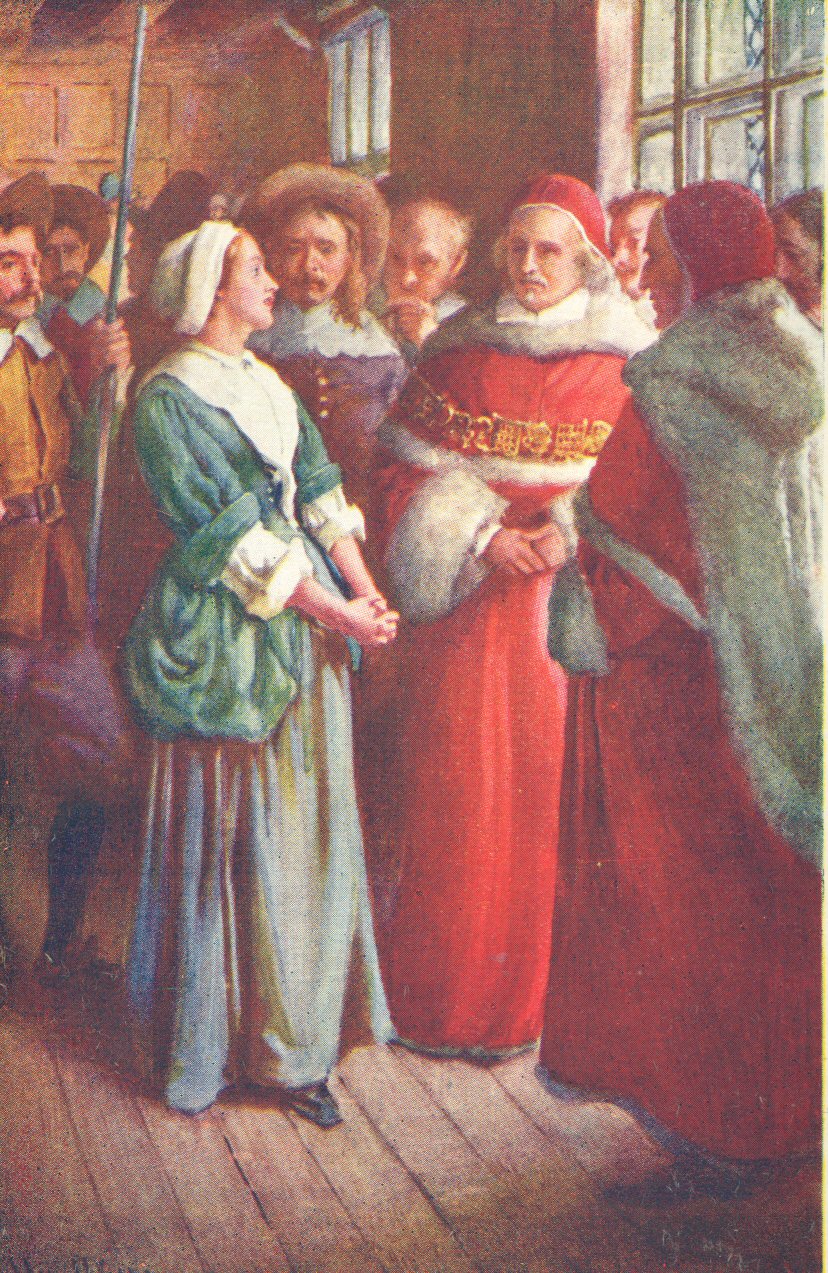
Woman. My lord (directing herself to judge Hale), I make bold to come once again to your Lordship, to know what may be done with my husband.
Woman. My lord (speaking to Judge Hale), I have come before you once again to ask what can be done about my husband.
Judge Hale. To whom he said, Woman, I told thee before I could do thee no good; because they have taken that for a conviction which thy husband spoke at the sessions: and unless there be something done to undo that, I can do thee no good.
Judge Hale. He said to her, Woman, I told you before that I could not help you. This is because they have taken what your husband said at the sessions as a conviction. Unless something is done to undo that conviction, I cannot help you.
Woman. My lord, said she, he is kept unlawfully in prison; they clapped him up before there was any proclamation against the meetings; the indictment also is false. Besides, they never asked him whether he was guilty or no; neither did he confess the indictment.
Woman. My lord, she said, he is being held in prison unlawfully. They locked him up before any proclamation against the meetings. The indictment is also false. Besides, they never asked him whether he was guilty. He did not admit to the charges in the indictment either.
One of the Justices. Then one of the justices that stood by, whom she knew not, said, My Lord, he was lawfully convicted.
One of the Justices. Then one of the justices standing nearby spoke. She did not know him. He said, My Lord, he was lawfully convicted.
Wom. It is false, said she; for when they said to him, Do you confess the indictment? he said only this, that he had been at several meetings, both where there were preaching the Word, and prayer, and that they had God’s presence among them.
Wom. “That is false,” she said. “When they asked him, ‘Do you admit the charges?’ he said only this. He had attended several meetings where the Word was preached and prayers were offered. And God’s presence was with them at those meetings.”
Judge Twisdon. Whereat Judge Twisdon answered very angrily, saying, What, you think we can do what we list; your husband is a breaker of the peace, and is convicted by the law, etc. Whereupon Judge Hale called for the Statute Book.
Judge Twisdon. Judge Twisdon answered very angrily, saying, What, do you think we can do whatever we please? Your husband is a breaker of the peace and has been convicted under the law, etc. Then Judge Hale called for the Statute Book.
Wom. But, said she, my lord, he was not lawfully convicted.
Wom. But she said, my lord, he was not lawfully convicted.
Chester. Then Justice Chester said, My lord, he was lawfully convicted.
Chester. Then Justice Chester said, My lord, he was legally convicted.
Wom. It is false, said she; it was but a word of discourse that they took for a conviction (as you heard before).
Wom. “That is false,” she said. “It was only something said in conversation that they took as conviction, as you heard before.”
Chest. But it is recorded, woman; it is recorded, said Justice Chester; as if it must be of necessity true, because it was recorded. With which words he often endeavoured to stop her mouth, having no other argument to convince her, but it is recorded, it is recorded.
Chest. But it is recorded, woman. It is recorded, said Justice Chester. He spoke as if it had to be true because it was recorded. He often tried to silence her with these words. He had no other argument to convince her, only that it was recorded, it was recorded.
Wom. My Lord, said she, I was a while since at London, to see if I could get my husband’s liberty; and there I spoke with my lord Barkwood, one of the House of Lords, to whom I delivered a petition, who took it of me and presented it to some of the rest of the House of Lords, for my husband’s releasement; who, when they had seen it, they said, that they could not release him, but had committed his releasement to the judges, at the next assizes. This he told me; and now I am come to you to see if any thing may be done in this business, and you give neither releasement nor relief. To which they gave her no answer, but made as if they heard her not.
Wom. My Lord, she said, some time ago I went to London to see if I could secure my husband’s release. There I spoke with my lord Barkwood, a member of the House of Lords, and gave him a petition. He presented it to some of the other Lords, asking for my husband’s release. After reading it, they said they could not release him. They had left the decision about his release to the judges at the next assizes. Lord Barkwood told me this. Now I have come to you to see if anything can be done in this matter, but you offer neither release nor relief. They gave her no answer and pretended not to hear her.
Chest. Only Justice Chester was often up with this,—He is convicted, and it is recorded.
Chest. Only Justice Chester often repeated this: He is convicted, and it is recorded.
Wom. If it be, it is false, said she.
Wom. If it is, it is false, she said.
Chest. My lord, said Justice Chester, he is a pestilent fellow, there is not such a fellow in the country again.
Chest. My lord, said Justice Chester, he is a dangerous man. There is no one else like him in the country.
Twis. What, will your husband leave preaching? If he will do so, then send for him.
Twis. What, will your husband stop preaching? If he will, then send for him.
Wom. My lord, said she, he dares not leave preaching as long as he can speak.
Wom. My lord, she said, he dares not stop preaching as long as he can speak.
Twis. See here, what should we talk any more about such a fellow? Must he do what he lists? He is a breaker of the peace.
Twis. Look here, why should we talk any more about a fellow like that? Can he do whatever he wants? He is a breaker of the peace.
Wom. She told him again, that he desired to live peaceably, and to follow his calling, that his family might be maintained; and moreover, said, My Lord, I have four small children, that cannot help themselves, one of which is blind, and have nothing to live upon, but the charity of good people.
Wom. She told him again that her husband wanted to live peacefully and work so he could support his family. She added, “My Lord, I have four young children who cannot care for themselves. One of them is blind. We have nothing to live on except the charity of good people.”
Hale. Hast thou four children? said Judge Hale; thou art but a young woman to have four children.
Hale. Do you have four children? said Judge Hale. You are very young to have four children.
Wom. My lord, said she, I am but mother-in-law to them, having not been married to him yet full two years. Indeed, I was with child when my husband was first apprehended; but being young, and unaccustomed to such things, said she, I being smayed [^224] at the news, fell into labour, and so continued for eight days, and then was delivered, but my child died.
Wom. My lord, she said, I am only their stepmother. I have not yet been married to him for two full years. I was pregnant when my husband was first arrested. But I was young and unused to such things. The news frightened me [^224], and I went into labor. I remained in labor for eight days, then gave birth, but my child died.
Hale. Whereat, he looking very soberly on the matter, said, Alas, poor woman!
Hale. At this, he looked very serious and said, Alas, poor woman!
Twis. But Judge Twisdon told her, that she made poverty her cloak; and said, moreover, that he understood I was maintained better by running up and down a preaching, than by following my calling.
Twis. But Judge Twisdon told her she was using poverty as an excuse. He also said he understood that I earned more by traveling around preaching than by working at my trade.
Hale. What is his calling? said Judge Hale.
Hale. What is his occupation? asked Judge Hale.
Answer. Then some of the company that stood by, said, A tinker, my lord.
Answer. Then some of the people standing nearby said, “A tinker, my lord.”
Wom. Yes, said she; and because he is a tinker, and a poor man, therefore he is despised, and cannot have justice.
Wom. Yes, she said. Because he is a tinker and a poor man, he is looked down on and cannot get justice.
Hale. Then Judge Hale answered very mildly, saying, I tell thee, woman, seeing it is so, that they have taken what thy husband spake for a conviction; thou must either apply thyself to the King, or sue out his pardon, or get a writ of error.
Hale. Then Judge Hale answered very gently: “Woman, they have taken what your husband said as grounds for conviction. Since that is so, you must appeal to the King, seek a pardon for your husband, or obtain a writ of error.”
Chest. But when Justice Chester heard him give her this counsel; and especially (as she supposed) because he spoke of a writ of error, he chafed, and seemed to be very much offended; saying, My lord, he will preach and do what he lists.
Chest. But when Justice Chester heard him give her this advice, he grew angry and seemed deeply offended. She thought this was especially because he had spoken of a writ of error. Justice Chester said, My lord, he will preach and do whatever he pleases.
Wom. He preacheth nothing but the Word of God, said she.
Wom. He preaches nothing but the word of God, she said.
Twis. He preach the Word of God! said Twisdon; and withal, she thought he would have struck her; he runneth up and down, and doth harm.
Twis. “He preaches the Word of God!” said Twisdon. She thought he was about to strike her. “He runs around doing harm.”
Wom. No, my lord, said she, it is not so; God hath owned him, and done much good by him.
Wom. No, my lord, she said, that is not true. God has accepted him and done much good through him.
Twis. God! said he, his doctrine is the doctrine of the devil.
Twis. God! he said, his teaching is the devil's teaching.
Wom. My lord, said she, when the righteous Judge shall appear, it will be known that his doctrine is not the doctrine of the devil.
Wom. My lord, she said, when the righteous Judge appears, everyone will know that his teaching is not from the devil.
Twis. My lord, said he, to Judge Hale, do not mind her, but send her away.
Twis. He said to Judge Hale, “My lord, do not listen to her. Send her away.”
Hale. Then said Judge Hale, I am sorry, woman, that I can do thee no good; thou must do one of those three things aforesaid, namely, either to apply thyself to the King, or sue out his pardon, or get a writ of error; but a writ of error will be cheapest.
Hale. Then Judge Hale said, I am sorry, woman, that I cannot help you. You must do one of the three things mentioned earlier. You must appeal to the King, seek his pardon, or obtain a writ of error. But a writ of error will be cheapest.
Wom. At which Chester again seemed to be in a chafe, and put off his hat, and as she thought, scratched his head for anger: but when I saw, said she, that there was no prevailing to have my husband sent for, though I often desired them that they would send for him, that he might speak for himself; telling them, that he could give them better satisfaction than I could, in what they demanded of him, with several other things, which now I forget; only this I remember, that though I was somewhat timorous at my first entrance into the chamber, yet before I went out, I could not but break forth into tears, not so much because they were so hard-hearted against me, and my husband, but to think what a sad account such poor creatures will have to give at the coming of the Lord, when they shall there answer for all things whatsoever they have done in the body, whether it be good, or whether it be bad.
Wom. At this, Chester again seemed angry. He took off his hat and, she thought, scratched his head in anger. “But I saw that I could not persuade them to send for my husband,” she said. “I often asked them to send for him so that he could speak for himself. I told them he could answer their questions better than I could. I said several other things that I now forget. “I do remember that I was somewhat afraid when I first entered the chamber. But before I left, I could not help bursting into tears. It was not so much because they were hard-hearted toward me and my husband. Rather, I thought of the sad account those poor creatures would have to give when the Lord comes. Then they will have to answer for everything they have done in the body, whether good or bad.”
So, when I departed from them, the book of statutes was brought, but what they said of it I know nothing at all, neither did I hear any more from them.
So, when I left them, the book of statutes was brought in. But I know nothing at all about what they said about it, and I heard nothing more from them.
Some Carriages of the Adversaries of God’s Truth with me at the next Assizes, which was on the 19th of the first month, 1662.
Some ways the opponents of God’s truth treated me at the next Assizes, which were on the 19th of the first month, 1662.
I shall pass by what befell between these two assizes, how I had, by my jailor, some liberty granted me, more than at the first, and how I followed my wonted course of preaching, taking all occasions that were put into my hand to visit the people of God; exhorting them to be steadfast in the faith of Jesus Christ, and to take heed that they touched not the Common Prayer, etc., but to mind the Word of God, which giveth direction to Christians in every point, being able to make the man of God perfect in all things through faith in Jesus Christ, and thoroughly to furnish him unto all good works. 2 Tim. iii. 17. Also how I having, I say, somewhat more liberty, did go to see the Christians at London; which my enemies hearing of, were so angry, that they had almost cast my jailor out of his place, threatening to indict him, and to do what they could against him. They charged me also, that I went thither to plot and raise division, and make insurrection, which, God knows, was a slander; whereupon my liberty was more straitened than it was before; so that I must not now look out of the door. Well, when the next sessions came, which was about the 10th of the 11th month (1661), I did expect to have been very roundly dealt withal; but they passed me by, and would not call me, so that I rested till the assizes, which was held the 19th of the first month (1662) following; and when they came, because I had a desire to come before the judge, I desired my jailor to put my name into the calendar among the felons, and made friends of the judge and high-sheriff, who promised that I should be called: so that I thought what I had done might have been effectual for the obtaining of my desire: but all was in vain; for when the assizes came, though my name was in the calendar, and also though both the judge and sheriff had promised that I should appear before them, yet the justices and the clerk of the peace, did so work it about, that I, notwithstanding, was deferred, and was not suffered to appear: and although I say, I do not know of all their carriages towards me, yet this I know, that the clerk of the peace (Mr Cobb) did discover himself to be one of my greatest opposers: for, first he came to my jailor and told him that I must not go down before the judge, and therefore must not be put into the calendar; to whom my jailor said, that my name was in already. He bid him put it out again; my jailor told him that he could not: for he had given the judge a calendar with my name in it, and also the sheriff another. At which he was very much displeased, and desired to see that calendar that was yet in my jailor’s hand, who, when he had given it him, he looked on it, and said it was a false calendar; he also took the calendar and blotted out my accusation, as my jailor had written it (which accusation I cannot tell what it was, because it was so blotted out), and he himself put in words to this purpose: That John Bunyan was committed to prison; being lawfully convicted for upholding of unlawful meetings and conventicles, etc. But yet for all this, fearing that what he had done, unless he added thereto, it would not do, he first ran to the clerk of the assizes; then to the justices, and afterwards, because he would not leave any means unattempted to hinder me, he came again to my jailor, and told him, that if I did go down before the judge, and was released, he would make him pay my fees, which he said was due to him; and further, told him, that he would complain of him at the next quarter sessions for making of false calendars, though my jailor himself, as I afterwards learned, had put in my accusation worse than in itself it was by far. And thus was I hindered and prevented at that time also from appearing before the judge: and left in prison.
I will pass over what happened between these two assizes. My jailer gave me somewhat more freedom than I had at first, and I continued my usual practice of preaching. I took every opportunity offered to visit God’s people. I urged them to remain steadfast in their faith in Jesus Christ and to take care not to touch the Common Prayer, etc. Instead, they should attend to the Word of God, which guides Christians in every matter. Through faith in Jesus Christ, it can make the man of God perfect in all things and fully equip him for every good work. 2 Tim. iii. 17. I will also pass over how, having somewhat more freedom, I went to see the Christians in London. When my enemies heard of it, they were so angry that they nearly had my jailer dismissed. They threatened to bring charges against him and to do whatever they could against him. They also accused me of going there to plot, stir up division, and incite an uprising. God knows that was a slander. As a result, my freedom was restricted more than before, so that I was no longer allowed even to look out of the door. When the next sessions came, around the 10th of the 11th month (1661), I expected to be dealt with very harshly. But they passed me over and would not call me. So I remained in prison until the assizes held on the 19th of the first month (1662) following. I wanted to appear before the judge, so I asked my jailer to put my name on the calendar among the felons. I also enlisted the help of the judge and the high-sheriff, who promised that I would be called. I thought that what I had done might succeed in getting me the hearing I wanted. But it was all in vain. When the assizes came, my name was on the calendar, and both the judge and the sheriff had promised that I would appear before them. Yet the justices and the clerk of the peace arranged matters so that my case was postponed, and I was not allowed to appear. Although I do not know everything they did concerning me, I do know this. The clerk of the peace, Mr Cobb, showed himself to be one of my greatest opponents. First, he came to my jailer and told him that I must not go before the judge. My name, therefore, must not be put on the calendar. My jailer told him that my name was already on it. Mr Cobb ordered him to remove it, but my jailer said he could not. He had already given the judge one calendar with my name on it and the sheriff another. Mr Cobb was very displeased and asked to see the calendar still in my jailer’s possession. When my jailer gave it to him, he looked at it and said it was a false calendar. He also blotted out the charge as my jailer had written it. I cannot say what the charge was, because it was so thoroughly blotted out. Mr Cobb then wrote words to this effect: that John Bunyan had been committed to prison after being lawfully convicted of supporting unlawful meetings and conventicles, etc. Even after all this, he feared that what he had done would not be enough unless he did more. So he ran first to the clerk of the assizes, then to the justices. Afterward, because he wanted to leave no means untried to hinder me, he came back to my jailer. He told him that if I went before the judge and was released, he would make the jailer pay my fees, which he said were owed to him. He also said he would complain about the jailer at the next quarter sessions for making false calendars. Yet, as I later learned, my jailer himself had written the charge against me as far worse than it really was. And so, once again, I was prevented from appearing before the judge and left in prison.
Farewell.
Goodbye.
John Bunyan.
John Bunyan.