This dialogue follows Socrates as he questions public speakers about persuasion, power, and justice. He compares persuasive speech to cooking, arguing that both can please people without doing them good.
209 pages 4h 3m reading time
The work where Western thought first sharply asks whether the power to persuade is good or dangerous.
Argues that it is worse to do wrong than to suffer wrong, and that a person who does wrong is better off being punished than escaping it.
Pits Socrates against Callicles, who says the strong should take what they want and that justice is a trick the weak use to hold them back, a challenge later echoed by Nietzsche.
Ends with a myth of souls judged naked after death, one of the earliest pictures in Western writing of a final judgment based on how a person lived.
Shaped the long debate over rhetoric (the art of persuasive speech), which Aristotle took up in his own book on the subject and which still frames how people judge politicians and advertisers.
Shadowed by Socrates' death
Written after Athens executed Socrates, it has him predict he would be helpless if put on trial.
Gorgias was a real star
The title figure was a famous speaker from Sicily whose speeches had dazzled crowds in Athens.
A mysterious opponent
No record of Callicles survives outside this dialogue, so scholars still debate whether he really existed.
A reaction from Gorgias
A later ancient story claims Gorgias read the dialogue and remarked on how well Plato could mock people.


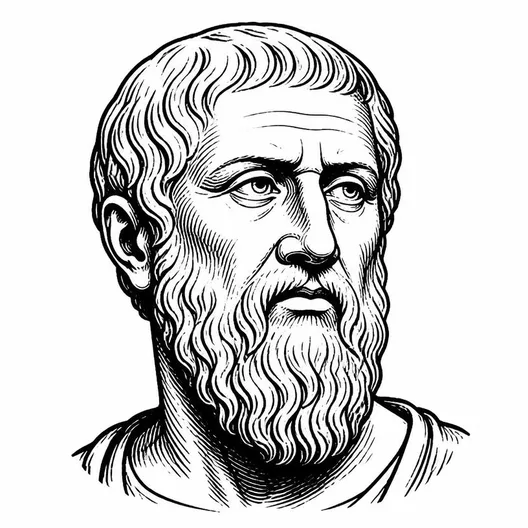 Plato c. 380 BCE