Chapter 5
The River and the Range
My next business was to descend upon the river. I had lost sight of the pass which I had seen from the saddle, but had made such notes of it that I could not fail to find it. I was bruised and stiff, and my boots had begun to give, for I had been going on rough ground for more than three weeks; but, as the day wore on, and I found myself descending without serious difficulty, I became easier. In a couple of hours I got among pine forests where there was little undergrowth, and descended quickly till I reached the edge of another precipice, which gave me a great deal of trouble, though I eventually managed to avoid it. By about three or four o’clock I found myself on the river-bed.
My next task was to descend to the river. I could no longer see the pass I had spotted from the saddle. But I had made such careful notes that I was sure to find it. I was bruised and stiff, and my boots had begun to wear out. I had been traveling over rough ground for more than three weeks. But as the day went on, I felt more at ease. I was descending without serious difficulty. In a couple of hours, I reached pine forests with little undergrowth. I descended quickly until I came to the edge of another precipice. It gave me a great deal of trouble, though I eventually managed to avoid it. By about three or four o’clock, I reached the riverbed.
From calculations which I made as to the height of the valley on the other side the saddle over which I had come, I concluded that the saddle itself could not be less than nine thousand feet high; and I should think that the river-bed, on to which I now descended, was three thousand feet above the sea-level. The water had a terrific current, with a fall of not less than forty to fifty feet per mile. It was certainly the river next to the northward of that which flowed past my master’s run, and would have to go through an impassable gorge (as is commonly the case with the rivers of that country) before it came upon known parts. It was reckoned to be nearly two thousand feet above the sea-level where it came out of the gorge on to the plains.
I calculated the height of the valley beyond the mountain pass I had crossed. From this, I concluded that the pass itself must be at least nine thousand feet high. I estimated that the riverbed I was descending to was three thousand feet above sea level. The water had a terrific current, dropping at least forty to fifty feet per mile. It was certainly the next river north of the one that flowed past my employer’s ranch. Before reaching known territory, it would have to pass through a gorge that could not be crossed. This was common for rivers in that country. The river was estimated to be nearly two thousand feet above sea level where it emerged from the gorge onto the plains.
As soon as I got to the river side I liked it even less than I thought I should. It was muddy, being near its parent glaciers. The stream was wide, rapid, and rough, and I could hear the smaller stones knocking against each other under the rage of the waters, as upon a seashore. Fording was out of the question. I could not swim and carry my swag, and I dared not leave my swag behind me. My only chance was to make a small raft; and that would be difficult to make, and not at all safe when it was made,—not for one man in such a current.
As soon as I reached the riverbank, I liked the river even less than I had expected. It was muddy because it was close to the glaciers where it began. The river was wide, fast, and rough. I could hear smaller stones knocking against one another beneath the raging water, as on a seashore. Wading across was out of the question. I could not swim while carrying my pack, and I did not dare leave it behind. My only chance was to make a small raft. But it would be difficult to make and not at all safe once finished, not for one man in such a current.
As it was too late to do much that afternoon, I spent the rest of it in going up and down the river side, and seeing where I should find the most favourable crossing. Then I camped early, and had a quiet comfortable night with no more music, for which I was thankful, as it had haunted me all day, although I perfectly well knew that it had been nothing but my own fancy, brought on by the reminiscence of what I had heard from Chowbok and by the over-excitement of the preceding evening.
Since it was too late to do much that afternoon, I walked up and down the riverbank, looking for the best place to cross. Then I made camp early and had a quiet, comfortable night. There was no more music, which I was thankful for, since it had haunted me all day. Even so, I knew perfectly well that I had only imagined it. The music had been brought on by memories of what I had heard from Chowbok and by the previous evening’s excitement.
Next day I began gathering the dry bloom stalks of a kind of flag or iris-looking plant, which was abundant, and whose leaves, when torn into strips, were as strong as the strongest string. I brought them to the waterside, and fell to making myself a kind of rough platform, which should suffice for myself and my swag if I could only stick to it. The stalks were ten or twelve feet long, and very strong, but light and hollow. I made my raft entirely of them, binding bundles of them at right angles to each other, neatly and strongly, with strips from the leaves of the same plant, and tying other rods across. It took me all day till nearly four o’clock to finish the raft, but I had still enough daylight for crossing, and resolved on doing so at once.
The next day I began gathering dry flower stalks from a plant that looked like a flag or iris. It grew in abundance, and its leaves, torn into strips, were as strong as the strongest string. I carried the stalks to the water and began making a rough platform. It would be enough to carry me and my belongings if I could only stay on it. The stalks were ten or twelve feet long and very strong, but light and hollow. I made my raft entirely from them. I bound bundles of stalks neatly and tightly at right angles to one another, using strips from the same plant’s leaves. I also tied other stalks across them. It took me all day, until nearly four o’clock, to finish the raft. But I still had enough daylight to cross, so I decided to set off at once.
I had selected a place where the river was broad and comparatively still, some seventy or eighty yards above a furious rapid. At this spot I had built my raft. I now launched it, made my swag fast to the middle, and got on to it myself, keeping in my hand one of the longest blossom stalks, so that I might punt myself across as long as the water was shallow enough to let me do so. I got on pretty well for twenty or thirty yards from the shore, but even in this short space I nearly upset my raft by shifting too rapidly from one side to the other. The water then became much deeper, and I leaned over so far in order to get the bloom rod to the bottom that I had to stay still, leaning on the rod for a few seconds. Then, when I lifted up the rod from the ground, the current was too much for me and I found myself being carried down the rapid. Everything in a second flew past me, and I had no more control over the raft; neither can I remember anything except hurry, and noise, and waters which in the end upset me. But it all came right, and I found myself near the shore, not more than up to my knees in water and pulling my raft to land, fortunately upon the left bank of the river, which was the one I wanted. When I had landed I found that I was about a mile, or perhaps a little less, below the point from which I started. My swag was wet upon the outside, and I was myself dripping; but I had gained my point, and knew that my difficulties were for a time over. I then lit my fire and dried myself; having done so I caught some of the young ducks and sea-gulls, which were abundant on and near the river-bed, so that I had not only a good meal, of which I was in great want, having had an insufficient diet from the time that Chowbok left me, but was also well provided for the morrow.
I had chosen a place where the river was wide and fairly calm, about seventy or eighty yards above a furious rapid. I had built my raft there. Now I launched it, tied my bundle securely in the middle, and climbed aboard. I held one of the longest flower stalks so I could push myself across as long as the water was shallow enough. I made fairly good progress for twenty or thirty yards from the shore. But even in that short distance, I nearly overturned the raft by shifting too quickly from one side to the other. Then the water became much deeper. I leaned so far over to reach the bottom with the stalk that I had to stay still for a few seconds, leaning on it. When I lifted the stalk from the riverbed, the current was too strong for me. I found myself being carried down the rapid. In an instant, everything rushed past me, and I had no more control over the raft. I can remember nothing but haste, noise, and water, which eventually overturned me. But everything turned out all right. I found myself near the shore, in water no deeper than my knees, pulling my raft to land. Fortunately, I was on the left bank, the one I wanted. Once ashore, I found that I was about a mile, or perhaps a little less, downstream from my starting point. My bundle was wet on the outside, and I was dripping. But I had reached my goal and knew my difficulties were over for the time being. I then lit a fire and dried myself. After that, I caught some young ducks and sea gulls, which were plentiful on and near the riverbed. So I had a good meal, which I badly needed. I had not eaten enough since Chowbok left me. I was also well supplied for the next day.
I thought of Chowbok, and felt how useful he had been to me, and in how many ways I was the loser by his absence, having now to do all sorts of things for myself which he had hitherto done for me, and could do infinitely better than I could. Moreover, I had set my heart upon making him a real convert to the Christian religion, which he had already embraced outwardly, though I cannot think that it had taken deep root in his impenetrably stupid nature. I used to catechise him by our camp fire, and explain to him the mysteries of the Trinity and of original sin, with which I was myself familiar, having been the grandson of an archdeacon by my mother’s side, to say nothing of the fact that my father was a clergyman of the English Church. I was therefore sufficiently qualified for the task, and was the more inclined to it, over and above my real desire to save the unhappy creature from an eternity of torture, by recollecting the promise of St. James, that if any one converted a sinner (which Chowbok surely was) he should hide a multitude of sins. I reflected, therefore, that the conversion of Chowbok might in some degree compensate for irregularities and short-comings in my own previous life, the remembrance of which had been more than once unpleasant to me during my recent experiences.
I thought of Chowbok and how useful he had been to me. I felt how much I had lost by his absence. I now had to do all sorts of things for myself that he had done for me until then. He could do them infinitely better than I could. Moreover, I had set my heart on making him a true convert to Christianity. He had already outwardly embraced the religion, though I cannot think it had taken deep root in his impenetrably stupid nature. I used to question him about the faith by our campfire. I explained to him the mysteries of the Trinity and original sin, which I knew well myself. My maternal grandfather had been an archdeacon, not to mention the fact that my father was an English Church clergyman. I was therefore sufficiently qualified for the task. Besides my genuine desire to save the unhappy creature from an eternity of torture, I had another reason for undertaking it. I remembered St. James’s promise that anyone who converted a sinner would hide a multitude of sins. Chowbok was certainly a sinner. I therefore reflected that converting Chowbok might make up, to some degree, for the misdeeds and failings of my own past. During my recent experiences, I had more than once found it unpleasant to remember them.
Indeed, on one occasion I had even gone so far as to baptize him, as well as I could, having ascertained that he had certainly not been both christened and baptized, and gathering (from his telling me that he had received the name William from the missionary) that it was probably the first-mentioned rite to which he had been subjected. I thought it great carelessness on the part of the missionary to have omitted the second, and certainly more important, ceremony which I have always understood precedes christening both in the case of infants and of adult converts; and when I thought of the risks we were both incurring I determined that there should be no further delay. Fortunately it was not yet twelve o’clock, so I baptized him at once from one of the pannikins (the only vessels I had) reverently, and, I trust, efficiently. I then set myself to work to instruct him in the deeper mysteries of our belief, and to make him, not only in name, but in heart a Christian.
Indeed, on one occasion I had even baptized him as best I could. I had established that he had certainly not been both christened and baptized. He had told me that the missionary had given him the name William. From this, I gathered that he had probably been christened. I thought the missionary very careless to have omitted baptism, which was certainly the more important ceremony. I had always understood that baptism came before christening, both for infants and adult converts. When I thought of the risks we were both taking, I decided not to delay any longer. Fortunately, it was not yet twelve o’clock, so I baptized him at once. I used one of the pannikins, the only vessels I had. I did it reverently and, I trust, effectively. I then set to work teaching him the deeper mysteries of our faith. I wanted to make him a Christian, not only in name, but in his heart.
It is true that I might not have succeeded, for Chowbok was very hard to teach. Indeed, on the evening of the same day that I baptized him he tried for the twentieth time to steal the brandy, which made me rather unhappy as to whether I could have baptized him rightly. He had a prayer-book—more than twenty years old—which had been given him by the missionaries, but the only thing in it which had taken any living hold upon him was the title of Adelaide the Queen Dowager, which he would repeat whenever strongly moved or touched, and which did really seem to have some deep spiritual significance to him, though he could never completely separate her individuality from that of Mary Magdalene, whose name had also fascinated him, though in a less degree.
It is true that I might not have succeeded, for Chowbok was very hard to teach. In fact, on the evening of the day I baptized him, he tried to steal the brandy for the twentieth time. This made me rather uneasy about whether I could have baptized him properly. He had a prayer book more than twenty years old, given to him by the missionaries. But the only thing in it that had made a lasting impression on him was the title of Adelaide the Queen Dowager. He would repeat it whenever he was deeply moved or touched. The title really did seem to have some deep spiritual meaning for him. Yet he could never completely separate her identity from that of Mary Magdalene. Her name had also fascinated him, though to a lesser degree.
He was indeed stony ground, but by digging about him I might have at any rate deprived him of all faith in the religion of his tribe, which would have been half way towards making him a sincere Christian; and now all this was cut off from me, and I could neither be of further spiritual assistance to him nor he of bodily profit to myself: besides, any company was better than being quite alone.
He was indeed stony ground. But by working on him, I might at least have destroyed all his faith in his tribe's religion. That would have been halfway toward making him a sincere Christian. Now all this was out of my reach. I could no longer help him spiritually, nor could he be of any practical use to me. Besides, any company was better than being completely alone.
I got very melancholy as these reflections crossed me, but when I had boiled the ducks and eaten them I was much better. I had a little tea left and about a pound of tobacco, which should last me for another fortnight with moderate smoking. I had also eight ship biscuits, and, most precious of all, about six ounces of brandy, which I presently reduced to four, for the night was cold.
I grew very gloomy as these thoughts crossed my mind. But after I boiled and ate the ducks, I felt much better. I had a little tea left and about a pound of tobacco. The tobacco would last another two weeks if I smoked moderately. I also had eight ship biscuits and, most precious of all, about six ounces of brandy. I soon reduced the brandy to four ounces, for the night was cold.
I rose with early dawn, and in an hour I was on my way, feeling strange, not to say weak, from the burden of solitude, but full of hope when I considered how many dangers I had overcome, and that this day should see me at the summit of the dividing range.
I got up at dawn and set out an hour later. The weight of solitude made me feel strange, even weak. But I was full of hope when I thought of all the dangers I had overcome. I would reach the summit of the dividing range that day.
After a slow but steady climb of between three and four hours, during which I met with no serious hindrance, I found myself upon a tableland, and close to a glacier which I recognised as marking the summit of the pass. Above it towered a succession of rugged precipices and snowy mountain sides. The solitude was greater than I could bear; the mountain upon my master’s sheep-run was a crowded thoroughfare in comparison with this sombre sullen place. The air, moreover, was dark and heavy, which made the loneliness even more oppressive. There was an inky gloom over all that was not covered with snow and ice. Grass there was none.
After a slow but steady climb of three to four hours, I reached a plateau. I had met no serious obstacles along the way. Nearby was a glacier that I recognized as marking the top of the pass. Above it towered a series of rugged cliffs and snowy mountain slopes. The solitude was more than I could bear. The mountain on my master's sheep farm was a crowded thoroughfare compared with this dark, forbidding place. The air was dark and heavy too, making the loneliness even more oppressive. Everything not covered in snow and ice lay in an inky gloom. There was no grass.
Each moment I felt increasing upon me that dreadful doubt as to my own identity—as to the continuity of my past and present existence—which is the first sign of that distraction which comes on those who have lost themselves in the bush. I had fought against this feeling hitherto, and had conquered it; but the intense silence and gloom of this rocky wilderness were too much for me, and I felt that my power of collecting myself was beginning to be impaired.
With each moment, I felt a dreadful doubt about my own identity growing stronger. I doubted whether my past and present existence were truly connected. This is the first sign of the mental confusion that comes over people lost in the bush. Until then, I had fought and overcome this feeling. But the intense silence and gloom of this rocky wilderness were too much for me. I felt that I was beginning to lose my ability to pull myself together.
I rested for a little while, and then advanced over very rough ground, until I reached the lower end of the glacier. Then I saw another glacier, descending from the eastern side into a small lake. I passed along the western side of the lake, where the ground was easier, and when I had got about half way I expected that I should see the plains which I had already seen from the opposite mountains; but it was not to be so, for the clouds rolled up to the very summit of the pass, though they did not overlip it on to the side from which I had come. I therefore soon found myself enshrouded by a cold thin vapour, which prevented my seeing more than a very few yards in front of me. Then I came upon a large patch of old snow, in which I could distinctly trace the half-melted tracks of goats—and in one place, as it seemed to me, there had been a dog following them. Had I lighted upon a land of shepherds? The ground, where not covered with snow, was so poor and stony, and there was so little herbage, that I could see no sign of a path or regular sheep-track. But I could not help feeling rather uneasy as I wondered what sort of a reception I might meet with if I were to come suddenly upon inhabitants. I was thinking of this, and proceeding cautiously through the mist, when I began to fancy that I saw some objects darker than the cloud looming in front of me. A few steps brought me nearer, and a shudder of unutterable horror ran through me when I saw a circle of gigantic forms, many times higher than myself, upstanding grim and grey through the veil of cloud before me.
I rested for a little while, then crossed very rough ground until I reached the lower end of the glacier. There I saw another glacier coming down from the eastern side into a small lake. I walked along the western side of the lake, where the ground was easier. About halfway along, I expected to see the plains I had already seen from the mountains opposite. But it was not to be. Clouds rolled up to the very summit of the pass, though they did not spill over onto the side I had come from. Soon I was surrounded by a cold, thin mist that kept me from seeing more than a few yards ahead. Then I came upon a large patch of old snow, where I could clearly make out the half-melted tracks of goats. In one place, it seemed to me that a dog had been following them. Had I come upon a land of shepherds? Where the ground was not covered with snow, it was poor and stony, with very little grass. I could see no sign of a path or regular sheep track. But I could not help feeling rather uneasy as I wondered what sort of welcome I might receive if I suddenly came upon the inhabitants. I was thinking about this as I moved cautiously through the mist. Then I began to imagine I could see objects darker than the cloud looming ahead. A few steps brought me closer. When I saw a circle of gigantic forms, a shudder of unspeakable horror ran through me. They stood grim and grey through the veil of cloud before me, many times taller than I was.
I suppose I must have fainted, for I found myself some time afterwards sitting upon the ground, sick and deadly cold. There were the figures, quite still and silent, seen vaguely through the thick gloom, but in human shape indisputably.
I suppose I must have fainted, because some time later I found myself sitting on the ground, sick and deathly cold. The figures were still there, motionless and silent, dimly visible through the thick darkness. They were unmistakably human in shape.
A sudden thought occurred to me, which would have doubtless struck me at once had I not been prepossessed with forebodings at the time that I first saw the figures, and had not the cloud concealed them from me—I mean that they were not living beings, but statues. I determined that I would count fifty slowly, and was sure that the objects were not alive if during that time I could detect no sign of motion.
A sudden thought occurred to me: the figures were not living beings, but statues. The thought would surely have struck me at once, had I not been filled with dread when I first saw them, and had the cloud not concealed them from me. I decided to count slowly to fifty. If I saw no sign of movement during that time, I would be sure the figures were not alive.
How thankful was I when I came to the end of my fifty and there had been no movement!
I was so relieved when I reached the end of my fifty and there had been no movement!
I counted a second time—but again all was still.
I counted a second time, but again all was still.
I then advanced timidly forward, and in another moment I saw that my surmise was correct. I had come upon a sort of Stonehenge of rude and barbaric figures, seated as Chowbok had sat when I questioned him in the wool-shed, and with the same superhumanly malevolent expression upon their faces. They had been all seated, but two had fallen. They were barbarous—neither Egyptian, nor Assyrian, nor Japanese—different from any of these, and yet akin to all. They were six or seven times larger than life, of great antiquity, worn and lichen grown. They were ten in number. There was snow upon their heads and wherever snow could lodge. Each statue had been built of four or five enormous blocks, but how these had been raised and put together is known to those alone who raised them. Each was terrible after a different kind. One was raging furiously, as in pain and great despair; another was lean and cadaverous with famine; another cruel and idiotic, but with the silliest simper that can be conceived—this one had fallen, and looked exquisitely ludicrous in his fall—the mouths of all were more or less open, and as I looked at them from behind, I saw that their heads had been hollowed.
I moved forward timidly, and a moment later I saw that my guess was right. I had come upon a sort of Stonehenge made up of crude, barbaric figures. They were seated as Chowbok had sat when I questioned him in the wool-shed. Their faces wore the same superhumanly evil expression. All had been seated, but two had fallen. They were barbaric, neither Egyptian, nor Assyrian, nor Japanese. They were different from all of these, yet had something in common with each. They were six or seven times larger than life, very ancient, weathered, and covered with lichen. There were ten of them. Snow lay on their heads and wherever else it could settle. Each statue had been built from four or five enormous blocks. But only those who raised them knew how the blocks had been lifted and put together. Each statue was terrifying in a different way. One raged furiously, as if in pain and deep despair. Another was thin and deathly from hunger. Another looked cruel and stupid, but wore the silliest smirk imaginable. This one had fallen and looked wonderfully ridiculous lying there. The mouths of all the statues were open to some degree. As I looked at them from behind, I saw that their heads had been hollowed out.
I was sick and shivering with cold. Solitude had unmanned me already, and I was utterly unfit to have come upon such an assembly of fiends in such a dreadful wilderness and without preparation. I would have given everything I had in the world to have been back at my master’s station; but that was not to be thought of: my head was failing, and I felt sure that I could never get back alive.
I was sick and shivering with cold. Being alone had already left me shaken. I was completely unprepared to come upon such a gathering of fiends in that dreadful wilderness. I would have given everything I owned to be back at my master’s station. But going back was out of the question. My mind was failing, and I was sure I could never get back alive.
Then came a gust of howling wind, accompanied with a moan from one of the statues above me. I clasped my hands in fear. I felt like a rat caught in a trap, as though I would have turned and bitten at whatever thing was nearest me. The wildness of the wind increased, the moans grew shriller, coming from several statues, and swelling into a chorus. I almost immediately knew what it was, but the sound was so unearthly that this was but little consolation. The inhuman beings into whose hearts the Evil One had put it to conceive these statues, had made their heads into a sort of organ-pipe, so that their mouths should catch the wind and sound with its blowing. It was horrible. However brave a man might be, he could never stand such a concert, from such lips, and in such a place. I heaped every invective upon them that my tongue could utter as I rushed away from them into the mist, and even after I had lost sight of them, and turning my head round could see nothing but the storm-wraiths driving behind me, I heard their ghostly chanting, and felt as though one of them would rush after me and grip me in his hand and throttle me.
Then came a gust of howling wind, along with a moan from one of the statues above me. I clasped my hands in fear. I felt like a rat caught in a trap, ready to turn and bite whatever was nearest. The wind grew wilder, and the moans grew shriller. They came from several statues, swelling into a chorus. I understood almost immediately what was happening, but the sound was so unearthly that this gave me little comfort. The inhuman beings who had conceived these statues had been inspired by the Evil One. They had made the statues’ heads into a kind of organ pipe. Their mouths caught the wind and sounded as it blew. It was horrible. However brave a man might be, he could never endure such a concert, from such lips, in such a place. I hurled every curse I could think of at the statues as I rushed away into the mist. Even after I lost sight of them, I could still hear their ghostly chanting. I turned my head and saw nothing but the ghostly shapes of the storm sweeping along behind me. Yet I felt as though one of the statues would rush after me, seize me in its hand, and strangle me.
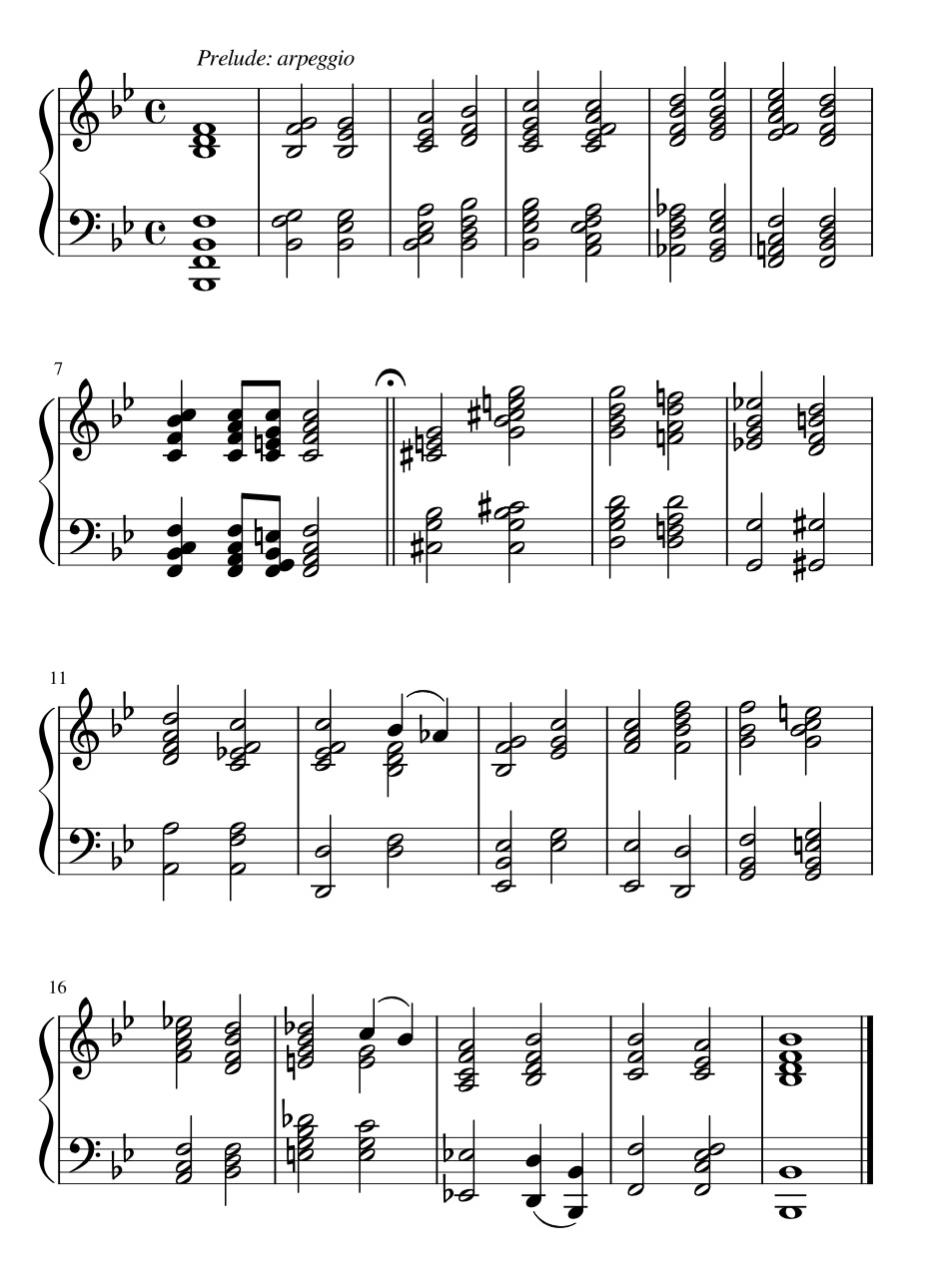
I may say here that, since my return to England, I heard a friend playing some chords upon the organ which put me very forcibly in mind of the Erewhonian statues (for Erewhon is the name of the country upon which I was now entering). They rose most vividly to my recollection the moment my friend began. They are as follows, and are by the greatest of all musicians:—
I should mention that, since returning to England, I heard a friend play some chords on the organ. They reminded me very strongly of the Erewhonian statues. Erewhon is the name of the country I was now entering. The statues came vividly to mind the moment my friend began. The chords are as follows, and were written by the greatest of all musicians:
See Handel’s compositions for the harpsichord, published by Litolf, p. 78.