Chapter 7
Visiting
One morning, as Miss Matty and I sat at our work—it was before twelve o’clock, and Miss Matty had not changed the cap with yellow ribbons that had been Miss Jenkyns’s best, and which Miss Matty was now wearing out in private, putting on the one made in imitation of Mrs Jamieson’s at all times when she expected to be seen—Martha came up, and asked if Miss Betty Barker might speak to her mistress. Miss Matty assented, and quickly disappeared to change the yellow ribbons, while Miss Barker came upstairs; but, as she had forgotten her spectacles, and was rather flurried by the unusual time of the visit, I was not surprised to see her return with one cap on the top of the other. She was quite unconscious of it herself, and looked at us, with bland satisfaction. Nor do I think Miss Barker perceived it; for, putting aside the little circumstance that she was not so young as she had been, she was very much absorbed in her errand, which she delivered herself of with an oppressive modesty that found vent in endless apologies.
One morning, Miss Matty and I sat doing our needlework. It was before twelve o’clock, and Miss Matty had not changed her cap with the yellow ribbons. The cap had been Miss Jenkyns’s best, and Miss Matty was now wearing it out in private. Whenever she expected to be seen, she wore the cap made to imitate Mrs Jamieson’s. Martha came up and asked if Miss Betty Barker might speak to her mistress. Miss Matty agreed and quickly went to change her cap while Miss Barker came upstairs. But she had forgotten her spectacles and was rather flustered by the unusual hour of the visit. So I was not surprised to see her return wearing one cap on top of the other. She was quite unaware of it and looked at us with gentle satisfaction. I do not think Miss Barker noticed it either. She was not as young as she had been, and she was very absorbed in the reason for her visit. She explained her errand with an overwhelming modesty that expressed itself in endless apologies.
Miss Betty Barker was the daughter of the old clerk at Cranford who had officiated in Mr Jenkyns’s time. She and her sister had had pretty good situations as ladies’ maids, and had saved money enough to set up a milliner’s shop, which had been patronised by the ladies in the neighbourhood. Lady Arley, for instance, would occasionally give Miss Barkers the pattern of an old cap of hers, which they immediately copied and circulated among the élite of Cranford. I say the élite, for Miss Barkers had caught the trick of the place, and piqued themselves upon their “aristocratic connection.” They would not sell their caps and ribbons to anyone without a pedigree. Many a farmer’s wife or daughter turned away huffed from Miss Barkers’ select millinery, and went rather to the universal shop, where the profits of brown soap and moist sugar enabled the proprietor to go straight to (Paris, he said, until he found his customers too patriotic and John Bullish to wear what the Mounseers wore) London, where, as he often told his customers, Queen Adelaide had appeared, only the very week before, in a cap exactly like the one he showed them, trimmed with yellow and blue ribbons, and had been complimented by King William on the becoming nature of her head-dress.
Miss Betty Barker was the daughter of Cranford’s old clerk, who had served in Mr Jenkyns’s time. She and her sister had held fairly good jobs as ladies’ maids. They had saved enough money to open a millinery shop, where local ladies bought their hats. Lady Arley, for example, would occasionally give the Miss Barkers a pattern from one of her old caps. They would immediately copy it and sell the copies among Cranford’s élite. I say élite because the Miss Barkers had picked up the local habit of priding themselves on their “aristocratic connection.” They would not sell their caps and ribbons to anyone without a pedigree. Many a farmer’s wife or daughter left the Miss Barkers’ exclusive millinery shop in a huff. They went instead to the general store, where profits from brown soap and moist sugar paid for the owner’s trips to London. He used to say he went to Paris, until he found his customers were too patriotic and John Bullish to wear what the Mounseers wore. The owner often told his customers that Queen Adelaide had appeared in London only the week before. She had worn a cap exactly like the one he showed them, trimmed with yellow and blue ribbons. King William, he said, had complimented her on how becoming it was.
Miss Barkers, who confined themselves to truth, and did not approve of miscellaneous customers, throve notwithstanding. They were self-denying, good people. Many a time have I seen the eldest of them (she that had been maid to Mrs Jamieson) carrying out some delicate mess to a poor person. They only aped their betters in having “nothing to do” with the class immediately below theirs. And when Miss Barker died, their profits and income were found to be such that Miss Betty was justified in shutting up shop and retiring from business. She also (as I think I have before said) set up her cow; a mark of respectability in Cranford almost as decided as setting up a gig is among some people. She dressed finer than any lady in Cranford; and we did not wonder at it; for it was understood that she was wearing out all the bonnets and caps and outrageous ribbons which had once formed her stock-in-trade. It was five or six years since she had given up shop, so in any other place than Cranford her dress might have been considered passée.
The Miss Barkers stuck to the truth and did not approve of customers from all sorts of backgrounds. Even so, they prospered. They were kind, self-denying people. Many times I saw the older sister, who had been Mrs Jamieson's maid, carrying a delicate dish to a poor person. They only copied their social superiors by having “nothing to do” with the class immediately below their own. When Miss Barker died, their profits and income proved large enough to justify Miss Betty closing the shop and retiring from business. As I think I have said before, she also acquired a cow. In Cranford, owning a cow was almost as clear a sign of respectability as owning a gig was among some people. She dressed more finely than any lady in Cranford, and we were not surprised. We understood that she was wearing out all the bonnets, caps, and outrageous ribbons that had once been her stock-in-trade. She had given up the shop five or six years earlier, so anywhere but Cranford her clothes might have been considered out of fashion.
And now Miss Betty Barker had called to invite Miss Matty to tea at her house on the following Tuesday. She gave me also an impromptu invitation, as I happened to be a visitor—though I could see she had a little fear lest, since my father had gone to live in Drumble, he might have engaged in that “horrid cotton trade,” and so dragged his family down out of “aristocratic society.” She prefaced this invitation with so many apologies that she quite excited my curiosity. “Her presumption” was to be excused. What had she been doing? She seemed so overpowered by it I could only think that she had been writing to Queen Adelaide to ask for a receipt for washing lace; but the act which she so characterised was only an invitation she had carried to her sister’s former mistress, Mrs Jamieson. “Her former occupation considered, could Miss Matty excuse the liberty?” Ah! thought I, she has found out that double cap, and is going to rectify Miss Matty’s head-dress. No! it was simply to extend her invitation to Miss Matty and to me. Miss Matty bowed acceptance; and I wondered that, in the graceful action, she did not feel the unusual weight and extraordinary height of her head-dress. But I do not think she did, for she recovered her balance, and went on talking to Miss Betty in a kind, condescending manner, very different from the fidgety way she would have had if she had suspected how singular her appearance was. “Mrs Jamieson is coming, I think you said?” asked Miss Matty.
Miss Betty Barker had now called to invite Miss Matty to tea at her house the following Tuesday. She also invited me on the spur of the moment, since I happened to be visiting. But I could see she was a little afraid that my father might have entered that “horrid cotton trade” after moving to Drumble. If so, he might have dragged his family down out of “aristocratic society.” She offered the invitation with so many apologies that she made me very curious. “Her presumption” was to be excused. What had she done? She seemed so overwhelmed by it that I could only think she had written to Queen Adelaide for a recipe for washing lace. But the act she described that way was only an invitation she had taken to her sister’s former mistress, Mrs Jamieson. “Considering her former occupation, could Miss Matty excuse the liberty?” Ah, I thought, she has noticed the two caps and is going to put Miss Matty’s head-dress right. No! She simply meant to invite Miss Matty and me as well. Miss Matty bowed to accept, and I wondered that she did not feel the unusual weight and extraordinary height of her head-dress as she made this graceful gesture. But I do not think she did. She regained her balance and went on talking to Miss Betty in a kind, gracious manner. It was very different from how fidgety she would have been if she had suspected how strange she looked. “Mrs Jamieson is coming, I think you said?” asked Miss Matty.
“Yes. Mrs Jamieson most kindly and condescendingly said she would be happy to come. One little stipulation she made, that she should bring Carlo. I told her that if I had a weakness, it was for dogs.”
“Yes. Mrs Jamieson very kindly and graciously said she would be happy to come. She had one small condition: she wanted to bring Carlo. I told her that if I had a weakness, it was for dogs.”
“And Miss Pole?” questioned Miss Matty, who was thinking of her pool at Preference, in which Carlo would not be available as a partner.
“And Miss Pole?” asked Miss Matty. She was thinking about her game of Preference, where Carlo could not be her partner.
“I am going to ask Miss Pole. Of course, I could not think of asking her until I had asked you, madam—the rector’s daughter, madam. Believe me, I do not forget the situation my father held under yours.”
“I’m going to ask Miss Pole. Of course, I couldn’t ask her before asking you, madam. You are the rector’s daughter, after all. Believe me, I haven’t forgotten that my father worked under yours.”
“And Mrs Forrester, of course?”
“And Mrs Forrester, of course?”
“And Mrs Forrester. I thought, in fact, of going to her before I went to Miss Pole. Although her circumstances are changed, madam, she was born a Tyrrell, and we can never forget her alliance to the Bigges, of Bigelow Hall.”
“And Mrs Forrester. In fact, I thought of visiting her before Miss Pole. Although her circumstances have changed, madam, she was born a Tyrrell. And we can never forget her connection to the Bigges of Bigelow Hall.”
Miss Matty cared much more for the little circumstance of her being a very good card-player.
Miss Matty cared much more about the little detail that she was a very good card player.
“Mrs Fitz-Adam—I suppose”—
“Mrs Fitz-Adam, I suppose...”
“No, madam. I must draw a line somewhere. Mrs Jamieson would not, I think, like to meet Mrs Fitz-Adam. I have the greatest respect for Mrs Fitz-Adam—but I cannot think her fit society for such ladies as Mrs Jamieson and Miss Matilda Jenkyns.”
“No, madam. I must draw the line somewhere. I don’t think Mrs Jamieson would like to meet Mrs Fitz-Adam. I have the greatest respect for Mrs Fitz-Adam. But I don’t think she is suitable company for ladies like Mrs Jamieson and Miss Matilda Jenkyns.”
Miss Betty Barker bowed low to Miss Matty, and pursed up her mouth. She looked at me with sidelong dignity, as much as to say, although a retired milliner, she was no democrat, and understood the difference of ranks.
Miss Betty Barker bowed deeply to Miss Matty and pursed her lips. She gave me a dignified sideways glance. It seemed to say that, although she was a retired hatmaker, she was no democrat and understood the differences between social ranks.
“May I beg you to come as near half-past six to my little dwelling, as possible, Miss Matilda? Mrs Jamieson dines at five, but has kindly promised not to delay her visit beyond that time—half-past six.” And with a swimming curtsey Miss Betty Barker took her leave.
“Could you please come to my little home as close to half past six as possible, Miss Matilda? Mrs Jamieson dines at five, but she has kindly promised to arrive no later than half past six.” With a graceful, sweeping curtsy, Miss Betty Barker took her leave.
My prophetic soul foretold a visit that afternoon from Miss Pole, who usually came to call on Miss Matilda after any event—or indeed in sight of any event—to talk it over with her.
My prophetic soul told me that Miss Pole would visit that afternoon. She usually came to see Miss Matilda after any event, or even when one was in sight, to talk it over.
“Miss Betty told me it was to be a choice and select few,” said Miss Pole, as she and Miss Matty compared notes.
“Miss Betty told me it was to be a small, select group,” said Miss Pole, as she and Miss Matty compared notes.
“Yes, so she said. Not even Mrs Fitz-Adam.”
“Yes, that’s what she said. Not even Mrs Fitz-Adam.”
Now Mrs Fitz-Adam was the widowed sister of the Cranford surgeon, whom I have named before. Their parents were respectable farmers, content with their station. The name of these good people was Hoggins. Mr Hoggins was the Cranford doctor now; we disliked the name and considered it coarse; but, as Miss Jenkyns said, if he changed it to Piggins it would not be much better. We had hoped to discover a relationship between him and that Marchioness of Exeter whose name was Molly Hoggins; but the man, careless of his own interests, utterly ignored and denied any such relationship, although, as dear Miss Jenkyns had said, he had a sister called Mary, and the same Christian names were very apt to run in families.
Mrs Fitz-Adam was the widowed sister of the Cranford surgeon I mentioned earlier. Their parents were respectable farmers who were content with their place in society. Their family name was Hoggins. Mr Hoggins was now the Cranford doctor. We disliked his name and thought it coarse. But as Miss Jenkyns said, if he changed it to Piggins, it would not be much better. We had hoped to find a family connection between him and the Marchioness of Exeter named Molly Hoggins. But the man, careless of his own interests, paid no attention to the possibility and flatly denied any such connection. This was despite the fact that he had a sister called Mary. As dear Miss Jenkyns had said, the same first names often run in families.
Soon after Miss Mary Hoggins married Mr Fitz-Adam, she disappeared from the neighbourhood for many years. She did not move in a sphere in Cranford society sufficiently high to make any of us care to know what Mr Fitz-Adam was. He died and was gathered to his fathers without our ever having thought about him at all. And then Mrs Fitz-Adam reappeared in Cranford (“as bold as a lion,” Miss Pole said), a well-to-do widow, dressed in rustling black silk, so soon after her husband’s death that poor Miss Jenkyns was justified in the remark she made, that “bombazine would have shown a deeper sense of her loss.”
Soon after Miss Mary Hoggins married Mr Fitz-Adam, she disappeared from the neighbourhood for many years. Her place in Cranford society was not high enough for any of us to care what Mr Fitz-Adam did. He died and was laid to rest with his ancestors, without our ever having thought about him at all. Then Mrs Fitz-Adam reappeared in Cranford, “as bold as a lion,” Miss Pole said. She was a well-off widow, dressed in rustling black silk. She returned so soon after her husband’s death that poor Miss Jenkyns was justified in saying that “bombazine would have shown a deeper sense of her loss.”
I remember the convocation of ladies who assembled to decide whether or not Mrs Fitz-Adam should be called upon by the old blue-blooded inhabitants of Cranford. She had taken a large rambling house, which had been usually considered to confer a patent of gentility upon its tenant, because, once upon a time, seventy or eighty years before, the spinster daughter of an earl had resided in it. I am not sure if the inhabiting this house was not also believed to convey some unusual power of intellect; for the earl’s daughter, Lady Jane, had a sister, Lady Anne, who had married a general officer in the time of the American war, and this general officer had written one or two comedies, which were still acted on the London boards, and which, when we saw them advertised, made us all draw up, and feel that Drury Lane was paying a very pretty compliment to Cranford. Still, it was not at all a settled thing that Mrs Fitz-Adam was to be visited, when dear Miss Jenkyns died; and, with her, something of the clear knowledge of the strict code of gentility went out too. As Miss Pole observed, “As most of the ladies of good family in Cranford were elderly spinsters, or widows without children, if we did not relax a little, and become less exclusive, by-and-by we should have no society at all.”
I remember the gathering of ladies who met to decide whether Cranford’s old blue-blooded residents should pay Mrs Fitz-Adam a visit. She had rented a large, rambling house. The house was generally thought to grant its tenant a certificate of gentility. This was because, seventy or eighty years earlier, the unmarried daughter of an earl had lived there. I am not sure whether living in the house was also thought to give someone unusual intellectual powers. The earl’s daughter, Lady Jane, had a sister, Lady Anne. Lady Anne had married a general during the American war. The general had written one or two comedies that were still performed on the London stage. Whenever we saw them advertised, we all sat up straighter. We felt that Drury Lane was paying Cranford a very pretty compliment. Still, when dear Miss Jenkyns died, it was far from settled whether Mrs Fitz-Adam would be visited. With Miss Jenkyns, some of our clear knowledge of the strict code of gentility died too. As Miss Pole observed, “Most of the ladies from good families in Cranford were elderly unmarried women or widows without children. If we did not relax a little and become less exclusive, before long we would have no society at all.”
Mrs Forrester continued on the same side.
Mrs Forrester stayed on the same side.
“She had always understood that Fitz meant something aristocratic; there was Fitz-Roy—she thought that some of the King’s children had been called Fitz-Roy; and there was Fitz-Clarence, now—they were the children of dear good King William the Fourth. Fitz-Adam!—it was a pretty name, and she thought it very probably meant ‘Child of Adam.’ No one, who had not some good blood in their veins, would dare to be called Fitz; there was a deal in a name—she had had a cousin who spelt his name with two little ffs—ffoulkes—and he always looked down upon capital letters and said they belonged to lately-invented families. She had been afraid he would die a bachelor, he was so very choice. When he met with a Mrs ffarringdon, at a watering-place, he took to her immediately; and a very pretty genteel woman she was—a widow, with a very good fortune; and ‘my cousin,’ Mr ffoulkes, married her; and it was all owing to her two little ffs.”
“She had always understood that Fitz meant something aristocratic. There was Fitz-Roy. She thought some of the King’s children had been called Fitz-Roy. And there was Fitz-Clarence. They were the children of dear, good King William the Fourth. Fitz-Adam! It was a pretty name, and she thought it very probably meant ‘Child of Adam.’ No one without some noble blood in their veins would dare to be called Fitz. There was a great deal in a name. She had had a cousin who spelled his name with two little ffs: ffoulkes. He always looked down on capital letters and said they belonged to recently invented families. She had feared he would never marry because he was so very particular. When he met a Mrs ffarringdon at a seaside resort, he took to her immediately. She was a very pretty, refined woman, a widow with a very good fortune. And ‘my cousin,’ Mr ffoulkes, married her. It was all because of her two little ffs.”
Mrs Fitz-Adam did not stand a chance of meeting with a Mr Fitz-anything in Cranford, so that could not have been her motive for settling there. Miss Matty thought it might have been the hope of being admitted into the society of the place, which would certainly be a very agreeable rise for ci-devant Miss Hoggins; and if this had been her hope it would be cruel to disappoint her.
Mrs Fitz-Adam had no chance of meeting a Mr Fitz-anything in Cranford. So that could not have been her reason for settling there. Miss Matty thought she might have hoped to be accepted into Cranford society. That would certainly be a pleasant rise in status for former Miss Hoggins. And if that was her hope, it would be cruel to disappoint her.
So everybody called upon Mrs Fitz-Adam—everybody but Mrs Jamieson, who used to show how honourable she was by never seeing Mrs Fitz-Adam when they met at the Cranford parties. There would be only eight or ten ladies in the room, and Mrs Fitz-Adam was the largest of all, and she invariably used to stand up when Mrs Jamieson came in, and curtsey very low to her whenever she turned in her direction—so low, in fact, that I think Mrs Jamieson must have looked at the wall above her, for she never moved a muscle of her face, no more than if she had not seen her. Still Mrs Fitz-Adam persevered.
So everyone called on Mrs Fitz-Adam, everyone except Mrs Jamieson. She used to show how honourable she was by pretending not to see Mrs Fitz-Adam when they met at Cranford parties. There would be only eight or ten ladies in the room, and Mrs Fitz-Adam was the largest of them all. She always stood up when Mrs Jamieson came in. Whenever Mrs Jamieson turned in her direction, Mrs Fitz-Adam gave her a very low curtsey. In fact, she curtseyed so low that I think Mrs Jamieson must have looked at the wall above her. Mrs Jamieson never moved a muscle of her face, just as if she had not seen her. Still, Mrs Fitz-Adam persisted.
The spring evenings were getting bright and long when three or four ladies in calashes met at Miss Barker’s door. Do you know what a calash is? It is a covering worn over caps, not unlike the heads fastened on old-fashioned gigs; but sometimes it is not quite so large. This kind of head-gear always made an awful impression on the children in Cranford; and now two or three left off their play in the quiet sunny little street, and gathered in wondering silence round Miss Pole, Miss Matty, and myself. We were silent too, so that we could hear loud, suppressed whispers inside Miss Barker’s house: “Wait, Peggy! wait till I’ve run upstairs and washed my hands. When I cough, open the door; I’ll not be a minute.”
The spring evenings were growing brighter and longer when three or four ladies in calashes met at Miss Barker’s door. Do you know what a calash is? It is a covering worn over a cap, rather like the hood of an old-fashioned gig. But a calash is sometimes not quite as large. This kind of headwear always made a frightening impression on the children of Cranford. Now two or three stopped playing in the quiet, sunny little street. They gathered around Miss Pole, Miss Matty, and me in wondering silence. We were silent too, so we could hear loud, hushed whispers inside Miss Barker’s house: “Wait, Peggy! Wait until I’ve run upstairs and washed my hands. When I cough, open the door. I won’t be a minute.”
And, true enough it was not a minute before we heard a noise, between a sneeze and a crow; on which the door flew open. Behind it stood a round-eyed maiden, all aghast at the honourable company of calashes, who marched in without a word. She recovered presence of mind enough to usher us into a small room, which had been the shop, but was now converted into a temporary dressing-room. There we unpinned and shook ourselves, and arranged our features before the glass into a sweet and gracious company-face; and then, bowing backwards with “After you, ma’am,” we allowed Mrs Forrester to take precedence up the narrow staircase that led to Miss Barker’s drawing-room. There she sat, as stately and composed as though we had never heard that odd-sounding cough, from which her throat must have been even then sore and rough. Kind, gentle, shabbily-dressed Mrs Forrester was immediately conducted to the second place of honour—a seat arranged something like Prince Albert’s near the Queen’s—good, but not so good. The place of pre-eminence was, of course, reserved for the Honourable Mrs Jamieson, who presently came panting up the stairs—Carlo rushing round her on her progress, as if he meant to trip her up.
And sure enough, less than a minute later, we heard a sound somewhere between a sneeze and a crow. Then the door flew open. Behind it stood a wide-eyed young woman, aghast at the distinguished company in calashes who marched in without a word. She recovered enough to show us into a small room. It had once been the shop, but had been turned into a temporary dressing room. There we unpinned and shook ourselves out, and arranged our faces in the mirror into sweet, gracious expressions for company. Then, bowing as we stepped back and saying “After you, ma’am,” we let Mrs Forrester go first. She led us up the narrow staircase to Miss Barker’s drawing room. Miss Barker sat there as stately and composed as though we had never heard that strange cough. Her throat must have been sore and rough from it even then. Kind, gentle, shabbily dressed Mrs Forrester was immediately shown to the second place of honour. Her seat was arranged rather like Prince Albert’s beside the Queen’s, a good place, but not quite so good. The most important place was, of course, reserved for the Honourable Mrs Jamieson. She soon came panting up the stairs, with Carlo rushing around her as she went, as if he meant to trip her up.
And now Miss Betty Barker was a proud and happy woman! She stirred the fire, and shut the door, and sat as near to it as she could, quite on the edge of her chair. When Peggy came in, tottering under the weight of the tea-tray, I noticed that Miss Barker was sadly afraid lest Peggy should not keep her distance sufficiently. She and her mistress were on very familiar terms in their every-day intercourse, and Peggy wanted now to make several little confidences to her, which Miss Barker was on thorns to hear, but which she thought it her duty, as a lady, to repress. So she turned away from all Peggy’s asides and signs; but she made one or two very malapropos answers to what was said; and at last, seized with a bright idea, she exclaimed, “Poor, sweet Carlo! I’m forgetting him. Come downstairs with me, poor ittie doggie, and it shall have its tea, it shall!”
And now Miss Betty Barker was a proud and happy woman! She stirred the fire and shut the door. Then she sat as close to it as she could, right on the edge of her chair. When Peggy came in, staggering under the weight of the tea tray, I noticed Miss Barker’s anxiety. She was terribly afraid that Peggy would not keep enough distance between them. In everyday life, Peggy and her mistress were very familiar with each other. Peggy now wanted to share several little secrets with her. Miss Barker was desperate to hear them, but she thought it her duty as a lady to discourage her. So she turned away from all Peggy’s whispered remarks and signals. But she gave one or two very inappropriate answers to what was being said. At last, a bright idea struck her, and she exclaimed, “Poor, sweet Carlo! I’m forgetting him. Come downstairs with me, poor little doggie, and it shall have its tea, it shall!”
In a few minutes she returned, bland and benignant as before; but I thought she had forgotten to give the “poor ittie doggie” anything to eat, judging by the avidity with which he swallowed down chance pieces of cake. The tea-tray was abundantly loaded—I was pleased to see it, I was so hungry; but I was afraid the ladies present might think it vulgarly heaped up. I know they would have done at their own houses; but somehow the heaps disappeared here. I saw Mrs Jamieson eating seed-cake, slowly and considerately, as she did everything; and I was rather surprised, for I knew she had told us, on the occasion of her last party, that she never had it in her house, it reminded her so much of scented soap. She always gave us Savoy biscuits. However, Mrs Jamieson was kindly indulgent to Miss Barker’s want of knowledge of the customs of high life; and, to spare her feelings, ate three large pieces of seed-cake, with a placid, ruminating expression of countenance, not unlike a cow’s.
A few minutes later, she returned, as pleasant and gracious as before. But I thought she had forgotten to feed the “poor ittie doggie”. He eagerly swallowed the stray pieces of cake he found. The tea tray was piled high with food. I was pleased to see it, because I was so hungry. But I was afraid the ladies there might think the display vulgar. I knew they would have thought so in their own homes. Somehow, though, the piles disappeared here. I saw Mrs Jamieson eating seed-cake, slowly and thoughtfully, as she did everything. I was rather surprised. At her last party, she had told us she never kept seed-cake in her house. It reminded her too much of scented soap. She always gave us Savoy biscuits instead. However, Mrs Jamieson was kindly forgiving of Miss Barker’s ignorance of high-society customs. To spare Miss Barker’s feelings, she ate three large pieces of seed-cake. She looked calm and thoughtful as she chewed, rather like a cow.
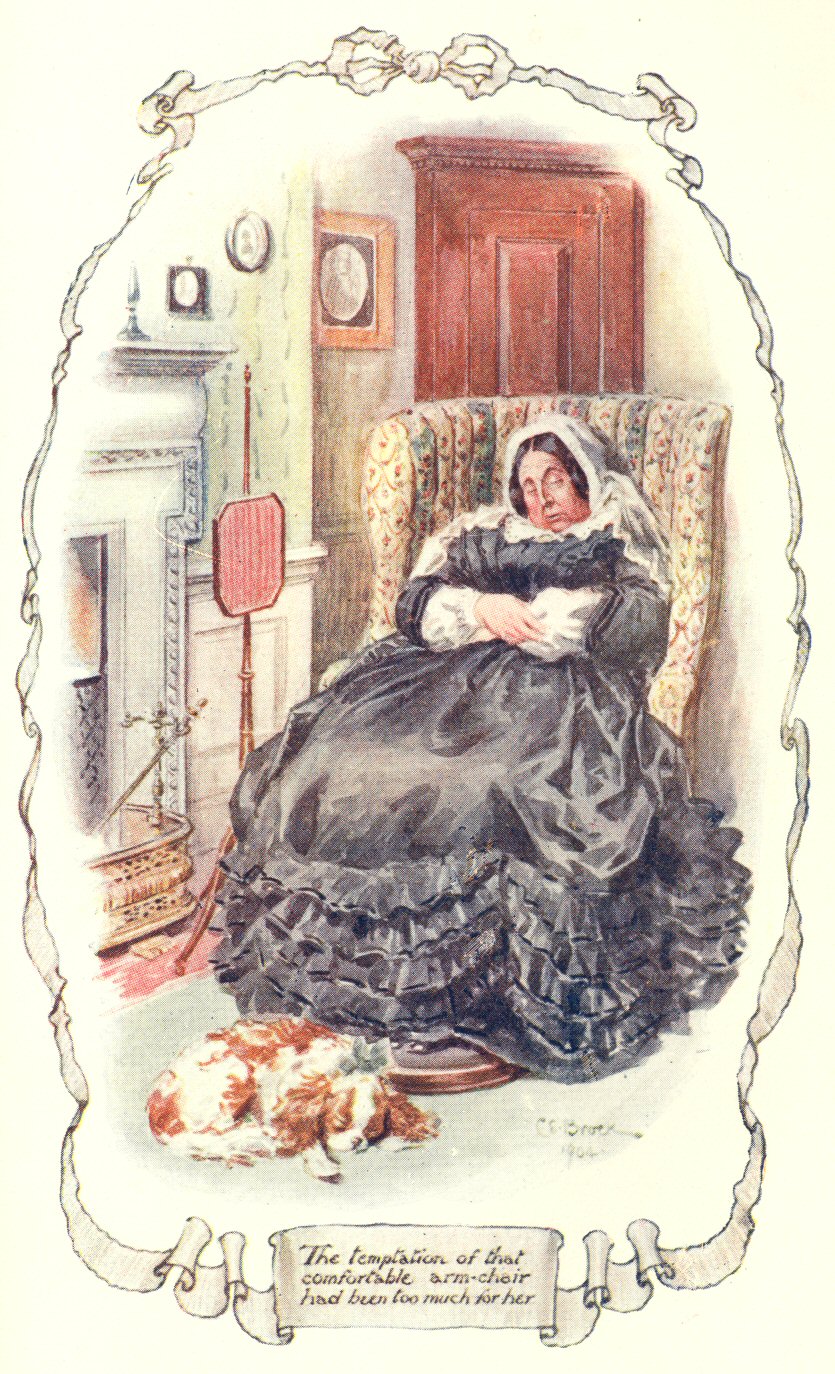
After tea there was some little demur and difficulty. We were six in number; four could play at Preference, and for the other two there was Cribbage. But all, except myself (I was rather afraid of the Cranford ladies at cards, for it was the most earnest and serious business they ever engaged in), were anxious to be of the “pool.” Even Miss Barker, while declaring she did not know Spadille from Manille, was evidently hankering to take a hand. The dilemma was soon put an end to by a singular kind of noise. If a baron’s daughter-in-law could ever be supposed to snore, I should have said Mrs Jamieson did so then; for, overcome by the heat of the room, and inclined to doze by nature, the temptation of that very comfortable arm-chair had been too much for her, and Mrs Jamieson was nodding. Once or twice she opened her eyes with an effort, and calmly but unconsciously smiled upon us; but by-and-by, even her benevolence was not equal to this exertion, and she was sound asleep.
After tea, there was some hesitation and difficulty. There were six of us. Four could play Preference, and the other two could play Cribbage. But everyone except me wanted to join the “pool.” I was rather afraid to play cards with the Cranford ladies. It was the most earnest and serious business they ever engaged in. Even Miss Barker clearly wanted to play, though she declared she did not know Spadille from Manille. A strange noise soon put an end to the dilemma. If a baron’s daughter-in-law could ever be thought to snore, I would have said Mrs Jamieson was snoring then. The heat of the room had overcome her, and she was naturally inclined to doze. The comfortable armchair had been too tempting, and Mrs Jamieson was nodding off. Once or twice she opened her eyes with an effort and smiled at us calmly, without knowing it. But soon even her goodwill was not enough to make her keep doing this, and she was sound asleep.
“It is very gratifying to me,” whispered Miss Barker at the card-table to her three opponents, whom, notwithstanding her ignorance of the game, she was “basting” most unmercifully—“very gratifying indeed, to see how completely Mrs Jamieson feels at home in my poor little dwelling; she could not have paid me a greater compliment.”
“It gives me great pleasure,” Miss Barker whispered to her three opponents at the card table. Though she knew nothing about the game, she was beating them “mercilessly.” “It gives me great pleasure to see how completely Mrs Jamieson feels at home in my poor little house. She could not have paid me a greater compliment.”
Miss Barker provided me with some literature in the shape of three or four handsomely-bound fashion-books ten or twelve years old, observing, as she put a little table and a candle for my especial benefit, that she knew young people liked to look at pictures. Carlo lay and snorted, and started at his mistress’s feet. He, too, was quite at home.
Miss Barker gave me three or four beautifully bound fashion books to read. They were ten or twelve years old. As she set out a small table and a candle especially for me, she said she knew young people liked looking at pictures. Carlo lay at his mistress’s feet, snorting and starting. He, too, was quite at home.
The card-table was an animated scene to watch; four ladies’ heads, with niddle-noddling caps, all nearly meeting over the middle of the table in their eagerness to whisper quick enough and loud enough: and every now and then came Miss Barker’s “Hush, ladies! if you please, hush! Mrs Jamieson is asleep.”
The card table was a lively sight. Four ladies’ heads, their caps bobbing, nearly met over the middle of the table. They were all eager to whisper quickly and loudly enough. Every now and then Miss Barker would say, “Hush, ladies! Please, hush! Mrs Jamieson is asleep.”
It was very difficult to steer clear between Mrs Forrester’s deafness and Mrs Jamieson’s sleepiness. But Miss Barker managed her arduous task well. She repeated the whisper to Mrs Forrester, distorting her face considerably, in order to show, by the motions of her lips, what was said; and then she smiled kindly all round at us, and murmured to herself, “Very gratifying, indeed; I wish my poor sister had been alive to see this day.”
It was very difficult to manage between Mrs Forrester’s deafness and Mrs Jamieson’s sleepiness. But Miss Barker handled her difficult task well. She repeated the whisper to Mrs Forrester, making exaggerated faces so her lip movements would show what was being said. Then she smiled kindly at all of us and murmured to herself, “Very gratifying, indeed. I wish my poor sister had lived to see this day.”
Presently the door was thrown wide open; Carlo started to his feet, with a loud snapping bark, and Mrs Jamieson awoke: or, perhaps, she had not been asleep—as she said almost directly, the room had been so light she had been glad to keep her eyes shut, but had been listening with great interest to all our amusing and agreeable conversation. Peggy came in once more, red with importance. Another tray! “Oh, gentility!” thought I, “can you endure this last shock?” For Miss Barker had ordered (nay, I doubt not, prepared, although she did say, “Why, Peggy, what have you brought us?” and looked pleasantly surprised at the unexpected pleasure) all sorts of good things for supper—scalloped oysters, potted lobsters, jelly, a dish called “little Cupids” (which was in great favour with the Cranford ladies, although too expensive to be given, except on solemn and state occasions—macaroons sopped in brandy, I should have called it, if I had not known its more refined and classical name). In short, we were evidently to be feasted with all that was sweetest and best; and we thought it better to submit graciously, even at the cost of our gentility—which never ate suppers in general, but which, like most non-supper-eaters, was particularly hungry on all special occasions.
Soon the door was thrown wide open. Carlo jumped to his feet with a loud, snapping bark, and Mrs Jamieson woke up. Or perhaps she had not been asleep. Almost at once, she said the room had been so bright that she had been glad to keep her eyes shut. But she had listened with great interest to all our amusing and pleasant conversation. Peggy came in again, red with self-importance. Another tray! “Oh, gentility!” I thought. “Can you endure this last shock?” Miss Barker had ordered all sorts of good things for supper. Indeed, I have no doubt she had prepared them, although she said, “Why, Peggy, what have you brought us?” She looked pleasantly surprised by the unexpected treat. There were scalloped oysters, potted lobsters, jelly, and a dish called “little Cupids.” The Cranford ladies were very fond of little Cupids, though they were too expensive to serve except on solemn and grand occasions. I would have called them macaroons soaked in brandy, if I had not known their more refined and classical name. In short, we were clearly to be feasted on all that was sweetest and best. We thought it best to submit graciously, even at the cost of our gentility. As a rule, gentility never ate supper. But like most people who did not eat supper, gentility was particularly hungry on special occasions.
Miss Barker, in her former sphere, had, I daresay, been made acquainted with the beverage they call cherry-brandy. We none of us had ever seen such a thing, and rather shrank back when she proffered it us—“just a little, leetle glass, ladies; after the oysters and lobsters, you know. Shell-fish are sometimes thought not very wholesome.” We all shook our heads like female mandarins; but, at last, Mrs Jamieson suffered herself to be persuaded, and we followed her lead. It was not exactly unpalatable, though so hot and so strong that we thought ourselves bound to give evidence that we were not accustomed to such things by coughing terribly—almost as strangely as Miss Barker had done, before we were admitted by Peggy.
I imagine Miss Barker had come across cherry-brandy in her former life. None of us had ever seen such a drink, and we drew back a little when she offered it to us. “Just a little, teeny little glass, ladies, after the oysters and lobsters, you know. Shellfish are sometimes thought not very good for you.” We all shook our heads like female mandarins. But at last, Mrs Jamieson let herself be persuaded, and we followed her lead. It did not taste all that bad, though it was so hot and strong that we felt obliged to cough terribly to show we were not used to such things. We coughed almost as strangely as Miss Barker had done before Peggy let us in.
“It’s very strong,” said Miss Pole, as she put down her empty glass; “I do believe there’s spirit in it.”
“It’s very strong,” said Miss Pole as she put down her empty glass. “I really think there’s alcohol in it.”
“Only a little drop—just necessary to make it keep,” said Miss Barker. “You know we put brandy-pepper over our preserves to make them keep. I often feel tipsy myself from eating damson tart.”
“Only a little drop, just enough to make it keep,” said Miss Barker. “You know we put brandy-pepper over our preserves to make them keep. I often feel tipsy myself after eating damson tart.”
I question whether damson tart would have opened Mrs Jamieson’s heart as the cherry-brandy did; but she told us of a coming event, respecting which she had been quite silent till that moment.
I doubt that damson tart would have opened Mrs Jamieson’s heart as the cherry brandy did. But she told us about an upcoming event she had said nothing about until then.
“My sister-in-law, Lady Glenmire, is coming to stay with me.”
“My sister-in-law, Lady Glenmire, is coming to stay with me.”
There was a chorus of “Indeed!” and then a pause. Each one rapidly reviewed her wardrobe, as to its fitness to appear in the presence of a baron’s widow; for, of course, a series of small festivals were always held in Cranford on the arrival of a visitor at any of our friends’ houses. We felt very pleasantly excited on the present occasion.
There was a chorus of “Indeed!” and then a pause. Each woman quickly considered whether her clothes were suitable for meeting a baron’s widow. For, of course, whenever a visitor arrived at a friend’s house in Cranford, there was always a series of small parties. We felt pleasantly excited about this occasion.
Not long after this the maids and the lanterns were announced. Mrs Jamieson had the sedan-chair, which had squeezed itself into Miss Barker’s narrow lobby with some difficulty, and most literally “stopped the way.” It required some skilful manœuvring on the part of the old chairmen (shoemakers by day, but when summoned to carry the sedan dressed up in a strange old livery—long great-coats, with small capes, coeval with the sedan, and similar to the dress of the class in Hogarth’s pictures) to edge, and back, and try at it again, and finally to succeed in carrying their burden out of Miss Barker’s front door. Then we heard their quick pit-a-pat along the quiet little street as we put on our calashes and pinned up our gowns; Miss Barker hovering about us with offers of help, which, if she had not remembered her former occupation, and wished us to forget it, would have been much more pressing.
Not long afterward, the maids and lanterns were announced. Mrs Jamieson’s sedan chair had squeezed into Miss Barker’s narrow entrance hall with some difficulty and had quite literally “stopped the way.” The old chairmen had to maneuver skillfully to get their burden through Miss Barker’s front door. They edged forward, backed up, and tried again before finally succeeding. By day they were shoemakers, but when called to carry the sedan chair, they dressed in strange old uniforms. These were long greatcoats with small capes, as old as the chair itself and like the clothes worn by chairmen in Hogarth’s pictures. Then, as we put on our calashes and pinned up our gowns, we heard their quick footsteps pattering along the quiet little street. Miss Barker hovered around us, offering to help. Her offers would have been much more insistent if she had not remembered her former occupation and wished us to forget it.