Chapter 1
Our Society
In the first place, Cranford is in possession of the Amazons; all the holders of houses above a certain rent are women. If a married couple come to settle in the town, somehow the gentleman disappears; he is either fairly frightened to death by being the only man in the Cranford evening parties, or he is accounted for by being with his regiment, his ship, or closely engaged in business all the week in the great neighbouring commercial town of Drumble, distant only twenty miles on a railroad. In short, whatever does become of the gentlemen, they are not at Cranford. What could they do if they were there? The surgeon has his round of thirty miles, and sleeps at Cranford; but every man cannot be a surgeon. For keeping the trim gardens full of choice flowers without a weed to speck them; for frightening away little boys who look wistfully at the said flowers through the railings; for rushing out at the geese that occasionally venture in to the gardens if the gates are left open; for deciding all questions of literature and politics without troubling themselves with unnecessary reasons or arguments; for obtaining clear and correct knowledge of everybody’s affairs in the parish; for keeping their neat maid-servants in admirable order; for kindness (somewhat dictatorial) to the poor, and real tender good offices to each other whenever they are in distress, the ladies of Cranford are quite sufficient. “A man,” as one of them observed to me once, “is so in the way in the house!” Although the ladies of Cranford know all each other’s proceedings, they are exceedingly indifferent to each other’s opinions. Indeed, as each has her own individuality, not to say eccentricity, pretty strongly developed, nothing is so easy as verbal retaliation; but, somehow, good-will reigns among them to a considerable degree.
To begin with, Cranford is in the hands of the Amazons. All the occupants of houses above a certain rent are women. If a married couple settles in the town, somehow the gentleman disappears. Perhaps he is frightened to death by being the only man at Cranford’s evening parties. Or his absence is explained by his being with his regiment or his ship. Or he is busy all week in Drumble, the large commercial town nearby, only twenty miles away by rail. In short, whatever happens to the gentlemen, they are not in Cranford. What could they do if they were there? The surgeon travels thirty miles on his rounds and sleeps in Cranford. But every man cannot be a surgeon. The ladies of Cranford are quite capable of keeping their tidy gardens full of choice flowers, without a single weed. They can frighten away little boys who gaze longingly at those flowers through the railings. They can rush out at the geese that sometimes venture into the gardens if the gates are left open. They can settle all questions of literature and politics without bothering with unnecessary reasons or arguments. They can find out everything about everyone’s affairs in the parish, clearly and accurately. They can keep their neat maidservants in admirable order. They can be kind, if somewhat bossy, to the poor. And they can offer each other genuine, tender help whenever they are in distress. “A man,” as one of them once remarked to me, “is so in the way in the house!” Although the ladies of Cranford know everything about one another’s doings, they care very little about one another’s opinions. Indeed, each has a strongly developed individuality, if not eccentricity. So it is easy for them to answer one remark with another. But somehow, considerable goodwill prevails among them.
The Cranford ladies have only an occasional little quarrel, spirited out in a few peppery words and angry jerks of the head; just enough to prevent the even tenor of their lives from becoming too flat. Their dress is very independent of fashion; as they observe, “What does it signify how we dress here at Cranford, where everybody knows us?” And if they go from home, their reason is equally cogent, “What does it signify how we dress here, where nobody knows us?” The materials of their clothes are, in general, good and plain, and most of them are nearly as scrupulous as Miss Tyler, of cleanly memory; but I will answer for it, the last gigot, the last tight and scanty petticoat in wear in England, was seen in Cranford—and seen without a smile.
The Cranford ladies have only an occasional little quarrel. They let off steam with a few sharp words and angry tosses of the head. These quarrels are just enough to keep their steady lives from becoming too dull. They dress with little regard for fashion. As they say, “What does it matter how we dress here in Cranford, where everybody knows us?” And if they go away from home, their reason is just as convincing. “What does it matter how we dress here, where nobody knows us?” Their clothes are generally made from good, plain materials. Most of the ladies are nearly as particular about cleanliness as Miss Tyler, who is remembered for hers. But I can say with certainty that the last gigot sleeve and the last tight, narrow petticoat worn in England were seen in Cranford. And no one smiled at the sight.
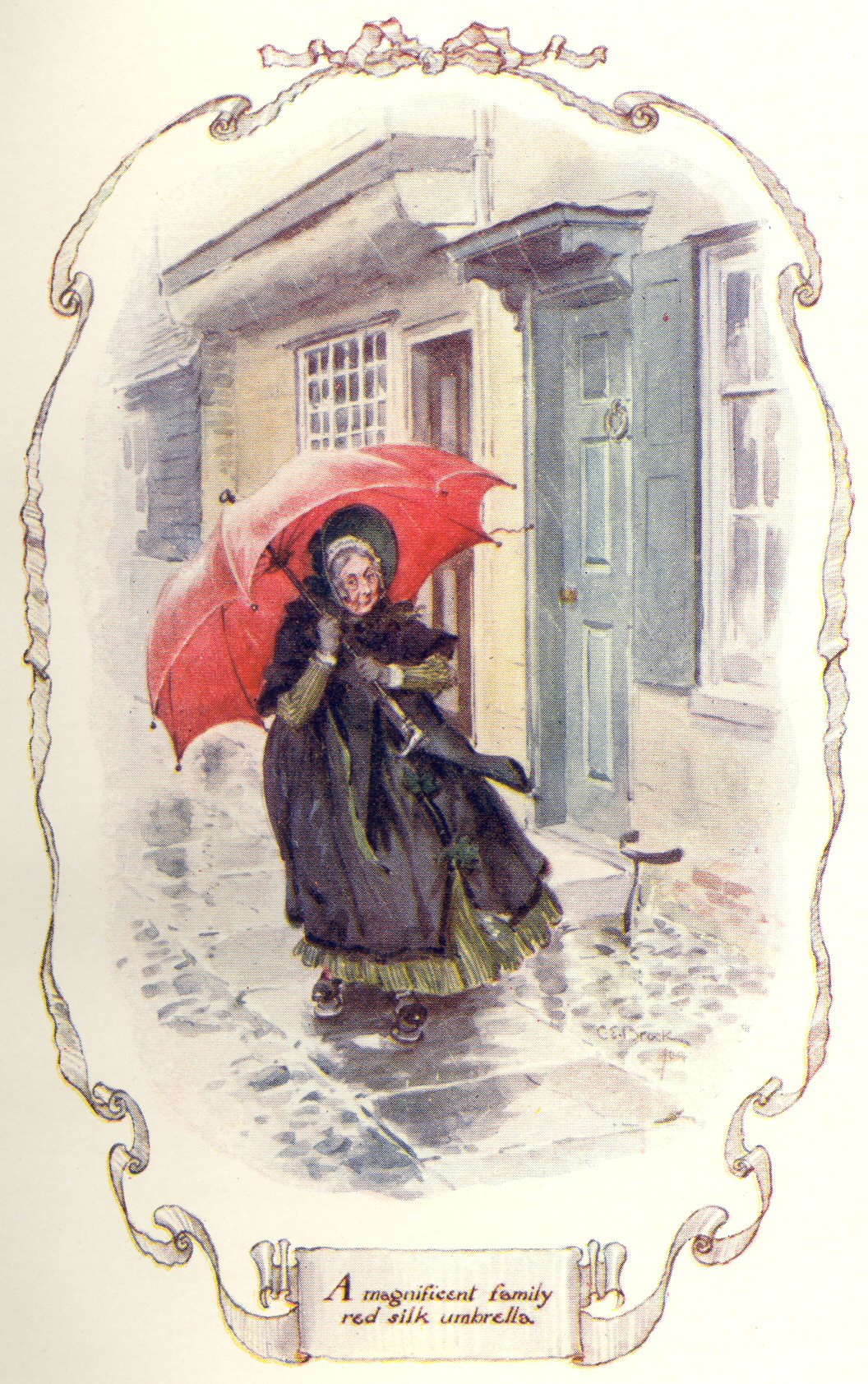
I can testify to a magnificent family red silk umbrella, under which a gentle little spinster, left alone of many brothers and sisters, used to patter to church on rainy days. Have you any red silk umbrellas in London? We had a tradition of the first that had ever been seen in Cranford; and the little boys mobbed it, and called it “a stick in petticoats.” It might have been the very red silk one I have described, held by a strong father over a troop of little ones; the poor little lady—the survivor of all—could scarcely carry it.
I can vouch for a magnificent red silk umbrella that belonged to one family. A gentle little unmarried woman used to hurry to church under it on rainy days. She was the only one left of many brothers and sisters. Do you have red silk umbrellas in London? We had a story about the first one ever seen in Cranford. The little boys crowded around it and called it “a stick in petticoats.” It might have been the very same red silk umbrella I have described, held by a strong father over a crowd of little children. The poor little lady, the only survivor of them all, could scarcely carry it.
Then there were rules and regulations for visiting and calls; and they were announced to any young people who might be staying in the town, with all the solemnity with which the old Manx laws were read once a year on the Tinwald Mount.
There were also rules for visits and calls. These were announced to any young people staying in town. The announcement was made with all the solemnity of the annual reading of the old Manx laws on Tinwald Mount.
“Our friends have sent to inquire how you are after your journey to-night, my dear” (fifteen miles in a gentleman’s carriage); “they will give you some rest to-morrow, but the next day, I have no doubt, they will call; so be at liberty after twelve—from twelve to three are our calling hours.”
“Our friends have sent to ask how you are after your journey tonight, my dear.” (Fifteen miles in a gentleman’s carriage.) “They will let you rest tomorrow, but I have no doubt they will visit the next day. So be free after twelve. Our visiting hours are from twelve to three.”
Then, after they had called—
Then, after they had visited...
“It is the third day; I dare say your mamma has told you, my dear, never to let more than three days elapse between receiving a call and returning it; and also, that you are never to stay longer than a quarter of an hour.”
“It is the third day. I expect your mother has told you, my dear, never to wait more than three days before returning a visit. She must also have told you never to stay longer than fifteen minutes.”
“But am I to look at my watch? How am I to find out when a quarter of an hour has passed?”
“But am I supposed to look at my watch? How will I know when fifteen minutes have passed?”
“You must keep thinking about the time, my dear, and not allow yourself to forget it in conversation.”
“You must keep an eye on the time, my dear, and not forget about it while you’re talking.”
As everybody had this rule in their minds, whether they received or paid a call, of course no absorbing subject was ever spoken about. We kept ourselves to short sentences of small talk, and were punctual to our time.
Everyone kept this rule in mind, whether they were receiving a visitor or paying a visit. So, of course, we never discussed anything absorbing. We stuck to brief small talk and kept to our allotted time.
I imagine that a few of the gentlefolks of Cranford were poor, and had some difficulty in making both ends meet; but they were like the Spartans, and concealed their smart under a smiling face. We none of us spoke of money, because that subject savoured of commerce and trade, and though some might be poor, we were all aristocratic. The Cranfordians had that kindly esprit de corps which made them overlook all deficiencies in success when some among them tried to conceal their poverty. When Mrs Forrester, for instance, gave a party in her baby-house of a dwelling, and the little maiden disturbed the ladies on the sofa by a request that she might get the tea-tray out from underneath, everyone took this novel proceeding as the most natural thing in the world, and talked on about household forms and ceremonies as if we all believed that our hostess had a regular servants’ hall, second table, with housekeeper and steward, instead of the one little charity-school maiden, whose short ruddy arms could never have been strong enough to carry the tray upstairs, if she had not been assisted in private by her mistress, who now sat in state, pretending not to know what cakes were sent up, though she knew, and we knew, and she knew that we knew, and we knew that she knew that we knew, she had been busy all the morning making tea-bread and sponge-cakes.
I imagine that a few of Cranford’s gentlefolk were poor and had trouble making ends meet. But they were like the Spartans, hiding their pain behind smiling faces. None of us spoke about money, because the subject suggested commerce and trade. Though some of us might be poor, we were all aristocratic. The Cranfordians had a kindly esprit de corps, a sense of loyalty to one another. This made them overlook any failures when some among them tried to hide their poverty. For example, Mrs Forrester once gave a party in her dollhouse of a home. Her young maid disturbed the ladies on the sofa by asking to get the tea tray from underneath it. Everyone treated this unusual request as perfectly natural. We continued talking about household customs and formalities. We spoke as if we all believed our hostess had a proper servants’ hall and a separate servants’ table, with a housekeeper and steward. In fact, she had only one young maid from a charity school. The girl’s short, ruddy arms could never have been strong enough to carry the tray upstairs without her mistress’s private help. Yet Mrs Forrester now sat there in state, pretending not to know what cakes had been sent up. She knew she had spent the whole morning making tea bread and sponge cakes. And we knew it, and she knew that we knew, and we knew that she knew that we knew.
There were one or two consequences arising from this general but unacknowledged poverty, and this very much acknowledged gentility, which were not amiss, and which might be introduced into many circles of society to their great improvement. For instance, the inhabitants of Cranford kept early hours, and clattered home in their pattens, under the guidance of a lantern-bearer, about nine o’clock at night; and the whole town was abed and asleep by half-past ten. Moreover, it was considered “vulgar” (a tremendous word in Cranford) to give anything expensive, in the way of eatable or drinkable, at the evening entertainments. Wafer bread-and-butter and sponge-biscuits were all that the Honourable Mrs Jamieson gave; and she was sister-in-law to the late Earl of Glenmire, although she did practise such “elegant economy.”
Cranford’s widespread but unacknowledged poverty, combined with its much acknowledged gentility, had one or two good effects. Many social circles could adopt these practices to their great improvement. For instance, Cranford’s inhabitants kept early hours. At about nine o’clock at night, they clattered home in their pattens, guided by someone carrying a lantern. The whole town was in bed and asleep by half-past ten. It was also considered “vulgar” to serve expensive food or drink at evening gatherings. “Vulgar” was a tremendous word in Cranford. All the Honourable Mrs Jamieson served was thin bread and butter and sponge biscuits. Yet she was sister-in-law to the late Earl of Glenmire, even though she practiced such “elegant economy.”
“Elegant economy!” How naturally one falls back into the phraseology of Cranford! There, economy was always “elegant,” and money-spending always “vulgar and ostentatious”; a sort of sour-grapeism which made us very peaceful and satisfied. I never shall forget the dismay felt when a certain Captain Brown came to live at Cranford, and openly spoke about his being poor—not in a whisper to an intimate friend, the doors and windows being previously closed, but in the public street! in a loud military voice! alleging his poverty as a reason for not taking a particular house. The ladies of Cranford were already rather moaning over the invasion of their territories by a man and a gentleman. He was a half-pay captain, and had obtained some situation on a neighbouring railroad, which had been vehemently petitioned against by the little town; and if, in addition to his masculine gender, and his connection with the obnoxious railroad, he was so brazen as to talk of being poor—why, then, indeed, he must be sent to Coventry. Death was as true and as common as poverty; yet people never spoke about that, loud out in the streets. It was a word not to be mentioned to ears polite. We had tacitly agreed to ignore that any with whom we associated on terms of visiting equality could ever be prevented by poverty from doing anything that they wished. If we walked to or from a party, it was because the night was so fine, or the air so refreshing, not because sedan-chairs were expensive. If we wore prints, instead of summer silks, it was because we preferred a washing material; and so on, till we blinded ourselves to the vulgar fact that we were, all of us, people of very moderate means. Of course, then, we did not know what to make of a man who could speak of poverty as if it was not a disgrace. Yet, somehow, Captain Brown made himself respected in Cranford, and was called upon, in spite of all resolutions to the contrary. I was surprised to hear his opinions quoted as authority at a visit which I paid to Cranford about a year after he had settled in the town. My own friends had been among the bitterest opponents of any proposal to visit the Captain and his daughters, only twelve months before; and now he was even admitted in the tabooed hours before twelve. True, it was to discover the cause of a smoking chimney, before the fire was lighted; but still Captain Brown walked upstairs, nothing daunted, spoke in a voice too large for the room, and joked quite in the way of a tame man about the house. He had been blind to all the small slights, and omissions of trivial ceremonies, with which he had been received. He had been friendly, though the Cranford ladies had been cool; he had answered small sarcastic compliments in good faith; and with his manly frankness had overpowered all the shrinking which met him as a man who was not ashamed to be poor. And, at last, his excellent masculine common sense, and his facility in devising expedients to overcome domestic dilemmas, had gained him an extraordinary place as authority among the Cranford ladies. He himself went on in his course, as unaware of his popularity as he had been of the reverse; and I am sure he was startled one day when he found his advice so highly esteemed as to make some counsel which he had given in jest to be taken in sober, serious earnest.
“Elegant economy!” How naturally I slip back into the language of Cranford! There, economy was always “elegant,” and spending money was always “vulgar and ostentatious.” It was a kind of sour-grapeism that left us very peaceful and satisfied. I shall never forget the dismay when a certain Captain Brown came to live in Cranford and openly spoke about being poor. He did not whisper it to a close friend after shutting the doors and windows. He said it in the public street! In a loud military voice! He gave his poverty as a reason for not taking a particular house. The ladies of Cranford were already complaining about a man and a gentleman invading their territory. He was a captain on half pay and had obtained a position on a nearby railroad. The little town had petitioned vehemently against that railroad. If, besides being a man and having connections to the hated railroad, he was bold enough to talk about being poor, then indeed he must be sent to Coventry. Death was as real and as common as poverty. Yet people never spoke about death aloud in the streets. It was not a word to be mentioned to polite ears. We had a silent agreement to ignore the possibility that poverty could stop our social equals from doing anything they wished. If we walked to or from a party, it was because the night was so fine or the air so refreshing. It was not because sedan-chairs were expensive. If we wore printed cotton instead of summer silks, it was because we preferred a washable fabric. And so it went, until we blinded ourselves to the vulgar fact that we were all people of very modest means. Of course, we did not know what to make of a man who could speak of poverty as if it were not a disgrace. Yet somehow Captain Brown earned respect in Cranford. Despite all the resolutions against it, people went to visit him. About a year after he settled in town, I visited Cranford and was surprised to hear his opinions quoted as authoritative. Only twelve months earlier, my own friends had been among the bitterest opponents of any suggestion that they visit the Captain and his daughters. Now he was even admitted during the forbidden hours before twelve. True, he had come to find out why a chimney smoked, before the fire was lit. But Captain Brown still walked upstairs without hesitation, spoke in a voice too loud for the room, and joked quite like a tame man of the house. He had taken no notice of the small slights and omitted courtesies with which he had been received. He had been friendly, though the Cranford ladies had been cool. He had taken their small sarcastic compliments in good faith. With his manly frankness, he had overcome all their reluctance toward a man who was not ashamed to be poor. At last, his excellent masculine common sense and his knack for finding ways around household problems won him an extraordinary place as an authority among the Cranford ladies. He carried on as unaware of his popularity as he had been of his earlier unpopularity. I am sure he was startled one day to discover how highly his advice was valued. Some advice he had given in jest was taken in sober, serious earnest.
It was on this subject: An old lady had an Alderney cow, which she looked upon as a daughter. You could not pay the short quarter of an hour call without being told of the wonderful milk or wonderful intelligence of this animal. The whole town knew and kindly regarded Miss Betsy Barker’s Alderney; therefore great was the sympathy and regret when, in an unguarded moment, the poor cow tumbled into a lime-pit. She moaned so loudly that she was soon heard and rescued; but meanwhile the poor beast had lost most of her hair, and came out looking naked, cold, and miserable, in a bare skin. Everybody pitied the animal, though a few could not restrain their smiles at her droll appearance. Miss Betsy Barker absolutely cried with sorrow and dismay; and it was said she thought of trying a bath of oil. This remedy, perhaps, was recommended by some one of the number whose advice she asked; but the proposal, if ever it was made, was knocked on the head by Captain Brown’s decided “Get her a flannel waistcoat and flannel drawers, ma’am, if you wish to keep her alive. But my advice is, kill the poor creature at once.”
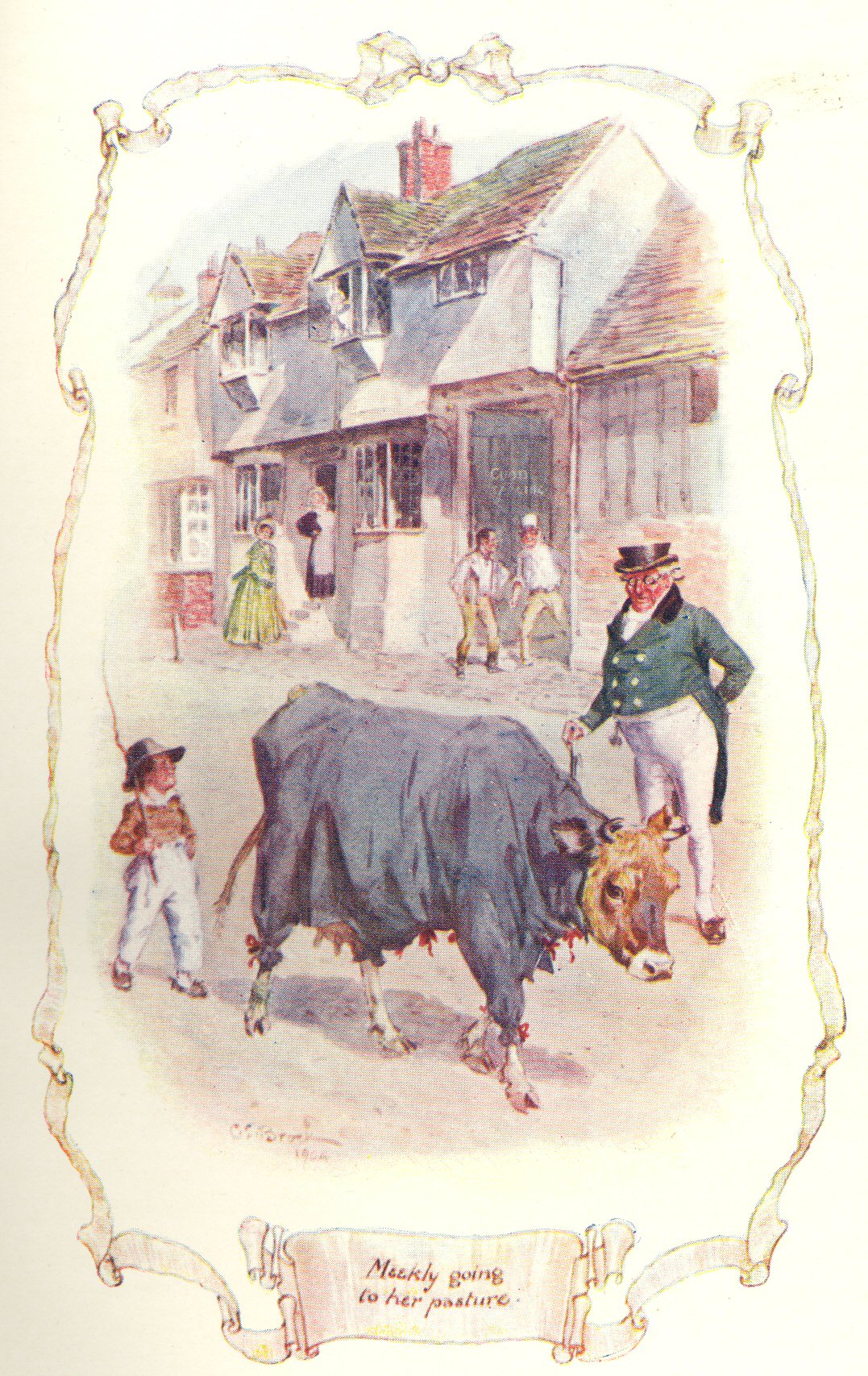
The story was this: An old lady had an Alderney cow, which she regarded as a daughter. You could not pay her a short, fifteen-minute visit without hearing about the cow’s wonderful milk or intelligence. The whole town knew and was fond of Miss Betsy Barker’s Alderney. So everyone was deeply sorry when the poor cow, in an unguarded moment, fell into a lime pit. She moaned so loudly that she was soon heard and rescued. But by then she had lost most of her hair. She came out looking naked, cold, and miserable, with her skin bare. Everyone pitied the animal, though a few could not help smiling at her comical appearance. Miss Betsy Barker actually cried with sorrow and dismay, and people said she thought of trying an oil bath. Perhaps someone she had asked for advice recommended the treatment. But if anyone did suggest it, Captain Brown firmly put an end to the idea: “Get her a flannel vest and flannel underpants, ma’am, if you wish to keep her alive. But my advice is, kill the poor creature at once.”
Miss Betsy Barker dried her eyes, and thanked the Captain heartily; she set to work, and by-and-by all the town turned out to see the Alderney meekly going to her pasture, clad in dark grey flannel. I have watched her myself many a time. Do you ever see cows dressed in grey flannel in London?
Miss Betsy Barker dried her eyes and thanked the Captain warmly. She set to work, and soon all the town turned out to see the Alderney cow walking meekly to her pasture, dressed in dark grey flannel. I have watched her myself many times. Do you ever see cows dressed in grey flannel in London?
Captain Brown had taken a small house on the outskirts of the town, where he lived with his two daughters. He must have been upwards of sixty at the time of the first visit I paid to Cranford after I had left it as a residence. But he had a wiry, well-trained, elastic figure, a stiff military throw-back of his head, and a springing step, which made him appear much younger than he was. His eldest daughter looked almost as old as himself, and betrayed the fact that his real was more than his apparent age. Miss Brown must have been forty; she had a sickly, pained, careworn expression on her face, and looked as if the gaiety of youth had long faded out of sight. Even when young she must have been plain and hard-featured. Miss Jessie Brown was ten years younger than her sister, and twenty shades prettier. Her face was round and dimpled. Miss Jenkyns once said, in a passion against Captain Brown (the cause of which I will tell you presently), “that she thought it was time for Miss Jessie to leave off her dimples, and not always to be trying to look like a child.” It was true there was something childlike in her face; and there will be, I think, till she dies, though she should live to a hundred. Her eyes were large blue wondering eyes, looking straight at you; her nose was unformed and snub, and her lips were red and dewy; she wore her hair, too, in little rows of curls, which heightened this appearance. I do not know whether she was pretty or not; but I liked her face, and so did everybody, and I do not think she could help her dimples. She had something of her father’s jauntiness of gait and manner; and any female observer might detect a slight difference in the attire of the two sisters—that of Miss Jessie being about two pounds per annum more expensive than Miss Brown’s. Two pounds was a large sum in Captain Brown’s annual disbursements.
Captain Brown had rented a small house on the outskirts of town, where he lived with his two daughters. He must have been over sixty when I first visited Cranford after moving away. But he had a lean, fit, springy figure, a stiff military tilt to his head, and a bouncy step. These made him look much younger than he was. His eldest daughter looked almost as old as he did, revealing that he was older than he appeared. Miss Brown must have been forty. She had a sickly, pained, worried expression, and looked as if the joy of youth had long since faded. Even when young, she must have been plain, with hard features. Miss Jessie Brown was ten years younger than her sister and much prettier. Her face was round and dimpled. Once, when Miss Jenkyns was angry with Captain Brown, she made a remark about Miss Jessie. I will tell you the cause of her anger shortly. She said, “I think it is time for Miss Jessie to give up her dimples and stop trying to look like a child all the time.” It was true that there was something childlike about Miss Jessie’s face. I think there always will be, even if she lives to be a hundred. Her large blue eyes had a wondering look and gazed straight at you. Her nose was still unformed and turned up, and her lips were red and moist. She also wore her hair in little rows of curls, which made her look even more childlike. I do not know whether she was pretty or not, but I liked her face, and so did everybody else. I do not think she could help having dimples. She had some of her father’s lively walk and manner. Any woman watching might notice a slight difference in the sisters’ clothes. Miss Jessie’s cost about two pounds more a year than Miss Brown’s. Two pounds was a large sum in Captain Brown’s yearly expenses.
Such was the impression made upon me by the Brown family when I first saw them all together in Cranford Church. The Captain I had met before—on the occasion of the smoky chimney, which he had cured by some simple alteration in the flue. In church, he held his double eye-glass to his eyes during the Morning Hymn, and then lifted up his head erect and sang out loud and joyfully. He made the responses louder than the clerk—an old man with a piping feeble voice, who, I think, felt aggrieved at the Captain’s sonorous bass, and quivered higher and higher in consequence.
That was the impression the Brown family made on me when I first saw them all together in Cranford Church. I had met the Captain before, when he fixed a smoky chimney by making a simple change to the flue. In church, he held his eyeglasses to his eyes during the Morning Hymn. Then he raised his head and sang out loudly and joyfully. He made the responses louder than the clerk, an old man with a weak, high-pitched voice. I think the Captain’s booming bass offended the clerk, who responded by singing in an increasingly high, trembling voice.
On coming out of church, the brisk Captain paid the most gallant attention to his two daughters. He nodded and smiled to his acquaintances; but he shook hands with none until he had helped Miss Brown to unfurl her umbrella, had relieved her of her prayer-book, and had waited patiently till she, with trembling nervous hands, had taken up her gown to walk through the wet roads.
As they came out of church, the brisk Captain was very attentive and courteous to his two daughters. He nodded and smiled at people he knew, but he did not shake hands with anyone yet. First, he helped Miss Brown open her umbrella and took her prayer book. Then he waited patiently as she lifted her dress with trembling, nervous hands to walk along the wet roads.
I wonder what the Cranford ladies did with Captain Brown at their parties. We had often rejoiced, in former days, that there was no gentleman to be attended to, and to find conversation for, at the card-parties. We had congratulated ourselves upon the snugness of the evenings; and, in our love for gentility, and distaste of mankind, we had almost persuaded ourselves that to be a man was to be “vulgar”; so that when I found my friend and hostess, Miss Jenkyns, was going to have a party in my honour, and that Captain and the Miss Browns were invited, I wondered much what would be the course of the evening. Card-tables, with green baize tops, were set out by daylight, just as usual; it was the third week in November, so the evenings closed in about four. Candles, and clean packs of cards, were arranged on each table. The fire was made up; the neat maid-servant had received her last directions; and there we stood, dressed in our best, each with a candle-lighter in our hands, ready to dart at the candles as soon as the first knock came. Parties in Cranford were solemn festivities, making the ladies feel gravely elated as they sat together in their best dresses. As soon as three had arrived, we sat down to “Preference,” I being the unlucky fourth. The next four comers were put down immediately to another table; and presently the tea-trays, which I had seen set out in the store-room as I passed in the morning, were placed each on the middle of a card-table. The china was delicate egg-shell; the old-fashioned silver glittered with polishing; but the eatables were of the slightest description. While the trays were yet on the tables, Captain and the Miss Browns came in; and I could see that, somehow or other, the Captain was a favourite with all the ladies present. Ruffled brows were smoothed, sharp voices lowered at his approach. Miss Brown looked ill, and depressed almost to gloom. Miss Jessie smiled as usual, and seemed nearly as popular as her father. He immediately and quietly assumed the man’s place in the room; attended to every one’s wants, lessened the pretty maid-servant’s labour by waiting on empty cups and bread-and-butterless ladies; and yet did it all in so easy and dignified a manner, and so much as if it were a matter of course for the strong to attend to the weak, that he was a true man throughout. He played for threepenny points with as grave an interest as if they had been pounds; and yet, in all his attention to strangers, he had an eye on his suffering daughter—for suffering I was sure she was, though to many eyes she might only appear to be irritable. Miss Jessie could not play cards: but she talked to the sitters-out, who, before her coming, had been rather inclined to be cross. She sang, too, to an old cracked piano, which I think had been a spinet in its youth. Miss Jessie sang, “Jock of Hazeldean” a little out of tune; but we were none of us musical, though Miss Jenkyns beat time, out of time, by way of appearing to be so.
I wondered what the Cranford ladies did with Captain Brown at their parties. In the past, we had often rejoiced that no gentleman needed attention or conversation at our card parties. We had congratulated ourselves on how cozy the evenings were. In our love of refinement and dislike of men, we had almost persuaded ourselves that being a man was “vulgar.” So I wondered how the evening would go when my friend and hostess, Miss Jenkyns, planned a party in my honor. Captain Brown and the Miss Browns were invited. As usual, the card tables, with their green baize tops, were set out while it was still daylight. It was the third week in November, so the evenings drew in around four. Candles and fresh packs of cards were arranged on each table. The fire was built up, and the neat maid had received her final instructions. There we stood in our best clothes, each holding a candle lighter. We were ready to rush to the candles as soon as the first knock came. Parties in Cranford were solemn festivities. The ladies felt gravely elated as they sat together in their best dresses. As soon as three guests had arrived, we sat down to play “Preference,” with me as the unlucky fourth. The next four arrivals were seated immediately at another table. Soon the tea trays were placed in the middle of the card tables. I had seen the trays set out in the storeroom when I passed that morning. The china was as delicate as eggshell, and the old-fashioned silver glittered from polishing. But there was very little to eat. While the trays were still on the tables, Captain Brown and the Miss Browns came in. I could see that, somehow or other, the Captain was a favorite with all the ladies present. Frowns smoothed out and sharp voices softened as he approached. Miss Brown looked ill and depressed, almost gloomy. Miss Jessie smiled as usual and seemed nearly as popular as her father. The Captain immediately and quietly took the man’s place in the room. He attended to everyone’s needs, helping the pretty maid by serving ladies whose cups were empty or who had no bread and butter. He did everything so easily and with such dignity. He seemed to take it for granted that the strong should look after the weak. In every way, he was a true man. He played for threepenny points with as serious an interest as if they had been pounds. Yet, while attending to strangers, he kept an eye on his suffering daughter. I was sure she was suffering, though to many people she might have seemed merely irritable. Miss Jessie could not play cards, but she talked to those sitting out. Before she arrived, they had been rather inclined to be cross. She also sang to an old cracked piano, which I think had been a spinet in its youth. Miss Jessie sang “Jock of Hazeldean” a little out of tune. But none of us were musical, though Miss Jenkyns beat time, out of time, to appear musical.
It was very good of Miss Jenkyns to do this; for I had seen that, a little before, she had been a good deal annoyed by Miss Jessie Brown’s unguarded admission (à propos of Shetland wool) that she had an uncle, her mother’s brother, who was a shopkeeper in Edinburgh. Miss Jenkyns tried to drown this confession by a terrible cough—for the Honourable Mrs Jamieson was sitting at a card-table nearest Miss Jessie, and what would she say or think if she found out she was in the same room with a shop-keeper’s niece! But Miss Jessie Brown (who had no tact, as we all agreed the next morning) would repeat the information, and assure Miss Pole she could easily get her the identical Shetland wool required, “through my uncle, who has the best assortment of Shetland goods of any one in Edinbro’.” It was to take the taste of this out of our mouths, and the sound of this out of our ears, that Miss Jenkyns proposed music; so I say again, it was very good of her to beat time to the song.
It was very kind of Miss Jenkyns to do this. A little earlier, I had seen how annoyed she was by Miss Jessie Brown’s careless admission. While talking about Shetland wool, Miss Jessie had mentioned an uncle, her mother’s brother, who was a shopkeeper in Edinburgh. Miss Jenkyns tried to drown out this confession with a terrible cough. The Honourable Mrs Jamieson was sitting at the card table nearest Miss Jessie. What would she say or think if she discovered she was in the same room as a shopkeeper’s niece! But Miss Jessie Brown would repeat the information. We all agreed the next morning that she had no tact. She assured Miss Pole she could easily get her the exact Shetland wool she needed, “through my uncle, who has the best assortment of Shetland goods of any one in Edinbro’.” Miss Jenkyns proposed music to get the taste of this out of our mouths and the sound of it out of our ears. So I say again, it was very kind of her to beat time to the song.
When the trays re-appeared with biscuits and wine, punctually at a quarter to nine, there was conversation, comparing of cards, and talking over tricks; but by-and-by Captain Brown sported a bit of literature.
The trays returned with biscuits and wine, promptly at a quarter to nine. Everyone chatted, compared cards, and talked over the tricks. But after a while, Captain Brown brought up literature.
“Have you seen any numbers of ‘The Pickwick Papers’?” said he. (They were then publishing in parts.) “Capital thing!”
“Have you seen any installments of ‘The Pickwick Papers’?” he asked. (It was being published in installments at the time.) “It's excellent!”
Now Miss Jenkyns was daughter of a deceased rector of Cranford; and, on the strength of a number of manuscript sermons, and a pretty good library of divinity, considered herself literary, and looked upon any conversation about books as a challenge to her. So she answered and said, “Yes, she had seen them; indeed, she might say she had read them.”
Miss Jenkyns was the daughter of a former rector of Cranford who had died. She had a number of manuscript sermons and a fairly good library of religious books. On that basis, she considered herself literary and took any conversation about books as a challenge. So she answered, “Yes, she had seen them. Indeed, she might say she had read them.”
“And what do you think of them?” exclaimed Captain Brown. “Aren’t they famously good?”
“And what do you think of them?” exclaimed Captain Brown. “Aren’t they really good?”
So urged Miss Jenkyns could not but speak.
Urged in this way, Miss Jenkyns could not help but speak.
“I must say, I don’t think they are by any means equal to Dr Johnson. Still, perhaps, the author is young. Let him persevere, and who knows what he may become if he will take the great Doctor for his model?” This was evidently too much for Captain Brown to take placidly; and I saw the words on the tip of his tongue before Miss Jenkyns had finished her sentence.
“I must say, I don’t think they are anywhere near as good as Dr Johnson. Still, perhaps the author is young. Let him keep trying. Who knows what he may become if he takes the great Doctor as his model?” This was clearly too much for Captain Brown to accept calmly. I could see that he was ready to speak before Miss Jenkyns had finished her sentence.
“It is quite a different sort of thing, my dear madam,” he began.
“It’s quite different, my dear madam,” he began.
“I am quite aware of that,” returned she. “And I make allowances, Captain Brown.”
“I know that very well,” she replied. “And I do take it into account, Captain Brown.”
“Just allow me to read you a scene out of this month’s number,” pleaded he. “I had it only this morning, and I don’t think the company can have read it yet.”
“Please let me read you a scene from this month’s issue,” he pleaded. “I only got it this morning, and I don’t think anyone here has read it yet.”
“As you please,” said she, settling herself with an air of resignation. He read the account of the “swarry” which Sam Weller gave at Bath. Some of us laughed heartily. I did not dare, because I was staying in the house. Miss Jenkyns sat in patient gravity. When it was ended, she turned to me, and said with mild dignity—
“As you please,” she said, settling herself with a resigned air. He read Sam Weller’s account of the “swarry” at Bath. Some of us laughed heartily. I did not dare laugh, because I was staying in the house. Miss Jenkyns sat patiently, her face serious. When the reading ended, she turned to me and said with gentle dignity:
“Fetch me ‘Rasselas,’ my dear, out of the book-room.”
“Please get me ‘Rasselas’ from the book room, my dear.”
When I had brought it to her, she turned to Captain Brown—
After I brought it to her, she turned to Captain Brown:
“Now allow me to read you a scene, and then the present company can judge between your favourite, Mr Boz, and Dr Johnson.”
“Now let me read you a scene. Then everyone here can judge between your favourite, Mr Boz, and Dr Johnson.”
She read one of the conversations between Rasselas and Imlac, in a high-pitched, majestic voice: and when she had ended, she said, “I imagine I am now justified in my preference of Dr Johnson as a writer of fiction.” The Captain screwed his lips up, and drummed on the table, but he did not speak. She thought she would give him a finishing blow or two.
She read one of the conversations between Rasselas and Imlac in a high-pitched, majestic voice. When she finished, she said, “I think I have now shown why I prefer Dr Johnson as a fiction writer.” The Captain pursed his lips and drummed on the table, but he said nothing. She thought she would deliver a finishing blow or two.
“I consider it vulgar, and below the dignity of literature, to publish in numbers.”
“I consider it vulgar and beneath the dignity of literature to publish in installments.”
“How was the Rambler published, ma’am?” asked Captain Brown in a low voice, which I think Miss Jenkyns could not have heard.
“How was the Rambler published, ma’am?” Captain Brown asked in a low voice. I don’t think Miss Jenkyns could have heard him.
“Dr Johnson’s style is a model for young beginners. My father recommended it to me when I began to write letters—I have formed my own style upon it; I recommend it to your favourite.”
“Dr Johnson’s style is a model for young beginners. My father recommended it to me when I began writing letters. I have based my own style on his. I recommend his style to your favourite.”
“I should be very sorry for him to exchange his style for any such pompous writing,” said Captain Brown.
“I’d be very sorry if he gave up his style for such pompous writing,” said Captain Brown.
Miss Jenkyns felt this as a personal affront, in a way of which the Captain had not dreamed. Epistolary writing she and her friends considered as her forte. Many a copy of many a letter have I seen written and corrected on the slate, before she “seized the half-hour just previous to post-time to assure” her friends of this or of that; and Dr Johnson was, as she said, her model in these compositions. She drew herself up with dignity, and only replied to Captain Brown’s last remark by saying, with marked emphasis on every syllable, “I prefer Dr Johnson to Mr Boz.”
Miss Jenkyns took this as a personal insult, in a way Captain Brown had never imagined. She and her friends considered letter writing her forte. I had often seen her draft and correct letters on her slate. Only then would she write that she had “seized the half-hour just previous to post-time to assure” her friends of one thing or another. She said Dr Johnson was her model for these letters. She drew herself up with dignity. Her only reply to Captain Brown’s last remark was to say, with emphasis on every syllable, “I prefer Dr Johnson to Mr Boz.”
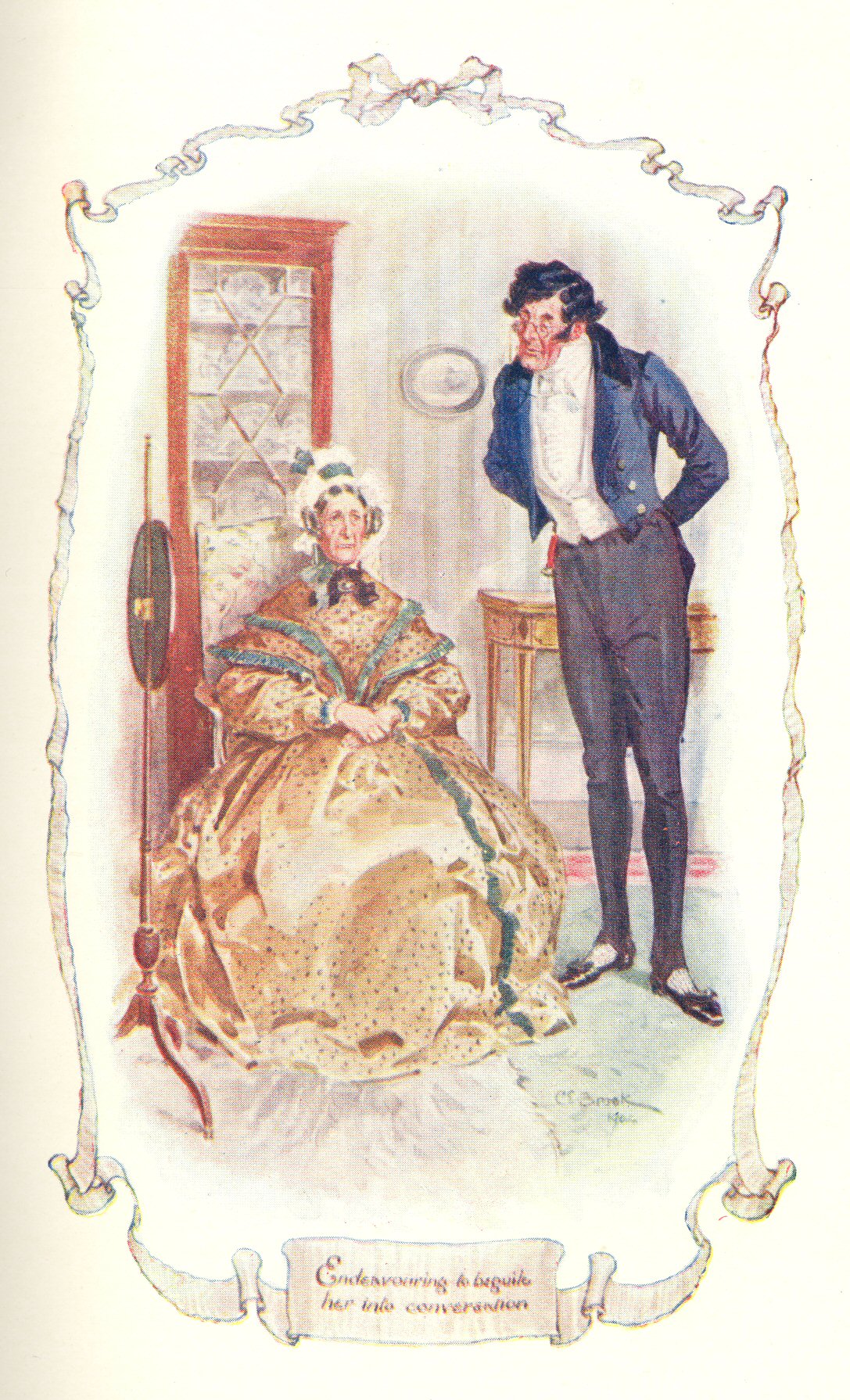
It is said—I won’t vouch for the fact—that Captain Brown was heard to say, sotto voce, “D—n Dr Johnson!” If he did, he was penitent afterwards, as he showed by going to stand near Miss Jenkyns’ arm-chair, and endeavouring to beguile her into conversation on some more pleasing subject. But she was inexorable. The next day she made the remark I have mentioned about Miss Jessie’s dimples.
It is said that Captain Brown was heard to say under his breath, “Damn Dr Johnson!” I cannot vouch for the story. If he did say it, he was sorry afterwards. He showed this by going to stand near Miss Jenkyns’ armchair and trying to draw her into conversation about something more pleasant. But she would not be persuaded. The next day she made the remark I have mentioned about Miss Jessie’s dimples.