8
The Role of Dance
Dancing is the only activity in which almost all ages and both sexes participate and it therefore offers a unique opportunity for an analysis of education.
Dancing is the only activity that includes people of almost all ages and both sexes. So dancing offers a unique opportunity to study education.
In the dance there are virtuosos but no formal teachers. It is a highly individual activity set in a social framework. This framework varies from a small dancing party at which twelve to twenty people are present to the major festivities of a malaga (travelling party) or a wedding when the largest guest house in the village is crowded within and encircled by spectators without. With the size and importance of the festivity, the formality of the arrangements varies also. Usually the occasion of even a small siva (dance) is the presence of at least two or three strange young people from another village. The pattern entertainment is a division of the performers into visitors and hosts, the two sides taking turns in providing the music and dancing. This pattern is still followed even when the malaga numbers only two individuals, a number of hosts going over to swell the visitors’ ranks.
There are expert dancers, but no formal dance teachers. Dancing is a highly individual activity within a social setting. The setting ranges from a small dance party with twelve to twenty people to major celebrations. These may mark a malaga (travelling party) or a wedding. At such celebrations, the village’s largest guest house is packed inside and surrounded by spectators outside. The formality of the arrangements also varies with the size and importance of the celebration. Usually, even a small siva (dance) takes place because at least two or three unfamiliar young visitors from another village are present. The usual arrangement is to divide the performers into visitors and hosts. The two groups take turns providing music and dancing. This arrangement is followed even when the malaga consists of only two people. In that case, some hosts join the visitors’ group to increase its numbers.
It is at these small informal dances that the children learn to dance. In the front of the house sit the young people who are the centre and arbiters of the occasion. The matai and his wife and possibly a related matai and the other elders of the household sit at the back of the house, in direct reversal of the customary procedure according to which the place of the young people is in the background. Around the ends cluster women and children, and outside lurk the boys and girls who are not participating in the dancing, although at any moment they may be drawn into it. On such occasions the dancing is usually started by the small children, beginning possibly with seven- and eight-year-olds. The chief’s wife or one of the young men will call out the names of the children and they are stood up in a group of three, sometimes all boys or girls, sometimes with a girl between two boys, which is the conventional adult grouping for the taupo and her two talking chiefs. The young men, sitting in a group near the centre of the house, provide the music, one of them standing and leading the singing to the accompaniment of an imported stringed instrument which has taken the place of the rude bamboo drum of earlier times. The leader sets the key and the whole company join in either in the song, or by clapping, or by beating on the floor with their knuckles. The dancers themselves are the final arbiters of the excellence of the music and it is not counted as petulance for a dancer to stop in the middle and demand better music as the price of continuing. The songs sung are few in number; the young people of one village seldom know more than a dozen airs; and perhaps twice as many sets of words which are sung now to one air, now to another. The verse pattern is simply based upon the number of syllables; a change in stress is permitted and rhyme is not demanded so that any new event is easily set in the old pattern, and names of villages and of individuals are inserted with great freedom. The content of the songs is likely to take on an extremely personal character containing many quips at the expense of individuals and their villages.
Children learn to dance at these small, informal dances. The young people sit at the front of the house, where they are the focus and judges of the occasion. The matai and his wife sit at the back, possibly with a related matai and the household’s other elders. This arrangement directly reverses the usual practice of keeping young people in the background. Women and children gather around the ends of the house. Outside, boys and girls who are not dancing linger, although they may be drawn into the dancing at any moment. On these occasions, small children usually start the dancing, possibly beginning with seven- and eight-year-olds. The chief’s wife or one of the young men calls out the children’s names. The children are then stood up in groups of three. Sometimes the groups are all boys or all girls. Sometimes a girl stands between two boys, the usual adult arrangement for the taupo and her two talking chiefs. The young men sit together near the center of the house and provide the music. One stands and leads the singing, accompanied by an imported stringed instrument. This instrument has replaced the simple bamboo drum used in earlier times. The leader sets the key, and everyone joins in by singing, clapping, or beating their knuckles on the floor. The dancers themselves have the final say on the quality of the music. A dancer may stop halfway through and demand better music before continuing. Such a demand is not considered bad-tempered. Only a few songs are sung. The young people in one village seldom know more than a dozen tunes and perhaps twice as many sets of lyrics. These lyrics are sung to one tune at one time and another tune at another time. The verse pattern depends simply on the number of syllables. Changes in stress are allowed, and rhyme is not required, so any new event easily fits the old pattern. The names of villages and individuals are added very freely. The songs are likely to become extremely personal, with many jokes at the expense of individuals and their villages.
The form of the participation of the audience changes according to the age of the dancers. In the case of the smaller children, it consists of an endless stream of good-natured comment: “Faster!” “Down lower! Lower!” “Do it again!” “Fasten your lavalava.” In the dancing of the more expert boys and girls the group takes part by a steady murmur of “Thank you, thank you, for your dancing!” “Beautiful! Engaging! Charming! Bravo!” which gives very much the effect of the irregular stream of “Amens” at an evangelistic revival. This articulate courtesy becomes almost lyric in quality when the dancer is a person of rank for whom dancing at all is a condescension.
The audience participates differently depending on the dancers’ ages. For smaller children, the audience offers an endless stream of good-natured comments: “Faster!” “Down lower! Lower!” “Do it again!” “Fasten your lavalava.” When more skilled boys and girls dance, the group joins in with a steady murmur of praise. “Thank you, thank you, for your dancing!” “Beautiful! Engaging! Charming! Bravo!” The praise sounds very much like the uneven flow of “Amens” at an evangelistic revival. These spoken courtesies become almost poetic when the dancer is a person of high rank. For such a person, dancing at all means lowering themselves to honor the audience.
The little children are put out upon these public floors with a minimum of preliminary instruction. As babies in their mothers’ arms at just such a party as this, they learned to clap before they learned to walk, so that the beat is indelibly fixed in their minds. As two- and three-year-olds they have stood on a mat at home and clapped their hands in time to their elders’ singing. Now they are called upon to perform before a group. Wide-eyed, terrified babies stand beside some slightly older child, clapping in desperation and trying to add new steps borrowed on the spur of the moment from their companions. Every improvement is greeted with loud applause. The child who performed best at the last party is haled forward at the next, for the group is primarily interested in its own amusement rather than in distributing an equal amount of practice among the children. Hence some children rapidly outdistance the rest, through interest and increased opportunity as well as superior gift. This tendency to give the talented child another and another chance is offset somewhat by rivalry between relatives who wish to thrust their little ones forward.
The little children are sent onto these public dance floors with very little instruction beforehand. As babies in their mothers’ arms at parties just like this one, they learned to clap before they could walk. So the beat is permanently fixed in their minds. At two and three, they stood on a mat at home, clapping in time to their elders’ singing. Now they are asked to perform before a group. Wide-eyed, terrified little children stand beside a slightly older child, clapping desperately. They try to add new steps, copying their companions on the spot. Every improvement is met with loud applause. The child who performed best at the last party is pulled forward at the next. This is because the group cares mainly about its own amusement, rather than giving every child equal practice. So some children quickly move far ahead of the rest. Their progress comes from interest and greater opportunity, as well as greater talent. This tendency to give talented children chance after chance is partly balanced by rivalry among relatives eager to put their own little ones forward.
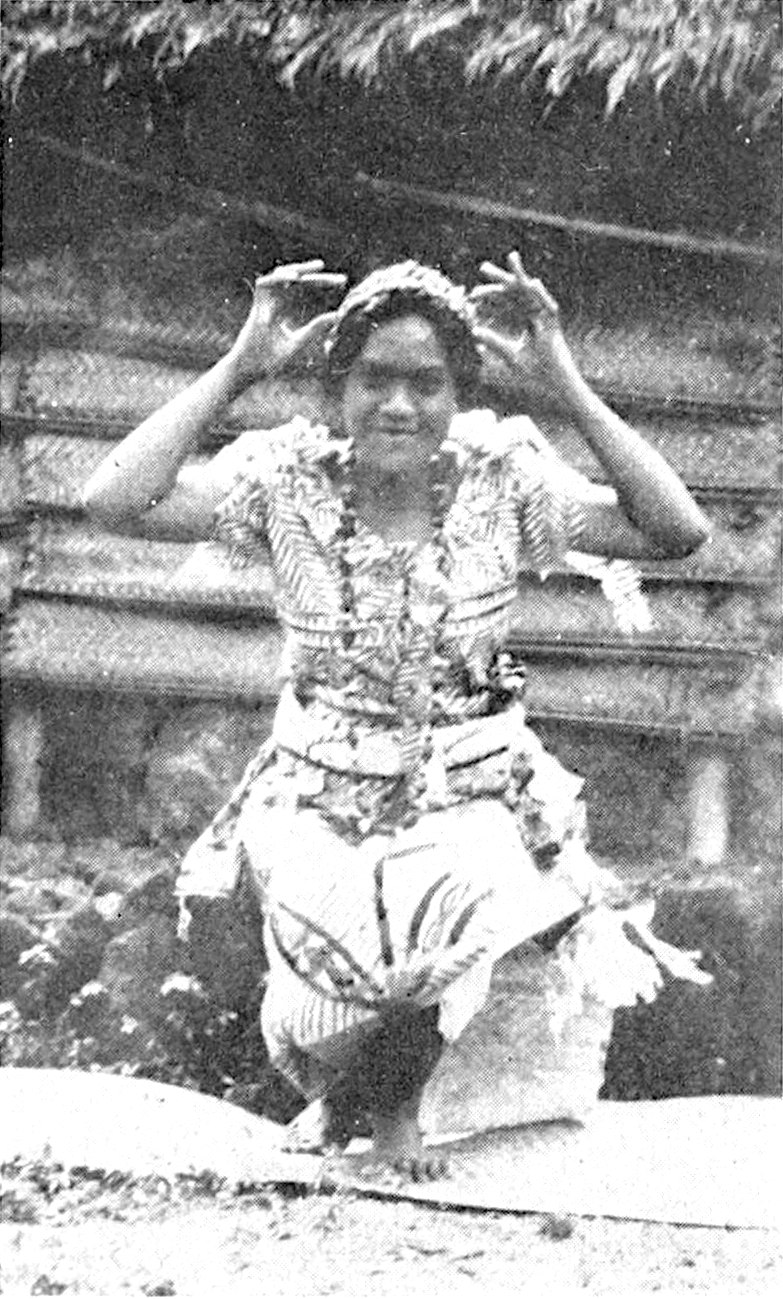
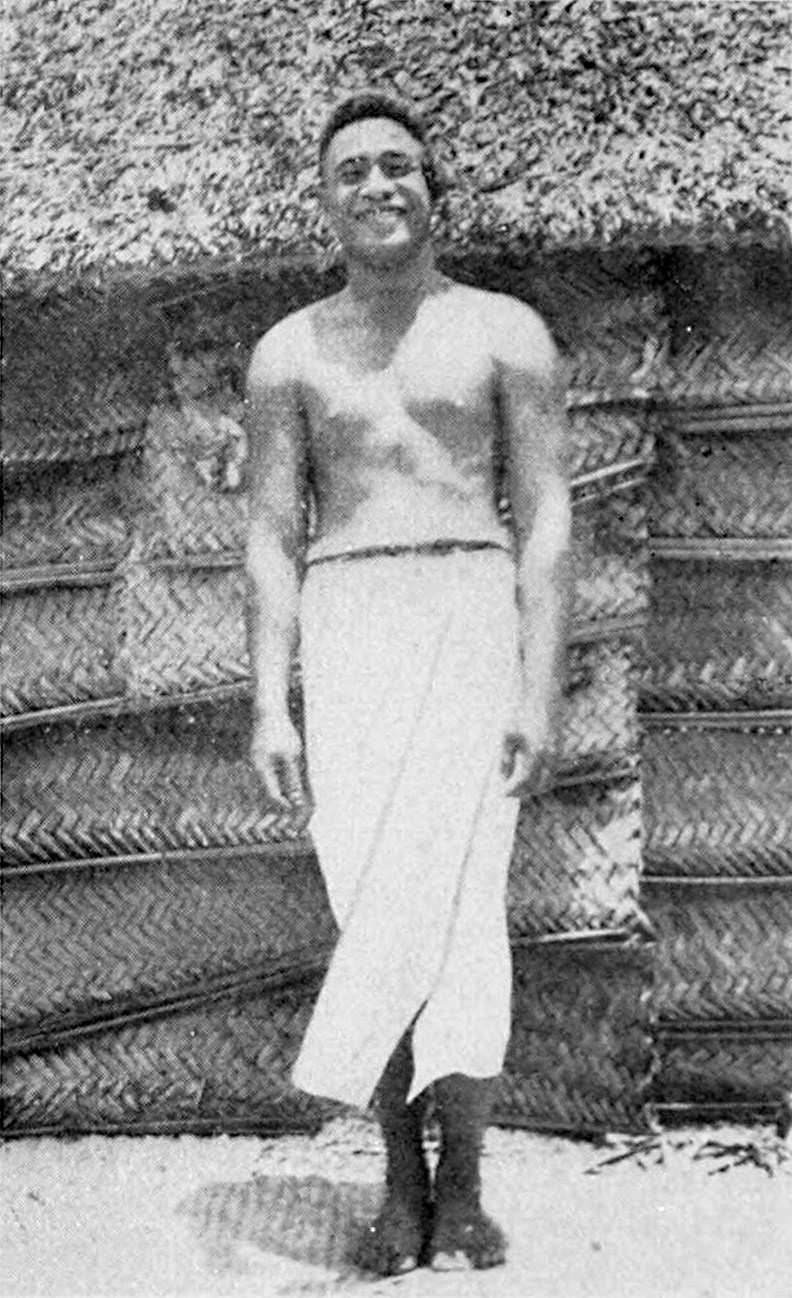
While the children are dancing, the older boys and girls are refurbishing their costumes with flowers, shell necklaces, anklets and bracelets of leaves. One or two will probably slip off home and return dressed in elaborate bark skirts. A bottle of cocoanut oil is produced from the family chest and rubbed on the bodies of the older dancers. Should a person of rank be present and consent to dance, the hostess family bring out their finest mats and tapas as costume. Sometimes this impromptu dressing assumes such importance that an adjoining house is taken over as a dressing room; at others it is of so informal a nature that spectators, who have gathered outside arrayed only in sheets, have to borrow a dress or a lavalava from some other spectator before they can appear on the dance floor. The form of the dance itself is eminently individualistic. No figures are prescribed except the half dozen formal little claps which open the dance and the use of one of a few set endings. There are twenty-five or thirty figures, two or three set transitional positions, and at least three definite styles, the dance of the taupo, the dance of the boys, and the dance of the jesters. These three styles relate definitely to the kind of dance and not to the status of the dancer. The taupo’s dance is grave, aloof, beautiful. She is required to preserve a set, dreamy, nonchalant expression of infinite hauteur and detachment. The only permissible alternative to this expression is a series of grimaces, impudent rather than comic in nature and deriving their principal appeal from the strong contrast which they present to the more customary gravity. The manaia also when he dances in his manaia rôle is required to follow this same decorous and dignified pattern. Most little girls and a few little boys pattern their dancing on this convention. Chiefs, on the rare occasions when they consent to dance, and older women of rank have the privilege of choosing between this style and the adoption of a comedian’s rôle. The boys’ dance is much jollier than the girls’. There is much greater freedom of movement and a great deal of emphasis on the noise made by giving rapid rhythmical slaps to the unclothed portions of the body which produce a crackling tattoo of sound. This style is neither salacious nor languorous although the taupo’s dance is often both. It is athletic, slightly rowdy, exuberant, and owes much of its appeal to the feats of rapid and difficult co-ordination which the slapping involves. The jester’s dance is peculiarly the dance of those who dance upon either side of the taupo, or the manaia, and honour them by mocking them. It is primarily the prerogative of talking chiefs and old men and old women in general. The original motive is contrast; the jester provides comic relief for the stately dance of the taupo, and the higher the rank of the taupo, the higher the rank of the men and women who will condescend to act as clownish foils to her ability. The dancing of these jesters is characterised by burlesque, horseplay, exaggeration of the stereotyped figures, a great deal of noise made by hammering on the open mouth with spread palm, and a large amount of leaping about and pounding on the floor. The clown is occasionally so proficient that he takes the centre of the floor on these ceremonious occasions.
While the children dance, the older boys and girls refresh their costumes with flowers, shell necklaces, and leaf anklets and bracelets. One or two will probably slip home and return wearing elaborate bark skirts. A bottle of coconut oil is brought out from the family chest and rubbed onto the older dancers’ bodies. If a person of rank is present and agrees to dance, the host family brings out its finest mats and tapas for costumes. Sometimes this improvised dressing becomes so important that a neighboring house becomes a dressing room. At other times, the preparations are so informal that spectators have gathered outside wearing only sheets. These spectators must borrow a dress or a lavalava from another spectator before stepping onto the dance floor. The dance itself allows great individual freedom. No movements are required except the half dozen formal little claps that open the dance and one of a few set endings. There are twenty-five or thirty movements, two or three set transitional positions, and at least three distinct styles. These are the dance of the taupo, the boys’ dance, and the jesters’ dance. These three styles refer specifically to the kind of dance, not the dancer’s status. The taupo’s dance is solemn, aloof, and beautiful. She must maintain a fixed, dreamy, unconcerned expression of utter superiority and detachment. The only allowed alternative is a series of grimaces that are cheeky rather than comic. Their main appeal comes from their sharp contrast with her usual solemnity. The manaia must follow the same restrained and dignified pattern when dancing in his manaia role. Most little girls and a few little boys model their dancing on this style. Chiefs, on the rare occasions when they agree to dance, and older women of rank have a choice. They may use this style or take on a comedian’s role. The boys’ dance is much livelier than the girls’. It allows much greater freedom of movement and strongly emphasizes the sound of rapid, rhythmic slaps on bare skin. These slaps produce a crackling drumbeat. This style is neither sexually suggestive nor languid, although the taupo’s dance is often both. It is athletic, slightly rowdy, and exuberant. Much of its appeal comes from the feats of quick, difficult coordination involved in the slapping. The jester’s dance belongs especially to those who dance on either side of the taupo, or the manaia. These dancers honor them by mocking them. The style is primarily reserved for talking chiefs and for old men and old women in general. The original purpose is contrast. The jester provides comic relief alongside the stately dance of the taupo. The higher the taupo’s rank, the higher the rank of the men and women willing to play clowns. Their clowning sets off her skill. The jesters’ dancing features parody, horseplay, and exaggerated versions of the standard movements. They make considerable noise by striking their open mouths with flat palms, and leap about and pound the floor. Occasionally, a clown is so skilled that he takes the center of the floor during these ceremonial occasions.
The little girl who is learning to dance has these three styles from which to choose, she has twenty-five or thirty figures from which to compose her dance and most important of all she has the individual dancers to watch. My first interpretation of the skill of the younger children was that they each took an older boy or girl as a model and sedulously and slavishly copied the whole dance. But I was not able to find a single instance in which a child would admit or seemed in any way conscious of having copied another; nor did I find, after closer familiarity with the group, any younger child whose style of dancing could definitely be referred to the imitation of another dancer. The style of every dancer of any virtuosity is known to every one in the village and when it is copied, it is copied conspicuously so that Vaitogi, the little girl who places her forearms parallel with the top of her head, her palms flat on her head, and advances in a stooping position, uttering hissing sounds, will be said to be dancing a la Sina. There is no stigma upon such imitation; the author does not resent it nor particularly glory in it; the crowd does not upbraid it; but so strong is the feeling for individualisation that a dancer will seldom introduce more than one such feature into an evening’s performance; and when the dancing of two girls is similar, it is similar in spite of the efforts of both, rather than because of any attempt at imitation. Naturally, the dancing of the young children is much more similar than the dancing of the young men and girls who had had time and opportunity really to perfect a style.
The little girl learning to dance has these three styles to choose from. She has twenty-five or thirty movements to combine into her dance. Most importantly, she has individual dancers to watch. At first, I thought each younger child chose an older boy or girl as a model. I thought the children carefully copied every part of that dancer’s performance. But I could not find a single child who admitted copying another or seemed at all aware of doing so. Nor, after getting to know the group better, could I clearly trace any younger child’s style to another dancer’s influence. Everyone in the village knows the style of every highly skilled dancer. When someone copies such a style, the imitation is obvious. For example, Vaitogi places her forearms level with the top of her head, with her palms flat on her head. The little girl then moves forward, stooping and making hissing sounds. People will say she is dancing a la Sina. There is no shame attached to such imitation. The original dancer neither resents the imitation nor takes particular pride in it. The crowd does not criticize it. But the desire for individuality is so strong that a dancer seldom includes more than one borrowed feature in an evening’s performance. And when two girls dance similarly, the resemblance exists despite both girls’ efforts, rather than through any attempt to imitate. Naturally, young children’s dancing is much more alike than that of young men and girls. The older dancers have had the time and opportunity to truly perfect a style.
The attitude of the elders towards precocity in singing, leading the singing or dancing, is in striking contrast to their attitude towards every other form of precocity. On the dance floor the dreaded accusation, “You are presuming above your age,” is never heard. Little boys who would be rebuked and possibly whipped for such behaviour on any other occasion are allowed to preen themselves, to swagger and bluster and take the limelight without a word of reproach. The relatives crow with delight over a precocity for which they would hide their heads in shame were it displayed in any other sphere.
The elders welcome children acting beyond their years in singing, leading the singing, or dancing. Their attitude is strikingly different toward every other kind of behavior beyond a child’s years. On the dance floor, the dreaded accusation, “You are acting above your age,” is never heard. Little boys are allowed to show off, swagger, boast, and take center stage without a word of criticism. On any other occasion, such behavior would earn them a scolding and possibly a whipping. Their relatives loudly delight in behavior beyond the boys’ years. Yet those relatives would hang their heads in shame if the boys behaved that way in any other setting.
It is on these semi-formal occasions that the dance really serves as an educational factor. The highly ceremonious dance of the taupo or manaia and their talking chiefs at a wedding or a malaga, with its elaborate costuming, compulsory distribution of gifts, and its vigilant attention to precedent and prerogative, offers no opportunities to the amateur or the child. They may only cluster outside the guest house and watch the proceedings. The existence of such a heavily stylized and elaborate archetype of course serves an additional function in giving zest as well as precedent to the informal occasions which partially ape its grandeur.
Dance truly serves an educational purpose on these semi-formal occasions. The highly ceremonial dance of the taupo or manaia and their talking chiefs takes place at weddings or a malaga. It involves elaborate costumes, required gift-giving, and careful attention to established customs and special rights. Such a dance offers no opportunities for amateurs or children. They can only gather outside the guest house and watch. Of course, this highly stylized and elaborate model also adds excitement to informal occasions and gives them a pattern to follow. These informal occasions partly imitate its grandeur.
The significance of the dance in the education and socialisation of Samoan children is two-fold. In the first place it effectively offsets the rigorous subordination in which children are habitually kept. Here the admonitions of the elders change from “Sit down and keep still!” to “Stand up and dance!” The children are actually the centre of the group instead of its barely tolerated fringes. The parents and relatives distribute generous praise by way of emphasising their children’s superiority over the children of their neighbours or their visitors. The ubiquitous ascendency of age is somewhat relaxed in the interests of greater proficiency. Each child is a person with a definite contribution to make regardless of sex and age. This emphasis on individuality is carried to limits which seriously mar the dance as an æsthetic performance. The formal adult dance with its row of dancers, the taupo in the centre and an even number of dancers on each side focussed upon her with every movement directed towards accentuating her dancing, loses both symmetry and unity in the hands of the ambitious youngsters. Each dancer moves in a glorious individualistic oblivion of the others, there is no pretence of co-ordination or of subordinating the wings to the centre of the line. Often a dancer does not pay enough attention to her fellow dancers to avoid continually colliding with them. It is a genuine orgy of aggressive individualistic exhibitionism. This tendency, so blatantly displayed on these informal occasions, does not mar the perfection of the occasional formal dance when the solemnity of the occasion becomes a sufficient check upon the participants’ aggressiveness. The formal dance is of personal significance only to people of rank or to the virtuoso to whom it presents a perfect occasion for display.
Dance has a twofold importance in the education and social development of Samoan children. First, dance effectively counterbalances the strict obedience usually demanded of children. Here, the elders’ commands change from “Sit down and keep still!” to “Stand up and dance!” The children actually become the centre of the group instead of remaining at its barely tolerated edges. Parents and relatives give generous praise to stress their children’s superiority over their neighbours’ or visitors’ children. The usual authority of older people is somewhat relaxed to encourage greater skill. Each child is an individual with a clear contribution to make, regardless of sex and age. This emphasis on individuality goes so far that it seriously harms the dance as an artistic performance. In the formal adult dance, the dancers stand in a row, with the taupo in the centre. An equal number of dancers stand on each side, focusing on her. Every movement is meant to highlight her dancing. But in the hands of ambitious youngsters, the dance loses both balance and unity. Each dancer moves with glorious individuality, oblivious to the others. There is no attempt to coordinate movements or make the dancers at the sides support the dancer in the centre. Often, a dancer pays so little attention to her fellow dancers that she keeps colliding with them. It is a genuine orgy of aggressive individual showing off. This tendency is so obvious at informal gatherings, but it does not spoil the perfection of occasional formal dances. On those occasions, the solemn atmosphere is enough to restrain the participants’ aggressiveness. The formal dance has personal importance only for people of rank or exceptionally skilled dancers. For those skilled dancers, it offers a perfect opportunity to show off.
The second influence of the dance is its reduction of the threshold of shyness. There is as much difference between one Samoan child and another in the matter of shyness and self-consciousness as is apparent among our children, but where our shyest children avoid the limelight altogether, the Samoan child looks pained and anxious but dances just the same. The limelight is regarded as inevitable and the child makes at least a minimum of effort to meet its requirements by standing up and going through a certain number of motions. The beneficial effects of this early habituation to the public eye and the resulting control of the body are more noticeable in the case of boys than of girls. Fifteen- and sixteen-year-old boys dance with a charm and a complete lack of self-consciousness which is a joy to watch. The adolescent girl whose gawky, awkward gait and lack of co-ordination may be appalling, becomes a graceful, self-possessed person upon the dance floor. But this ease and poise does not seem to be carried over into everyday life with the same facility as it is in the case of young boys.
The second effect of dancing is that it makes children less shy. Samoan children differ in shyness and self-consciousness just as much as our children do. But while our shyest children avoid the spotlight altogether, the Samoan child looks distressed and anxious but dances anyway. Being in the spotlight is seen as unavoidable. The child makes at least a minimal effort to meet its demands by standing up and performing some movements. Getting used to being watched early in life, and the physical control that results, have beneficial effects. These benefits are more noticeable in boys than in girls. Fifteen- and sixteen-year-old boys dance with charm and a complete lack of self-consciousness, making them a joy to watch. An adolescent girl's walk may be strikingly awkward and uncoordinated, yet she becomes graceful and confident on the dance floor. But girls do not seem to carry this ease and poise into everyday life as readily as young boys do.
In one way this informal dance floor approximates more closely to our educational methods than does any other aspect of Samoan education. For here the precocious child is applauded, made much of, given more and more opportunities to show its proficiency while the stupid child is rebuked, neglected and pushed to the wall. This difference in permitted practice is reflected in increasing differences in the skill of the children as they grow older. Inferiority feeling in the classic picture which is so frequent in our society is rare in Samoa. Inferiority there seems to be derived from two sources, clumsiness in sex relations which affects the young men after they are grown and produces the moetotolo, and clumsiness upon the dance floor. I have already told the story of the little girl, shy beyond her fellows, whom prospective high rank had forced into the limelight and made miserably diffident and self-conscious.
In one way, this informal dance floor resembles our educational methods more closely than any other part of Samoan education. Here, children who develop early are applauded, given special attention, and offered more opportunities to show their skills. Meanwhile, slow learners are scolded, neglected, and pushed aside. These differences in opportunities to practice lead to growing differences in skill as the children get older. The familiar feelings of inferiority so common in our society are rare in Samoa. In Samoa, feelings of inferiority seem to come from two sources. One is awkwardness in sexual relations, which affects young men after they reach adulthood and produces the moetotolo. The other is awkwardness on the dance floor. I have already told the story of the little girl who was shyer than her peers. Her expected future high rank had forced her into the spotlight, making her painfully unsure of herself and self-conscious.
And the most unhappy of the older girls was Masina, a girl about three years past puberty. Masina could not dance. Every one in the village knew that she could not dance. Her contemporaries deplored it; the younger children made fun of her. She had little charm, was deprecating in her manner, awkward, shy and ill at ease. All of her five lovers had been casual, all temporary, all unimportant. She associated with girls much younger than herself. She had no self-confidence. No one sought her hand in marriage and she would not marry until her family needed the kind of property which forms a bride price.
The unhappiest of the older girls was Masina, who was about three years past puberty. Masina could not dance. Everyone in the village knew she could not dance. Girls her own age regretted her inability to dance, and the younger children made fun of her. She had little charm, put herself down, and was awkward, shy, and uncomfortable around others. All five of her lovers had been casual, temporary, and unimportant. She spent time with girls much younger than herself. She had no self-confidence. No one asked to marry her. She would not marry until her family needed the kind of property given as a bride price.
It is interesting to notice that the one aspect of life in which the elders actively discriminate against the less proficient children seems to be the most powerful determinant in giving the children a feeling of inferiority.
Interestingly, elders actively discriminate against less skilled children in only one area of life. That area seems to do the most to make the children feel inferior.
The strong emphasis upon dancing does not discriminate against the physically defective. Instead every defect is capitalised in the form of the dance or compensated for by the perfection of the dance. I saw one badly hunchbacked boy who had worked out a most ingenious imitation of a turtle and also a combination dance with another boy in which the other supported him on his back. Ipu, the little albino, danced with aggressive facility and with much applause, while mad Laki, who suffered from a delusion that he was the high chief of the island, was only too delighted to dance for any one who addressed him with the elaborate courtesy phrases suitable to his rank. The dumb brother of the high chief of one village utilised his deaf mute gutturals as a running accompaniment to his dance, while the brothers of a fourteen-year-old feeble-minded mad boy were accustomed to deck his head with branches which excited him to a frenzied rhythmical activity, suggesting a stag whose antlers had been caught in the bush. The most precocious girl dancer in Taū was almost blind. So every defect, every handicap was included in this universal, specialised exploitation of personality.
The strong emphasis on dancing does not exclude people with physical disabilities. Instead, every disability shapes the dance or is offset by the dancer’s perfect performance. I saw one boy with a severely hunched back who had developed a very clever imitation of a turtle. He also performed a dance with another boy, who supported him on his back. Ipu, the little boy with albinism, danced with bold ease and received much applause. Laki, who was mentally ill, had the delusion that he was the island’s high chief. He was only too delighted to dance for anyone who addressed him with the elaborate courtesies appropriate to that rank. The deaf brother of one village’s high chief could not speak. He used his guttural sounds as a running accompaniment to his dance. The brothers of a fourteen-year-old boy with intellectual disabilities and mental illness regularly decorated his head with branches. The branches excited him into frenzied, rhythmic movement, suggesting a stag whose antlers had become caught in the bushes. The most precocious girl dancer in Taū was almost blind. So every disability, every limitation, became part of this universal practice of making specialized use of each person’s individuality.
The dancing child is almost always a very different person from her everyday self. After long acquaintance it is sometimes possible to guess the type of dance which a particular girl will do. This is particularly easy in the case of obviously tom-boy girls, but one is continually fooled by the depths of sophistication in the dancing of some pensive, dull child, or the lazy grace of some noisy little hoodlum.
A child who dances is almost always very different from her everyday self. After knowing a girl for a long time, you can sometimes guess the kind of dance she will perform. Guessing is especially easy with girls who are clearly tomboys. But you are constantly surprised by the sophisticated dancing of some quiet, dull child, or the lazy grace of some noisy little troublemaker.
Formal dancing displays are a recognised social entertainment and the highest courtesy a chief can offer his guest is to have his taupo dance for him. So likewise the boys dance after they have been tattooed, the manaia dances when he goes to woo his bride, the bride dances at her wedding. In the midnight conviviality of a malaga the dance often becomes flagrantly obscene and definitely provocative in character, but both of these are special developments of less importance than the function of informal dancing in the development of individuality and the compensation for repression of personality in other spheres of life.
Formal dance performances are an established form of social entertainment. The highest courtesy a chief can offer a guest is to have his taupo dance for the guest. Likewise, boys dance after being tattooed, the manaia dances when he goes to court his bride, and the bride dances at her wedding. During the midnight festivities of a malaga, dancing often becomes blatantly obscene and clearly sexually provocative. But both are special forms of dancing, less important than the role informal dancing plays in developing individuality. Informal dancing also makes up for the suppression of personality in other areas of life.