6
The Girl in the Community
The community ignores both boys and girls from birth until they are fifteen or sixteen years of age. Children under this age have no social standing, no recognised group activities, no part in the social life except when they are conscripted for the informal dance floor. But at a year or two beyond puberty—the age varies from village to village so that boys of sixteen will in one place still be classed as small boys, in another as taule’ale’as, young men—both boys and girls are grouped into a rough approximation of the adult groupings, given a name for their organisation, and are invested with definite obligations and privileges in the community life.
The community ignores both boys and girls from birth until they are fifteen or sixteen. Children below this age have no social standing and no recognized group activities. They take no part in social life except when required to join informal dancing. But a year or two after puberty, both boys and girls enter groups roughly modeled on adult groups. The age varies from village to village. As a result, sixteen-year-old boys are still considered small boys in one village, but taule’ale’as, young men, in another. These groups receive names, and their members gain specific duties and privileges in community life.
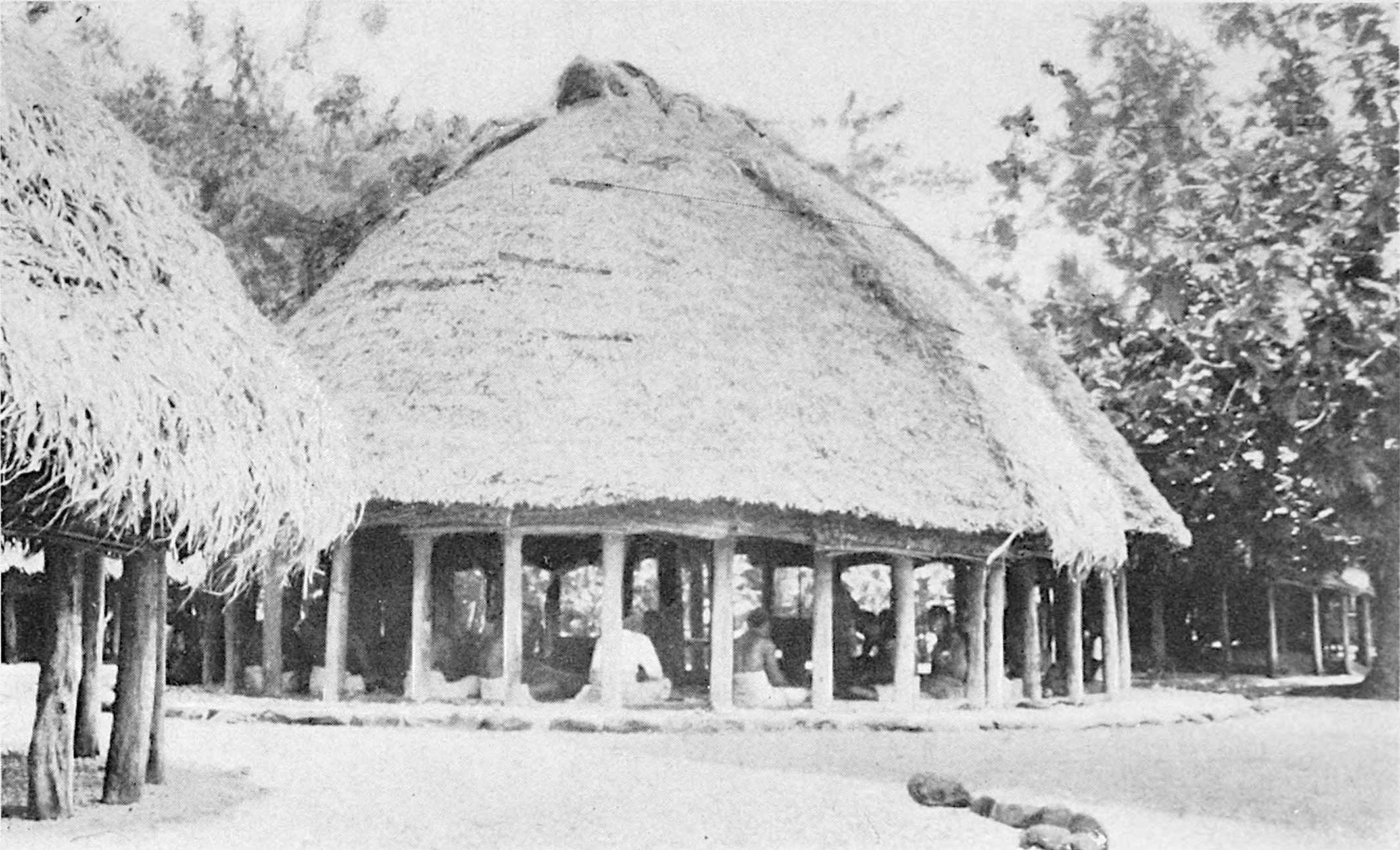
The organisation of young men, the Aumaga, of young girls and the wives of untitled men and widows, the Aualuma, and of the wives of titled men, are all echoes of the central political structure of the village, the Fono, the organisation of matais, men who have the titles of chiefs or of talking chiefs. The Fono is always conceived as a round house in which each title has a special position, must be addressed with certain ceremonial phrases, and given a fixed place in the order of precedence in the serving of the kava. This ideal house has certain fixed divisions, in the right sector sit the high chief and his special assistant chiefs; in the front of the house sit the talking chiefs whose business it is to make the speeches, welcome strangers, accept gifts, preside over the distribution of food and make all plans and arrangements for group activities. Against the posts at the back of the house sit the matais of low rank, and between the posts and at the centre sit those of so little importance that no place is reserved for them. This framework of titles continues from generation to generation and holds a fixed place in the larger ideal structure of the titles of the whole island, the whole archipelago, the whole of Samoa. With some of these titles, which are in the gift of certain families, go certain privileges, a right to a house name, a right to confer a taupo name, a princess title, upon some young girl relative and an heir-apparent title, the manaia, on some boy of the household. Besides these prerogatives of the high chiefs, each member of the two classes of matais, chiefs and talking chiefs, has certain ceremonial rights. A talking chief must be served his kava with a special gesture, must be addressed with a separate set of verbs and nouns suitable to his rank, must be rewarded by the chiefs in tapa or fine mats for his ceremonially rendered services. The chiefs must be addressed with still another set of nouns and verbs, must be served with a different and more honourable gesture in the kava ceremony, must be furnished with food by their talking chiefs, must be honoured and escorted by the talking chiefs on every important occasion. The name of the village, the ceremonial name of the public square in which great ceremonies are held, the name of the meeting house of the Fono, the names of the principal chiefs and talking chiefs, the names of taupo and manaia, of the Aualuma and the Aumaga, are contained in a set of ceremonial salutations called the Fa’alupega, or courtesy titles of a village or district. Visitors on formally entering a village must recite the Fa’alupega as their initial courtesy to their hosts.
The young men’s organization is the Aumaga. The organization for young girls, wives of untitled men, and widows is the Aualuma. The wives of titled men also have an organization. All these groups reflect the village’s central political structure, the Fono. The Fono is the organization of matais, men who hold titles as chiefs or talking chiefs. The Fono is always pictured as a round house, with a special position for each title. Each titleholder must be addressed with specific ceremonial phrases and served kava in a fixed order of rank. This ideal house has fixed sections. The high chief and his special assistant chiefs sit in the right section. The talking chiefs sit at the front of the house. Their duties are to make speeches, welcome strangers, accept gifts, and oversee the distribution of food. They also make all plans and arrangements for group activities. Low-ranking matais sit against the posts at the back of the house. Those considered so unimportant that they have no reserved place sit between the posts and in the center. This system of titles continues from generation to generation. It has a fixed place within the larger ideal system of titles across the island, the archipelago, and all Samoa. Certain families have the right to award some of these titles, and some titles carry specific privileges. These include the right to a house name and the right to give a young female relative a taupo name. This is a princess title. They also include the right to give a boy in the household an heir-apparent title, the manaia. Beyond these privileges of high chiefs, every chief and talking chief has certain ceremonial rights. A talking chief must be served kava with a special gesture. People must address him using a distinct set of verbs and nouns appropriate to his rank. Chiefs must reward his ceremonial services with tapa or fine mats. Chiefs must be addressed with yet another set of nouns and verbs. They must be served with a different, more honorable gesture during the kava ceremony. Their talking chiefs must supply them with food. Talking chiefs must also honor and escort chiefs on every important occasion. A set of ceremonial greetings includes the village’s name and the ceremonial name of its public square, where major ceremonies take place. It also includes the name of the Fono meeting house and the names of the principal chiefs and talking chiefs. The names of taupo and manaia, and of the Aualuma and the Aumaga, are included too. These greetings are called the Fa’alupega, or the courtesy titles of a village or district. Visitors formally entering a village must recite the Fa’alupega as their first courtesy to their hosts.
The Aumaga mirrors this organisation of the older men. Here the young men learn to make speeches, to conduct themselves with gravity and decorum, to serve and drink the kava, to plan and execute group enterprises. When a boy is old enough to enter the Aumaga, the head of his household either sends a present of food to the group, announcing the addition of the boy to their number, or takes him to a house where they are meeting and lays down a great kava root as a present. Henceforth the boy is a member of a group which is almost constantly together. Upon them falls all the heavy work of the village and also the greater part of the social intercourse between villages which centres about the young unmarried people. When a visiting village comes, it is the Aumaga which calls in a body upon the visiting taupo, taking gifts, dancing and singing for her benefit.
The Aumaga follows the same structure as the older men’s organization. Here the young men learn to give speeches, behave seriously and respectfully, and serve and drink kava. They also learn to plan and carry out group projects. When a boy is old enough to join the Aumaga, his household head introduces him in one of two ways. The household head either sends the group a gift of food, announcing that the boy is joining them. Or he takes the boy to a house where the group is meeting and presents a large kava root. From then on, the boy belongs to a group whose members are almost always together. The young men do all the village’s heavy work. They also handle most social contact between villages, which centers on young unmarried people. When people from another village visit, the Aumaga goes as a group to visit the visiting taupo. They bring gifts and dance and sing for her.
The organisation of the Aualuma is a less formalised version of the Aumaga. When a girl is of age, two or three years past puberty, varying with the village practice, her matai will send an offering of food to the house of the chief taupo of the village, thus announcing that he wishes the daughter of his house to be henceforth counted as one of the group of young girls who form her court. But while the Aumaga is centred about the Fono, the young men meeting outside or in a separate house, but exactly mirroring the forms and ceremonies of their elders, the Aualuma is centred about the person of the taupo, forming a group of maids of honour. They have no organisation as have the Aumaga, and furthermore, they do hardly any work. Occasionally the young girls may be called upon to sew thatch or gather paper mulberry; more occasionally they plant and cultivate a paper mulberry crop, but their main function is to be ceremonial helpers for the meetings of the wives of matais, and village hostesses in inter-village life. In many parts of Samoa the Aualuma has fallen entirely to pieces and is only remembered in the greeting words that fall from the lips of a stranger. But if the Aumaga should disappear, Samoan village life would have to be entirely reorganised, for upon the ceremonial and actual work of the young and untitled men the whole life of the village depends.
The Aualuma is a less formally organized version of the Aumaga. A girl comes of age two or three years after puberty, depending on village practice. Her matai then sends an offering of food to the house of the village’s chief taupo. This announces his wish for the daughter of his household to join the young girls who form her court. But while the Aumaga centres on the Fono, the Aualuma centres on the taupo herself. The young men meet outside or in a separate house, exactly following their elders’ customs and ceremonies. The young women form a group of maids of honour. They have no organization like that of the Aumaga, and they do hardly any work. Occasionally, the young girls may be called on to sew thatch or gather paper mulberry. Even less often, they plant and tend a paper mulberry crop. But their main role is to provide ceremonial help at meetings of the wives of matais. They also serve as village hostesses during visits between villages. In many parts of Samoa, the Aualuma has broken up entirely. It is remembered only in the greetings spoken by a stranger. But if the Aumaga disappeared, Samoan village life would have to be completely reorganized. The village’s whole way of life depends on the ceremonial and practical work of young men without titles.
Although the wives of matais have no organisation recognised in the Fa’alupega (courtesy titles), their association is firmer and more important than that of the Aualuma. The wives of titled men hold their own formal meetings, taking their status from their husbands, sitting at their husbands’ posts and drinking their husbands’ kava. The wife of the highest chief receives highest honour, the wife of the principal talking chief makes the most important speeches. The women are completely dependent upon their husbands for their status in this village group. Once a man has been given a title, he can never go back to the Aumaga. His title may be taken away from him when he is old, or if he is inefficient, but a lower title will be given him that he may sit and drink his kava with his former associates. But the widow or divorced wife of a matai must go back into the Aualuma, sit with the young girls outside the house, serve the food and run the errands, entering the women’s fono only as a servant or an entertainer.
Although the wives of matais have no organization recognized in the Fa’alupega (courtesy titles), their association is stronger and more important than the Aualuma. The wives of titled men hold their own formal meetings, with their status determined by their husbands’ status. They sit at their husbands’ posts and drink their husbands’ kava. The wife of the highest chief receives the highest honor. The wife of the principal talking chief makes the most important speeches. The women depend entirely on their husbands for their status in this village group. Once a man has received a title, he can never return to the Aumaga. His title may be taken away when he is old or if he is ineffective. But he will receive a lower title so he can sit and drink kava with his former associates. A matai’s widow or divorced wife, however, must return to the Aualuma. She must sit with the young girls outside the house, serve the food, and run errands. She may enter the women’s fono only as a servant or entertainer.
The women’s fonos are of two sorts: fonos which precede or follow communal work, sewing the thatch for a guest house, bringing the coral rubble for its floor or weaving fine mats for the dowry of the taupo; and ceremonial fonos to welcome visitors from another village. Each of these meetings was designated by its purpose, as a falelalaga, a weaving bee, or an ’aiga fiafia tama’ita’i, ladies’ feast. The women are only recognised socially by the women of a visiting village but the taupo and her court are the centre of the recognition of both men and women in the malaga, the traveling party. And these wives of high chiefs have to treat their own taupo with great courtesy and respect, address her as “your highness,” accompany her on journeys, use a separate set of nouns and verbs when speaking to her. Here then is a discrepancy in which the young girls who are kept in strict subjection within their households, outrank their aunts and mothers in the social life between villages. This ceremonial undercutting of the older women’s authority might seriously jeopardise the discipline of the household, if it were not for two considerations. The first is the tenuousness of the girls’ organisation, the fact that within the village their chief raison d’être is to dance attendance upon the older women, who have definite industrial tasks to perform for the village; the second is the emphasis upon the idea of service as the chief duty of the taupo. The village princess is also the village servant. It is she who waits upon strangers, spreads their beds and makes their kava, dances when they wish it, and rises from her sleep to serve either the visitors or her own chief. And she is compelled to serve the social needs of the women as well as the men. Do they decide to borrow thatch in another village, they dress their taupo in her best and take her along to decorate the malaga. Her marriage is a village matter, planned and carried through by the talking chiefs and their wives who are her counsellors and chaperons. So that the rank of the taupo is really a further daily inroad upon her freedom as an individual, while the incessant chaperonage to which she is subjected and the way in which she is married without regard to her own wishes are a complete denial of her personality. And similarly, the slighter prestige of her untitled sisters, whose chief group activity is waiting upon their elders, has even less real significance in the daily life of the village.
The women’s fonos are of two kinds. Some fonos take place before or after communal work. This work includes sewing thatch for a guest house, bringing coral rubble for its floor, or weaving fine mats for the taupo’s dowry. Other fonos are ceremonial meetings to welcome visitors from another village. Each meeting was named for its purpose, such as a falelalaga, a weaving bee, or an ’aiga fiafia tama’ita’i, ladies’ feast. Only the women from a visiting village formally acknowledge the local women’s social standing. But both men and women in the malaga, the traveling party, focus their recognition on the taupo and her court. And these wives of high chiefs must treat their own taupo with great courtesy and respect. They must address her as “your highness,” accompany her on journeys, and use special nouns and verbs when speaking to her. Here, then, is a contradiction. Young girls are kept under strict control within their households, yet outrank their aunts and mothers in social relations between villages. This ceremonial undermining of older women’s authority might seriously threaten household discipline, if not for two factors. The first is the weakness of the girls’ organization. Within the village, its main reason for existing is to attend to the older women. These older women have specific productive tasks to perform for the village. The second factor is the emphasis on service as the taupo’s main duty. The village princess is also the village servant. She waits on strangers, prepares their beds, makes their kava, and dances when they want her to. She also gets up from sleep to serve either visitors or her own chief. And she must serve the social needs of women as well as men. If the women decide to borrow thatch from another village, they dress their taupo in her finest clothes. They then take her along to add splendor to the malaga. Her marriage is a village affair, planned and arranged by the talking chiefs and their wives, her advisers and chaperones. So the taupo’s rank actually places further daily limits on her individual freedom. The constant chaperoning and marriage without regard for her wishes completely deny her individuality. Similarly, the lesser prestige of her untitled sisters has even less practical significance in the village’s daily life. Their main group activity is waiting on their elders.
With the exception of the taupo, the assumption of whose title is the occasion of a great festival and enormous distribution of property by her chief to the talking chiefs who must hereafter support and confirm her rank, a Samoan girl of good family has two ways of making her début. The first, the formal entry into the Aualuma is often neglected and is more a formal fee to the community than a recognition of the girl herself. The second way is to go upon a malaga, a formal travelling party. She may go as a near relative of the taupo in which case she will be caught up in a whirl of entertainment with which the young men of the host village surround their guests; or she may travel as the only girl in a small travelling party in which case she will be treated as a taupo. (All social occasions demand the presence of a taupo, a manaia, and a talking chief; and if individuals actually holding these titles are not present, some one else has to play the rôle.) Thus it is in inter-village life, either as a member of the Aualuma who call upon and dance for the manaia of the visiting malaga, or as a visiting girl in a strange village, that the unmarried Samoan girl is honoured and recognised by her community.
Except for the taupo, a Samoan girl from a good family has two ways to make her social debut. When a girl takes the taupo title, a great festival is held. Her chief distributes enormous amounts of property to the talking chiefs, who must thereafter support and confirm her rank. The first way to make a debut, formal entry into the Aualuma, is often skipped. It is more a formal payment to the community than a recognition of the girl herself. The second way is to join a malaga, a formal travelling party. She may go as a close relative of the taupo. In that case, the host village's young men draw her into a whirl of entertainment provided for their guests. Or she may travel as the only girl in a small travelling party. In that case, she will be treated as a taupo. (All social occasions require a taupo, a manaia, and a talking chief. If the actual titleholders are absent, someone else must play each role.) So unmarried Samoan girls gain honour and recognition from their community through contact between villages. A girl may receive this recognition as a member of the Aualuma, visiting and dancing for the visiting malaga's manaia. Or she may receive it as a girl visiting an unfamiliar village.
But these are exceptional occasions. A malaga may come only once a year, especially in Manu’a which numbers only seven villages in the whole archipelago. And in the daily life of the village, at crises, births, deaths, marriages, the unmarried girls have no ceremonial part to play. They are simply included with the “women of the household” whose duty it is to prepare the layette for the new baby, or carry stones to strew on the new grave. It is almost as if the community by its excessive recognition of the girl as a taupo or member of the Aualuma, considered itself exonerated from paying any more attention to her.
But these are unusual occasions. A malaga may come only once a year, especially in Manu’a, with only seven villages in the whole archipelago. In daily village life, unmarried girls have no ceremonial role during crises, births, deaths, or marriages. The girls are simply included among the “women of the household”. These women must prepare clothes and supplies for the new baby or carry stones to spread over the new grave. It is almost as if the community gives a girl so much recognition as a taupo or member of the Aualuma that it feels free of any duty to pay her further attention.
This attitude is fostered by the scarcity of taboos. In many parts of Polynesia, all women, and especially menstruating women, are considered contaminating and dangerous. A continuous rigorous social supervision is necessary, for a society can no more afford to ignore its most dangerous members than it can afford to neglect its most valuable. But in Samoa a girl’s power of doing harm is very limited. She cannot make tafolo, a breadfruit pudding usually made by the young men in any case, nor make the kava while she is menstruating. But she need retire to no special house; she need not eat alone; there is no contamination in her touch or look. In common with the young men and the older women, a girl gives a wide berth to a place where chiefs are engaged in formal work, unless she has special business there. It is not the presence of a woman which is interdicted but the uncalled-for intrusion of any one of either sex. No woman can be officially present at a gathering of chiefs unless she is taupo making the kava, but any woman may bring her husband his pipe or come to deliver a message, so long as her presence need not be recognised. The only place where a woman’s femininity is in itself a real source of danger is in the matter of fishing canoes and fishing tackle which she is forbidden to touch upon pain of spoiling the fishing. But the enforcement of this prohibition is in the hands of individual fishermen in whose houses the fishing equipment is kept.
This attitude is encouraged by the scarcity of taboos. In many parts of Polynesia, all women, especially menstruating women, are considered contaminating and dangerous. Constant, strict social supervision is necessary. A society can no more afford to ignore its most dangerous members than to neglect its most valuable ones. But in Samoa, a girl’s ability to cause harm is very limited. While menstruating, she cannot make tafolo, a breadfruit pudding, or prepare the kava. Young men usually make the pudding anyway. But she does not have to stay in a special house or eat alone. Her touch or gaze is not considered contaminating. Like young men and older women, a girl stays well away from places where chiefs conduct formal business. She may approach if she has specific business there. The ban is not on a woman’s presence, but on unnecessary intrusion by anyone of either sex. No woman can officially attend a gathering of chiefs unless she is taupo preparing the kava. But any woman may bring her husband his pipe or deliver a message, provided her presence need not be acknowledged. Only with fishing canoes and fishing equipment is being female considered a real source of danger. Women are forbidden to touch either, because doing so is believed to spoil the fishing. But individual fishermen enforce this ban, and the fishing equipment is kept in their houses.
Within the relationship group matters are entirely different. Here women are very specifically recognised. The oldest female progenitor of the line, that is, the sister of the last holder of the title, or his predecessor’s sister, has special rights over the distribution of the dowry which comes into the household. She holds the veto in the selling of land and other important family matters. Her curse is the most dreadful a man can incur for she has the power to “cut the line” and make the name extinct. If a man falls ill, it is his sister who must first take the formal oath that she has wished him no harm, as anger in her heart is most potent for evil. When a man dies, it is his paternal aunt or his sister who prepares the body for burial, anointing it with turmeric and rubbing it with oil, and it is she who sits beside the body, fanning away the flies, and keeps the fan in her possession ever after. And, in the more ordinary affairs of the household, in the economic arrangements between relatives, in disputes over property or in family feuds, the women play as active a part as the men.
Within the kinship group, matters are entirely different. Here women receive very specific recognition. The oldest female ancestor of the line has special rights over how the dowry entering the household is distributed. She is the sister of the last titleholder, or the sister of his predecessor. She can veto land sales and other important family decisions. Her curse is the most dreadful a man can bring upon himself. This is because she has the power to “cut the line” and make the family name die out. If a man falls ill, his sister must first formally swear that she has wished him no harm. This is because her anger has especially great power to cause harm. When a man dies, his father’s sister or his own sister prepares his body for burial. She anoints the body with turmeric and rubs it with oil. She also sits beside the body, fanning away the flies, and keeps the fan for the rest of her life. In more ordinary household affairs, women play as active a part as men. The same is true of economic arrangements between relatives, property disputes, and family feuds.
The girl and woman repays the general social negligence which she receives with a corresponding insouciance. She treats the lore of the village, the genealogies of the titles, the origin myths and local tales, the intricacies of the social organisation with supreme indifference. It is an exceptional girl who can give her great-grandfather’s name, the exceptional boy who cannot give his genealogy in traditional form for several generations. While the boy of sixteen or seventeen is eagerly trying to master the esoteric allusiveness of the talking chief whose style he most admires, the girl of the same age learns the minimum of etiquette. Yet this is in no wise due to lack of ability. The taupo must have a meticulous knowledge, not only of the social arrangements of her own village, but also of those of neighbouring villages. She must serve visitors in proper form and with no hesitation after the talking chief has chanted their titles and the names of their kava cups. Should she take the wrong post which is the prerogative of another taupo who outranks her, her hair will be soundly pulled by her rival’s female attendants. She learns the intricacies of the social organisation as well as her brother does. Still more notable is the case of the wife of a talking chief. Whether she is chosen for her docility by a man who has already assumed his title, or whether, as is often the case, she marries some boy of her acquaintance who later is made a talking chief, the tausi, wife of a talking chief, is quite equal to the occasion. In the meetings of women she must be a master of etiquette and the native rules of order, she must interlard her speeches with a wealth of unintelligible traditional material and rich allusiveness, she must preserve the same even voice, the same lofty demeanour, as her husband. And ultimately, the wife of an important talking chief must qualify as a teacher as well as a performer, for it is her duty to train the taupo. But unless the community thus recognises her existence, and makes formal demand upon her time and ability, a woman gives to it a bare minimum of her attention.
Girls and women respond to society’s general neglect with a matching lack of concern. A girl shows complete indifference to village lore, the genealogies of titles, origin myths, local tales, and complex social arrangements. Only an exceptional girl can name her great-grandfather. Only an exceptional boy cannot recite his genealogy in the traditional form for several generations. A boy of sixteen or seventeen eagerly studies the talking chief whose style he most admires. He tries to master the chief’s obscure references and indirect expressions. Meanwhile, a girl of the same age learns only the minimum of etiquette. Yet the girl’s indifference is not at all due to a lack of ability. The taupo must know the social arrangements of her own village and neighbouring villages in exact detail. After the talking chief has chanted visitors’ titles and the names of their kava cups, she must serve them correctly, without hesitation. If she takes a position reserved for a higher-ranking taupo, her rival’s female attendants will pull her hair hard. She learns the complexities of social organisation as well as her brother does. The wife of a talking chief is an even more striking example. A man who already holds the title may choose her for her obedience. Or, as often happens, she may marry a boy she knows who later becomes a talking chief. In either case, the tausi, wife of a talking chief, is fully equal to the demands of her role. At women’s meetings, she must be an expert in etiquette and the local rules for conducting meetings. She must fill her speeches with abundant, incomprehensible traditional material and elaborate indirect references. She must maintain the same steady voice and dignified manner as her husband. Ultimately, an important talking chief’s wife must become qualified to teach as well as perform. Training the taupo is her duty. But unless the community recognises her existence in these ways and formally calls on her time and abilities, a woman gives the community only the bare minimum of her attention.
In like manner, women are not dealt with in the primitive penal code. A man who commits adultery with a chief’s wife was beaten and banished, sometimes even drowned by the outraged community, but the woman was only cast out by her husband. The taupo who was found not to be a virgin was simply beaten by her female relatives. To-day if evil befalls the village, and it is attributed to some unconfessed sin on the part of a member of the community, the Fono and the Aumaga are convened and confession is enjoined upon any one who may have evil upon his conscience, but no such demand is made upon the Aualuma or the wives of the matais. This is in striking contrast to the family confessional where the sister is called upon first.
Similarly, women are not covered by the traditional penal code. A man who committed adultery with a chief’s wife was beaten and banished, sometimes even drowned by the outraged community. But the woman was only thrown out by her husband. The taupo who was found not to be a virgin was simply beaten by her female relatives. Today, if misfortune strikes the village and is blamed on a community member’s unconfessed sin, the Fono and the Aumaga meet. Anyone with wrongdoing on his conscience is urged to confess. But no such demand is made of the Aualuma or the wives of the matais. This exemption contrasts sharply with the family confession, where the sister is called on first.
In matters of work the village makes a few precise demands. It is the women’s work to cultivate the sugar cane and sew the thatch for the roof of the guest house, to weave the palm leaf blinds, and bring the coral rubble for the floor. When the girls have a paper mulberry plantation, the Aumaga occasionally help them in the work, the girls in turn making a feast for the boys, turning the whole affair into an industrious picnic. But between men’s formal work and women’s formal work there is a rigid division. Women do not enter into house-building or boat-building activities, nor go out in fishing canoes, nor may men enter the formal weaving house or the house where women are making tapa in a group. If the women’s work makes it necessary for them to cross the village, as is the case when rubble is brought up from the seashore to make the floor of the guest house, the men entirely disappear, either gathering in some remote house, or going away to the bush or to another village. But this avoidance is only for large formal occasions. If her husband is building the family a new cook-house, a woman may make tapa two feet away, while a chief may sit and placidly braid cinet while his wife weaves a fine mat at his elbow.
The village sets a few specific requirements for work. Women grow the sugar cane and sew the thatch for the guest house roof. They also weave the palm leaf blinds and bring coral rubble for the floor. When the girls have a paper mulberry plantation, the Aumaga sometimes help them with the work. The girls, in return, prepare a feast for the boys, turning the whole event into a working picnic. But men’s and women’s formal work are strictly separate. Women do not take part in building houses or boats, or go out in fishing canoes. Nor may men enter the formal weaving house or a house where women are making tapa together. If women’s work requires them to cross the village, the men disappear entirely. For example, women cross the village when bringing rubble from the seashore for the guest house floor. The men either gather in a distant house or go into the bush or to another village. But men and women avoid each other only during large, formal work events. If her husband is building a new cooking house for the family, a woman may make tapa two feet away. A chief may also sit calmly braiding cinet while his wife weaves a fine mat beside him.
So, although unlike her husband and brothers a woman spends most of her time within the narrower circle of her household and her relationship group, when she does participate in community affairs she is treated with the punctilio which marks all phases of Samoan social life. The better part of her attention and interest is focused on a smaller group, cast in a more personal mode. For this reason, it is impossible to evaluate accurately the difference in innate social drive between men and women in Samoa. In those social spheres where women have been given an opportunity, they take their place with as much ability as the men. The wives of the talking chiefs in fact exhibit even greater adaptability than their husbands. The talking chiefs are especially chosen for their oratorical and intellectual abilities, whereas the women have a task thrust upon them at their marriage requiring great oratorical skill, a fertile imagination, tact, and a facile memory.
So, unlike her husband and brothers, a woman spends most of her time within her household and extended family circle. Yet when she participates in community affairs, she receives the careful courtesy that marks all parts of Samoan social life. Most of her attention and interest centers on a smaller group, where relationships are more personal. For this reason, it is impossible to judge accurately any difference in men’s and women’s natural drive to socialize in Samoa. In areas of social life where women have been given opportunities, they show as much ability as men. The wives of the talking chiefs actually show even greater adaptability than their husbands. The talking chiefs are chosen specifically for their speaking skills and intellectual abilities. By contrast, their wives have a role thrust upon them when they marry. This role requires great speaking skill, a rich imagination, tact, and a quick memory.