4
The Samoan Household
A Samoan village is made up of some thirty to forty households, each of which is presided over by a headman called a matai. These headmen hold either chiefly titles or the titles of talking chiefs, who are the official orators, spokesmen and ambassadors of chiefs. In a formal village assembly each matai has his place, and represents and is responsible for all the members of his household. These households include all the individuals who live for any length of time under the authority and protection of a common matai. Their composition varies from the biological family consisting of parents and children only, to households of fifteen and twenty people who are all related to the matai or to his wife by blood, marriage or adoption, but who often have no close relationship to each other. The adopted members of a household are usually but not necessarily distant relatives.
A Samoan village has about thirty to forty households, each led by a headman called a matai. These headmen hold either chiefly titles or the titles of talking chiefs. Talking chiefs are the official speakers, representatives, and ambassadors of chiefs. In a formal village assembly, each matai has his place and represents all the members of his household. He is also responsible for all of them. These households include everyone who lives for any length of time under the authority and protection of a common matai. Some households consist only of parents and children. Others have fifteen to twenty people, all related to the matai or his wife by blood, marriage, or adoption. But these household members often have no close relationship to one another. Adopted household members are usually distant relatives, but not always.
Widows and widowers, especially when they are childless, usually return to their blood relatives, but a married couple may live with the relatives of either one. Such a household is not necessarily a close residential unit, but may be scattered over the village in three or four houses. No one living permanently in another village is counted as a member of the household, which is strictly a local unit. Economically, the household is also a unit, for all work upon the plantations under the supervision of the matai who in turn parcels out to them food and other necessities.
Widows and widowers, especially those without children, usually return to their blood relatives. But a married couple may live with either spouse’s relatives. The household does not necessarily live close together, but may be spread across three or four houses in the village. No one living permanently in another village is counted as a household member. The household is strictly a local unit. The household is also an economic unit, because all members work on the plantations under the supervision of the matai. The matai, in turn, distributes food and other necessities to the household members.
Within the household, age rather than relationship gives disciplinary authority. The matai exercises nominal and usually real authority over every individual under his protection, even over his father and mother. This control is, of course, modified by personality differences, always carefully tempered, however, by a ceremonious acknowledgment of his position. The newest baby born into such a household is subject to every individual in it, and his position improves no whit with age until a younger child appears upon the scene. But in most households the position of youngest is a highly temporary one. Nieces and nephews or destitute young cousins come to swell the ranks of the household and at adolescence a girl stands virtually in the middle with as many individuals who must obey her as there are persons to whom she owes obedience. Where increased efficiency and increased self-consciousness would perhaps have made her obstreperous and restless in a differently organised family, here she has ample outlet for a growing sense of authority.
Within the household, age rather than family relationship determines who has authority to discipline others. The matai has official, and usually actual, authority over everyone under his protection, even his father and mother. Differences in personality naturally affect how much control he has. Even so, everyone always carefully shows formal respect for his position. The newest baby born into such a household must obey everyone in the household. His position does not improve at all as he grows older until a younger child arrives. But in most households, being the youngest is very temporary. Nieces, nephews, or young cousins without means of support join the household. By adolescence, a girl stands almost in the middle. She has about as many people who must obey her as people she must obey. In a differently organized family, her growing abilities and self-awareness might perhaps have made her defiant and restless. Here, however, she has plenty of opportunities to exercise her growing sense of authority.
This development is perfectly regular. A girl’s marriage makes a minimum of difference in this respect, except in so far as her own children increase most pertinently the supply of agreeably docile subordinates. But the girls who remain unmarried even beyond their early twenties are in nowise less highly regarded or less responsible than their married sisters. This tendency to make the classifying principle age, rather than married state, is reinforced outside the home by the fact that the wives of untitled men and all unmarried girls past puberty are classed together in the ceremonial organisation of the village.
This development follows a completely regular pattern. A girl’s marriage makes very little difference in this respect. The main exception is that her own children add to her supply of pleasantly obedient subordinates. But girls who remain unmarried even beyond their early twenties are no less respected or responsible than their married sisters. Outside the home, village ceremonial organization reinforces this tendency to group women by age rather than marital status. The wives of untitled men and all unmarried girls past puberty belong to the same ceremonial group.
Relatives in other households also play a rôle in the children’s lives. Any older relative has a right to demand personal service from younger relatives, a right to criticise their conduct and to interfere in their affairs. Thus a little girl may escape alone down to the beach to bathe only to be met by an older cousin who sets her washing or caring for a baby or to fetch some cocoanut to scrub the clothes. So closely is the daily life bound up with this universal servitude and so numerous are the acknowledged relationships in the name of which service can be exacted, that for the children an hour’s escape from surveillance is almost impossible.
Relatives in other households also play a role in the children’s lives. Any older relative has the right to demand personal service from younger relatives, criticize their behavior, and interfere in their affairs. So a little girl may slip away alone to the beach to bathe, only to meet an older cousin. The cousin puts her to work washing clothes, caring for a baby, or fetching coconut to scrub the clothes. Daily life is so closely tied to this universal obligation to serve others, and so many recognized family relationships justify demanding service, that children can almost never escape supervision for even an hour.
This loose but demanding relationship group has its compensations also. Within it a child of three can wander safely and come to no harm, can be sure of finding food and drink, a sheet to wrap herself up in for a nap, a kind hand to dry casual tears and bind up her wounds. Any small children who are missing when night falls, are simply “sought among their kinsfolk,” and a baby whose mother has gone inland to work on the plantation is passed from hand to hand for the length of the village.
This loosely organized but demanding family group also has its benefits. Within the group, a three-year-old can wander safely and come to no harm. She can count on finding food and drink, and a sheet to wrap herself in for a nap. She can also count on a kind hand to dry passing tears and bandage her wounds. Any small children missing at nightfall are simply “looked for among their relatives.” A baby whose mother has gone inland to work on the plantation is passed from person to person along the village.
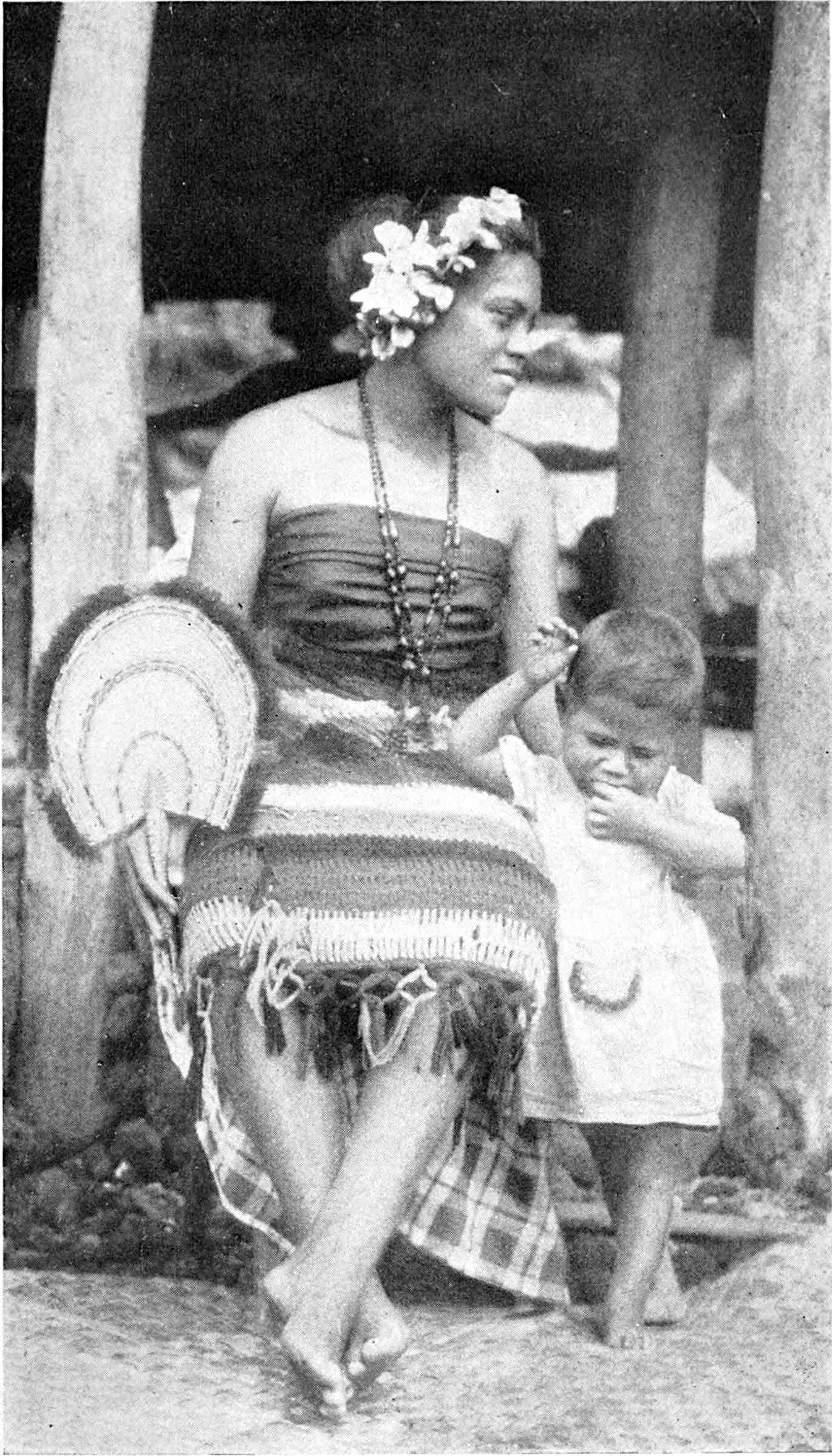
The ranking by age is disturbed in only a few cases. In each village one or two high chiefs have the hereditary right to name some girl of their household as its taupo, the ceremonial princess of the house. The girl who at fifteen or sixteen is made a taupo is snatched from her age group and sometimes from her immediate family also and surrounded by a glare of prestige. The older women of the village accord her courtesy titles, her immediate family often exploits her position for their personal ends and in return show great consideration for her wishes. But as there are only two or three taupos in a village, their unique position serves to emphasise rather than to disprove the general status of young girls.
The age-based ranking is disrupted in only a few cases. In each village, one or two high chiefs have the hereditary right to choose a girl from their household as its taupo, the household’s ceremonial princess. A girl made a taupo at fifteen or sixteen is abruptly separated from her age group, and sometimes her immediate family. She becomes the focus of intense attention and prestige. The village’s older women address her with courtesy titles. Her immediate family often uses her position for their own purposes and, in return, gives great weight to her wishes. But because a village has only two or three taupos, their unique position highlights rather than contradicts young girls’ general status.
Coupled with this enormous diffusion of authority goes a fear of overstraining the relationship bond, which expresses itself in an added respect for personality. The very number of her captors is the girl’s protection, for does one press her too far, she has but to change her residence to the home of some more complacent relative. It is possible to classify the different households open to her as those with hardest work, least chaperonage, least scolding, largest or least number of contemporaries, fewest babies, best food, etc. Few children live continuously in one household, but are always testing out other possible residences. And this can be done under the guise of visits and with no suggestion of truancy. But the minute that the mildest annoyance grows up at home, the possibility of flight moderates the discipline and alleviates the child’s sense of dependency. No Samoan child, except the taupo, or the thoroughly delinquent, ever has to deal with a feeling of being trapped. There are always relatives to whom one can flee. This is the invariable answer which a Samoan gives when some familial impasse is laid before him. “But she will go to some other relative.” And theoretically the supply of relatives is inexhaustible. Unless the vagrant has committed some very serious offence like incest, it is only necessary formally to depart from the bosom of one’s household. A girl whose father has beaten her over severely in the morning will be found living in haughty sanctuary, two hundred feet away, in a different household. So cherished is this system of consanguineous refuge, that an untitled man or a man of lesser rank will beard the nobler relative who comes to demand a runaway child. With great politeness and endless expressions of conciliation, he will beg his noble chief to return to his noble home and remain there quietly until his noble anger is healed against his noble child.
Authority is spread so widely that people fear putting too much strain on family ties. This fear brings greater respect for each person’s individuality. The sheer number of people controlling a girl also protects her. If one pushes her too far, she need only move to the home of a more easygoing relative. She can classify the available households by what each offers: the hardest work, the least supervision, the least scolding. Other differences include the most or fewest children her age, the fewest babies, the best food, and so on. Few children live in one household all the time. Instead, they keep trying out other possible homes. They can do so as visitors, without any suggestion that they are running away. But as soon as even a slight annoyance arises at home, the possibility of leaving softens the discipline. Having somewhere else to go also eases the child’s sense of dependence. No Samoan child, except the taupo or a thoroughly delinquent child, ever has to feel trapped. There are always relatives to turn to for refuge. Whenever someone describes a family deadlock to a Samoan, the answer is always the same. “But she will go to some other relative.” And in theory, the supply of relatives is endless. Unless the wandering child has committed a very serious offense, such as incest, all that is necessary is a formal departure from the household. A girl whose father has beaten her far too harshly in the morning will be found in another household. There, just two hundred feet away, she takes proud refuge. This system of refuge among blood relatives is so cherished that even a man without a title will defend it. He, or a man of lower rank, will confront a higher-ranking relative who comes to demand a runaway child’s return. With great politeness and endless soothing words, he will beg his noble chief to return to his noble home. There the chief should remain quietly until his noble anger toward his noble child has passed.
The most important relationships within a Samoan household which influence the lives of the young people are the relationships between the boys and girls who call each other “brother” and “sister,” whether by blood, marriage or adoption, and the relationship between younger and older relatives. The stress upon the sex difference between contemporaries and the emphasis on relative age are amply explained by the conditions of family life. Relatives of opposite sex have a most rigid code of etiquette prescribed for all their contacts with each other. After they have reached years of discretion, nine or ten years of age in this case, they may not touch each other, sit close together, eat together, address each other familiarly, or mention any salacious matter in each other’s presence. They may not remain in any house, except their own, together, unless half the village is gathered there. They may not walk together, use each other’s possessions, dance on the same floor, or take part in any of the same small group activities. This strict avoidance applies to all individuals of the opposite sex within five years above or below one’s own age with whom one was reared or to whom one acknowledges relationship by blood or marriage. The conformance to this brother and sister taboo begins when the younger of the two children feels “ashamed” at the elder’s touch and continues until old age when the decrepit, toothless pair of old siblings may again sit on the same mat and not feel ashamed.
The most important relationships shaping young people’s lives within a Samoan household are those between boys and girls called “brother” and “sister.” These ties may come through blood, marriage, or adoption. Relationships between younger and older relatives are also among the most important. The conditions of family life fully explain the emphasis on sex differences among peers and on relative age. Relatives of opposite sexes must follow an extremely strict code of conduct in all their interactions. Once these relatives are old enough to understand proper behavior, at nine or ten, they may not touch each other. They may not sit close together, eat together, speak familiarly to each other, or mention sexual matters in each other’s presence. They may not be together in any house except their own, unless half the village is gathered there. They may not walk together, use each other’s possessions, dance on the same floor, or join the same small-group activities. This strict avoidance applies to all opposite-sex relatives within five years of one’s own age, whether older or younger. It covers anyone one grew up with or recognizes as a relative by blood or marriage. Following this brother and sister taboo begins when the younger child feels “ashamed” at the older child’s touch. The taboo continues until old age. Then the frail, toothless siblings may again sit on the same mat without feeling ashamed.
See Appendix, page 249.
Tei, the word for younger relative, stresses the other most emotionally charged relationship. The first maternal enthusiasm of a girl is never expended upon her own children but upon some younger relative. And it is the girls and women who use this term most, continuing to cherish it after they and the younger ones to whom it is applied are full grown. The younger child in turn expends its enthusiasm upon a still younger one without manifesting any excessive affection for the fostering elders.
Tei, the word for a younger relative, highlights the other relationship with the strongest emotional ties. A girl’s first maternal enthusiasm is never directed toward her own children, but toward a younger relative. Girls and women use this term most often. They continue to cherish the term even after both they and their younger relatives are fully grown. The younger child, in turn, directs that enthusiasm toward an even younger child, without showing excessive affection for older caregivers.
The word aiga is used roughly to cover all relationships by blood, marriage and adoption, and the emotional tone seems to be the same in each case. Relationship by marriage is counted only as long as an actual marriage connects two kinship groups. If the marriage is broken in any way, by desertion, divorce, or death, the relationship is dissolved and members of the two families are free to marry each other. If the marriage left any children, a reciprocal relationship exists between the two households as long as the child lives, for the mother’s family will always have to contribute one kind of property, the father’s family another, for occasions when property must be given away in the name of the child.
The word aiga is used broadly to cover all relationships through blood, marriage, and adoption. The emotional tone seems to be the same in each case. Relationships through marriage count only as long as an actual marriage connects two family groups. If the marriage ends in any way, through desertion, divorce, or death, the relationship between the families ends. Members of the two families are then free to marry each other. If the marriage produced any children, the two households have mutual obligations for as long as the child lives. This is because property must sometimes be given away in the child’s name. On these occasions, the mother’s family must always contribute one kind of property, and the father’s family another.
A relative is regarded as some one upon whom one has a multitude of claims and to whom one owes a multitude of obligations. From a relative one may demand food, clothing, and shelter, or assistance in a feud. Refusal of such a demand brands one as stingy and lacking in human kindness, the virtue most esteemed among the Samoans. No definite repayment is made at the time such services are given, except in the case of the distribution of food to all those who share in a family enterprise. But careful count of the value of the property given and of the service rendered is kept and a return gift demanded at the earliest opportunity. Nevertheless, in native theory the two acts are separate, each one in turn becoming a “beggar,” a pensioner upon another’s bounty. In olden times, the beggar sometimes wore a special girdle which delicately hinted at the cause of his visit. One old chief gave me a graphic description of the behaviour of some one who had come to ask a favour of a relative. “He will come early in the morning and enter quietly, sitting down in the very back of the house, in the place of least honour. You will say to him, ‘So you have come, be welcome!’ and he will answer, ‘I have come indeed, saving your noble presence.’ Then you will say, ‘Are you thirsty? Alas for your coming, there is little that is good within the house.’ And he will answer, ‘Let it rest, thank you, for indeed I am not hungry nor would I drink.’ And he will sit and you will sit all day long and no mention is made of the purpose of his coming. All day he will sit and brush the ashes out of the hearth, performing this menial and dirty task with very great care and attention. If some one must go inland to the plantation to fetch food, he is the first to offer to go. If some one must go fishing to fill out the crew of a canoe, surely he is delighted to go, even though the sun is hot and his journey hither has been long. And all day you sit and wonder, ‘What can it be that he has come for? Is it that largest pig that he wants, or has he heard perhaps that my daughter has just finished a large and beautiful piece of tapa? Would it perhaps be well to send that tapa, as I had perhaps planned, as a present to my talking chief, to send it now, so that I may refuse him with all good faith?’ And he sits and studies your countenance and wonders if you will be favourable to his request. He plays with the children but refuses the necklace of flowers which they have woven for him and gives it instead to your daughter. Finally night comes. It is time to sleep and still he has not spoken. So finally you say to him, ‘Lo, I would sleep. Will you sleep also or will you be returning whence you have come?’ And only then will he speak and tell you the desire in his heart.”
A relative is seen as someone you can ask for many things and to whom you owe many obligations. You may demand food, clothing, shelter, or help in a feud from a relative. Refusing such a demand marks a person as stingy and lacking in human kindness. Human kindness is the virtue the Samoans value most. No specific repayment is made when such help is given. The exception is food distributed to everyone who takes part in a family undertaking. But people carefully track the value of property given and services provided. They demand a gift in return at the earliest opportunity. Nevertheless, in Samoan thinking, the two acts are separate. Each person takes a turn as a “beggar,” dependent on another’s generosity. In earlier times, the beggar sometimes wore a special belt that subtly suggested the reason for his visit. One old chief vividly described to me how someone behaved when asking a relative for a favor. “He will come early in the morning and enter quietly. He will sit at the very back of the house, in the least honored place. You will say to him, ‘So you have come, welcome!’ He will answer, ‘I have indeed come, with due respect to your noble presence.’ Then you will say, ‘Are you thirsty? What a shame you have come when there is so little good food in the house.’ And he will answer, ‘Please don’t trouble yourself, thank you. I am not hungry, and I do not want a drink.’ And he will sit, and you will sit, all day long. Neither of you mentions the purpose of his visit. All day he will sit and brush the ashes out of the hearth. He performs this lowly, dirty task with great care and attention. If someone must go inland to the plantation to fetch food, he is the first to offer. If someone must go fishing to complete a canoe’s crew, he is certainly delighted to go. He is delighted even though the sun is hot and his journey here has been long. And all day you sit and wonder, ‘What can he have come for? Does he want that largest pig? Or has he perhaps heard that my daughter has just finished a large and beautiful piece of tapa? Would it perhaps be wise to send that tapa as a present to my talking chief? Perhaps I had planned to send it anyway. Should I send it now, so that I can refuse him in all good faith?’ And he sits and studies your face, wondering whether you will agree to his request. He plays with the children but refuses the flower necklace they have woven for him. Instead, he gives the necklace to your daughter. Finally night comes. It is time to sleep, and still he has not spoken. So finally you say to him, ‘Well, I want to sleep. Will you sleep too, or will you return to where you came from?’ Only then will he speak and tell you what his heart desires.”
So the intrigue, the needs, the obligations of the larger relationship group which threads its carefully remembered way in and out of many houses and many villages, cuts across the life of the household. One day it is the wife’s relatives who come to spend a month or borrow a fine mat; the next day it is the husband’s; the third, a niece who is a valued worker in the household may be called home by the illness of her father. Very seldom do all of even the small children of a biological family live in one household and while the claims of the household are paramount, in the routine of everyday life, illness or need on the part of the closer relative in another household will call the wanderers home again.
So the schemes, needs, and obligations of the extended family cut across household life. This family network reaches into many houses and villages, and its connections are carefully remembered. One day, the wife’s relatives come to stay for a month or borrow a fine mat. The next day, the husband’s relatives do the same. On the third day, a niece who provides valuable help in the household may be called home because her father is ill. Very seldom do all the children of a biological family live in one household, even when the children are small. In everyday life, the household’s demands come first. But illness or need affecting a closer relative in another household will bring those living away back home.
Obligations either to give general assistance or to give specific traditionally required service, as in a marriage or at a birth, follow relationship lines, not household lines. But a marriage of many years’ duration binds the relationship groups of husband and wife so closely together that to all appearances it is the household unit which gives aid and accedes to a request brought by the relative of either one. Only in families of high rank where the distaff side has priority in decisions and in furnishing the taupo, the princess of the house, and the male line priority in holding the title, does the actual blood relationship continue to be a matter of great practical importance; and this importance is lost in the looser household group constituted as it is by the three principles of blood, marriage and adoption, and bound together by common ties of everyday living and mutual economic dependence.
Obligations to provide general help or specific traditional services, such as at marriages or births, follow family relationships, not households. But a long marriage binds the husband’s and wife’s family groups closely together. To all appearances, the household provides help and grants requests from relatives of either spouse. Actual blood relationships remain practically important only in high-ranking families. In these families, the female line has priority in decisions and in providing the taupo, the princess of the house. The male line has priority in holding the title. But blood relationships lose this importance in the more loosely organized household group. The household brings people together through blood, marriage, and adoption. Shared daily life and mutual economic dependence bind the household together.
The matai of a household is theoretically exempt from the performance of small domestic tasks, but he is seldom actually so except in the case of a chief of high rank. However, the leading rôle is always accorded to him in any industrial pursuit; he dresses the pig for the feasts and cuts up the cocoanuts which the boys and women have gathered. The family cooking is done by the men and women both, but the bulk of the work falls upon the boys and young men. The old men spin the cocoanut fibre, and braid it into the native cord which is used for fish lines, fish nets, to sew canoe parts together and to bind all the different parts of a house in place. With the old women who do the bulk of the weaving and making of bark cloth, they supervise the younger children who remain at home. The heavy routine agricultural work falls upon the women who are responsible for the weeding, transplanting, gathering and transportation of the food, and the gathering of the paper mulberry wands from which bark will be peeled for making tapa, of the hibiscus bark and pandanus leaves for weaving mats. The older girls and women also do the routine reef fishing for octopuses, sea eggs, jelly fish, crabs, and other small fry. The younger girls carry the water, care for the lamps (to-day except in times of great scarcity when the candle nut and cocoanut oil are resorted to, the natives use kerosene lamps and lanterns), and sweep and arrange the houses. Tasks are all graduated with a fair recognition of abilities which differ with age, and except in the case of individuals of very high rank, a task is rejected because a younger person has skill enough to perform it, rather than because it is beneath an adult’s dignity.
The matai of a household is, in theory, excused from small household tasks. But in practice, he seldom is, unless he is a high-ranking chief. However, he is always given the leading role in any productive work. He prepares the pig for feasts and cuts up the coconuts gathered by the boys and women. Both men and women cook for the family, but boys and young men do most of the work. The old men spin coconut fiber and braid it into traditional cord. This cord is used for fishing lines and nets, to sew canoe parts together, and to bind house parts in place. The old women do most of the weaving and make most of the bark cloth. Together, the old men and women supervise the younger children who stay at home. The women do the heavy, routine farm work. They are responsible for weeding, transplanting, gathering food, and carrying it. They also gather paper mulberry shoots, whose bark will be peeled off to make tapa. They gather hibiscus bark and pandanus leaves for weaving mats as well. The older girls and women also do the routine reef fishing. They catch octopuses, sea urchins, jellyfish, crabs, and other small sea creatures. The younger girls carry water, care for the lamps, and sweep and arrange the houses. Today, Samoans use kerosene lamps and lanterns, except during severe shortages, when they turn to candlenuts and coconut oil. All tasks are assigned with reasonable regard for differences in ability at different ages. Except for people of very high rank, adults turn down tasks because someone younger is skilled enough to do them. They do not turn them down because the work is beneath their dignity.
Rank in the village and rank in the household reflect each other, but village rank hardly affects the young children. If a girl’s father is a matai, the matai of the household in which she lives, she has no appeal from his authority. But if some other member of the family is the matai, he and his wife may protect her from her father’s exactions. In the first case, disagreement with her father means leaving the household and going to live with other relatives; in the second case it may mean only a little internal friction. Also in the family of a high chief or a high talking chief there is more emphasis upon ceremonial, more emphasis upon hospitality. The children are better bred and also much harder worked. But aside from the general quality of a household which is dependent upon the rank of its head, households of very different rank may seem very similar to young children. They are usually more concerned with the temperament of those in authority than with their rank. An uncle in another village who is a very high chief is of much less significance in a child’s life than some old woman in her own household who has a frightful temper.
Village rank and household rank reflect each other, but village rank hardly affects young children. If a girl’s father is a matai, and the matai of her household, she cannot appeal against his authority. But if another family member is the matai, he and his wife may protect her from her father’s demands. In the first case, disagreeing with her father means leaving the household to live with other relatives. In the second case, disagreement may cause only a little tension within the household. Also, the family of a high chief or a high talking chief places more emphasis on ceremony and hospitality. The children are better mannered but also have to work much harder. But apart from a household’s general character, which depends on its head’s rank, different households may seem much alike. Even households of very different ranks may seem similar to young children. Children are usually more concerned with the temperaments of those in authority than with their rank. An uncle in another village who is a very high chief matters much less in a child’s life. An old woman in her own household with a terrible temper matters much more.
Nevertheless, rank not of birth but of title is very important in Samoa. The status of a village depends upon the rank of its high chief, the prestige of a household depends upon the title of its matai. Titles are of two grades, chiefs and talking chiefs, each title carries many other duties and prerogatives besides the headship of a household. And the Samoans find rank a never-failing source of interest. They have invented an elaborate courtesy language which must be used to people of rank; complicated etiquette surrounds each rank in society. Something which concerns their elders so nearly cannot help being indirectly reflected in the lives of some of the children. This is particularly true of the relationship of children to each other in households which hold titles to which some of them will one day attain. How these far-away issues of adult life affect the lives of children and young people can best be understood by following their influence in the lives of particular children.
Nevertheless, rank based on title, not birth, is very important in Samoa. A village’s status depends on the rank of its high chief. A household’s prestige depends on the title of its matai. Titles fall into two levels: chiefs and talking chiefs. Each title carries many duties and privileges beyond leading a household. And Samoans never lose interest in rank. They have developed an elaborate language of courtesy that must be used when speaking to people of rank. Each rank in society has complicated rules of etiquette. Something so important to their elders inevitably has an indirect effect on the lives of some children. This is especially true of relationships among children in households holding titles that some of those children will eventually inherit. The best way to understand how these distant concerns of adult life affect children and young people is through individual children’s lives.
In the household of a high chief named Malae lived two little girls, Meta, twelve, and Timu, eleven. Meta was a self-possessed, efficient little girl. Malae had taken her from her mother’s house—her mother was his cousin—because she showed unusual intelligence and precocity. Timu, on the other hand, was an abnormally shy, backward child, below her age group in intelligence. But Meta’s mother was only a distant cousin of Malae. Had she not married into a strange village where Malae was living temporarily, Meta might never have come actively to the notice of her noble relative. And Timu was the only daughter of Malae’s dead sister. Her father had been a quarter caste which served to mark her off and increase her self-consciousness. Dancing was an agony to her. She fled precipitately from an elder’s admonitory voice. But Timu would be Malae’s next taupo, princess. She was pretty, the principal recognised qualification, and she came from the distaff side of the house, the preferred descent for a taupo. So Meta, the more able in every way, was pushed to the wall, and Timu, miserable over the amount of attention she received, was dragged forward. The mere presence of another more able and enterprising child would probably have emphasised Timu’s feeling of inferiority, but this publicity stressed it painfully. Commanded to dance on every occasion, she would pause whenever she caught an onlooker’s eye and stand a moment wringing her hands before going on with the dance.
Two little girls, Meta, twelve, and Timu, eleven, lived in the household of a high chief named Malae. Meta was a confident, capable little girl. Malae had taken her from her mother’s home because she showed unusual intelligence and maturity for her age. Her mother was his cousin. Timu, on the other hand, was unusually shy and slow to develop, with intelligence below others her age. But Meta’s mother was only a distant cousin of Malae. She had married into an unfamiliar village where Malae was living temporarily. If she had not, Meta might never have attracted her high-ranking relative’s attention. And Timu was the only daughter of Malae’s dead sister. Her father had been of one-quarter European ancestry, which set her apart and made her more self-conscious. Dancing was agony for her. She would run away at the sound of an elder’s scolding voice. But Timu would be Malae’s next taupo, or princess. She was pretty, the main recognized qualification. She also belonged to the female side of the family, the preferred line of descent for a taupo. So Meta, who was more capable in every way, was pushed aside. Timu, miserable about all the attention she received, was forced into the spotlight. Just having another, more capable and enterprising child nearby would probably have deepened Timu’s sense of inferiority. But the public attention made her feel painfully inferior. Ordered to dance on every occasion, she would pause whenever she caught a spectator’s eye. She would stand for a moment, wringing her hands, before continuing the dance.
In another household, this same title of Malae’s taupo played a different rôle. This was in the household of Malae’s paternal aunt who lived with her husband in Malae’s guest house in his native village. Her eldest daughter, Pana, held the title of taupo of the house of Malae. But Pana was twenty-six, though still unmarried. She must be wedded soon and then another girl must be found to hold the title. Timu would still be too young. Pana had three younger sisters who by birth were supremely eligible to the title. But Mele, the eldest of twenty, was lame, and Pepe of fourteen was blind in one eye and an incorrigible tomboy. The youngest was even younger than Timu. So all three were effectually barred from succession. This fact reacted favourably upon the position of Filita. She was a seventeen-year-old niece of the father of the other children with no possible claims on a title in the house of Malae, but she had lived with her cousins since childhood. Filita was pretty, efficient, adequate, neither lame like Mele nor blind and hoydenish like Pepe. True she could never hope to be taupo, but neither could they, despite their superior birth, so peace and amity reigned because of her cousins’ deficiencies. Still another little girl came within the circle of influence of the title. This was Pula, another little cousin in a third village. But her more distant relationship and possible claims were completely obscured by the fact that she was the only granddaughter of the highest chief in her own village and her becoming the taupo of that title was inevitable so that her life was untouched by any other possibility. Thus six girls in addition to the present taupo, were influenced for good or evil by the possibility of succession to the title. But as there are seldom more than one or two taupos in a village, these influences are still fairly circumscribed when compared with the part which rank plays in the lives of boys, for there are usually one or more matai names in every relationship group.
In another household, the same title of Malae’s taupo played a different role. This household belonged to Malae’s paternal aunt. She and her husband lived in Malae’s guest house in his native village. Her eldest daughter, Pana, held the title of taupo of the house of Malae. But Pana was twenty-six and still unmarried. She had to marry soon, and then another girl would have to take the title. Timu would still be too young. Pana had three younger sisters whose birth gave them the strongest claims to the title. But Mele, the eldest, was twenty and lame. Pepe, fourteen, was blind in one eye and an unchangeable tomboy. The youngest was even younger than Timu. So all three were effectively ruled out as successors. Their exclusion improved Filita’s position. She was seventeen and a niece of the other children’s father. She had no possible claim to a title in the house of Malae, but had lived with her cousins since childhood. Filita was pretty, efficient, and capable, neither lame like Mele nor blind and boisterous like Pepe. True, Filita could never hope to be taupo. But neither could her cousins, despite their higher birth, so their shortcomings allowed everyone to live together peacefully. Another little girl also fell within the title’s influence. She was Pula, another young cousin, who lived in a third village. But Pula’s more distant relationship and possible claims were completely overshadowed by another fact. She was the only granddaughter of the highest chief in her own village. Her becoming the taupo associated with his title was inevitable, so no other possibility affected her life. Thus, besides the current taupo, six girls were affected, for better or worse, by the possibility of inheriting the title. But a village seldom has more than one or two taupos, so the title’s influence remains fairly limited. Rank plays a greater part in boys’ lives, since every kinship group usually has one or more matai names.
Rivalry plays a much stronger part here. In the choice of the taupo and the manaia (the titular heir-apparent) there is a strong prejudice in favour of blood relationship and also for the choice of the taupo from the female and the manaia from the male line. But in the interests of efficiency this scheme had been modified, so that most titles were filled by the most able youth from the whole relationship and affinity group. So it was in Alofi. Tui, a chief of importance in the village, had one son, an able intelligent boy. Tui’s brothers were dull and inept, no fit successors to the title. One of them had an ill-favoured young son, a stupid, unattractive youngster. There were no other males in the near relationship group. It was assumed that the exceedingly eligible son would succeed his father. And then at twenty he died. The little nephew hardly gave promise of a satisfactory development, and so Tui had his choice of looking outside his village or outside of his near relationship group. Village feeling runs high in Tui’s village. Tui’s blood relatives lived many villages away. They were strangers. If he did not go to them and search for a promising youth whom he could train as his successor, he must either find an eligible young husband for his daughter or look among his wife’s people. Provisionally he took this last course, and his wife’s brother’s son came to live in his household. In a year, his new father promised the boy, he might assume his dead cousin’s name if he showed himself worthy.
Rivalry plays a much stronger role here. When choosing the taupo and the manaia (the designated heir to the title), blood relatives are strongly preferred. There is also a strong preference for choosing the taupo from the female line and the manaia from the male line. But to make the system work better, these rules had been modified. Most titles went to the most capable young person among all relatives by blood and marriage. This was the case in Alofi. Tui, an important chief in the village, had one son, a capable, intelligent boy. Tui’s brothers were dull and incompetent, unfit to inherit the title. One brother had an unattractive young son, a stupid, unappealing boy. There were no other males among Tui’s close relatives. Everyone assumed that Tui’s highly suitable son would succeed his father. Then, at twenty, the son died. The little nephew hardly seemed likely to develop into a suitable successor. So Tui had to look either outside his village or beyond his close relatives. Loyalty to the village runs strong in Tui’s village. Tui’s blood relatives lived many villages away. They were strangers. He could visit those relatives and search for a promising young man to train as his successor. If he did not, he had to find a suitable young husband for his daughter or look among his wife’s relatives. For the time being, he chose his wife’s relatives, and his wife’s brother’s son came to live in his household. The boy’s new father promised him that, in a year, he could take his dead cousin’s name if he proved worthy.
In the family of high chief Fua a very different problem presented itself. His was the highest title in the village. He was over sixty and the question of succession was a moot one. The boys in his household consisted of Tata, his eldest son who was illegitimate, Molo and Nua, the sons of his widowed sister, Sisi, his son by his first legal wife (since divorced and remarried on another island), and Tuai, the husband of his niece, the sister of Molo and Nua. And in the house of Fua’s eldest brother lived his brother’s daughter’s son, Alo, a youth of great promise. Here then were enough claimants to produce a lively rivalry. Tuai was the oldest, calm, able, but not sufficiently hopeful to be influenced in his conduct except as it made him more ready to assert the claims of superior age over his wife’s younger brothers whose claims were better than his. Next in age came Tata, the sour, beetle-browed bastard, whose chances were negligible as long as there were those of legitimate birth to dispute his left-handed claims. But Tata did not lose hope. Cautious, tortuous-minded, he watched and waited. He was in love with Lotu, the daughter of a talking chief of only medium rank. For one of Fua’s sons, Lotu would have been a good match. But as Fua’s bastard who wished to be chief, he must marry high or not at all. The two nephews, Molo and Nua, played different hands. Nua, the younger, went away to seek his fortune as a native marine at the Naval Station. This meant a regular income, some knowledge of English, prestige of a sort. Molo, the elder brother, stayed at home and made himself indispensable. He was the tamafafine, the child of the distaff side, and it was his rôle to take his position for granted, the tamafafine of the house of Fua, what more could any one ask in the way of immediate prestige. As for the future—his manner was perfect. All of these young men, and likewise Alo, the great nephew, were members of the Aumaga, grown up and ready to assume adult responsibilities. Sisi, the sixteen-year-old legitimate son, was still a boy, slender, diffident, presuming far less upon his position as son and heir-apparent than did his cousin. He was an attractive, intelligent boy. If his father lived until Sisi was twenty-five or thirty, his succession seemed inevitable. Even should his father die sooner, the title might have been held for him. But in this latter possibility there was one danger. Samala, his father’s older brother, would have a strong voice in the choice of a successor to the title. And Alo was Samala’s adored grandson, the son of his favourite daughter. Alo was the model of all that a young man should be. He eschewed the company of women, stayed much at home and rigorously trained his younger brother and sister. While the other young men played cricket, he sat at Samala’s feet and memorised genealogies. He never forgot that he was the son of Sāfuá, the house of Fua. More able than Molo, his claim to the title was practically as good, although within the family group Molo as the child of the distaff side would always outvote him. So Alo was Sisi’s most dangerous rival, provided his father died soon. And should Fua live twenty years longer, another complication threatened his succession. Fua had but recently remarried, a woman of very high rank and great wealth who had a five-year-old illegitimate son, Nifo. Thinking always of this child, for she and Fua had no children, she did all that she could to undermine Sisi’s position as heir-apparent and there was every chance that as her ascendency over Fua increased with his advancing age, she might have Nifo named as his successor. His illegitimacy and lack of blood tie would be offset by the fact that he was child of the distaff side in the noblest family in the island and would inherit great wealth from his mother.
A very different problem arose in the family of high chief Fua. He held the highest title in the village. He was over sixty, and the question of who would succeed him was unsettled. The young men in his household included Tata, his eldest son, who was illegitimate, and Molo and Nua, his widowed sister’s sons. There was also Sisi, his son by his first legal wife, who had since divorced and remarried on another island. Another was Tuai, the husband of Fua’s niece, who was Molo and Nua’s sister. Alo, a young man of great promise, lived in the house of Fua’s eldest brother. Alo was that brother’s daughter’s son. Here, then, were enough claimants to create a lively rivalry. Tuai was the oldest, calm and capable, but he had little hope of succeeding Fua. The prospect affected his conduct only by making him more willing to claim authority based on his greater age. He asserted that authority over his wife’s younger brothers, whose claims to the title were stronger than his. Next in age came Tata, the bitter, heavy-browed bastard. His chances were negligible as long as legitimate relatives could challenge his claim based on illegitimate birth. But Tata did not give up hope. Cautious and devious, he watched and waited. He was in love with Lotu, the daughter of a talking chief of only middle rank. For one of Fua’s sons, Lotu would have been a good match. But as Fua’s bastard who wanted to become chief, Tata had to marry someone of high rank or not marry at all. The two nephews, Molo and Nua, played their hands differently. Nua, the younger, went away to seek his fortune as a native marine at the Naval Station. This service meant a regular income, some knowledge of English, and a certain kind of prestige. Molo, the elder brother, stayed home and made himself indispensable. He was the tamafafine, the child of the female line, and his role was to take his position for granted. He was the tamafafine of the house of Fua. What more could anyone ask for in the way of immediate prestige? As for the future, his manner was perfect. All these young men, including the great-nephew Alo, belonged to the Aumaga. They were grown up and ready to take on adult responsibilities. Sisi, the sixteen-year-old legitimate son, was still a boy, slender and shy. He relied far less on his position as son and expected heir than his cousin did on his own position. He was an attractive, intelligent boy. If his father lived until Sisi was twenty-five or thirty, Sisi’s succession seemed inevitable. Even if his father died sooner, the title might have been kept for him. But this second possibility carried one danger. Samala, his father’s older brother, would have a strong say in choosing the next titleholder. And Alo was Samala’s adored grandson, the son of his favourite daughter. Alo was the model of everything a young man should be. He avoided women’s company, spent much of his time at home, and strictly trained his younger brother and sister. While the other young men played cricket, he sat at Samala’s feet and memorised genealogies. He never forgot that he was the son of Sāfuá, the house of Fua. More capable than Molo, Alo had practically as good a claim to the title. Within the family group, however, Molo’s voice would always carry more weight because he was descended through the female line. So Alo was Sisi’s most dangerous rival, provided Sisi’s father died soon. And if Fua lived another twenty years, another complication threatened Sisi’s succession. Fua had only recently remarried. His new wife was a woman of very high rank and great wealth, with a five-year-old illegitimate son, Nifo. She and Fua had no children, and she always kept Nifo’s interests in mind. She did everything she could to weaken Sisi’s position as expected heir. As Fua grew older and her influence over him increased, there was every chance she might have Nifo named his successor. Nifo’s illegitimacy and lack of a blood relationship to Fua would be offset by his descent through the female line. That line belonged to the noblest family on the island, and he would inherit great wealth from his mother.
Of a different character was the problem which confronted Sila, the stepdaughter of Ono, a matai of low rank. She was the eldest in a family of seven children. Ono was an old man, decrepit and ineffective. Lefu, Sila’s mother and his second wife, was worn out, weary from bearing eleven children. The only adult males in the household were Laisa, Ono’s brother, an old man like himself, and Laisa’s idle shiftless son, a man of thirty, whose only interest in life was love affairs. He was unmarried and shied away from this responsibility as from all others. The sister next younger than Sila was sixteen. She had left home and lived, now here, now there, among her relatives. Sila was twenty-two. She had been married at sixteen and against her will to a man much older than herself who had beaten her for her childish ways. After two years of married life, she had run away from her husband and gone home to live with her parents, bringing her little two-year-old boy, who was now five years old, with her. At twenty she had had a love affair with a boy of her own village, and borne a daughter who had lived only a few months. After her baby died her lover had deserted her. Sila disliked matrimony. She was conscientious, sharp-tongued, industrious. She worked tirelessly for her child and her small brothers and sisters. She did not want to marry again. But there were three old people and six children in her household with only herself and her idle cousin to provide for them. And so she said despondently: “I think I will get married to that boy.” “Which boy, Sila?” I asked. “The father of my baby who is dead.” “But I thought you said you did not want him for a husband?” “No more do I. But I must find some one to care for my family.” And indeed there was no other way. Her stepfather’s title was a very low one. There were no young men within the family to succeed to it. Her lover was industrious and of even lower degree. The bait of the title would secure a worker for the family.
Sila faced a different kind of problem. She was the stepdaughter of Ono, a low-ranking matai. She was the oldest of seven children. Ono was an old man, frail and ineffective. Lefu, Sila’s mother and his second wife, was exhausted from bearing eleven children. The only adult men in the household were Ono’s brother Laisa and Laisa’s lazy, irresponsible son. Laisa was an old man like Ono. His son was thirty, and his only interest in life was love affairs. He was unmarried and avoided marriage as he avoided all other responsibilities. Sila’s next younger sister was sixteen. She had left home and moved from one relative’s home to another. Sila was twenty-two. At sixteen, she had been married against her will to a much older man. He had beaten her for her childish behavior. After two years of marriage, she had run away from her husband and returned to her parents’ home. She had brought her little two-year-old boy, who was now five. At twenty, she had had a love affair with a boy from her village. She had given birth to a daughter who lived only a few months. After her baby died, her lover had abandoned her. Sila disliked marriage. She was conscientious, sharp-tongued, and hardworking. She worked tirelessly for her child and her young brothers and sisters. She did not want to marry again. But her household included three old people and six children. Only she and her lazy cousin were there to provide for them. So she said sadly: “I think I will get married to that boy.” “Which boy, Sila?” I asked. “The father of my baby who died.” “But I thought you said you did not want him as a husband?” “I still don’t. But I must find someone to care for my family.” And there really was no other way. Her stepfather’s title was a very low-ranking one. There were no young men in the family to inherit the title. Her lover was hardworking and ranked even lower. The lure of the title would secure someone to work for the family.
And so within many households the shadow of nobility falls upon the children, sometimes lightly, sometimes heavily, often long before they are old enough to understand the meaning of these intrusions from the adult world.
And so, in many households, the shadow of nobility falls on children, sometimes lightly, sometimes heavily. Often, the children are too young to understand what these intrusions from the adult world mean.