A short, comic novel follows a young man thrown out of a castle into war, shipwreck, and disaster. His teacher Pangloss insists, even after an earthquake, that this is the best of all possible worlds.
123 pages 2h 23m reading time
Voltaire's masterpiece and a classic of Enlightenment satire.
Mocks Leibniz's claim that a good God must have made "the best of all possible worlds," an idea Voltaire found cruel after the 1755 Lisbon earthquake killed tens of thousands.
Ends with the advice "we must cultivate our garden," favoring useful work over grand theories.
Its philosopher Pangloss gave the language "Panglossian," a word for blind optimism.
Signed by a fake author
It claimed to be translated from German by a "Doctor Ralph," and Voltaire denied writing it.
Printed in many cities
To beat the censors, copies came out in several European cities at almost the same moment in early 1759.
Banned yet a bestseller
Geneva and Paris moved to ban it, but it was reprinted many times in its first year alone.
Seized in America
In 1929, United States customs in Boston seized copies as indecent, about 170 years after it appeared.


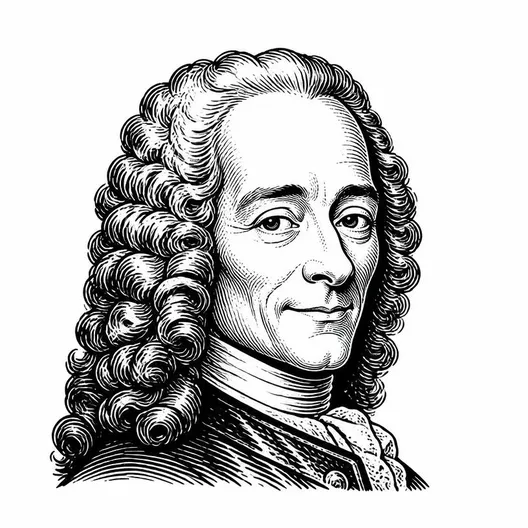 Voltaire 1759