Chapter 46
The Woman Yogi Who Never Eats
“Sir, whither are we bound this morning?” Mr. Wright was driving the Ford; he took his eyes off the road long enough to gaze at me with a questioning twinkle. From day to day he seldom knew what part of Bengal he would be discovering next.
“Sir, where are we headed this morning?” Mr. Wright was driving the Ford. He glanced away from the road just long enough to look at me with a questioning twinkle in his eyes. From day to day, he seldom knew what part of Bengal he would be exploring next.
“God willing,” I replied devoutly, “we are on our way to see an eighth wonder of the world-a woman saint whose diet is thin air!”
“God willing,” I replied with devotion, “we’re on our way to see an eighth wonder of the world: a woman saint who lives on air alone!”
“Repetition of wonders-after Therese Neumann.” But Mr. Wright laughed eagerly just the same; he even accelerated the speed of the car. More extraordinary grist for his travel diary! Not one of an average tourist, that!
“More wonders, after Therese Neumann.” But Mr. Wright laughed eagerly all the same. He even sped up the car. More extraordinary material for his travel diary! No ordinary tourist’s diary, that!
The Ranchi school had just been left behind us; we had risen before the sun. Besides my secretary and myself, three Bengali friends were in the party. We drank in the exhilarating air, the natural wine of the morning. Our driver guided the car warily among the early peasants and the two-wheeled carts, slowly drawn by yoked, hump-shouldered bullocks, inclined to dispute the road with a honking interloper.
We had just left the Ranchi school behind. We had gotten up before sunrise. Three Bengali friends were traveling with my secretary and me. We drank in the invigorating air, the natural wine of the morning. Our driver steered carefully among the farmers out early and the two-wheeled carts. Pairs of hump-shouldered bullocks yoked together pulled the carts slowly. The bullocks seemed unwilling to share the road with the honking intruder.
“Sir, we would like to know more of the fasting saint.”
“Sir, we would like to know more about the fasting saint.”
“Her name is Giri Bala,” I informed my companions. “I first heard about her years ago from a scholarly gentleman, Sthiti Lal Nundy. He often came to the Gurpar Road home to tutor my brother Bishnu.”
“Her name is Giri Bala,” I told my companions. “I first heard about her years ago from a scholar named Sthiti Lal Nundy. He often came to our home on Gurpar Road to tutor my brother Bishnu.”
“‘I know Giri Bala well,’ Sthiti Babu told me. ‘She employs a certain yoga technique which enables her to live without eating. I was her close neighbor in Nawabganj near Ichapur. [^46] I made it a point to watch her closely; never did I find evidence that she was taking either food or drink. My interest finally mounted so high that I approached the Maharaja of Burdwan [^46] and asked him to conduct an investigation. Astounded at the story, he invited her to his palace. She agreed to a test and lived for two months locked up in a small section of his home. Later she returned for a palace visit of twenty days; and then for a third test of fifteen days. The Maharaja himself told me that these three rigorous scrutinies had convinced him beyond doubt of her non-eating state.’
“‘I know Giri Bala well,’ Sthiti Babu told me. ‘She uses a particular yoga technique that allows her to live without eating. I was her close neighbor in Nawabganj near Ichapur. [^46] I made a point of watching her closely. I never found any evidence that she ate or drank anything. My interest eventually grew so strong that I approached the Maharaja of Burdwan [^46] and asked him to investigate. Amazed by the story, he invited her to his palace. She agreed to a test and spent two months locked in a small part of his home. Later, she returned to the palace for twenty days, then for a third test lasting fifteen days. The Maharaja himself told me that these three strict tests had convinced him beyond doubt that she lived without eating.’
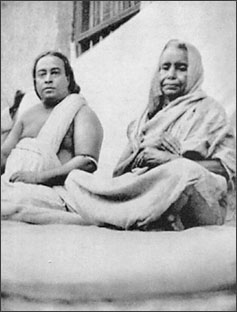
GIRI BALA
GIRI BALA
This great woman yogi has not taken food or drink since 1880. I am pictured with her, in 1936, at her home in the isolated Bengal village of Biur. Her non-eating state has been rigorously investigated by the Maharaja of Burdwan. She employs a certain yoga technique to recharge her body with cosmic energy from the ether, sun, and air.
This great woman yogi has not eaten or drunk anything since 1880. I am pictured with her in 1936 at her home in Biur, an isolated village in Bengal. The Maharaja of Burdwan has rigorously investigated her ability to live without food or drink. She uses a specific yoga technique to recharge her body with cosmic energy from the ether, sun, and air.
“This story of Sthiti Babu’s has remained in my mind for over twenty- five years,” I concluded. “Sometimes in America I wondered if the river of time would not swallow the yogini [^46] before I could meet her. She must be quite aged now. I do not even know where, or if, she lives. But in a few hours we shall reach Purulia; her brother has a home there.”
“Sthiti Babu’s story has stayed with me for over twenty-five years,” I concluded. “Sometimes in America I wondered if time would take the yogini [^46] away before I could meet her. She must be quite old now. I do not even know where she lives, or if she is still alive. But in a few hours we will reach Purulia. Her brother has a home there.”
By ten-thirty our little group was conversing with the brother, Lambadar Dey, a lawyer of Purulia.
By ten-thirty, our little group was talking with the brother, Lambadar Dey, a lawyer from Purulia.
“Yes, my sister is living. She sometimes stays with me here, but at present she is at our family home in Biur.” Lambadar Babu glanced doubtfully at the Ford. “I hardly think, Swamiji, that any automobile has ever penetrated into the interior as far as Biur. It might be best if you all resign yourselves to the ancient jolt of the bullock cart!”
“Yes, my sister is alive. She sometimes stays here with me, but right now she is at our family home in Biur.” Lambadar Babu looked doubtfully at the Ford. “Swamiji, I hardly think any car has ever traveled so far into the countryside as Biur. It might be best if you all accept the age-old jolting ride in a bullock cart!”
As one voice our party pledged loyalty to the Pride of Detroit.
Our whole group pledged loyalty to the Pride of Detroit in one voice.
“The Ford comes from America,” I told the lawyer. “It would be a shame to deprive it of an opportunity to get acquainted with the heart of Bengal!”
“The Ford comes from America,” I told the lawyer. “It would be a shame to deny it a chance to get to know the heart of Bengal!”
“May Ganesh [^46] go with you!” Lambadar Babu said, laughing. He added courteously, “If you ever get there, I am sure Giri Bala will be glad to see you. She is approaching her seventies, but continues in excellent health.”
“May Ganesh [^46] go with you!” Lambadar Babu said, laughing. He added politely, “If you ever get there, I’m sure Giri Bala will be glad to see you. She is nearly seventy, but still in excellent health.”
“Please tell me, sir, if it is absolutely true that she eats nothing?” I looked directly into his eyes, those telltale windows of the mind.
“Please tell me, sir, is it absolutely true that she eats nothing?” I looked directly into his eyes, those revealing windows into the mind.
“It is true.” His gaze was open and honorable. “In more than five decades I have never seen her eat a morsel. If the world suddenly came to an end, I could not be more astonished than by the sight of my sister’s taking food!”
“It’s true.” His gaze was open and honest. “In more than fifty years, I have never seen her eat a bite. If the world suddenly ended, I couldn’t be more astonished than I would be to see my sister eat!”
We chuckled together over the improbability of these two cosmic events.
We chuckled together at how unlikely these two cosmic events were.
“Giri Bala has never sought an inaccessible solitude for her yoga practices,” Lambadar Babu went on. “She has lived her entire life surrounded by her family and friends. They are all well accustomed now to her strange state. Not one of them who would not be stupefied if Giri Bala suddenly decided to eat anything! Sister is naturally retiring, as befits a Hindu widow, but our little circle in Purulia and in Biur all know that she is literally an ‘exceptional’ woman.”
“Giri Bala has never sought a remote place to practice yoga alone,” Lambadar Babu continued. “She has spent her whole life surrounded by family and friends. They are all now used to her unusual condition. Every one of them would be stunned if Giri Bala suddenly decided to eat anything! Sister is naturally reserved, as is expected of a Hindu widow. But everyone in our little circle in Purulia and Biur knows she is literally an ‘exceptional’ woman.”
The brother’s sincerity was manifest. Our little party thanked him warmly and set out toward Biur. We stopped at a street shop for curry and luchis, attracting a swarm of urchins who gathered round to watch Mr. Wright eating with his fingers in the simple Hindu manner. [^46] Hearty appetites caused us to fortify ourselves against an afternoon which, unknown at the moment, was to prove fairly laborious.
The brother’s sincerity was clear. Our small group thanked him warmly and set out toward Biur. We stopped at a street shop for curry and luchis, drawing a crowd of children. They gathered around to watch Mr. Wright eating with his fingers in the simple Hindu manner. [^46] Our hearty appetites led us to eat well, preparing us for the afternoon. We did not know then that the afternoon would turn out to be fairly demanding.
Our way now led east through sun-baked rice fields into the Burdwan section of Bengal. On through roads lined with dense vegetation; the songs of the maynas and the stripe-throated bulbuls streamed out from trees with huge, umbrellalike branches. A bullock cart now and then, the rini, rini, manju, manju squeak of its axle and iron-shod wooden wheels contrasting sharply in mind with the swish, swish of auto tires over the aristocratic asphalt of the cities.
Our route now took us east through sun-baked rice fields into the Burdwan region of Bengal. We continued along roads lined with dense vegetation. The songs of the maynas and the stripe-throated bulbuls poured from trees with huge, umbrella-like branches. Now and then, a bullock cart passed, its axle and iron-shod wooden wheels squeaking rini, rini, manju, manju. In my mind, that squeaking contrasted sharply with the swish, swish of car tires over the cities’ upper-class asphalt.
“Dick, halt!” My sudden request brought a jolting protest from the Ford. “That overburdened mango tree is fairly shouting an invitation!”
“Dick, stop!” My sudden request made the Ford jolt in protest. “That mango tree is so loaded with fruit, it’s practically shouting an invitation!”
The five of us dashed like children to the mango-strewn earth; the tree had benevolently shed its fruits as they had ripened.
The five of us ran like children to the ground covered with mangoes. The tree had generously dropped its fruit as each mango ripened.
“Full many a mango is born to lie unseen,” I paraphrased, “and waste its sweetness on the stony ground.”
“Many a mango grows only to lie unseen,” I paraphrased, “and waste its sweetness on the rocky ground.”
“Nothing like this in America, Swamiji, eh?” laughed Sailesh Mazumdar, one of my Bengali students.
“Nothing like this in America, Swamiji, right?” said Sailesh Mazumdar, one of my Bengali students, with a laugh.
“No,” I admitted, covered with mango juice and contentment. “How I have missed this fruit in the West! A Hindu’s heaven without mangoes is inconceivable!”
“No,” I admitted, covered in mango juice and full of contentment. “How I’ve missed mangoes in the West! A Hindu’s heaven without mangoes is impossible to imagine!”
I picked up a rock and downed a proud beauty hidden on the highest limb.
I picked up a rock and knocked down a proud beauty hidden on the highest branch.
“Dick,” I asked between bites of ambrosia, warm with the tropical sun, “are all the cameras in the car?”
“Dick,” I asked between bites of heavenly food warmed by the tropical sun, “are all the cameras in the car?”
“Yes, sir; in the baggage compartment.”
“Yes, sir. In the baggage compartment.”
“If Giri Bala proves to be a true saint, I want to write about her in the West. A Hindu yogini with such inspiring powers should not live and die unknown-like most of these mangoes.”
“If Giri Bala proves to be a true saint, I want to write about her in the West. A Hindu yogini with such inspiring powers should not live and die unknown, as most of these mangoes do.”
Half an hour later I was still strolling in the sylvan peace.
Half an hour later, I was still strolling through the peaceful woods.
“Sir,” Mr. Wright remarked, “we should reach Giri Bala before the sun sets, to have enough light for photographs.” He added with a grin, “The Westerners are a skeptical lot; we can’t expect them to believe in the lady without any pictures!”
“Sir,” Mr. Wright said, “we should reach Giri Bala before sunset so we have enough light for photographs.” He added with a grin, “Westerners are a skeptical bunch. We can’t expect them to believe in the lady without any pictures!”
This bit of wisdom was indisputable; I turned my back on temptation and reentered the car.
There was no arguing with this wisdom. I turned away from temptation and got back into the car.
“You are right, Dick,” I sighed as we sped along, “I sacrifice the mango paradise on the altar of Western realism. Photographs we must have!”
“You’re right, Dick,” I sighed as we sped along. “I’m sacrificing the mango paradise on the altar of Western realism. We must have photographs!”
The road became more and more sickly: wrinkles of ruts, boils of hardened clay, the sad infirmities of old age! Our group dismounted occasionally to allow Mr. Wright to more easily maneuver the Ford, which the four of us pushed from behind.
The road grew more and more sickly, with wrinkled ruts and boils of hardened clay. All the sad ailments of old age! Our group occasionally got out so Mr. Wright could maneuver the Ford more easily while the four of us pushed from behind.
“Lambadar Babu spoke truly,” Sailesh acknowledged. “The car is not carrying us; we are carrying the car!”
“Lambadar Babu was right,” Sailesh admitted. “The car isn’t carrying us. We’re carrying the car!”
Our climb-in, climb-out auto tedium was beguiled ever and anon by the appearance of a village, each one a scene of quaint simplicity.
The tedium of getting in and out of the car was occasionally eased by the sight of a village. Each village was charmingly simple.
“Our way twisted and turned through groves of palms among ancient, unspoiled villages nestling in the forest shade,” Mr. Wright has recorded in his travel diary, under date of May 5, 1936. “Very fascinating are these clusters of thatched mud huts, decorated with one of the names of God on the door; many small, naked children innocently playing about, pausing to stare or run wildly from this big, black, bullockless carriage tearing madly through their village. The women merely peep from the shadows, while the men lazily loll beneath the trees along the roadside, curious beneath their nonchalance. In one place, all the villagers were gaily bathing in the large tank (in their garments, changing by draping dry cloths around their bodies, dropping the wet ones). Women bearing water to their homes, in huge brass jars.
“Our route wound through palm groves among ancient, unspoiled villages tucked into the forest shade,” Mr. Wright recorded in his travel diary on May 5, 1936. “These clusters of thatched mud huts are fascinating, each with one of God’s names decorating the door. Many small, naked children play innocently nearby. They pause to stare or run wildly from this big, black carriage without bullocks, racing madly through their village. The women only peek out from the shadows, while the men lounge lazily beneath the roadside trees. The men are curious despite their casual manner. In one place, all the villagers were happily bathing in the large water tank (wearing their clothes). To change, they wrapped dry cloths around their bodies and dropped the wet ones. Women carried water home in huge brass jars.
“The road led us a merry chase over mount and ridge; we bounced and tossed, dipped into small streams, detoured around an unfinished causeway, slithered across dry, sandy river beds and finally, about 5:00 P.M., we were close to our destination, Biur. This minute village in the interior of Bankura District, hidden in the protection of dense foliage, is unapproachable by travelers during the rainy season, when the streams are raging torrents and the roads serpentlike spit the mud-venom.
“The road took us on a wild chase over mountains and ridges. We bounced and jolted, dipped into small streams, and detoured around an unfinished causeway. We slid across dry, sandy riverbeds and finally, around 5:00 P.M., neared our destination, Biur. This tiny village deep in Bankura District lies hidden and sheltered by dense foliage. Travelers cannot reach the village during the rainy season, when the streams become raging torrents and the roads spit mud like venomous snakes.
“Asking for a guide among a group of worshipers on their way home from a temple prayer (out in the lonely field), we were besieged by a dozen scantily clad lads who clambered on the sides of the car, eager to conduct us to Giri Bala.
“We asked for a guide among worshipers heading home from a temple prayer (out in the lonely field). A dozen boys wearing very little clothing swarmed around us and climbed onto the sides of the car. The boys were eager to lead us to Giri Bala.
“The road led toward a grove of date palms sheltering a group of mud huts, but before we had reached it, the Ford was momentarily tipped at a dangerous angle, tossed up and dropped down. The narrow trail led around trees and tank, over ridges, into holes and deep ruts. The car became anchored on a clump of bushes, then grounded on a hillock, requiring a lift of earth clods; on we proceeded, slowly and carefully; suddenly the way was stopped by a mass of brush in the middle of the cart track, necessitating a detour down a precipitous ledge into a dry tank, rescue from which demanded some scraping, adzing, and shoveling. Again and again the road seemed impassable, but the pilgrimage must go on; obliging lads fetched spades and demolished the obstacles (shades of Ganesh!) while hundreds of children and parents stared.
“The road led toward a grove of date palms sheltering a group of mud huts. But before we reached the grove, the Ford briefly tilted at a dangerous angle, then bounced up and dropped down. The narrow trail wound around trees and a reservoir, over ridges, and into holes and deep ruts. The car got stuck on a clump of bushes, then scraped bottom on a small hill. We had to raise the car with clods of earth. We continued slowly and carefully. Suddenly, a mass of brush blocked the cart track. We had to detour down a steep ledge into a dry reservoir. Getting the car out required some scraping, chopping with an adze, and shoveling. Again and again the road seemed impassable, but the pilgrimage had to go on. Helpful boys fetched spades and cleared the obstacles while hundreds of children and parents stared. (Shades of Ganesh!)”
“Soon we were threading our way along the two ruts of antiquity, women gazing wide-eyed from their hut doors, men trailing alongside and behind us, children scampering to swell the procession. Ours was perhaps the first auto to traverse these roads; the ‘bullock cart union’ must be omnipotent here! What a sensation we created-a group piloted by an American and pioneering in a snorting car right into their hamlet fastness, invading the ancient privacy and sanctity!
“Soon we were making our way along the road’s two ancient ruts. Women stared wide-eyed from their hut doors. Men followed beside and behind us, and children scampered over to join the growing procession. Ours was perhaps the first car to travel these roads. The ‘bullock cart union’ must be all-powerful here! What a sensation we caused! Our group, led by an American in a snorting car, was breaking new ground in their secluded village. We were invading its age-old privacy and sanctity!
“Halting by a narrow lane we found ourselves within a hundred feet of Giri Bala’s ancestral home. We felt the thrill of fulfillment after the long road struggle crowned by a rough finish. We approached a large, two-storied building of brick and plaster, dominating the surrounding adobe huts; the house was under the process of repair, for around it was the characteristically tropical framework of bamboos.
“Stopping by a narrow lane, we found ourselves within a hundred feet of Giri Bala’s ancestral home. We felt the thrill of finally arriving after a long, difficult journey with a rough final stretch. We approached a large, two-story brick-and-plaster building that towered over the surrounding adobe huts. The house was being repaired, as shown by the bamboo scaffolding around it, typical of the tropics.
“With feverish anticipation and suppressed rejoicing we stood before the open doors of the one blessed by the Lord’s ‘hungerless’ touch. Constantly agape were the villagers, young and old, bare and dressed, women aloof somewhat but inquisitive too, men and boys unabashedly at our heels as they gazed on this unprecedented spectacle.
“With intense anticipation and barely contained joy, we stood before the open doors of the one blessed by the Lord’s ‘hungerless’ touch. The villagers kept staring in amazement, young and old, naked and clothed. The women stayed somewhat apart but were curious too. The men and boys followed close behind us without embarrassment, gazing at this spectacle unlike anything they had seen before.
“Soon a short figure came into view in the doorway-Giri Bala! She was swathed in a cloth of dull, goldish silk; in typically Indian fashion, she drew forward modestly and hesitatingly, peering slightly from beneath the upper fold of her swadeshi cloth. Her eyes glistened like smouldering embers in the shadow of her head piece; we were enamored by a most benevolent and kindly face, a face of realization and understanding, free from the taint of earthly attachment.
“Soon a short figure appeared in the doorway. It was Giri Bala! She was wrapped in dull, golden silk. In typical Indian fashion, she moved forward modestly and hesitantly, peering out beneath the upper fold of her swadeshi cloth. Her eyes glowed like smoldering embers in the shadow of her head covering. We were captivated by her deeply compassionate and kind face. Her face showed spiritual realization and understanding, free from any trace of worldly attachment.
“Meekly she approached and silently assented to our snapping a number of pictures with our ‘still’ and ‘movie’ cameras. [^46] Patiently and shyly she endured our photo techniques of posture adjustment and light arrangement. Finally we had recorded for posterity many photographs of the only woman in the world who is known to have lived without food or drink for over fifty years. (Therese Neumann, of course, has fasted since 1923.) Most motherly was Giri Bala’s expression as she stood before us, completely covered in the loose-flowing cloth, nothing of her body visible but her face with its downcast eyes, her hands, and her tiny feet. A face of rare peace and innocent poise-a wide, childlike, quivering lip, a feminine nose, narrow, sparkling eyes, and a wistful smile.”
“She approached meekly and silently agreed to let us take several pictures with our ‘still’ and ‘movie’ cameras. [^46] Patiently and shyly, she let us adjust her pose and arrange the lighting. Finally, we had preserved many photographs for future generations. They showed the only woman in the world known to have lived without food or drink for over fifty years. (Therese Neumann, of course, has fasted since 1923.) Giri Bala’s expression was deeply motherly as she stood before us, completely covered in loose, flowing cloth. Only her face with its lowered eyes, her hands, and her tiny feet were visible. Her face showed rare peace and innocent composure. She had a wide, childlike, trembling lip, a feminine nose, narrow, sparkling eyes, and a wistful smile.”
Mr. Wright’s impression of Giri Bala was shared by myself; spirituality enfolded her like her gently shining veil. She pronamed before me in the customary gesture of greeting from a householder to a monk. Her simple charm and quiet smile gave us a welcome beyond that of honeyed oratory; forgotten was our difficult, dusty trip.
I shared Mr. Wright’s impression of Giri Bala. Spirituality surrounded her like her softly shining veil. She pronamed, bowing before me in the customary greeting from a householder to a monk. Her simple charm and quiet smile welcomed us more warmly than sweet words ever could. We forgot our difficult, dusty trip.
The little saint seated herself cross-legged on the verandah. Though bearing the scars of age, she was not emaciated; her olive-colored skin had remained clear and healthy in tone.
The little saint sat cross-legged on the veranda. Though she showed signs of age, she was not extremely thin. Her olive-colored skin had stayed clear and healthy.
“Mother,” I said in Bengali, “for over twenty-five years I have thought eagerly of this very pilgrimage! I heard about your sacred life from Sthiti Lal Nundy Babu.”
“Mother,” I said in Bengali, “I’ve eagerly looked forward to this very pilgrimage for over twenty-five years! I heard about your holy life from Sthiti Lal Nundy Babu.”
She nodded in acknowledgment. “Yes, my good neighbor in Nawabganj.”
She nodded. “Yes, my good neighbor in Nawabganj.”
“During those years I have crossed the oceans, but I never forgot my early plan to someday see you. The sublime drama that you are here playing so inconspicuously should be blazoned before a world that has long forgotten the inner food divine.”
“Over those years, I have crossed oceans, but I never forgot my early plan to visit you someday. The sublime drama you are quietly acting out here should be proclaimed to the world. The world has long forgotten the divine nourishment within.”
The saint lifted her eyes for a minute, smiling with serene interest.
The saint looked up for a minute, smiling with calm interest.
“Baba (honored father) knows best,” she answered meekly.
“Baba (honored father) knows best,” she said meekly.
I was happy that she had taken no offense; one never knows how great yogis or yoginis will react to the thought of publicity. They shun it, as a rule, wishing to pursue in silence the profound soul research. An inner sanction comes to them when the proper time arrives to display their lives openly for the benefit of seeking minds.
I was happy she had taken no offense. One never knows how great yogis or yoginis will react to the idea of publicity. They usually avoid publicity, wishing to explore the depths of the soul in silence. When the right time comes, they feel an inner approval to share their lives openly for the benefit of seekers.
“Mother,” I went on, “please forgive me, then, for burdening you with many questions. Kindly answer only those that please you; I shall understand your silence, also.”
“Mother,” I continued, “then please forgive me for burdening you with so many questions. Please answer only the questions you want to answer. I will understand your silence, too.”
She spread her hands in a gracious gesture. “I am glad to reply, insofar as an insignificant person like myself can give satisfactory answers.”
She spread her hands in a gracious gesture. “I’m happy to answer, as far as someone as insignificant as I am can give satisfactory answers.”
“Oh, no, not insignificant!” I protested sincerely. “You are a great soul.”
“Oh, no, you’re not insignificant!” I said sincerely, objecting. “You are a great soul.”
“I am the humble servant of all.” She added quaintly, “I love to cook and feed people.”
“I am the humble servant of everyone.” She added with old-fashioned charm, “I love to cook and feed people.”
A strange pastime, I thought, for a non-eating saint!
What a strange hobby, I thought, for a saint who doesn't eat!
“Tell me, Mother, from your own lips-do you live without food?”
“Tell me yourself, Mother, do you live without food?”
“That is true.” She was silent for a few moments; her next remark showed that she had been struggling with mental arithmetic. “From the age of twelve years four months down to my present age of sixty-eight- a period of over fifty-six years-I have not eaten food or taken liquids.”
“That is true.” She was silent for a few moments. Her next remark showed she had been struggling to do the math in her head. “From age twelve years and four months to my current age of sixty-eight, over fifty-six years have passed. During that time, I have not eaten food or drunk liquids.”
“Are you never tempted to eat?”
“Do you never feel tempted to eat?”
“If I felt a craving for food, I would have to eat.” Simply yet regally she stated this axiomatic truth, one known too well by a world revolving around three meals a day!
“If I craved food, I would have to eat.” She stated this obvious truth simply, yet with regal dignity. A world revolving around three meals a day knew that truth all too well!
“But you do eat something!” My tone held a note of remonstrance.
“But you do eat something!” There was a hint of protest in my voice.
“Of course!” She smiled in swift understanding.
“Of course!” She smiled as she quickly understood.
“Your nourishment derives from the finer energies of the air and sunlight, [^46] and from the cosmic power which recharges your body through the medulla oblongata.”
“You get nourishment from the subtle energies of air and sunlight, [^46] and from cosmic power. This cosmic power recharges your body through the medulla oblongata.”
“Baba knows.” Again she acquiesced, her manner soothing and unemphatic.
“Baba knows.” Again she agreed, in a soothing, understated way.
“Mother, please tell me about your early life. It holds a deep interest for all of India, and even for our brothers and sisters beyond the seas.”
“Mother, please tell me about your early life. All of India is deeply interested in your early life, and so are our brothers and sisters overseas.”
Giri Bala put aside her habitual reserve, relaxing into a conversational mood.
Giri Bala set aside her usual reserve and relaxed into conversation.
“So be it.” Her voice was low and firm. “I was born in these forest regions. My childhood was unremarkable save that I was possessed by an insatiable appetite. I had been betrothed in early years.
“So be it.” Her voice was low and firm. “I was born in these forests. My childhood was ordinary except that I had an appetite I could never satisfy. I had been engaged to marry at a young age.
“‘Child,’ my mother often warned me, ‘try to control your greed. When the time comes for you to live among strangers in your husband’s family, what will they think of you if your days are spent in nothing but eating?’
“‘Child,’ my mother often warned me, ‘try to control your greed. One day, you’ll live among strangers in your husband’s family. What will your husband’s family think of you if you spend your days doing nothing but eating?’
“The calamity she had foreseen came to pass. I was only twelve when I joined my husband’s people in Nawabganj. My mother-in-law shamed me morning, noon, and night about my gluttonous habits. Her scoldings were a blessing in disguise, however; they roused my dormant spiritual tendencies. One morning her ridicule was merciless.
“The disaster she had foreseen happened. I was only twelve when I went to live with my husband’s family in Nawabganj. My mother-in-law shamed me morning, noon, and night for eating too much. But her scoldings were a blessing in disguise. They awakened my dormant spiritual inclinations. One morning her mockery was merciless.
“‘I shall soon prove to you,’ I said, stung to the quick, ‘that I shall never touch food again as long as I live.’
“‘I’ll soon prove to you,’ I said, deeply hurt, ‘that I’ll never eat again as long as I live.’
“My mother-in-law laughed in derision. ‘So!’ she said, ‘how can you live without eating, when you cannot live without overeating?’
“My mother-in-law laughed mockingly. ‘So!’ she said, ‘how can you live without eating when you cannot live without overeating?’
“This remark was unanswerable! Yet an iron resolution scaffolded my spirit. In a secluded spot I sought my Heavenly Father.
“I had no answer to that remark! Yet a firm resolve supported my spirit. In a quiet, private place, I sought my Heavenly Father.
“‘Lord,’ I prayed incessantly, ‘please send me a guru, one who can teach me to live by Thy light and not by food.’
“‘Lord,’ I prayed constantly, ‘please send me a guru. Let him teach me to live by your light, not by food.’
“A divine ecstasy fell over me. Led by a beatific spell, I set out for the Nawabganj ghat on the Ganges. On the way I encountered the priest of my husband’s family.
“A divine joy came over me. Drawn by a sense of heavenly bliss, I set out for the Nawabganj ghat on the Ganges. On the way, I met my husband’s family priest.
“‘Venerable sir,’ I said trustingly, ‘kindly tell me how to live without eating.’
“‘Respected sir,’ I said trustingly, ‘please tell me how to live without eating.’
“He stared at me without reply. Finally he spoke in a consoling manner. ‘Child,’ he said, ‘come to the temple this evening; I will conduct a special Vedic ceremony for you.’
“He stared at me without answering. Finally, he spoke reassuringly. ‘Child,’ he said, ‘come to the temple this evening. I will perform a special Vedic ceremony for you.’
“This vague answer was not the one I was seeking; I continued toward the ghat. The morning sun pierced the waters; I purified myself in the Ganges, as though for a sacred initiation. As I left the river bank, my wet cloth around me, in the broad glare of day my master materialized himself before me!
“This vague answer was not what I was looking for. I continued toward the ghat. The morning sun shone through the water. I purified myself in the Ganges, as though preparing for a sacred initiation. As I left the riverbank with my wet cloth wrapped around me, my master materialized before me in broad daylight!
“‘Dear little one,’ he said in a voice of loving compassion, ‘I am the guru sent here by God to fulfill your urgent prayer. He was deeply touched by its very unusual nature! From today you shall live by the astral light, your bodily atoms fed from the infinite current.’”
“‘Dear little one,’ he said with loving compassion, ‘I am the guru God sent here to answer your urgent prayer. Your very unusual prayer deeply touched him! From today on, you will live on astral light. The infinite current will feed the atoms in your body.’”
Giri Bala fell into silence. I took Mr. Wright’s pencil and pad and translated into English a few items for his information.
Giri Bala grew silent. I took Mr. Wright’s pencil and pad and translated a few points into English for him.
The saint resumed the tale, her gentle voice barely audible. “The ghat was deserted, but my guru cast round us an aura of guarding light, that no stray bathers later disturb us. He initiated me into a kria technique which frees the body from dependence on the gross food of mortals. The technique includes the use of a certain mantra [^46] and a breathing exercise more difficult than the average person could perform. No medicine or magic is involved; nothing beyond the kria.”
The saint continued her story, her gentle voice barely audible. “The ghat was deserted, but my guru surrounded us with protective light so that no passing bathers would disturb us later. He initiated me into a kria technique that frees the body from dependence on ordinary human food. The technique includes a certain mantra [^46] and a breathing exercise too difficult for the average person to perform. No medicine or magic is involved, only the kria.”
In the manner of the American newspaper reporter, who had unknowingly taught me his procedure, I questioned Giri Bala on many matters which I thought would be of interest to the world. She gave me, bit by bit, the following information:
I followed the approach of the American newspaper reporter, who had unknowingly taught me his methods. I questioned Giri Bala about many things I thought would interest the world. Bit by bit, she gave me the following information:
“I have never had any children; many years ago I became a widow. I sleep very little, as sleep and waking are the same to me. I meditate at night, attending to my domestic duties in the daytime. I slightly feel the change in climate from season to season. I have never been sick or experienced any disease. I feel only slight pain when accidentally injured. I have no bodily excretions. I can control my heart and breathing. I often see my guru as well as other great souls, in vision.”
“I have never had any children. I became a widow many years ago. I sleep very little, since sleeping and being awake are the same to me. I meditate at night and take care of household duties during the day. I barely feel the changes in climate from season to season. I have never been sick or had any disease. I feel only slight pain when I am accidentally injured. My body produces no waste. I can control my heartbeat and breathing. I often see my guru and other great souls in visions.”
“Mother,” I asked, “why don’t you teach others the method of living without food?”
“Mother,” I asked, “why don’t you teach others how to live without food?”
My ambitious hopes for the world’s starving millions were nipped in the bud.
My ambitious hopes for the world’s starving millions were crushed at the very start.
“No.” She shook her head. “I was strictly commanded by my guru not to divulge the secret. It is not his wish to tamper with God’s drama of creation. The farmers would not thank me if I taught many people to live without eating! The luscious fruits would lie uselessly on the ground. It appears that misery, starvation, and disease are whips of our karma which ultimately drive us to seek the true meaning of life.”
“No.” She shook her head. “My guru strictly ordered me not to reveal the secret. He does not want to interfere with God’s drama of creation. Farmers would not thank me if I taught many people to live without eating! The delicious fruits would lie on the ground, going to waste. Misery, starvation, and disease seem to be the whips of our karma. These whips ultimately drive us to seek the true meaning of life.”
“Mother,” I said slowly, “what is the use of your having been singled out to live without eating?”
“Mother,” I said slowly, “what good comes from your being chosen to live without eating?”
“To prove that man is Spirit.” Her face lit with wisdom. “To demonstrate that by divine advancement he can gradually learn to live by the Eternal Light and not by food.”
“To prove that human beings are Spirit.” Her face glowed with wisdom. “To show that through spiritual growth, people can gradually learn to live on the Eternal Light instead of food.”
The saint sank into a deep meditative state. Her gaze was directed inward; the gentle depths of her eyes became expressionless. She gave a certain sigh, the prelude to the ecstatic breathless trance. For a time she had fled to the questionless realm, the heaven of inner joy.
The saint sank into deep meditation. Her gaze turned inward, and her gentle eyes grew expressionless. She gave a particular sigh, signaling the start of a blissful trance in which her breathing stopped. For a time, she had escaped to a realm beyond questions, a heaven of inner joy.
The tropical darkness had fallen. The light of a small kerosene lamp flickered fitfully over the faces of a score of villagers squatting silently in the shadows. The darting glowworms and distant oil lanterns of the huts wove bright eerie patterns into the velvet night. It was the painful hour of parting; a slow, tedious journey lay before our little party.
Darkness had fallen over the tropics. A small kerosene lamp cast a flickering light over the faces of twenty villagers squatting silently in the shadows. Darting glowworms and distant oil lanterns in the huts wove bright, eerie patterns into the velvety night. The painful time to say goodbye had come. A slow, tiring journey lay ahead of our small group.
“Giri Bala,” I said as the saint opened her eyes, “please give me a keepsake-a strip of one of your saris.”
“Giri Bala,” I said as the saint opened her eyes, “please give me a keepsake, a strip from one of your saris.”
She soon returned with a piece of Benares silk, extending it in her hand as she suddenly prostrated herself on the ground.
She soon returned with a piece of Benares silk. Holding it out in her hand, she suddenly bowed down flat on the ground.
“Mother,” I said reverently, “rather let me touch your own blessed feet!”
“Mother,” I said with reverence, “let me touch your own blessed feet instead!”
46-1: In northern Bengal.
46-1: In northern Bengal.
46-2: H. H. Sir Bijay Chand Mahtab, now dead. His family doubtless possesses some record of the Maharaja’s three investigations of Giri Bala.
46-2: H. H. Sir Bijay Chand Mahtab, now deceased. His family undoubtedly has some record of the Maharaja’s three investigations of Giri Bala.
46-3: Woman yogi.
46-3: Female yogi.
46-4: “Remover of Obstacles,” the god of good fortune.
46-4: “Remover of Obstacles,” the god of good fortune.
46-5: Sri Yukteswar used to say: “The Lord has given us the fruits of the good earth. We like to see our food, to smell it, to taste it- the Hindu likes also to touch it!” One does not mind hearing it, either, if no one else is present at the meal!
46-5: Sri Yukteswar used to say: “The Lord has given us the fruits of the good earth. We like to see our food, smell it, and taste it. The Hindu also likes to touch it!” We don't mind hearing our food, either, if no one else is present at the meal!
46-6: Mr. Wright also took moving pictures of Sri Yukteswar during his last Winter Solstice Festival in Serampore.
46-6: Mr. Wright also filmed Sri Yukteswar during his last Winter Solstice Festival in Serampore.
46-7: “What we eat is radiation; our food is so much quanta of energy,” Dr. George W. Crile of Cleveland told a gathering of medical men on May 17, 1933 in Memphis. “This all-important radiation, which releases electrical currents for the body’s electrical circuit, the nervous system, is given to food by the sun’s rays. Atoms, Dr. Crile says, are solar systems. Atoms are the vehicles that are filled with solar radiance as so many coiled springs. These countless atomfuls of energy are taken in as food. Once in the human body, these tense vehicles, the atoms, are discharged in the body’s protoplasm, the radiance furnishing new chemical energy, new electrical currents. ‘Your body is made up of such atoms,’ Dr. Crile said. ‘They are your muscles, brains, and sensory organs, such as the eyes and ears.’”
46-7: “What we eat is radiation. Our food consists of quanta of energy,” Dr. George W. Crile of Cleveland told a gathering of doctors. He spoke on May 17, 1933 in Memphis. “This essential radiation releases electrical currents for the body’s electrical circuit, the nervous system. The sun’s rays give food this radiation. Atoms, Dr. Crile says, are solar systems. Atoms carry solar radiance, storing energy like coiled springs. We take in these countless energy-filled atoms as food. Once inside the human body, the tightly wound atoms release their energy in the body’s protoplasm. Their radiation supplies new chemical energy and new electrical currents. ‘Your body is made up of such atoms,’ Dr. Crile said. ‘These atoms make up your muscles, brain, and sensory organs, such as your eyes and ears.’”
Someday scientists will discover how man can live directly on solar energy. “Chlorophyll is the only substance known in nature that somehow possesses the power to act as a ‘sunlight trap,’” William L. Laurence writes in the New York Times. “It ‘catches’ the energy of sunlight and stores it in the plant. Without this no life could exist. We obtain the energy we need for living from the solar energy stored in the plant-food we eat or in the flesh of the animals that eat the plants. The energy we obtain from coal or oil is solar energy trapped by the chlorophyll in plant life millions of years ago. We live by the sun through the agency of chlorophyll.”
Someday scientists will discover how humans can live directly on solar energy. “Chlorophyll is the only known substance in nature that somehow can act as a ‘sunlight trap,’” William L. Laurence writes in the New York Times. “It ‘catches’ the energy of sunlight and stores that energy in plants. Without this process, no life could exist. We get the energy we need to live from solar energy stored in the plants we eat. We also get it from the meat of animals that eat plants. The energy we get from coal or oil is solar energy trapped by chlorophyll in plants millions of years ago. We live on the sun’s energy through chlorophyll.”
46-8: Potent vibratory chant. The literal translation of Sanskrit mantra is “instrument of thought,” signifying the ideal, inaudible sounds which represent one aspect of creation; when vocalized as syllables, a mantra constitutes a universal terminology. The infinite powers of sound derive from AUM, the “Word” or creative hum of the Cosmic Motor.
46-8: A powerful vibrational chant. The Sanskrit word mantra literally means “instrument of thought.” It refers to ideal, inaudible sounds that represent one aspect of creation. When voiced as syllables, a mantra forms a universal language. The infinite powers of sound come from AUM, the “Word” or creative hum of the Cosmic Motor.