Chapter 44
With Mahatma Gandhi at Wardha
“Welcome to Wardha!” Mahadev Desai, secretary to Mahatma Gandhi, greeted Miss Bletch, Mr. Wright, and myself with these cordial words and the gift of wreaths of khaddar (homespun cotton). Our little group had just dismounted at the Wardha station on an early morning in August, glad to leave the dust and heat of the train. Consigning our luggage to a bullock cart, we entered an open motor car with Mr. Desai and his companions, Babasaheb Deshmukh and Dr. Pingale. A short drive over the muddy country roads brought us to Maganvadi, the ashram of India’s political saint.
“Welcome to Wardha!” With these warm words, Mahadev Desai, secretary to Mahatma Gandhi, greeted Miss Bletch, Mr. Wright, and me. He also gave us wreaths of khaddar (homespun cotton). Our little group had just stepped off the train at Wardha station early one August morning. We were glad to leave the train’s dust and heat behind. We handed our luggage over to be carried in a bullock cart. Then we got into an open car with Mr. Desai and his companions, Babasaheb Deshmukh and Dr. Pingale. A short drive along muddy country roads brought us to Maganvadi, the ashram of India’s political saint.
Mahatma Gandhi
Mahatma Gandhi
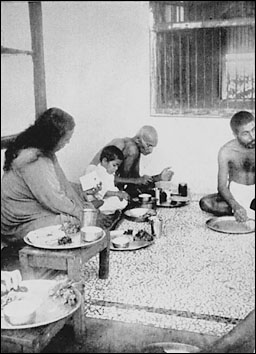
I enjoy a quiet lunch with India’s political saint at his hermitage in Wardha, August, 1935.
I enjoy a quiet lunch with India’s political saint at his hermitage in Wardha in August 1935.
Mr. Desai led us at once to the writing room where, cross-legged, sat Mahatma Gandhi. Pen in one hand and a scrap of paper in the other, on his face a vast, winning, warm-hearted smile!
Mr. Desai led us straight to the writing room, where Mahatma Gandhi sat cross-legged. He held a pen in one hand and a scrap of paper in the other. His face beamed with a huge, charming, warm-hearted smile!
“Welcome!” he scribbled in Hindi; it was a Monday, his weekly day of silence.
“Welcome!” he scribbled in Hindi. It was Monday, his weekly day of silence.
Though this was our first meeting, we beamed on each other affectionately. In 1925 Mahatma Gandhi had honored the Ranchi school by a visit, and had inscribed in its guest-book a gracious tribute.
Though we were meeting for the first time, we smiled warmly at each other. In 1925, Mahatma Gandhi had honored the Ranchi school with a visit. He had written a kind tribute in the school’s guest book.
The tiny 100-pound saint radiated physical, mental, and spiritual health. His soft brown eyes shone with intelligence, sincerity, and discrimination; this statesman has matched wits and emerged the victor in a thousand legal, social, and political battles. No other leader in the world has attained the secure niche in the hearts of his people that Gandhi occupies for India’s unlettered millions. Their spontaneous tribute is his famous title-Mahatma, “great soul.” [^44] For them alone Gandhi confines his attire to the widely-cartooned loincloth, symbol of his oneness with the downtrodden masses who can afford no more.
The tiny, 100-pound saint radiated physical, mental, and spiritual health. His gentle brown eyes shone with intelligence, sincerity, and sound judgment. This statesman had matched wits with opponents and won a thousand legal, social, and political battles. No other world leader has so secure a place in his people’s hearts as Gandhi has among India’s millions who cannot read. Their spontaneous tribute to him is his famous title, Mahatma, “great soul.” [^44] For their sake alone, Gandhi wears only the loincloth so often depicted in cartoons. His loincloth symbolizes his unity with the downtrodden masses who can afford nothing more.
“The ashram residents are wholly at your disposal; please call on them for any service.” With characteristic courtesy, the Mahatma handed me this hastily-written note as Mr. Desai led our party from the writing room toward the guest house.
“The ashram residents are fully available to help you. Please ask them for any service.” With his usual courtesy, the Mahatma handed me this quickly written note. He did so as Mr. Desai led our group from the writing room toward the guest house.
Our guide led us through orchards and flowering fields to a tile- roofed building with latticed windows. A front-yard well, twenty-five feet across, was used, Mr. Desai said, for watering stock; near-by stood a revolving cement wheel for threshing rice. Each of our small bedrooms proved to contain only the irreducible minimum-a bed, handmade of rope. The whitewashed kitchen boasted a faucet in one corner and a fire pit for cooking in another. Simple Arcadian sounds reached our ears-the cries of crows and sparrows, the lowing of cattle, and the rap of chisels being used to chip stones.
Our guide led us through orchards and flowering fields to a building with a tiled roof and latticed windows. A well in the front yard measured twenty-five feet across. Mr. Desai said the well was used to water livestock. Nearby stood a rotating cement wheel for threshing rice. Each of our small bedrooms contained only the bare minimum: a handmade rope bed. The whitewashed kitchen had a faucet in one corner and a cooking fire pit in another. Simple countryside sounds reached our ears: the calls of crows and sparrows, the lowing of cattle, and chisels tapping as they chipped stones.
Observing Mr. Wright’s travel diary, Mr. Desai opened a page and wrote on it a list of Satyagraha [^44] vows taken by all the Mahatma’s strict followers (satyagrahis):
Noticing Mr. Wright’s travel diary, Mr. Desai opened it to a page. He wrote a list of Satyagraha [^44] vows taken by all the Mahatma’s strict followers (satyagrahis):
“Nonviolence; Truth; Non-Stealing; Celibacy; Non-Possession; Body- Labor; Control of the Palate; Fearlessness; Equal Respect for all Religions; Swadeshi (use of home manufactures); Freedom from Untouchability. These eleven should be observed as vows in a spirit of humility.”
“Nonviolence, truthfulness, not stealing, celibacy, owning no possessions, physical labor, control over eating, fearlessness, equal respect for all religions, Swadeshi (using locally made goods), freedom from untouchability. These eleven principles should be followed as vows in a spirit of humility.”
(Gandhi himself signed this page on the following day, giving the date also-August 27, 1935.)
(Gandhi himself signed this page the next day, also adding the date: August 27, 1935.)
Two hours after our arrival my companions and I were summoned to lunch. The Mahatma was already seated under the arcade of the ashram porch, across the courtyard from his study. About twenty-five barefooted satyagrahis were squatting before brass cups and plates. A community chorus of prayer; then a meal served from large brass pots containing chapatis (whole-wheat unleavened bread) sprinkled with ghee; talsari (boiled and diced vegetables), and a lemon jam.
Two hours after we arrived, my companions and I were called to lunch. The Mahatma was already seated under the arches of the ashram porch, across the courtyard from his study. About twenty-five barefoot satyagrahis were squatting in front of brass cups and plates. Everyone prayed together, and then the meal was served from large brass pots. The pots held chapatis (whole-wheat unleavened bread) sprinkled with ghee, talsari (boiled and diced vegetables), and a lemon jam.
The Mahatma ate chapatis, boiled beets, some raw vegetables, and oranges. On the side of his plate was a large lump of very bitter neem leaves, a notable blood cleanser. With his spoon he separated a portion and placed it on my dish. I bolted it down with water, remembering childhood days when Mother had forced me to swallow the disagreeable dose. Gandhi, however, bit by bit was eating the neem paste with as much relish as if it had been a delicious sweetmeat.
The Mahatma ate chapatis, boiled beets, some raw vegetables, and oranges. At the side of his plate was a large lump of very bitter neem leaves, a well-known blood cleanser. He used his spoon to put a portion on my plate. I gulped the leaves down with water, remembering how Mother had forced me to swallow the unpleasant dose in childhood. Gandhi, however, ate the neem paste bit by bit, enjoying it as much as if it were a delicious sweet.
In this trifling incident I noted the Mahatma’s ability to detach his mind from the senses at will. I recalled the famous appendectomy performed on him some years ago. Refusing anesthetics, the saint had chatted cheerfully with his disciples throughout the operation, his infectious smile revealing his unawareness of pain.
In this small incident, I noticed the Mahatma’s ability to detach his mind from his senses at will. I remembered the well-known operation to remove his appendix some years earlier. The saint had refused anesthesia and chatted cheerfully with his disciples throughout the operation. His infectious smile showed that he was unaware of pain.
The afternoon brought an opportunity for a chat with Gandhi’s noted disciple, daughter of an English admiral, Miss Madeleine Slade, now called Mirabai. [^44] Her strong, calm face lit with enthusiasm as she told me, in flawless Hindi, of her daily activities.
That afternoon, I had a chance to chat with Gandhi’s well-known disciple, Miss Madeleine Slade, daughter of an English admiral. She was now called Mirabai. [^44] Her strong, calm face lit up with enthusiasm as she told me about her daily activities in flawless Hindi.
“Rural reconstruction work is rewarding! A group of us go every morning at five o’clock to serve the near-by villagers and teach them simple hygiene. We make it a point to clean their latrines and their mud-thatched huts. The villagers are illiterate; they cannot be educated except by example!” She laughed gaily.
“Helping rebuild rural communities is rewarding! A group of us goes out every morning at five to help nearby villagers and teach them basic hygiene. We make sure to clean their latrines and their mud huts with thatched roofs. The villagers cannot read or write, so we can teach them only by example!” She laughed cheerfully.
I looked in admiration at this highborn Englishwoman whose true Christian humility enables her to do the scavengering work usually performed only by “untouchables.”
I looked with admiration at this Englishwoman of noble birth. Her true Christian humility enables her to clean up waste, work usually done only by “untouchables.”
“I came to India in 1925,” she told me. “In this land I feel that I have ‘come back home.’ Now I would never be willing to return to my old life and old interests.”
“I came to India in 1925,” she told me. “Here I feel that I have ‘come back home.’ Now I would never want to return to my old life and interests.”
We discussed America for awhile. “I am always pleased and amazed,” she said, “to see the deep interest in spiritual subjects exhibited by the many Americans who visit India.” [^44]
We talked about America for a while. “I am always pleased and amazed,” she said, “by the deep interest in spiritual subjects among many Americans visiting India.” [^44]
Mirabai’s hands were soon busy at the charka (spinning wheel), omnipresent in all the ashram rooms and, indeed, due to the Mahatma, omnipresent throughout rural India.
Mirabai’s hands were soon busy at the charka (spinning wheel). Spinning wheels were in all the ashram rooms and, thanks to the Mahatma, throughout rural India.
Gandhi has sound economic and cultural reasons for encouraging the revival of cottage industries, but he does not counsel a fanatical repudiation of all modern progress. Machinery, trains, automobiles, the telegraph have played important parts in his own colossal life! Fifty years of public service, in prison and out, wrestling daily with practical details and harsh realities in the political world, have only increased his balance, open-mindedness, sanity, and humorous appreciation of the quaint human spectacle.
Gandhi has sound economic and cultural reasons for encouraging the revival of small-scale home industries. But he does not call for a fanatical rejection of all modern progress. Machinery, trains, automobiles, and the telegraph have played important roles in his own extraordinary life! His fifty years of public service have included time both in and out of prison. Throughout those years, he has wrestled daily with practical details and harsh political realities. These experiences have only strengthened his balance, open-mindedness, sound judgment, and humorous appreciation of the odd spectacle of human life.
Our trio enjoyed a six o’clock supper as guests of Babasaheb Deshmukh. The 7:00 P.M. prayer hour found us back at the Maganvadi ashram, climbing to the roof where thirty satyagrahis were grouped in a semicircle around Gandhi. He was squatting on a straw mat, an ancient pocket watch propped up before him. The fading sun cast a last gleam over the palms and banyans; the hum of night and the crickets had started. The atmosphere was serenity itself; I was enraptured.
The three of us enjoyed supper at six o’clock as guests of Babasaheb Deshmukh. By the 7:00 P.M. prayer hour, we were back at the Maganvadi ashram and climbing to the roof. There, thirty satyagrahis sat in a semicircle around Gandhi. He was squatting on a straw mat, with an old pocket watch propped up in front of him. The setting sun cast a final gleam over the palms and banyans. The sounds of night and the chirping of crickets had begun. The atmosphere was perfectly peaceful. I was spellbound.
A solemn chant led by Mr. Desai, with responses from the group; then a Gita reading. The Mahatma motioned to me to give the concluding prayer. Such divine unison of thought and aspiration! A memory forever: the Wardha roof top meditation under the early stars.
Mr. Desai led a solemn chant, with the group responding. Then came a reading from the Gita. The Mahatma gestured for me to offer the closing prayer. Such divine unity of thought and aspiration! A memory to keep forever: meditating on the rooftop in Wardha under the first stars.
Punctually at eight o’clock Gandhi ended his silence. The herculean labors of his life require him to apportion his time minutely.
At exactly eight o’clock, Gandhi ended his silence. The enormous demands of his life require him to plan his time down to the minute.
“Welcome, Swamiji!” The Mahatma’s greeting this time was not via paper. We had just descended from the roof to his writing room, simply furnished with square mats (no chairs), a low desk with books, papers, and a few ordinary pens (not fountain pens); a nondescript clock ticked in a corner. An all-pervasive aura of peace and devotion. Gandhi was bestowing one of his captivating, cavernous, almost toothless smiles.
“Welcome, Swamiji!” This time, the Mahatma spoke his greeting rather than writing it on paper. We had just come down from the roof to his writing room. The room was simply furnished with square mats (no chairs) and a low desk holding books, papers, and pens. The pens were ordinary ones (not fountain pens). An unremarkable clock ticked in a corner. A sense of peace and devotion filled the room. Gandhi was giving us one of his captivating, wide, almost toothless smiles.
“Years ago,” he explained, “I started my weekly observance of a day of silence as a means for gaining time to look after my correspondence. But now those twenty-four hours have become a vital spiritual need. A periodical decree of silence is not a torture but a blessing.”
“Years ago,” he explained, “I began setting aside one day each week for silence to make time for my correspondence. But now those twenty-four hours have become an essential spiritual need. Regularly choosing to remain silent is not torture but a blessing.”
I agreed wholeheartedly. [^44] The Mahatma questioned me about America and Europe; we discussed India and world conditions.
I agreed wholeheartedly. [^44] The Mahatma asked me about America and Europe. We discussed India and world conditions.
“Mahadev,” Gandhi said as Mr. Desai entered the room, “please make arrangements at Town Hall for Swamiji to speak there on yoga tomorrow night.”
“Mahadev,” Gandhi said as Mr. Desai entered the room, “please arrange for Swamiji to speak about yoga at Town Hall tomorrow night.”
As I was bidding the Mahatma good night, he considerately handed me a bottle of citronella oil.
As I said good night to the Mahatma, he thoughtfully handed me a bottle of citronella oil.
“The Wardha mosquitoes don’t know a thing about ahimsa, [^44] Swamiji!” he said, laughing.
“The mosquitoes in Wardha don’t know a thing about ahimsa, [^44] Swamiji!” he said, laughing.
The following morning our little group breakfasted early on a tasty wheat porridge with molasses and milk. At ten-thirty we were called to the ashram porch for lunch with Gandhi and the satyagrahis. Today the menu included brown rice, a new selection of vegetables, and cardamom seeds.
The next morning, our small group had an early breakfast of tasty wheat porridge with molasses and milk. At ten-thirty, we were called to the ashram porch for lunch with Gandhi and the satyagrahis. That day’s menu included brown rice, a different selection of vegetables, and cardamom seeds.
Noon found me strolling about the ashram grounds, on to the grazing land of a few imperturbable cows. The protection of cows is a passion with Gandhi.
At noon, I was strolling around the ashram grounds and into a pasture where a few untroubled cows grazed. Gandhi is passionate about protecting cows.
“The cow to me means the entire sub-human world, extending man’s sympathies beyond his own species,” the Mahatma has explained. “Man through the cow is enjoined to realize his identity with all that lives. Why the ancient rishis selected the cow for apotheosis is obvious to me. The cow in India was the best comparison; she was the giver of plenty. Not only did she give milk, but she also made agriculture possible. The cow is a poem of pity; one reads pity in the gentle animal. She is the second mother to millions of mankind. Protection of the cow means protection of the whole dumb creation of God. The appeal of the lower order of creation is all the more forceful because it is speechless.”
“To me, the cow represents the entire animal world, extending human sympathy beyond our own species,” the Mahatma has explained. “Through the cow, we are called to recognize our oneness with all living things. To me, it is obvious why the ancient rishis chose to honor the cow as divine. In India, the cow was the best symbol, for she gave so much. Not only did she give milk, but she also made farming possible. The cow is a poem of compassion. We see compassion in this gentle animal. She is a second mother to millions of people. Protecting the cow means protecting all of God’s creatures that cannot speak. These creatures’ appeal is all the more powerful because they cannot speak.”
Three daily rituals are enjoined on the orthodox Hindu. One is Bhuta Yajna, an offering of food to the animal kingdom. This ceremony symbolizes man’s realization of his obligations to less evolved forms of creation, instinctively tied to bodily identifications which also corrode human life, but lacking in that quality of liberating reason which is peculiar to humanity. Bhuta Yajna thus reinforces man’s readiness to succor the weak, as he in turn is comforted by countless solicitudes of higher unseen beings. Man is also under bond for rejuvenating gifts of nature, prodigal in earth, sea, and sky. The evolutionary barrier of incommunicability among nature, animals, man, and astral angels is thus overcome by offices of silent love.
Orthodox Hindus are required to perform three daily rituals. One is Bhuta Yajna, an offering of food to the animal kingdom. This ceremony symbolizes human recognition of our duties toward less evolved forms of creation. These creatures instinctively identify with their bodies, an attachment that also eats away at human life. But they lack the uniquely human power of reason that can free us. Bhuta Yajna thus strengthens our willingness to help the weak, just as countless acts of care from higher unseen beings comfort us. We also owe a debt to nature for its renewing gifts, abundant in earth, sea, and sky. Nature, animals, humans, and astral angels are separated by evolutionary barriers that prevent communication. Acts of silent love thus overcome these barriers.
The other two daily yajnas are Pitri and Nri. Pitri Yajna is an offering of oblations to ancestors, as a symbol of man’s acknowledgment of his debt to the past, essence of whose wisdom illumines humanity today. Nri Yajna is an offering of food to strangers or the poor, symbol of the present responsibilities of man, his duties to contemporaries.
The other two daily yajnas are Pitri and Nri. Pitri Yajna is an offering to ancestors. The offering symbolizes humanity’s recognition of its debt to the past, whose essential wisdom still guides humanity today. Nri Yajna is an offering of food to strangers or the poor. The offering symbolizes people’s present responsibilities and their duties to others living in their time.
In the early afternoon I fulfilled a neighborly Nri Yajna by a visit to Gandhi’s ashram for little girls. Mr. Wright accompanied me on the ten-minute drive. Tiny young flowerlike faces atop the long-stemmed colorful saris! At the end of a brief talk in Hindi [^44] which I was giving outdoors, the skies unloosed a sudden downpour. Laughing, Mr. Wright and I climbed aboard the car and sped back to Maganvadi amidst sheets of driving silver. Such tropical intensity and splash!
In the early afternoon, I fulfilled a neighborly Nri Yajna by visiting Gandhi’s ashram for little girls. Mr. Wright joined me for the ten-minute drive. Tiny, flowerlike young faces rose above colorful saris like flowers on long stems! As I finished a brief outdoor talk in Hindi [^44], rain suddenly poured from the sky. Laughing, Mr. Wright and I climbed into the car and sped back to Maganvadi through driving sheets of silver rain. Such tropical intensity and splashing!
Reentering the guest house I was struck anew by the stark simplicity and evidences of self-sacrifice which are everywhere present. The Gandhi vow of non-possession came early in his married life. Renouncing an extensive legal practice which had been yielding him an annual income of more than $20,000, the Mahatma dispersed all his wealth to the poor.
Returning to the guest house, I was struck again by the stark simplicity and signs of self-sacrifice everywhere. Gandhi took his vow to own nothing early in his married life. He gave up a large legal practice that had earned him more than $20,000 a year. The Mahatma gave all his wealth to the poor.
Sri Yukteswar used to poke gentle fun at the commonly inadequate conceptions of renunciation.
Sri Yukteswar often gently poked fun at the commonly held but inadequate ideas about renunciation.
“A beggar cannot renounce wealth,” Master would say. “If a man laments: ‘My business has failed; my wife has left me; I will renounce all and enter a monastery,’ to what worldly sacrifice is he referring? He did not renounce wealth and love; they renounced him!”
“A beggar cannot give up wealth,” Master would say. “If a man complains: ‘My business has failed. My wife has left me. I will give up everything and enter a monastery,’ what worldly sacrifice is he making? He did not give up wealth and love. Wealth and love gave him up!”
Saints like Gandhi, on the other hand, have made not only tangible material sacrifices, but also the more difficult renunciation of selfish motive and private goal, merging their inmost being in the stream of humanity as a whole.
Saints like Gandhi, on the other hand, have made real material sacrifices. But they have also made the harder sacrifice of giving up selfish motives and personal goals. In doing so, they have merged their deepest selves with humanity as a whole.
The Mahatma’s remarkable wife, Kasturabai, did not object when he failed to set aside any part of his wealth for the use of herself and their children. Married in early youth, Gandhi and his wife took the vow of celibacy after the birth of several sons. [^44] A tranquil heroine in the intense drama that has been their life together, Kasturabai has followed her husband to prison, shared his three-week fasts, and fully borne her share of his endless responsibilities. She has paid Gandhi the following tribute:
The Mahatma’s remarkable wife, Kasturabai, did not object when he set aside none of his wealth for her and their children. Gandhi and his wife married very young. After the birth of several sons, they took a vow of celibacy. [^44] Kasturabai has been a calm heroine throughout the intense drama of their life together. She has followed her husband to prison and shared his three-week fasts. She has also fully carried her share of his endless responsibilities. She has offered Gandhi the following tribute:
I thank you for having had the privilege of being your lifelong companion and helpmate. I thank you for the most perfect marriage in the world, based on brahmacharya (self-control) and not on sex. I thank you for having considered me your equal in your life work for India. I thank you for not being one of those husbands who spend their time in gambling, racing, women, wine, and song, tiring of their wives and children as the little boy quickly tires of his childhood toys. How thankful I am that you were not one of those husbands who devote their time to growing rich on the exploitation of the labor of others.
Thank you for the privilege of being your lifelong companion and partner. Thank you for the most perfect marriage in the world, based on brahmacharya (self-control) and not on sex. Thank you for treating me as your equal in your life’s work for India. Thank you for not being one of those husbands who spend their time gambling, racing, pursuing women, drinking, and singing. Such husbands grow tired of their wives and children, just as a little boy quickly tires of his childhood toys. How thankful I am that you were not one of those husbands who spend their time getting rich by exploiting other people’s labor.
How thankful I am that you put God and country before bribes, that you had the courage of your convictions and a complete and implicit faith in God. How thankful I am for a husband that put God and his country before me. I am grateful to you for your tolerance of me and my shortcomings of youth, when I grumbled and rebelled against the change you made in our mode of living, from so much to so little.
I am so thankful you put God and country before bribes. I am thankful you had the courage to stand by your convictions and trusted God completely and without question. I am so thankful to have a husband who put God and his country before me. I am grateful for your patience with me and my youthful shortcomings. I complained and rebelled when you changed our way of life from having so much to having so little.
As a young child, I lived in your parents’ home; your mother was a great and good woman; she trained me, taught me how to be a brave, courageous wife and how to keep the love and respect of her son, my future husband. As the years passed and you became India’s most beloved leader, I had none of the fears that beset the wife who may be cast aside when her husband has climbed the ladder of success, as so often happens in other countries. I knew that death would still find us husband and wife.
As a young child, I lived in your parents’ home. Your mother was a great and good woman. She raised me and taught me how to be a brave, courageous wife. She also taught me how to keep the love and respect of her son, my future husband. As the years passed and you became India’s most beloved leader, I never feared you would leave me. A wife may fear being cast aside once her husband becomes successful, as so often happens in other countries. I knew we would remain husband and wife until death.
For years Kasturabai performed the duties of treasurer of the public funds which the idolized Mahatma is able to raise by the millions. There are many humorous stories in Indian homes to the effect that husbands are nervous about their wives’ wearing any jewelry to a Gandhi meeting; the Mahatma’s magical tongue, pleading for the downtrodden, charms the gold bracelets and diamond necklaces right off the arms and necks of the wealthy into the collection basket!
For years Kasturabai served as treasurer of the public funds that the adored Mahatma can raise by the millions. Many funny stories circulate in Indian homes about husbands nervous to have their wives wear jewelry to a Gandhi meeting. Pleading for the downtrodden, the Mahatma speaks with such magic that he charms gold bracelets and diamond necklaces into the collection basket. The jewels seem to slip right off the arms and necks of the wealthy!
One day the public treasurer, Kasturabai, could not account for a disbursement of four rupees. Gandhi duly published an auditing in which he inexorably pointed out his wife’s four rupee discrepancy.
One day, Kasturabai, the public treasurer, could not account for a payment of four rupees. Gandhi duly published an audit report, firmly pointing out his wife’s four-rupee discrepancy.
I had often told this story before classes of my American students. One evening a woman in the hall had given an outraged gasp.
I had often told this story to my American students in class. One evening, a woman in the hall gasped in outrage.
“Mahatma or no Mahatma,” she had cried, “if he were my husband I would have given him a black eye for such an unnecessary public insult!”
“Mahatma or not,” she had shouted, “if he were my husband, I would have given him a black eye for such a needless public insult!”
After some good-humored banter had passed between us on the subject of American wives and Hindu wives, I had gone on to a fuller explanation.
After we had exchanged some friendly jokes about American wives and Hindu wives, I went on to explain more fully.
“Mrs. Gandhi considers the Mahatma not as her husband but as her guru, one who has the right to discipline her for even insignificant errors,” I had pointed out. “Sometime after Kasturabai had been publicly rebuked, Gandhi was sentenced to prison on a political charge. As he was calmly bidding farewell to his wife, she fell at his feet. ‘Master,’ she said humbly, ‘if I have ever offended you, please forgive me.’” [^44]
“Mrs. Gandhi sees the Mahatma not as her husband but as her guru,” I had pointed out. “She believes he has the right to discipline her for even minor mistakes. Some time after Kasturabai was publicly scolded, Gandhi was sentenced to prison on a political charge. As he calmly said goodbye to his wife, she fell at his feet. ‘Master,’ she said humbly, ‘if I have ever offended you, please forgive me.’” [^44]
At three o’clock that afternoon in Wardha, I betook myself, by previous appointment, to the writing room of the saint who had been able to make an unflinching disciple out of his own wife-rare miracle! Gandhi looked up with his unforgettable smile.
At three o’clock that afternoon in Wardha, I went to the saint’s writing room, as we had arranged. He had managed to make his own wife an unwavering disciple. A rare miracle! Gandhi looked up with his unforgettable smile.
“Mahatmaji,” I said as I squatted beside him on the uncushioned mat, “please tell me your definition of ahimsa.”
“Mahatmaji,” I said as I squatted beside him on the mat without a cushion, “please tell me how you define ahimsa.”
“The avoidance of harm to any living creature in thought or deed.”
“Avoiding harm to any living creature in thought or action.”
“Beautiful ideal! But the world will always ask: May one not kill a cobra to protect a child, or one’s self?”
“A beautiful ideal! But the world will always ask: Isn’t it acceptable to kill a cobra to protect a child or yourself?”
“I could not kill a cobra without violating two of my vows- fearlessness, and non-killing. I would rather try inwardly to calm the snake by vibrations of love. I cannot possibly lower my standards to suit my circumstances.” With his amazing candor, Gandhi added, “I must confess that I could not carry on this conversation were I faced by a cobra!”
“I could not kill a cobra without breaking two of my vows: fearlessness and not killing. I would rather try to calm the snake inwardly through vibrations of love. I cannot possibly lower my standards to fit my circumstances.” With his remarkable honesty, Gandhi added, “I must admit that I could not carry on this conversation if I were facing a cobra!”
I remarked on several very recent Western books on diet which lay on his desk.
I commented on several very recent Western books about diet on his desk.
“Yes, diet is important in the Satyagraha movement-as everywhere else,” he said with a chuckle. “Because I advocate complete continence for satyagrahis, I am always trying to find out the best diet for the celibate. One must conquer the palate before he can control the procreative instinct. Semi-starvation or unbalanced diets are not the answer. After overcoming the inward greed for food, a satyagrahi must continue to follow a rational vegetarian diet with all necessary vitamins, minerals, calories, and so forth. By inward and outward wisdom in regard to eating, the SATYAGRAHI’S sexual fluid is easily turned into vital energy for the whole body.”
“Yes, diet is important in the Satyagraha movement, just as it is everywhere else,” he said with a chuckle. “Because I advocate complete celibacy for satyagrahis, I am always looking for the best diet for celibate people. You must master your desire for food before you can control your sexual instinct. Near-starvation or unbalanced diets are not the answer. After overcoming the inner greed for food, a satyagrahi must continue to follow a sensible vegetarian diet. The diet must include all necessary vitamins, minerals, calories, and so on. Through inner discipline and wise food choices, the SATYAGRAHI’S sexual fluid is easily transformed into vital energy for the whole body.”
The Mahatma and I compared our knowledge of good meat-substitutes. “The avocado is excellent,” I said. “There are numerous avocado groves near my center in California.”
The Mahatma and I shared what we knew about good meat substitutes. “Avocados are excellent,” I said. “There are many avocado groves near my center in California.”
Gandhi’s face lit with interest. “I wonder if they would grow in Wardha? The satyagrahis would appreciate a new food.”
Gandhi’s face lit up with interest. “I wonder if they would grow in Wardha? The satyagrahis would appreciate a new food.”
“I will be sure to send some avocado plants from Los Angeles to Wardha.” [^44] I added, “Eggs are a high-protein food; are they forbidden to satyagrahis?”
“I’ll make sure to send some avocado plants from Los Angeles to Wardha.” [^44] I added, “Eggs are high in protein. Are eggs forbidden for satyagrahis?”
“Not unfertilized eggs.” The Mahatma laughed reminiscently. “For years I would not countenance their use; even now I personally do not eat them. One of my daughters-in-law was once dying of malnutrition; her doctor insisted on eggs. I would not agree, and advised him to give her some egg-substitute.
“Not unfertilized eggs.” The Mahatma laughed as he remembered. “For years I would not allow them to be eaten. Even now I do not eat them myself. One of my daughters-in-law was once dying of malnutrition. Her doctor insisted that she needed eggs. I would not agree and advised him to give her an egg substitute instead.
“‘Gandhiji,’ the doctor said, ‘unfertilized eggs contain no life sperm; no killing is involved.’
“‘Gandhiji,’ the doctor said, ‘unfertilized eggs contain no sperm capable of creating life, so no killing is involved.’
“I then gladly gave permission for my daughter-in-law to eat eggs; she was soon restored to health.”
“I then gladly gave my daughter-in-law permission to eat eggs. She soon regained her health.”
On the previous night Gandhi had expressed a wish to receive the Kriya Yoga of Lahiri Mahasaya. I was touched by the Mahatma’s open- mindedness and spirit of inquiry. He is childlike in his divine quest, revealing that pure receptivity which Jesus praised in children, “. . . of such is the kingdom of heaven.”
The night before, Gandhi had expressed a wish to receive Lahiri Mahasaya’s Kriya Yoga. I was touched by the Mahatma’s open-mindedness and desire to learn. He is childlike in his search for God, showing the pure openness Jesus praised in children, “. . . of such is the kingdom of heaven.”
The hour for my promised instruction had arrived; several satyagrahis now entered the room-Mr. Desai, Dr. Pingale, and a few others who desired the Kriya technique.
The time had come for the instruction I had promised. Several satyagrahis now entered the room: Mr. Desai, Dr. Pingale, and a few others who wanted the Kriya technique.
I first taught the little class the physical Yogoda exercises. The body is visualized as divided into twenty parts; the will directs energy in turn to each section. Soon everyone was vibrating before me like a human motor. It was easy to observe the rippling effect on Gandhi’s twenty body parts, at all times completely exposed to view! Though very thin, he is not unpleasingly so; the skin of his body is smooth and unwrinkled.
I first taught the small class the physical Yogoda exercises. You picture the body divided into twenty parts. Then you use your will to direct energy to each part in turn. Soon everyone was vibrating before me like a human motor. I could easily see the rippling effect on Gandhi’s twenty body parts, all of them always fully exposed! Though very thin, he is not unpleasantly so. His skin is smooth and unwrinkled.
Later I initiated the group into the liberating technique of Kriya Yoga.
Later, I initiated the group into the freeing practice of Kriya Yoga.
The Mahatma has reverently studied all world religions. The Jain scriptures, the Biblical New Testament, and the sociological writings of Tolstoy [^44] are the three main sources of Gandhi’s nonviolent convictions. He has stated his credo thus:
The Mahatma has studied all world religions with deep respect. Gandhi’s nonviolent beliefs draw on three main sources: the Jain scriptures, the Biblical New Testament, and Tolstoy’s sociological writings [^44]. He has stated his core beliefs as follows:
I believe the Bible, the Koran, and the Zend-Avesta [^44] to be as divinely inspired as the Vedas. I believe in the institution of Gurus, but in this age millions must go without a Guru, because it is a rare thing to find a combination of perfect purity and perfect learning. But one need not despair of ever knowing the truth of one’s religion, because the fundamentals of Hinduism as of every great religion are unchangeable, and easily understood.
I believe the Bible, the Koran, and the Zend-Avesta [^44] are as divinely inspired as the Vedas. I believe in the institution of Gurus, but today millions must go without a Guru. This is because perfect purity and perfect learning are rarely found together in one person. But no one needs to give up hope of knowing the truth of their religion. The basic principles of Hinduism, like those of every great religion, never change and are easy to understand.
I believe like every Hindu in God and His oneness, in rebirth and salvation. . . . I can no more describe my feeling for Hinduism than for my own wife. She moves me as no other woman in the world can. Not that she has no faults; I daresay she has many more than I see myself. But the feeling of an indissoluble bond is there. Even so I feel for and about Hinduism with all its faults and limitations. Nothing delights me so much as the music of the Gita, or the Ramayana by Tulsidas. When I fancied I was taking my last breath, the Gita was my solace.
Like every Hindu, I believe in God and his oneness, in rebirth and salvation. . . . I can no more explain my feelings for Hinduism than my feelings for my own wife. She moves me as no other woman in the world can. Not that she has no faults. I suspect she has many more than I notice. But I feel a bond that cannot be broken. I feel the same way about Hinduism, with all its faults and limitations. Nothing delights me as much as the music of the Gita or the Ramayana by Tulsidas. When I thought I was taking my last breath, the Gita comforted me.
Hinduism is not an exclusive religion. In it there is room for the worship of all the prophets of the world. [^44] It is not a missionary religion in the ordinary sense of the term. It has no doubt absorbed many tribes in its fold, but this absorption has been of an evolutionary, imperceptible character. Hinduism tells each man to worship God according to his own faith or dharma, [^44] and so lives at peace with all religions.
Hinduism is not an exclusive religion. It makes room for the worship of all the world's prophets. [^44] It is not a missionary religion in the usual sense. Hinduism has certainly brought many tribes into its fold, but the process has been gradual and almost unnoticeable. Hinduism tells each person to worship God according to their own faith or dharma, [^44] and so lives at peace with all religions.
Of Christ, Gandhi has written: “I am sure that if He were living here now among men, He would bless the lives of many who perhaps have never even heard His name . . . just as it is written: ‘Not every one that saith unto me, Lord, Lord . . . but he that doeth the will of my Father.’ [^44] In the lesson of His own life, Jesus gave humanity the magnificent purpose and the single objective toward which we all ought to aspire. I believe that He belongs not solely to Christianity, but to the entire world, to all lands and races.”
Gandhi has written about Christ: “I am sure that if he were living among us now, he would bless many lives. Perhaps many of those people have never even heard his name . . . just as it is written: ‘Not everyone who says to me, Lord, Lord . . . but whoever does the will of my Father.’ [^44] Through the example of his own life, Jesus gave humanity a magnificent purpose. He gave us the single goal we should all strive toward. I believe he belongs not only to Christianity, but to the whole world, to all lands and races.”
On my last evening in Wardha I addressed the meeting which had been called by Mr. Desai in Town Hall. The room was thronged to the window sills with about 400 people assembled to hear the talk on yoga. I spoke first in Hindi, then in English. Our little group returned to the ashram in time for a good-night glimpse of Gandhi, enfolded in peace and correspondence.
On my last evening in Wardha, I spoke at the meeting Mr. Desai had organized in Town Hall. About 400 people packed the room right up to the windowsills to hear the talk on yoga. I spoke first in Hindi, then in English. Our little group returned to the ashram in time for a brief good-night visit with Gandhi. He was at peace, surrounded by correspondence.
Night was still lingering when I rose at 5:00 A.M. Village life was already stirring; first a bullock cart by the ashram gates, then a peasant with his huge burden balanced precariously on his head. After breakfast our trio sought out Gandhi for farewell pronams. The saint rises at four o’clock for his morning prayer.
It was still dark when I got up at 5:00 A.M. Village life was already stirring. First came a bullock cart by the ashram gates, then a peasant balancing a huge load unsteadily on his head. After breakfast, the three of us sought out Gandhi to offer farewell pronams, respectful bows. The saint gets up at four o’clock for his morning prayer.
“Mahatmaji, good-by!” I knelt to touch his feet. “India is safe in your keeping!”
“Mahatmaji, goodbye!” I knelt to touch his feet. “India is safe in your hands!”
Years have rolled by since the Wardha idyl; the earth, oceans, and skies have darkened with a world at war. Alone among great leaders, Gandhi has offered a practical nonviolent alternative to armed might. To redress grievances and remove injustices, the Mahatma has employed nonviolent means which again and again have proved their effectiveness. He states his doctrine in these words:
Years have passed since the peaceful days at Wardha. The earth, oceans, and skies have darkened as the world has gone to war. Alone among great leaders, Gandhi has offered a practical, nonviolent alternative to military force. To address grievances and end injustices, the Mahatma has used nonviolent methods that have proved effective again and again. He explains his principles in these words:
I have found that life persists in the midst of destruction. Therefore there must be a higher law than that of destruction. Only under that law would well-ordered society be intelligible and life worth living.
I have found that life continues even amid destruction. So there must be a higher law than the law of destruction. Only under this higher law would an orderly society make sense and life be worth living.
If that is the law of life we must work it out in daily existence. Wherever there are wars, wherever we are confronted with an opponent, conquer by love. I have found that the certain law of love has answered in my own life as the law of destruction has never done.
If that is the law of life, we must put it into practice in daily life. Wherever there are wars, wherever we face an opponent, we must conquer through love. In my own life, I have found that the reliable law of love has worked as destruction never has.
In India we have had an ocular demonstration of the operation of this law on the widest scale possible. I don’t claim that nonviolence has penetrated the 360,000,000 people in India, but I do claim it has penetrated deeper than any other doctrine in an incredibly short time.
In India, we have seen this law at work on the largest possible scale. I don’t claim that nonviolence has reached all 360,000,000 people in India. But I do claim that nonviolence has taken deeper root than any other doctrine in an incredibly short time.
It takes a fairly strenuous course of training to attain a mental state of nonviolence. It is a disciplined life, like the life of a soldier. The perfect state is reached only when the mind, body, and speech are in proper coordination. Every problem would lend itself to solution if we determined to make the law of truth and nonviolence the law of life.
Developing a nonviolent state of mind takes fairly demanding training. It requires a disciplined life, like a soldier’s. This state becomes perfect only when mind, body, and speech work together properly. Every problem could be solved if we resolved to make truth and nonviolence the guiding law of our lives.
Just as a scientist will work wonders out of various applications of the laws of nature, a man who applies the laws of love with scientific precision can work greater wonders. Nonviolence is infinitely more wonderful and subtle than forces of nature like, for instance, electricity. The law of love is a far greater science than any modern science.
A scientist can work wonders by applying the laws of nature in different ways. In the same way, someone who applies the laws of love with scientific precision can work greater wonders. Nonviolence is infinitely more wonderful and subtle than natural forces like electricity. The law of love is a far greater science than any modern science.
Consulting history, one may reasonably state that the problems of mankind have not been solved by the use of brute force. World War I produced a world-chilling snowball of war karma that swelled into World War II. Only the warmth of brotherhood can melt the present colossal snowball of war karma which may otherwise grow into World War III. This unholy trinity will banish forever the possibility of World War IV by a finality of atomic bombs. Use of jungle logic instead of human reason in settling disputes will restore the earth to a jungle. If brothers not in life, then brothers in violent death.
Looking at history, we can reasonably say that brute force has not solved humanity’s problems. World War I created a snowball of war karma that chilled the world and grew into World War II. Only the warmth of brotherhood can melt today’s enormous snowball of war karma. Otherwise, the snowball may grow into World War III. This unholy trinity of wars will forever rule out World War IV through the final destruction of atomic bombs. Settling disputes by the law of the jungle instead of human reason will turn the earth back into a jungle. If we cannot be brothers in life, we will be brothers in violent death.
War and crime never pay. The billions of dollars that went up in the smoke of explosive nothingness would have been sufficient to have made a new world, one almost free from disease and completely free from poverty. Not an earth of fear, chaos, famine, pestilence, the danse macabre, but one broad land of peace, of prosperity, and of widening knowledge.
War and crime never pay. Billions of dollars went up in smoke, wasted on explosions that achieved nothing. That money would have been enough to build a new world, almost free from disease and completely free from poverty. It would not have been a world of fear, chaos, famine, deadly disease, and the dance of death. Instead, it would have been one vast land of peace, prosperity, and expanding knowledge.
The nonviolent voice of Gandhi appeals to man’s highest conscience. Let nations ally themselves no longer with death, but with life; not with destruction, but with construction; not with the Annihilator, but with the Creator.
Gandhi’s voice of nonviolence appeals to humanity’s highest conscience. Let nations no longer side with death, but with life. Let them choose building over destruction, and the Creator over the Annihilator.
“One should forgive, under any injury,” says the Mahabharata. “It hath been said that the continuation of species is due to man’s being forgiving. Forgiveness is holiness; by forgiveness the universe is held together. Forgiveness is the might of the mighty; forgiveness is sacrifice; forgiveness is quiet of mind. Forgiveness and gentleness are the qualities of the self-possessed. They represent eternal virtue.”
“One should forgive, no matter the injury,” says the Mahabharata. “It has been said that species continue to exist because people forgive. Forgiveness is holiness. Forgiveness holds the universe together. Forgiveness is the strength of the mighty. Forgiveness is sacrifice. Forgiveness is peace of mind. Forgiveness and gentleness are qualities of people with self-control. These qualities represent eternal virtue.”
Nonviolence is the natural outgrowth of the law of forgiveness and love. “If loss of life becomes necessary in a righteous battle,” Gandhi proclaims, “one should be prepared, like Jesus, to shed his own, not others’, blood. Eventually there will be less blood spilt in the world.”
Nonviolence grows naturally from the law of forgiveness and love. “If lives must be lost in a just battle,” Gandhi declares, “we should be ready to shed our own blood, like Jesus, not the blood of others. Eventually, less blood will be shed in the world.”
Epics shall someday be written on the Indian satyagrahis who withstood hate with love, violence with nonviolence, who allowed themselves to be mercilessly slaughtered rather than retaliate. The result on certain historic occasions was that the armed opponents threw down their guns and fled, shamed, shaken to their depths by the sight of men who valued the life of another above their own.
Someday, epics will be written about the Indian satyagrahis who met hatred with love and violence with nonviolence. These men allowed themselves to be mercilessly slaughtered rather than fight back. On certain historic occasions, their armed opponents were so affected that they threw down their guns and fled. The opponents felt ashamed and deeply shaken by seeing men who valued another person's life above their own.
“I would wait, if need be for ages,” Gandhi says, “rather than seek the freedom of my country through bloody means.” Never does the Mahatma forget the majestic warning: “All they that take the sword shall perish with the sword.” [^44] Gandhi has written:
“I would wait for ages if necessary,” Gandhi says, “rather than win my country’s freedom through bloodshed.” The Mahatma never forgets the solemn warning: “All who take up the sword will die by the sword.” [^44] Gandhi has written:
I call myself a nationalist, but my nationalism is as broad as the universe. It includes in its sweep all the nations of the earth. [^44] My nationalism includes the well-being of the whole world. I do not want my India to rise on the ashes of other nations. I do not want India to exploit a single human being. I want India to be strong in order that she can infect the other nations also with her strength. Not so with a single nation in Europe today; they do not give strength to the others.
I call myself a nationalist, but my nationalism is as broad as the universe. It embraces all the nations of the earth. [^44] My nationalism includes the well-being of the whole world. I do not want my India to rise on the ashes of other nations. I do not want India to exploit a single human being. I want India to be strong so that India can spread its strength to other nations too. Not a single nation in Europe today does the same. None of them gives strength to other nations.
President Wilson mentioned his beautiful fourteen points, but said: “After all, if this endeavor of ours to arrive at peace fails, we have our armaments to fall back upon.” I want to reverse that position, and I say: “Our armaments have failed already. Let us now be in search of something new; let us try the force of love and God which is truth.” When we have got that, we shall want nothing else.
President Wilson mentioned his beautiful fourteen points, but said: “After all, if our effort to achieve peace fails, we have our weapons to fall back on.” I want to reverse that position, and I say: “Our weapons have already failed. Let us now look for something new. Let us try the power of love and God, who is truth.” Once we have that power, we will want nothing else.
By the Mahatma’s training of thousands of true satyagrahis (those who have taken the eleven rigorous vows mentioned in the first part of this chapter), who in turn spread the message; by patiently educating the Indian masses to understand the spiritual and eventually material benefits of nonviolence; by arming his people with nonviolent weapons- non-cooperation with injustice, the willingness to endure indignities, prison, death itself rather than resort to arms; by enlisting world sympathy through countless examples of heroic martyrdom among satyagrahis, Gandhi has dramatically portrayed the practical nature of nonviolence, its solemn power to settle disputes without war.
The Mahatma trained thousands of true satyagrahis (those who have taken the eleven strict vows mentioned earlier in this chapter). These satyagrahis in turn spread the message. He patiently taught the Indian masses to understand the spiritual and, eventually, material benefits of nonviolence. He armed his people with nonviolent weapons: refusing to cooperate with injustice and willingly enduring humiliation, prison, even death rather than taking up arms. He also won worldwide sympathy through countless examples of heroic martyrdom among satyagrahis. Through these efforts, Gandhi has vividly shown that nonviolence is practical and has a profound power to settle disputes without war.
Gandhi has already won through nonviolent means a greater number of political concessions for his land than have ever been won by any leader of any country except through bullets. Nonviolent methods for eradication of all wrongs and evils have been strikingly applied not only in the political arena but in the delicate and complicated field of Indian social reform. Gandhi and his followers have removed many longstanding feuds between Hindus and Mohammedans; hundreds of thousands of Moslems look to the Mahatma as their leader. The untouchables have found in him their fearless and triumphant champion. “If there be a rebirth in store for me,” Gandhi wrote, “I wish to be born a pariah in the midst of pariahs, because thereby I would be able to render them more effective service.”
Gandhi has already won more political concessions for his country through nonviolence than any leader anywhere has won without gunfire. Nonviolent methods for ending all wrongs and evils have been applied with striking results, not only in politics. They have also been applied in the sensitive and complex work of Indian social reform. Gandhi and his followers have ended many longstanding feuds between Hindus and Muslims. Hundreds of thousands of Muslims look to the Mahatma as their leader. People treated as untouchables have found in him a fearless and successful champion. “If I am to be reborn,” Gandhi wrote, “I wish to be born an outcast among outcasts. That way, I could serve them more effectively.”
The Mahatma is indeed a “great soul,” but it was illiterate millions who had the discernment to bestow the title. This gentle prophet is honored in his own land. The lowly peasant has been able to rise to Gandhi’s high challenge. The Mahatma wholeheartedly believes in the inherent nobility of man. The inevitable failures have never disillusioned him. “Even if the opponent plays him false twenty times,” he writes, “the satyagrahi is ready to trust him the twenty- first time, for an implicit trust in human nature is the very essence of the creed.” [^44]
The Mahatma is truly a “great soul,” but millions who could not read had the wisdom to give him that title. This gentle prophet is honored in his own country. The humble peasant has been able to meet Gandhi’s great challenge. The Mahatma believes wholeheartedly in the goodness inherent in human nature. The inevitable failures have never shaken his faith. “Even if an opponent deceives him twenty times,” he writes, “the satyagrahi is ready to trust that opponent the twenty-first time. Complete trust in human nature is at the very heart of this belief.” [^44]
“Mahatmaji, you are an exceptional man. You must not expect the world to act as you do.” A critic once made this observation.
“Mahatmaji, you are an exceptional man. You must not expect the world to act as you do.” A critic once said these words.
“It is curious how we delude ourselves, fancying that the body can be improved, but that it is impossible to evoke the hidden powers of the soul,” Gandhi replied. “I am engaged in trying to show that if I have any of those powers, I am as frail a mortal as any of us and that I never had anything extraordinary about me nor have I now. I am a simple individual liable to err like any other fellow mortal. I own, however, that I have enough humility to confess my errors and to retrace my steps. I own that I have an immovable faith in God and His goodness, and an unconsumable passion for truth and love. But is that not what every person has latent in him? If we are to make progress, we must not repeat history but make new history. We must add to the inheritance left by our ancestors. If we may make new discoveries and inventions in the phenomenal world, must we declare our bankruptcy in the spiritual domain? Is it impossible to multiply the exceptions so as to make them the rule? Must man always be brute first and man after, if at all?” [^44]
“It is strange how we fool ourselves,” Gandhi replied. “We imagine we can improve the body but cannot awaken the soul’s hidden powers. I am trying to show that, if I have any of those powers, I am as frail as anyone else. There has never been anything extraordinary about me, nor is there now. I am an ordinary person who can make mistakes like anyone else. I admit, however, that I have enough humility to acknowledge my mistakes and turn back. I admit that I have an unshakable faith in God and his goodness. I also have a passion for truth and love that cannot burn out. But doesn’t everyone have these qualities within them, waiting to be awakened? If we are to make progress, we must not repeat history but make new history. We must add to the legacy our ancestors left us. If we can make new discoveries and inventions in the physical world, must we declare ourselves spiritually bankrupt? Is it impossible to make the exceptions so common that they become the rule? Must a person always be a brute first and truly human only afterward, if at all?” [^44]
Americans may well remember with pride the successful nonviolent experiment of William Penn in founding his 17th century colony in Pennsylvania. There were “no forts, no soldiers, no militia, even no arms.” Amidst the savage frontier wars and the butcheries that went on between the new settlers and the Red Indians, the Quakers of Pennsylvania alone remained unmolested. “Others were slain; others were massacred; but they were safe. Not a Quaker woman suffered assault; not a Quaker child was slain, not a Quaker man was tortured.” When the Quakers were finally forced to give up the government of the state, “war broke out, and some Pennsylvanians were killed. But only three Quakers were killed, three who had so far fallen from their faith as to carry weapons of defence.”
Americans may well take pride in William Penn’s successful experiment in nonviolence when he founded his 17th-century colony in Pennsylvania. There were “no forts, no soldiers, no militia, not even weapons.” Brutal frontier wars and massacres raged between the new settlers and Native Americans. Yet the Quakers of Pennsylvania alone remained unharmed. “Others were killed. Others were massacred. But the Quakers were safe. Not one Quaker woman was assaulted. Not one Quaker child was killed. Not one Quaker man was tortured.” When the Quakers were finally forced to give up governing the state, “war broke out, and some Pennsylvanians were killed. But only three Quakers were killed. Those three had strayed so far from their faith that they carried weapons to defend themselves.”
“Resort to force in the Great War (I) failed to bring tranquillity,” Franklin D. Roosevelt has pointed out. “Victory and defeat were alike sterile. That lesson the world should have learned.”
“Using force in World War I failed to bring peace,” Franklin D. Roosevelt has pointed out. “Victory and defeat were equally fruitless. The world should have learned that lesson.”
“The more weapons of violence, the more misery to mankind,” Lao-tzu taught. “The triumph of violence ends in a festival of mourning.”
“The more weapons of violence there are, the more humanity suffers,” Lao-tzu taught. “Victory through violence ends in a gathering of mourners.”
“I am fighting for nothing less than world peace,” Gandhi has declared. “If the Indian movement is carried to success on a nonviolent Satyagraha basis, it will give a new meaning to patriotism and, if I may say so in all humility, to life itself.”
“I am fighting for nothing less than world peace,” Gandhi has said. “If the Indian movement succeeds through nonviolent Satyagraha, the movement will give patriotism a new meaning. And, if I may say so with all humility, the movement will give life itself a new meaning.”
Before the West dismisses Gandhi’s program as one of an impractical dreamer, let it first reflect on a definition of Satyagraha by the Master of Galilee:
Before the West dismisses Gandhi’s program as the work of an impractical dreamer, the West should first consider a definition of Satyagraha by the Master of Galilee:
“Ye have heard that it hath been said, An eye for an eye, and a tooth for a tooth: but I say unto you, That ye resist not evil: [^44] but whosoever shall smite thee on thy right cheek, turn to him the other also.”
“You have heard the saying, An eye for an eye, and a tooth for a tooth. But I tell you, do not resist evil: [^44] if someone strikes you on your right cheek, turn the other cheek to him too.”
Gandhi’s epoch has extended, with the beautiful precision of cosmic timing, into a century already desolated and devastated by two World Wars. A divine handwriting appears on the granite wall of his life: a warning against the further shedding of blood among brothers.
Gandhi’s era has reached, with the beautiful precision of cosmic timing, into a century already devastated by two World Wars. Divine handwriting appears on the granite wall of his life: a warning against further bloodshed among brothers.
MAHATMA GANDHI’S HANDWRITING IN HINDI
MAHATMA GANDHI’S HANDWRITING IN HINDI
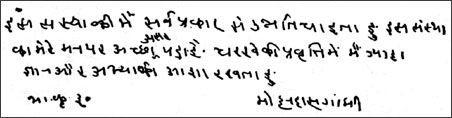
Mahatma Gandhi visited my high school with yoga training at Ranchi. He graciously wrote the above lines in the Ranchi guest-book. The translation is: “This institution has deeply impressed my mind. I cherish high hopes that this school will encourage the further practical use of the spinning wheel.”
Mahatma Gandhi visited my high school in Ranchi, which offered yoga training. He kindly wrote the lines above in the Ranchi guest book. The translation is: “This institution has deeply impressed me. I have high hopes that this school will encourage greater practical use of the spinning wheel.”
(Signed) MOHANDAS GANDHI September 17, 1925
(Signed) MOHANDAS GANDHI September 17, 1925
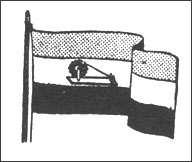
A national flag for India was designed in 1921 by Gandhi. The stripes are saffron, white and green; the charka (spinning wheel) in the center is dark blue. “The charka symbolizes energy,” he wrote, “and reminds us that during the past eras of prosperity in India’s history, hand spinning and other domestic crafts were prominent.”
Gandhi designed a national flag for India in 1921. The stripes are saffron, white and green. The charka (spinning wheel) in the center is dark blue. “The charka symbolizes energy,” Gandhi wrote, “and reminds us of past periods of prosperity in India’s history. During those periods, hand spinning and other household crafts played an important role.”
44-1: His family name is Mohandas Karamchand Gandhi. He never refers to himself as “Mahatma.”
44-1: His family name is Mohandas Karamchand Gandhi. He never calls himself “Mahatma.”
44-2: The literal translation from Sanskrit is “holding to truth.” Satyagraha is the famous nonviolence movement led by Gandhi.
44-2: The literal Sanskrit translation is “holding to truth.” Satyagraha is the famous nonviolent movement led by Gandhi.
44-3: False and alas! malicious reports were recently circulated that Miss Slade has severed all her ties with Gandhi and forsaken her vows. Miss Slade, the Mahatma’s Satyagraha disciple for twenty years, issued a signed statement to the United Press, dated Dec. 29, 1945, in which she explained that a series of baseless rumors arose after she had departed, with Gandhi’s blessings, for a small site in northeastern India near the Himalayas, for the purpose of founding there her now-flourishing Kisan Ashram (center for medical and agricultural aid to peasant farmers). Mahatma Gandhi plans to visit the new ashram during 1946.
44-3: False and, sadly, malicious reports recently spread claiming that Miss Slade had cut all ties with Gandhi and abandoned her vows. Miss Slade had been the Mahatma’s Satyagraha disciple for twenty years. She issued a signed statement to the United Press, dated Dec. 29, 1945. In her statement, she explained that a series of baseless rumors began after she left with Gandhi’s blessings. She had gone to a small site in northeastern India near the Himalayas to establish her now-thriving Kisan Ashram (center for medical and agricultural aid to peasant farmers). Mahatma Gandhi plans to visit the new ashram during 1946.
44-4: Miss Slade reminded me of another distinguished Western woman, Miss Margaret Woodrow Wilson, eldest daughter of America’s great president. I met her in New York; she was intensely interested in India. Later she went to Pondicherry, where she spent the last five years of her life, happily pursuing a path of discipline at the feet of Sri Aurobindo Ghosh. This sage never speaks; he silently greets his disciples on three annual occasions only.
44-4: Miss Slade reminded me of another distinguished Western woman, Miss Margaret Woodrow Wilson. She was the eldest daughter of America’s great president. I met her in New York. She was deeply interested in India. Later she went to Pondicherry, where she spent the last five years of her life. There she happily followed a path of spiritual discipline under Sri Aurobindo Ghosh. This sage never speaks. He greets his disciples silently only three times a year.
44-5: For years in America I had been observing periods of silence, to the consternation of callers and secretaries.
44-5: For years in America, I had practiced periods of silence, much to the dismay of visitors and secretaries.
44-6: Harmlessness; nonviolence; the foundation rock of Gandhi’s creed. He was born into a family of strict Jains, who revere ahimsa as the root-virtue. Jainism, a sect of Hinduism, was founded in the 6th century B.C. by Mahavira, a contemporary of Buddha. Mahavira means “great hero”; may he look down the centuries on his heroic son Gandhi!
44-6: Harmlessness and nonviolence form the foundation of Gandhi’s beliefs. He was born into a family of strict Jains, who honor ahimsa as the fundamental virtue. Jainism, a branch of Hinduism, was founded in the 6th century B.C. by Mahavira, who lived at the same time as Buddha. Mahavira means “great hero”. May he look down through the centuries on his heroic son Gandhi!
44-7: Hindi is the lingua franca for the whole of India. An Indo- Aryan language based largely on Sanskrit roots, Hindi is the chief vernacular of northern India. The main dialect of Western Hindi is Hindustani, written both in the Devanagari (Sanskrit) characters and in Arabic characters. Its subdialect, Urdu, is spoken by Moslems.
44-7: Hindi is the common language used throughout India. Hindi is an Indo-Aryan language based largely on Sanskrit roots. It is the main everyday language of northern India. The main dialect of Western Hindi is Hindustani, written in both Devanagari (Sanskrit) and Arabic scripts. Urdu, a subdialect of Hindustani, is spoken by Muslims.
44-8: Gandhi has described his life with a devastating candor in The Story Of My Experiments With Truth (Ahmedabad: Navajivan Press, 1927- 29, 2 vol.) This autobiography has been summarized in Mahatma Gandhi, His Own Story, edited by C. F. Andrews, with an introduction by John Haynes Holmes (New York: Macmillan Co., 1930).
44-8: Gandhi described his life with devastating honesty in The Story Of My Experiments With Truth (Ahmedabad: Navajivan Press, 1927-1929, 2 volumes). This autobiography is summarized in Mahatma Gandhi, His Own Story, edited by C. F. Andrews. The summary includes an introduction by John Haynes Holmes (New York: Macmillan Co., 1930).
Many autobiographies replete with famous names and colorful events are almost completely silent on any phase of inner analysis or development. One lays down each of these books with a certain dissatisfaction, as though saying: “Here is a man who knew many notable persons, but who never knew himself.” This reaction is impossible with Gandhi’s autobiography; he exposes his faults and subterfuges with an impersonal devotion to truth rare in annals of any age.
Many autobiographies are full of famous names and colorful events, yet say almost nothing about self-examination or inner growth. We finish each of these books feeling somewhat dissatisfied, as though saying: “Here is a man who knew many notable people, but who never knew himself.” No one could react this way to Gandhi’s autobiography. He reveals his faults and evasions with a detached devotion to truth rarely found in accounts from any age.
44-9: Kasturabai Gandhi died in imprisonment at Poona on February 22, 1944. The usually unemotional Gandhi wept silently. Shortly after her admirers had suggested a Memorial Fund in her honor, 125 lacs of rupees (nearly four million dollars) poured in from all over India. Gandhi has arranged that the fund be used for village welfare work among women and children. He reports his activities in his English weekly, Harijan.
44-9: Kasturabai Gandhi died while imprisoned at Poona on February 22, 1944. Gandhi, who usually showed little emotion, wept silently. Soon after her admirers proposed a Memorial Fund in her honor, donations poured in from all over India. The donations totaled 125 lacs of rupees (nearly four million dollars). Gandhi has arranged for the fund to support welfare work for women and children in villages. He reports on his activities in his weekly English-language publication, Harijan.
44-10: I sent a shipment to Wardha, soon after my return to America. The plants, alas! died on the way, unable to withstand the rigors of the long ocean transportation.
44-10: I sent a shipment to Wardha soon after returning to America. Sadly, the plants died on the way because they could not survive the harsh conditions of the long ocean journey.
44-11: Thoreau, Ruskin, and Mazzini are three other Western writers whose sociological views Gandhi has studied carefully.
44-11: Thoreau, Ruskin, and Mazzini are three other Western writers whose views on society Gandhi has studied carefully.
44-12: The sacred scripture given to Persia about 1000 B.C. by Zoroaster.
44-12: The sacred scripture Zoroaster gave to Persia around 1000 B.C.
44-13: The unique feature of Hinduism among the world religions is that it derives not from a single great founder but from the impersonal Vedic scriptures. Hinduism thus gives scope for worshipful incorporation into its fold of prophets of all ages and all lands. The Vedic scriptures regulate not only devotional practices but all important social customs, in an effort to bring man’s every action into harmony with divine law.
44-13: Hinduism is unique among world religions because it comes not from a single great founder but from the impersonal Vedic scriptures. Hinduism can therefore welcome and honor prophets from all ages and all lands within its tradition. The Vedic scriptures govern not only devotional practices but also all important social customs. These teachings seek to bring every human action into harmony with divine law.
44-14: A comprehensive Sanskrit word for law; conformity to law or natural righteousness; duty as inherent in the circumstances in which a man finds himself at any given time. The scriptures define dharma as “the natural universal laws whose observance enables man to save himself from degradation and suffering.”
44-14: A broad Sanskrit word meaning law, obedience to law, or natural righteousness. It also means the duty arising from a person’s circumstances at any given time. The scriptures define dharma as “the natural, universal laws that people can follow to save themselves from degradation and suffering.”
44-15: Matthew 7:21.
44-15: Matthew 7:21.
44-16: Matthew 26:52.
44-16: Matthew 26:52.
44-17: “Let not a man glory in this, that he love his country; Let him rather glory in this, that he love his kind.”-Persian Proverb.
44-17: “Let no one take pride in loving their country. Let them instead take pride in loving all humanity.” Persian Proverb.
44-18: “Then came Peter to him and said, Lord, how oft shall my brother sin against me, and I forgive him? till seven times? Jesus saith unto him, I say not unto thee, Until seven times: but, Until seventy times seven.”-Matthew 18:21-22.
44-18: “Then Peter came to Jesus and said, Lord, how often should I forgive my brother when he sins against me? Up to seven times? Jesus said to him, I tell you, not seven times, but seventy times seven.” Matthew 18:21-22.
44-19: Charles P. Steinmetz, the great electrical engineer, was once asked by Mr. Roger W. Babson: “What line of research will see the greatest development during the next fifty years?” “I think the greatest discovery will be made along spiritual lines,” Steinmetz replied. “Here is a force which history clearly teaches has been the greatest power in the development of men. Yet we have merely been playing with it and have never seriously studied it as we have the physical forces. Someday people will learn that material things do not bring happiness and are of little use in making men and women creative and powerful. Then the scientists of the world will turn their laboratories over to the study of God and prayer and the spiritual forces which as yet have hardly been scratched. When this day comes, the world will see more advancement in one generation than it has seen in the past four.”
44-19: Mr. Roger W. Babson once asked Charles P. Steinmetz, the great electrical engineer: “What field of research will develop the most during the next fifty years?” “I think the greatest discovery will be in the spiritual realm,” Steinmetz replied. “History clearly shows that spiritual force has been the greatest power in human development. Yet we have merely played with spiritual force. We have never studied it as seriously as we have studied physical forces. Someday people will learn that material things do not bring happiness. Material things also do little to make men and women creative and powerful. Then the world’s scientists will devote their laboratories to studying God, prayer, and spiritual forces. So far, we have barely begun to explore these forces. When that day comes, the world will advance more in one generation than it has in the past four.”
44-20: That is, resist not evil with evil. (Matthew 5:38-39)
44-20: In other words, do not resist evil with evil. (Matthew 5:38-39)