Chapter 42
Last Days with My Guru
“Guruji, I am glad to find you alone this morning.” I had just arrived at the Serampore hermitage, carrying a fragrant burden of fruit and roses. Sri Yukteswar glanced at me meekly.
“Guruji, I’m glad to find you alone this morning.” I had just arrived at the Serampore hermitage, carrying a fragrant load of fruit and roses. Sri Yukteswar glanced at me meekly.
“What is your question?” Master looked about the room as though he were seeking escape.
“What is your question?” Master looked around the room as if he were looking for a way to escape.
“Guruji, I came to you as a high-school youth; now I am a grown man, even with a gray hair or two. Though you have showered me with silent affection from the first hour to this, do you realize that once only, on the day of meeting, have you ever said, ‘I love you’?” I looked at him pleadingly.
“Guruji, I came to you as a high-school student. Now I am a grown man, even with a gray hair or two. Though you have showered me with quiet affection from our first meeting until now, do you realize something? You have only said ‘I love you’ once, on the day we met.” I looked at him pleadingly.
Master lowered his gaze. “Yogananda, must I bring out into the cold realms of speech the warm sentiments best guarded by the wordless heart?”
Master lowered his gaze. “Yogananda, must I put into cold words the warm feelings best kept in the heart’s silence?”
“Guruji, I know you love me, but my mortal ears ache to hear you say so.”
“Guruji, I know you love me. But my mortal ears ache to hear you say so.”
“Be it as you wish. During my married life I often yearned for a son, to train in the yogic path. But when you came into my life, I was content; in you I have found my son.” Two clear teardrops stood in Sri Yukteswar’s eyes. “Yogananda, I love you always.”
“As you wish. During my married life, I often longed for a son to train in the yogic path. But when you came into my life, I was content. In you, I have found my son.” Two clear tears stood in Sri Yukteswar’s eyes. “Yogananda, I love you always.”
“Your answer is my passport to heaven.” I felt a weight lift from my heart, dissolved forever at his words. Often had I wondered at his silence. Realizing that he was unemotional and self-contained, yet sometimes I feared I had been unsuccessful in fully satisfying him. His was a strange nature, never utterly to be known; a nature deep and still, unfathomable to the outer world, whose values he had long transcended.
“Your answer is my passport to heaven.” At his words, I felt a weight lift from my heart and disappear forever. I had often wondered about his silence. I knew he showed little emotion and kept to himself. Yet sometimes I feared I had failed to satisfy him fully. He had an unusual nature that could never be fully understood. His nature was deep and still, beyond the understanding of the outside world, whose values he had long since surpassed.
A few days later, when I spoke before a huge audience at Albert Hall in Calcutta, Sri Yukteswar consented to sit beside me on the platform, with the Maharaja of Santosh and the Mayor of Calcutta. Though Master made no remark to me, I glanced at him from time to time during my address, and thought I detected a pleased twinkle in his eyes.
A few days later, I spoke before a huge audience at Albert Hall in Calcutta. Sri Yukteswar agreed to sit beside me on the platform, with the Maharaja of Santosh and the Mayor of Calcutta. Though Master said nothing to me, I glanced at him from time to time during my talk. I thought I saw a pleased twinkle in his eyes.
Then came a talk before the alumni of Serampore College. As I gazed upon my old classmates, and as they gazed on their own “Mad Monk,” tears of joy showed unashamedly. My silver-tongued professor of philosophy, Dr. Ghoshal, came forward to greet me, all our past misunderstandings dissolved by the alchemist Time.
Then I gave a talk to the alumni of Serampore College. I looked at my old classmates, and they looked at their own “Mad Monk.” Tears of joy flowed without shame. My eloquent philosophy professor, Dr. Ghoshal, came forward to greet me. Time, the alchemist, had dissolved all our past misunderstandings.
A Winter Solstice Festival was celebrated at the end of December in the Serampore hermitage. As always, Sri Yukteswar’s disciples gathered from far and near. Devotional sankirtans, solos in the nectar-sweet voice of Kristo-da, a feast served by young disciples, Master’s profoundly moving discourse under the stars in the thronged courtyard of the ashram-memories, memories! Joyous festivals of years long past! Tonight, however, there was to be a new feature.
A Winter Solstice Festival was held at the end of December at the Serampore hermitage. As always, Sri Yukteswar’s disciples gathered from near and far. Devotional sankirtans, solos in Kristo-da’s nectar-sweet voice, a feast served by young disciples. Master’s deeply moving talk under the stars in the crowded courtyard of the ashram. Memories, memories! Joyous festivals of years long past! Tonight, however, there would be something new.
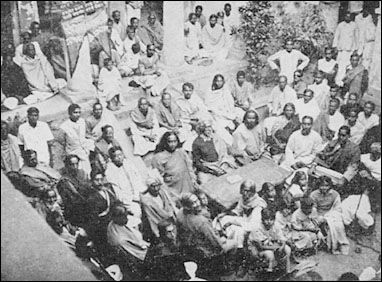
Last Solstice Festival celebrated by Sri Yukteswar, December, 1935. My Guru is seated in the center; I am at his right, in the large courtyard of his hermitage in Serampore.
The last Solstice Festival celebrated by Sri Yukteswar, December 1935. My Guru is seated in the center, and I am on his right. We are in the large courtyard of his hermitage in Serampore.
“Yogananda, please address the assemblage-in English.” Master’s eyes were twinkling as he made this doubly unusual request; was he thinking of the shipboard predicament that had preceded my first lecture in English? I told the story to my audience of brother disciples, ending with a fervent tribute to our guru.
“Yogananda, please speak to the gathering in English.” Master’s eyes twinkled as he made this request, unusual in two ways. Was he thinking of the difficult situation aboard the ship before my first lecture in English? I told the story to my fellow disciples, ending with a heartfelt tribute to our guru.
“His omnipresent guidance was with me not alone on the ocean steamer,” I concluded, “but daily throughout my fifteen years in the vast and hospitable land of America.”
“His guidance was with me everywhere, not just on the ocean steamer,” I concluded. “His guidance also stayed with me daily throughout my fifteen years in the vast and welcoming land of America.”
After the guests had departed, Sri Yukteswar called me to the same bedroom where-once only, after a festival of my early years-I had been permitted to sleep on his wooden bed. Tonight my guru was sitting there quietly, a semicircle of disciples at his feet. He smiled as I quickly entered the room.
After the guests left, Sri Yukteswar called me to the same bedroom where I had once slept on his wooden bed. I had been allowed to sleep there only once, after a festival in my early years. Tonight my guru was sitting there quietly, with disciples in a semicircle at his feet. He smiled as I quickly entered the room.
“Yogananda, are you leaving now for Calcutta? Please return here tomorrow. I have certain things to tell you.”
“Yogananda, are you leaving for Calcutta now? Please come back here tomorrow. I have some things to tell you.”
The next afternoon, with a few simple words of blessing, Sri Yukteswar bestowed on me the further monastic title of Paramhansa. [^42]
The next afternoon, Sri Yukteswar spoke a few simple words of blessing. He gave me the additional monastic title of Paramhansa. [^42]
“It now formally supersedes your former title of swami,” he said as I knelt before him. With a silent chuckle I thought of the struggle which my American students would undergo over the pronunciation of Paramhansaji. [^42]
“It now officially replaces your previous title of swami,” he said as I knelt before him. I chuckled silently, thinking of how my American students would struggle to pronounce Paramhansaji. [^42]
“My task on earth is now finished; you must carry on.” Master spoke quietly, his eyes calm and gentle. My heart was palpitating in fear.
“My work on earth is now finished. You must carry on.” Master spoke quietly, his eyes calm and gentle. My heart was pounding with fear.
“Please send someone to take charge of our ashram at Puri,” Sri Yukteswar went on. “I leave everything in your hands. You will be able to successfully sail the boat of your life and that of the organization to the divine shores.”
“Please send someone to take charge of our ashram at Puri,” Sri Yukteswar continued. “I’m leaving everything in your hands. You will be able to steer the boat of your life and the organization successfully to divine shores.”
In tears, I was embracing his feet; he rose and blessed me endearingly.
In tears, I held his feet. He stood up and blessed me lovingly.
The following day I summoned from Ranchi a disciple, Swami Sebananda, and sent him to Puri to assume the hermitage duties. [^42] Later my guru discussed with me the legal details of settling his estate; he was anxious to prevent the possibility of litigation by relatives, after his death, for possession of his two hermitages and other properties, which he wished to be deeded over solely for charitable purposes.
The next day I called a disciple, Swami Sebananda, from Ranchi. I sent him to Puri to take over the hermitage duties. [^42] Later, my guru discussed with me the legal details of settling his estate. He was eager to prevent any possibility of relatives suing after his death to claim his two hermitages and other properties. He wanted these properties legally transferred solely for charitable purposes.
“Arrangements were recently made for Master to visit Kidderpore, [^42] but he failed to go.” Amulaya Babu, a brother disciple, made this remark to me one afternoon; I felt a cold wave of premonition. To my pressing inquiries, Sri Yukteswar only replied, “I shall go to Kidderpore no more.” For a moment, Master trembled like a frightened child.
“Plans were recently made for Master to visit Kidderpore, [^42] but he did not go.” Amulaya Babu, a fellow disciple, told me this one afternoon. I felt a cold wave of foreboding. I pressed Sri Yukteswar with questions, but he only replied, “I shall never go to Kidderpore again.” For a moment, Master trembled like a frightened child.
(“Attachment to bodily residence, springing up of its own nature [i.e., arising from immemorial roots, past experiences of death],” Patanjali wrote, [^42] “is present in slight degree even in great saints.” In some of his discourses on death, my guru had been wont to add: “Just as a long-caged bird hesitates to leave its accustomed home when the door is opened.”)
(“Attachment to life in the body arises naturally [from ancient roots and past experiences of death],” Patanjali wrote, [^42] “and remains to a slight degree even in great saints.” In some of his talks on death, my guru would add: “Just as a bird long kept in a cage hesitates to leave its familiar home when the door opens.”)
“Guruji,” I entreated him with a sob, “don’t say that! Never utter those words to me!”
“Guruji,” I begged him with a sob, “don’t say that! Never say those words to me!”
Sri Yukteswar’s face relaxed in a peaceful smile. Though nearing his eighty-first birthday, he looked well and strong.
Sri Yukteswar’s face relaxed into a peaceful smile. Though he was almost eighty-one, he looked healthy and strong.
Basking day by day in the sunshine of my guru’s love, unspoken but keenly felt, I banished from my conscious mind the various hints he had given of his approaching passing.
Day by day, I basked in the warmth of my guru’s love, unspoken but deeply felt. I pushed out of my conscious mind the various hints he had given that his death was approaching.
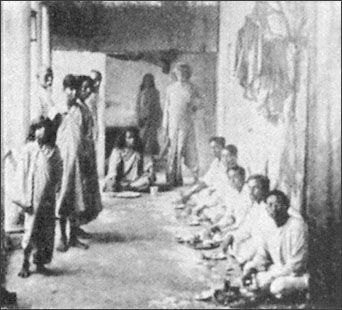
“Sir, the Kumbha Mela is convening this month at Allahabad.” I showed Master the mela dates in a Bengali almanac. [^42]
“Sir, the Kumbha Mela is taking place this month at Allahabad.” I showed Master the mela dates in a Bengali almanac. [^42]
“Do you really want to go?”
“Do you really want to go?”
Not sensing Sri Yukteswar’s reluctance to have me leave him, I went on, “Once you beheld the blessed sight of Babaji at an Allahabad kumbha. Perhaps this time I shall be fortunate enough to see him.”
Not realizing Sri Yukteswar was reluctant to let me leave him, I continued, “You once had the blessing of seeing Babaji at an Allahabad kumbha. Perhaps this time I’ll be fortunate enough to see him.”
“I do not think you will meet him there.” My guru then fell into silence, not wishing to obstruct my plans.
“I don’t think you will meet him there.” My guru then went quiet, not wanting to interfere with my plans.
When I set out for Allahabad the following day with a small group, Master blessed me quietly in his usual manner. Apparently I was remaining oblivious to implications in Sri Yukteswar’s attitude because the Lord wished to spare me the experience of being forced, helplessly, to witness my guru’s passing. It has always happened in my life that, at the death of those dearly beloved by me, God has compassionately arranged that I be distant from the scene. [^42]
The next day, I left for Allahabad with a small group. Master quietly blessed me in his usual way. Apparently, I remained unaware of what Sri Yukteswar’s attitude suggested because the Lord wanted to spare me a painful experience. He did not want me to be forced to watch helplessly as my guru died. Whenever someone I dearly loved has died, God has always compassionately arranged for me to be far away. [^42]
Our party reached the Kumbha Mela on January 23, 1936. The surging crowd of nearly two million persons was an impressive sight, even an overwhelming one. The peculiar genius of the Indian people is the reverence innate in even the lowliest peasant for the worth of the Spirit, and for the monks and sadhus who have forsaken worldly ties to seek a diviner anchorage. Imposters and hypocrites there are indeed, but India respects all for the sake of the few who illumine the whole land with supernal blessings. Westerners who were viewing the vast spectacle had a unique opportunity to feel the pulse of the land, the spiritual ardor to which India owes her quenchless vitality before the blows of time.
Our party reached the Kumbha Mela on January 23, 1936. The surging crowd of nearly two million people was an impressive, even overwhelming sight. The distinctive gift of the Indian people is their inborn reverence for the value of the Spirit. Even the poorest peasant shares this reverence, along with respect for monks and sadhus. These monks and sadhus have given up worldly ties to seek a more divine anchor. There are indeed imposters and hypocrites. But India respects all for the sake of the few who brighten the whole land with heavenly blessings. Westerners watching the vast spectacle had a unique chance to feel the pulse of the land. They could sense the spiritual passion that gives India her undying vitality in the face of time's blows.
The first day was spent by our group in sheer staring. Here were countless bathers, dipping in the holy river for remission of sins; there we saw solemn rituals of worship; yonder were devotional offerings being strewn at the dusty feet of saints; a turn of our heads, and a line of elephants, caparisoned horses and slow-paced Rajputana camels filed by, or a quaint religious parade of naked sadhus, waving scepters of gold and silver, or flags and streamers of silken velvet.
Our group spent the first day simply staring. Here, countless bathers dipped in the holy river to wash away their sins. There, we saw solemn rituals of worship. Farther off, devotional offerings were scattered at the dusty feet of saints. We turned our heads and saw a procession of elephants, richly decorated horses, and slow-moving Rajputana camels. Or we saw an unusual religious parade of naked sadhus waving gold and silver scepters, or silken velvet flags and streamers.
Anchorites wearing only loincloths sat quietly in little groups, their bodies besmeared with the ashes that protect them from the heat and cold. The spiritual eye was vividly represented on their foreheads by a single spot of sandalwood paste. Shaven-headed swamis appeared by the thousands, ocher-robed and carrying their bamboo staff and begging bowl. Their faces beamed with the renunciate’s peace as they walked about or held philosophical discussions with disciples.
Hermits wearing only loincloths sat quietly in small groups. Their bodies were covered in ashes that protect them from heat and cold. A single spot of sandalwood paste on each forehead vividly represented the spiritual eye. Thousands of swamis with shaved heads appeared, wearing ocher robes and carrying bamboo staffs and begging bowls. Their faces glowed with the peace of those who have renounced worldly life. They walked about or discussed philosophy with their disciples.
Here and there under the trees, around huge piles of burning logs, were picturesque sadhus, [^42] their hair braided and massed in coils on top of their heads. Some wore beards several feet in length, curled and tied in a knot. They meditated quietly, or extended their hands in blessing to the passing throng-beggars, maharajas on elephants, women in multicolored saris- their bangles and anklets tinkling, fakirs with thin arms held grotesquely aloft, brahmacharis carrying meditation elbow-props, humble sages whose solemnity hid an inner bliss. High above the din we heard the ceaseless summons of the temple bells.
Here and there under the trees, picturesque sadhus, [^42] sat around huge piles of burning logs. Their hair was braided and piled in coils on top of their heads. Some had beards several feet long, curled and tied in a knot. The sadhus meditated quietly or stretched out their hands to bless the passing crowds. Beggars passed by, along with maharajas riding elephants and women in multicolored saris, their bangles and anklets tinkling. There were fakirs with thin arms raised in distorted poses, and brahmacharis carrying elbow supports for meditation. Humble sages also passed, their solemn expressions hiding an inner bliss. High above the noise, we heard the constant call of the temple bells.
On our second mela day my companions and I entered various ashrams and temporary huts, offering pronams to saintly personages. We received the blessing of the leader of the Giri branch of the Swami Order-a thin, ascetical monk with eyes of smiling fire. Our next visit took us to a hermitage whose guru had observed for the past nine years the vows of silence and a strict fruitarian diet. On the central dais in the ashram hall sat a blind sadhu, Pragla Chakshu, profoundly learned in the shastras and highly revered by all sects.
On our second mela day, my companions and I visited various ashrams and temporary huts, offering pronams to holy people. We received the blessing of the leader of the Giri branch of the Swami Order. He was a thin monk who practiced strict self-denial, with eyes that glowed with smiling fire. Next we visited a hermitage whose guru had kept vows of silence and a strict fruit-only diet for nine years. A blind sadhu, Pragla Chakshu, sat on the central platform in the ashram hall. He had a deep knowledge of the shastras and was highly revered by all sects.
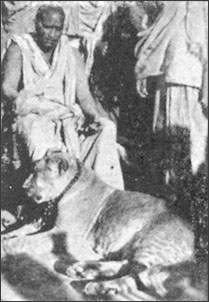
After I had given a brief discourse in Hindi on Vedanta, our group left the peaceful hermitage to greet a near-by swami, Krishnananda, a handsome monk with rosy cheeks and impressive shoulders. Reclining near him was a tame lioness. Succumbing to the monk’s spiritual charm- not, I am sure, to his powerful physique!-the jungle animal refuses all meat in favor of rice and milk. The swami has taught the tawny- haired beast to utter “Aum” in a deep, attractive growl-a cat devotee!
After I gave a brief talk in Hindi on Vedanta, our group left the peaceful hermitage to greet a nearby swami, Krishnananda. He was a handsome monk with rosy cheeks and impressive shoulders. A tame lioness lay near him. Won over by the monk’s spiritual charm, the jungle animal refuses all meat in favor of rice and milk. I am sure his spiritual charm, not his powerful build, won her over! The swami has taught the tawny lioness to say “Aum” in a deep, pleasing growl. A feline devotee!
Our next encounter, an interview with a learned young sadhu, is well described in Mr. Wright’s sparkling travel diary.
Our next encounter was an interview with a knowledgeable young sadhu. Mr. Wright describes the meeting well in his lively travel diary.
“We rode in the Ford across the very low Ganges on a creaking pontoon bridge, crawling snakelike through the crowds and over narrow, twisting lanes, passing the site on the river bank which Yoganandaji pointed out to me as the meeting place of Babaji and Sri Yukteswarji. Alighting from the car a short time later, we walked some distance through the thickening smoke of the sadhus’ fires and over the slippery sands to reach a cluster of tiny, very modest mud-and-straw huts. We halted in front of one of these insignificant temporary dwellings, with a pygmy doorless entrance, the shelter of Kara Patri, a young wandering sadhu noted for his exceptional intelligence. There he sat, cross-legged on a pile of straw, his only covering-and incidentally his only possession-being an ocher cloth draped over his shoulders.
“We drove the Ford across the Ganges, where the water was very low, on a creaking pontoon bridge. We crawled like a snake through the crowds and along narrow, winding lanes. We passed a spot on the riverbank that Yoganandaji pointed out as the meeting place of Babaji and Sri Yukteswarji. A short time later, we got out of the car and walked some distance through thickening smoke from the sadhus’ fires. We crossed slippery sand to reach a cluster of tiny, very simple mud-and-straw huts. We stopped before one of these unremarkable temporary shelters, with a tiny entrance and no door. The hut sheltered Kara Patri, a young wandering sadhu known for his exceptional intelligence. He sat there cross-legged on a pile of straw, wearing only an ocher cloth draped over his shoulders. The cloth was also his only possession.
“Truly a divine face smiled at us after we had crawled on all fours into the hut and pronamed at the feet of this enlightened soul, while the kerosene lantern at the entrance flickered weird, dancing shadows on the thatched walls. His face, especially his eyes and perfect teeth, beamed and glistened. Although I was puzzled by the Hindi, his expressions were very revealing; he was full of enthusiasm, love, spiritual glory. No one could be mistaken as to his greatness.
“After we crawled on all fours into the hut and bowed at this enlightened soul’s feet, a truly divine face smiled at us. Meanwhile, the kerosene lantern at the entrance cast strange, dancing shadows on the thatched walls. His face shone, especially his eyes and perfect teeth. Although I struggled to understand his Hindi, his expressions revealed a great deal. He was full of enthusiasm, love, and spiritual glory. No one could doubt his greatness.
“Imagine the happy life of one unattached to the material world; free of the clothing problem; free of food craving, never begging, never touching cooked food except on alternate days, never carrying a begging bowl; free of all money entanglements, never handling money, never storing things away, always trusting in God; free of transportation worries, never riding in vehicles, but always walking on the banks of the sacred rivers; never remaining in one place longer than a week in order to avoid any growth of attachment.
“Imagine the happy life of someone unattached to the material world. Such a person has no worries about clothing and no craving for food. They never beg, touch cooked food except on alternate days, or carry a begging bowl. They are free of all money troubles, never handle money, never store things away, and always trust in God. They have no worries about transportation. They never ride in vehicles but always walk along the banks of the sacred rivers. They never stay in one place longer than a week, to avoid growing attached.
“Such a modest soul! unusually learned in the Vedas, and possessing an M.A. degree and the title of shastri (master of scriptures) from Benares University. A sublime feeling pervaded me as I sat at his feet; it all seemed to be an answer to my desire to see the real, the ancient India, for he is a true representative of this land of spiritual giants.”
“Such a humble soul! He was unusually well versed in the Vedas. He held an M.A. degree and the title of shastri (master of scriptures) from Benares University. A feeling of deep awe filled me as I sat at his feet. The whole experience seemed to answer my desire to see the real, ancient India. For he truly represents this land of spiritual giants.”
I questioned Kara Patri about his wandering life. “Don’t you have any extra clothes for winter?”
I asked Kara Patri about his life of wandering. “Don’t you have any extra clothes for winter?”
“No, this is enough.”
“No, this is enough.”
“Do you carry any books?”
“Do you carry any books?”
“No, I teach from memory those people who wish to hear me.”
“No, I teach from memory to people who want to hear me.”
“What else do you do?”
“What else do you do?”
“I roam by the Ganges.”
“I wander along the Ganges.”
At these quiet words, I was overpowered by a yearning for the simplicity of his life. I remembered America, and all the responsibilities that lay on my shoulders.
His quiet words filled me with an overwhelming longing for the simplicity of his life. I thought of America and all the responsibilities I carried.
“No, Yogananda,” I thought, sadly for a moment, “in this life roaming by the Ganges is not for you.”
“No, Yogananda,” I thought with a moment of sadness, “wandering along the Ganges is not for you in this life.”
After the sadhu had told me a few of his spiritual realizations, I shot an abrupt question.
The sadhu shared a few of his spiritual insights with me. Then I abruptly asked him a question.
“Are you giving these descriptions from scriptural lore, or from inward experience?”
“Are you describing what you’ve learned from scripture, or what you’ve experienced within yourself?”
“Half from book learning,” he answered with a straightforward smile, “and half from experience.”
“Half from books,” he answered with an open smile, “and half from experience.”
We sat happily awhile in meditative silence. After we had left his sacred presence, I said to Mr. Wright, “He is a king sitting on a throne of golden straw.”
We sat happily for a while, meditating in silence. After we left his sacred presence, I said to Mr. Wright, “He is a king sitting on a throne of golden straw.”
We had our dinner that night on the mela grounds under the stars, eating from leaf plates pinned together with sticks. Dishwashings in India are reduced to a minimum!
We ate dinner that night on the mela grounds under the stars. We used plates made of leaves pinned together with sticks. Dishwashing in India is kept to a minimum!
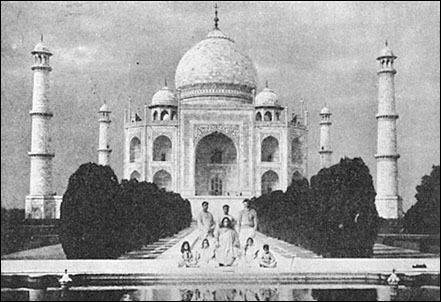
Two more days of the fascinating kumbha; then northwest along the Jumna banks to Agra. Once again I gazed on the Taj Mahal; in memory Jitendra stood by my side, awed by the dream in marble. Then on to the Brindaban ashram of Swami Keshabananda.
After two more days at the fascinating kumbha, I traveled northwest along the banks of the Jumna to Agra. Once again I gazed at the Taj Mahal. In my memory, Jitendra stood beside me, awed by the dream in marble. Then I went on to Swami Keshabananda’s ashram in Brindaban.
My object in seeking out Keshabananda was connected with this book. I had never forgotten Sri Yukteswar’s request that I write the life of Lahiri Mahasaya. During my stay in India I was taking every opportunity of contacting direct disciples and relatives of the Yogavatar. Recording their conversations in voluminous notes, I verified facts and dates, and collected photographs, old letters, and documents. My Lahiri Mahasaya portfolio began to swell; I realized with dismay that ahead of me lay arduous labors in authorship. I prayed that I might be equal to my role as biographer of the colossal guru. Several of his disciples feared that in a written account their master might be belittled or misinterpreted.
My reason for seeking out Keshabananda was connected with this book. I had never forgotten Sri Yukteswar’s request that I write the life of Lahiri Mahasaya. During my stay in India, I took every opportunity to contact the Yogavatar’s direct disciples and relatives. I recorded their conversations in extensive notes, checked facts and dates, and collected photographs, old letters, and documents. My collection of material on Lahiri Mahasaya began to grow. I realized with dismay how much hard work lay ahead of me in writing his biography. I prayed that I would be equal to the task of writing about this towering guru. Several of his disciples feared that a written account might diminish their master’s stature or misrepresent him.
“One can hardly do justice in cold words to the life of a divine incarnation,” Panchanon Bhattacharya had once remarked to me.
“Words alone can hardly do justice to the life of a divine incarnation,” Panchanon Bhattacharya once told me.
Other close disciples were similarly satisfied to keep the Yogavatar hidden in their hearts as the deathless preceptor. Nevertheless, mindful of Lahiri Mahasaya’s prediction about his biography, I spared no effort to secure and substantiate the facts of his outward life.
Other close disciples were likewise content to keep the Yogavatar hidden in their hearts as their immortal teacher. Still, I kept Lahiri Mahasaya’s prediction about his biography in mind. I made every effort to gather and verify the facts of his outward life.
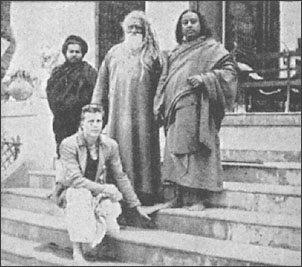
Swami Keshabananda greeted our party warmly at Brindaban in his Katayani Peith Ashram, an imposing brick building with massive black pillars, set in a beautiful garden. He ushered us at once into a sitting room adorned with an enlargement of Lahiri Mahasaya’s picture. The swami was approaching the age of ninety, but his muscular body radiated strength and health. With long hair and a snow-white beard, eyes twinkling with joy, he was a veritable patriarchal embodiment. I informed him that I wanted to mention his name in my book on India’s masters.
Swami Keshabananda warmly welcomed our group to his Katayani Peith Ashram in Brindaban. The impressive brick building had massive black pillars and stood in a beautiful garden. He immediately led us into a sitting room decorated with an enlarged picture of Lahiri Mahasaya. The swami was nearly ninety, but his muscular body radiated strength and health. With his long hair, snow-white beard, and eyes sparkling with joy, he was the very image of a patriarch. I told him I wanted to mention his name in my book on India’s masters.
“Please tell me about your earlier life.” I smiled entreatingly; great yogis are often uncommunicative.
“Please tell me about your earlier life.” I gave him a pleading smile. Great yogis are often reluctant to talk.
Keshabananda made a gesture of humility. “There is little of external moment. Practically my whole life has been spent in the Himalayan solitudes, traveling on foot from one quiet cave to another. For a while I maintained a small ashram outside Hardwar, surrounded on all sides by a grove of tall trees. It was a peaceful spot little visited by travelers, owing to the ubiquitous presence of cobras.” Keshabananda chuckled. “Later a Ganges flood washed away the hermitage and cobras alike. My disciples then helped me to build this Brindaban ashram.”
Keshabananda made a humble gesture. “There is little to tell about the outward events of my life. I have spent almost my whole life in the solitude of the Himalayas, walking from one quiet cave to another. For a while I ran a small ashram outside Hardwar, surrounded on all sides by a grove of tall trees. The spot was peaceful, but few travelers visited because cobras were everywhere.” Keshabananda chuckled. “Later, a flood of the Ganges washed away both the hermitage and the cobras. My disciples then helped me build this Brindaban ashram.”
One of our party asked the swami how he had protected himself against the Himalayan tigers. [^42]
Someone in our group asked the swami how he had protected himself from the Himalayan tigers. [^42]
Keshabananda shook his head. “In those high spiritual altitudes,” he said, “wild beasts seldom molest the yogis. Once in the jungle I encountered a tiger face-to-face. At my sudden ejaculation, the animal was transfixed as though turned to stone.” Again the swami chuckled at his memories.
Keshabananda shook his head. “At those great spiritual heights,” he said, “wild animals rarely bother yogis. Once in the jungle I came face-to-face with a tiger. At my sudden shout, the animal froze as though turned to stone.” The swami chuckled again at his memories.
“Occasionally I left my seclusion to visit my guru in Benares. He used to joke with me over my ceaseless travels in the Himalayan wilderness.
“Sometimes I left my seclusion to visit my guru in Benares. He used to joke with me about my endless travels through the Himalayan wilderness.
“‘You have the mark of wanderlust on your foot,’ he told me once. ‘I am glad that the sacred Himalayas are extensive enough to engross you.’
“‘You have a mark on your foot that shows your urge to travel,’ he told me once. ‘I’m glad the sacred Himalayas are vast enough to hold your interest.’
“Many times,” Keshabananda went on, “both before and after his passing, Lahiri Mahasaya has appeared bodily before me. For him no Himalayan height is inaccessible!”
“Many times,” Keshabananda continued, “Lahiri Mahasaya has appeared before me in physical form, both before and after his death. No Himalayan peak is beyond his reach!”
Two hours later he led us to a dining patio. I sighed in silent dismay. Another fifteen-course meal! Less than a year of Indian hospitality, and I had gained fifty pounds! Yet it would have been considered the height of rudeness to refuse any of the dishes, carefully prepared for the endless banquets in my honor. In India (nowhere else, alas!) a well-padded swami is considered a delightful sight. [^42]
Two hours later, he led us to a dining patio. I sighed silently in dismay. Another fifteen-course meal! After less than a year of Indian hospitality, I had gained fifty pounds! Yet refusing any dish would have been considered extremely rude. Each dish was carefully prepared for the endless banquets in my honor. In India, a plump swami is considered a delightful sight. Sadly, nowhere else! [^42]
After dinner, Keshabananda led me to a secluded nook.
After dinner, Keshabananda led me to a quiet, private spot.
“Your arrival is not unexpected,” he said. “I have a message for you.”
“I’m not surprised you’ve come,” he said. “I have a message for you.”
I was surprised; no one had known of my plan to visit Keshabananda.
I was surprised. No one had known about my plan to visit Keshabananda.
“While roaming last year in the northern Himalayas near Badrinarayan,” the swami continued, “I lost my way. Shelter appeared in a spacious cave, which was empty, though the embers of a fire glowed in a hole in the rocky floor. Wondering about the occupant of this lonely retreat, I sat near the fire, my gaze fixed on the sunlit entrance to the cave.
“Last year, I was wandering in the northern Himalayas near Badrinarayan,” the swami continued, “and I lost my way. I found shelter in a large cave. The cave was empty, though embers still glowed in a hole in the rocky floor. I wondered who lived in this lonely retreat. I sat near the fire, gazing steadily at the sunlit entrance to the cave.
“‘Keshabananda, I am glad you are here.’ These words came from behind me. I turned, startled, and was dazzled to behold Babaji! The great guru had materialized himself in a recess of the cave. Overjoyed to see him again after many years, I prostrated myself at his holy feet.
“‘Keshabananda, I am glad you are here.’ I heard these words behind me. Startled, I turned and was awestruck to see Babaji! The great guru had materialized in a recessed part of the cave. Overjoyed to see him again after many years, I lay face down at his holy feet.
“‘I called you here,’ Babaji went on. ‘That is why you lost your way and were led to my temporary abode in this cave. It is a long time since our last meeting; I am pleased to greet you once more.’
“‘I called you here,’ Babaji continued. ‘That is why you lost your way and were led to my temporary home in this cave. It has been a long time since we last met. I am pleased to welcome you again.’
“The deathless master blessed me with some words of spiritual help, then added: ‘I give you a message for Yogananda. He will pay you a visit on his return to India. Many matters connected with his guru and with the surviving disciples of Lahiri will keep Yogananda fully occupied. Tell him, then, that I won’t see him this time, as he is eagerly hoping; but I shall see him on some other occasion.’”
“The immortal master blessed me with some words of spiritual guidance, then added: ‘I have a message for Yogananda. He will visit you when he returns to India. Many matters involving his guru and Lahiri’s surviving disciples will keep Yogananda fully occupied. So tell him I won’t see him this time, as he is eagerly hoping. But I will see him on another occasion.’”
I was deeply touched to receive from Keshabananda’s lips this consoling promise from Babaji. A certain hurt in my heart vanished; I grieved no longer that, even as Sri Yukteswar had hinted, Babaji did not appear at the Kumbha Mela.
I was deeply moved to hear Keshabananda share this comforting promise from Babaji. A pain in my heart disappeared. I no longer grieved that Babaji had not appeared at the Kumbha Mela, as Sri Yukteswar had hinted.
Spending one night as guests of the ashram, our party set out the following afternoon for Calcutta. Riding over a bridge of the Jumna River, we enjoyed a magnificent view of the skyline of Brindaban just as the sun set fire to the sky-a veritable furnace of Vulcan in color, reflected below us in the still waters.
After spending one night as guests at the ashram, our group left for Calcutta the following afternoon. As we rode across a bridge over the Jumna River, we enjoyed a magnificent view of Brindaban’s skyline. Just then, the setting sun set the sky ablaze with colors like those of Vulcan’s furnace. The fiery colors were reflected in the still waters below us.
The Jumna beach is hallowed by memories of the child Sri Krishna. Here he engaged with innocent sweetness in his lilas (plays) with the gopis (maids), exemplifying the supernal love which ever exists between a divine incarnation and his devotees. The life of Lord Krishna has been misunderstood by many Western commentators. Scriptural allegory is baffling to literal minds. A hilarious blunder by a translator will illustrate this point. The story concerns an inspired medieval saint, the cobbler Ravidas, who sang in the simple terms of his own trade of the spiritual glory hidden in all mankind:
The Jumna beach is sacred because of its memories of the child Sri Krishna. Here, with innocent sweetness, he took part in his lilas (plays) with the gopis (maids). These plays showed the heavenly love that always exists between a divine incarnation and his devotees. Many Western commentators have misunderstood the life of Lord Krishna. Those who read scripture literally find its allegories baffling. A translator’s hilarious mistake illustrates this point. The story concerns an inspired medieval saint, the cobbler Ravidas. Using the simple language of his trade, he sang of the spiritual glory hidden in all humanity:
Under the vast vault of blue Lives the divinity clothed in hide.
Under the vast blue sky the divine lives clothed in skin.
One turns aside to hide a smile on hearing the pedestrian interpretation given to Ravidas’ poem by a Western writer:
You turn away to hide a smile when you hear a Western writer’s dull interpretation of Ravidas’ poem:
“He afterwards built a hut, set up in it an idol which he made from a hide, and applied himself to its worship.”
“He later built a hut and placed an idol he had made from animal hide inside the hut. He devoted himself to worshiping the idol.”
Ravidas was a brother disciple of the great Kabir. One of Ravidas’ exalted chelas was the Rani of Chitor. She invited a large number of Brahmins to a feast in honor of her teacher, but they refused to eat with a lowly cobbler. As they sat down in dignified aloofness to eat their own uncontaminated meal, lo! each Brahmin found at his side the form of Ravidas. This mass vision accomplished a widespread spiritual revival in Chitor.
Ravidas was a fellow disciple of the great Kabir. One of Ravidas’ spiritually advanced disciples was the Rani of Chitor. She invited many Brahmins to a feast in honor of her teacher. But the Brahmins refused to eat with a lowly cobbler. They sat apart in dignified isolation to eat their own uncontaminated meal. As they sat down, behold, each Brahmin saw the form of Ravidas beside him. This shared vision brought about a widespread spiritual revival in Chitor.
In a few days our little group reached Calcutta. Eager to see Sri Yukteswar, I was disappointed to hear that he had left Serampore and was now in Puri, about three hundred miles to the south.
A few days later, our small group reached Calcutta. I was eager to see Sri Yukteswar, but was disappointed to hear he had left Serampore. He was now in Puri, about three hundred miles to the south.
“Come to Puri ashram at once.” This telegram was sent on March 8th by a brother disciple to Atul Chandra Roy Chowdhry, one of Master’s chelas in Calcutta. News of the message reached my ears; anguished at its implications, I dropped to my knees and implored God that my guru’s life be spared. As I was about to leave Father’s home for the train, a divine voice spoke within.
“Come to Puri ashram at once.” On March 8, a fellow disciple sent this telegram to Atul Chandra Roy Chowdhry, one of Master’s disciples in Calcutta. I heard about the message and was anguished by what it implied. I fell to my knees and begged God to spare my guru’s life. As I was about to leave Father’s home to catch the train, a divine voice spoke within me.
“Do not go to Puri tonight. Thy prayer cannot be granted.”
“Do not go to Puri tonight. Your prayer cannot be granted.”
“Lord,” I said, grief-stricken, “Thou dost not wish to engage with me in a ‘tug of war’ at Puri, where Thou wilt have to deny my incessant prayers for Master’s life. Must he, then, depart for higher duties at Thy behest?”
“Lord,” I said, grief-stricken, “you do not want a ‘tug of war’ with me at Puri. There you will have to deny my constant prayers for Master’s life. Must he, then, leave for higher duties at your command?”
In obedience to the inward command, I did not leave that night for Puri. The following evening I set out for the train; on the way, at seven o’clock, a black astral cloud suddenly covered the sky. [^42] Later, while the train roared toward Puri, a vision of Sri Yukteswar appeared before me. He was sitting, very grave of countenance, with a light on each side.
Following the inner command, I did not leave for Puri that night. The next evening I set out for the train. On the way, at seven o’clock, a black astral cloud suddenly covered the sky. [^42] Later, as the train roared toward Puri, a vision of Sri Yukteswar appeared before me. He was sitting with a very solemn expression and a light on each side.
“Is it all over?” I lifted my arms beseechingly.
“Is it all over?” I raised my arms in a pleading gesture.
He nodded, then slowly vanished.
He nodded, then slowly disappeared.
As I stood on the Puri train platform the following morning, still hoping against hope, an unknown man approached me.
The next morning, I stood on the train platform in Puri, still hoping against hope. A man I didn’t know approached me.
“Have you heard that your Master is gone?” He left me without another word; I never discovered who he was nor how he had known where to find me.
“Have you heard that your Master is gone?” He left without another word. I never found out who he was or how he had known where to find me.
Stunned, I swayed against the platform wall, realizing that in diverse ways my guru was trying to convey to me the devastating news. Seething with rebellion, my soul was like a volcano. By the time I reached the Puri hermitage I was nearing collapse. The inner voice was tenderly repeating: “Collect yourself. Be calm.”
Stunned, I swayed against the platform wall. I realized my guru had been trying in different ways to tell me the devastating news. My soul seethed with rebellion like a volcano. By the time I reached the Puri hermitage, I was close to collapse. The inner voice kept repeating gently: “Collect yourself. Be calm.”
I entered the ashram room where Master’s body, unimaginably lifelike, was sitting in the lotus posture-a picture of health and loveliness. A short time before his passing, my guru had been slightly ill with fever, but before the day of his ascension into the Infinite, his body had become completely well. No matter how often I looked at his dear form I could not realize that its life had departed. His skin was smooth and soft; in his face was a beatific expression of tranquillity. He had consciously relinquished his body at the hour of mystic summoning.
I entered the ashram room where Master’s body sat in the lotus posture, looking unimaginably lifelike, healthy, and beautiful. Shortly before his death, my guru had been slightly ill with a fever. But before the day of his ascension into the Infinite, his body had become completely healthy. No matter how often I looked at his beloved form, I could not grasp that his life had ended. His skin was smooth and soft. His face held an expression of blissful peace. He had consciously let go of his body at the moment of the mystical call.
“The Lion of Bengal is gone!” I cried in a daze.
“The Lion of Bengal is gone!” I cried out, dazed.
I conducted the solemn rites on March 10th. Sri Yukteswar was buried [^42] with the ancient rituals of the swamis in the garden of his Puri ashram. His disciples later arrived from far and near to honor their guru at a vernal equinox memorial service. The Amrita Bazar Patrika, leading newspaper of Calcutta, carried his picture and the following report:
I conducted the solemn ceremonies on March 10. Sri Yukteswar was buried [^42] in the garden of his Puri ashram, following the ancient rituals of the swamis. His disciples later came from near and far to honor their guru at a spring equinox memorial service. The Amrita Bazar Patrika, Calcutta’s leading newspaper, published his picture and the following report:
The death Bhandara ceremony for Srimat Swami Sri Yukteswar Giri Maharaj, aged 81, took place at Puri on March 21. Many disciples came down to Puri for the rites.
The Bhandara ceremony marking the death of Srimat Swami Sri Yukteswar Giri Maharaj, aged 81, was held in Puri on March 21. Many disciples traveled to Puri for the rites.
One of the greatest expounders of the Bhagavad Gita, Swami Maharaj was a great disciple of Yogiraj Sri Shyama Charan Lahiri Mahasaya of Benares. Swami Maharaj was the founder of several Yogoda Sat-Sanga (Self-Realization Fellowship) centers in India, and was the great inspiration behind the yoga movement which was carried to the West by Swami Yogananda, his principal disciple. It was Sri Yukteswarji’s prophetic powers and deep realization that inspired Swami Yogananda to cross the oceans and spread in America the message of the masters of India.
Swami Maharaj was one of the greatest interpreters of the Bhagavad Gita. He was a great disciple of Yogiraj Sri Shyama Charan Lahiri Mahasaya of Benares. Swami Maharaj founded several Yogoda Sat-Sanga (Self-Realization Fellowship) centers in India. He was also the great inspiration behind the yoga movement brought to the West by his principal disciple, Swami Yogananda. Sri Yukteswarji’s prophetic powers and deep spiritual realization inspired Swami Yogananda to cross the oceans. His purpose was to spread the message of the masters of India in America.
His interpretations of the Bhagavad Gita and other scriptures testify to the depth of Sri Yukteswarji’s command of the philosophy, both Eastern and Western, and remain as an eye-opener for the unity between Orient and Occident. As he believed in the unity of all religious faiths, Sri Yukteswar Maharaj established Sadhu Sabha (Society of Saints) with the cooperation of leaders of various sects and faiths, for the inculcation of a scientific spirit in religion. At the time of his demise he nominated Swami Yogananda his successor as the president of Sadhu Sabha.
His interpretations of the Bhagavad Gita and other scriptures show Sri Yukteswarji’s deep understanding of both Eastern and Western philosophy. They continue to reveal the unity between East and West. Because Sri Yukteswar Maharaj believed in the unity of all religious faiths, he founded Sadhu Sabha (Society of Saints). Leaders of various sects and faiths worked with him to establish the society to encourage a scientific spirit in religion. At the time of his death, he named Swami Yogananda as his successor as president of Sadhu Sabha.
India is really poorer today by the passing of such a great man. May all fortunate enough to have come near him inculcate in themselves the true spirit of India’s culture and sadhana which was personified in him.
India is truly poorer today with the loss of such a great man. May all who were fortunate enough to be near him develop within themselves the true spirit of India’s culture and sadhana. He embodied that spirit.
I returned to Calcutta. Not trusting myself as yet to go to the Serampore hermitage with its sacred memories, I summoned Prafulla, Sri Yukteswar’s little disciple in Serampore, and made arrangements for him to enter the Ranchi school.
I returned to Calcutta. I still did not trust myself to visit the Serampore hermitage, with all its sacred memories. So I sent for Prafulla, Sri Yukteswar’s young disciple in Serampore, and arranged for him to enter the Ranchi school.
“The morning you left for the Allahabad mela,” Prafulla told me, “Master dropped heavily on the davenport.
“The morning you left for the Allahabad mela,” Prafulla told me, “Master sank heavily onto the sofa.
“‘Yogananda is gone!’ he cried. ‘Yogananda is gone!’ He added cryptically, ‘I shall have to tell him some other way.’ He sat then for hours in silence.”
“‘Yogananda is gone!’ he cried. ‘Yogananda is gone!’ He added mysteriously, ‘I’ll have to tell him some other way.’ Then he sat in silence for hours.”
My days were filled with lectures, classes, interviews, and reunions with old friends. Beneath a hollow smile and a life of ceaseless activity, a stream of black brooding polluted the inner river of bliss which for so many years had meandered under the sands of all my perceptions.
My days were filled with lectures, classes, interviews, and reunions with old friends. Behind my hollow smile and nonstop activity, a stream of dark thoughts polluted my inner river of bliss. For so many years, that river had wound beneath the sands of all my perceptions.
“Where has that divine sage gone?” I cried silently from the depths of a tormented spirit.
“Where has that divine sage gone?” I cried silently, my soul in deep anguish.
No answer came.
There was no answer.
“It is best that Master has completed his union with the Cosmic Beloved,” my mind assured me. “He is eternally glowing in the dominion of deathlessness.”
“It is best that Master has become fully united with the Cosmic Beloved,” my mind assured me. “He shines forever in the realm beyond death.”
“Never again may you see him in the old Serampore mansion,” my heart lamented. “No longer may you bring your friends to meet him, or proudly say: ‘Behold, there sits India’s Jnanavatar!’”
“You may never see him again in the old Serampore mansion,” my heart mourned. “You may no longer bring your friends to meet him, or proudly say: ‘Look, there sits India’s Jnanavatar!’”
Mr. Wright made arrangements for our party to sail from Bombay for the West in early June. After a fortnight in May of farewell banquets and speeches at Calcutta, Miss Bletch, Mr. Wright and myself left in the Ford for Bombay. On our arrival, the ship authorities asked us to cancel our passage, as no room could be found for the Ford, which we would need again in Europe.
Mr. Wright arranged for our group to sail from Bombay to the West in early June. After two weeks of farewell banquets and speeches in Calcutta in May, we left for Bombay in the Ford. Our group included Miss Bletch, Mr. Wright, and me. When we arrived, the shipping officials asked us to cancel our passage because there was no room for the Ford. We would need the car again in Europe.
“Never mind,” I said gloomily to Mr. Wright. “I want to return once more to Puri.” I silently added, “Let my tears once again water the grave of my guru.”
“Never mind,” I said sadly to Mr. Wright. “I want to go back to Puri once more.” I added silently, “Let my tears water my guru’s grave once again.”
42-1: Literally, param, highest; hansa, swan. The hansa is represented in scriptural lore as the vehicle of Brahma, Supreme Spirit; as the symbol of discrimination, the white hansa swan is thought of as able to separate the true soma nectar from a mixture of milk and water. Ham-sa (pronounced hong-sau) are two sacred Sanskrit chant words possessing a vibratory connection with the incoming and outgoing breath. Aham-Sa is literally “I am He.”
42-1: Literally, param means highest, and hansa means swan. In scriptural lore, the hansa is the vehicle of Brahma, Supreme Spirit. The white hansa swan symbolizes discrimination, the ability to distinguish the true from the false. The swan is thought to separate the true soma nectar from a mixture of milk and water. Ham-sa (pronounced hong-sau) are two sacred Sanskrit chant words whose vibrations are connected with the incoming and outgoing breath. Aham-Sa literally means “I am He.”
42-2: They have generally evaded the difficulty by addressing me as sir.
42-2: They have generally avoided the difficulty by calling me sir.
42-3: At the Puri ashram, Swami Sebananda is still conducting a small, flourishing yoga school for boys, and meditation groups for adults. Meetings of saints and pundits convene there periodically.
42-3: At the Puri ashram, Swami Sebananda still runs a small, thriving yoga school for boys and meditation groups for adults. Saints and pundits meet there from time to time.
42-4: A section of Calcutta.
42-4: A part of Calcutta.
42-5: Aphorisms: II:9.
42-5: Aphorisms: 2:9.
42-6: Religious melas are mentioned in the ancient Mahabharata. The Chinese traveler Hieuen Tsiang has left an account of a vast Kumbha Mela held in A.D. 644 at Allahabad. The largest mela is held every twelfth year; the next largest (Ardha or half) Kumbha occurs every sixth year. Smaller melas convene every third year, attracting about a million devotees. The four sacred mela cities are Allahabad, Hardwar, Nasik, and Ujjain.
42-6: Religious melas are mentioned in the ancient Mahabharata. The Chinese traveler Hieuen Tsiang recorded a vast Kumbha Mela held in A.D. 644 at Allahabad. The largest mela is held every twelve years. The next largest (Ardha or half) Kumbha takes place every six years. Smaller melas take place every three years, attracting about a million devotees. The four sacred mela cities are Allahabad, Hardwar, Nasik, and Ujjain.
Early Chinese travelers have left us many striking pictures of Indian society. The Chinese priest, Fa-Hsien, wrote an account of his eleven years in India during the reign of Chandragupta II (early 4th century). The Chinese author relates: “Throughout the country no one kills any living thing, nor drinks wine. . . . They do not keep pigs or fowl; there are no dealings in cattle, no butchers’ shops or distilleries. Rooms with beds and mattresses, food and clothes, are provided for resident and traveling priests without fail, and this is the same in all places. The priests occupy themselves with benevolent ministrations and with chanting liturgies; or they sit in meditation.” Fa-Hsien tells us the Indian people were happy and honest; capital punishment was unknown.
Early Chinese travelers left us many vivid accounts of Indian society. The Chinese priest Fa-Hsien described his eleven years in India during Chandragupta II’s reign (early 4th century). He writes: “Throughout the country no one kills any living thing or drinks wine. . . . The people do not keep pigs or poultry. There is no trade in cattle, and there are no butcher shops or distilleries. Rooms with beds and mattresses, food, and clothes are always provided for resident and traveling priests. These provisions are the same everywhere. The priests devote themselves to helping others and chanting religious services, or they sit in meditation.” Fa-Hsien tells us the Indian people were happy and honest. Capital punishment was unknown.
42-7: I was not present at the deaths of my mother, elder brother Ananta, eldest sister Roma, Master, Father, or of several close disciples.
42-7: I was not there when my mother, older brother Ananta, or oldest sister Roma died. I was also absent when Master, Father, and several close disciples died.
(Father passed on at Calcutta in 1942, at the age of eighty-nine.)
(Father passed away in Calcutta in 1942, at the age of eighty-nine.)
42-8: The hundreds of thousands of Indian sadhus are controlled by an executive committee of seven leaders, representing seven large sections of India. The present mahamandaleswar or president is Joyendra Puri. This saintly man is extremely reserved, often confining his speech to three words-Truth, Love, and Work. A sufficient conversation!
42-8: An executive committee of seven leaders oversees the hundreds of thousands of Indian sadhus. These leaders represent seven large regions of India. The current mahamandaleswar, or president, is Joyendra Puri. This saintly man is extremely reserved, often saying only three words: Truth, Love, and Work. Enough conversation!
42-9: There are many methods, it appears, for outwitting a tiger. An Australian explorer, Francis Birtles, has recounted that he found the Indian jungles “varied, beautiful, and safe.” His safety charm was flypaper. “Every night I spread a quantity of sheets around my camp and was never disturbed,” he explained. “The reason is psychological. The tiger is an animal of great conscious dignity. He prowls around and challenges man until he comes to the flypaper; he then slinks away. No dignified tiger would dare face a human being after squatting down upon a sticky flypaper!”
42-9: There seem to be many ways to outwit a tiger. An Australian explorer, Francis Birtles, reported finding the Indian jungles “varied, beautiful, and safe.” His good luck charm was flypaper. “Every night I spread sheets of flypaper around my camp and was never disturbed,” he explained. “The reason is psychological. The tiger is an animal with a strong sense of his own dignity. He prowls around and challenges people until he reaches the flypaper. Then he slinks away. No dignified tiger would dare face a human being after squatting on sticky flypaper!”
42-10: After I returned to America I took off sixty-five pounds.
42-10: After I returned to America, I lost sixty-five pounds.
42-11: Sri Yukteswar passed at this hour-7:00 P.M., March 9, 1936.
42-11: Sri Yukteswar passed away at this hour: 7:00 p.m., March 9, 1936.
42-12: Funeral customs in India require cremation for householders; swamis and monks of other orders are not cremated, but buried. (There are occasional exceptions.) The bodies of monks are symbolically considered to have undergone cremation in the fire of wisdom at the time of taking the monastic vow.
42-12: Funeral customs in India require cremation for householders. But swamis and monks of other orders are buried, not cremated. (There are occasional exceptions.) Monks’ bodies are symbolically considered to have been cremated in the fire of wisdom when they took their monastic vows.