Chapter 40
I Return to India
Gratefully I was inhaling the blessed air of India. Our boat Rajputana docked on August 22, 1935 in the huge harbor of Bombay. Even this, my first day off the ship, was a foretaste of the year ahead-twelve months of ceaseless activity. Friends had gathered at the dock with garlands and greetings; soon, at our suite in the Taj Mahal Hotel, there was a stream of reporters and photographers.
With gratitude, I breathed in the blessed air of India. Our boat Rajputana docked in Bombay’s huge harbor on August 22, 1935. Even my first day off the ship gave me a taste of the year ahead: twelve months of nonstop activity. Friends had gathered at the dock with garlands and greetings. Soon, a steady stream of reporters and photographers arrived at our suite in the Taj Mahal Hotel.
Bombay was a city new to me; I found it energetically modern, with many innovations from the West. Palms line the spacious boulevards; magnificent state structures vie for interest with ancient temples. Very little time was given to sight-seeing, however; I was impatient, eager to see my beloved guru and other dear ones. Consigning the Ford to a baggage car, our party was soon speeding eastward by train toward Calcutta. [^40]
Bombay was new to me. I found the city lively and modern, with many innovations from the West. Palms line the wide boulevards. Magnificent government buildings compete for attention with ancient temples. We spent very little time sightseeing, however. I was impatient and eager to see my beloved guru and other loved ones. After loading the Ford into a baggage car, our group was soon speeding east by train toward Calcutta. [^40]
Our arrival at Howrah Station found such an immense crowd assembled to greet us that for awhile we were unable to dismount from the train. The young Maharaja of Kasimbazar and my brother Bishnu headed the reception committee; I was unprepared for the warmth and magnitude of our welcome.
When we arrived at Howrah Station, an immense crowd had gathered to greet us. The crowd was so large that we could not get off the train for a while. The young Maharaja of Kasimbazar and my brother Bishnu led the reception committee. I had not expected such a warm and grand welcome.
Preceded by a line of automobiles and motorcycles, and amidst the joyous sound of drums and conch shells, Miss Bletch, Mr. Wright, and myself, flower-garlanded from head to foot, drove slowly to my father’s home.
A line of cars and motorcycles led the way as drums and conch shells sounded joyfully. Miss Bletch, Mr. Wright, and I wore flower garlands from head to foot. We drove slowly to my father’s home.
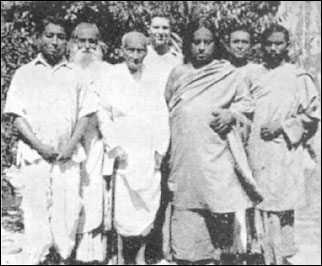
My brother Bishnu; Motilal Mukherji of Serampore, a highly advanced disciple of Sri Yukteswar; my father; Mr. Wright; myself; Tulsi Narayan Bose; Swami Satyananda of Ranchi
My brother Bishnu, Motilal Mukherji of Serampore (a highly advanced disciple of Sri Yukteswar), my father, Mr. Wright, me, Tulsi Narayan Bose, Swami Satyananda of Ranchi
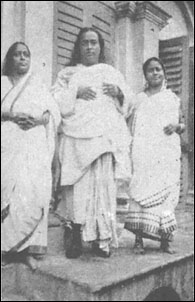
My aged parent embraced me as one returning from the dead; long we gazed on each other, speechless with joy. Brothers and sisters, uncles, aunts, and cousins, students and friends of years long past were grouped around me, not a dry eye among us. Passed now into the archives of memory, the scene of loving reunion vividly endures, unforgettable in my heart.
My elderly parent embraced me as if I had returned from the dead. For a long time, we gazed at each other, speechless with joy. Brothers and sisters, uncles, aunts, and cousins gathered around me, along with students and friends from years past. Not one of us had dry eyes. That loving reunion is now a memory, but it remains vivid and unforgettable in my heart.
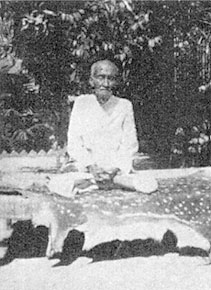
As for my meeting with Sri Yukteswar, words fail me; let the following description from my secretary suffice.
I cannot find words to describe my meeting with Sri Yukteswar. Let the following description from my secretary speak for me.
“Today, filled with the highest anticipations, I drove Yoganandaji from Calcutta to Serampore,” Mr. Wright recorded in his travel diary. “We passed by quaint shops, one of them the favorite eating haunt of Yoganandaji during his college days, and finally entered a narrow, walled lane. A sudden left turn, and there before us towered the simple but inspiring two-story ashram, its Spanish-style balcony jutting from the upper floor. The pervasive impression was that of peaceful solitude.
“Today, full of the highest hopes, I drove Yoganandaji from Calcutta to Serampore,” Mr. Wright wrote in his travel diary. “We passed quaint shops, including Yoganandaji’s favorite place to eat during his college days. Finally, we entered a narrow lane bordered by walls. We took a sudden left turn, and the simple but inspiring two-story ashram towered before us. Its Spanish-style balcony extended from the upper floor. The whole place gave an impression of peaceful solitude.
“In grave humility I walked behind Yoganandaji into the courtyard within the hermitage walls. Hearts beating fast, we proceeded up some old cement steps, trod, no doubt, by myriads of truth-seekers. The tension grew keener and keener as on we strode. Before us, near the head of the stairs, quietly appeared the Great One, Swami Sri Yukteswarji, standing in the noble pose of a sage.
“With deep humility, I followed Yoganandaji into the courtyard inside the hermitage walls. Our hearts beat fast as we climbed some old cement steps. Countless seekers of truth had no doubt walked those steps before us. The tension grew stronger and stronger as we continued. Ahead of us, near the top of the stairs, the Great One, Swami Sri Yukteswarji, quietly appeared. He stood with the dignity of a sage.
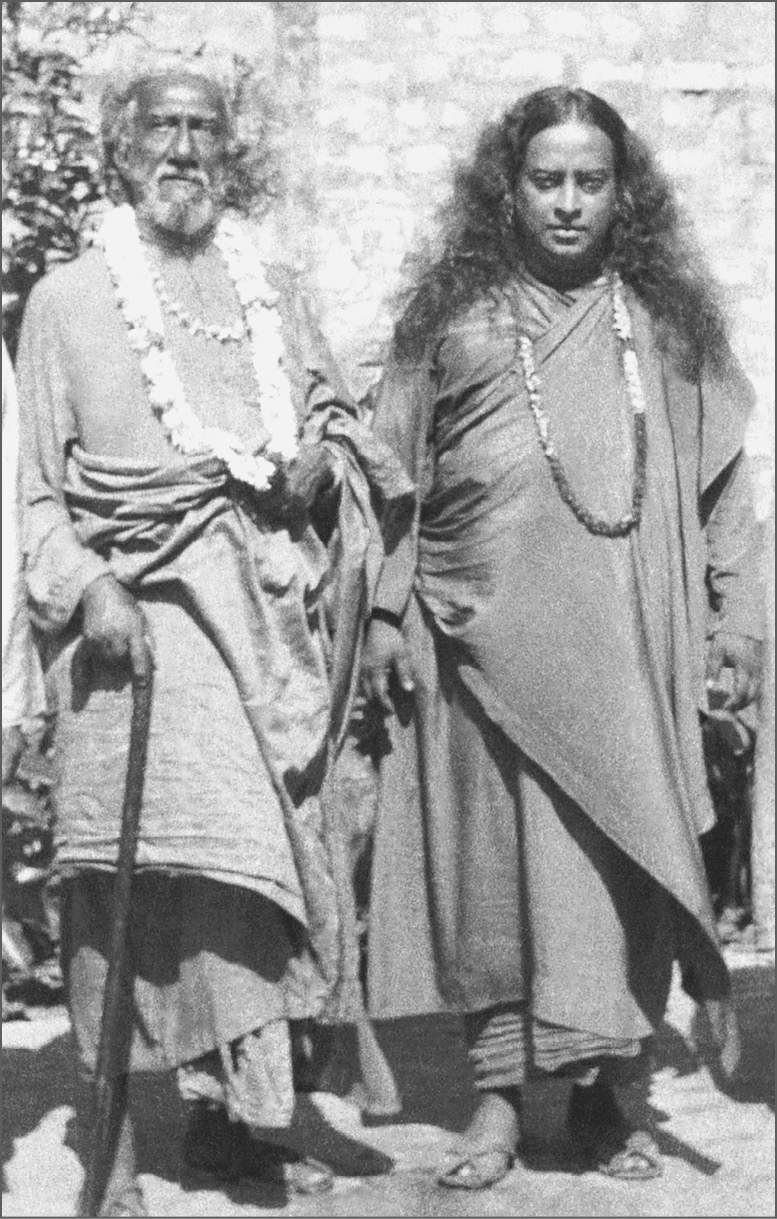
“My heart heaved and swelled as I felt myself blessed by the privilege of being in his sublime presence. Tears blurred my eager sight when Yoganandaji dropped to his knees, and with bowed head offered his soul’s gratitude and greeting, touching with his hand his guru’s feet and then, in humble obeisance, his own head. He rose then and was embraced on both sides of the bosom by Sri Yukteswarji.
“My heart swelled with emotion as I felt blessed by the privilege of being in his sublime presence. Tears blurred my eager eyes when Yoganandaji knelt and bowed his head, offering his heartfelt gratitude and greeting. He touched his guru’s feet with his hand, then touched his own head in humble respect. He then rose, and Sri Yukteswarji embraced him on both sides of his chest.
“No words passed at the beginning, but the most intense feeling was expressed in the mute phrases of the soul. How their eyes sparkled and were fired with the warmth of renewed soul-union! A tender vibration surged through the quiet patio, and even the sun eluded the clouds to add a sudden blaze of glory.
“At first, no words were spoken, but their souls silently expressed the deepest feelings. How their eyes sparkled with the warmth of their souls coming together again! A tender energy flowed through the quiet patio. Even the sun broke through the clouds, adding a sudden blaze of glory.
“On bended knee before the master I gave my own unexpressed love and thanks, touching his feet, calloused by time and service, and receiving his blessing. I stood then and faced two beautiful deep eyes smouldering with introspection, yet radiant with joy. We entered his sitting room, whose whole side opened to the outer balcony first seen from the street. The master braced himself against a worn davenport, sitting on a covered mattress on the cement floor. Yoganandaji and I sat near the guru’s feet, with orange-colored pillows to lean against and ease our positions on the straw mat.
“Kneeling before the master, I offered my silent love and thanks and touched his feet, calloused by time and service. I received his blessing. Then I stood and looked into his beautiful, deep eyes, glowing with inward reflection yet radiant with joy. We entered his sitting room. One whole side opened onto the outer balcony I had first seen from the street. The master leaned against a worn sofa, sitting on a covered mattress on the cement floor. Yoganandaji and I sat near the guru’s feet on the straw mat. We leaned against orange pillows to make ourselves more comfortable.
“I tried and tried to penetrate the Bengali conversation between the two Swamijis-for English, I discovered, is null and void when they are together, although Swamiji Maharaj, as the great guru is called by others, can and often does speak it. But I perceived the saintliness of the Great One through his heart-warming smile and twinkling eyes. One quality easily discernible in his merry, serious conversation is a decided positiveness in statement-the mark of a wise man, who knows he knows, because he knows God. His great wisdom, strength of purpose, and determination are apparent in every way.
“I tried again and again to understand the Bengali conversation between the two Swamijis. I discovered that English has no place when the two are together. Yet Swamiji Maharaj, as others call the great guru, can and often does speak English. But I sensed the Great One’s saintliness through his heartwarming smile and twinkling eyes. His conversation, both cheerful and serious, reveals one clear quality: he speaks with firm certainty. Such certainty marks a wise man who knows that he knows, because he knows God. His great wisdom, strength of purpose, and determination are clear in every way.
“Studying him reverently from time to time, I noted that he is of large, athletic stature, hardened by the trials and sacrifices of renunciation. His poise is majestic. A decidedly sloping forehead, as if seeking the heavens, dominates his divine countenance. He has a rather large and homely nose, with which he amuses himself in idle moments, flipping and wiggling it with his fingers, like a child. His powerful dark eyes are haloed by an ethereal blue ring. His hair, parted in the middle, begins as silver and changes to streaks of silvery-gold and silvery-black, ending in ringlets at his shoulders. His beard and moustache are scant or thinned out, yet seem to enhance his features and, like his character, are deep and light at the same time.
“Observing him reverently from time to time, I noticed his large, athletic build. He is hardened by the trials and sacrifices of renunciation. His bearing is majestic. His sharply sloping forehead dominates his divine face, as if reaching toward heaven. He has a rather large, plain-looking nose. In idle moments, he amuses himself by flicking and wiggling his nose with his fingers, like a child. His powerful dark eyes are surrounded by an unearthly blue ring. His hair is parted in the middle and starts out silver. It changes to streaks of silver-gold and silver-black, ending in curls at his shoulders. His beard and mustache are sparse or thinned out, yet seem to enhance his features. Like his character, his beard and mustache are both deep and light at the same time.
“He has a jovial and rollicking laugh which comes from deep in his chest, causing him to shake and quiver throughout his body-very cheerful and sincere. His face and stature are striking in their power, as are his muscular fingers. He moves with a dignified tread and erect posture.
“He has a hearty, lively laugh that comes from deep in his chest and makes his whole body shake. His laugh is very cheerful and sincere. His face and build convey striking power, as do his muscular fingers. He walks with dignity and stands straight.
“He was clad simply in the common dhoti and shirt, both once dyed a strong ocher color, but now a faded orange.
“He wore a simple, ordinary dhoti and shirt. Both had once been dyed a deep ocher, but had now faded to orange.
“Glancing about, I observed that this rather dilapidated room suggested the owner’s non-attachment to material comforts. The weather-stained white walls of the long chamber were streaked with fading blue plaster. At one end of the room hung a picture of Lahiri Mahasaya, garlanded in simple devotion. There was also an old picture showing Yoganandaji as he had first arrived in Boston, standing with the other delegates to the Congress of Religions.
“Looking around, I noticed that the rather run-down room suggested its owner’s lack of attachment to material comforts. The long room’s weather-stained white walls were streaked with fading blue plaster. At one end hung a picture of Lahiri Mahasaya, decorated with a garland as a simple act of devotion. There was also an old picture of Yoganandaji when he first arrived in Boston. He stood with the other delegates to the Congress of Religions.
“I noted a quaint concurrence of modernity and antiquation. A huge, cut-glass, candle-light chandelier was covered with cobwebs through disuse, and on the wall was a bright, up-to-date calendar. The whole room emanated a fragrance of peace and calmness. Beyond the balcony I could see coconut trees towering over the hermitage in silent protection.
“I noticed an unusual mix of old and new. A huge cut-glass chandelier made for candles was covered in cobwebs from lack of use. On the wall hung a bright, modern calendar. The whole room gave off a fragrance of peace and calm. Beyond the balcony, I could see coconut trees towering over the hermitage, silently protecting it.
“It is interesting to observe that the master has merely to clap his hands together and, before finishing, he is served or attended by some small disciple. Incidentally, I am much attracted to one of them-a thin lad, named Prafulla, [^40] with long black hair to his shoulders, a most penetrating pair of sparkling black eyes, and a heavenly smile; his eyes twinkle, as the corners of his mouth rise, like the stars and the crescent moon appearing at twilight.
“It is interesting to see that the master only has to clap his hands to summon a young disciple. Before he even finishes clapping, a disciple is there to serve or attend to him. Incidentally, I am very drawn to one of them, a thin boy named Prafulla, [^40] with shoulder-length black hair. He has strikingly penetrating, sparkling black eyes and a heavenly smile. As the corners of his mouth rise, his eyes twinkle like stars and the crescent moon appearing at twilight.
“Swami Sri Yukteswarji’s joy is obviously intense at the return of his ‘product’ (and he seems to be somewhat inquisitive about the ‘product’s product’). However, predominance of the wisdom-aspect in the Great One’s nature hinders his outward expression of feeling.
“Swami Sri Yukteswarji is clearly overjoyed at the return of his ‘product’. (And he seems somewhat curious about the ‘product’s product’.) However, wisdom dominates the Great One’s nature, making it harder for him to show his feelings outwardly.
“Yoganandaji presented him with some gifts, as is the custom when the disciple returns to his guru. We sat down later to a simple but well- cooked meal. All the dishes were vegetable and rice combinations. Sri Yukteswarji was pleased at my use of a number of Indian customs, ‘finger-eating’ for example.
“Yoganandaji gave him some gifts, as is customary when a disciple returns to his guru. Later, we sat down to a simple but well-cooked meal. All the dishes combined vegetables and rice. Sri Yukteswarji was pleased that I followed several Indian customs, such as ‘eating with my fingers’.
“After several hours of flying Bengali phrases and the exchange of warm smiles and joyful glances, we paid obeisance at his feet, bade adieu with a pronam, [^40] and departed for Calcutta with an everlasting memory of a sacred meeting and greeting. Although I write chiefly of my external impressions of him, yet I was always conscious of the true basis of the saint-his spiritual glory. I felt his power, and shall carry that feeling as my divine blessing.”
“After several hours of lively Bengali conversation, warm smiles, and joyful glances, we bowed at his feet. We said goodbye with a pronam, [^40] and left for Calcutta, carrying a lasting memory of our sacred meeting. Although I write mainly about my outward impressions of him, I always sensed the saint’s true foundation, his spiritual glory. I felt his power, and I will carry that feeling as my divine blessing.”
From America, Europe, and Palestine I had brought many presents for Sri Yukteswar. He received them smilingly, but without remark. For my own use, I had bought in Germany a combination umbrella-cane. In India I decided to give the cane to Master.
I had brought many gifts for Sri Yukteswar from America, Europe, and Palestine. He accepted them with a smile but said nothing. In Germany, I had bought a combined umbrella and cane for my own use. In India, I decided to give the cane to Master.
“This gift I appreciate indeed!” My guru’s eyes were turned on me with affectionate understanding as he made the unwonted comment. From all the presents, it was the cane that he singled out to display to visitors.
“I really appreciate this gift!” My guru looked at me with affectionate understanding as he made this unusual comment. Of all the presents, he singled out the cane to show visitors.
“Master, please permit me to get a new carpet for the sitting room.” I had noticed that Sri Yukteswar’s tiger skin was placed over a torn rug.
“Master, please let me get a new carpet for the sitting room.” I had noticed Sri Yukteswar’s tiger skin lay over a torn rug.
“Do so if it pleases you.” My guru’s voice was not enthusiastic. “Behold, my tiger mat is nice and clean; I am monarch in my own little kingdom. Beyond it is the vast world, interested only in externals.”
“Do so if you like.” My guru’s voice lacked enthusiasm. “Look, my tiger mat is nice and clean. I am king in my own little kingdom. Beyond the mat lies the vast world, interested only in outward appearances.”
As he uttered these words I felt the years roll back; once again I am a young disciple, purified in the daily fires of chastisement!
As he spoke these words, I felt the years roll back. Once again I am a young disciple, purified in the daily fires of stern correction!
As soon as I could tear myself away from Serampore and Calcutta, I set out, with Mr. Wright, for Ranchi. What a welcome there, a veritable ovation! Tears stood in my eyes as I embraced the selfless teachers who had kept the banner of the school flying during my fifteen years’ absence. The bright faces and happy smiles of the residential and day students were ample testimony to the worth of their many-sided school and yoga training.
As soon as I could pull myself away from Serampore and Calcutta, I left for Ranchi with Mr. Wright. What a welcome we received, a truly enthusiastic reception! Tears filled my eyes as I embraced the selfless teachers. They had kept the school thriving during my fifteen years away. The boarding and day students’ bright faces and happy smiles clearly showed the value of their well-rounded education and yoga training.
Yet, alas! the Ranchi institution was in dire financial difficulties. Sir Manindra Chandra Nundy, the old Maharaja whose Kasimbazar Palace had been converted into the central school building, and who had made many princely donations was now dead. Many free, benevolent features of the school were now seriously endangered for lack of sufficient public support.
Yet sadly, the Ranchi institution was in serious financial trouble. Sir Manindra Chandra Nundy was the elderly Maharaja whose Kasimbazar Palace had become the main school building. He had made many generous donations, but he was now dead. Many of the school’s free services and charitable programs were now seriously threatened by a lack of sufficient public support.
I had not spent years in America without learning some of its practical wisdom, its undaunted spirit before obstacles. For one week I remained in Ranchi, wrestling with critical problems. Then came interviews in Calcutta with prominent leaders and educators, a long talk with the young Maharaja of Kasimbazar, a financial appeal to my father, and lo! the shaky foundations of Ranchi began to be righted. Many donations including one huge check arrived in the nick of time from my American students.
My years in America had taught me some of the country’s practical wisdom and fearless spirit in facing obstacles. For one week I stayed in Ranchi, wrestling with critical problems. Then I met with prominent leaders and educators in Calcutta and spoke at length with the young Maharaja of Kasimbazar. I also appealed to my father for financial help. And, to my delight, Ranchi’s shaky foundations began to stabilize. Many donations, including one huge check, arrived just in time from my American students.
Within a few months after my arrival in India, I had the joy of seeing the Ranchi school legally incorporated. My lifelong dream of a permanently endowed yoga educational center stood fulfilled. That vision had guided me in the humble beginnings in 1917 with a group of seven boys.
Within a few months of my arrival in India, I was delighted to see the Ranchi school legally incorporated. My lifelong dream of a yoga education center with a permanent endowment had come true. That vision had guided me when I started modestly in 1917 with a group of seven boys.
In the decade since 1935, Ranchi has enlarged its scope far beyond the boys’ school. Widespread humanitarian activities are now carried on there in the Shyama Charan Lahiri Mahasaya Mission.
In the decade since 1935, Ranchi has expanded its work far beyond the boys’ school. The Shyama Charan Lahiri Mahasaya Mission now carries out a wide range of humanitarian activities there.
The school, or Yogoda Sat-Sanga Brahmacharya Vidyalaya, conducts outdoor classes in grammar and high school subjects. The residential students and day scholars also receive vocational training of some kind. The boys themselves regulate most of their activities through autonomous committees. Very early in my career as an educator I discovered that boys who impishly delight in outwitting a teacher will cheerfully accept disciplinary rules that are set by their fellow students. Never a model pupil myself, I had a ready sympathy for all boyish pranks and problems.
The school, Yogoda Sat-Sanga Brahmacharya Vidyalaya, holds outdoor classes in elementary and high school subjects. Both boarding students and day students also receive some kind of vocational training. The boys manage most of their own activities through self-governing committees. Very early in my teaching career, I discovered something about boys who take mischievous pleasure in outsmarting a teacher. Those same boys will cheerfully accept rules of discipline set by their fellow students. I was never a model student myself, so I readily sympathized with all the boys’ pranks and problems.
Sports and games are encouraged; the fields resound with hockey and football practice. Ranchi students often win the cup at competitive events. The outdoor gymnasium is known far and wide. Muscle recharging through will power is the Yogoda feature: mental direction of life energy to any part of the body. The boys are also taught asanas (postures), sword and lathi (stick) play, and jujitsu. The Yogoda Health Exhibitions at the Ranchi Vidyalaya have been attended by thousands.
Sports and games are encouraged. The fields ring with the sounds of hockey and football practice. Ranchi students often win the cup at competitions. The outdoor gymnasium is widely known. A feature of Yogoda is recharging muscles through willpower by mentally directing life energy to any part of the body. The boys also learn asanas (postures), sword fighting, lathi (stick) fighting, and jujitsu. Thousands have attended the Yogoda Health Exhibitions at the Ranchi Vidyalaya.
Instruction in primary subjects is given in Hindi to the Kols, Santals, and Mundas, aboriginal tribes of the province. Classes for girls only have been organized in near-by villages.
Basic subjects are taught in Hindi to the Kols, Santals, and Mundas, Indigenous tribes of the province. Classes for girls only have been organized in nearby villages.
The unique feature at Ranchi is the initiation into Kriya Yoga. The boys daily practice their spiritual exercises, engage in Gita chanting, and are taught by precept and example the virtues of simplicity, self-sacrifice, honor, and truth. Evil is pointed out to them as being that which produces misery; good as those actions which result in true happiness. Evil may be compared to poisoned honey, tempting but laden with death.
The unique feature at Ranchi is initiation into Kriya Yoga. The boys practice their spiritual exercises daily and chant the Gita. Through instruction and example, they learn the virtues of simplicity, self-sacrifice, honor, and truth. They are taught that evil causes misery, while good actions bring true happiness. Evil may be compared to poisoned honey, tempting but deadly.
Overcoming restlessness of body and mind by concentration techniques has achieved astonishing results: it is no novelty at Ranchi to see an appealing little figure, aged nine or ten years, sitting for an hour or more in unbroken poise, the unwinking gaze directed to the spiritual eye. Often the picture of these Ranchi students has returned to my mind, as I observed collegians over the world who are hardly able to sit still through one class period. [^40]
Concentration techniques for overcoming restlessness in body and mind have produced astonishing results. At Ranchi, seeing a charming child of nine or ten sitting perfectly still for an hour or more is nothing unusual. The child’s steady, unblinking gaze is directed toward the spiritual eye. The image of these Ranchi students has often returned to my mind as I watched college students around the world. Those college students could hardly sit still through a single class. [^40]
Ranchi lies 2000 feet above sea level; the climate is mild and equable. The twenty-five acre site, by a large bathing pond, includes one of the finest orchards in India-five hundred fruit trees-mango, guava, litchi, jackfruit, date. The boys grow their own vegetables, and spin at their charkas.
Ranchi lies 2,000 feet above sea level. The climate is mild and steady. The twenty-five-acre site sits beside a large bathing pond and includes one of the finest orchards in India. The orchard has five hundred fruit trees: mango, guava, litchi, jackfruit, and date. The boys grow their own vegetables and spin on their charkas.
A guest house is hospitably open for Western visitors. The Ranchi library contains numerous magazines, and about a thousand volumes in English and Bengali, donations from the West and the East. There is a collection of the scriptures of the world. A well-classified museum displays archeological, geological, and anthropological exhibits; trophies, to a great extent, of my wanderings over the Lord’s varied earth.
A guest house warmly welcomes Western visitors. The Ranchi library holds many magazines and about a thousand books in English and Bengali, donated from West and East. There is a collection of scriptures from around the world. A well-organized museum displays archaeological, geological, and anthropological exhibits. Most are treasures gathered during my travels across the Lord’s varied earth.
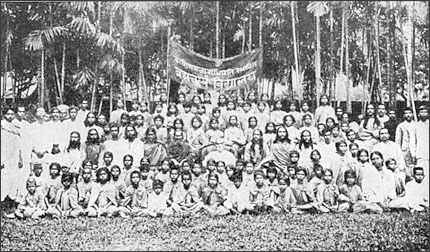
A group of Ranchi students and teachers pose with the venerable Maharaja of Kasimbazar (at center, in white). In 1918 he gave his Kasimbazar Palace and twenty-five acres in Ranchi as a permanent site for my yoga school for boys.
A group of Ranchi students and teachers pose with the respected Maharaja of Kasimbazar (at center, in white). In 1918, he donated his Kasimbazar Palace and twenty-five acres in Ranchi. This became the permanent site for my yoga school for boys.
The charitable hospital and dispensary of the Lahiri Mahasaya Mission, with many outdoor branches in distant villages, have already ministered to 150,000 of India’s poor. The Ranchi students are trained in first aid, and have given praiseworthy service to their province at tragic times of flood or famine.
The Lahiri Mahasaya Mission’s charitable hospital and dispensary have many outpatient branches in distant villages. Together, they have already served 150,000 of India’s poor. The Ranchi students are trained in first aid. They have provided admirable service to their province during tragic floods and famines.
In the orchard stands a Shiva temple, with a statue of the blessed master, Lahiri Mahasaya. Daily prayers and scripture classes are held in the garden under the mango bowers.
A Shiva temple stands in the orchard, with a statue of the blessed master, Lahiri Mahasaya. Daily prayers and scripture classes are held in the garden under the shade of the mango trees.
Branch high schools, with the residential and yoga features of Ranchi, have been opened and are now flourishing. These are the Yogoda Sat- Sanga Vidyapith (School) for Boys, at Lakshmanpur in Bihar; and the Yogoda Sat-Sanga High School and hermitage at Ejmalichak in Midnapore.
Branch high schools offering residential facilities and yoga, like those at Ranchi, have opened and are now flourishing. They are the Yogoda Sat-Sanga Vidyapith (School) for Boys at Lakshmanpur in Bihar, and the Yogoda Sat-Sanga High School and hermitage at Ejmalichak in Midnapore.
A stately Yogoda Math was dedicated in 1939 at Dakshineswar, directly on the Ganges. Only a few miles north of Calcutta, the new hermitage affords a haven of peace for city dwellers. Suitable accommodations are available for Western guests, and particularly for those seekers who are intensely dedicating their lives to spiritual realization. The activities of the Yogoda Math include a fortnightly mailing of Self- Realization Fellowship teachings to students in various parts of India.
A grand Yogoda Math was dedicated in 1939 at Dakshineswar, right on the Ganges. Just a few miles north of Calcutta, the new hermitage offers city dwellers a peaceful refuge. Suitable rooms are available for Western guests, especially seekers deeply committed to spiritual realization. The Yogoda Math’s activities include mailing Self-Realization Fellowship teachings every two weeks to students in various parts of India.
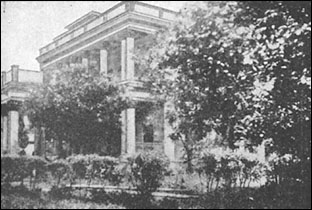
Yogoda Math, beautiful hermitage of Self-Realization Fellowship at Dakshineswar on the Ganges. Founded in 1938 as a yoga retreat for students of East and West.
Yogoda Math, a beautiful Self-Realization Fellowship retreat at Dakshineswar on the Ganges. Founded in 1938 as a yoga retreat for students from East and West.
It is needless to say that all these educational and humanitarian activities have required the self-sacrificing service and devotion of many teachers and workers. I do not list their names here, because they are so numerous; but in my heart each one has a lustrous niche. Inspired by the ideals of Lahiri Mahasaya, these teachers have abandoned promising worldly goals to serve humbly, to give greatly.
Of course, all these educational and humanitarian activities have depended on the selfless service and devotion of many teachers and workers. I do not list their names here because there are so many. But each one holds a shining place in my heart. Inspired by the ideals of Lahiri Mahasaya, these teachers have given up promising worldly ambitions to serve humbly and give generously.
Mr. Wright formed many fast friendships with Ranchi boys; clad in a simple dhoti, he lived for awhile among them. At Ranchi, Calcutta, Serampore, everywhere he went, my secretary, who has a vivid gift of description, hauled out his travel diary to record his adventures. One evening I asked him a question.
Mr. Wright formed many close friendships with the Ranchi boys. Wearing a simple dhoti, he lived among them for a while. In Ranchi, Calcutta, Serampore, and everywhere else he went, my secretary pulled out his travel diary to record his adventures. He had a gift for vivid description. One evening I asked him a question.
“Dick, what is your impression of India?”
“Dick, what do you think of India?”
“Peace,” he said thoughtfully. “The racial aura is peace.”
“Peace,” he said thoughtfully. “The race has an aura of peace.”
40-1: We broke our journey in Central Provinces, halfway across the continent, to see Mahatma Gandhi at Wardha. Those days are described in [^44].
40-1: We paused our journey in Central Provinces, halfway across the continent, to visit Mahatma Gandhi at Wardha. Our days there are described in [^44].
40-2: Prafulla was the lad who had been present with Master when a cobra approached (see page 116).
40-2: Prafulla was the boy who had been with Master when a cobra approached (see page 116).
40-3: Literally, “holy name,” a word of greeting among Hindus, accompanied by palm-folded hands lifted from the heart to the forehead in salutation. A pronam in India takes the place of the Western greeting by handshaking.
40-3: Literally, “holy name,” a greeting among Hindus. The greeting is accompanied by pressing the palms together and raising the hands from the heart to the forehead. A pronam in India takes the place of the Western handshake.
40-4: Mental training through certain concentration techniques has produced in each Indian generation men of prodigious memory. Sir T. Vijayaraghavachari, in the Hindustan Times, has described the tests put to the modern professional “memory men” of Madras. “These men,” he wrote, “were unusually learned in Sanskrit literature. Seated in the midst of a large audience, they were equal to the tests that several members of the audience simultaneously put them to. The test would be like this: one person would start ringing a bell, the number of rings having to be counted by the ‘memory man.’ A second person would dictate from a paper a long exercise in arithmetic, involving addition, subtraction, multiplication, and division. A third would go on reciting from the Ramayana or the Mahabharata a long series of poems, which had to be reproduced; a fourth would set problems in versification which required the composition of verses in proper meter on a given subject, each line to end in a specified word, a fifth man would carry on with a sixth a theological disputation, the exact language of which had to be quoted in the precise order in which the disputants conducted it, and a seventh man was all the while turning a wheel, the number of revolutions of which had to be counted. The memory expert had simultaneously to do all these feats purely by mental processes, as he was allowed no paper and pencil. The strain on the faculties must have been terrific. Ordinarily men in unconscious envy are apt to depreciate such efforts by affecting to believe that they involve only the exercise of the lower functionings of the brain. It is not, however, a pure question of memory. The greater factor is the immense concentration of mind.”
40-4: Mental training through certain concentration techniques has produced men with extraordinary memories in every Indian generation. Sir T. Vijayaraghavachari described tests given to the modern professional “memory men” of Madras in the Hindustan Times. “These men,” he wrote, “had an unusually deep knowledge of Sanskrit literature. Seated before a large audience, they successfully handled tests given by several audience members at once. The test would go like this: one person would ring a bell. The ‘memory man’ had to count the rings. A second person would read aloud a long arithmetic exercise from a paper, involving addition, subtraction, multiplication, and division. A third would keep reciting a long series of poems from the Ramayana or the Mahabharata. The memory expert had to repeat those poems. A fourth would assign verse-writing tasks. These required composing verses in the proper meter on a given subject, with each line ending in a specified word. A fifth man would debate theology with a sixth. The memory expert had to quote their exact words in the precise order in which they spoke. Meanwhile, a seventh man would turn a wheel, and the memory expert had to count its revolutions. The memory expert had to perform all these tasks at once, entirely in his mind. He was allowed no paper or pencil. The mental strain must have been tremendous. People, often unconsciously envious, tend to belittle such achievements. They pretend to believe these feats involve only the brain’s lower functions. But these feats are not simply a matter of memory. The more important factor is immense mental concentration.”