Chapter 4
My Interrupted Escape Toward the Himalayas
“Leave your classroom on some trifling pretext, and engage a hackney carriage. Stop in the lane where no one in my house can see you.”
“Leave your classroom on some minor excuse, and hire a carriage. Stop in the lane where no one in my house can see you.”
These were my final instructions to Amar Mitter, a high school friend who planned to accompany me to the Himalayas. We had chosen the following day for our flight. Precautions were necessary, as Ananta exercised a vigilant eye. He was determined to foil the plans of escape which he suspected were uppermost in my mind. The amulet, like a spiritual yeast, was silently at work within me. Amidst the Himalayan snows, I hoped to find the master whose face often appeared to me in visions.
These were my final instructions to Amar Mitter, a high school friend who planned to join me in the Himalayas. We had chosen the next day for our escape. We needed to be careful because Ananta was watching closely. He suspected that escape plans were at the front of my mind and was determined to stop me. Like a spiritual yeast, the amulet was silently working within me. Among the Himalayan snows, I hoped to find the master whose face often appeared to me in visions.
The family was living now in Calcutta, where Father had been permanently transferred. Following the patriarchal Indian custom, Ananta had brought his bride to live in our home, now at 4 Gurpar Road. There in a small attic room I engaged in daily meditations and prepared my mind for the divine search.
Our family was now living in Calcutta, where Father had been permanently transferred. Following the patriarchal Indian custom, Ananta had brought his bride to live in our home at 4 Gurpar Road. In a small attic room there, I meditated daily and prepared my mind for the search for God.
The memorable morning arrived with inauspicious rain. Hearing the wheels of Amar’s carriage in the road, I hastily tied together a blanket, a pair of sandals, Lahiri Mahasaya’s picture, a copy of the Bhagavad Gita, a string of prayer beads, and two loincloths. This bundle I threw from my third-story window. I ran down the steps and passed my uncle, buying fish at the door.
The memorable morning arrived with rain, a bad omen. Hearing the wheels of Amar’s carriage on the road, I hurried to tie my things into a bundle. I packed a blanket, a pair of sandals, Lahiri Mahasaya’s picture, a copy of the Bhagavad Gita, prayer beads, and two loincloths. I threw the bundle from my third-story window. I ran down the stairs and passed my uncle, who was buying fish at the door.
“What is the excitement?” His gaze roved suspiciously over my person.
“What’s all the excitement?” He looked me up and down suspiciously.
I gave him a noncommittal smile and walked to the lane. Retrieving my bundle, I joined Amar with conspiratorial caution. We drove to Chadni Chowk, a merchandise center. For months we had been saving our tiffin money to buy English clothes. Knowing that my clever brother could easily play the part of a detective, we thought to outwit him by European garb.
I gave him a smile that revealed nothing and walked to the lane. I picked up my bundle and cautiously joined Amar, like a fellow conspirator. We drove to Chadni Chowk, a shopping district. For months we had been saving our lunch money to buy English clothes. We knew my clever brother could easily act as a detective, so we hoped to outwit him by dressing as Europeans.
On the way to the station, we stopped for my cousin, Jotin Ghosh, whom I called Jatinda. He was a new convert, longing for a guru in the Himalayas. He donned the new suit we had in readiness. Well- camouflaged, we hoped! A deep elation possessed our hearts.
On the way to the station, we stopped to pick up my cousin, Jotin Ghosh, whom I called Jatinda. He was a new convert, eager to find a guru in the Himalayas. He put on the new suit we had ready. Well disguised, we hoped! Our hearts were filled with joy.
“All we need now are canvas shoes.” I led my companions to a shop displaying rubber-soled footwear. “Articles of leather, gotten only through the slaughter of animals, must be absent on this holy trip.” I halted on the street to remove the leather cover from my Bhagavad Gita, and the leather straps from my English-made sola topee (helmet).
“All we need now are canvas shoes.” I led my companions to a shop selling rubber-soled shoes. “Leather comes only from slaughtering animals, so we must take no leather items on this holy trip.” I stopped in the street to remove the leather cover from my Bhagavad Gita. I also removed the leather straps from my English-made sola topee (helmet).
At the station we bought tickets to Burdwan, where we planned to transfer for Hardwar in the Himalayan foothills. As soon as the train, like ourselves, was in flight, I gave utterance to a few of my glorious anticipations.
At the station, we bought tickets to Burdwan. There we planned to change trains for Hardwar in the Himalayan foothills. As soon as the train was speeding away like us, I shared a few of my glorious hopes.
“Just imagine!” I ejaculated. “We shall be initiated by the masters and experience the trance of cosmic consciousness. Our flesh will be charged with such magnetism that wild animals of the Himalayas will come tamely near us. Tigers will be no more than meek house cats awaiting our caresses!”
“Just imagine!” I exclaimed. “The masters will initiate us, and we will experience the trance of cosmic consciousness. Our bodies will be charged with such magnetism that wild animals of the Himalayas will approach us tamely. Tigers will be no more than gentle house cats waiting to be petted!”
This remark-picturing a prospect I considered entrancing, both metaphorically and literally-brought an enthusiastic smile from Amar. But Jatinda averted his gaze, directing it through the window at the scampering landscape.
My remark described a prospect I found entrancing, both figuratively and literally. The remark brought an enthusiastic smile to Amar’s face. But Jatinda looked away, gazing out the window at the landscape rushing past.
“Let the money be divided in three portions.” Jatinda broke a long silence with this suggestion. “Each of us should buy his own ticket at Burdwan. Thus no one at the station will surmise that we are running away together.”
“Let’s divide the money into three parts.” Jatinda broke a long silence with this suggestion. “Each of us should buy his own ticket at Burdwan. That way, no one at the station will suspect we’re running away together.”
I unsuspectingly agreed. At dusk our train stopped at Burdwan. Jatinda entered the ticket office; Amar and I sat on the platform. We waited fifteen minutes, then made unavailing inquiries. Searching in all directions, we shouted Jatinda’s name with the urgency of fright. But he had faded into the dark unknown surrounding the little station.
I agreed without suspecting anything. At dusk, our train stopped at Burdwan. Jatinda went into the ticket office. Amar and I sat on the platform. We waited fifteen minutes, then asked about him, but learned nothing. We searched in all directions, shouting Jatinda’s name with frightened urgency. But he had disappeared into the unknown darkness surrounding the little station.
I was completely unnerved, shocked to a peculiar numbness. That God would countenance this depressing episode! The romantic occasion of my first carefully-planned flight after Him was cruelly marred.
I was completely shaken, shocked into a strange numbness. How could God allow such a depressing episode! The romance of my first carefully planned escape in search of him was cruelly spoiled.
“Amar, we must return home.” I was weeping like a child. “Jatinda’s callous departure is an ill omen. This trip is doomed to failure.”
“Amar, we must go home.” I was crying like a child. “Jatinda’s heartless departure is a bad sign. This trip is bound to fail.”
“Is this your love for the Lord? Can’t you stand the little test of a treacherous companion?”
“Is this how you love the Lord? Can’t you handle the small test of a companion who betrays you?”
Through Amar’s suggestion of a divine test, my heart steadied itself. We refreshed ourselves with famous Burdwan sweetmeats, sitabhog (food for the goddess) and motichur (nuggets of sweet pearl). In a few hours, we entrained for Hardwar, via Bareilly. Changing trains at Moghul Serai, we discussed a vital matter as we waited on the platform.
Amar’s suggestion of a divine test calmed my heart. We refreshed ourselves with Burdwan’s famous sweets, sitabhog (food for the goddess) and motichur (nuggets of sweet pearl). A few hours later, we boarded a train for Hardwar, via Bareilly. While changing trains at Moghul Serai, we discussed a crucial matter as we waited on the platform.
“Amar, we may soon be closely questioned by railroad officials. I am not underrating my brother’s ingenuity! No matter what the outcome, I will not speak untruth.”
“Amar, railroad officials may soon question us closely. I’m not underestimating my brother’s cleverness! No matter what happens, I will not lie.”
“All I ask of you, Mukunda, is to keep still. Don’t laugh or grin while I am talking.”
“All I ask, Mukunda, is that you stay still. Don’t laugh or grin while I’m talking.”
At this moment, a European station agent accosted me. He waved a telegram whose import I immediately grasped.
At that moment, a European station agent approached me. He waved a telegram, and I immediately understood its meaning.
“Are you running away from home in anger?”
“Are you running away from home because you’re angry?”
“No!” I was glad his choice of words permitted me to make emphatic reply. Not anger but “divinest melancholy” was responsible, I knew, for my unconventional behavior.
“No!” I was glad his choice of words allowed me to answer so firmly. I knew my unusual behavior came not from anger but from “divinest melancholy.”
The official then turned to Amar. The duel of wits that followed hardly permitted me to maintain the counseled stoic gravity.
The official then turned to Amar. The battle of wits that followed made it hard to stay calm and serious, as I had been advised.
“Where is the third boy?” The man injected a full ring of authority into his voice. “Come on; speak the truth!”
“Where is the third boy?” The man made his voice sound fully authoritative. “Come on, tell the truth!”
“Sir, I notice you are wearing eyeglasses. Can’t you see that we are only two?” Amar smiled impudently. “I am not a magician; I can’t conjure up a third companion.”
“Sir, I see you’re wearing glasses. Can’t you see there are only two of us?” Amar smiled cheekily. “I’m not a magician. I can’t conjure up a third companion.”
The official, noticeably disconcerted by this impertinence, sought a new field of attack.
The official was visibly unsettled by this disrespect. He looked for a new angle of attack.
“What is your name?”
“What is your name?”
“I am called Thomas. I am the son of an English mother and a converted Christian Indian father.”
“My name is Thomas. My mother is English, and my father is Indian and converted to Christianity.”
“What is your friend’s name?”
“What is your friend’s name?”
“I call him Thompson.”
“I call him Thompson.”
By this time my inward mirth had reached a zenith; I unceremoniously made for the train, whistling for departure. Amar followed with the official, who was credulous and obliging enough to put us into a European compartment. It evidently pained him to think of two half- English boys traveling in the section allotted to natives. After his polite exit, I lay back on the seat and laughed uncontrollably. My friend wore an expression of blithe satisfaction at having outwitted a veteran European official.
By now, my inner amusement had reached its peak. I headed straight for the train as it whistled for departure. Amar followed with the official, who was gullible and helpful enough to seat us in a European compartment. The official clearly found it painful to imagine two half-English boys traveling in the section reserved for natives. After he politely left, I leaned back on the seat and laughed uncontrollably. My friend looked cheerfully satisfied at having outwitted an experienced European official.
On the platform I had contrived to read the telegram. From my brother, it went thus: “Three Bengali boys in English clothes running away from home toward Hardwar via Moghul Serai. Please detain them until my arrival. Ample reward for your services.”
On the platform, I had managed to read the telegram. My brother had sent it, and it read: “Three Bengali boys in English clothes are running away from home toward Hardwar via Moghul Serai. Please hold them until I arrive. You will be well rewarded for your help.”
“Amar, I told you not to leave marked timetables in your home.” My glance was reproachful. “Brother must have found one there.”
“Amar, I told you not to leave marked timetables at home.” I gave him a reproachful look. “Brother must have found one there.”
My friend sheepishly acknowledged the thrust. We halted briefly in Bareilly, where Dwarka Prasad awaited us with a telegram from Ananta. My old friend tried valiantly to detain us; I convinced him that our flight had not been undertaken lightly. As on a previous occasion, Dwarka refused my invitation to set forth to the Himalayas.
My friend sheepishly admitted I had a point. We stopped briefly in Bareilly, where Dwarka Prasad was waiting with a telegram from Ananta. My old friend tried hard to persuade us to stay. But I convinced him we had not decided to run away lightly. As he had once before, Dwarka refused my invitation to head for the Himalayas.
While our train stood in a station that night, and I was half asleep, Amar was awakened by another questioning official. He, too, fell a victim to the hybrid charms of “Thomas” and “Thompson.” The train bore us triumphantly into a dawn arrival at Hardwar. The majestic mountains loomed invitingly in the distance. We dashed through the station and entered the freedom of city crowds. Our first act was to change into native costume, as Ananta had somehow penetrated our European disguise. A premonition of capture weighed on my mind.
That night, our train stood at a station. While I was half asleep, another official woke Amar to question him. The official, too, fell for the combined charms of “Thomas” and “Thompson.” The train carried us triumphantly into Hardwar at dawn. The majestic mountains rose invitingly in the distance. We rushed through the station and into the freedom of the city crowds. First, we changed into Indian clothes, since Ananta had somehow seen through our European disguise. A feeling that we would be caught weighed on my mind.
Deeming it advisable to leave Hardwar at once, we bought tickets to proceed north to Rishikesh, a soil long hallowed by feet of many masters. I had already boarded the train, while Amar lagged on the platform. He was brought to an abrupt halt by a shout from a policeman. Our unwelcome guardian escorted us to a station bungalow and took charge of our money. He explained courteously that it was his duty to hold us until my elder brother arrived.
Thinking it best to leave Hardwar at once, we bought tickets to travel north to Rishikesh. Many masters had long made the ground there sacred by walking on it. I had already boarded the train, while Amar lingered on the platform. A shout from a policeman stopped him short. Our unwelcome guardian escorted us to a station bungalow and took charge of our money. He politely explained that his duty was to keep us there until my elder brother arrived.
Learning that the truants’ destination had been the Himalayas, the officer related a strange story.
After learning that the runaways had been heading for the Himalayas, the officer told a strange story.
“I see you are crazy about saints! You will never meet a greater man of God than the one I saw only yesterday. My brother officer and I first encountered him five days ago. We were patrolling by the Ganges, on a sharp lookout for a certain murderer. Our instructions were to capture him, alive or dead. He was known to be masquerading as a sadhu in order to rob pilgrims. A short way before us, we spied a figure which resembled the description of the criminal. He ignored our command to stop; we ran to overpower him. Approaching his back, I wielded my ax with tremendous force; the man’s right arm was severed almost completely from his body.
“I see you’re crazy about saints! You will never meet a greater man of God than the one I saw just yesterday. My fellow officer and I first came across him five days ago. We were patrolling along the Ganges, keeping a sharp lookout for a particular murderer. Our orders were to capture him, alive or dead. He was known to be posing as a sadhu to rob pilgrims. A short distance ahead, we spotted someone who matched the criminal’s description. He ignored our order to stop, so we ran to overpower him. I came up behind him and swung my ax with tremendous force. The blow almost completely severed his right arm from his body.
“Without outcry or any glance at the ghastly wound, the stranger astonishingly continued his swift pace. As we jumped in front of him, he spoke quietly.
“Amazingly, the stranger kept moving quickly without crying out or even glancing at the gruesome wound. As we jumped in front of him, he spoke quietly.
“‘I am not the murderer you are seeking.’
“‘I’m not the murderer you’re looking for.’
“I was deeply mortified to see I had injured the person of a divine- looking sage. Prostrating myself at his feet, I implored his pardon, and offered my turban-cloth to staunch the heavy spurts of blood.
“I was deeply ashamed to see that I had injured a sage who looked divine. I bowed low at his feet and begged his forgiveness. I offered the cloth of my turban to stop the heavy spurts of blood.
“‘Son, that was just an understandable mistake on your part.’ The saint regarded me kindly. ‘Run along, and don’t reproach yourself. The Beloved Mother is taking care of me.’ He pushed his dangling arm into its stump and lo! it adhered; the blood inexplicably ceased to flow.
“‘Son, you simply made an understandable mistake.’ The saint looked at me kindly. ‘Go on now, and don’t blame yourself. The Beloved Mother is taking care of me.’ He pushed his dangling arm into the stump, and suddenly the arm reattached. The bleeding stopped for no explainable reason.
“‘Come to me under yonder tree in three days and you will find me fully healed. Thus you will feel no remorse.’
“‘Come to me under that tree in three days, and you will find me fully healed. Then you will feel no remorse.’
“Yesterday my brother officer and I went eagerly to the designated spot. The sadhu was there and allowed us to examine his arm. It bore no scar or trace of hurt!
“Yesterday my fellow officer and I eagerly went to the agreed spot. The sadhu was there and let us examine his arm. His arm had no scar or sign of injury!
“‘I am going via Rishikesh to the Himalayan solitudes.’ He blessed us as he departed quickly. I feel that my life has been uplifted through his sanctity.”
“‘I am going through Rishikesh to the solitude of the Himalayas.’ He blessed us as he left quickly. I feel that his holiness has uplifted my life.”
The officer concluded with a pious ejaculation; his experience had obviously moved him beyond his usual depths. With an impressive gesture, he handed me a printed clipping about the miracle. In the usual garbled manner of the sensational type of newspaper (not missing, alas! even in India), the reporter’s version was slightly exaggerated: it indicated that the sadhu had been almost decapitated!
The officer ended with a religious exclamation. His experience had clearly moved him more deeply than usual. With an impressive gesture, he handed me a newspaper clipping about the miracle. In the typically muddled style of sensational newspapers, the reporter’s account was slightly exaggerated. Sadly, even India has such newspapers. The report claimed that the sadhu had been almost beheaded!
Amar and I lamented that we had missed the great yogi who could forgive his persecutor in such a Christlike way. India, materially poor for the last two centuries, yet has an inexhaustible fund of divine wealth; spiritual “skyscrapers” may occasionally be encountered by the wayside, even by worldly men like this policeman.
Amar and I regretted missing the great yogi who could forgive his persecutor in such a Christlike way. India has been materially poor for the last two centuries, yet it has an endless store of divine wealth. Even worldly men like this policeman may occasionally encounter spiritual “skyscrapers” by the roadside.
We thanked the officer for relieving our tedium with his marvelous story. He was probably intimating that he was more fortunate than we: he had met an illumined saint without effort; our earnest search had ended, not at the feet of a master, but in a coarse police station!
We thanked the officer for easing our boredom with his marvelous story. He was probably hinting that he was luckier than we were: he had met an enlightened saint without any effort. Our earnest search had ended not at a master’s feet, but in a shabby police station!
So near the Himalayas and yet, in our captivity, so far, I told Amar I felt doubly impelled to seek freedom.
The Himalayas were so close, yet our captivity made them seem so far away. I told Amar I felt twice as driven to seek freedom.
“Let us slip away when opportunity offers. We can go on foot to holy Rishikesh.” I smiled encouragingly.
“Let’s slip away when we get the chance. We can walk to holy Rishikesh.” I smiled encouragingly.
But my companion had turned pessimist as soon as the stalwart prop of our money had been taken from us.
But my companion became pessimistic as soon as our money and the solid support it provided were taken from us.
“If we started a trek over such dangerous jungle land, we should finish, not in the city of saints, but in the stomachs of tigers!”
“If we trekked through such dangerous jungle, we’d end up not in the city of saints, but in tigers’ stomachs!”
Ananta and Amar’s brother arrived after three days. Amar greeted his relative with affectionate relief. I was unreconciled; Ananta got no more from me than a severe upbraiding.
Ananta and Amar’s brother arrived after three days. Amar greeted his brother with affection and relief. I was still upset. All Ananta got from me was a harsh scolding.
“I understand how you feel.” My brother spoke soothingly. “All I ask of you is to accompany me to Benares to meet a certain saint, and go on to Calcutta to visit your grieving father for a few days. Then you can resume your search here for a master.”
“I understand how you feel.” My brother spoke gently. “All I ask is that you come with me to Benares to meet a certain saint. Then go on to Calcutta to visit your grieving father for a few days. After that, you can return here and continue your search for a master.”
Amar entered the conversation at this point to disclaim any intention of returning to Hardwar with me. He was enjoying the familial warmth. But I knew I would never abandon the quest for my guru.
Amar joined the conversation then to say he had no intention of returning to Hardwar with me. He was enjoying the warmth of family life. But I knew I would never give up my search for my guru.
Our party entrained for Benares. There I had a singular and instant response to my prayers.
Our group boarded a train for Benares. There I received an extraordinary and immediate answer to my prayers.
A clever scheme had been prearranged by Ananta. Before seeing me at Hardwar, he had stopped in Benares to ask a certain scriptural authority to interview me later. Both the pundit and his son had promised to undertake my dissuasion from the path of a sannyasi . [^4]
Ananta had arranged a clever scheme in advance. Before seeing me at Hardwar, he had stopped in Benares to speak with a certain expert on scripture. He had asked the expert to meet with me later. Both the pundit and his son had promised to try to turn me away from the path of a sannyasi . [^4]
Ananta took me to their home. The son, a young man of ebullient manner, greeted me in the courtyard. He engaged me in a lengthy philosophic discourse. Professing to have a clairvoyant knowledge of my future, he discountenanced my idea of being a monk.
Ananta took me to their home. The son, a lively young man, greeted me in the courtyard. He drew me into a long discussion of philosophy. Claiming he could foresee my future, he discouraged me from becoming a monk.
“You will meet continual misfortune, and be unable to find God, if you insist on deserting your ordinary responsibilities! You cannot work out your past karma [^4] without worldly experiences.”
“You will keep facing misfortune and be unable to find God if you insist on abandoning your everyday responsibilities! You cannot work through your past karma [^4] without experience in the world.”
Krishna’s immortal words rose to my lips in reply: “‘Even he with the worst of karma who ceaselessly meditates on Me quickly loses the effects of his past bad actions. Becoming a high-souled being, he soon attains perennial peace. Arjuna, know this for certain: the devotee who puts his trust in Me never perishes!’” [^4]
Krishna’s timeless words came to my lips in reply: “‘Even someone with the worst karma quickly loses the effects of past wrongdoing if he constantly meditates on me. As he becomes spiritually noble, he soon finds lasting peace. Arjuna, know for certain: the devotee who trusts in me never perishes!’” [^4]
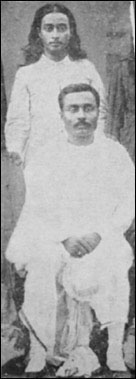
I stand behind my elder brother, Ananta.
I stand behind my older brother, Ananta.
But the forceful prognostications of the young man had slightly shaken my confidence. With all the fervor of my heart I prayed silently to God:
But the young man's forceful predictions had slightly shaken my confidence. With all my heart, I prayed silently to God:
“Please solve my bewilderment and answer me, right here and now, if Thou dost desire me to lead the life of a renunciate or a worldly man!”
“Please clear up my confusion and answer me, right here and now! Do you want me to renounce worldly life or live as a worldly man?”
I noticed a sadhu of noble countenance standing just outside the compound of the pundit’s house. Evidently he had overheard the spirited conversation between the self-styled clairvoyant and myself, for the stranger called me to his side. I felt a tremendous power flowing from his calm eyes.
I noticed a sadhu with a noble face standing just outside the grounds of the pundit’s house. Apparently, he had overheard the lively conversation between the self-proclaimed clairvoyant and me, because he called me over. I felt a tremendous power flowing from his calm eyes.
“Son, don’t listen to that ignoramus. In response to your prayer, the Lord tells me to assure you that your sole path in this life is that of the renunciate.”
“Son, don’t listen to that ignorant man. In answer to your prayer, the Lord tells me to assure you of this: Your only path in this life is to give up worldly life.”
With astonishment as well as gratitude, I smiled happily at this decisive message.
Surprised and grateful, I smiled happily at this decisive message.
“Come away from that man!” The “ignoramus” was calling me from the courtyard. My saintly guide raised his hand in blessing and slowly departed.
“Get away from that man!” The “ignoramus” was calling to me from the courtyard. My saintly guide raised his hand in blessing and slowly walked away.
“That sadhu is just as crazy as you are.” It was the hoary-headed pundit who made this charming observation. He and his son were gazing at me lugubriously. “I heard that he too has left his home in a vague search for God.”
“That sadhu is just as crazy as you are.” The white-haired scholar made this charming remark. He and his son were looking at me gloomily. “I heard that he too has left home on a vague search for God.”
I turned away. To Ananta I remarked that I would not engage in further discussion with our hosts. My brother agreed to an immediate departure; we soon entrained for Calcutta.
I turned away. I told Ananta I would not discuss the matter further with our hosts. My brother agreed to leave immediately. We soon boarded a train for Calcutta.
“Mr. Detective, how did you discover I had fled with two companions?” I vented my lively curiosity to Ananta during our homeward journey. He smiled mischievously.
“Mr. Detective, how did you find out I had run away with two companions?” I eagerly asked Ananta as we traveled home. He smiled mischievously.
“At your school, I found that Amar had left his classroom and had not returned. I went to his home the next morning and unearthed a marked timetable. Amar’s father was just leaving by carriage and was talking to the coachman.
“At your school, I learned that Amar had left his classroom and had not returned. I went to his home the next morning and found a marked timetable. Amar’s father was just leaving in a carriage and was talking to the driver.
“‘My son will not ride with me to his school this morning. He has disappeared!’ the father moaned.
“‘My son won’t ride to school with me this morning. He’s disappeared!’ the father moaned.
“‘I heard from a brother coachman that your son and two others, dressed in European suits, boarded the train at Howrah Station,’ the man stated. ‘They made a present of their leather shoes to the cab driver.’
“‘Another coachman told me your son and two others, wearing European suits, boarded the train at Howrah Station,’ the man said. ‘The three gave their leather shoes to the cab driver as a gift.’
“Thus I had three clues-the timetable, the trio of boys, and the English clothing.”
“So I had three clues: the timetable, the three boys, and the English clothing.”
I was listening to Ananta’s disclosures with mingled mirth and vexation. Our generosity to the coachman had been slightly misplaced!
I listened to Ananta’s revelations with a mix of amusement and annoyance. Our generosity to the coachman had been a little misplaced!
“Of course I rushed to send telegrams to station officials in all the cities which Amar had underlined in the timetable. He had checked Bareilly, so I wired your friend Dwarka there. After inquiries in our Calcutta neighborhood, I learned that cousin Jatinda had been absent one night but had arrived home the following morning in European garb. I sought him out and invited him to dinner. He accepted, quite disarmed by my friendly manner. On the way I led him unsuspectingly to a police station. He was surrounded by several officers whom I had previously selected for their ferocious appearance. Under their formidable gaze, Jatinda agreed to account for his mysterious conduct.
“Of course I rushed to send telegrams to station officials in all the cities Amar had underlined in the timetable. He had marked Bareilly, so I sent a telegram to your friend Dwarka there. After asking around our Calcutta neighborhood, I learned that cousin Jatinda had been away one night. But he had returned home the next morning in European clothes. I found him and invited him to dinner. He accepted, his suspicions completely eased by my friendly manner. On the way, I led him to a police station without raising his suspicions. Several officers surrounded him. I had chosen them beforehand for their fierce appearance. Under their intimidating gaze, Jatinda agreed to explain his mysterious behavior.
“‘I started for the Himalayas in a buoyant spiritual mood,’ he explained. ‘Inspiration filled me at the prospect of meeting the masters. But as soon as Mukunda said, ”During our ecstasies in the Himalayan caves, tigers will be spellbound and sit around us like tame pussies,“ my spirits froze; beads of perspiration formed on my brow. ”What then?“ I thought. ”If the vicious nature of the tigers be not changed through the power of our spiritual trance, shall they treat us with the kindness of house cats?“ In my mind’s eye, I already saw myself the compulsory inmate of some tiger’s stomach-entering there not at once with the whole body, but by installments of its several parts!’”
“‘I set off for the Himalayas in high spiritual spirits,’ he explained. ‘The thought of meeting the masters filled me with inspiration. But then Mukunda said, ”During our ecstasies in the Himalayan caves, tigers will be spellbound and sit around us like tame cats.“ At those words, my spirits froze, and sweat beaded on my forehead. ”What then?“ I thought. ”If our spiritual trance doesn’t change the tigers’ vicious nature, will the tigers treat us as kindly as house cats?“ In my mind, I already saw myself trapped inside some tiger’s stomach against my will. I wouldn’t enter the stomach all at once, with my body whole, but in installments, one body part at a time!’”
My anger at Jatinda’s vanishment was evaporated in laughter. The hilarious sequel on the train was worth all the anguish he had caused me. I must confess to a slight feeling of satisfaction: Jatinda too had not escaped an encounter with the police!
My anger at Jatinda’s disappearance dissolved into laughter. The hilarious turn of events on the train was worth all the distress he had caused me. I must admit I felt a little satisfaction: Jatinda, too, had not escaped an encounter with the police!
“Ananta, [^4] you are a born sleuthhound!” My glance of amusement was not without some exasperation. “And I shall tell Jatinda I am glad he was prompted by no mood of treachery, as it appeared, but only by the prudent instinct of self-preservation!”
“Ananta, [^4] you are a born detective!” My amused glance also showed some irritation. “And I shall tell Jatinda I’m glad he wasn’t acting out of betrayal, as he seemed to be. He was acting only out of a sensible instinct to protect himself!”
At home in Calcutta, Father touchingly requested me to curb my roving feet until, at least, the completion of my high school studies. In my absence, he had lovingly hatched a plot by arranging for a saintly pundit, Swami Kebalananda, [^4] to come regularly to the house.
At home in Calcutta, Father movingly asked me to stop wandering at least until I finished high school. While I was away, he had lovingly hatched a plan. He had arranged for a saintly scholar, Swami Kebalananda, [^4] to visit the house regularly.
“The sage will be your Sanskrit tutor,” my parent announced confidently.
“The sage will teach you Sanskrit,” my parent said confidently.
Father hoped to satisfy my religious yearnings by instructions from a learned philosopher. But the tables were subtly turned: my new teacher, far from offering intellectual aridities, fanned the embers of my God-aspiration. Unknown to Father, Swami Kebalananda was an exalted disciple of Lahiri Mahasaya. The peerless guru had possessed thousands of disciples, silently drawn to him by the irresistibility of his divine magnetism. I learned later that Lahiri Mahasaya had often characterized Kebalananda as rishi or illumined sage.
Father hoped that lessons from a learned philosopher would satisfy my religious longings. But his plan quietly had the opposite effect. Instead of giving me dry intellectual lessons, my new teacher fueled my longing for God. Unknown to Father, Swami Kebalananda was a spiritually advanced disciple of Lahiri Mahasaya. The incomparable guru had thousands of disciples, drawn silently to him by his irresistible divine magnetism. I later learned that Lahiri Mahasaya had often called Kebalananda a rishi, or enlightened sage.
Luxuriant curls framed my tutor’s handsome face. His dark eyes were guileless, with the transparency of a child’s. All the movements of his slight body were marked by a restful deliberation. Ever gentle and loving, he was firmly established in the infinite consciousness. Many of our happy hours together were spent in deep Kriya meditation.
Thick curls framed my tutor’s handsome face. His dark eyes were innocent and open, like a child’s. Every movement of his slender body was calm and unhurried. Always gentle and loving, he was firmly rooted in infinite consciousness. We spent many happy hours together in deep Kriya meditation.
Kebalananda was a noted authority on the ancient shastras or sacred books: his erudition had earned him the title of “Shastri Mahasaya,” by which he was usually addressed. But my progress in Sanskrit scholarship was unnoteworthy. I sought every opportunity to forsake prosaic grammar and to talk of yoga and Lahiri Mahasaya. My tutor obliged me one day by telling me something of his own life with the master.
Kebalananda was a recognized authority on the ancient shastras or sacred books. His deep knowledge had earned him the title of “Shastri Mahasaya,” as he was usually called. But my progress in studying Sanskrit was nothing special. I took every chance to leave behind dull grammar and talk about yoga and Lahiri Mahasaya. One day, my tutor obliged by telling me a little about his own life with the master.
“Rarely fortunate, I was able to remain near Lahiri Mahasaya for ten years. His Benares home was my nightly goal of pilgrimage. The guru was always present in a small front parlor on the first floor. As he sat in lotus posture on a backless wooden seat, his disciples garlanded him in a semicircle. His eyes sparkled and danced with the joy of the Divine. They were ever half closed, peering through the inner telescopic orb into a sphere of eternal bliss. He seldom spoke at length. Occasionally his gaze would focus on a student in need of help; healing words poured then like an avalanche of light.
“I was exceptionally fortunate to remain near Lahiri Mahasaya for ten years. Every night, I made a pilgrimage to his Benares home. The guru was always in a small front sitting room on the first floor. He sat in the lotus position on a backless wooden seat, with his disciples forming a semicircle around him. His eyes sparkled and danced with divine joy. His eyes were always half closed, looking through an inner telescopic lens into a realm of eternal bliss. He rarely spoke at length. Occasionally, his gaze would settle on a student who needed help. Then healing words poured out like an avalanche of light.”
“An indescribable peace blossomed within me at the master’s glance. I was permeated with his fragrance, as though from a lotus of infinity. To be with him, even without exchanging a word for days, was experience which changed my entire being. If any invisible barrier rose in the path of my concentration, I would meditate at the guru’s feet. There the most tenuous states came easily within my grasp. Such perceptions eluded me in the presence of lesser teachers. The master was a living temple of God whose secret doors were open to all disciples through devotion.
“A peace beyond words blossomed within me at the master’s glance. His fragrance filled me, as though it came from a lotus of infinity. Being with him changed my entire being, even when we went days without exchanging a word. If any invisible barrier blocked my concentration, I would meditate at the guru’s feet. There I could easily reach the subtlest states of awareness. Such perceptions escaped me in the presence of lesser teachers. The master was a living temple of God. Through devotion, all disciples could enter the temple’s secret doors.
“Lahiri Mahasaya was no bookish interpreter of the scriptures. Effortlessly he dipped into the ‘divine library.’ Foam of words and spray of thoughts gushed from the fountain of his omniscience. He had the wondrous clavis which unlocked the profound philosophical science embedded ages ago in the Vedas. [^4] If asked to explain the different planes of consciousness mentioned in the ancient texts, he would smilingly assent.
“Lahiri Mahasaya did not interpret the scriptures through book learning. He drew effortlessly from the ‘divine library.’ Words foamed and thoughts sprayed from the fountain of his all-knowing mind. He held the wondrous key to the deep philosophical science contained in the Vedas since ancient times. [^4] If asked to explain the different levels of consciousness mentioned in the ancient texts, he would agree with a smile.
“‘I will undergo those states, and presently tell you what I perceive.’ He was thus diametrically unlike the teachers who commit scripture to memory and then give forth unrealized abstractions.
“‘I will experience those states and soon tell you what I perceive.’ He was thus the complete opposite of teachers who memorize scripture and then teach abstract ideas they have not experienced.
“‘Please expound the holy stanzas as the meaning occurs to you.’ The taciturn guru often gave this instruction to a near-by disciple. ‘I will guide your thoughts, that the right interpretation be uttered.’ In this way many of Lahiri Mahasaya’s perceptions came to be recorded, with voluminous commentaries by various students.
“‘Please explain the sacred verses as you understand them.’ The quiet guru often gave this instruction to a nearby disciple. ‘I will guide your thoughts so that you express the right interpretation.’ In this way, many of Lahiri Mahasaya’s insights were recorded, along with extensive commentaries by various students.
“The master never counseled slavish belief. ‘Words are only shells,’ he said. ‘Win conviction of God’s presence through your own joyous contact in meditation.’
“The master never encouraged blind belief. ‘Words are only shells,’ he said. ‘Become convinced of God’s presence through your own joyful contact with him in meditation.’
“No matter what the disciple’s problem, the guru advised Kriya Yoga for its solution.
“No matter what problem the disciple faced, the guru recommended Kriya Yoga as the solution.
“‘The yogic key will not lose its efficiency when I am no longer present in the body to guide you. This technique cannot be bound, filed, and forgotten, in the manner of theoretical inspirations. Continue ceaselessly on your path to liberation through Kriya, whose power lies in practice.’
“‘The yogic key will remain effective when I am no longer in the body to guide you. This technique cannot be bound in a book, filed away, and forgotten like theoretical insights. Keep moving without pause toward liberation through Kriya. Its power lies in practice.’
“I myself consider Kriya the most effective device of salvation through self-effort ever to be evolved in man’s search for the Infinite.” Kebalananda concluded with this earnest testimony. “Through its use, the omnipotent God, hidden in all men, became visibly incarnated in the flesh of Lahiri Mahasaya and a number of his disciples.”
“I myself consider Kriya the most effective method of salvation through personal effort ever developed in humanity’s search for the Infinite.” Kebalananda ended with these heartfelt words. “Through Kriya, the all-powerful God hidden in all people took visible bodily form in Lahiri Mahasaya. God also took visible bodily form in a number of Lahiri Mahasaya’s disciples.”
A Christlike miracle by Lahiri Mahasaya took place in Kebalananda’s presence. My saintly tutor recounted the story one day, his eyes remote from the Sanskrit texts before us.
Lahiri Mahasaya performed a Christlike miracle in Kebalananda’s presence. My saintly tutor told me the story one day, his gaze far from the Sanskrit texts before us.
“A blind disciple, Ramu, aroused my active pity. Should he have no light in his eyes, when he faithfully served our master, in whom the Divine was fully blazing? One morning I sought to speak to Ramu, but he sat for patient hours fanning the guru with a hand-made palm-leaf punkha. When the devotee finally left the room, I followed him.
“A blind disciple, Ramu, stirred my pity and my desire to help. Should his eyes remain without light when he faithfully served our master, in whom the Divine shone fully? One morning I tried to speak to Ramu. But he sat patiently for hours, fanning the guru with a handmade palm-leaf punkha fan. When the devotee finally left the room, I followed him.
“‘Ramu, how long have you been blind?’
“‘Ramu, how long have you been blind?’
“‘From my birth, sir! Never have my eyes been blessed with a glimpse of the sun.’
“‘Since birth, sir! I have never been blessed with even a glimpse of the sun.’
“‘Our omnipotent guru can help you. Please make a supplication.’
“‘Our all-powerful guru can help you. Please pray to him.’
“The following day Ramu diffidently approached Lahiri Mahasaya. The disciple felt almost ashamed to ask that physical wealth be added to his spiritual superabundance.
“The next day, Ramu hesitantly approached Lahiri Mahasaya. The disciple felt almost ashamed to ask for material wealth on top of his overflowing spiritual riches.
“‘Master, the Illuminator of the cosmos is in you. I pray you to bring His light into my eyes, that I perceive the sun’s lesser glow.’
“‘Master, the one who lights the universe is in you. Please bring his light into my eyes so I can see the sun’s lesser glow.’
“‘Ramu, someone has connived to put me in a difficult position. I have no healing power.’
“‘Ramu, someone has schemed to put me in a difficult position. I have no power to heal.’
“‘Sir, the Infinite One within you can certainly heal.’
“‘Sir, the Infinite One within you can certainly heal.’
“‘That is indeed different, Ramu. God’s limit is nowhere! He who ignites the stars and the cells of flesh with mysterious life- effulgence can surely bring luster of vision into your eyes.’
“‘That is truly different, Ramu. God has no limits! He fills the stars and the body’s cells with the mysterious light of life. Surely he can also bring the light of sight to your eyes.’
“The master touched Ramu’s forehead at the point between the eyebrows. [^4] ”‘Keep your mind concentrated there, and frequently chant the name of the prophet Rama [^4] for seven days. The splendor of the sun shall have a special dawn for you.’
“The master touched Ramu’s forehead between the eyebrows. [^4] ”‘Keep your mind focused there, and frequently chant the name of the prophet Rama [^4] for seven days. The sun’s splendor will bring you a special dawn.’
“Lo! in one week it was so. For the first time, Ramu beheld the fair face of nature. The Omniscient One had unerringly directed his disciple to repeat the name of Rama, adored by him above all other saints. Ramu’s faith was the devotionally ploughed soil in which the guru’s powerful seed of permanent healing sprouted.” Kebalananda was silent for a moment, then paid a further tribute to his guru.
“Look! Within one week, it happened. For the first time, Ramu saw the beauty of nature. The Omniscient One had guided his disciple without error to repeat the name of Rama, whom he revered above all other saints. Ramu’s faith was soil tilled by devotion, where the guru’s powerful seed of lasting healing took root.” Kebalananda fell silent for a moment, then offered another tribute to his guru.
“It was evident in all miracles performed by Lahiri Mahasaya that he never allowed the ego-principle [^4] to consider itself a causative force. By perfection of resistless surrender, the master enabled the Prime Healing Power to flow freely through him.
“All the miracles Lahiri Mahasaya performed made one thing clear. He never let the ego-principle [^4] see itself as the cause of those miracles. Through complete surrender without resistance, the master allowed the Prime Healing Power to flow freely through him.
“The numerous bodies which were spectacularly healed through Lahiri Mahasaya eventually had to feed the flames of cremation. But the silent spiritual awakenings he effected, the Christlike disciples he fashioned, are his imperishable miracles.”
“The many bodies Lahiri Mahasaya healed so remarkably eventually had to burn in the flames of cremation. But the quiet spiritual awakenings he brought about and the Christlike disciples he shaped are his everlasting miracles.”
I never became a Sanskrit scholar; Kebalananda taught me a diviner syntax.
I never became a Sanskrit scholar. Kebalananda taught me a more divine kind of grammar.
4-1: Literally, “renunciate.” From Sanskrit verb roots, “to cast aside.”
4-1: Literally, “one who renounces.” From Sanskrit verb roots meaning “to cast aside.”
4-2: Effects of past actions, in this or a former life; from Sanskrit kri, “to do.”
4-2: Effects of past actions, in this life or a previous one. From Sanskrit kri, “to do.”
4-3: Bhagavad Gita, IX, 30-31. Krishna was the greatest prophet of India; Arjuna was his foremost disciple.
4-3: Bhagavad Gita, IX, 30-31. Krishna was India's greatest prophet. Arjuna was his leading disciple.
4-4: I always addressed him as Ananta-da. Da is a respectful suffix which the eldest brother in an Indian family receives from junior brothers and sisters.
4-4: I always called him Ananta-da. Da is a respectful suffix that younger siblings in an Indian family add to their eldest brother’s name.
4-5: At the time of our meeting, Kebalananda had not yet joined the Swami Order and was generally called “Shastri Mahasaya.” To avoid confusion with the name of Lahiri Mahasaya and of Master Mahasaya ([^9]), I am referring to my Sanskrit tutor only by his later monastic name of Swami Kebalananda. His biography has been recently published in Bengali. Born in the Khulna district of Bengal in 1863, Kebalananda gave up his body in Benares at the age of sixty-eight. His family name was Ashutosh Chatterji.
4-5: When we met, Kebalananda had not yet joined the Swami Order and was generally called “Shastri Mahasaya.” I want to avoid confusion with the names of Lahiri Mahasaya and Master Mahasaya ([^9]). For that reason, I refer to my Sanskrit tutor only by his later monastic name, Swami Kebalananda. His biography was recently published in Bengali. Kebalananda was born in the Khulna district of Bengal in 1863. He left his body in Benares at the age of sixty-eight. His family name was Ashutosh Chatterji.
4-6: The ancient four Vedas comprise over 100 extant canonical books. Emerson paid the following tribute in his Journal to Vedic thought: “It is sublime as heat and night and a breathless ocean. It contains every religious sentiment, all the grand ethics which visit in turn each noble poetic mind. . . . It is of no use to put away the book; if I trust myself in the woods or in a boat upon the pond, Nature makes a Brahmin of me presently: eternal necessity, eternal compensation, unfathomable power, unbroken silence. . . . This is her creed. Peace, she saith to me, and purity and absolute abandonment- these panaceas expiate all sin and bring you to the beatitude of the Eight Gods.”
4-6: The four ancient Vedas contain over 100 surviving sacred books. Emerson paid this tribute to Vedic thought in his Journal: “It is as sublime as heat, night, and a breathless ocean. It contains every religious feeling and all the great moral principles that come, in turn, to each noble poetic mind. . . . Putting the book away is no use. If I venture into the woods or onto the pond in a boat, Nature soon makes a Brahmin of me: eternal necessity, eternal compensation, unfathomable power, unbroken silence. . . . This is her creed. Peace, she says to me, and purity and complete surrender. These cure-alls atone for all sin and bring you to the bliss of the Eight Gods.”
4-7: The seat of the “single” or spiritual eye. At death the consciousness of man is usually drawn to this holy spot, accounting for the upraised eyes found in the dead.
4-7: The location of the “single” or spiritual eye. At death, a person’s consciousness is usually drawn to this holy spot. This explains why the eyes of the dead are turned upward.
4-8: The central sacred figure of the Sanskrit epic, Ramayana.
4-8: The main sacred figure in the Sanskrit epic, Ramayana.
4-9: Ahankara, egoism; literally, “I do.” The root cause of dualism or illusion of maya, whereby the subject (ego) appears as object; the creatures imagine themselves to be creators.
4-9: Ahankara, egoism, literally means “I do.” It is the root cause of dualism, or the illusion of maya, in which the subject (ego) appears as an object. Created beings therefore imagine themselves to be creators.