Chapter 35
Lahiri Mahasaya’s Christlike Life
“Thus it becometh us to fulfill all righteousness.” [^35] In these words to John the Baptist, and in asking John to baptize him, Jesus was acknowledging the divine rights of his guru.
“It is right for us to fulfill all righteousness in this way.” [^35] Jesus said these words to John the Baptist and asked John to baptize him. By doing so, Jesus was acknowledging the divine rights of his guru.
From a reverent study of the Bible from an Oriental viewpoint, [^35] and from intuitional perception, I am convinced that John the Baptist was, in past lives, the guru of Christ. There are numerous passages in the Bible which infer that John and Jesus in their last incarnations were, respectively, Elijah and his disciple Elisha. (These are the spellings in the Old Testament. The Greek translators spelled the names as Elias and Eliseus; they reappear in the New Testament in these changed forms.)
Through a reverent study of the Bible from an Eastern viewpoint, [^35] and through intuitive insight, I am convinced that John the Baptist was the guru of Christ in past lives. Many Bible passages suggest that John and Jesus, in their last incarnations, were Elijah and his disciple Elisha, respectively. (Elijah and Elisha are the Old Testament spellings. The Greek translators spelled the names Elias and Eliseus. These changed forms appear in the New Testament.)
The very end of the Old Testament is a prediction of the reincarnation of Elijah and Elisha: “Behold, I will send you Elijah the prophet before the coming of the great and dreadful day of the Lord.” [^35] Thus John (Elijah), sent “before the coming . . . of the Lord,” was born slightly earlier to serve as a herald for Christ. An angel appeared to Zacharias the father to testify that his coming son John would be no other than Elijah (Elias).
The Old Testament ends with a prediction of the reincarnation of Elijah and Elisha: “Look, I will send you Elijah the prophet before the great and dreadful day of the Lord comes.” [^35] So John (Elijah), sent “before the coming . . . of the Lord,” was born slightly earlier to announce Christ’s arrival. An angel appeared to John’s father, Zacharias. The angel declared that his future son John would be none other than Elijah (Elias).
“But the angel said unto him, Fear not, Zacharias: for thy prayer is heard; and thy wife Elisabeth shall bear thee a son, and thou shalt call his name John. . . . And many of the children of Israel shall he turn to the Lord their God. And he shall go before him [^35] in the spirit and power of Elias, to turn the hearts of the fathers to the children, and the disobedient to the wisdom of the just; to make ready a people prepared for the Lord.” [^35] Jesus twice unequivocally identified Elijah (Elias) as John: “Elias is come already, and they knew him not. . . . Then the disciples understood that he spake unto them of John the Baptist.” [^35] Again, Christ says: “For all the prophets and the law prophesied until John. And if ye will receive it, this is Elias, which was for to come.” [^35] When John denied that he was Elias (Elijah), [^35] he meant that in the humble garb of John he came no longer in the outward elevation of Elijah the great guru. In his former incarnation he had given the “mantle” of his glory and his spiritual wealth to his disciple Elisha. “And Elisha said, I pray thee, let a double portion of thy spirit be upon me. And he said, Thou hast asked a hard thing: nevertheless, if thou see me when I am taken from thee, it shall be so unto thee. . . . And he took the mantle of Elijah that fell from him.” [^35]
“But the angel said to him, Do not be afraid, Zacharias, for your prayer has been heard. Your wife Elisabeth will bear you a son, and you are to name him John. . . . He will turn many of the children of Israel to the Lord their God. And he will go before him [^35] in the spirit and power of Elias. He will turn fathers’ hearts toward their children and guide the disobedient toward the wisdom of the righteous. He will do this to make a people ready for the Lord.” [^35] Jesus twice clearly identified Elijah (Elias) as John: “Elias has already come, and they did not recognize him. . . . Then the disciples understood that he was speaking to them about John the Baptist.” [^35] Again, Christ says: “For all the prophets and the law prophesied until John. And if you are willing to accept it, John is Elias, who was to come.” [^35] When John denied that he was Elias (Elijah), [^35] he meant that he now came in John’s humble clothing. He no longer appeared with the outward grandeur of Elijah, the great guru. In his former incarnation, he had given the “mantle” of his glory and his spiritual wealth to his disciple Elisha. “And Elisha said, Please, let a double portion of your spirit rest on me. And he said, You have asked for something difficult. Still, if you see me when I am taken from you, you will receive what you have asked for. . . . And he picked up the mantle of Elijah that had fallen from him.” [^35]
The roles became reversed, because Elijah-John was no longer needed to be the ostensible guru of Elisha-Jesus, now perfected in divine realization.
Their roles reversed because Elijah-John no longer needed to be the apparent guru of Elisha-Jesus. Elisha-Jesus had now reached perfect divine realization.
When Christ was transfigured on the mountain [^35] it was his guru Elias, with Moses, whom he saw. Again, in his hour of extremity on the cross, Jesus cried out the divine name: “Eli, Eli, lama sabachthani? that is to say, My God, my God, why hast thou forsaken me? Some of them that stood there, when they heard that, said, This man calleth for Elias. . . . Let us see whether Elias will come to save him.” [^35]
When Christ was transfigured on the mountain [^35] he saw his guru Elias, along with Moses. Again, in his greatest suffering on the cross, Jesus cried out the divine name: “Eli, Eli, lama sabachthani? That is, My God, my God, why have you abandoned me? Some of those standing there heard him and said, This man is calling for Elias. . . . Let us see whether Elias will come to save him.” [^35]
The eternal bond of guru and disciple that existed between John and Jesus was present also for Babaji and Lahiri Mahasaya. With tender solicitude the deathless guru swam the Lethean waters that swirled between the last two lives of his chela, and guided the successive steps taken by the child and then by the man Lahiri Mahasaya. It was not until the disciple had reached his thirty-third year that Babaji deemed the time to be ripe to openly reestablish the never-severed link. Then, after their brief meeting near Ranikhet, the selfless master banished his dearly-beloved disciple from the little mountain group, releasing him for an outward world mission. “My son, I shall come whenever you need me.” What mortal lover can bestow that infinite promise?
The eternal bond of guru and disciple between John and Jesus also existed between Babaji and Lahiri Mahasaya. With tender care, the deathless guru swam through the Lethean waters of forgetfulness separating his disciple’s last two lives. He guided Lahiri Mahasaya’s steps, first as a child and then as a man. Only when the disciple reached his thirty-third year did Babaji consider the time right to openly renew their unbroken bond. Then, after their brief meeting near Ranikhet, the selfless master sent his dearly loved disciple away from the small mountain group. He released Lahiri Mahasaya to carry out a mission in the wider world. “My son, I shall come whenever you need me.” What mortal lover can make such an infinite promise?
Unknown to society in general, a great spiritual renaissance began to flow from a remote corner of Benares. Just as the fragrance of flowers cannot be suppressed, so Lahiri Mahasaya, quietly living as an ideal householder, could not hide his innate glory. Slowly, from every part of India, the devotee-bees sought the divine nectar of the liberated master.
Unknown to society at large, a great spiritual revival began to spread from a remote corner of Benares. Just as the fragrance of flowers cannot be contained, Lahiri Mahasaya could not hide his natural spiritual glory. He lived quietly as an ideal householder. Gradually, devotees from every part of India came like bees seeking the divine nectar of the spiritually liberated master.
The English office superintendent was one of the first to notice a strange transcendental change in his employee, whom he endearingly called “Ecstatic Babu.”
The English office manager was among the first to notice a strange spiritual change in his employee. He affectionately called the employee “Ecstatic Babu.”
“Sir, you seem sad. What is the trouble?” Lahiri Mahasaya made this sympathetic inquiry one morning to his employer.
“Sir, you seem sad. What’s wrong?” Lahiri Mahasaya asked his employer with sympathy one morning.
“My wife in England is critically ill. I am torn by anxiety.”
“My wife in England is critically ill. I am overwhelmed with worry.”
“I shall get you some word about her.” Lahiri Mahasaya left the room and sat for a short time in a secluded spot. On his return he smiled consolingly.
“I’ll get you some news about her.” Lahiri Mahasaya left the room and sat for a short time in a secluded spot. When he returned, he smiled reassuringly.
“Your wife is improving; she is now writing you a letter.” The omniscient yogi quoted some parts of the missive.
“Your wife is getting better. She is writing you a letter now.” The all-knowing yogi quoted some parts of the letter.
“Ecstatic Babu, I already know that you are no ordinary man. Yet I am unable to believe that, at will, you can banish time and space!”
“Ecstatic Babu, I already know you are no ordinary man. But I can’t believe you can make time and space disappear whenever you choose!”
The promised letter finally arrived. The astounded superintendent found that it contained not only the good news of his wife’s recovery, but also the same phrases which, weeks earlier, Lahiri Mahasaya had repeated.
The promised letter finally arrived. The superintendent was astonished to find not only the good news of his wife’s recovery in the letter. It also contained the same phrases Lahiri Mahasaya had repeated weeks earlier.
The wife came to India some months later. She visited the office, where Lahiri Mahasaya was quietly sitting at his desk. The woman approached him reverently.
The wife came to India a few months later. She visited the office, where Lahiri Mahasaya was sitting quietly at his desk. The woman approached him with deep respect.
“Sir,” she said, “it was your form, haloed in glorious light, that I beheld months ago by my sickbed in London. At that moment I was completely healed! Soon after, I was able to undertake the long ocean voyage to India.”
“Sir,” she said, “months ago, I saw your form surrounded by glorious light beside my sickbed in London. At that moment I was completely healed! Soon after, I was able to make the long ocean voyage to India.”
Day after day, one or two devotees besought the sublime guru for Kriya initiation. In addition to these spiritual duties, and to those of his business and family life, the great master took an enthusiastic interest in education. He organized many study groups, and played an active part in the growth of a large high school in the Bengalitola section of Benares. His regular discourses on the scriptures came to be called his “Gita Assembly,” eagerly attended by many truth-seekers.
Day after day, one or two devotees pleaded with the revered guru for Kriya initiation. Alongside his spiritual, business, and family duties, the great master took an enthusiastic interest in education. He organized many study groups. He also played an active role in the growth of a large high school in the Bengalitola section of Benares. His regular talks on the scriptures became known as his “Gita Assembly,” which many seekers of truth eagerly attended.
By these manifold activities, Lahiri Mahasaya sought to answer the common challenge: “After performing one’s business and social duties, where is the time for devotional meditation?” The harmoniously balanced life of the great householder-guru became the silent inspiration of thousands of questioning hearts. Earning only a modest salary, thrifty, unostentatious, accessible to all, the master carried on naturally and happily in the path of worldly life.
Through these many activities, Lahiri Mahasaya sought to answer a common challenge: “After meeting our work and social responsibilities, where is the time for devotional meditation?” The balanced life of this great householder-guru quietly inspired thousands of questioning hearts. The master earned only a modest salary, lived thriftily and without show, and was accessible to all. He followed the path of worldly life naturally and happily.
Though ensconced in the seat of the Supreme One, Lahiri Mahasaya showed reverence to all men, irrespective of their differing merits. When his devotees saluted him, he bowed in turn to them. With a childlike humility, the master often touched the feet of others, but seldom allowed them to pay him similar honor, even though such obeisance toward the guru is an ancient Oriental custom.
Though firmly established in the Supreme One, Lahiri Mahasaya showed reverence to all people, regardless of their differing merits. When his devotees bowed to him, he bowed to them in return. With childlike humility, the master often touched the feet of others, but rarely let others honor him the same way. This was despite the ancient Eastern custom of showing such reverence to the guru.
A significant feature of Lahiri Mahasaya’s life was his gift of Kriya initiation to those of every faith. Not Hindus only, but Moslems and Christians were among his foremost disciples. Monists and dualists, those of all faiths or of no established faith, were impartially received and instructed by the universal guru. One of his highly advanced chelas was Abdul Gufoor Khan, a Mohammedan. It shows great courage on the part of Lahiri Mahasaya that, although a high-caste Brahmin, he tried his utmost to dissolve the rigid caste bigotry of his time. Those from every walk of life found shelter under the master’s omnipresent wings. Like all God-inspired prophets, Lahiri Mahasaya gave new hope to the outcastes and down-trodden of society.
A significant part of Lahiri Mahasaya’s life was his gift of Kriya initiation to people of every faith. Not only Hindus but also Muslims and Christians were among his leading disciples. This universal guru welcomed and taught everyone equally, whether monists, dualists, followers of any faith, or people with no established faith. One of his highly advanced disciples was Abdul Gufoor Khan, a Muslim. Although Lahiri Mahasaya was a high-caste Brahmin, he did everything he could to break down his era’s rigid caste prejudices. His efforts showed great courage. People from every walk of life found shelter under the master’s wings, which extended everywhere. Like all prophets inspired by God, Lahiri Mahasaya gave new hope to society’s outcasts and oppressed people.
“Always remember that you belong to no one, and no one belongs to you. Reflect that some day you will suddenly have to leave everything in this world-so make the acquaintanceship of God now,” the great guru told his disciples. “Prepare yourself for the coming astral journey of death by daily riding in the balloon of God-perception. Through delusion you are perceiving yourself as a bundle of flesh and bones, which at best is a nest of troubles. [^35] Meditate unceasingly, that you may quickly behold yourself as the Infinite Essence, free from every form of misery. Cease being a prisoner of the body; using the secret key of Kriya, learn to escape into Spirit.”
“Always remember that you belong to no one, and no one belongs to you. Remember that someday you will suddenly have to leave everything in this world. So get to know God now,” the great guru told his disciples. “Prepare yourself for death’s coming astral journey by riding daily in the balloon of God-perception. Delusion makes you see yourself as a bundle of flesh and bones, at best a nest of troubles. [^35] Meditate constantly so that you may quickly see yourself as the Infinite Essence, free from every kind of misery. Stop being a prisoner of the body. Use the secret key of Kriya to learn to escape into Spirit.”
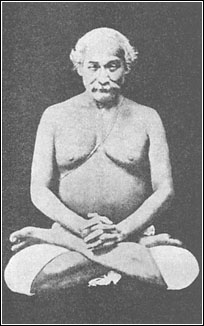
The great guru encouraged his various students to adhere to the good traditional discipline of their own faith. Stressing the all-inclusive nature of Kriya as a practical technique of liberation, Lahiri Mahasaya then gave his chelas liberty to express their lives in conformance with environment and up bringing.
The great guru encouraged his students to follow the good traditional practices of their own faiths. Lahiri Mahasaya emphasized that Kriya was a practical technique for liberation open to all. He then gave his disciples freedom to live in ways that reflected their surroundings and upbringing.
“A Moslem should perform his namaj [^35] worship four times daily,” the master pointed out. “Four times daily a Hindu should sit in meditation. A Christian should go down on his knees four times daily, praying to God and then reading the Bible.”
“A Muslim should perform his namaj [^35] prayers four times a day,” the master explained. “A Hindu should sit in meditation four times a day. A Christian should kneel four times a day, praying to God and then reading the Bible.”
With wise discernment the guru guided his followers into the paths of Bhakti (devotion), Karma (action), Jnana (wisdom), or Raja (royal or complete) Yogas, according to each man’s natural tendencies. The master, who was slow to give his permission to devotees wishing to enter the formal path of monkhood, always cautioned them to first reflect well on the austerities of the monastic life.
With wise judgment, the guru guided his followers toward different paths of yoga, based on each man’s natural tendencies. These were Bhakti (devotion), Karma (action), Jnana (wisdom), or Raja (royal or complete) Yogas. The master was slow to grant permission to devotees who wanted to formally become monks. He always warned them to first think carefully about the hardships and strict discipline of monastic life.
The great guru taught his disciples to avoid theoretical discussion of the scriptures. “He only is wise who devotes himself to realizing, not reading only, the ancient revelations,” he said. “Solve all your problems through meditation. [^35] Exchange unprofitable religious speculations for actual God-contact. Clear your mind of dogmatic theological debris; let in the fresh, healing waters of direct perception. Attune yourself to the active inner Guidance; the Divine Voice has the answer to every dilemma of life. Though man’s ingenuity for getting himself into trouble appears to be endless, the Infinite Succor is no less resourceful.”
The great guru taught his disciples to avoid purely theoretical discussions of the scriptures. “Only those who devote themselves to experiencing the ancient revelations, not just reading them, are wise,” he said. “Solve all your problems through meditation. [^35] Replace fruitless religious speculation with actual contact with God. Clear your mind of rigid theological clutter. Let in the fresh, healing waters of direct perception. Tune in to the active inner Guidance. The Divine Voice has the answer to every dilemma in life. Though human creativity in getting into trouble seems endless, the Infinite’s help is no less resourceful.”
The master’s omnipresence was demonstrated one day before a group of disciples who were listening to his exposition of the Bhagavad Gita. As he was explaining the meaning of Kutastha Chaitanya or the Christ Consciousness in all vibratory creation, Lahiri Mahasaya suddenly gasped and cried out:
One day, the master demonstrated his omnipresence to a group of disciples listening to his explanation of the Bhagavad Gita. He was explaining Kutastha Chaitanya, or the Christ Consciousness in all vibratory creation. As he explained, Lahiri Mahasaya suddenly gasped and cried out:
“I am drowning in the bodies of many souls off the coast of Japan!”
“I am drowning in the bodies of many souls off the coast of Japan!”
The next morning the chelas read a newspaper account of the death of many people whose ship had foundered the preceding day near Japan.
The next morning, the disciples read a newspaper report about many people who had died. Their ship had sunk near Japan the day before.
The distant disciples of Lahiri Mahasaya were often made aware of his enfolding presence. “I am ever with those who practice Kriya,” he said consolingly to chelas who could not remain near him. “I will guide you to the Cosmic Home through your enlarging perceptions.”
Lahiri Mahasaya’s disciples who lived far away often sensed his presence surrounding them. “I am always with those who practice Kriya,” he said to comfort disciples who could not stay near him. “I will guide you to the Cosmic Home as your perceptions expand.”
Swami Satyananda was told by a devotee that, unable to go to Benares, the man had nevertheless received precise Kriya initiation in a dream. Lahiri Mahasaya had appeared to instruct the chela in answer to his prayers.
A devotee told Swami Satyananda that, although he could not go to Benares, he had received precise Kriya initiation in a dream. Lahiri Mahasaya had appeared in answer to the devotee’s prayers to instruct him as a disciple.
If a disciple neglected any of his worldly obligations, the master would gently correct and discipline him.
If a disciple neglected any everyday duties, the master would gently correct and discipline him.
“Lahiri Mahasaya’s words were mild and healing, even when he was forced to speak openly of a chela’s faults,” Sri Yukteswar once told me. He added ruefully, “No disciple ever fled from our master’s barbs.” I could not help laughing, but I truthfully assured Sri Yukteswar that, sharp or not, his every word was music to my ears.
“Lahiri Mahasaya’s words were gentle and healing,” Sri Yukteswar once told me, “even when he had to address a disciple’s faults openly.” He added with regret, “No disciple ever ran away from our master’s sharp words.” I couldn’t help laughing, but I sincerely assured Sri Yukteswar that every word he spoke was music to my ears, sharp or not.
Lahiri Mahasaya carefully graded Kriya into four progressive initiations. [^35] He bestowed the three higher techniques only after the devotee had manifested definite spiritual progress. One day a certain chela, convinced that his worth was not being duly evaluated, gave voice to his discontent.
Lahiri Mahasaya carefully organized Kriya into four successive levels of initiation. [^35] He taught the three higher techniques only after the devotee had shown clear spiritual progress. One day, a chela (disciple) spoke up about his dissatisfaction, convinced that his worth was not being properly recognized.
“Master,” he said, “surely I am ready now for the second initiation.”
“Master,” he said, “surely I’m ready now for the second initiation.”
At this moment the door opened to admit a humble disciple, Brinda Bhagat. He was a Benares postman.
Just then, the door opened, and a humble disciple, Brinda Bhagat, came in. He was a postman in Benares.
“Brinda, sit by me here.” The great guru smiled at him affectionately. “Tell me, are you ready for the second technique of Kriya?”
“Brinda, sit here beside me.” The great guru smiled at him affectionately. “Tell me, are you ready for the second technique of Kriya?”
The little postman folded his hands in supplication. “Gurudeva,” he said in alarm, “no more initiations, please! How can I assimilate any higher teachings? I have come today to ask your blessings, because the first divine Kriya has filled me with such intoxication that I cannot deliver my letters!”
The little postman pressed his hands together in a pleading gesture. “Gurudeva,” he said in alarm, “no more initiations, please! How can I take in any higher teachings? I’ve come today to ask for your blessings. The first divine Kriya has filled me with such spiritual intoxication that I can’t deliver my letters!”
“Already Brinda swims in the sea of Spirit.” At these words from Lahiri Mahasaya, his other disciple hung his head.
“Brinda already swims in the sea of Spirit.” When Lahiri Mahasaya said this, his other disciple lowered his head.
“Master,” he said, “I see I have been a poor workman, finding fault with my tools.”
“Master,” he said, “I see I have been a poor worker, blaming my tools.”
The postman, who was an uneducated man, later developed his insight through Kriya to such an extent that scholars occasionally sought his interpretation on involved scriptural points. Innocent alike of sin and syntax, little Brinda won renown in the domain of learned pundits.
The postman was uneducated, but later developed such deep insight through Kriya that scholars occasionally sought his explanations of complex scriptural passages. As unfamiliar with sin as with grammar, little Brinda became renowned among learned pundits.
Besides the numerous Benares disciples of Lahiri Mahasaya, hundreds came to him from distant parts of India. He himself traveled to Bengal on several occasions, visiting at the homes of the fathers-in-law of his two sons. Thus blessed by his presence, Bengal became honeycombed with small Kriya groups. Particularly in the districts of Krishnagar and Bishnupur, many silent devotees to this day have kept the invisible current of spiritual meditation flowing.
Besides Lahiri Mahasaya’s many disciples in Benares, hundreds came to him from distant parts of India. He also traveled to Bengal several times, visiting the homes of his two sons’ fathers-in-law. Blessed by his presence, Bengal became filled with small Kriya groups. Especially in the districts of Krishnagar and Bishnupur, many quiet devotees have kept the invisible current of spiritual meditation flowing to this day.
Among many saints who received Kriya from Lahiri Mahasaya may be mentioned the illustrious Swami Vhaskarananda Saraswati of Benares, and the Deogarh ascetic of high stature, Balananda Brahmachari. For a time Lahiri Mahasaya served as private tutor to the son of Maharaja Iswari Narayan Sinha Bahadur of Benares. Recognizing the master’s spiritual attainment, the maharaja, as well as his son, sought Kriya initiation, as did the Maharaja Jotindra Mohan Thakur.
Many saints received Kriya from Lahiri Mahasaya, including the distinguished Swami Vhaskarananda Saraswati of Benares. Another was Balananda Brahmachari, an ascetic of great stature from Deogarh. For a time, Lahiri Mahasaya worked as a private tutor to the son of Maharaja Iswari Narayan Sinha Bahadur of Benares. Recognizing the master’s spiritual attainment, both the maharaja and his son sought Kriya initiation. Maharaja Jotindra Mohan Thakur also sought initiation.
A number of Lahiri Mahasaya’s disciples with influential worldly position were desirous of expanding the Kriya circle by publicity. The guru refused his permission. One chela, the royal physician to the Lord of Benares, started an organized effort to spread the master’s name as “Kashi Baba” (Exalted One of Benares). [^35] Again the guru forbade it.
Several of Lahiri Mahasaya’s disciples held influential worldly positions and wanted to expand the Kriya circle through publicity. The guru refused to give permission. One disciple was the royal physician to the Lord of Benares. He began an organized effort to promote the master’s name as “Kashi Baba” (Exalted One of Benares). [^35] Again the guru forbade the effort.
“Let the fragrance of the Kriya flower be wafted naturally, without any display,” he said. “Its seeds will take root in the soil of spiritually fertile hearts.”
“Let the fragrance of the Kriya flower spread naturally, without any show,” he said. “Its seeds will take root in the soil of spiritually fertile hearts.”
Although the great master did not adopt the system of preaching through the modern medium of an organization, or through the printing press, he knew that the power of his message would rise like a resistless flood, inundating by its own force the banks of human minds. The changed and purified lives of devotees were the simple guarantees of the deathless vitality of Kriya.
The great master did not preach through modern organizations or the printing press. Yet he knew his message would rise like an unstoppable flood, overflowing the banks of human minds by its own power. The transformed and purified lives of devotees were simple guarantees of the undying power of Kriya.
In 1886, twenty-five years after his Ranikhet initiation, Lahiri Mahasaya was retired on a pension. [^35] With his availability in the daytime, disciples sought him out in ever-increasing numbers. The great guru now sat in silence most of the time, locked in the tranquil lotus posture. He seldom left his little parlor, even for a walk or to visit other parts of the house. A quiet stream of chelas arrived, almost ceaselessly, for a darshan (holy sight) of the guru.
In 1886, twenty-five years after his initiation at Ranikhet, Lahiri Mahasaya retired with a pension. [^35] Now that he was available during the day, disciples came to him in ever-increasing numbers. The great guru now spent most of his time sitting silently and peacefully in the lotus posture. He rarely left his small sitting room, even to take a walk or visit other parts of the house. A quiet stream of chelas, or disciples, arrived almost without pause for a darshan (holy sight) of the guru.
To the awe of all beholders, Lahiri Mahasaya’s habitual physiological state exhibited the superhuman features of breathlessness, sleeplessness, cessation of pulse and heartbeat, calm eyes unblinking for hours, and a profound aura of peace. No visitors departed without upliftment of spirit; all knew they had received the silent blessing of a true man of God.
To the awe of all who saw him, Lahiri Mahasaya’s usual physical state showed superhuman qualities. He did not breathe or sleep, and his pulse and heartbeat stopped. His calm eyes remained unblinking for hours, and he radiated a deep peace. No visitor left without feeling uplifted in spirit. All knew they had received the silent blessing of a true man of God.
The master now permitted his disciple, Panchanon Bhattacharya, to open an “Arya Mission Institution” in Calcutta. Here the saintly disciple spread the message of Kriya Yoga, and prepared for public benefit certain yogic herbal [^35] medicines.
The master now allowed his disciple, Panchanon Bhattacharya, to open an “Arya Mission Institution” in Calcutta. There, the saintly disciple spread the message of Kriya Yoga. He also prepared certain yogic herbal [^35] medicines for the public’s benefit.
In accordance with ancient custom, the master gave to people in general a neem [^35] oil for the cure of various diseases. When the guru requested a disciple to distil the oil, he could easily accomplish the task. If anyone else tried, he would encounter strange difficulties, finding that the medicinal oil had almost evaporated after going through the required distilling processes. Evidently the master’s blessing was a necessary ingredient.
Following ancient custom, the master gave people neem [^35] oil to cure various diseases. When the guru asked a disciple to distill the oil, the disciple could easily do so. If anyone else tried, they would run into strange difficulties. They would find that the medicinal oil had almost evaporated after the required distillation steps. Evidently, the master’s blessing was a necessary ingredient.
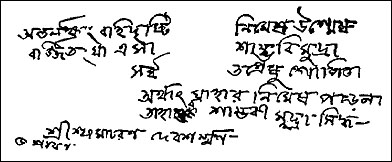
Lahiri Mahasaya’s handwriting and signature, in Bengali script, are shown above. The lines occur in a letter to a chela; the great master interprets a Sanskrit verse as follows: “He who has attained a state of calmness wherein his eyelids do not blink, has achieved Sambhabi Mudra.” (signed) “Sri Shyama Charan Deva Sharman”
Lahiri Mahasaya’s handwriting and signature in Bengali script are shown above. These lines come from a letter to a chela (disciple). The great master explains a Sanskrit verse as follows: “Someone who has reached a state of calm in which his eyelids do not blink has achieved Sambhabi Mudra.” (signed) “Sri Shyama Charan Deva Sharman”
The Arya Mission Institution undertook the publication of many of the guru’s scriptural commentaries. Like Jesus and other great prophets, Lahiri Mahasaya himself wrote no books, but his penetrating interpretations were recorded and arranged by various disciples. Some of these voluntary amanuenses were more discerning than others in correctly conveying the profound insight of the guru; yet, on the whole, their efforts were successful. Through their zeal, the world possesses unparalleled commentaries by Lahiri Mahasaya on twenty-six ancient scriptures.
The Arya Mission Institution took on the publication of many of the guru’s commentaries on scripture. Like Jesus and other great prophets, Lahiri Mahasaya himself wrote no books. But various disciples recorded and organized his deeply insightful interpretations. Some of these volunteer scribes were better than others at accurately conveying the guru’s profound insights. Yet overall, their efforts were successful. Thanks to their dedication, the world has Lahiri Mahasaya’s unmatched commentaries on twenty-six ancient scriptures.
Sri Ananda Mohan Lahiri, a grandson of the master, has written an interesting booklet on Kriya. “The text of the Bhagavad Gita is a part of the great epic, the Mahabharata, which possesses several knot- points (vyas-kutas),” Sri Ananda wrote. “Keep those knot-points unquestioned, and we find nothing but mythical stories of a peculiar and easily-misunderstood type. Keep those knot-points unexplained, and we have lost a science which the East has preserved with superhuman patience after a quest of thousands of years of experiment. [^35] It was the commentaries of Lahiri Mahasaya which brought to light, clear of allegories, the very science of religion that had been so cleverly put out of sight in the riddle of scriptural letters and imagery. No longer a mere unintelligible jugglery of words, the otherwise unmeaning formulas of Vedic worship have been proved by the master to be full of scientific significance. . . .
Sri Ananda Mohan Lahiri, a grandson of the master, has written an interesting booklet on Kriya. “The Bhagavad Gita is part of the great epic, the Mahabharata, which contains several puzzling passages called knot-points (vyas-kutas),” Sri Ananda wrote. “If we leave those knot-points unquestioned, we find only unusual mythical stories that are easily misunderstood. If we leave those knot-points unexplained, we lose a science that the East has preserved with superhuman patience. That science emerged from a quest involving thousands of years of experimentation. [^35] Lahiri Mahasaya’s commentaries revealed, free of allegory, the very science of religion. That science had been cleverly hidden in the riddles of scriptural language and imagery. The master proved that the otherwise meaningless formulas of Vedic worship were full of scientific significance. They were no longer merely an incomprehensible play on words. . . .
“We know that man is usually helpless against the insurgent sway of evil passions, but these are rendered powerless and man finds no motive in their indulgence when there dawns on him a consciousness of superior and lasting bliss through Kriya. Here the give-up, the negation of the lower passions, synchronizes with a take-up, the assertion of a beatitude. Without such a course, hundreds of moral maxims which run in mere negatives are useless to us.
“We know that people are usually helpless against the overwhelming force of evil passions. But these passions lose their power when people become aware of a higher, lasting bliss through Kriya. Then people find no reason to indulge those passions. Here, giving up lower passions goes hand in hand with embracing bliss. Without this approach, hundreds of moral rules that merely tell us what not to do are useless to us.
“Our eagerness for worldly activity kills in us the sense of spiritual awe. We cannot comprehend the Great Life behind all names and forms, just because science brings home to us how we can use the powers of nature; this familiarity has bred a contempt for her ultimate secrets. Our relation with nature is one of practical business. We tease her, so to speak, to know how she can be used to serve our purposes; we make use of her energies, whose Source yet remains unknown. In science our relation with nature is one that exists between a man and his servant, or in a philosophical sense she is like a captive in the witness box. We cross-examine her, challenge her, and minutely weigh her evidence in human scales which cannot measure her hidden values. On the other hand, when the self is in communion with a higher power, nature automatically obeys, without stress or strain, the will of man. This effortless command over nature is called ‘miraculous’ by the uncomprehending materialist.
“Our eagerness for worldly activity kills our sense of spiritual awe. We cannot understand the Great Life behind all names and forms because science shows us how to use nature’s powers. This familiarity has made us look down on her deepest secrets. Our relationship with nature is one of practical business. We pester her, so to speak, to discover how she can serve our purposes. We use her energies, yet their Source remains unknown. In science, we treat nature as a man treats his servant. Or, in a philosophical sense, she is like a prisoner in the witness box. We cross-examine her, challenge her, and carefully weigh her evidence on human scales that cannot measure her hidden worth. On the other hand, when the self is in communion with a higher power, nature automatically obeys the human will. Nature obeys without stress or strain. The materialist who does not understand calls this effortless command over nature ‘miraculous.’
“The life of Lahiri Mahasaya set an example which changed the erroneous notion that yoga is a mysterious practice. Every man may find a way through Kriya to understand his proper relation with nature, and to feel spiritual reverence for all phenomena, whether mystical or of everyday occurrence, in spite of the matter-of-factness of physical science. [^35] We must bear in mind that what was mystical a thousand years ago is no longer so, and what is mysterious now may become lawfully intelligible a hundred years hence. It is the Infinite, the Ocean of Power, that is at the back of all manifestations.
“The life of Lahiri Mahasaya set an example that changed the mistaken idea that yoga is a mysterious practice. Through Kriya, every person may find a way to understand their proper relationship with nature. They may also feel spiritual reverence for all phenomena, whether mystical or ordinary, despite physical science’s matter-of-fact approach. [^35] We must remember that what was mystical a thousand years ago is no longer mystical. And what is mysterious now may become understandable through natural laws a hundred years from now. The Infinite, the Ocean of Power, is behind all manifestations.
“The law of Kriya Yoga is eternal. It is true like mathematics; like the simple rules of addition and subtraction, the law of Kriya can never be destroyed. Burn to ashes all the books on mathematics, the logically-minded will always rediscover such truths; destroy all the sacred books on yoga, its fundamental laws will come out whenever there appears a true yogi who comprises within himself pure devotion and consequently pure knowledge.”
“The law of Kriya Yoga is eternal. It is as true as mathematics. Like the simple rules of addition and subtraction, the law of Kriya can never be destroyed. Even if all books on mathematics are burned to ashes, logical thinkers will always rediscover these truths. Even if all sacred books on yoga are destroyed, yoga’s fundamental laws will reappear whenever a true yogi appears. Such a yogi has pure devotion and, as a result, pure knowledge.”
Just as Babaji is among the greatest of avatars, a Mahavatar, and Sri Yukteswar a Jnanavatar or Incarnation of Wisdom, so Lahiri Mahasaya may justly be called Yogavatar, or Incarnation of Yoga. By the standards of both qualitative and quantitative good, he elevated the spiritual level of society. In his power to raise his close disciples to Christlike stature and in his wide dissemination of truth among the masses, Lahiri Mahasaya ranks among the saviors of mankind.
Babaji is among the greatest avatars, a Mahavatar. Sri Yukteswar is a Jnanavatar or Incarnation of Wisdom. Just as these titles suit them, Lahiri Mahasaya may rightly be called Yogavatar, or Incarnation of Yoga. He raised society’s spiritual level through both the quality and the extent of the good he did. He had the power to raise his close disciples to Christlike stature and spread truth widely among the masses. For both achievements, Lahiri Mahasaya ranks among the saviors of humanity.
His uniqueness as a prophet lies in his practical stress on a definite method, Kriya, opening for the first time the doors of yoga freedom to all men. Apart from the miracles of his own life, surely the Yogavatar reached the zenith of all wonders in reducing the ancient complexities of yoga to an effective simplicity not beyond the ordinary grasp.
What makes him unique as a prophet is his practical emphasis on a specific method, Kriya. For the first time, this method opened the doors to the freedom of yoga to all people. Beyond the miracles of his own life, surely the Yogavatar achieved the greatest wonder of all. He simplified yoga’s ancient complexities into an effective practice that ordinary people could understand.
In reference to miracles, Lahiri Mahasaya often said, “The operation of subtle laws which are unknown to people in general should not be publicly discussed or published without due discrimination.” If in these pages I have appeared to flout his cautionary words, it is because he has given me an inward reassurance. Also, in recording the lives of Babaji, Lahiri Mahasaya, and Sri Yukteswar, I have thought it advisable to omit many true miraculous stories, which could hardly have been included without writing, also, an explanatory volume of abstruse philosophy.
Speaking of miracles, Lahiri Mahasaya often said, “Subtle laws unknown to most people should not be publicly discussed or published without careful judgment.” If I seem to have ignored his warning in these pages, it is because he has reassured me inwardly. Also, in recording the lives of Babaji, Lahiri Mahasaya, and Sri Yukteswar, I thought it best to leave out many true stories of miracles. I could hardly have included those stories without also writing a volume of difficult philosophy to explain them.
New hope for new men! “Divine union,” the Yogavatar proclaimed, “is possible through self-effort, and is not dependent on theological beliefs or on the arbitrary will of a Cosmic Dictator.”
New hope for new people! “Divine union,” the Yogavatar declared, “is possible through your own efforts. It does not depend on theological beliefs or the arbitrary will of a Cosmic Dictator.”
Through use of the Kriya key, persons who cannot bring themselves to believe in the divinity of any man will behold at last the full divinity of their own selves.
By using the Kriya key, people who cannot bring themselves to believe any man is divine will finally see their own full divinity.
35-1: Matthew 3:15.
35-1: Matthew 3:15.
35-2: Many Biblical passages reveal that the law of reincarnation was understood and accepted. Reincarnational cycles are a more reasonable explanation for the different states of evolution in which mankind is found, than the common Western theory which assumes that something (consciousness of egoity) came out of nothing, existed with varying degrees of lustihood for thirty or ninety years, and then returned to the original void. The inconceivable nature of such a void is a problem to delight the heart of a medieval Schoolman.
35-2: Many Biblical passages show that the law of reincarnation was understood and accepted. Cycles of reincarnation explain humanity’s different stages of development more reasonably than the common Western theory does. That theory assumes that something (awareness of oneself) came from nothing. This awareness existed with varying degrees of vitality for thirty or ninety years, then returned to the original void. The very idea of such a void defies understanding, a problem that would delight a medieval Scholastic philosopher.
35-3: Malachi 4:5.
35-3: Malachi 4:5.
35-4: “Before him,” i.e., “before the Lord.”
35-4: “Before him” means “before the Lord.”
35-5: Luke 1:13-17.
35-5: Luke 1:13-17.
35-6: Matthew 17:12-13.
35-6: Matthew 17:12-13.
35-7: Matthew 11:13-14.
35-7: Matthew 11:13-14.
35-8: John 1:21.
35-8: John 1:21.
35-9: II Kings 2:9-14.
35-9: 2 Kings 2:9-14.
35-10: Matthew 17:3.
35-10: Matthew 17:3.
35-11: Matthew 27:46-49.
35-11: Matthew 27:46-49.
35-12: “How many sorts of death are in our bodies! Nothing is therein but death.”-Martin Luther, in “Table-Talk.”
35-12: “How many kinds of death are in our bodies! There is nothing in our bodies but death.”Martin Luther, in “Table-Talk.”
35-13: The chief prayer of the Mohammedans, usually repeated four or five times daily.
35-13: The main prayer of Muslims, usually repeated four or five times a day.
35-14: “Seek truth in meditation, not in moldy books. Look in the sky to find the moon, not in the pond.”-Persian Proverb.
35-14: “Seek truth through meditation, not in moldy books. Look for the moon in the sky, not in the pond.”-Persian Proverb.
35-15: As Kriya Yoga is capable of many subdivisions, Lahiri Mahasaya wisely sifted out four steps which he discerned to be those which contained the essential marrow, and which were of the highest value in actual practice.
35-15: Because Kriya Yoga can be divided into many parts, Lahiri Mahasaya wisely selected four steps. He recognized that these steps contained its essence and had the greatest value in actual practice.
35-16: Other titles bestowed on Lahiri Mahasaya by his disciples were Yogibar (greatest of yogis), Yogiraj (king of yogis), and Munibar (greatest of saints), to which I have added Yogavatar (incarnation of yoga).
35-16: Lahiri Mahasaya’s disciples also gave him the titles Yogibar (greatest of yogis), Yogiraj (king of yogis), and Munibar (greatest of saints). To these titles I have added Yogavatar (incarnation of yoga).
35-17: He had given, altogether, thirty-five years of service in one department of the government.
35-17: He had served in one government department for a total of thirty-five years.
35-18: Vast herbal knowledge is found in ancient Sanskrit treatises. Himalayan herbs were employed in a rejuvenation treatment which aroused the attention of the world in 1938 when the method was used on Pundit Madan Mohan Malaviya, 77-year-old Vice-Chancellor of Benares Hindu University. To a remarkable extent, the noted scholar regained in 45 days his health, strength, memory, normal eyesight; indications of a third set of teeth appeared, while all wrinkles vanished. The herbal treatment, known as Kaya Kalpa, is one of 80 rejuvenation methods outlined in Hindu Ayurveda or medical science. Pundit Malaviya underwent the treatment at the hands of Sri Kalpacharya Swami Beshundasji, who claims 1766 as his birth year. He possesses documents proving him to be more than 100 years old; Associated Press reporters remarked that he looked about 40.
35-18: Ancient Sanskrit texts contain extensive knowledge of herbs. Himalayan herbs were used in a rejuvenation treatment that drew worldwide attention in 1938. The treatment was given to Pundit Madan Mohan Malaviya, the 77-year-old Vice-Chancellor of Benares Hindu University. In 45 days, the noted scholar remarkably regained his health, strength, memory, and normal eyesight. Signs of a third set of teeth appeared, while all his wrinkles vanished. The herbal treatment, known as Kaya Kalpa, is one of 80 rejuvenation methods described in Hindu Ayurveda, or medical science. Pundit Malaviya received the treatment from Sri Kalpacharya Swami Beshundasji, who claims he was born in 1766. Swami Beshundasji has documents proving he is more than 100 years old. Associated Press reporters remarked that he looked about 40.
Ancient Hindu treatises divided medical science into 8 branches: salya (surgery); salakya (diseases above the neck); kayachikitsa (medicine proper); bhutavidya (mental diseases); kaumara (care of infancy); agada (toxicology); Rasayana (longevity); Vagikarana (tonics). Vedic physicians used delicate surgical instruments, employed plastic surgery, understood medical methods to counteract the effects of poison gas, performed Caesarean sections and brain operations, were skilled in dynamization of drugs. Hippocrates, famous physician of the 5th century B.C., borrowed much of his materia medica from Hindu sources.
Ancient Hindu medical texts divided medicine into 8 branches: salya (surgery), salakya (diseases above the neck), kayachikitsa (general medicine), bhutavidya (mental illness), kaumara (infant care), agada (toxicology), Rasayana (longevity), and Vagikarana (tonics). Vedic physicians used delicate surgical instruments and performed plastic surgery. They knew how to counteract the effects of poison gas. They performed Caesarean sections and brain operations and were skilled at dynamization, a method of preparing drugs. Hippocrates, a famous physician of the 5th century B.C., drew much of his knowledge of medicinal substances from Hindu sources.
35-19: The East Indian margosa tree. Its medicinal values have now become recognized in the West, where the bitter neem bark is used as a tonic, and the oil from seeds and fruit has been found of utmost worth in the treatment of leprosy and other diseases.
35-19: The East Indian margosa tree. Its medicinal benefits are now recognized in the West, where the bitter neem bark is used as a tonic. Oil from its seeds and fruit has proved extremely valuable in treating leprosy and other diseases.
35-20: “A number of seals recently excavated from archaeological sites of the Indus valley, datable in the third millennium B.C., show figures seated in meditative postures now used in the system of Yoga, and warrant the inference that even at that time some of the rudiments of Yoga were already known. We may not unreasonably draw the conclusion that systematic introspection with the aid of studied methods has been practiced in India for five thousand years. . . . India has developed certain valuable religious attitudes of mind and ethical notions which are unique, at least in the wideness of their application to life. One of these has been a tolerance in questions of intellectual belief-doctrine-that is amazing to the West, where for many centuries heresy-hunting was common, and bloody wars between nations over sectarian rivalries were frequent.”-Extracts from an article by Professor W. Norman Brown in the May, 1939 issue of the Bulletin of the American Council of Learned Societies, Washington, D.C.
35-20: “Several seals recently excavated at archaeological sites in the Indus valley date to the third millennium B.C. They show figures sitting in meditation postures now used in Yoga. These figures support the conclusion that some basic elements of Yoga were already known even then. We may reasonably conclude that systematic self-examination, using carefully developed methods, has been practiced in India for five thousand years. . . . India has developed certain valuable religious attitudes and ethical ideas that are unique, at least in their widespread application to life. One is a tolerance of differing beliefs and doctrines that amazes the West. In the West, hunting down heretics was common for many centuries, and nations frequently fought bloody wars over religious rivalries.” Extracts from an article by Professor W. Norman Brown in the May, 1939 issue of the Bulletin of the American Council of Learned Societies, Washington, D.C.
35-21: One thinks here of Carlyle’s observation in Sartor Resartus: “The man who cannot wonder, who does not habitually wonder (and worship), were he president of innumerable Royal Societies and carried . . . the epitome of all laboratories and observatories, with their results, in his single head,-is but a pair of spectacles behind which there is no eye.”
35-21: This brings to mind Carlyle’s observation in Sartor Resartus: “Consider a man who cannot feel wonder, who does not regularly wonder (and worship). Even if he presided over countless Royal Societies, he would still be only a pair of glasses with no eye behind them. The same would be true even if his mind held . . . a summary of all laboratories and observatories and their results.”