Chapter 33
Babaji, Modern India’s Yogi-Christ
The northern Himalayan crags near Badrinarayan are still blessed by the living presence of Babaji, guru of Lahiri Mahasaya. The secluded master has retained his physical form for centuries, perhaps for millenniums. The deathless Babaji is an avatara. This Sanskrit word means “descent”; its roots are ava, “down,” and tri, “to pass.” In the Hindu scriptures, avatara signifies the descent of Divinity into flesh.
The rocky northern Himalayan peaks near Badrinarayan are still blessed by the living presence of Babaji, Lahiri Mahasaya’s guru. The secluded master has kept his physical form for centuries, perhaps for thousands of years. The immortal Babaji is an avatara. This Sanskrit word means “descent.” Its roots are ava, “down,” and tri, “to pass.” In the Hindu scriptures, avatara means the descent of Divinity into human form.
“Babaji’s spiritual state is beyond human comprehension,” Sri Yukteswar explained to me. “The dwarfed vision of men cannot pierce to his transcendental star. One attempts in vain even to picture the avatar’s attainment. It is inconceivable.”
“Babaji’s spiritual state is beyond human understanding,” Sri Yukteswar explained to me. “Our limited vision cannot reach his transcendent star. We cannot even begin to imagine what the avatar has attained. His attainment is beyond comprehension.”
The Upanishads have minutely classified every stage of spiritual advancement. A siddha (“perfected being”) has progressed from the state of a jivanmukta (“freed while living”) to that of a paramukta (“supremely free”-full power over death); the latter has completely escaped from the mayic thralldom and its reincarnational round. The paramukta therefore seldom returns to a physical body; if he does, he is an avatar, a divinely appointed medium of supernal blessings on the world.
The Upanishads have classified every stage of spiritual advancement in detail. A siddha (“perfected being”) has advanced from the state of a jivanmukta (“freed while living”) to a paramukta (“supremely free”). A paramukta has full power over death and has completely escaped bondage to maya and its cycle of reincarnation. The paramukta therefore rarely returns to a physical body. If he does, he is an avatar, divinely appointed to bring heavenly blessings to the world.
An avatar is unsubject to the universal economy; his pure body, visible as a light image, is free from any debt to nature. The casual gaze may see nothing extraordinary in an avatar’s form but it casts no shadow nor makes any footprint on the ground. These are outward symbolic proofs of an inward lack of darkness and material bondage. Such a God-man alone knows the Truth behind the relativities of life and death. Omar Khayyam, so grossly misunderstood, sang of this liberated man in his immortal scripture, the Rubaiyat:
An avatar is not bound by the laws governing the universe. His pure body, visible as an image of light, owes no debt to nature. To a casual observer, an avatar’s form may look ordinary. But his form casts no shadow and leaves no footprints on the ground. These outward signs symbolically prove his inner freedom from darkness and bondage to matter. Only such a God-man knows the Truth beyond the relative realities of life and death. Omar Khayyam has been deeply misunderstood. He sang of this liberated man in his immortal scripture, the Rubaiyat:
“Ah, Moon of my Delight who know’st no wane, The Moon of Heav’n is rising once again; How oft hereafter rising shall she look Through this same Garden after me-in vain!”
“Ah, Moon of my Delight, you never fade. The Moon of Heaven is rising once again. How often will she rise hereafter and search this same Garden for me in vain!”
The “Moon of Delight” is God, eternal Polaris, anachronous never. The “Moon of Heav’n” is the outward cosmos, fettered to the law of periodic recurrence. Its chains had been dissolved forever by the Persian seer through his self-realization. “How oft hereafter rising shall she look . . . after me-in vain!” What frustration of search by a frantic universe for an absolute omission!
The “Moon of Delight” is God, the eternal Polaris, never bound by time. The “Moon of Heav’n” is the outer cosmos, bound by the law of recurring cycles. Through self-realization, the Persian seer had broken those chains forever. “How often she will rise in the future and look . . . for me, in vain!” How frustrating for a frantic universe to search for someone who is utterly absent!
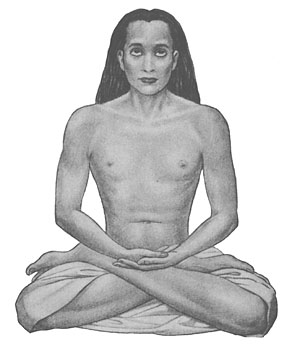
I have helped an artist to draw a true likeness of the great Yogi-Christ of modern India.
I have helped an artist draw an accurate portrait of the great Yogi-Christ of modern India.
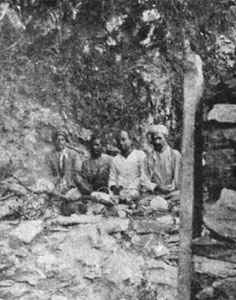
One of the caves occupied by Babaji in the Drongiri Mountains near Ranikhet in the Himalayas. A grandson of Lahiri Mahasaya, Ananda Mohan Lahiri (second from right, in white), and three other devotees are visiting the sacred spot.
One of the caves where Babaji stayed in the Drongiri Mountains near Ranikhet in the Himalayas. Ananda Mohan Lahiri, a grandson of Lahiri Mahasaya, is visiting the sacred site with three other devotees. He is second from the right, dressed in white.
Christ expressed his freedom in another way: “And a certain scribe came, and said unto him, Master, I will follow thee whithersoever thou goest. And Jesus saith unto him, The foxes have holes, and the birds of the air have nests; but the Son of man hath not where to lay his head.” [^33]
Christ expressed his freedom in another way: “A scribe came to him and said, Master, I will follow you wherever you go. Jesus said to him, Foxes have dens, and birds have nests. But the Son of man has nowhere to lay his head.” [^33]
Spacious with omnipresence, could Christ indeed be followed except in the overarching Spirit?
Christ was present everywhere. Could he truly be followed except in the all-encompassing Spirit?
Krishna, Rama, Buddha, and Patanjali were among the ancient Indian avatars. A considerable poetic literature in Tamil has grown up around Agastya, a South Indian avatar. He worked many miracles during the centuries preceding and following the Christian era, and is credited with retaining his physical form even to this day.
Krishna, Rama, Buddha, and Patanjali were among the ancient Indian avatars. A large body of Tamil poetry has developed around Agastya, a South Indian avatar. He performed many miracles during the centuries before and after the start of the Christian era. He is said to have kept his physical form even to this day.
Babaji’s mission in India has been to assist prophets in carrying out their special dispensations. He thus qualifies for the scriptural classification of Mahavatar (Great Avatar). He has stated that he gave yoga initiation to Shankara, ancient founder of the Swami Order, and to Kabir, famous medieval saint. His chief nineteenth-century disciple was, as we know, Lahiri Mahasaya, revivalist of the lost Kriya art.
Babaji’s mission in India has been to help prophets carry out their special spiritual missions. He therefore qualifies for the scriptural title of Mahavatar (Great Avatar). He has said that he initiated Shankara, the ancient founder of the Swami Order, into yoga. He also said he initiated Kabir, the famous medieval saint. As we know, his chief nineteenth-century disciple was Lahiri Mahasaya, who revived the lost art of Kriya.
The Mahavatar is in constant communion with Christ; together they send out vibrations of redemption, and have planned the spiritual technique of salvation for this age. The work of these two fully-illumined masters-one with the body, and one without it-is to inspire the nations to forsake suicidal wars, race hatreds, religious sectarianism, and the boomerang-evils of materialism. Babaji is well aware of the trend of modern times, especially of the influence and complexities of Western civilization, and realizes the necessity of spreading the self-liberations of yoga equally in the West and in the East.
The Mahavatar is in constant communion with Christ. Together they send out vibrations of redemption and have planned the spiritual methods of salvation for this age. These two fully enlightened masters, one with a body and one without, work to inspire the nations. They urge nations to abandon suicidal wars, racial hatred, religious divisions, and the evils of materialism that rebound on people. Babaji understands modern trends, especially the influence and complexities of Western civilization. He recognizes the need to spread yoga’s practices of self-liberation equally in the West and the East.
That there is no historical reference to Babaji need not surprise us. The great guru has never openly appeared in any century; the misinterpreting glare of publicity has no place in his millennial plans. Like the Creator, the sole but silent Power, Babaji works in a humble obscurity.
We need not be surprised that there is no historical record of Babaji. The great guru has never appeared publicly in any century. The distorting glare of publicity has no place in his plans, which span thousands of years. Like the Creator, the sole and silent Power, Babaji works humbly, out of public view.
Great prophets like Christ and Krishna come to earth for a specific and spectacular purpose; they depart as soon as it is accomplished. Other avatars, like Babaji, undertake work which is concerned more with the slow evolutionary progress of man during the centuries than with any one outstanding event of history. Such masters always veil themselves from the gross public gaze, and have the power to become invisible at will. For these reasons, and because they generally instruct their disciples to maintain silence about them, a number of towering spiritual figures remain world-unknown. I give in these pages on Babaji merely a hint of his life-only a few facts which he deems it fit and helpful to be publicly imparted.
Great prophets like Christ and Krishna come to earth for a specific and spectacular purpose. They leave as soon as that purpose is fulfilled. Other avatars, like Babaji, take on work focused more on humanity’s slow spiritual evolution over centuries. Their work is less concerned with any single major event in history. Such masters always keep themselves hidden from the public eye and can become invisible at will. For these reasons, and because these masters generally tell their disciples to remain silent about them, many great spiritual figures remain unknown to the world. In these pages about Babaji, I offer only a glimpse of his life. I share just a few facts that he considers suitable and helpful to make public.
No limiting facts about Babaji’s family or birthplace, dear to the annalist’s heart, have ever been discovered. His speech is generally in Hindi, but he converses easily in any language. He has adopted the simple name of Babaji (revered father); other titles of respect given him by Lahiri Mahasaya’s disciples are Mahamuni Babaji Maharaj (supreme ecstatic saint), Maha Yogi (greatest of yogis), Trambak Baba and Shiva Baba (titles of avatars of Shiva). Does it matter that we know not the patronymic of an earth-released master?
No facts about Babaji’s family or birthplace have ever been discovered, though historians cherish such defining details. He usually speaks Hindi, but he converses easily in any language. He has adopted the simple name Babaji (revered father). Lahiri Mahasaya’s disciples have given him other titles of respect. These include Mahamuni Babaji Maharaj (supreme ecstatic saint) and Maha Yogi (greatest of yogis). They also call him Trambak Baba and Shiva Baba (titles of avatars of Shiva). Does it matter that we do not know the family name of a master freed from earthly ties?
“Whenever anyone utters with reverence the name of Babaji,” Lahiri Mahasaya said, “that devotee attracts an instant spiritual blessing.”
“Whenever anyone says Babaji’s name with reverence,” Lahiri Mahasaya said, “that devotee immediately receives a spiritual blessing.”
The deathless guru bears no marks of age on his body; he appears to be no more than a youth of twenty-five. Fair-skinned, of medium build and height, Babaji’s beautiful, strong body radiates a perceptible glow. His eyes are dark, calm, and tender; his long, lustrous hair is copper-colored. A very strange fact is that Babaji bears an extraordinarily exact resemblance to his disciple Lahiri Mahasaya. The similarity is so striking that, in his later years, Lahiri Mahasaya might have passed as the father of the youthful-looking Babaji.
The immortal guru’s body shows no signs of age. He looks no older than twenty-five. Babaji has fair skin and is of medium build and height. His beautiful, strong body gives off a visible glow. His eyes are dark, calm, and tender. His long, shining hair is copper-colored. Strangely, Babaji looks almost exactly like his disciple Lahiri Mahasaya. The resemblance is so striking that, in his later years, Lahiri Mahasaya could have passed for the youthful-looking Babaji’s father.
Swami Kebalananda, my saintly Sanskrit tutor, spent some time with Babaji in the Himalayas.
My saintly Sanskrit tutor, Swami Kebalananda, spent some time with Babaji in the Himalayas.
“The peerless master moves with his group from place to place in the mountains,” Kebalananda told me. “His small band contains two highly advanced American disciples. After Babaji has been in one locality for some time, he says: ‘Dera danda uthao.’ (‘Let us lift our camp and staff.’) He carries a symbolic danda (bamboo staff). His words are the signal for moving with his group instantaneously to another place. He does not always employ this method of astral travel; sometimes he goes on foot from peak to peak.
“The unmatched master travels with his group from place to place in the mountains,” Kebalananda told me. “His small group includes two highly advanced American disciples. After Babaji has stayed in one place for some time, he says: ‘Dera danda uthao.’ (‘Let us lift our camp and staff.’) He carries a symbolic danda (bamboo staff). His words signal that he and his group are to move instantly to another place. He does not always use this method of astral travel. Sometimes he walks from peak to peak.
“Babaji can be seen or recognized by others only when he so desires. He is known to have appeared in many slightly different forms to various devotees-sometimes without beard and moustache, and sometimes with them. As his undecaying body requires no food, the master seldom eats. As a social courtesy to visiting disciples, he occasionally accepts fruits, or rice cooked in milk and clarified butter.
“Babaji can be seen or recognized by others only when he chooses. He is known to have appeared to different devotees in many slightly different forms. Sometimes he has a beard and moustache, and sometimes he does not. Because his body does not decay and needs no food, the master rarely eats. To be polite to visiting disciples, he occasionally accepts fruit or rice cooked in milk and clarified butter.
“Two amazing incidents of Babaji’s life are known to me,” Kebalananda went on. “His disciples were sitting one night around a huge fire which was blazing for a sacred Vedic ceremony. The master suddenly seized a burning log and lightly struck the bare shoulder of a chela who was close to the fire.
“I know of two amazing incidents in Babaji’s life,” Kebalananda continued. “One night, his disciples sat around a huge fire blazing for a sacred Vedic ceremony. The master suddenly grabbed a burning log. He lightly struck the bare shoulder of a chela, or disciple, who was close to the fire.
“‘Sir, how cruel!’ Lahiri Mahasaya, who was present, made this remonstrance.
“‘Sir, how cruel!’ Lahiri Mahasaya was present and voiced this protest.
“‘Would you rather have seen him burned to ashes before your eyes, according to the decree of his past karma?’
“‘Would you rather have watched him burn to ashes before your eyes, as his past karma required?’
“With these words Babaji placed his healing hand on the chela’s disfigured shoulder. ‘I have freed you tonight from painful death. The karmic law has been satisfied through your slight suffering by fire.’
“With these words, Babaji placed his healing hand on the disciple’s disfigured shoulder. ‘Tonight I have saved you from a painful death. Your slight suffering from the fire has satisfied the law of karma.’
“On another occasion Babaji’s sacred circle was disturbed by the arrival of a stranger. He had climbed with astonishing skill to the nearly inaccessible ledge near the camp of the master.
“On another occasion, a stranger’s arrival disturbed Babaji’s sacred circle. With astonishing skill, the stranger had climbed to the nearly unreachable ledge near the master’s camp.
“‘Sir, you must be the great Babaji.’ The man’s face was lit with inexpressible reverence. ‘For months I have pursued a ceaseless search for you among these forbidding crags. I implore you to accept me as a disciple.’
“‘Sir, you must be the great Babaji.’ The man’s face glowed with reverence beyond words. ‘For months I have searched endlessly for you among these harsh, rocky peaks. I beg you to accept me as a disciple.’
“When the great guru made no response, the man pointed to the rocky chasm at his feet.
“When the great guru did not respond, the man pointed to the rocky chasm at his feet.
“‘If you refuse me, I will jump from this mountain. Life has no further value if I cannot win your guidance to the Divine.’
“‘If you turn me away, I will jump from this mountain. Life has no value anymore if I cannot have your guidance to the Divine.’
“‘Jump then,’ Babaji said unemotionally. ‘I cannot accept you in your present state of development.’
“‘Then jump,’ Babaji said without emotion. ‘I can’t accept you at your current stage of development.’
“The man immediately hurled himself over the cliff. Babaji instructed the shocked disciples to fetch the stranger’s body. When they returned with the mangled form, the master placed his divine hand on the dead man. Lo! he opened his eyes and prostrated himself humbly before the omnipotent one.
“The man immediately threw himself over the cliff. Babaji told the shocked disciples to bring back the stranger’s body. When the disciples returned with the mangled body, the master placed his divine hand on the dead man. Then, behold! The man opened his eyes and bowed down humbly before the all-powerful master.
“‘You are now ready for discipleship.’ Babaji beamed lovingly on his resurrected chela. ‘You have courageously passed a difficult test. Death shall not touch you again; now you are one of our immortal flock.’ Then he spoke his usual words of departure, ‘Dera danda uthao’; the whole group vanished from the mountain.”
“‘You are now ready to be a disciple.’ Babaji smiled lovingly at his chela, whom he had brought back to life. ‘You have bravely passed a difficult test. Death will never touch you again. Now you are one of our immortal flock.’ Then he spoke his usual words of departure, ‘Dera danda uthao’. The whole group vanished from the mountain.”
An avatar lives in the omnipresent Spirit; for him there is no distance inverse to the square. Only one reason, therefore, can motivate Babaji in maintaining his physical form from century to century: the desire to furnish humanity with a concrete example of its own possibilities. Were man never vouchsafed a glimpse of Divinity in the flesh, he would remain oppressed by the heavy mayic delusion that he cannot transcend his mortality.
An avatar lives in the omnipresent Spirit. For him, the inverse-square law of distance does not apply. Therefore, only one reason can motivate Babaji to keep his physical form century after century. He wants to give humanity a concrete example of its own possibilities. If people were never given a glimpse of Divinity in human form, they would remain burdened by mayic delusion. They would remain convinced that they cannot rise beyond their mortality.
Jesus knew from the beginning the sequence of his life; he passed through each event not for himself, not from any karmic compulsion, but solely for the upliftment of reflective human beings. His four reporter-disciples-Matthew, Mark, Luke, and John-recorded the ineffable drama for the benefit of later generations.
Jesus knew from the beginning how his life would unfold. He went through each event not for himself, nor because karma compelled him. He did so solely to uplift thoughtful human beings. His four disciples who recorded his life, Matthew, Mark, Luke, and John, preserved this drama beyond words for later generations.
For Babaji, also, there is no relativity of past, present, future; from the beginning he has known all phases of his life. Yet, accommodating himself to the limited understanding of men, he has played many acts of his divine life in the presence of one or more witnesses. Thus it came about that a disciple of Lahiri Mahasaya was present when Babaji deemed the time to be ripe for him to proclaim the possibility of bodily immortality. He uttered this promise before Ram Gopal Muzumdar, that it might finally become known for the inspiration of other seeking hearts. The great ones speak their words and participate in the seemingly natural course of events, solely for the good of man, even as Christ said: “Father . . . I knew that thou hearest me always: but because of the people which stand by i said it, that they may believe that thou hast sent me.” [^33] During my visit at Ranbajpur with Ram Gopal, “the sleepless saint,” [^33] he related the wondrous story of his first meeting with Babaji.
For Babaji, too, past, present, and future are not relative. From the beginning, he has known every phase of his life. Yet he has adapted to people’s limited understanding by revealing many acts of his divine life before one or more witnesses. So a disciple of Lahiri Mahasaya was present when Babaji decided the time had come to proclaim that bodily immortality was possible. He made this promise before Ram Gopal Muzumdar so that others seeking spiritual truth might eventually hear it and find inspiration. The great ones speak and take part in the seemingly natural course of events solely for humanity’s good. As Christ said: “Father . . . I knew that you always hear me. But I said this because of the people standing here, so they may believe that you sent me.” [^33] During my visit with Ram Gopal at Ranbajpur, “the sleepless saint,” [^33] told me the wondrous story of his first meeting with Babaji.
“I sometimes left my isolated cave to sit at Lahiri Mahasaya’s feet in Benares,” Ram Gopal told me. “One midnight as I was silently meditating in a group of his disciples, the master made a surprising request.
“I sometimes left my secluded cave to sit at Lahiri Mahasaya’s feet in Benares,” Ram Gopal told me. “One night at midnight, I was meditating silently with a group of his disciples. As we meditated, the master made a surprising request.
“‘Ram Gopal,’ he said, ‘go at once to the Dasasamedh bathing ghat.’
“‘Ram Gopal,’ he said, ‘go right away to the Dasasamedh bathing ghat.’
“I soon reached the secluded spot. The night was bright with moonlight and the glittering stars. After I had sat in patient silence for awhile, my attention was drawn to a huge stone slab near my feet. It rose gradually, revealing an underground cave. As the stone remained balanced in some unknown manner, the draped form of a young and surpassingly lovely woman was levitated from the cave high into the air. Surrounded by a soft halo, she slowly descended in front of me and stood motionless, steeped in an inner state of ecstasy. She finally stirred, and spoke gently.
“I soon reached the secluded spot. Moonlight and glittering stars lit up the night. After I had sat patiently in silence for a while, I noticed a huge stone slab near my feet. The slab rose slowly, revealing an underground cave. As the stone stayed balanced in some unknown way, a young, extraordinarily beautiful woman in draped clothing floated up from the cave. She rose high into the air. Surrounded by a soft halo, she slowly descended in front of me. She stood motionless, absorbed in a state of inner ecstasy. At last she stirred and spoke gently.
“‘I am Mataji, [^33] the sister of Babaji. I have asked him and also Lahiri Mahasaya to come to my cave tonight to discuss a matter of great importance.’
“‘I am Mataji, [^33] Babaji’s sister. I have asked him and Lahiri Mahasaya to come to my cave tonight to discuss something very important.’
“A nebulous light was rapidly floating over the Ganges; the strange luminescence was reflected in the opaque waters. It approached nearer and nearer until, with a blinding flash, it appeared by the side of Mataji and condensed itself instantly into the human form of Lahiri Mahasaya. He bowed humbly at the feet of the woman saint.
“A hazy light floated rapidly over the Ganges. The strange glow was reflected in the murky waters. The light came closer and closer until, with a blinding flash, it appeared beside Mataji. Instantly, the light took the human form of Lahiri Mahasaya. He bowed humbly at the feet of the woman saint.
“Before I had recovered from my bewilderment, I was further wonder- struck to behold a circling mass of mystical light traveling in the sky. Descending swiftly, the flaming whirlpool neared our group and materialized itself into the body of a beautiful youth who, I understood at once, was Babaji. He looked like Lahiri Mahasaya, the only difference being that Babaji appeared much younger, and had long, bright hair.
“Before I could recover from my confusion, I was even more amazed to see swirling mystical light in the sky. The flaming whirlpool descended quickly toward our group and took the form of a beautiful young man. I knew at once that he was Babaji. He looked like Lahiri Mahasaya, except that Babaji appeared much younger and had long, bright hair.
“Lahiri Mahasaya, Mataji, and myself knelt at the guru’s feet. An ethereal sensation of beatific glory thrilled every fiber of my being as I touched his divine flesh.
“Lahiri Mahasaya, Mataji, and I knelt at the guru’s feet. Heavenly bliss and glory thrilled every part of my being as I touched his divine body.
“‘Blessed sister,’ Babaji said, ‘I am intending to shed my form and plunge into the Infinite Current.’
“‘Blessed sister,’ Babaji said, ‘I intend to leave my body and plunge into the Infinite Current.’
“‘I have already glimpsed your plan, beloved master. I wanted to discuss it with you tonight. Why should you leave your body?’ The glorious woman looked at him beseechingly.
“‘I have already had a glimpse of your plan, beloved master. I wanted to discuss your plan with you tonight. Why should you leave your body?’ The glorious woman looked at him pleadingly.
“‘What is the difference if I wear a visible or invisible wave on the ocean of my Spirit?’
“‘What difference does it make if I wear a visible or invisible wave on the ocean of my Spirit?’
“Mataji replied with a quaint flash of wit. ‘Deathless guru, if it makes no difference, then please do not ever relinquish your form.’ [^33]
“Mataji replied with a playful flash of wit. ‘Immortal guru, if it makes no difference, then please never give up your form.’ [^33]
“‘Be it so,’ Babaji said solemnly. ‘I will never leave my physical body. It will always remain visible to at least a small number of people on this earth. The Lord has spoken His own wish through your lips.’
“‘So be it,’ Babaji said solemnly. ‘I will never leave my physical body. My body will always remain visible to at least a small number of people on this earth. The Lord has expressed his own wish through your words.’
“As I listened in awe to the conversation between these exalted beings, the great guru turned to me with a benign gesture.
“I listened in awe as these exalted beings spoke. As I listened, the great guru turned toward me with a kind gesture.
“‘Fear not, Ram Gopal,’ he said, ‘you are blessed to be a witness at the scene of this immortal promise.’
“‘Don’t be afraid, Ram Gopal,’ he said. ‘You are blessed to be here to witness this eternal promise.’
“As the sweet melody of Babaji’s voice faded away, his form and that of Lahiri Mahasaya slowly levitated and moved backward over the Ganges. An aureole of dazzling light templed their bodies as they vanished into the night sky. Mataji’s form floated to the cave and descended; the stone slab closed of itself, as if working on an invisible leverage.
“As the sweet melody of Babaji’s voice faded, he and Lahiri Mahasaya slowly rose into the air. They moved backward over the Ganges. A halo of dazzling light formed a temple around their bodies as they vanished into the night sky. Mataji floated to the cave and descended. The stone slab closed by itself, as if moved by an invisible lever.
“Infinitely inspired, I wended my way back to Lahiri Mahasaya’s place. As I bowed before him in the early dawn, my guru smiled at me understandingly.
“Infinitely inspired, I made my way back to Lahiri Mahasaya’s place. As I bowed before him at dawn, my guru smiled at me with understanding.
“‘I am happy for you, Ram Gopal,’ he said. ‘The desire of meeting Babaji and Mataji, which you have often expressed to me, has found at last a sacred fulfillment.’
“‘I am happy for you, Ram Gopal,’ he said. ‘You have often told me how much you wanted to meet Babaji and Mataji. That wish has finally come true in a sacred way.’
“My fellow disciples informed me that Lahiri Mahasaya had not moved from his dais since early the preceding evening.
“My fellow disciples told me Lahiri Mahasaya had not moved from his raised platform since early the previous evening.
“‘He gave a wonderful discourse on immortality after you had left for the Dasasamedh ghat,’ one of the chelas told me. For the first time I fully realized the truth in the scriptural verses which state that a man of self-realization can appear at different places in two or more bodies at the same time.
“‘He gave a wonderful talk on immortality after you left for the Dasasamedh ghat,’ one of the disciples told me. For the first time, I fully understood the truth of the scriptural verses about men who have achieved self-realization. Such a man can appear in different places in two or more bodies at the same time.
“Lahiri Mahasaya later explained to me many metaphysical points concerning the hidden divine plan for this earth,” Ram Gopal concluded. “Babaji has been chosen by God to remain in his body for the duration of this particular world cycle. Ages shall come and go- still the deathless master, [^33] beholding the drama of the centuries, shall be present on this stage terrestrial.”
“Lahiri Mahasaya later explained many spiritual truths to me about the hidden divine plan for this earth,” Ram Gopal concluded. “God has chosen Babaji to remain in his body throughout this particular world cycle. Ages will come and go. Still, the deathless master, [^33] watching the drama of the centuries unfold, will remain on this earthly stage.”
33-1: Matthew 8:19-20.
33-1: Matthew 8:19-20.
33-2: John 11:41-42.
33-2: John 11:41-42.
33-3: The omnipresent yogi who observed that I failed to bow before the Tarakeswar shrine ([^13]).
33-3: The omnipresent yogi who noticed I had not bowed before the Tarakeswar shrine ([^13]).
33-4: “Holy Mother.” Mataji also has lived through the centuries; she is almost as far advanced spiritually as her brother. She remains in ecstasy in a hidden underground cave near the Dasasamedh ghat.
33-4: “Holy Mother.” Mataji has also lived for centuries. She is almost as spiritually advanced as her brother. She remains in ecstasy in a hidden underground cave near the Dasasamedh ghat.
33-5: This incident reminds one of Thales. The great Greek philosopher taught that there was no difference between life and death. “Why, then,” inquired a critic, “do you not die?” “Because,” answered Thales, “it makes no difference.”
33-5: This incident brings Thales to mind. The great Greek philosopher taught that there was no difference between life and death. “Why, then,” asked a critic, “don’t you die?” “Because,” Thales replied, “it makes no difference.”
33-6: “Verily, verily, I say unto you, If a man keep my saying (remain unbrokenly in the Christ Consciousness), he shall never see death.”-John 8:51.
33-6: “Truly, truly, I tell you, if a man follows my teaching (remains continually in the Christ Consciousness), he will never experience death.” John 8:51.