Chapter 29
Rabindranath Tagore and I Compare Schools
“Rabindranath Tagore taught us to sing, as a natural form of self- expression, like the birds.”
“Rabindranath Tagore taught us to sing as a natural way to express ourselves, like birds.”
Bhola Nath, a bright fourteen-year-old lad at my Ranchi school, gave me this explanation after I had complimented him one morning on his melodious outbursts. With or without provocation, the boy poured forth a tuneful stream. He had previously attended the famous Tagore school of “Santiniketan” (Haven of Peace) at Bolpur.
Bhola Nath, a bright fourteen-year-old boy at my Ranchi school, gave me this explanation one morning. I had just complimented him on his bursts of beautiful singing. With or without a reason, the boy would pour out a stream of song. He had previously attended the famous Tagore school of “Santiniketan” (Haven of Peace) at Bolpur.
“The songs of Rabindranath have been on my lips since early youth,” I told my companion. “All Bengal, even the unlettered peasants, delights in his lofty verse.”
“I’ve been singing Rabindranath’s songs since I was young,” I told my companion. “All Bengal, even peasants who cannot read, takes delight in his inspiring poetry.”
Bhola and I sang together a few refrains from Tagore, who has set to music thousands of Indian poems, some original and others of hoary antiquity.
Bhola and I sang a few refrains from Tagore together. Tagore has set thousands of Indian poems to music, some original and others dating back to ancient times.
“I met Rabindranath soon after he had received the Nobel Prize for literature,” I remarked after our vocalizing. “I was drawn to visit him because I admired his undiplomatic courage in disposing of his literary critics.” I chuckled.
“I met Rabindranath soon after he received the Nobel Prize for literature,” I said after we finished singing. “I wanted to visit him because I admired his bold, blunt way of dealing with his literary critics.” I chuckled.
Bhola curiously inquired the story.
Bhola asked about the story out of curiosity.
“The scholars severely flayed Tagore for introducing a new style into Bengali poetry,” I began. “He mixed colloquial and classical expressions, ignoring all the prescribed limitations dear to the pundits’ hearts. His songs embody deep philosophic truth in emotionally appealing terms, with little regard for the accepted literary forms.
“The scholars harshly criticized Tagore for introducing a new style into Bengali poetry,” I began. “He mixed everyday and classical language, ignoring all the rules the traditional scholars held dear. His songs express deep philosophical truths in emotionally appealing language, with little regard for accepted literary forms.
“One influential critic slightingly referred to Rabindranath as a ‘pigeon-poet who sold his cooings in print for a rupee.’ But Tagore’s revenge was at hand; the whole Western world paid homage at his feet soon after he had translated into English his Gitanjali (”Song Offerings“). A trainload of pundits, including his one-time critics, went to Santiniketan to offer their congratulations.
“One influential critic mockingly called Rabindranath a ‘pigeon-poet who sold his cooings in print for a rupee.’ But Tagore’s revenge was near. Soon after he translated his Gitanjali (”Song Offerings“) into English, the whole Western world bowed at his feet. A trainload of scholars, including his former critics, went to Santiniketan to congratulate him.
“Rabindranath received his guests only after an intentionally long delay, and then heard their praise in stoic silence. Finally he turned against them their own habitual weapons of criticism.
“Rabindranath deliberately kept his guests waiting a long time before receiving them. Then he listened to their praise in calm silence. Finally, he turned their own usual weapons of criticism against them.
“‘Gentlemen,’ he said, ‘the fragrant honors you here bestow are incongruously mingled with the putrid odors of your past contempt. Is there possibly any connection between my award of the Nobel Prize, and your suddenly acute powers of appreciation? I am still the same poet who displeased you when I first offered my humble flowers at the shrine of Bengal.’
“‘Gentlemen,’ he said, ‘the sweet scent of the honors you give me here clashes with the stench of your past contempt. Could my Nobel Prize possibly have anything to do with your suddenly keen appreciation? I am still the same poet who displeased you when I first offered my humble flowers at Bengal’s shrine.’
“The newspapers published an account of the bold chastisement given by Tagore. I admired the outspoken words of a man unhypnotized by flattery,” I went on. “I was introduced to Rabindranath in Calcutta by his secretary, Mr. C. F. Andrews, [^29] who was simply attired in a Bengali dhoti. He referred lovingly to Tagore as his gurudeva.
“The newspapers reported Tagore’s bold rebuke. I admired the frank words of a man who was not swayed by flattery,” I continued. “His secretary, Mr. C. F. Andrews, [^29] introduced me to Rabindranath in Calcutta. Andrews was dressed simply in a Bengali dhoti. He spoke lovingly of Tagore as his gurudeva.
“Rabindranath received me graciously. He emanated a soothing aura of charm, culture, and courtliness. Replying to my question about his literary background, Tagore told me that one ancient source of his inspiration, besides our religious epics, had been the classical poet, Bidyapati.”
“Rabindranath welcomed me graciously. His charm, culture, and courteous manners had a soothing effect. I asked Tagore about his literary influences. He told me that, besides our religious epics, the classical poet Bidyapati was an ancient source of his inspiration.”
Inspired by these memories, I began to sing Tagore’s version of an old Bengali song, “Light the Lamp of Thy Love.” Bhola and I chanted joyously as we strolled over the Vidyalaya grounds.
Inspired by these memories, I began singing Tagore’s version of an old Bengali song, “Light the Lamp of Thy Love.” Bhola and I chanted joyfully as we walked around the Vidyalaya grounds.
About two years after founding the Ranchi school, I received an invitation from Rabindranath to visit him at Santiniketan in order to discuss our educational ideals. I went gladly. The poet was seated in his study when I entered; I thought then, as at our first meeting, that he was as striking a model of superb manhood as any painter could desire. His beautifully chiseled face, nobly patrician, was framed in long hair and flowing beard. Large, melting eyes; an angelic smile; and a voice of flutelike quality which was literally enchanting. Stalwart, tall, and grave, he combined an almost womanly tenderness with the delightful spontaneity of a child. No idealized conception of a poet could find more suitable embodiment than in this gentle singer.
About two years after founding the Ranchi school, I received an invitation from Rabindranath to visit him at Santiniketan. He wanted to discuss our educational ideals. I gladly went. The poet was sitting in his study when I entered. As at our first meeting, I thought he was as striking an example of fine manhood as any painter could wish for. Long hair and a flowing beard framed his beautifully sculpted face, with its noble, aristocratic features. He had large, tender eyes, an angelic smile, and a flute-like voice that truly enchanted me. Strong, tall, and serious, he combined an almost womanly tenderness with the delightful spontaneity of a child. No ideal vision of a poet could have found a more fitting embodiment than this gentle singer.
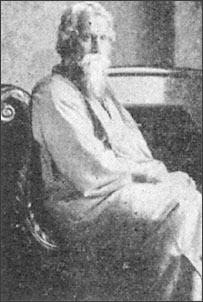
Tagore and I were soon deep in a comparative study of our schools, both founded along unorthodox lines. We discovered many identical features-outdoor instruction, simplicity, ample scope for the child’s creative spirit. Rabindranath, however, laid considerable stress on the study of literature and poetry, and the self-expression through music and song which I had already noted in the case of Bhola. The Santiniketan children observed periods of silence, but were given no special yoga training.
Tagore and I were soon deep in a comparison of our schools, both founded on unconventional principles. We found many identical features: outdoor lessons, simplicity, and plenty of room for children’s creativity. Rabindranath, however, placed great emphasis on studying literature and poetry. He also emphasized self-expression through music and song, as I had already seen with Bhola. The Santiniketan children had periods of silence, but received no special yoga training.
The poet listened with flattering attention to my description of the energizing “Yogoda” exercises and the yoga concentration techniques which are taught to all students at Ranchi.
The poet listened with flattering interest as I described the energizing “Yogoda” exercises and the yoga concentration techniques. All students at Ranchi are taught these exercises and techniques.
Tagore told me of his own early educational struggles. “I fled from school after the fifth grade,” he said, laughing. I could readily understand how his innate poetic delicacy had been affronted by the dreary, disciplinary atmosphere of a schoolroom.
Tagore told me about his early struggles with education. “I ran away from school after the fifth grade,” he said, laughing. I could easily understand how the classroom’s dull, strict atmosphere had offended his naturally sensitive, poetic spirit.
“That is why I opened Santiniketan under the shady trees and the glories of the sky.” He motioned eloquently to a little group studying in the beautiful garden. “A child is in his natural setting amidst the flowers and songbirds. Only thus may he fully express the hidden wealth of his individual endowment. True education can never be crammed and pumped from without; rather it must aid in bringing spontaneously to the surface the infinite hoards of wisdom within.” [^29]
“That is why I opened Santiniketan under shady trees and the glorious sky.” He gestured expressively toward a small group studying in the beautiful garden. “A child is in his natural setting among flowers and songbirds. Only in such surroundings can he fully express the rich gifts hidden within him. True education can never be forced into a child from outside. Instead, education must help the infinite stores of wisdom within him come naturally to the surface.” [^29]
I agreed. “The idealistic and hero-worshiping instincts of the young are starved on an exclusive diet of statistics and chronological eras.”
I agreed. “Young people's idealism and admiration for heroes are starved by a diet of nothing but statistics and historical periods.”
The poet spoke lovingly of his father, Devendranath, who had inspired the Santiniketan beginnings.
The poet spoke lovingly of his father, Devendranath, who had inspired the founding of Santiniketan.
“Father presented me with this fertile land, where he had already built a guest house and temple,” Rabindranath told me. “I started my educational experiment here in 1901, with only ten boys. The eight thousand pounds which came with the Nobel Prize all went for the upkeep of the school.”
“Father gave me this fertile land, where he had already built a guest house and temple,” Rabindranath told me. “I began my educational experiment here in 1901 with only ten boys. All eight thousand pounds from the Nobel Prize went toward keeping the school running.”
The elder Tagore, Devendranath, known far and wide as “Maharishi,” was a very remarkable man, as one may discover from his Autobiography. Two years of his manhood were spent in meditation in the Himalayas. In turn, his father, Dwarkanath Tagore, had been celebrated throughout Bengal for his munificent public benefactions. From this illustrious tree has sprung a family of geniuses. Not Rabindranath alone; all his relatives have distinguished themselves in creative expression. His brothers, Gogonendra and Abanindra, are among the foremost artists [^29] of India; another brother, Dwijendra, is a deep-seeing philosopher, at whose gentle call the birds and woodland creatures respond.
The elder Tagore, Devendranath, was widely known as “Maharishi.” He was a remarkable man, as readers may discover from his Autobiography. He spent two years of his adult life meditating in the Himalayas. His father, Dwarkanath Tagore, had in turn been celebrated throughout Bengal for his generous contributions to public welfare. From this distinguished family tree has grown a family of geniuses. Not just Rabindranath but all his relatives have distinguished themselves through creative expression. His brothers, Gogonendra and Abanindra, are among India’s leading artists [^29]. Another brother, Dwijendra, is a deeply insightful philosopher whose gentle call draws a response from birds and woodland creatures.
Rabindranath invited me to stay overnight in the guest house. It was indeed a charming spectacle, in the evening, to see the poet seated with a group in the patio. Time unfolded backward: the scene before me was like that of an ancient hermitage-the joyous singer encircled by his devotees, all aureoled in divine love. Tagore knitted each tie with the cords of harmony. Never assertive, he drew and captured the heart by an irresistible magnetism. Rare blossom of poesy blooming in the garden of the Lord, attracting others by a natural fragrance!
Rabindranath invited me to stay overnight in the guest house. That evening, the sight of the poet sitting with a group on the patio was truly charming. Time seemed to turn backward. The scene before me was like an ancient hermitage, with the joyful singer surrounded by his devotees. All were surrounded by a glow of divine love. Tagore wove each bond with threads of harmony. Never forceful, he won people's hearts with his irresistible magnetism. A rare flower of poetry blooming in the Lord's garden, drawing others with its natural fragrance!
In his melodious voice, Rabindranath read to us a few of his exquisite poems, newly created. Most of his songs and plays, written for the delectation of his students, have been composed at Santiniketan. The beauty of his lines, to me, lies in his art of referring to God in nearly every stanza, yet seldom mentioning the sacred Name. “Drunk with the bliss of singing,” he wrote, “I forget myself and call thee friend who art my lord.”
In his melodious voice, Rabindranath read us a few of his beautiful, newly written poems. Most of his songs and plays were written at Santiniketan for his students’ enjoyment. To me, the beauty of his lines lies in how he refers to God in nearly every stanza. Yet he rarely mentions God’s sacred name. “Drunk with the bliss of singing,” he wrote, “I forget myself and call you friend, though you are my lord.”
The following day, after lunch, I bade the poet a reluctant farewell. I rejoice that his little school has now grown to an international university, “Viswa-Bharati,” where scholars of all lands have found an ideal setting.
The next day, after lunch, I reluctantly said goodbye to the poet. I am delighted that his little school has now grown into an international university, “Viswa-Bharati.” Scholars from all lands have found an ideal setting there.
“Where the mind is without fear and the head is held high; Where knowledge is free; Where the world has not been broken up into fragments by narrow domestic walls; Where words come out from the depth of truth; Where tireless striving stretches its arms toward perfection; Where the clear stream of reason has not lost its way into the dreary desert sand of dead habit; Where the mind is led forward by Thee into ever-widening thought and action; Into that heaven of freedom, my Father, let my country awake!” [^29] RABINDRANATH TAGORE
“Where the mind is free from fear and heads are held high, Where knowledge is free, Where the world has not been divided into fragments by narrow walls between people, Where words come from the depths of truth, Where tireless effort reaches toward perfection, Where the clear stream of reason has not lost its way in the bleak desert sands of lifeless habit, Where you lead the mind forward into ever broader thought and action, Into that heaven of freedom, my Father, let my country awaken!” [^29] RABINDRANATH TAGORE
29-1: The English writer and publicist, close friend of Mahatma Gandhi. Mr. Andrews is honored in India for his many services to his adopted land.
29-1: Mr. Andrews is an English writer and publicist, and a close friend of Mahatma Gandhi. He is honored in India for his many services to his adopted country.
29-2: “The soul having been often born, or, as the Hindus say, ‘traveling the path of existence through thousands of births’ . . . there is nothing of which she has not gained the knowledge; no wonder that she is able to recollect . . . what formerly she knew. . . . For inquiry and learning is reminiscence all.”-Emerson.
29-2: “The soul has been born many times. As the Hindus say, she has been ‘traveling the path of existence through thousands of births’ . . . She has learned everything. No wonder she can remember . . . what she knew before. . . . For all inquiry and learning is remembering.”-Emerson.
29-3: Rabindranath, too, in his sixties, engaged in a serious study of painting. Exhibitions of his “futuristic” work were given some years ago in European capitals and New York.
29-3: Rabindranath, too, took up a serious study of painting in his sixties. Exhibitions of his “futuristic” work were held some years ago in European capitals and New York.
29-4: Gitanjali (New York: Macmillan Co.). A thoughtful study of the poet will be found in The Philosophy Of Rabindranath Tagore, by the celebrated scholar, Sir S. Radhakrishnan (Macmillan, 1918). Another expository volume is B. K. Roy’s Rabindranath Tagore: The Man And His Poetry (New York: Dodd, Mead, 1915). Buddha And The Gospel Of Buddhism (New York: Putnam’s, 1916), by the eminent Oriental art authority, Ananda K. Coomaraswamy, contains a number of illustrations in color by the poet’s brother, Abanindra Nath Tagore.
29-4: Gitanjali (New York: Macmillan Co.). The celebrated scholar Sir S. Radhakrishnan offers a thoughtful study of the poet in The Philosophy Of Rabindranath Tagore (Macmillan, 1918). Another explanatory study is B. K. Roy’s Rabindranath Tagore: The Man And His Poetry (New York: Dodd, Mead, 1915). Buddha And The Gospel Of Buddhism (New York: Putnam’s, 1916) is by Ananda K. Coomaraswamy, the distinguished authority on Oriental art. The book contains several color illustrations by the poet’s brother, Abanindra Nath Tagore.