Chapter 27
Starting a Yoga School in Ranchi
“Why are you averse to organizational work?”
“Why do you dislike organizational work?”
Master’s question startled me a bit. It is true that my private conviction at the time was that organizations were “hornets’ nests.”
Master’s question startled me a little. At the time, I did privately believe that organizations were “hornets’ nests.”
“It is a thankless task, sir,” I answered. “No matter what the leader does or does not, he is criticized.”
“It’s a thankless job, sir,” I replied. “No matter what a leader does or doesn’t do, he is criticized.”
“Do you want the whole divine channa (milk curd) for yourself alone?” My guru’s retort was accompanied by a stern glance. “Could you or anyone else achieve God-contact through yoga if a line of generous- hearted masters had not been willing to convey their knowledge to others?” He added, “God is the Honey, organizations are the hives; both are necessary. Any form is useless, of course, without the spirit, but why should you not start busy hives full of the spiritual nectar?”
“Do you want all the divine channa (milk curd) for yourself alone?” My guru replied with a stern glance. “Could you or anyone else connect with God through yoga if generations of generous masters hadn’t shared their knowledge?” He added, “God is the Honey, organizations are the hives. Both are necessary. Any form is useless, of course, without the spirit. But why shouldn’t you start busy hives full of spiritual nectar?”
His counsel moved me deeply. Although I made no outward reply, an adamant resolution arose in my breast: I would share with my fellows, so far as lay in my power, the unshackling truths I had learned at my guru’s feet. “Lord,” I prayed, “may Thy Love shine forever on the sanctuary of my devotion, and may I be able to awaken that Love in other hearts.”
His advice moved me deeply. Although I said nothing, I made a firm decision in my heart. I would do all I could to share the liberating truths I had learned from my guru with others. “Lord,” I prayed, “may your love shine forever on the sanctuary of my devotion. And may I be able to awaken that love in other hearts.”
On a previous occasion, before I had joined the monastic order, Sri Yukteswar had made a most unexpected remark.
Once before, when I had not yet joined the monastic order, Sri Yukteswar had made a very unexpected remark.
“How you will miss the companionship of a wife in your old age!” he had said. “Do you not agree that the family man, engaged in useful work to maintain his wife and children, thus plays a rewarding role in God’s eyes?”
“How you’ll miss having a wife’s companionship in your old age!” he had said. “Don’t you agree that a man doing useful work to support his wife and children plays a rewarding role in God’s eyes?”
“Sir,” I had protested in alarm, “you know that my desire in this life is to espouse only the Cosmic Beloved.”
“Sir,” I had protested in alarm, “you know I want to marry only the Cosmic Beloved in this life.”
Master had laughed so merrily that I understood his observation was made merely as a test of my faith.
Master had laughed so cheerfully that I understood he had made his comment only to test my faith.
“Remember,” he had said slowly, “that he who discards his worldly duties can justify himself only by assuming some kind of responsibility toward a much larger family.”
“Remember,” he had said slowly, “if a man gives up his worldly duties, he can justify that choice in only one way. He must take on some responsibility toward a much larger family.”
The ideal of an all-sided education for youth had always been close to my heart. I saw clearly the arid results of ordinary instruction, aimed only at the development of body and intellect. Moral and spiritual values, without whose appreciation no man can approach happiness, were yet lacking in the formal curriculum. I determined to found a school where young boys could develop to the full stature of manhood. My first step in that direction was made with seven children at Dihika, a small country site in Bengal.
The ideal of a well-rounded education for young people had always been close to my heart. I clearly saw the barren results of ordinary education, aimed only at developing the body and intellect. Yet moral and spiritual values were missing from the formal curriculum. Without an appreciation of these values, no one can come close to happiness. I decided to establish a school where young boys could grow fully into manhood. I took my first step toward this goal with seven children at Dihika, a small rural location in Bengal.
A year later, in 1918, through the generosity of Sir Manindra Chandra Nundy, the Maharaja of Kasimbazar, I was able to transfer my fast- growing group to Ranchi. This town in Bihar, about two hundred miles from Calcutta, is blessed with one of the most healthful climates in India. The Kasimbazar Palace at Ranchi was transformed into the headquarters for the new school, which I called Brahmacharya Vidyalaya [^27] in accordance with the educational ideals of the rishis. Their forest ashrams had been the ancient seats of learning, secular and divine, for the youth of India.
A year later, in 1918, Sir Manindra Chandra Nundy, the Maharaja of Kasimbazar, generously made my move to Ranchi possible. I was able to bring my rapidly growing group there. Ranchi is a town in Bihar, about two hundred miles from Calcutta. It is blessed with one of India’s healthiest climates. The Kasimbazar Palace at Ranchi became the headquarters for the new school. I called the school Brahmacharya Vidyalaya [^27], following the educational ideals of the rishis. Their forest ashrams had been ancient centers where India’s young people received both secular and spiritual education.
At Ranchi I organized an educational program for both grammar and high school grades. It included agricultural, industrial, commercial, and academic subjects. The students were also taught yoga concentration and meditation, and a unique system of physical development, “Yogoda,” whose principles I had discovered in 1916.
At Ranchi I organized an educational program for elementary and high school students. The program covered agriculture, industry, business, and academic subjects. Students also learned yoga concentration and meditation, along with a unique system of physical development called “Yogoda.” I had discovered the principles of Yogoda in 1916.
Realizing that man’s body is like an electric battery, I reasoned that it could be recharged with energy through the direct agency of the human will. As no action, slight or large, is possible without willing, man can avail himself of his prime mover, will, to renew his bodily tissues without burdensome apparatus or mechanical exercises. I therefore taught the Ranchi students my simple “Yogoda” techniques by which the life force, centred in man’s medulla oblongata, can be consciously and instantly recharged from the unlimited supply of cosmic energy.
Realizing that the human body is like an electric battery, I reasoned that the will could directly recharge its energy. Since no action, small or large, is possible without willing, people can use their will, their main driving force, to renew their bodily tissues. They can do so without cumbersome equipment or mechanical exercises. I therefore taught the Ranchi students my simple “Yogoda” techniques. These techniques allow people to consciously and instantly recharge their life force from the unlimited supply of cosmic energy. This life force is centered in the medulla oblongata.
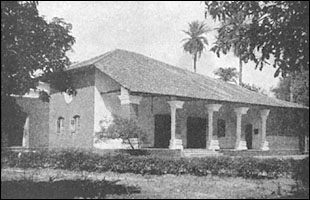
Central building of the Yogoda Sat-Sanga Brahmacharya Vidyalaya at Ranchi, Bihar, established in 1918 as a yoga school for boys, with grammar and high school education. Connected with it is the philanthropic Lahiri Mahasaya Mission.
Main building of the Yogoda Sat-Sanga Brahmacharya Vidyalaya at Ranchi, Bihar. The school was founded in 1918 as a yoga school for boys, offering elementary and high school education. The charitable Lahiri Mahasaya Mission is connected with the school.
The boys responded wonderfully to this training, developing extraordinary ability to shift the life energy from one part of the body to another part, and to sit in perfect poise in difficult body postures. [^27] They performed feats of strength and endurance which many powerful adults could not equal. My youngest brother, Bishnu Charan Ghosh, joined the Ranchi school; he later became a leading physical culturist in Bengal. He and one of his students traveled to Europe and America, giving exhibitions of strength and skill which amazed the university savants, including those at Columbia University in New York.
The boys responded wonderfully to this training. They developed extraordinary skill in moving life energy from one part of the body to another. They could also sit with perfect balance in difficult body positions. [^27] The boys performed feats of strength and endurance that many powerful adults could not match. My youngest brother, Bishnu Charan Ghosh, joined the Ranchi school. He later became a leading expert in physical training in Bengal. He and one of his students traveled to Europe and America, giving demonstrations of strength and skill. Their demonstrations amazed university scholars, including those at Columbia University in New York.
At the end of the first year at Ranchi, applications for admission reached two thousand. But the school, which at that time was solely residential, could accommodate only about one hundred. Instruction for day students was soon added.
By the end of the first year at Ranchi, the school had received two thousand applications for admission. But at the time, the school accepted only boarding students and had room for only about one hundred. Classes for day students were soon added.
In the Vidyalaya I had to play father-mother to the little children, and to cope with many organizational difficulties. I often remembered Christ’s words: “Verily I say unto you, There is no man that hath left house, or brethren or sisters, or father, or mother, or wife, or children, or lands, for my sake, and the gospel’s, but he shall receive an hundredfold now in this time, houses and brethren, and sisters, and mothers, and children, and lands, with persecutions; and in the world to come eternal life.” [^27] Sri Yukteswar had interpreted these words: “The devotee who forgoes the life-experiences of marriage and family, and exchanges the problems of a small household and limited activities for the larger responsibilities of service to society in general, is undertaking a task which is often accompanied by persecution from a misunderstanding world, but also by a divine inner contentment.”
In the Vidyalaya I had to act as both father and mother to the little children. I also had to deal with many organizational difficulties. I often remembered Christ’s words: “Truly I tell you, anyone who has left home, brothers, sisters, father, mother, wife, children, or land for my sake and the gospel’s will receive a hundred times as much now. They will receive homes, brothers, sisters, mothers, children, and land, along with persecution. And in the world to come, they will receive eternal life.” [^27] Sri Yukteswar had explained these words: “The devotee gives up the experiences of marriage and family life. In place of a small household’s problems and limited activities, the devotee takes on greater responsibilities in serving society. Such service often brings persecution from a world that misunderstands, but also a divine inner contentment.”
One day my father arrived in Ranchi to bestow a paternal blessing, long withheld because I had hurt him by refusing his offer of a position with the Bengal-Nagpur Railway.
One day my father came to Ranchi to give me his blessing as a father. He had long withheld his blessing because I had hurt him by turning down his offer of a job with the Bengal-Nagpur Railway.
“Son,” he said, “I am now reconciled to your choice in life. It gives me joy to see you amidst these happy, eager youngsters; you belong here rather than with the lifeless figures of railroad timetables.” He waved toward a group of a dozen little ones who were tagging at my heels. “I had only eight children,” he observed with twinkling eyes, “but I can feel for you!”
“Son,” he said, “I have now accepted your choice in life. It makes me happy to see you among these happy, eager children. You belong here rather than among the lifeless numbers in railroad timetables.” He waved toward a group of a dozen little children who were following close behind me. “I had only eight children,” he said with a twinkle in his eyes, “but I can sympathize with you!”
With a large fruit orchard and twenty-five fertile acres at our disposal, the students, teachers, and myself enjoyed many happy hours of outdoor labor in these ideal surroundings. We had many pets, including a young deer who was fairly idolized by the children. I too loved the fawn so much that I allowed it to sleep in my room. At the light of dawn, the little creature would toddle over to my bed for a morning caress.
We had a large fruit orchard and twenty-five acres of fertile land to use. The students, teachers, and I spent many happy hours working outdoors in these ideal surroundings. We had many pets, including a young deer the children practically worshipped. I too loved the fawn so much that I let it sleep in my room. At dawn, the little creature would toddle over to my bed to be petted.
One day I fed the pet earlier than usual, as I had to attend to some business in the town of Ranchi. Although I cautioned the boys not to feed the fawn until my return, one of them was disobedient, and gave the baby deer a large quantity of milk. When I came back in the evening, sad news greeted me: “The little fawn is nearly dead, through over feeding.”
One day I fed the pet earlier than usual because I had some business to take care of in Ranchi. I warned the boys not to feed the fawn until I returned. But one boy disobeyed and gave the baby deer a large amount of milk. When I returned that evening, I was met with sad news: “The little fawn is nearly dead from being overfed.”
In tears, I placed the apparently lifeless pet on my lap. I prayed piteously to God to spare its life. Hours later, the small creature opened its eyes, stood up, and walked feebly. The whole school shouted for joy.
Crying, I placed the pet, which seemed lifeless, on my lap. I prayed desperately to God to spare its life. Hours later, the little creature opened its eyes, stood up, and walked weakly. The whole school shouted for joy.
But a deep lesson came to me that night, one I can never forget. I stayed up with the fawn until two o’clock, when I fell asleep. The deer appeared in a dream, and spoke to me:
But that night I learned a deep lesson I can never forget. I stayed up with the fawn until two o’clock, when I fell asleep. The deer appeared in a dream and spoke to me:
“You are holding me back. Please let me go; let me go!”
“You’re holding me back. Please let me go. Let me go!”
“All right,” I answered in the dream.
“All right,” I replied in the dream.
I awoke immediately, and cried out, “Boys, the deer is dying!” The children rushed to my side.
I woke up immediately and shouted, “Boys, the deer is dying!” The children rushed to my side.
I ran to the corner of the room where I had placed the pet. It made a last effort to rise, stumbled toward me, then dropped at my feet, dead.
I ran to the corner of the room where I had put the pet. It made one last effort to stand and stumbled toward me. Then it fell dead at my feet.
According to the mass karma which guides and regulates the destinies of animals, the deer’s life was over, and it was ready to progress to a higher form. But by my deep attachment, which I later realized was selfish, and by my fervent prayers, I had been able to hold it in the limitations of the animal form from which the soul was struggling for release. The soul of the deer made its plea in a dream because, without my loving permission, it either would not or could not go. As soon as I agreed, it departed.
According to the collective karma that guides and governs the fate of animals, the deer’s life was over. The deer was ready to move on to a higher form. But my deep attachment and intense prayers had kept the deer trapped in its animal form. I later realized that my attachment was selfish. The deer’s soul was struggling to break free of that form. The soul pleaded with me in a dream because, without my loving permission, the soul either would not or could not leave. As soon as I agreed, the soul departed.
All sorrow left me; I realized anew that God wants His children to love everything as a part of Him, and not to feel delusively that death ends all. The ignorant man sees only the unsurmountable wall of death, hiding, seemingly forever, his cherished friends. But the man of unattachment, he who loves others as expressions of the Lord, understands that at death the dear ones have only returned for a breathing-space of joy in Him.
All sorrow left me. I realized again that God wants his children to love everything as a part of him. He does not want them to believe the illusion that death ends everything. A person who lacks understanding sees only death’s unbreakable wall, which seems to hide beloved friends forever. But a person who loves others as expressions of the Lord, without attachment, understands death differently. Their loved ones have only returned to God for a brief rest in his joy.
The Ranchi school grew from small and simple beginnings to an institution now well-known in India. Many departments of the school are supported by voluntary contributions from those who rejoice in perpetuating the educational ideals of the rishis. Under the general name of Yogoda Sat-Sanga, [^27] flourishing branch schools have been established at Midnapore, Lakshmanpur, and Puri.
The Ranchi school grew from small, simple beginnings into an institution now well known in India. Many school departments are supported by voluntary donations from people who gladly help keep the rishis’ educational ideals alive. Under the shared name of Yogoda Sat-Sanga, [^27] thriving branch schools have been established at Midnapore, Lakshmanpur, and Puri.
The Ranchi headquarters maintains a Medical Department where medicines and the services of doctors are supplied freely to the poor of the locality. The number treated has averaged more than 18,000 persons a year. The Vidyalaya has made its mark, too, in Indian competitive sports, and in the scholastic field, where many Ranchi alumni have distinguished themselves in later university life.
The Ranchi headquarters has a Medical Department that provides free medicine and doctors’ services to poor people in the area. On average, more than 18,000 people have been treated each year. The Vidyalaya has also made its mark in competitive sports in India and in education. Many Ranchi alumni have gone on to distinguish themselves at university.
The school, now in its twenty-eighth year and the center of many activities, [^27] has been honored by visits of eminent men from the East and the West. One of the earliest great figures to inspect the Vidyalaya in its first year was Swami Pranabananda, the Benares “saint with two bodies.” As the great master viewed the picturesque outdoor classes, held under the trees, and saw in the evening that young boys were sitting motionless for hours in yoga meditation, he was profoundly moved.
The school, now in its twenty-eighth year and a center of many activities, [^27] has welcomed distinguished visitors from East and West. One of the first great figures to visit the Vidyalaya during its first year was Swami Pranabananda. He was the Benares “saint with two bodies.” The great master saw the picturesque outdoor classes held under the trees. In the evening, he saw young boys sitting motionless for hours in yoga meditation. These sights moved him deeply.
“Joy comes to my heart,” he said, “to see that Lahiri Mahasaya’s ideals for the proper training of youth are being carried on in this institution. My guru’s blessings be on it.”
“It brings me joy,” he said, “to see this institution carrying on Lahiri Mahasaya’s ideals for educating young people properly. May my guru bless this institution.”
A young lad sitting by my side ventured to ask the great yogi a question.
A young boy sitting beside me dared to ask the great yogi a question.
“Sir,” he said, “shall I be a monk? Is my life only for God?”
“Sir,” he said, “will I become a monk? Is my life meant only for God?”
Though Swami Pranabananda smiled gently, his eyes were piercing the future.
Though Swami Pranabananda smiled gently, his eyes were looking deep into the future.
“Child,” he replied, “when you grow up, there is a beautiful bride waiting for you.” The boy did eventually marry, after having planned for years to enter the Swami Order.
“Child,” he replied, “a beautiful bride is waiting for you when you grow up.” The boy did eventually marry, though he had planned for years to enter the Swami Order.
Sometime after Swami Pranabananda had visited Ranchi, I accompanied my father to the Calcutta house where the yogi was temporarily staying. Pranabananda’s prediction, made to me so many years before, came rushing to my mind: “I shall see you, with your father, later on.”
Some time after Swami Pranabananda’s visit to Ranchi, I went with my father to a house in Calcutta. The yogi was staying there temporarily. Pranabananda’s prediction from so many years earlier came rushing back to me: “I will see you with your father later on.”
As Father entered the swami’s room, the great yogi rose from his seat and embraced my parent with loving respect.
As Father entered the swami’s room, the great yogi stood up. He embraced my father with love and respect.
“Bhagabati,” he said, “what are you doing about yourself? Don’t you see your son racing to the Infinite?” I blushed to hear his praise before my father. The swami went on, “You recall how often our blessed guru used to say: ‘Banat, banat, ban jai.’ [^26] So keep up Kriya Yoga ceaselessly, and reach the divine portals quickly.”
“Bhagabati,” he said, “what are you doing for your own spiritual progress? Don’t you see your son racing toward the Infinite?” I blushed to hear him praise me in front of my father. The swami continued, “You remember how often our blessed guru used to say: ‘Banat, banat, ban jai.’ [^26] So keep practicing Kriya Yoga without ceasing, and quickly reach the gates of the divine.”
The body of Pranabananda, which had appeared so well and strong during my amazing first visit to him in Benares, now showed definite aging, though his posture was still admirably erect.
Pranabananda had looked so healthy and strong during my amazing first visit to him in Benares. Now his body showed clear signs of aging, though his posture was still admirably upright.
“Swamiji,” I inquired, looking straight into his eyes, “please tell me the truth: Aren’t you feeling the advance of age? As the body is weakening, are your perceptions of God suffering any diminution?”
“Swamiji,” I asked, looking straight into his eyes, “please tell me the truth: Aren’t you feeling your age? As your body grows weaker, is your awareness of God fading at all?”
He smiled angelically. “The Beloved is more than ever with me now.” His complete conviction overwhelmed my mind and soul. He went on, “I am still enjoying the two pensions-one from Bhagabati here, and one from above.” Pointing his finger heavenward, the saint fell into an ecstasy, his face lit with a divine glow-an ample answer to my question.
He smiled like an angel. “The Beloved is with me now more than ever.” His complete certainty overwhelmed my mind and soul. He continued, “I am still enjoying two pensions, one from Bhagabati here, and one from above.” Pointing toward heaven, the saint entered a state of spiritual ecstasy. His face shone with a divine glow, more than answering my question.
Noticing that Pranabananda’s room contained many plants and packages of seed, I asked their purpose.
I noticed many plants and packets of seeds in Pranabananda’s room. I asked what the plants and seeds were for.
“I have left Benares permanently,” he said, “and am now on my way to the Himalayas. There I shall open an ashram for my disciples. These seeds will produce spinach and a few other vegetables. My dear ones will live simply, spending their time in blissful God-union. Nothing else is necessary.”
“I have left Benares for good,” he said, “and I’m now on my way to the Himalayas. I’ll open an ashram there for my disciples. These seeds will grow into spinach and a few other vegetables. My dear ones will live simply, spending their time in joyful union with God. Nothing else is necessary.”
Father asked his brother disciple when he would return to Calcutta.
Father asked his fellow disciple when he would return to Calcutta.
“Never again,” the saint replied. “This year is the one in which Lahiri Mahasaya told me I would leave my beloved Benares forever and go to the Himalayas, there to throw off my mortal frame.”
“Never again,” the saint replied. “Lahiri Mahasaya told me I would leave my beloved Benares forever this year. I would go to the Himalayas to leave my mortal body behind.”
My eyes filled with tears at his words, but the swami smiled tranquilly. He reminded me of a little heavenly child, sitting securely on the lap of the Divine Mother. The burden of the years has no ill effect on a great yogi’s full possession of supreme spiritual powers. He is able to renew his body at will; yet sometimes he does not care to retard the aging process, but allows his karma to work itself out on the physical plane, using his old body as a time-saving device to exclude the necessity of working out karma in a new incarnation.
His words brought tears to my eyes, but the swami smiled calmly. He reminded me of a little heavenly child, sitting safely in the Divine Mother’s lap. The passing years do not weaken a great yogi’s complete command of supreme spiritual powers. He can renew his body at will. Yet sometimes he chooses not to slow down aging, but lets his karma work itself out in the physical world. By keeping his old body, he saves time and avoids having to work out karma in a new incarnation.
Months later I met an old friend, Sanandan, who was one of Pranabananda’s close disciples.
Months later, I met an old friend, Sanandan. He was one of Pranabananda’s close disciples.
“My adorable guru is gone,” he told me, amidst sobs. “He established a hermitage near Rishikesh, and gave us loving training. When we were pretty well settled, and making rapid spiritual progress in his company, he proposed one day to feed a huge crowd from Rishikesh. I inquired why he wanted such a large number.
“My beloved guru is gone,” he told me between sobs. “He founded a hermitage near Rishikesh and trained us with love. Once we were fairly well settled and making rapid spiritual progress with him, he made a proposal. He wanted to feed a huge crowd from Rishikesh one day. I asked why he wanted so many people.
“‘This is my last festival ceremony,’ he said. I did not understand the full implications of his words.
“‘This is my last festival ceremony,’ he said. I did not fully understand what his words meant.
“Pranabanandaji helped with the cooking of great amounts of food. We fed about 2000 guests. After the feast, he sat on a high platform and gave an inspired sermon on the Infinite. At the end, before the gaze of thousands, he turned to me, as I sat beside him on the dais, and spoke with unusual force.
“Pranabanandaji helped cook large amounts of food. We fed about 2,000 guests. After the feast, he sat on a high platform and gave an inspired sermon on the Infinite. At the end, with thousands watching, he turned to me. I was sitting beside him on the platform. He spoke with unusual force.
“‘Sanandan, be prepared; I am going to kick the frame. [^27] ’
“‘Sanandan, get ready. I am going to leave my body. [^27] ’
“After a stunned silence, I cried loudly, ‘Master, don’t do it! Please, please, don’t do it!’ The crowd was tongue-tied, watching us curiously. My guru smiled at me, but his solemn gaze was already fixed on Eternity.
“After a stunned silence, I shouted, ‘Master, don’t do it! Please, please, don’t do it!’ The crowd watched us curiously, unable to speak. My guru smiled at me, but his serious gaze was already fixed on Eternity.
“‘Be not selfish,’ he said, ‘nor grieve for me. I have been long cheerfully serving you all; now rejoice and wish me Godspeed. I go to meet my Cosmic Beloved.’ In a whisper, Pranabanandaji added, ‘I shall be reborn shortly. After enjoying a short period of the Infinite Bliss, I shall return to earth and join Babaji. [^27] You shall soon know when and where my soul has been encased in a new body.’
“‘Don’t be selfish,’ he said, ‘or grieve for me. I have happily served you all for a long time. Now rejoice and wish me well on my journey. I am going to meet my Cosmic Beloved.’ In a whisper, Pranabanandaji added, ‘I will be reborn soon. After enjoying a short time of Infinite Bliss, I will return to earth and join Babaji. [^27] You will soon know when and where my soul has entered a new body.’
“He cried again, ‘Sanandan, here I kick the frame by the second Kriya Yoga.’ [^27]
“He cried out again, ‘Sanandan, I now leave my body through the second Kriya Yoga.’ [^27]
“He looked at the sea of faces before us, and gave a blessing. Directing his gaze inwardly to the spiritual eye, he became immobile. While the bewildered crowd thought he was meditating in an ecstatic state, he had already left the tabernacle of flesh and plunged his soul into the cosmic vastness. The disciples touched his body, seated in the lotus posture, but it was no longer the warm flesh. Only a stiffened frame remained; the tenant had fled to the immortal shore.”
“He looked at the sea of faces before us and gave a blessing. Turning his gaze inward toward the spiritual eye, he became motionless. The bewildered crowd thought he was meditating in a state of ecstasy. But he had already left his body and plunged his soul into the vastness of the cosmos. The disciples touched his body, still seated in the lotus position, but his flesh was no longer warm. Only a stiffened body remained. The soul that had lived within it had fled to the shore of immortality.”
I inquired where Pranabananda was to be reborn.
I asked where Pranabananda would be reborn.
“That’s a sacred trust I cannot divulge to anyone,” Sanandan replied. “Perhaps you may find out some other way.”
“That’s a sacred secret I can’t share with anyone,” Sanandan replied. “Perhaps you may find out another way.”
Years later I discovered from Swami Keshabananda [^27] that Pranabananda, a few years after his birth in a new body, had gone to Badrinarayan in the Himalayas, and there joined the group of saints around the great Babaji.
Years later, I learned the following from Swami Keshabananda [^27]. A few years after his birth in a new body, Pranabananda had gone to Badrinarayan in the Himalayas. There he had joined the group of saints around the great Babaji.
27-1: Vidyalaya, school. Brahmacharya here refers to one of the four stages in the Vedic plan for man’s life, as comprising that of (1) the celibate student (brahmachari); (2) the householder with worldly responsibilities (grihastha); (3) the hermit (vanaprastha); (4) the forest dweller or wanderer, free from all earthly concerns (sannyasi). This ideal scheme of life, while not widely observed in modern India, still has many devout followers. The four stages are carried out religiously under the lifelong direction of a guru.
27-1: Vidyalaya means school. Brahmacharya here refers to one of the four stages in the Vedic plan for a man’s life. These stages are: (1) the celibate student (brahmachari), (2) the householder with worldly responsibilities (grihastha), (3) the hermit (vanaprastha), (4) the forest dweller or wanderer, free from all earthly concerns (sannyasi). Although this ideal plan for life is not widely followed in modern India, it still has many devout followers. The four stages are followed as a religious practice under a guru’s lifelong guidance.
27-2: A number of American students also have mastered various asanas or postures, including Bernard Cole, an instructor in Los Angeles of the Self-Realization Fellowship teachings.
27-2: A number of American students have also mastered various asanas, or postures. They include Bernard Cole, who teaches Self-Realization Fellowship teachings in Los Angeles.
27-3: Mark 10:29-30..
27-3: Mark 10:29-30.
27-4: Yogoda: yoga, union, harmony, equilibrium; da, that which imparts. Sat-Sanga: sat, truth; sanga, fellowship. In the West, to avoid the use of a Sanskrit name, the Yogoda Sat-Sanga movement has been called the Self-Realization Fellowship.
27-4: Yogoda: yoga means union, harmony, equilibrium. da means that which imparts. Sat-Sanga: sat means truth. sanga means fellowship. In the West, the Yogoda Sat-Sanga movement has been called the Self-Realization Fellowship to avoid using a Sanskrit name.
27-5: The activities at Ranchi are described more fully in [^40]. The Lakshmanpur school is in the capable charge of Mr. G. C. Dey, B.A. The medical department is ably supervised by Dr. S. N. Pal and Sasi Bhusan Mullick.
27-5: The activities at Ranchi are described in more detail in [^40]. Mr. G. C. Dey, B.A., capably runs the Lakshmanpur school. Dr. S. N. Pal and Sasi Bhusan Mullick skillfully supervise the medical department.
27-6: One of Lahiri Mahasaya’s favorite remarks, given as encouragement for his students’ perseverance. A free translation is: “Striving, striving, one day behold! the Divine Goal!”
27-6: One of Lahiri Mahasaya’s favorite sayings, used to encourage his students to persevere. A loose translation is: “Keep striving, keep striving, and one day you will see the Divine Goal!”
27-7: i.e., give up the body.
27-7: That is, leave the body.
27-8: Lahiri Mahasaya’s guru, who is still living. (See [^33].)
27-8: Lahiri Mahasaya’s guru, who is still alive. (See [^33].)
27-9: The second Kriya, as taught by Lahiri Mahasaya, enables the devotee that has mastered it to leave and return to the body consciously at any time. Advanced yogis use the second Kriya technique during the last exit of death, a moment they invariably know beforehand.
27-9: Lahiri Mahasaya taught that devotees who master the second Kriya can consciously leave and return to their bodies at any time. Advanced yogis use the second Kriya technique when they leave their bodies for the final time at death. They always know beforehand when this moment will come.
27-10: My meeting with Keshabananda is described in [^42].
27-10: My meeting with Keshabananda is described in [^42].