

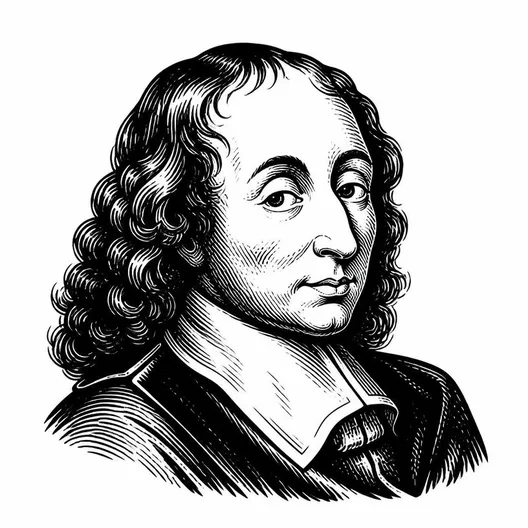
Blaise Pascal
French mathematician and philosopher whose Pensées made a case for God through probability Show bio
Bio
Blaise Pascal found mathematics on his own, though his father tried to keep it from him. He worked out Euclid's first 32 geometry theorems by 12, in charcoal on a tile floor. Pascal wrote a geometry essay at 16 that philosopher René Descartes assumed his father had written.
He built a calculating machine before turning 19 to spare his father endless tax sums. Pascal swapped letters on gambling with mathematician Pierre de Fermat, launching the math of probability.
He had a religious experience in 1654 and largely left mathematics for writing on faith. Pascal carried his gambling math into the Pensées, calling belief in God the better bet.