Chapter 5
Setting the Trap
Inside of fifteen minutes we were on our way. A certain amount of caution was sacrificed for the sake of speed, and the men leaped away either across the forest top, or over open spaces of ground, but concentration was forbidden. The Big Boss named the spot on the hillside as the rallying point.
Within fifteen minutes, we were on our way. We sacrificed some caution for speed. The men leaped away over the treetops or across open ground, but they were forbidden to gather together. The Big Boss named the spot on the hillside as the meeting point.
"We'll have to take a chance on being seen, so long as we don't group," he declared, "at least until within five miles of the rallying spot. From then on I want every man to disappear from sight and to travel under cover. And keep your ultrophones open, and tuned on ten-four-seven-six."
"We'll have to risk being seen, as long as we don't group together," he said. "At least until we're within five miles of the rallying spot. From then on, I want every man to stay out of sight and travel under cover. Keep your ultrophones on and tuned to ten-four-seven-six."
Wilma and I had received our battle equipment from the Gear boss. It consisted of a long-gun, a hand-gun, with a special case of ammunition constructed of inertron, which made the load weigh but a few ounces, and a short sword. This gear we strapped over each other's shoulders, on top of our jumping belts. In addition, we each received an ultrophone, and a light inertron blanket rolled into a cylinder about six inches long by two or three in diameter. This fabric was exceedingly thin and light, but it had considerable warmth, because of the mixture of inertron in its composition.
Wilma and I had received our battle equipment from the Gear boss. It included a long-gun, a hand-gun, and a short sword. The ammunition came in a special inertron case that made the load weigh only a few ounces. We strapped the gear over each other’s shoulders, on top of our jumping belts. We each also received an ultrophone and a light inertron blanket. The blanket was rolled into a cylinder about six inches long and two or three inches across. The fabric was extremely thin and light, but it was quite warm because it contained inertron.
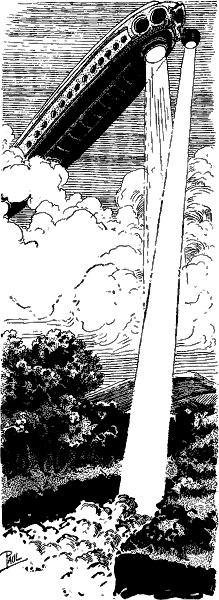
"This looks like business," Wilma remarked to me with sparkling eyes. (And I might mention a curious thing here. The word "business" had survived from the 20th Century American vocabulary, but not with any meaning of "industry" or "trade," for such things being purely community activities were spoken of as "work" and "clearing." Business simply meant fighting, and that was all.)
"This looks like business," Wilma said to me, her eyes sparkling. (I should mention something curious here. The word "business" had survived from 20th-century American English, but it no longer meant "industry" or "trade." Those were purely community activities, so people called them "work" and "clearing." Business simply meant fighting, and nothing else.)
"Did you bring all this equipment from the valley?" I asked the Gear Boss.
"Did you bring all this equipment from the valley?" I asked the Gear Boss.
"No," he said. "There was no time to gather anything. All this stuff we cleared from the Susquannas a few hours ago. I was with the Boss on the way down, and he had me jump on ahead and arrange it. But you two had better be moving. He's beckoning you now."
"No," he said. "There was no time to gather anything. We cleared all this stuff from the Susquannas a few hours ago. I was with the Boss on the way down. He had me jump ahead and arrange it. But you two had better get moving. He's waving you over now."
Hart was about to call us on our phones when we looked up. As soon as we did so, he leaped away, waving us to follow closely.
Hart was about to call us on our phones when we looked up. As soon as we did, he leaped away, waving for us to follow closely.
He was a powerful man, and he darted ahead in long, swift, low leaps up the banks of the stream, which followed a fairly straight course at this point. By extending ourselves, however, Wilma and I were able to catch up to him.
He was a powerful man, and he bounded ahead along the stream bank in long, swift, low leaps. The stream ran fairly straight at that point. But Wilma and I pushed ourselves and caught up with him.
As we gradually synchronized our leaps with his, he outlined to us, between the grunts that accompanied each leap, his plan of action.
As we gradually matched our leaps to his, he explained his plan between the grunts that came with each leap.
"We have to start the big business—unh—sooner or later," he said. "And if—unh—the Hans have found any way of locating our positions—unh—it's time to start now, although the Council of Bosses—unh—had intended waiting a few years until enough rocket ships have been—unh—built. But no matter what the sacrifice—unh—we can't afford to let them get us on the run—unh—. We'll set a trap for the yellow devils in the—unh—valley if they come back for their wreckage—unh—and if they don't, we'll go rocketing for some of their liners—unh—on the Nu-yok, Clee-lan, Si-ka-ga course. We can use—unh—that idea of yours of shooting up the repellor—unh—beams. Want you to give us a demonstration."
"We have to start the big fight, unh, sooner or later," he said. "And if, unh, the Hans have found a way to locate our positions, unh, it's time to start now. The Council of Bosses, unh, had planned to wait a few years until enough rocket ships had been, unh, built. But whatever the sacrifice, unh, we can't afford to let them put us on the run, unh. We'll set a trap for the yellow devils in the, unh, valley if they come back for their wreckage, unh. And if they don't, we'll take our rockets after some of their liners, unh, on the Nu-yok, Clee-lan, Si-ka-ga course. We can use, unh, your idea of shooting up the repellor, unh, beams. I want you to give us a demonstration."
With further admonition to follow him closely, he increased his pace, and Wilma and I were taxed to our utmost to keep up with him. It was only in ascending the slopes that my tougher muscles overbalanced his greater skill, and I was able to set the pace for him, as I had for Wilma.
He again warned us to follow closely, then picked up his pace. Wilma and I struggled as hard as we could to keep up. Only on the uphill slopes did my stronger muscles make up for his greater skill. There I was able to set the pace for him, as I had for Wilma.
We slept in greater comfort that night, under our inertron blankets, and were off with the dawn, leaping cautiously to the top of the ridge overlooking the valley which Wilma and I had left.
We slept more comfortably that night under our inertron blankets. At dawn, we set off, leaping cautiously to the top of the ridge overlooking the valley Wilma and I had left.
The Boss scanned the sky with his ultroscope, patiently taking some fifteen minutes to the task, and then swung his phone into use, calling the roll and giving the men their instructions.
The Boss patiently scanned the sky with his ultroscope for about fifteen minutes. Then he used his phone to call the roll and give the men their instructions.
His first order was for us all to slip our ear and chest discs into permanent position.
His first order was for all of us to put our ear and chest discs in place permanently.
These ultrophones were quite different from the one used by Wilma's companion scout the day I saved her from the vicious attack of the bandit Gang. That one was contained entirely in a small pocket case. These, with which we were now equipped, consisted of a pair of ear discs, each a separate and self-contained receiving set. They slipped into little pockets over our ears in the fabric helmets we wore, and shut out virtually all extraneous sounds. The chest discs were likewise self-contained sending sets, strapped to the chest a few inches below the neck and actuated by the vibrations from the vocal cords through the body tissues. The total range of these sets was about eighteen miles. Reception was remarkably clear, quite free from the static that so marked the 20th Century radios, and of a strength in direct proportion to the distance of the speaker.
These ultrophones were quite different from the one used by Wilma's fellow scout. I had seen that one the day I saved Wilma from the vicious attack by the bandit Gang. It fit entirely inside a small pocket case. The ultrophones we now had consisted of two ear discs. Each disc was a separate, self-contained receiver. They slipped into small pockets over the ears of our fabric helmets and blocked out almost all outside sounds. The chest discs were also self-contained transmitters. They were strapped to the chest a few inches below the neck. Vibrations from the vocal cords traveled through the body and activated them. The sets had a range of about eighteen miles. Reception was remarkably clear, with none of the static so common on 20th Century radios. The signal strength was directly proportional to the speaker's distance.
The Boss' set was triple powered, so that his orders would cut in on any local conversations, which were indulged in, however, with great restraint, and only for the purpose of maintaining contacts.
The Boss' set had triple power, so his orders would cut into any local conversations. Those conversations, however, were kept to a minimum and held only to maintain contact.
I marveled at the efficiency of this modern method of battle communication in contrast to the clumsy signaling devices of more ancient times; and also at other military contrasts in which the 20th and 25th Century methods were the reverse of each other in efficiency. These modern Americans, for instance, knew little of hand to hand fighting, and nothing, naturally, of trench warfare. Of barrages they were quite ignorant, although they possessed weapons of terrific power. And until my recent flash of inspiration, no one among them, apparently, had ever thought of the scheme of shooting a rocket into a repellor beam and letting the beam itself hurl it upward into the most vital part of the Han ship.
I marveled at the efficiency of modern battlefield communications compared with the clumsy signaling devices of earlier times. I also marveled at other military contrasts, where 20th and 25th Century methods were efficient in opposite ways. These modern Americans, for example, knew little about hand-to-hand fighting and, naturally, nothing about trench warfare. They knew nothing about barrages, although they had weapons of tremendous power. And until my recent flash of inspiration, apparently none of them had thought of shooting a rocket into a repellor beam. The beam itself would then hurl the rocket upward into the most vital part of the Han ship.
Hart patiently placed his men, first giving his instructions to the campmasters, and then remaining silent, while they placed the individuals.
Hart patiently stationed his men. He first gave instructions to the campmasters, then stayed silent while they assigned each man his position.
In the end, the hundred men were ringed about the valley, on the hillsides and tops, each in a position from which he had a good view of the wreckage of the Han ship. But not a man had come in view, so far as I could see, in the whole process.
In the end, the hundred men surrounded the valley, taking positions on the hillsides and hilltops. Each had a good view of the wreckage of the Han ship. But as far as I could see, not one of them had come into view during the whole process.
The Boss explained to me that it was his idea that he, Wilma and I should investigate the wreck. If Han ships should appear in the sky, we would leap for the hillsides.
The Boss told me he wanted Wilma and me to investigate the wreck with him. If Han ships appeared in the sky, we would dash for the hillsides.
I suggested to him to have the men set up their long-guns trained on an imaginary circle surrounding the wreck. He busied himself with this after the three of us leaped down to the Han ship, serving as a target himself, while he called on the men individually to aim their pieces and lock them in position.
I suggested that he have the men aim their long-guns at points on an imaginary circle around the wreck. After the three of us jumped down to the Han ship, he took care of it. He acted as a target while calling on each man to aim his gun and lock it in position.
In the meantime Wilma and I climbed into the wreckage, but did not find much. Practically all of the instruments and machinery had been twisted out of all recognizable shape, or utterly destroyed by the ship's disintegrator rays which apparently had continued to operate in the midst of its warped remains for some moments after the crash.
Meanwhile, Wilma and I climbed into the wreckage, but we didn't find much. Nearly all the instruments and machinery had been twisted beyond recognition or completely destroyed by the ship's disintegrator rays. Apparently, the rays had continued to operate amid the twisted wreckage for a few moments after the crash.
It was unpleasant work searching the mangled bodies of the crew. But it had to be done. The Han clothing, I observed, was quite different from that of the Americans, and in many respects more like the garb to which I had been accustomed in the earlier part of my life. It was made of synthetic fabrics like silks, loose and comfortable trousers of knee length, and sleeveless shirts.
Searching the crew’s mangled bodies was unpleasant work. But it had to be done. I noticed that Han clothing was quite different from American clothing. In many ways, it was more like the clothes I had worn earlier in my life. It was made of synthetic fabrics like silk and consisted of loose, comfortable knee-length trousers and sleeveless shirts.
No protection, except that against drafts, was needed, Wilma explained to me, for the Han cities were entirely enclosed, with splendid arrangements for ventilation and heating. These arrangements of course were equally adequate in their airships. The Hans, indeed, had quite a distaste for unshaded daylight, since their lighting apparatus diffused a controlled amount of violet rays, making the unmodified sunlight unnecessary for health, and undesirable for comfort. Since the Hans did not have the secret of inertron, none of them wore anti-gravity belts. Yet in spite of the fact that they had to bear their own full weights at all times, they were physically far inferior to the Americans, for they lived lives of degenerative physical inertia, having machinery of every description for the performance of all labor, and convenient conveyances for any movement of more than a few steps.
Wilma explained that no protection was needed except against drafts. The Han cities were completely enclosed and had excellent ventilation and heating. Their airships, of course, had equally good ventilation and heating. The Hans actually disliked unshaded daylight. Their lighting equipment provided a controlled amount of violet rays, making natural sunlight unnecessary for health and uncomfortable. Since the Hans did not know the secret of inertron, none of them wore anti-gravity belts. They therefore had to bear their full weight at all times. Even so, they were physically far inferior to the Americans. Their physically inactive lives had caused them to degenerate. They had machines of every kind to do all their work, and convenient vehicles for any movement beyond a few steps.
Even from the twisted wreckage of this ship I could see that seats, chairs and couches played an extremely important part in their scheme of existence.
Even from the ship’s twisted wreckage, I could see that seats, chairs, and couches were extremely important to their way of life.
But none of the bodies were overweight. They seemed to have been the bodies of men in good health, but muscularly much underdeveloped. Wilma explained to me that they had mastered the science of gland control, and of course dietetics, to the point where men and women among them not uncommonly reached the age of a hundred years with arteries and general health in splendid condition.
But none of the bodies were overweight. The men seemed to have been in good health, but their muscles were greatly underdeveloped. Wilma explained that they had mastered gland control and, of course, the science of diet. As a result, men and women among them often reached a hundred with healthy arteries and excellent overall health.
I did not have time to study the ship and its contents as carefully as I would have liked, however. Time pressed, and it was our business to discover some clue to the deadly accuracy with which the ship had spotted the Wyoming Works.
But I did not have time to study the ship and its contents as carefully as I wanted. Time was short, and we had to find a clue to how the ship had spotted the Wyoming Works with deadly accuracy.
The Boss had hardly finished his arrangements for the ring barrage, when one of the scouts on an eminence to the north, announced the approach of seven Han ships, spread out in a great semi-circle.
The Boss had hardly finished arranging the ring barrage when a scout on a hill to the north reported seven Han ships approaching in a wide semicircle.
Hart leaped for the hillside, calling to us to do likewise, but Wilma and I had raised the flaps of our helmets and switched off our "speakers" for conversation between ourselves, and by the time we discovered what had happened, the ships were clearly visible, so fast were they approaching.
Hart leaped toward the hillside, calling for us to do the same. But Wilma and I had raised our helmet flaps and turned off our "speakers" so we could talk. By the time we realized what had happened, the ships were already clearly visible. They were approaching that fast.
"Jump!" we heard the Boss order, "Deering to the north. Rogers to the east."
"Jump!" we heard the Boss order. "Deering to the north. Rogers to the east."
But Wilma looked at me meaningly and pointed to where the twisted plates of the ship, projecting from the ground, offered a shelter.
But Wilma gave me a meaningful look and pointed to the ship's twisted plates. They jutted from the ground, offering shelter.
"Too late, Boss," she said. "They'd see us. Besides I think there's something here we ought to look at. It's probably their magnetic graph."
"Too late, Boss," she said. "They'd see us. Besides, I think there's something here we should look at. It's probably their magnetic graph."
"You're signing your death warrant," Hart warned.
"You're signing your death warrant," Hart warned.
"We'll risk it," said Wilma and I together.
"We'll risk it," Wilma and I said together.
"Good for you," replied the Boss. "Take command then, Rogers, for the present. Do you all know his voice, boys?"
"Good for you," the Boss replied. "Take command for now, Rogers. Do you all know his voice, boys?"
A chorus of assent rang in our ears, and I began to do some fast thinking as the girl and I ducked into the twisted mass of metal.
A chorus of agreement rang in our ears. I began to think fast as the girl and I ducked into the twisted mass of metal.
"Wilma, hunt for that record," I said, knowing that by the simple process of talking I could keep the entire command continuously informed as to the situation. "On the hillsides, keep your guns trained on the circles and stand by. On the hilltops, how many of you are there? Speak in rotation from Bald Knob around to the east, north, west."
"Wilma, look for that record," I said. I knew that simply by talking, I could keep the entire command continuously informed about the situation. "Those on the hillsides, keep your guns aimed at the circles and stand by. Those on the hilltops, how many of you are there? Answer in turn, starting at Bald Knob and going around to the east, north, and west."
In turn the men called their names. There were twenty of them.
The men called out their names one by one. There were twenty of them.
I assigned them by name to cover the various Han ships, numbering the latter from left to right.
I assigned each of them by name to cover a Han ship, numbering the ships from left to right.
"Train your rockets on their repellor rays about three-quarters of the way up, between ships and ground. Aim is more important than elevation. Follow those rays with your aim continuously. Shoot when I tell you, not before. Deering has the record. The Hans probably have not seen us, or at least think there are but two of us in the valley, since they're settling without opening up disintegrators. Any opinions?"
"Aim your rockets at their repellor rays, about three-quarters of the way up between the ships and the ground. Aim matters more than elevation. Keep your rockets trained on those rays. Shoot when I tell you, not before. Deering has the record. The Hans probably haven't seen us, or at least think there are only two of us in the valley. They are landing without firing their disintegrators. Any opinions?"
My ear discs remained silent.
My ear discs stayed silent.
"Deering and I remain here until they land and debark. Stand by and keep alert."
"Deering and I will stay here until they land and get off. Stand by and stay alert."
Rapidly and easily the largest of the Han ships settled to the earth. Three scouted sharply to the south, rising to a higher level. The others floated motionless about a thousand feet above.
The largest of the Han ships landed quickly and smoothly. Three others rose higher and headed sharply south to scout. The rest hovered motionless about a thousand feet above the ground.
Peeping through a small fissure between two plates, I saw the vast hulk of the ship come to rest full on the line of our prospective ring barrage. A door clanged open a couple of feet from the ground, and one by one the crew emerged.
Peering through a small crack between two plates, I saw the huge ship come to rest directly on the line where we planned to lay our ring barrage. A door clanged open a couple of feet above the ground. The crew came out one by one.